


Questions
Newest firstShowing 1–28 of 28 questions
- 1. Given below are two statements:
Statement I: A satellite is moving around earth in the orbit very close to the earth surface. The time period of revolution of satellite depends upon the density of earth.
Statement II: The time period of revolution of the satellite is \( T=2\pi\sqrt{\frac{R_{e}}{g}} \) (for satellite very close to the earth surface), where \( R_{e} \) radius of earth and g acceleration due to gravity.
In the light of the above statements, choose the correct answer from the options given below : 2026 Hard - 2. Initially a satellite of 100 kg is in a circular orbit of radius \(1.5 R _{ E }\). This satellite can be moved to a circular orbit of radius \(3 R _{ E }\) by supplying \(\alpha \times 10^6 J\) of energy. The value of \(\alpha\) is _________ .
(Take Radius of Earth \(R_E=6 \times 10^6 m\) and \(g =10 m / s ^2\) ) 2026 Hard - 3. A satellite is launched into a circular orbit of radius ' R ' around the earth. A second satellite is launched into an orbit of radius 1.03 R . The time period of revolution of the second satellite is larger than the first one approximately by 2025 Medium
- 4. A satellite of mass 1000 kg is launched to revolve around the earth in an orbit at a height of 270 km from the earth's surface. Kinetic energy of the satellite in this orbit is ______ \( \times 10^{10}\text{ J} \).
(Mass of earth \( = 6 \times 10^{24}\text{ kg} \), Radius of earth \( = 6.4 \times 10^6\text{ m} \), Gravitational constant \( = 6.67 \times 10^{-11}\text{ N m}^2\text{ kg}^{-2} \))
2025 Medium - 5. A satellite of mass \(\frac{M}{2}\) is revolving around earth in a circular orbit at a height of \(\frac{R}{3}\) from earth surface. The angular momentum of the satellite is \(M \sqrt{\frac{G M R}{x}}\). The value of \(x\) is ______ , where \(M\) and \(R\) are the mass and radius of earth, respectively. ( G is the gravitational constant) 2025 Hard
- 6. If a satellite orbiting the Earth is 9 times closer to the Earth than the Moon, what is the time period of rotation of the satellite? Given rotational time period of Moon \(=27\) days and gravitational attraction between the satellite and the moon is neglected. 2025 Medium
- 7. Two planets, \(A\) and \(B\) are orbiting a common star in circular orbits of radius \(R_A\) and \(R_B\), respectively, with \(R_B=2 R_A\). The planet \(B\) is \(4 \sqrt{2}\) times more massive than planet \(A\). The ratio \(\left(\frac{L_B}{L_A}\right)\) of angular momentum \(\left(L_B\right)\) of planet \(B\) to that of planet \(A\left(L_A\right)\) is closest to integer ________. 2025 Medium
- 8. A light planet is revolving around a massive star in a circular orbit of radius \(R\) with a period of revolution \(T\). If the force of attraction between planet and star is proportional to \(\mathrm{R}^{-3 / 2}\) then choose the correct option. 2024 Hard
- 9. Two planets \(A\) and \(B\) having masses \(m_1\) and \(m_2\) move around the sun in circular orbits of \(r_1\) and \(r_2\) radii respectively. If angular momentum of \(\mathrm{A}\) is \(\mathrm{L}\) and that of \(B\) is \(3L\), the ratio of time period \(\left(\frac{T_A}{T_B}\right)\) is _______. 2024 Hard
- 10. Two satellite \(A\) and \(B\) go round a planet in circular orbits having radii \(4 R\) and \(R\) respectively. If the speed of \(\mathrm{A}\) is \(3 v\), the speed of \(\mathrm{B}\) will be _______. 2024 Hard
- 11. Choose the incorrect statement from the following 2023 Medium
- 12. The orbital angular momentum of a satellite is \(L\), when it is revolving in a circular orbit at height \(h\) from earth surface. If the distance of satellite from the earth centre is increased by eight times to its initial value, then the new angular momentum will be \(............\,L\) 2023 Medium
- 13. The time period of a satellite, revolving above earth's surface at a height equal to \(R\) will be (Given \(g =\pi^2 m / s ^2, R =\) radius of earth) 2023 Medium
- 14. Two satellites of masses \(m\) and \(3\,m\) revolve around the earth in circular orbits of radii \(r\) and \(3 r\) respectively. The ratio of orbital speeds of the satellites respectively is : 2023 Medium
- 15. Two satellites \(S _{1}\) and \(S _{2}\) are revolving in circular orbits around a planet with radius \(R _{1}=3200 \,km\) and \(R _{2}=800\, km\) respectively. The ratio of speed of satellite \(S_{1}\) to the speed of satellite \(S_{2}\) in their respective orbits would be \(\frac{1}{ x }\) where \(x =\) 2022 Medium
- 16. A satellite is launched into a circular orbit of radius \(‘R’\) around earth while a second satellite is launched into an orbit of radius \(1.02 R\). The percentage difference in the time periods of the two satellites is ......... \(\%\) 2021 Medium
- 17. Consider a binary star system of star \(A\) and star \(B\) with masses \(m_{A}\) and \(m_{B}\) revolving in a circular orbit of radii \(r_{A}\) and \(r_{B}\), respectively. If \(T_{A}\) and \(T_{B}\) are the time period of star \(A\) and star \(B\), respectively, then - 2021 Medium
- 18. Consider two satellites \(S_{1}\) and \(S_{2}\) with periods of revolution \(1\, hr\). and \(8\, hr\). respectively revolving around a planet in circular orbits. The ratio of angular velocity of satellite \(S_{1}\) to the angular velocity of satellites \(S _{2}\) is 2021 Medium
- 19. Two satellites \(A\) and \(B\) of masses \(200\, kg\) and \(400\, kg\) are revolving round the earth at height of \(600\, km\) and \(1600\, km\) respectively. If \(T _{ A }\) and \(T _{ B }\) are the time periods of \(A\) and \(B\) respectively then the value of \(T _{ B }- T _{ A }\) [Given : radius of earth \(=6400\, km\), mass of earth \(=6 \times 10^{24}\, kg\) ]
 2021 Hard
- 20. Two satellites revolve around a planet in coplanar circular orbits in anticlockwise direction. Their period of revolutions are \(1\, hour\) and \(8\, hours\) respectively. The radius of the orbit of nearer satellite is \(2 \times 10^{3}\, {km}\). The angular speed of the farther satellite as observed from the nearer satellite at the instant when both the satellites are closest is \(\frac{\pi}{{x}}\, {rad} \,{h}^{-1}\) where \({x}\) is ..... . 2021 Hard
- 21. Two stars of masses \(m\) and \(2\, m\) at a distance \(d\) rotate about their common centre of mass in free space. The period of revolution is 2021 Hard
- 22. A body is moving in a low circular orbit about a planet of mass \(M\) and radius \(R\). The radius of the orbit can be taken to be \(R\) it self. Then the ratio of the speed of this body in the orbit to the escape velocity from the planet is 2020 Medium
- 23. A satellite is in an elliptical orbit around a planet \(P.\) It is observed that the velocity of the satellite when it is farthest from the planet is \(6\) time less than that when it is closest to the planet. The ratio of distances between the satellite and the planet at closest and farthest points is\(......\) 2020 Medium
- 24. A satellite is moving in a low nearly circular orbit around the earth. Its radius is roughly equal to that of the earth's radius \(R _{ e }\). By firing rockets attached to it, its speed is instantaneously increased in the direction of its motion so that is become \(\sqrt{\frac{3}{2}}\) times larger. Due to this the farthest distance from the centre of the earth that the satellite reaches is \(R\), value of \(R\) is\(....R_e\) 2020 Hard
- 25. The mass density of a spherical galaxy varies as \(\frac{ K }{ r }\) over a large distance \('r'\) from its centre. In that region, a small star is in a circular orbit of radius \(R\). Then the period of revolution, \(T\) depends on \(R\) as 2020 Hard
- 26. A test particle is moving in a circular orbit in the gravitational field produced by a mass density \(\rho \left( r \right) = \frac{K}{{{r^2}}}\). Identify the correct relation between the radius \(R\) of the particle’s orbit and its period \(T\) 2019 Hard
- 27. Figure shows elliptical path \(abcd\) of a planet around the sun \(S\) such that the area of triangle \(csa\) is \(\frac {1}{4}\) the area of the ellipse. (See figure) With \(db\) as the semimajor axis, and \(ca\) as the semiminor axis. If \(t_1\) is the time taken for planet to go over path \(abc\) and \(t_2\) for path taken over \(cda\) then
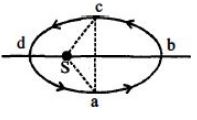 2016 Hard
- 28. A very long (length \(L\) ) cylindrical galaxy is made of uniformly distributed mass and has radius \(R(R < < L).\) A star outside the galaxy is orbiting the galaxy in a plane perpendicular to the galaxy and passing through its centre. If the time period of star is \(T\) and its distance from the galaxy's axis is \(r,\) then 2015 Medium
No questions on this page match these filters.
Other STD 11 - Gravitation topics
Frequently asked
How many Motion of Satellites in Circular Orbits and Planets in Elliptical Orbits questions came in JEE Mains?
28 questions from 2015–2026, each with the correct answer and a full solution.
How difficult are Motion of Satellites in Circular Orbits and Planets in Elliptical Orbits questions?
0% are easy, 54% medium and 46% hard.