


Questions
Newest firstShowing 1–15 of 15 questions
- 1. \(\gamma_{\mathrm{A}}\) is the specific heat ratio of monoatomic gas A having 3 translational degrees of freedom. \(\gamma_B\) is the specific heat ratio of polyatomic gas B having 3 translational, 3 rotational degrees of freedom and 1 vibrational mode. If \(\frac{\gamma_{\mathrm{A}}}{\gamma_{\mathrm{B}}}=\left(1+\frac{1}{\mathrm{n}}\right)\), then the value of \(n\) is _______. 2025 Easy
- 2. Match the List-I with List-II
List - I List - II (A) Triatomic rigid gas (I) \(\frac{C_P}{C_V} = \frac{5}{3}\) (B) Diatomic non-rigid gas (II) \(\frac{C_P}{C_V} = \frac{7}{5}\) (C) Monoatomic gas (III) \(\frac{C_P}{C_V} = \frac{4}{3}\) (D) Diatomic rigid ga (IV) \(\frac{C_P}{C_V} = \frac{9}{7}\)
Choose the correct answer from the options given below : 2025 Medium - 3. The translational degrees of freedom \((f)\) and rotational degrees of freedom \((f)\) of \(\mathrm{CH}_4\) molecule are _______. 2024 Hard
- 4. Let \(\gamma_1\) be the ratio of molar specific heat at constant pressure and molar specific heat at constant volume of a monoatomic gas and \(\gamma_2\) be the similar ratio of diatomic gas. Considering the diatomic gas molecule as a rigid rotator, the ratio, \(\frac{\gamma_1}{\gamma_2}\) is 2023 Medium
- 5. Match List\(-I\) with List\(-II:\)
Choose the correct answer from the options given below: 2023 MediumList\(-I\) List\(-II\) \((A)\) \(3\) Translational degrees of freedom \((I)\) Monoatomic gases \((B)\) \(3\) Translational,\(2\) rotational degrees of freedoms \((II)\) Polyatomic gases \((C)\) \(3\) Translational,\(2\) rotational and \(1\) vibrational degrees of freedom \((III)\) Rigid diatomic gases \((D)\) \(3\) Translational,\(3\) rotational and more than one vibrational degrees of freedom \((IV)\) Nonrigid diatomic gases - 6. The correct relation between \(\gamma=\frac{ C _p}{ c _v}\) and temperature \(T\) is : 2023 Medium
- 7. Sound travels in a mixture of two moles of helium and n moles of hydrogen. If rms speed of gas molecules in the mixture is \(\sqrt{2}\) times the speed of sound, then the value of \(n\) will be 2022 Hard
- 8. Which statements are correct about degrees of freedom? \(A.\) \(A\) molecule with \(n\) degrees of freedom has \(n^{2}\) different ways of storing energy. \(B.\) Each degree of freedom is associated with \(\frac{1}{2} RT\) average energy per mole. \(C.\) \(A\) monoatomic gas molecule has \(1\) rotational degree of freedom where as diatomic molecule has \(2\) rotational degrees of freedom \(D\) \(CH _{4}\) has a total to \(6\) degrees of freedom Choose the correct answer from the option given below: 2022 Hard
- 9. A polyatomic ideal gas has \(24\) vibrational modes. What is the value of \(\gamma\) ? 2021 Hard
- 10. Given below are two statements: Statement \(I :\) In a diatomic molecule, the rotational energy at a given temperature obeys Maxwell's distribution. Statement \(II :\) In a diatomic molecule, the rotational energy at a given temperature equals the translational kinetic energy for each molecule. In the light of the above statements, choose the correct answer from the options given below: 2021 Medium
- 11. The internal energy \((U),\) pressure \((P)\) and volume \(( V )\) of an ideal gas are related as \(U =\) \(3 P V+4\). The gas is :- 2021 Hard
- 12. Consider two ideal diatomic gases \(\mathrm{A}\) and \(\mathrm{B}\) at some temperature \(T\). Molecules of the gas \(A\) are rigid, and have a mass \(m\). Molecules of the gas \(\mathrm{B}\) have an additional vibrational mode, and have a mass \(\frac{\mathrm{m}}{4} .\) The ratio of the specific heats \((\mathrm{C}_{\mathrm{v}}^{\mathrm{A}}\) and \(\mathrm{C}_{\mathrm{v}}^{\mathrm{B}})\) of gas \(\mathrm{A}\) and \(\mathrm{B}\), respectively is 2020 Medium
- 13. Match the \(\frac{C _{ P }}{ C _{ v }}\) ratio for ideal gases with different type of molecules
2020 MediumMoleculae type \(\frac{C _{ P }}{ C _{ v }}\) \((A)\) Monoatomic \((I)\) \(\frac{7}{ 5}\) \((B)\) Diatomic rigid molecules \((II)\) \(\frac{9}{7}\) \((C)\) Diatomic non-rigid molecules \((III)\) \(\frac{4}{3}\) \((D)\) Triatomic rigid molecules \((IV)\) \(\frac{5}{3}\) - 14. To raise the temperature of a certain mass of gas by \(50^{\circ} C\) at a constant pressure, \(160\) calories of heat is required. When the same mass of gas is cooled by \(100^{\circ} C\) at constant volume, \(240\) calories of heat is released. How many degrees of freedom does each molecule of this gas have (assume gas to be ideal) \(?\) 2020 Medium
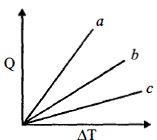
- 15. Figure shows the variation in temperature \(\left( {\Delta T} \right)\) with the amount of heat supplied \((Q)\) in an isobaric process corresponding to a monoatomic \((M)\), diatomic \((D)\) and a polyatomic \((P)\) gas. The initial state of all the gases are the same and the scales for the two axes coincide. Ignoring vibrational degrees of freedom, the lines \(a, b\) and \(c\) respectively correspond to
 2013 Medium
No questions on this page match these filters.
Other STD 11 - Kinetic theory of gases topics
Frequently asked
How many Degree of Freedom questions came in JEE Mains?
15 questions from 2013–2025, each with the correct answer and a full solution.
How difficult are Degree of Freedom questions?
7% are easy, 60% medium and 33% hard.