


Questions
Newest firstShowing 1–14 of 14 questions
-
- (A) 1
- (B) 2
- (C) 3
- (D) 4
Show answer and solution
Correct Answer: (D)
The steric number \(H\) is calculated as \(H = \dfrac{1}{2}(V + M - C + A)\), where \(V\) is the number of valence electrons on the central atom, \(M\) is the number of monovalent atoms, \(C\) is the cationic charge, and \(A\) is the anionic charge.
For \(sp^3d\) hybridization, \(H = 5\).
BrF\(_5\): \(H = \dfrac{1}{2}(7 + 5) = 6\) (\(sp^3d^2\))
XeF\(_5^-\): \(H = \dfrac{1}{2}(8 + 5 + 1) = 7\) (\(sp^3d^3\))
BF\(_4^-\): \(H = \dfrac{1}{2}(3 + 4 + 1) = 4\) (\(sp^3\))
ICl\(_4^-\): \(H = \dfrac{1}{2}(7 + 4 + 1) = 6\) (\(sp^3d^2\))
XeF\(_4\): \(H = \dfrac{1}{2}(8 + 4) = 6\) (\(sp^3d^2\))
SF\(_4\): \(H = \dfrac{1}{2}(6 + 4) = 5\) (\(sp^3d\))
NH\(_4^+\): \(H = \dfrac{1}{2}(5 + 4 - 1) = 4\) (\(sp^3\))
ClF\(_3\): \(H = \dfrac{1}{2}(7 + 3) = 5\) (\(sp^3d\))
XeF\(_2\): \(H = \dfrac{1}{2}(8 + 2) = 5\) (\(sp^3d\))
ICl\(_2^-\): \(H = \dfrac{1}{2}(7 + 2 + 1) = 5\) (\(sp^3d\))
The species with \(sp^3d\) hybridization are SF\(_4\), ClF\(_3\), XeF\(_2\), and ICl\(_2^-\).
The number of such species is \(4\).
Answer: \(4\) -
- (A) A, C and D Only
- (B) A, B and C Only
- (C) A, D and E Only
- (D) A and D Only
Show answer and solution
Correct Answer: (D)
Manganate ion → \(MnO_{4}^{-2}\)
Permanganate ion → \(MnO_{4}^{-}\)
(A) Both are tetrahedral (\(d^{3}s\) Hybridisation)
(B) \(MnO_{4}^{-}\) (+7 oxidation state)
\(MnO_{4}^{2-}\) (+6 oxidation state)
(C) \(Mn^{2+} + S_{2}O_{8}^{2-} \to MnO_{4}^{-}\) (Permanganate ion)
(D) \(MnO_{4}^{-}\) → Diamagnetic
\(MnO_{4}^{2-}\) → Paramagnetic
(E) It is oxidising agent - 3. In the given structure, number of sp and \(\mathrm{sp}^2\) hybridized carbon atoms present respectively are :
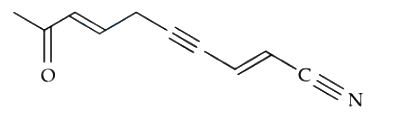
2025 Easy- (A) 4 and 5
- (B) 3 and 5
- (C) 3 and 6
- (D) 4 and 6
Show answer and solution
Correct Answer: (B)
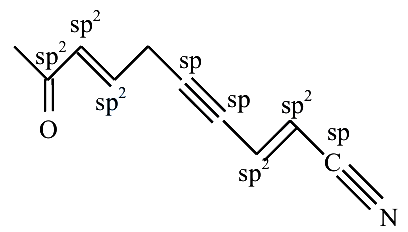
Number of sp and \(\mathrm{sp}^2\) hybridised carbon atom are 3 and 5. - 4. In which one of the following pairs the central atoms exhibit \(\mathrm{sp}^2\) hybridization ? 2024 Medium
- (A) \(\mathrm{BF}_3\) and \(\mathrm{NO}_2^{-}\)
- (B) \(\mathrm{NH}_2^{-}\)and \(\mathrm{H}_2 \mathrm{O}\)
- (C) \(\mathrm{H}_2 \mathrm{O}\) and \(\mathrm{NO}_2\)
- (D) \(\mathrm{NH}_2^{-}\)and \(\mathrm{BF}_3\)
Show answer and solution
Correct Answer: (A)
\(\mathrm{BF}_3 \rightarrow \mathrm{sp}^2\)\(\mathrm{NO}_2^{-} \rightarrow \mathrm{sp}^2\)
\(\mathrm{H}_2 \mathrm{O} \rightarrow \mathrm{sp}^3\)
\(\mathrm{NO}_2 \rightarrow \mathrm{sp}^2\)
\(\mathrm{NH}_2^{-} \rightarrow \mathrm{sp}^3\)
-
- (A) \(A-III, B-I, C-IV, D-II\)
- (B) \(A-II, B-I, C-IV, D-III\)
- (C) \(A-IV, B-III, C-I, D-II\)
- (D) \(A-III, B-IV, C-I, D-II\)
Show answer and solution
Correct Answer: (D)
\(s p^3 \rightarrow\) Tetrahedral\(\mathrm{dsp}^2 \rightarrow\) Square planar
\(s p^3 \mathrm{~d} \rightarrow\) Trigonal Bipyramidal
\(\mathrm{sp}^3 \mathrm{~d}^2 \rightarrow\) Octahedral
-
- (A) \(4\)
- (B) \(10\)
- (C) \(15\)
- (D) \(5\)
Show answer and solution
Correct Answer: (A)
\(\mathrm{NH}_3 \rightarrow \mathrm{sp}^3\)\(\mathrm{SO}_2 \rightarrow \mathrm{sp}^2\)
\(\mathrm{SiO}_2 \rightarrow \mathrm{sp}^3\)
\(\mathrm{BeCl}_2 \rightarrow \mathrm{sp}\)
\(\mathrm{CO}_2 \rightarrow \mathrm{sp}\)
\(\mathrm{H}_2 \mathrm{O} \rightarrow \mathrm{sp}^3\)
\(\mathrm{CH}_4 \rightarrow \mathrm{sp}^3\)
\(\mathrm{BF}_3 \rightarrow \mathrm{sp}^2\)
-
- (A) \(7\)
- (B) \(5\)
- (C) \(6\)
- (D) \(8\)
Show answer and solution
Correct Answer: (C)
Central atom utilising \(\mathrm{sp}^2\) hybrid orbitals\(\mathrm{SO}_2, \mathrm{C}_2 \mathrm{H}_4, \mathrm{BCl}_3, \mathrm{HCHO}, \mathrm{C}_6 \mathrm{H}_6, \mathrm{BF}_3\)
- 8. The hybridization of \(P\) exhibited in \(P F_{5}\) is \(s p^{x} d^{y}\). The value of \(y\) is \(...\) 2022 Easy
- (A) \(1\)
- (B) \(10\)
- (C) \(100\)
- (D) \(0.1\)
Show answer and solution
Correct Answer: (A)
\(PF _{5} \Rightarrow sp ^{3} d\) hybridisation(\(5\) sigma bonds, zero lone pair on central atom)
Value of \(y=1\)
- 9. The number of \(sp ^{3}\) hybridised carbons in an acyclic neutral compound with molecular formula \(C _{4} H _{5} N\) is. 2022 Medium
- (A) \(0\) or \(1\)
- (B) \(2\)
- (C) \(3\)
- (D) \(4\)
Show answer and solution
Correct Answer: (A)
\(DU =4+1-\left(\frac{5-1}{2}\right)=3\)\(CH _{2}= C = CH = CH = NH\)
Zero \(sp ^{3}\) carbon
-
- (A) \((a)-(i), (b)-(ii), (c)-(v)\) and \((d)-(iii)\)
- (B) \((a)-(ii), (b)-(i), (c)-(iv)\) and \((d)-(v)\)
- (C) \((a)-(iv), (b)-(iii), (c)-(ii)\) and \((d)-(v)\)
- (D) \((a)-(iii), (b)-(i), (c)-(v)\) and \((d)-(iv)\)
Show answer and solution
Correct Answer: (D)
\((a)\) \(\mathrm{SF}_{4}-\mathrm{sp}^{3} \mathrm{~d}\) hybridisation\((b)\) \(IF_{5}-\mathrm{sp}^{3} \mathrm{~d}^{2}\) hybridisation
\((c)\) \(\mathrm{NO}_{2}^{+}-\mathrm{sp}\) hybridisation
\((d)\) \(\mathrm{NH}_{4}^{+}-\mathrm{sp}^{3}\) hybridisation
-
- (A) \(I\) and \(II\) only
- (B) \(I\), \(II\) and \(III\)
- (C) \(I\) and \(III\) only
- (D) \(II\) and \(III\) only
Show answer and solution
Correct Answer: (C)
\((i)\) \(VBT\) does not explain colour exhibited by complex of transition metal because splitting of \(d-\) orbitals in explained by \(CFT\).
\((ii)\) \(VBT\) does not distinguish between strong and weak field complex.
\((iii)\) \(VBT\) does not give quantitative interpretation of magnetic properties.
\(\therefore \) According to question statement \(I\) and \(III\) are correct -
- (A) \([IF_6]^ -\)
- (B) \([ICl_4]^ -\)
- (C) \([ICl_2]^ -\)
- (D) \([BrF_2]^ -\)
Show answer and solution
Correct Answer: (B)
\({[IC{l_4}]^ - } \to s{p^3}{d^2}\)\({[I{F_6}]^ - } \to s{p^3}{d^3}\)
\({[IC{l_2}]^ - } \to s{p^3}d\)
\({[Br{F_2}]^ - } \to s{p^3}d\)
-
- (A) \(NO_3^-\)
- (B) \(NO_2\)
- (C) \(NO_2^+\)
- (D) \(NO_2^-\)
Show answer and solution
Correct Answer: (C)
The hybridization of \(\mathrm{NO}_{2}^{+}\) is sp.It is a linear molecule.
Rest does not have sp hybridization.
Therefore, the correct option is C.
- 14. The structure of which of the following chloro species can be explained on the basis of \(dsp^2\) hybridization ? 2013 Hard
- (A) \(PdCl_4^{2 - }\)
- (B) \(FeCl_4^{2 - }\)
- (C) \(CoCl_4^{2 - }\)
- (D) \(NiCl_4^{2 - }\)
Show answer and solution
Correct Answer: (A)
\([PdCl_4]^{2-}\) is \(dsp^2\) hybridized and square planar in shape.
No questions on this page match these filters.
Other STD 11 - Chemical bonding and molecular structure topics
Frequently asked
How many Hybridisation questions came in JEE Mains?
14 questions from 2013–2026, each with the correct answer and a full solution.
How difficult are Hybridisation questions?
14% are easy, 50% medium and 36% hard.