


Questions
Newest firstShowing 1–27 of 27 questions
-
- (A) 2
- (B) 4
- (C) 5
- (D) 7
Show answer and solution
Correct Answer: (B)
The general formula of an alkane is \(C_n H_{2n+2}\).
The balanced chemical equation for the complete combustion of an alkane is:
\(C_n H_{2n+2} + \left(\dfrac{3n+1}{2}\right) O_2 \rightarrow n CO_2 + (n+1) H_2O\)
Given that \(8\) moles of oxygen are required for complete combustion:
\(\dfrac{3n+1}{2} = 8\)
\(3n + 1 = 16\)
\(n = 5\)
The molecular formula of the alkane \((Y)\) is \(C_5H_{12}\).
Since \((Y)\) yields only one monochlorinated product \((Z)\) upon reaction with \(Cl_2/h\nu\), all the hydrogen atoms in the alkane must be equivalent.
Among the isomers of \(C_5H_{12}\) (n-pentane, isopentane, and neopentane), only 2,2-dimethylpropane (neopentane) has all equivalent hydrogen atoms.
The structure of neopentane is \(C(CH_3)_4\).
In this structure, the central carbon is quaternary, and the four surrounding methyl carbons are primary carbon atoms.
Therefore, the total number of primary carbon atoms in \((Y)\) is \(4\).
Answer: \(4\) -
- (A) III > I > II > IV
- (B) III > II > I > IV
- (C) I > III > II > IV
- (D) I > III > IV > II
Show answer and solution
Correct Answer: (C)
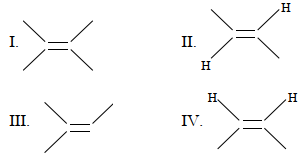
Stability order :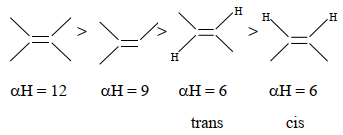
Trans is more stable than cis -
- (A) C > A > B > D
- (B) C > A > D > B
- (C) B > D > A > C
- (D) A > B > C > D
Show answer and solution
Correct Answer: (A)
The stability of alkenes is directly proportional to the number of \(\alpha\)-hydrogen atoms due to hyperconjugation.
Let us count the number of \(\alpha\)-hydrogen atoms in each given alkene:
A. 2-Methylbut-2-ene: \((CH_3)_2C=CHCH_3\)
Number of \(\alpha\)-hydrogen atoms = \(3 + 3 + 3 = 9\)
B. cis-But-2-ene: \(CH_3CH=CHCH_3\)
Number of \(\alpha\)-hydrogen atoms = \(3 + 3 = 6\)
C. 2,3-Dimethylbut-2-ene: \((CH_3)_2C=C(CH_3)_2\)
Number of \(\alpha\)-hydrogen atoms = \(3 + 3 + 3 + 3 = 12\)
D. Prop-1-ene: \(CH_3CH=CH_2\)
Number of \(\alpha\)-hydrogen atoms = \(3\)
Since the stability of an alkene increases with the number of \(\alpha\)-hydrogen atoms, the correct stability order is C > A > B > D.
Answer: C > A > B > D -
- (A) A & E Only
- (B) A, B & D Only
- (C) C, D & E Only
- (D) A, C & E Only
Show answer and solution
Correct Answer: (D)
\(Ph - CH = CH _2 \xrightarrow[ HBr ]{( PhCOO )_2} Ph - CH _2- CH _2- Br\)
Anti Markovnikov addition
• Reaction follow radical addition in presence of peroxide
• In absence of peroxide follow carbocation mechanism
• Benzene also formed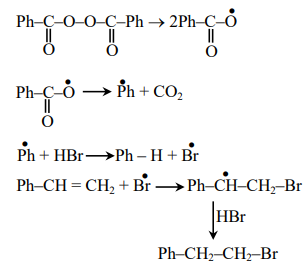
-
- (A) 15
- (B) 16
- (C) 17
- (D) 27
Show answer and solution
Correct Answer: (D)
So, the total number of sigma \((\sigma)\) bonds present in compound X is 27. -
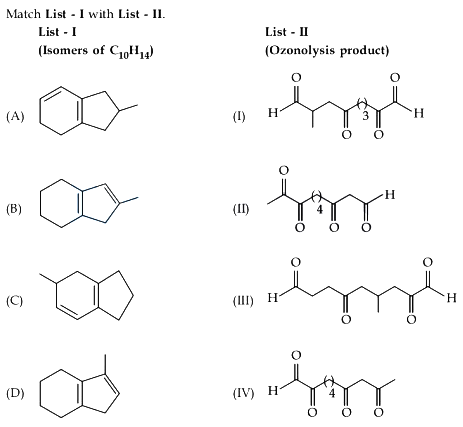
- (A) (A)-(I), (B)-(IV), (C)-(III), (D)-(II)
- (B) (A)-(III), (B)-(II), (C)-(I), (D)-(IV)
- (C) (A)-(III), (B)-(IV), (C)-(I), (D)-(II)
- (D) (A)-(II), (B)-(III), (C)-(I), (D)-(IV)
Show answer and solution
Correct Answer: (C)
Ozonolysis product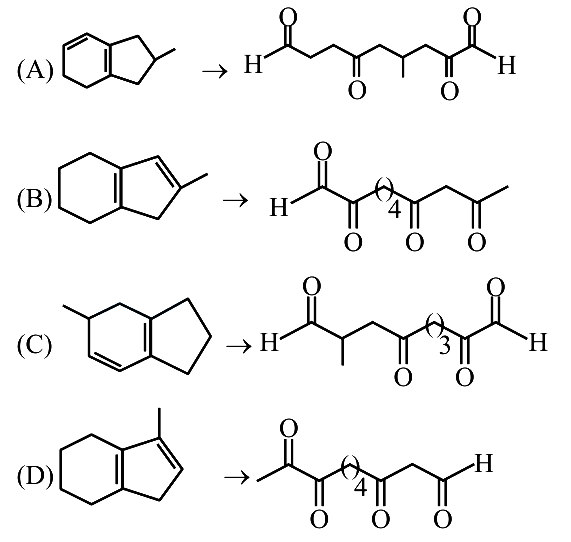
-
- (A) R
- (B) P
- (C) Q
- (D) S
Show answer and solution
Correct Answer: (C)
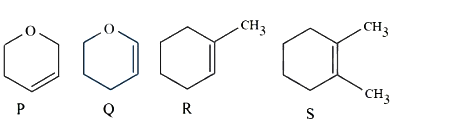
Addition of \(\mathrm{H}-\mathrm{Br}_{(\mathrm{aq})}\) to alkene follows electrophilic addition mechanism. In the rate determining step a carbocation intermediate is formed. Among P, Q, R & S compound Q will form most stable carbocation intermediate since it is resonance stabilized.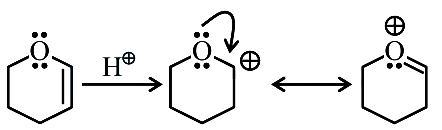
-
- (A) Both Statement I and Statement II are true
- (B) Statement I is false but Statement II are true
- (C) Statement I is true but Statement II is false
- (D) Both Statement I and Statement II are false
Show answer and solution
Correct Answer: (C)
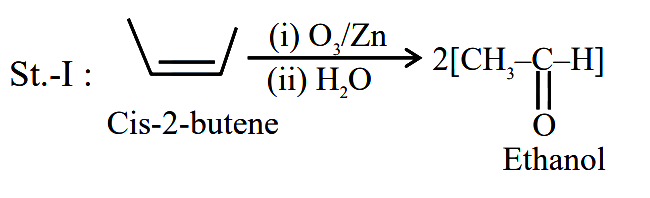
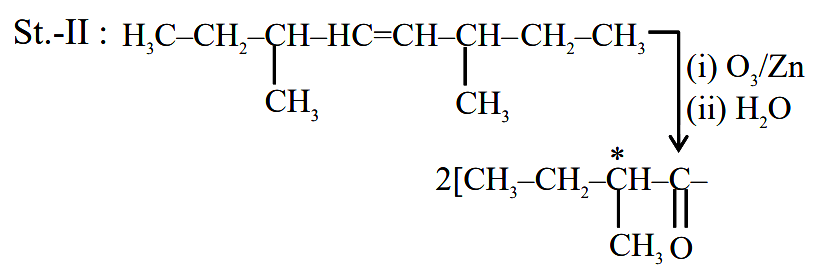
St-I : Correct statement
St-II : In correct statement because product has chiral centre. -
- (A) B \(\&\) E Only
- (B) B, C \(\&\) D Only
- (C) A, C \(\&\) D Only
- (D) B \(\&\) D Only
Show answer and solution
Correct Answer: (D)
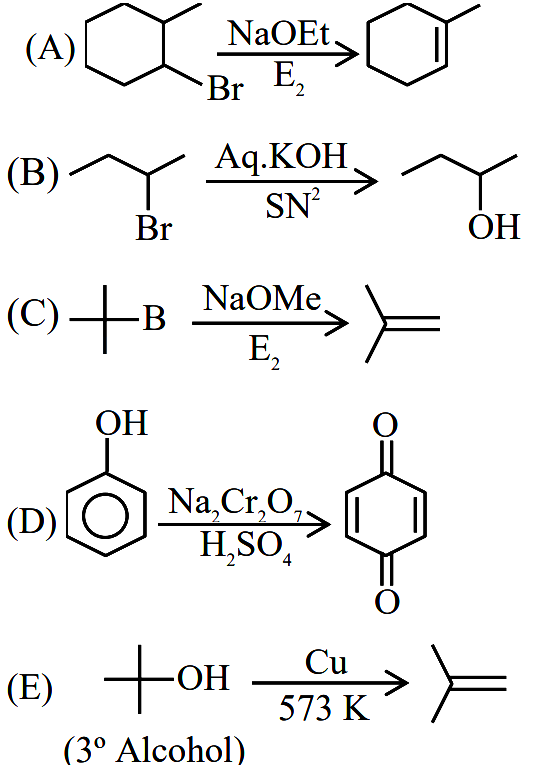
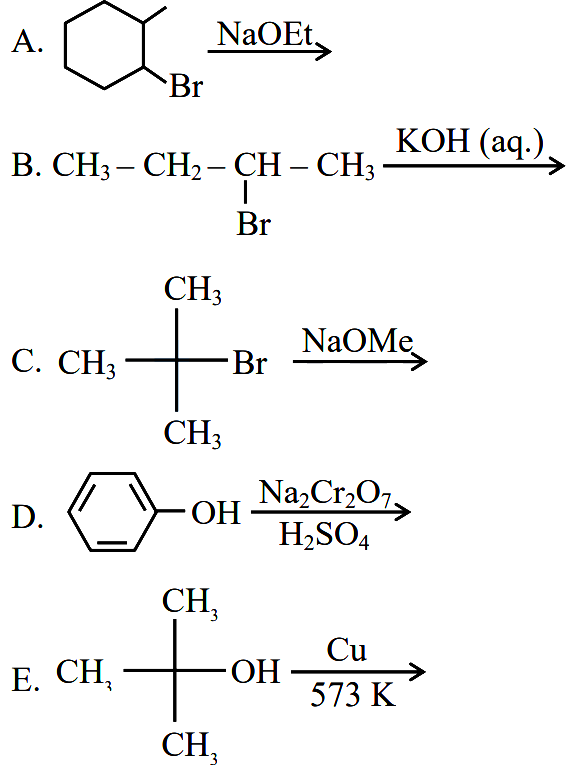
Option (B) and (D) reaction are not able to form alkene as a product. -
- (A) \(4\)
- (B) \(6\)
- (C) \(8\)
- (D) \(12\)
Show answer and solution
Correct Answer: (A)
\(2\) chiral centres
No. of stereoisomers \(=4\)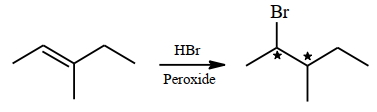
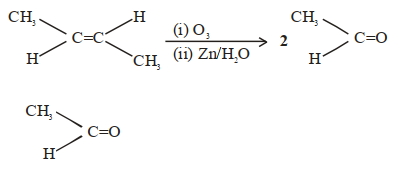
- 11. Consider the given reaction. The total number of oxygen atoms present per molecule of the product \((P)\) is _______.
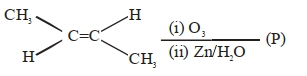 2024 Hard
- (A) \(2\)
- (B) \(1\)
- (C) \(7\)
- (D) \(5\)
Show answer and solution
Correct Answer: (B)
\(Image\)Hence total number of oxygen atom present per Molecule \(image\) is I.
-
- (A) \(\mathrm{A}-\mathrm{CH}_3 \mathrm{CH}_2 \mathrm{CH}_2-\mathrm{OH}, \mathrm{B}-\mathrm{CH}_3 \mathrm{CH}_2 \mathrm{CH}_2-\mathrm{OH}\)
- (D) \(\mathrm{A}-\mathrm{CH}_3 \mathrm{CH}_2 \mathrm{CH}_3, \mathrm{~B}-\mathrm{CH}_3 \mathrm{CH}_2 \mathrm{CH}_3\)
Show answer and solution
Correct Answer: (C)
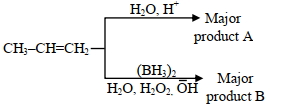
\((1)\) Hydration Reaction : (Image) \((2)\) Hydroboration Oxidation Reaction :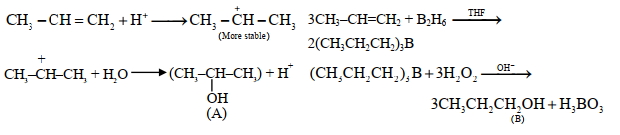
- 13. Number of isomeric products formed by monochlorination of \(2\)-methylbutane in presence of sunlight is _______. 2024 Hard
- (A) \(2\)
- (B) \(3\)
- (C) \(10\)
- (D) \(6\)
Show answer and solution
Correct Answer: (D)
\(\therefore\) Number of isomeric products = \(6\)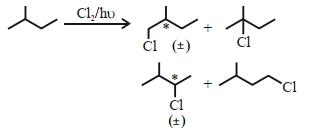
-
- (A) \(\mathrm{Ph}-\mathrm{CH}_2-\mathrm{CH}_2-\mathrm{CH}_3\)
- (D) \(\mathrm{Ph}-\mathrm{CH}_2-\mathrm{CH}_2-\mathrm{CH}_2-\mathrm{OH}\)
Show answer and solution
Correct Answer: (D)
\(\mathrm{PhCH}=\mathrm{CH}_2 \xrightarrow{\mathrm{B}_2 \mathrm{H}_6 / \mathrm{H}_2 \mathrm{O}_2, \mathrm{OH}^{-}} \mathrm{PhCH}_2 \mathrm{CH}_2 \mathrm{OH}\)\(\mathrm{PhCH}_2 \mathrm{CH}_2 \mathrm{OH}+\mathrm{HBr} \xrightarrow[\text { (II) } \mathrm{H}_3 \mathrm{O}^{+}]{\mathrm{PhCH}_2 \mathrm{CH}_2 \mathrm{Br}+\mathrm{H}_2 \mathrm{O}\left(\mathrm{SN}^{\mathrm{NGP}}\right)}\)
-
- (A) \(13\)
- (B) \(14\)
- (C) \(15\)
- (D) \(12\)
Show answer and solution
Correct Answer: (D)
Element Percentage Mole Mole ratio \(C\) \(85.8\) \(\frac{85.8}{12}=7.15\) \(1\) \(H\) \(14.2\) \(\frac{14.2}{1}=14.2\) \(2\) Empirical formula \(\left( CH _2\right)\)
\(14 \times n=84\)
\(n =6\)
\(\therefore\) Molecular formula \(C _6 H _{12}\)
-
- (A) \(1\)
- (B) \(2\)
- (C) \(3\)
- (D) \(4\)
Show answer and solution
Correct Answer: (A)
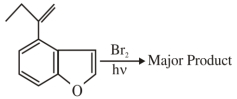
No. of Br atoms \(=1\)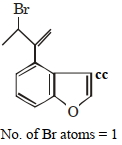
-
- (A) \(30\)
- (B) \(3\)
- (C) \(0.3\)
- (D) \(4\)
Show answer and solution
Correct Answer: (B)
\(448\, \mathrm{ml}\) of \(\mathrm{A} \Rightarrow 1.53 \,\mathrm{gm} \mathrm{A}\)\(22400\, \mathrm{ml}\) of \(\mathrm{A} \Rightarrow \frac{1.53}{445} \times 22400\, \mathrm{gm} \,\mathrm{A}=7650\)
\(\mathrm{H}_{3} \mathrm{CHC}-\mathrm{CH}-\mathrm{Cl} \quad \xrightarrow[Zn/ H_2O]{{O}_{3}} \mathrm{CH}_{3}-\mathrm{CH}=\mathrm{O}\)
It has \(3\) carbon atoms \(\quad\quad\quad\quad\quad\) Aldehyde
\(\ \, \mathrm{~mm}\) is \(36+5+35.5=76.5\)
- 18. Among the following, the aromatic compounds are \({Image}\) Choose the correct answer from the following options
 2021 Medium
- (A) \((A)\) and \((B)\) only
- (B) \((B)\) and \((C)\) only
- (C) \((B), (C)\) and \((D)\) only
- (D) \((A), (B)\) and \((C)\) only
Show answer and solution
Correct Answer: (B)
\((A)\) Non-Aromatic\((B)\) Aromatic
\((C)\) Aromatic
\((D)\) Anti-Aromatic
-
- (A) Both \((A)\) and \((R)\) are true but \((R)\) is NOT the correct explanation of \((A)\)
- (B) \((A)\) is false but \((R)\) is true.
- (C) Both \((A)\) and \((R)\) are true and \(( R )\) is the correct explanation of \((A)\)
- (D) \((A)\) is true but \((R)\) is false
Show answer and solution
Correct Answer: (C)
Its \(IUPAC\) name \(1-\)bromopropan\(-2-\)ol \(\mathrm{A}\) and \(\mathrm{R}\) are true and \((\mathrm{R})\) is the correct explanation of \((\mathrm{A})\)
-
- (A) Zinc chloride and \(HCl\)
- (B) Cold dilute solution of \(KMnO _{4}\)
- (C) Sodium and Liquid \(NH _{3}\)
- (D) Partially deactivated palladised charcoal
Show answer and solution
Correct Answer: (D)
Partially deactivated palladised charcoal \(\left( H _{2} / pd / CaCO _{3}\right)\) is lindlar catalyst. -
- (A) \(\alpha - \) hydrogen
- (B) \(\gamma - \) hydrogen
- (C) \(\delta - \) hydrogen
- (D) \(\beta - \) hydrogen
Show answer and solution
Correct Answer: (B)
Allylic radical will form in presence of sunlight - 22. Which one of the following alkenes when treated with \(HCl\) yields majorly an anti Markovnikov product? 2019 Hard
- (A) \(H_2N -CH = CH_2\)
- (B) \(F_3C -CH = CH_2\)
- (C) \(CH_3 O -CH = CH_2\)
- (D) \(Cl -CH = CH_2\)
Show answer and solution
Correct Answer: (B)
In this case antimarkonikov product will be formed as major product because carbocation formed at a double bonded carbon having lesser number of \(H\) atom will be unstable due to presence of an electron with drawing group \((CF_3)\) attached to it.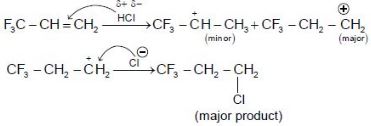
-
- (A) \(Y\) will have higher dipole moment and higher boiling point than \(X\)
- (B) \(Y\) will have higher dipole moment and lower boiling point than \(X\)
- (C) \(X\) will have lower dipole moment and lower boiling point than \(Y\)
- (D) \(X\) will have higher dipole moment and higher boiling point than \(Y\)
Show answer and solution
Correct Answer: (D)
When \(2-\) butyne is treated with \(H_2/\) Lindlar's catalyst, compound \(X\) (cis \(-2-\) butene) is produced as the major product; and when treated with \(Na/liq\,NH_3\) it produces \(Y\) (trans \(-2-\) butene) as the major product. Cisisomer \((X)\) will have higher dipole moment and higher boiling point than trans \((Y)\). -
- (A) \(6\)
- (B) \(0\)
- (C) \(2\)
- (D) \(4\)
Show answer and solution
Correct Answer: (D)
When alkenes are treated with \(HBr\) in the presence of peroxides, an anti-Markovnikov addition occurs in the sense that the hydrogen atom becomes attached to the carbon atom with the fewer hydrogen atoms.The product formed has two chirality centres, therefore, four stereoisomers \(\left(2^{2}\right)\) will exist.
\(\begin{array}{*{20}{c}}
{\,\,\,\,\,C{H_3}} \\
| \\
{C{H_3} - C{H_2} - C = CH - C{H_3}}
\end{array}\) \(\xrightarrow[{Peroxide}]{{HBr}}\) \(\mathop {\begin{array}{*{20}{c}}
{\,\begin{array}{*{20}{c}}
{\,\,\,\,\,\,C{H_3}} \\
|
\end{array}} \\
{C{H_3} - C{H_2} - {}_*CH - \mathop {CH}\limits^{*\,} - C{H_3}} \\
{\,\,\,\,\,\,\,\,\,\,\,\,\,\,\,\,\,\,\,\,\,\,\,\,\,\,\,\,\,\,\,\,\,\,\,|} \\
{\,\,\,\,\,\,\,\,\,\,\,\,\,\,\,\,\,\,\,\,\,\,\,\,\,\,\,\,\,\,\,\,\,\,\,\,\,Br}
\end{array}}\limits_{Major\,\,product} \) - 25. The reaction of propene with \(HOCl (Cl_2 + H_2O)\) proceeds through the intermediate : 2016 Hard
- (A) \(CH_3 -CH(OH)-CH_2^+\)
- (B) \(CH_3 -CHCl-CH_2^+\)
- (C) \(CH_3 -CH^+ -CH_2 -OH\)
- (D) \(CH_3 -CH^+ -CH_2 -Cl\)
Show answer and solution
Correct Answer: (D)
\(C{{H}_{3}}-CH=C{{H}_{2}}\xrightarrow[(electrophilic\,addition)]{\overset{\delta -}{\mathop{HO}}\,-\overset{\delta +}{\mathop{Cl}}\,}\) \(\underset{(\operatorname{int}ermediate)}{\mathop{C{{H}_{3}}-\overset{+}{\mathop{C}}\,H-C{{H}_{2}}-Cl}}\,\) \(\xrightarrow{O{{H}^{-}}}C{{H}_{3}}-CH(OH)-C{{H}_{2}}-Cl\) - 26. In the presence of peroxide, \(HCl\) and \(HI\) do not give anti-Markownikoff's addition of alkenes because 2014 Hard
- (A) One of the steps is endothermic in \(HCl\) and \(HI\)
- (B) Both \(HCl\) and \(HI\) are strong acids
- (C) \(HCl\) is oxidizing and the \(HI\) is reducing
- (D) All the steps are exothermic is \(HCl\) and \(HI\)
Show answer and solution
Correct Answer: (A)
Anti-Markownikoff addition is possible only in case of \(HBr\) and not in \(HCl\) and \(HI\). In \(HBr\) both the chain initiation and propagation steps are exothermic, while in \(HCl,\) first step is Exothermic, and second step is endothermic and in \(HI,\) no step is exothermic. Hence \(HCl\) and \(HI\) do not undergo anti-Markownikoff's addition. - 27. The addition of \(HI\) in the presence of peroxide catalyst does not follow anti-Markovnikov's rule because 2013 Hard
- (A) \(HI\) is a strong reducing agent
- (B) \(H-I\) bond is too strong to be broken homolytically
- (C) \(I\) atom combines with \(H\) atom to give back \(HI\)
- (D) Iodine atom is not reactive enough to add across a double bond
Show answer and solution
Correct Answer: (D)
\(HI\) does not exhibit peroxide effect. \(HI\) bond although dissociates easily into iodine radicals, they being bigger in size are not much reactive but recombine together to form iodine molecule

No questions on this page match these filters.
Other STD 11 - Hydricarbon topics
Frequently asked
How many Alkene questions came in JEE Mains?
27 questions from 2013–2026, each with the correct answer and a full solution.
How difficult are Alkene questions?
22% are easy, 26% medium and 52% hard.