


Topics
9 topics- 20Qs Chemical Reactivity
- 36Qs Lonisation energy Most asked
- 25Qs Atomic and lonic radii
- 7Qs Valency and oxidation state
- 2Qs Screening effect and effective nuclear charge
- 15Qs Electron affinity
- 24Qs Extended or long form of periodic table
- 4Qs Electronegativity
- 2Qs History of periodic table
All Classification of elements and periodicity in properties questions
Newest firstShowing 1–50 of 135 questions
-
- (A) 7 and 5
- (B) 5 and 6
- (C) 5 and 7
- (D) 6 and 7
Show answer and solution
Correct Answer: (C)
Least metallic \(= F\), valence electrons \(= 7\)
Most metallic \(= P\), valence electrons \(= 5\) -
- (A) 5
- (B) 2
- (C) 3
- (D) 4
Show answer and solution
Correct Answer: (D)
Step-by-step Solution:
Total energy required to convert 1 mole of \( \text{Li(g)} \) to \( \text{Li}^{2+}(\text{g}) \) is the sum of the first and second ionization enthalpies:
\( E_{\text{total}} = IE_1 + IE_2 \)
= \( 520 + 7297 = 7817\text{ kJ mol}^{-1} \)
Given mass of lithium = \( 3.5\text{ mg} = 3.5 \times 10^{-3}\text{ g} \)
Molar mass of Lithium = \( 7\text{ g mol}^{-1} \)
Number of moles of lithium (\( n \)):
\( n = \frac{3.5 \times 10^{-3}\text{ g}}{7\text{ g mol}^{-1}} = 5 \times 10^{-4}\text{ mol} \)
Total energy required for \( 5 \times 10^{-4}\text{ mol} \) of Lithium:
\( \text{Energy (in kJ)} = 5 \times 10^{-4}\text{ mol} \times 7817\text{ kJ mol}^{-1} = 3.9085\text{ kJ} \)
Converting the energy into Joules (\( \text{J} \)) to match the options:
\( \text{Energy (in J)} = 3.9085 \times 10^3\text{ J} = 3908.5\text{ J} \)
Rounding off to the nearest integer, we get \( 3909 \).
Correct Option: D (3909) -
- (A) Statement-I is false but Statement-II is true
- (B) Both Statement-I and Statement-II are true.
- (C) Both Statement-I and Statement-II are false.
- (D) Statement-I is true but Statement-II is false.
Show answer and solution
Correct Answer: (B)
\(\xrightarrow[Z_{\text {eff }} \uparrow I . E . \uparrow]{\begin{array}{l}C<O<N<F \\ 2 p^2 2 p^4 2 p^3 2 p^5\end{array}}\)
Statement-I is correct
\(S > Se > Te > Po > O\)
\(
\left|\Delta_{eg} H\right| \quad \begin{array}{lllll}
200 & 195 & 190 & 174 & 141(in kJ / mol)
\end{array}
\)
Statement-II is correct. -
- (A) Both Statement I and Statement II are true
- (B) Both Statement I and Statement II are false
- (C) Statement I is false but Statement II is true
- (D) Statement I is true but Statement II is false
Show answer and solution
Correct Answer: (D)
Metallic character of s-block elements is greater than p-block elements.
Anionic radius is greater than atomic radius but cationic radius is always less than atomic radius for any element. -
- (A) Both Statement I and Statement II are true
- (B) Both Statement I and Statement II are false
- (C) Statement I is true but Statement II is false
- (D) Statement I is false but Statement II is true
Show answer and solution
Correct Answer: (D)
The first ionisation enthalpy generally increases across a period from left to right due to an increase in effective nuclear charge. For the third period elements \(\text{Na}\), \(\text{Mg}\), \(\text{Cl}\), and \(\text{Ar}\), the correct order of first ionisation enthalpy is \(\text{Ar} > \text{Cl} > \text{Mg} > \text{Na}\). Thus, Statement I is false.
The electronic configuration of \(\text{Ca}\) is \([\text{Ar}] 4s^2\). After the removal of two electrons, \(\text{Ca}^{2+}\) attains the highly stable noble gas configuration of Argon \([\text{Ar}]\). Removing a third electron requires breaking this stable noble gas core, which requires a very large amount of energy. Therefore, the third ionisation enthalpy of \(\text{Ca}\) is exceptionally high compared to \(\text{Al}\), \(\text{Fe}\), and \(\text{B}\). Thus, Statement II is true.
Answer: Statement I is false but Statement II is true -
- (A) Both Statement I and Statement II are false
- (B) Statement I is false but Statement II is true
- (C) Statement I is true but Statement II is false
- (D) Both Statement I and Statement II are true
Show answer and solution
Correct Answer: (B)
Correct order of size is \(Mg > Al > Mg ^{2+}> Al ^{3+}\)
Atomic size depends mainly upon \(Z _{\text {effective }}\) and shell number.
Generally on moving down the group electron affinity decreases and on moving across the period electron affinity increase.
In the periodic table Cl has maximum electron affinity. Halogen has higher electron affinity than Chalcogen.
\(Cl > Br > S > O\) -
- (A) Both Statement I and Statement II are true
- (B) Both Statement I and Statement II are false
- (C) Statement I is true but Statement II is false
- (D) Statement I is false but Statement II is true
Show answer and solution
Correct Answer: (A)
Electronegativity increases across a period from left to right. Nitrogen, oxygen, and fluorine belong to group 15, 16, and 17 respectively in the second period. Thus, the correct order of electronegativity is \(F > O > N\). Statement I is true.
In \(OF_2\), fluorine is more electronegative than oxygen and always exhibits an oxidation state of \(-1\). Let the oxidation state of oxygen be \(x\). Then \(x + 2(-1) = 0 \Rightarrow x = +2\).
In \(Na_2O\), sodium is an alkali metal and exhibits an oxidation state of \(+1\). Let the oxidation state of oxygen be \(y\). Then \(2(+1) + y = 0 \Rightarrow y = -2\).
Statement II is also true.
Both Statement I and Statement II are true.
Answer: Both Statement I and Statement II are true -
- (A) Both Statement I and Statement II are true
- (B) Both Statement I and Statement II are false
- (C) Statement I is true but Statement II is false
- (D) Statement I is false but Statement II is true
Show answer and solution
Correct Answer: (A)
Statement I:
\(Al_2O_3\) and \(Cr_2O_3\) are both amphoteric oxides.
\(Cl_2O_7\) and \(Mn_2O_7\) are both acidic oxides.
\(Na_2O\) and \(V_2O_3\) are both basic oxides.
\(CO\) and \(N_2O\) are both neutral oxides.
All \(4\) pairs contain oxides of the same nature. Hence, Statement I is true.
Statement II:
\(Na_2O\) is a strongly basic oxide.
\(Al_2O_3\) is an amphoteric oxide.
\(CO\) is a neutral oxide.
\(Cl_2O_7\) is a strongly acidic oxide.
Thus, the most basic oxide is \(Na_2O\) and the most acidic oxide is \(Cl_2O_7\). Hence, Statement II is true.
Both Statement I and Statement II are true.
Answer: Both Statement I and Statement II are true -
- (A) Both statement I and statement II are true
- (B) Both statement I and statement II are false
- (C) Statement I is false but statement II is true
- (D) Statement I is true but statement II is false
Show answer and solution
Correct Answer: (A)
\( Na^{+}:-1s^{2} 2s^{2} 2p^{6} \) (fully filled electronic configuration)
\( Mg^{+}:-1s^{2} 2s^{2} 2p^{6} 3s^{1} \)
\( IE_{2} \) of \( Na > IE_{2} \) of Mg
Size of \( O^{2-} > F^{-} \) -
- (A) Both Statement I and Statement II are true
- (B) Both Statement I and Statement II are false
- (C) Statement I is true but Statement II is false
- (D) Statement I is false but Statement II is true
Show answer and solution
Correct Answer: (B)
Statement I: The second ionization enthalpy of Ga is higher than that of Al. This is due to the poor shielding effect of the ten \(3d\) electrons in Ga, which increases the effective nuclear charge and holds the valence electrons more tightly. The correct order of second ionization enthalpy is \(B > Ga > Al\). Thus, Statement I is false.
Statement II: The first ionization enthalpy generally decreases down the group. However, Pb has a slightly higher ionization enthalpy than Sn due to the poor shielding of \(4f\) and \(5d\) electrons (lanthanoid contraction). The correct order of first ionization enthalpy for Group 14 elements is \(Sn < Pb < Ge < Si < C\). Thus, Statement II is false.
Both Statement I and Statement II are false.
Answer: Both Statement I and Statement II are false -
- (A) lowest and lowest
- (B) highest and lowest
- (C) lowest and highest
- (D) highest and highest
Show answer and solution
Correct Answer: (C)
In a period, as we move from left to right, the atomic size decreases and the effective nuclear charge increases.
Due to the large atomic size and low effective nuclear charge, the element at the extreme left (alkali metal) has the lowest first ionisation enthalpy in the period.
As we move to the extreme right (excluding noble gases), the elements (halogens) have the smallest atomic size and highest effective nuclear charge in the period. They require only one electron to complete their octet. Thus, they have the highest negative electron gain enthalpy.
Therefore, the first ionisation enthalpy of the extreme left element is the lowest, and the negative electron gain enthalpy of the extreme right element is the highest.
Answer: lowest and highest - 12. In period 4 of the periodic table, the elements with highest and lowest atomic radii are respectively: 2026 Medium
- (A) Na & Cl
- (B) K & Se
- (C) K & Br
- (D) Rb & Br
Show answer and solution
Correct Answer: (C)
In a period moving from left to right atomic size decreases. -
- (A) A-II, B-III, C-IV, D-I
- (B) A-IV, B-III, C-II, D-I
- (C) A-III, B-II, C-IV, D-I
- (D) A-III, B-II, C-I, D-IV
Show answer and solution
Correct Answer: (A)
Given \(n=2\), the electronic configurations correspond to elements of the second period.
A. \(ns^2 \Rightarrow 2s^2\) is Beryllium (Be).
B. \(ns^2np^1 \Rightarrow 2s^2 2p^1\) is Boron (B).
C. \(ns^2np^3 \Rightarrow 2s^2 2p^3\) is Nitrogen (N).
D. \(ns^2np^6 \Rightarrow 2s^2 2p^6\) is Neon (Ne).
The first ionization energy generally increases across a period from left to right. However, Beryllium has a higher ionization energy than Boron due to the stable fully-filled \(2s\) subshell. Nitrogen has a high ionization energy due to its stable half-filled \(2p\) subshell. Neon, being a noble gas, has the highest ionization energy.
The order of first ionization energy is B \(<\) Be \(<\) N \(<\) Ne.
Arranging the given values in increasing order: \(800 < 899 < 1402 < 2080\) kJ mol\(^{-1}\).
Thus, the matching is:
A. Be \(\rightarrow 899\) (II)
B. B \(\rightarrow 800\) (III)
C. N \(\rightarrow 1402\) (IV)
D. Ne \(\rightarrow 2080\) (I)
This corresponds to A-II, B-III, C-IV, D-I.
Answer: A-II, B-III, C-IV, D-I -
- (A) \(-906\) kJ/mol
- (B) \(-856\) kJ/mol
- (C) \(+1450\) kJ/mol
- (D) \(+590\) kJ/mol
Show answer and solution
Correct Answer: (C)
Ionization enthalpy is the energy required to remove an electron from an isolated gaseous atom or ion. It is always an endothermic process, so its value is always positive.
The second ionization enthalpy is the energy required to remove an electron from a unipositive ion. Since the effective nuclear charge increases after the removal of the first electron, the remaining electrons are held more tightly by the nucleus. Thus, the second ionization enthalpy is always greater than the first ionization enthalpy (\(IE_{2} > IE_{1}\)).
Given the first ionization enthalpy of Mg is \(+737\) kJ/mol, the second ionization enthalpy must be positive and greater than \(+737\) kJ/mol.
Among the given options, only \(+1450\) kJ/mol satisfies these conditions.
Answer: \(+1450\) kJ/mol -
- (A) \(F < N < C < O\)
- (B) \(C < O < N < F\)
- (C) \(C < N < F < O\)
- (D) \(C < F < N < O\)
Show answer and solution
Correct Answer: (C)
To compare second ionization potential configuration of mono-cation is observed.\(C ^{+}\) \(N ^{+}\) \(O ^{+}\) \(F ^{+}\) [He]\(2 s^2 sp ^1\) [He]\(2 s^2 sp ^2\) [He]\(2 s^2 sp ^3\)Half - filled stable. [He]\(2 s^2 sp ^4\)
\(2^{nd}\) IE order:
\(O > F > N > C\) - 16. The correct set that contains all kinds (basic, acidic, amphoteric and neutral) of oxides is: 2026 Medium
- (A) \(Na_2 O, K_2 O, Al_2 O_3\) and \(As_2 O_3\)
- (B) \(Al_2 O_3, As_2 O_3, CO\) and \(NO\)
- (C) \(K_2 O, Cl_2 O_7, As_2 O_3\) and \(NO\)
- (D) \(Na_2 O, N_2 O, Al_2 O_3\) and \(CO\)
Show answer and solution
Correct Answer: (C)
\(K_2O\) is a metallic oxide and is basic in nature.
\(Cl_2O_7\) is a non-metallic oxide with a high oxidation state and is acidic in nature.
\(As_2O_3\) is a metalloid oxide and is amphoteric in nature.
\(NO\) is a neutral oxide.
Thus, the set \(K_2O, Cl_2O_7, As_2O_3\) and \(NO\) contains all kinds of oxides.
Answer: \(K_2 O, Cl_2 O_7, As_2 O_3\) and \(NO\) - 17. The correct trend in the first ionization enthalpies of the elements in the \(3^{rd}\) period of periodic table is: 2026 Hard
- (A) \(Al < Si < S < P < Cl\)
- (B) \(Al < S < P < Si < Cl\)
- (C) \(Si < S < Al < P < Cl\)
- (D) \(S < Si < Al < P < Cl\)
Show answer and solution
Correct Answer: (A)
In general on moving from left to right in a period ionization energy increases as \(Z_{eff}\) increases.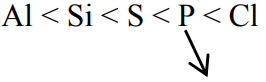
(Ionisation energy of phosphorus is more because of half filled stable configuration) -
- (A) \((r_A + r_B), 2(r_A + r_B)\)
- (B) \(\dfrac{1}{2}(r_A + r_B), (r_A + r_B)\)
- (C) \((r_A + r_B), (r_A + r_B)\)
- (D) \(2(r_A + r_B), \dfrac{1}{2}(r_A + r_B)\)
Show answer and solution
Correct Answer: (A)
The covalent bond length of the AB molecule is the internuclear distance between atom A and atom B.
Bond length = \(r_A + r_B\)
The total length of the AB molecule is the distance between the outermost boundaries of the two atoms along the internuclear axis.
Total length = Radius of A + Bond length + Radius of B
Total length = \(r_A + (r_A + r_B) + r_B = 2(r_A + r_B)\)
Answer: \((r_A + r_B), 2(r_A + r_B)\) -
- (A) A, B and D only
- (B) A, B, C and D
- (C) A and B only
- (D) B and C only
Show answer and solution
Correct Answer: (A)
→ On moving left to right in a period IE increases and from top to bottom in a group IE decreases.
\( F>P>S>B \) (IE order)
→ On moving left to right in a period metallic and basic character decreases.
\( K>Mg>Al>B \) (Metallic character order)
On moving top to bottom in a group metallic and basic character increases.
\( K_{2}O>Na_{2}O>MgO>Al_{2}O_{3} \)
→ EA: Group 17 > Group 16 > Group 15
\( Cl>F>S>P \) -
- (A) \(\mathrm{r}_{\mathrm{Br}} \lt \mathrm{r}_{\mathrm{K}}\)
- (B) \(\mathrm{r}_{\mathrm{Mg}} \lt \mathrm{r}_{\mathrm{Al}}\)
- (C) \(\mathrm{r}_{\mathrm{Rb}} \lt \mathrm{r}_{\mathrm{Cs}}\)
- (D) \(\mathrm{r}_{\mathrm{At}} \lt \mathrm{r}_{\mathrm{Cs}}\)
Show answer and solution
Correct Answer: (B)
In a period from left to right atomic size decreases. -
- (A) A < D < B < C
- (B) A < C < B < D
- (C) A < B < C < D
- (D) D < A < B < C
Show answer and solution
Correct Answer: (D)
\(\mathrm{N}:-1 \mathrm{~s}^2 2 \mathrm{~s}^2 2 \mathrm{p}^3\) (Electronegativity \(\left.=3\right)\)
\(\mathrm{O}:-1 \mathrm{~s}^2 2 \mathrm{~s}^2 2 \mathrm{p}^4\) (Electronegativity \(=3.5\))
\(\mathrm{F}:-1 \mathrm{~s}^2 2 \mathrm{~s}^2 2 \mathrm{p}^5\) (Electronegativity \(=4\))
\(\mathrm{C}:-1 \mathrm{~s}^2 2 \mathrm{~s}^2 2 \mathrm{p}^2\) (Electronegativity \(=2.55\))
Correct order \(=\mathrm{C} \gt \mathrm{B} \gt \mathrm{A} \gt \mathrm{D}\) -
- (A) \(1402 \mathrm{~kJ} \mathrm{~mol}^{-1}\)
- (B) \(834 \mathrm{~kJ} \mathrm{~mol}^{-1}\)
- (C) \(1012 \mathrm{~kJ} \mathrm{~mol}^{-1}\)
- (D) \(947 \mathrm{~kJ} \mathrm{~mol}^{-1}\)
Show answer and solution
Correct Answer: (C)
The main component of apatite family is phosphorus.
Order of \(\mathrm{IE}_1\) of group 15 elements \(\mathrm{N}>\mathrm{P}>\mathrm{As}>\mathrm{Sb}\) IE of phosphorus \(=1012 \mathrm{~kJ} \mathrm{~mol}^{-1}\). -
- (A) Both Statement I and Statement II are true
- (B) Statement I is false but Statement II is true
- (C) Both Statement I and Statement II are false
- (D) Statement I is true but Statement II is false
Show answer and solution
Correct Answer: (C)
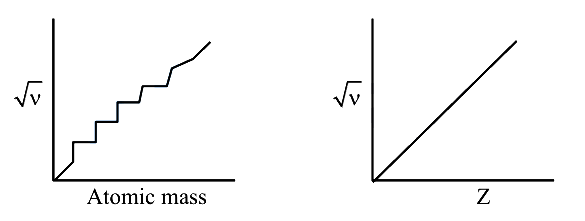
Explanation:
According to Moseley's Law for characteristic X-ray spectra, the relationship between frequency and atomic number is expressed as:
\( \sqrt{\nu} = a(Z - b) \)
Where \( \nu \) represents the frequency of the emitted X-rays, \( Z \) represents the atomic number, and \( a \) and \( b \) are constants.
1. Analysis of Statement (I): The graph plotted between \( \sqrt{\nu} \) and atomic mass is not a straight line; instead, it forms a jagged, irregular curve. This discovery led Henry Moseley to conclude that the atomic number is a far more fundamental property of an element than its atomic mass. Therefore, Statement I is false.
2. Analysis of Statement (II): Moseley's law specifies that the square root of the frequency (\( \sqrt{\nu} \)) is directly proportional to the atomic number, which means a plot of \( \sqrt{\nu} \) versus \( Z \) yields a straight line. Conversely, a plot of frequency (\( \nu \)) versus atomic number (\( Z \)) will yield a parabola (\( \nu \propto Z^2 \)), not a straight line. Therefore, Statement II is also false.
Since both statements are entirely false, Option C is the correct choice. -
- (A) Both Statement (I) and Statement (II) are false.
- (B) Both Statement (I) and Statement (II) are true.
- (C) Statement (I) is false but Statement (II) is true.
- (D) Statement (I) is true but Statement (II) is false.
Show answer and solution
Correct Answer: (A)
Law of octaves was arranged in the increasing order of their atomic weight.
Lothar Meyer plotted the physical properties such as atomic volume, melting point and boiling point against atomic weight. -
- (A) Statement I is true but Statement II is false
- (B) Both Statement I and Statement II are true
- (C) Both Statement I and Statement II are false
- (D) Statement I is false but Statement II is true
Show answer and solution
Correct Answer: (D)
Statement-I : False but Statement-II is true.
On moving left to right in periodic table nonmetallic character increases and we know that nonmetal oxides are acidc in nature.
Non metallic character \(\uparrow\) Acidic strength of oxide \(\uparrow\) -
- (A) Both Statement I and Statement II are incorrect
- (B) Statement I is incorrect but Statement II is correct
- (C) Statement I is correct but Statement II is incorrect
- (D) Both Statement I and Statement II are correct
Show answer and solution
Correct Answer: (B)
\(\Rightarrow\) The metallic radius order of \(\mathrm{Al} ~\&~ \mathrm{Ga}\) is
\(\mathrm{B} \lt \underbrace{\mathrm{Ga} \lt \mathrm{Al}}_{\downarrow} \lt \mathrm{In} \lt \mathrm{T} \ell\)
(due to poor shielding of d-subshell electrons)
\(\Rightarrow\) The ionic radius order of \(\mathrm{Al}^{+3} ~\&~ \mathrm{Ga}^{+3}\) is \(\mathrm{B}^{+3} \lt \mathrm{Al}^{+3} \lt \mathrm{Ga}^{+3} \lt \mathrm{In}^{+3} \lt \mathrm{T} \ell^{+3}\) -
- (A) Statement I is false but Statement II is true
- (B) Statement I is true but Statement II is false
- (C) Both Statement I and Statement II are true
- (D) Both Statement I and Statement II are false
Show answer and solution
Correct Answer: (B)
First ionization energy of Lead \(=715 \mathrm{~kJ} \mathrm{~mol}^{-1}\)
First ionization energy of Tin \(=708 \mathrm{~kJ} \mathrm{~mol}^{-1}\)
\(\left(\mathrm{IE}_1\right)\) of Lead is greater than that of Tin due to ineffective shielding of d - and f -electrons.
Therefore Statement-I is true.
First ionization energy of Germanium \(=761 \mathrm{~kJ} \mathrm{~mol}^{-1}\)
First ionization energy of Silicon \(=786 \mathrm{~kJ} \mathrm{~mol}^{-1}\)
\(\left(\mathrm{IE}_1\right)\) of Germanium is lower than that of Silicon as the effect of higher atomic radius of Ge outweighs the increase in nuclear charge from Si to Ge and effective shielding of inner electrons.
Therefore Statement-II is false. -
- (A) Statement I is incorrect but Statement II is correct
- (B) Statement I is correct but Statement II is incorrect
- (C) Both Statement I and Statement II are incorrect
- (D) Both Statement I and Statement II are correct
Show answer and solution
Correct Answer: (D)
\(\mathrm{r} \propto \mathrm{q}^{-}\)(for isoelectronic species)
\(\propto \frac{1}{q^{+}}\)
\(\therefore\) Statement I is correct
Magnitude of electron gain enthalpy
\(\mathrm{Cl}>\mathrm{F}>\mathrm{Br}>\mathrm{I}\) -
- (A) (A)-(IV), (B)-(I), (C)-(II), (D)-(III)
- (B) (A)-(IV), (B)-(I), (C)- (III), (D)-(II)
- (C) (A)-(III), (B)-(IV), (C)- (II), (D)-(I)
- (D) (A)-(II), (B)-(III), (C)-(IV), (D)-(I)
Show answer and solution
Correct Answer: (A)
Ionic radii \(-\mathrm{Al}^{3+} < \mathrm{Mg}^{2+} < \mathrm{Na}^{+} < \mathrm{F}^{-}\)
Ionisation energy - \(\mathrm{B} < \mathrm{C} < \mathrm{O} < \mathrm{N}\)
Metallic character \(-\mathrm{B} < \mathrm{Al} < \mathrm{Mg} < \mathrm{K}\)
Electron negativity \(-\mathrm{Si} < \mathrm{P} < \mathrm{S} < \mathrm{Cl}\) - 30. The element that does not belong to the same period of the remaining elements (modern periodic table) is _______. 2025 Easy
- (A) Iridium
- (B) Platinum
- (C) Osmium
- (D) Palladium
Show answer and solution
Correct Answer: (D)
Palladium \(\Rightarrow 5^{\text {th }}\) period
Iridium, Osmium, Platinum \(\Rightarrow 6^{\text {th }}\) Period - 31. The elements of Group 13 with highest and lowest first ionisation enthalpies are respectively: 2025 Medium
- (A) \(\mathrm{B} ~\&~ \mathrm{Ga}\)
- (B) B & Tl
- (C) \(\mathrm{Tl} ~\&~ \mathrm{~B}\)
- (D) B & In
Show answer and solution
Correct Answer: (D)
IE order
\(\mathrm{B} \gt \mathrm{T} \ell \gt \mathrm{Ga} \gt \mathrm{Al} \gt \mathrm{In}\) -
- (A) \(\mathrm{Si}\gt\mathrm{P}\gt\mathrm{Cl}\gt\mathrm{F}\)
- (B) \(\mathrm{Be}\gt\mathrm{Mg}\gt\mathrm{Al}\gt\mathrm{Si}\)
- (C) \(\mathrm{Al}\gt\mathrm{B}\gt\mathrm{N}\gt\mathrm{F}\)
- (D) \(\mathrm{Mg}\gt\mathrm{Al}\gt\mathrm{C}\gt\mathrm{O}\)
Show answer and solution
Correct Answer: (B)
Correct order of atomic radius : \(\mathrm{Be} < \mathrm{Mg}>\mathrm{Al}>\mathrm{Si}\) -
- (A) Group 13
- (B) Group 14
- (C) Group 2
- (D) Group 4
Show answer and solution
Correct Answer: (A)
The successive 5 ionisation energies of an element are \(800,2427,3658,25024\) and \(32824 \mathrm{~kJ} / \mathrm{mol}\), respectively.
\(\begin{aligned}
& \frac{\mathrm{IE}_2}{\mathrm{IE}_1}=\frac{2427}{800}=3.03 \\
& \frac{\mathrm{IE}}{\mathrm{IE}_2}=\frac{3658}{2427}=1.51 \\
& \frac{\mathrm{IE}}{\mathrm{IE}_3}=\frac{25024}{3658}=6.84
\end{aligned}\)
\(\frac{\mathrm{IE}_5}{\mathrm{IE}_4}=\frac{32824}{25024}=1.31\)
Since ( \(\mathrm{IE}_4 / \mathrm{IE}_3\) ) value is maximum, the element belongs to group 13. -
- (A) \(\mathrm{A}_2 \mathrm{O}\)
- (B) \(\mathrm{A}_2 \mathrm{O}_3\)
- (C) \(\mathrm{AO}_2\)
- (D) \(\mathrm{AO}\)
Show answer and solution
Correct Answer: (B)
Among given atoms, Boron has least atomic radius oxide of Boron \(=\mathrm{B}_2 \mathrm{O}_3\) -
- (A) B & C only
- (B) A, C and d only
- (C) B and D only
- (D) B,C and E only
Show answer and solution
Correct Answer: (A)
(A) The process of adding an \(\mathrm{e}^{-}\)to a neutral gaseous atom is not always exothermic it may be exothermic or endothermic.
(C) \(\mathrm{Be} \quad \mathrm{B}\)
\(1 s^2 2 s^2 \quad 1 s^2 2 s^2 2 p^1\)
In Be 2 s subshell in fully filled
So, need high energy to remove \(\mathrm{e}^{-}\)as compared to B.
(D)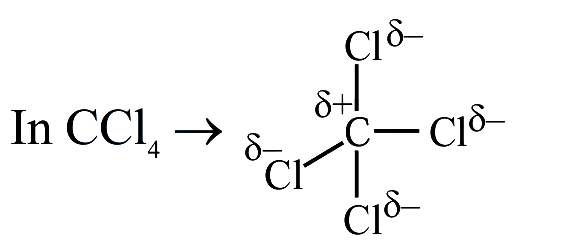
due to partially positive charge \(z_{\text {eff }} \uparrow, \mathrm{EN} \uparrow\)
So, EN of \(\mathrm{C} \Rightarrow \mathrm{CCl}_4 \gt \mathrm{CH}_4\)
(E) Cs is most electropositive. -
- (A) \(\mathrm{A}, \mathrm{C}\) and E Only
- (B) A and E Only
- (C) \(\mathrm{B}, \mathrm{C}\) and E Only
- (D) D and E Only
Show answer and solution
Correct Answer: (A)
Properties of elements are function of atomic numbers.
Elements having similar outer electronic configuration are arranged in same group.
Number of elements in a period is double of number of atomic orbitals available in energy level that is being filled. -
- (A) \(A\) only
- (B) \(A\), \(B\) and \(D\) only
- (C) \(A\) and \(B\) only
- (D) \(B\), \(C\) and \(D\) only
Show answer and solution
Correct Answer: (B)
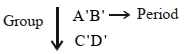
In general along the period from left to right, size decreases and metallic character decrease.In general down the group, size increases and metallic character increases.\(\mathrm{B}^{\prime}<\mathrm{A}^{\prime}(\text { size }) \quad \mathrm{C}^{\prime}>\mathrm{A}^{\prime}(\text { size })\)
\(\mathrm{D}^{\prime}<\mathrm{C}^{\prime}(\text { size }) \quad \mathrm{D}^{\prime}>\mathrm{B}^{\prime}(\text { size })\)
\(\mathrm{B}^{\prime}<\mathrm{A}^{\prime}(\text { metallic character })\)
\(\mathrm{D}^{\prime}<\mathrm{C}^{\prime}(\text { metallic character })\)
\(\mathrm{B}^{\prime+}<\mathrm{A}^{\prime+}(\text { size })\)
\(\mathrm{D}^{\prime+}<\mathrm{C}^{\prime+}(\text { size })\)
\(\therefore \mathrm{C}\) statement is incorrect.
-
- (A) Both \(\mathrm{A}\) and \(\mathrm{R}\) are true and \(\mathrm{R}\) is the correct explanation of \(A\)
- (B) \(A\) is true but \(R\) is false
- (C) \(A\) is false but \(R\) is true
- (D) Both \(\mathrm{A}\) and \(\mathrm{R}\) are true but \(\mathrm{R}\) is \(NOT\) the correct explanation of \(\mathrm{A}\)
Show answer and solution
Correct Answer: (C)
First ionisation energy increases along the period. Along the period \(\mathrm{Z}\) increases which outweighs the shielding effect. -
- (A) Both statement \(I\) and Statement \(II\) are true.
- (B) Statement \(I\) is true but Statement \(II\) is False.
- (C) Statement \(I\) is false but Statement \(II\) is true.
- (D) Both Statement \(I\) and Statement \(II\) is false.
Show answer and solution
Correct Answer: (C)
Chemical reactivity of elements decreases along the period therefore statement \(-\mathrm{I}\) is false.\(Group -1\) elements from basic nature oxides while group - \(17\) elements form acidic oxides therefore statement \(-\mathrm{II}\) is true.
-
- (A) Both Statement \(I\) and Statement \(II\) are false
- (B) Statement \(I\) is false but Statement \(II\) is true
- (C) Statement \(I\) is true but Statement \(VII\) is false
- (D) Both Statement \(I\) and Statement \(II\) are true
Show answer and solution
Correct Answer: (B)
\(I\). In \(p-\)Block both metals and non metals are present but in \(d\)-Block only metals are present.\(II\). \(EN\) and \(IE\) of non metals are greater than that of metals
\(I\) - False, \(II\)-True
-
- (A) Both Statement \(I\) and Statement \(II\) are true
- (B) Statement \(I\) is true but Statement \(II\) is false
- (C) Both Statement \(I\) and Statement \(II\) are false
- (D) Statement \(I\) is false but Statement \(II\) is true
Show answer and solution
Correct Answer: (D)
Explanation:
Let us evaluate both statements according to the periodic trends of electron gain enthalpy:
1. Analysis of Statement I: In Group 17 (halogens), electron gain enthalpy generally becomes less negative down the group. However, Fluorine (\( \text{F} \)) has an exceptionally small atomic size and high electron density in its compact \( 2p \) subshell. This creates significant inter-electronic repulsion when an extra electron is added. Consequently, Chlorine (\( \text{Cl} \)) releases more energy and has a more negative electron gain enthalpy (\( -349\text{ kJ/mol} \)) than Fluorine (\( -328\text{ kJ/mol} \)). Thus, Chlorine has the most negative electron gain enthalpy in its group, making Statement I false.
2. Analysis of Statement II: In Group 16 (chalcogens), due to the very compact size of the Oxygen (\( \text{O} \)) atom, an incoming electron experiences severe repulsion from the valence electrons already present in the \( 2p \) subshell. Therefore, less energy is released upon electron addition compared to its heavier congeners. The electron gain enthalpy values across the group are: \( \text{O} = -141\text{ kJ/mol} \), \( \text{S} = -200\text{ kJ/mol} \), \( \text{Se} = -195\text{ kJ/mol} \), \( \text{Te} = -190\text{ kJ/mol} \), and \( \text{Po} = -174\text{ kJ/mol} \). Since \( -141\text{ kJ/mol} \) represents the smallest absolute magnitude of energy released, Oxygen has the least negative electron gain enthalpy in its group, making Statement II true.
Hence, Option D is the correct choice. -
- (A) Both Statement \(I\) and Statement \(II\) are incorrect
- (B) Statement \(I\) is correct but Statement \(II\) is incorrect
- (C) Both Statement \(I\) and Statement \(II\) are correct
- (D) Statement \(I\) is incorrect but Statement \(II\) is correct
Show answer and solution
Correct Answer: (D)
Oxidation state of an element in a particular compound is defined by the charge acquired by its atom on the basis of electronegativity consideration from other atoms in molecule. -
- (A) Statement \(I\) is false but Statement \(II\) is true
- (B) Both Statement \(I\) and Statement \(II\) are true
- (C) Statement \(I\) is true but Statement \(II\) is false
- (D) Both Statement \(I\) and Statement \(II\) are false
Show answer and solution
Correct Answer: (C)
s-block elements are highly reactive and found in combined state. -
- (A) Statement \(I\) is correct but Statement \(II\) is false
- (B) Both Statement \(I\) and Statement \(II\) are true
- (C) Both Statement \(I\) and Statement \(II\) are false
- (D) Statement \(I\) is incorrect but Statement \(II\) is true
Show answer and solution
Correct Answer: (A)
\(\mathrm{r}_{\mathrm{Na}}>\mathrm{r}_{\mathrm{Na}^{+}}\)So, Statement \((I)\) is correct but size of anions are greater than size of neutral atoms.
So, statement \((II)\) is incorrect.
-
- (A) \((D)\) and \((E)\) only
- (B) \((A)\) and \((C)\) only
- (C) \((B)\) and \((E)\) only
- (D) \((B)\) and \((D)\) only
Show answer and solution
Correct Answer: (B)
As electronegativity increases non-metallic nature increases.Along the period ionisation energy increases.
High electronegativity difference results in ionic bond formation.
Oxides of metals are generally basic and that of non-metals are acidic in nature.
- 46. If \(IUPAC \) name of an element is \("unununium"\) then correct statement regarding element is 2024 Hard
- (A) It is a inner transition element
- (B) It belongs to \(8^{th}\) period in periodic table
- (C) It is transition element
- (D) It is a non-transition element
Show answer and solution
Correct Answer: (C)
\((c)\) \("Unununium"\) : At number \(= 111\)
It is a transition element. Period number \(= 7^{th}\); Group number \(= 11\) - 47. If IUPAC name of an element is "Unununnium" then the element belongs to nth group of periodic table. The value of n is _______. 2024 Medium
- (A) 11
- (B) 22
- (C) 33
- (D) 44
Show answer and solution
Correct Answer: (A)
111 belongs to \(11^{\text {th }}\) group - 48. In case of isoelectronic species the size of \(\mathrm{F}^{-}, \mathrm{Ne}\) and \(\mathrm{Na}^{+}\)is affected by _______. 2024 Hard
- (A) Principal quantum number \((n)\)
- (B) None of the factors because their size is the same
- (C) Electron-electron interaction in the outer orbitals
- (D) Nuclear charge \((z)\)
Show answer and solution
Correct Answer: (D)
In \(\mathrm{F}^{-}, \mathrm{Ne}, \mathrm{Na}^{+}\)all have \(1 \mathrm{~s}^2, 2 \mathrm{~s}^2, 2 \mathrm{p}^0\) configuration. They have different size due to the difference in nuclear charge. -
- (A) \(A-II, B-III, C-IV, D-I\)
- (B) \(A-III, B-II, C-I, D-IV\)
- (C) \(A-IV, B-III, C-II, D-I\)
- (D) \(A-II, B-I, C-IV, D-III\)
Show answer and solution
Correct Answer: (C)
Elements with highest electronegativity \(\rightarrow \mathrm{F}, \mathrm{O}\)Elements with largest atomic size \(\rightarrow \mathrm{Fr}, \mathrm{Ra}\)
Elements which shows properties of both metal and non-metals i.e. metalloids \(\rightarrow \mathrm{Ge}\), As
Elements with highest negative electron gain enthalpy \(\rightarrow \mathrm{Cl}, \mathrm{S}\)
-
- (A) (A)-(II), (B)-(IV), (C)-(III), (D)-(I)
- (B) (A)-(I), (B)-(IV), (C)-(III), (D)-(II)
- (C) (A)-(IV), (B)-(II), (C)-(I), (D)-(III)
- (D) (A)-(III), (B)-(I), (C)-(IV), (D)-(II)
Show answer and solution
Correct Answer: (D)
(A)-(III), (B)-(I), (C)-(IV), (D)-(II)
No questions on this page match these filters.
About Classification of elements and periodicity in properties PYQs
Classification of elements and periodicity in properties has 135 questions from 2013–2026. The most came in 2024 (21), 2026 (19) and 2022 (18).
The most asked topics are Lonisation energy, Atomic and lonic radii and Extended or long form of periodic table.
24% are easy, 53% medium and 22% hard.
Classification of elements and periodicity in properties PYQs by year
Frequently asked
How many Classification of elements and periodicity in properties questions came in JEE Mains?
135 questions from 2013–2026, each with the correct answer and a full solution.
Which Classification of elements and periodicity in properties topic is asked the most?
Lonisation energy, with 36 questions, followed by Atomic and lonic radii with 25.
Which year had the most Classification of elements and periodicity in properties questions?
2024, with 21 questions.
How difficult are Classification of elements and periodicity in properties questions?
24% are easy, 53% medium and 22% hard.