


Questions
Newest firstShowing 1–50 of 64 questions
-
- (A) 125
- (B) 250
- (C) 375
- (D) 500
Show answer and solution
Correct Answer: (C)
\(M_1 V_1 n_1 = M_2 V_2 n_2\)
\(0.6 \times 750 \times 1 = x \times 10^{-3} \times 200 \times 6\)
\(450 = x \times 1.2\)
\(x = \frac{450}{1.2}\)
\(x = 375\)
-
- (A) 1
- (B) 2
- (C) 3
- (D) 4
Show answer and solution
Correct Answer: (C)
\(MnO _4^{-}+ I ^{-} \rightarrow MnO _2+ I _2\)
\(I _2+ S _2 O _3^{2-} \rightarrow S _4 O _6^{2-}+ I ^{-}\)
gram eq of \(KMnO _4=\) gram eq of \(Na _2 S_2 O _3\)
\(0.2 \times \frac{500}{1000} \times 3=0.1 \times V \times 1\)
\(V =3 L\) -
- (A) KI-starch
- (B) \(KMnO_4\)
- (C) \(Pb(CH_3COO)_2\)
- (D) \(K_2Cr_2O_7\)
Show answer and solution
Correct Answer: (D)
\(SO_2\) gas acts as a reducing agent. When a paper dipped in an acidified solution of potassium dichromate (\(K_2Cr_2O_7\)) is exposed to \(SO_2\) gas, the orange-colored dichromate ion (\(Cr_2O_7^{2-}\)) is reduced to the green-colored chromium(III) ion (\(Cr^{3+}\)).
The chemical reaction is:
\(K_2Cr_2O_7 + H_2SO_4 + 3SO_2 \rightarrow K_2SO_4 + Cr_2(SO_4)_3 + H_2O\)
The formation of chromium(III) sulfate, \(Cr_2(SO_4)_3\), is responsible for the green color.
Thus, the compound '\(X\)' is \(K_2Cr_2O_7\).
Answer: \(K_2Cr_2O_7\) -
- (A) 11
- (B) 13
- (C) 15
- (D) 17
Show answer and solution
Correct Answer: (B)
\(A \rightarrow CrO _2 Cl _2\)
\(B \rightarrow Na _2 CrO _4\)
\(C \rightarrow CrO _5\)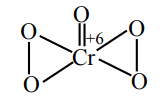
\(X=2, Y=5\) and \(Z=6\) -
- (A) \( Na_{2}[Pb(OH)_{2}], PbCrO_{4} \) and \( (NH_{4})_{2}[Pb(CH_{3}COO)_{4}] \)
- (B) \( PbCrO_{4}, Na_{2}[Pb(OH)_{4}] \) and \( [Pb(NH_{3})_{4}]SO_{4} \)
- (C) \( Na_{2}[Pb(OH)_{2}], PbCrO_{4} \) and \( [Pb(NH_{3})_{4}]SO_{4} \)
- (D) \( PbCrO_{4}, Na_{2}[Pb(OH)_{4}] \) and \( (NH_{4})_{2}[Pb(CH_{3}COO)_{4}] \)
Show answer and solution
Correct Answer: (D)
The reactions are as follows:
\( PbCl_{2}+K_{2}CrO_{4}\rightarrow PbCrO_{4}+2KCl \)
(Hot solution)
\( PbCrO_{4}+4NaOH \) (excess) \( (A) \rightarrow Na_{2}[Pb(OH)_{4}]+Na_{2}CrO_{4} \)
\( PbSO_{4}+4CH_{3}COONH_{4} \rightarrow(NH_{4})_{2}[Pb(CH_{3}COO)_{4}]+(NH_{4})_{2}SO_{4} \) -
- (A) A and B Only
- (B) C, D and E Only
- (C) C and E Only
- (D) B and E Only
Show answer and solution
Correct Answer: (C)
The highest manganese fluoride is \(MnF_4\), where the oxidation state of Mn is \(+4\).
The highest manganese oxide is \(Mn_2O_7\), where the oxidation state of Mn is \(+7\).
The difference in oxidation states is \(|x| = |7 - 4| = 3\).
The number of unpaired electrons in the given ions are:
\(Sc^{3+}\): \([Ar] 3d^0 \Rightarrow 0\) unpaired electrons
\(Zn^{2+}\): \([Ar] 3d^{10} \Rightarrow 0\) unpaired electrons
\(V^{2+}\): \([Ar] 3d^3 \Rightarrow 3\) unpaired electrons
\(Fe^{2+}\): \([Ar] 3d^6 \Rightarrow 4\) unpaired electrons
\(Co^{2+}\): \([Ar] 3d^7 \Rightarrow 3\) unpaired electrons
Thus, \(V^{2+}\) (C) and \(Co^{2+}\) (E) have \(3\) unpaired electrons.
Answer: C and E Only -
- (A) A, B and C Only
- (B) A, C and D Only
- (C) A and C Only
- (D) B and D Only
Show answer and solution
Correct Answer: (B)
Statement A is correct. Potassium dichromate acts as a strong oxidising agent in acidic medium and oxidises \(Fe^{2+}\) to \(Fe^{3+}\), converting \(FeSO_4\) to \(Fe_2(SO_4)_3\).
Statement B is incorrect. Sodium dichromate is deliquescent (absorbs moisture from the atmosphere), which prevents it from being weighed accurately. Therefore, it cannot be used as a primary standard in volumetric estimation. Potassium dichromate is used instead.
Statement C is correct. Chromate (\(CrO_4^{2-}\)) and dichromate (\(Cr_2O_7^{2-}\)) ions are interconvertible in aqueous solution depending on the \(pH\) of the solution. In acidic medium, chromate changes to dichromate, and in basic medium, dichromate changes to chromate: \(2CrO_4^{2-} + 2H^+ \rightleftharpoons Cr_2O_7^{2-} + H_2O\).
Statement D is correct. The structure of the dichromate ion consists of two tetrahedral \(CrO_3\) groups joined by a bridging oxygen atom, and the \(Cr-O-Cr\) bond angle is \(126^\circ\).
Therefore, statements A, C, and D are correct.
Answer: A, C and D Only -
- (A) A, B, C and D
- (B) A, B and D Only
- (C) A, C and D Only
- (D) A, B and C Only
Show answer and solution
Correct Answer: (B)
\(Mn _2 O _7: Mn\) in +7 oxidation state.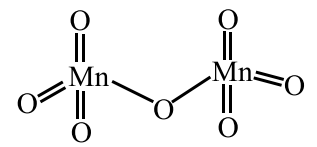
-
- (A) Both Statement I and Statement II are true
- (B) Both Statement I and Statement II are false
- (C) Statement I is true but Statement II is false
- (D) Statement I is false but Statement II is true
Show answer and solution
Correct Answer: (B)
Statement I is false because sodium dichromate is deliquescent (absorbs moisture from the atmosphere) and cannot be weighed accurately, so it is not used as a primary standard. Potassium dichromate, however, is a primary standard.
Statement II is false because phenolphthalein is a weak organic acid, not a weak base. It remains largely undissociated in an acidic medium (colorless) and dissociates in a basic medium to give a pink color.
Therefore, both Statement I and Statement II are false.
Answer: Both Statement I and Statement II are false -
- (A) \( Mn_{2}O_{7} \) and \( MnO_{2} \)
- (B) \( MnO_{4}^{-} \) and MnO
- (C) \( MnO_{4}^{-} \) and \( MnO_{2} \)
- (D) \( Mn_{2}O_{7} \) and MnO
Show answer and solution
Correct Answer: (C)
\( 3MnO_{4}^{2-}+4H^{+} \rightarrow 2MnO_{4}^{-}+MnO_{2}+2H_{2}O \) -
- (A) \(CrO_{2}Cl_{2}\) and +5
- (B) \(CrO_{2}Cl_{2}\) and +6
- (C) \(Cr_{2}O_{2}Cl_{2}\) and +6
- (D) \(Cr_{2}O_{2}Cl_{2}\) and +3
Show answer and solution
Correct Answer: (B)
\(4 NaCl + K _2 Cr _2 O _7+6 H _2 SO _4\)
\(\longrightarrow 2 KHSO _4+2 CrO _2 Cl _2+4 NaHSO _4+3 H _2 O\) (Chromyl chloride)
In Chromyl chloride Cr is in +6 oxidation state. - 12. The oxidation state of chromium in the final product formed in the reaction between KI and acidified \( K_{2}Cr_{2}O_{7} \) solution is: 2026 Medium
- (A) \(+4\)
- (B) \(+3\)
- (C) \(+2\)
- (D) \(+6\)
Show answer and solution
Correct Answer: (B)
\( K_{2}Cr_{2}O_{7} + KI \xrightarrow{H^{+}} I_{2} + Cr^{3+} \) -
- (A) 6
- (B) 10
- (C) 12
- (D) 8
Show answer and solution
Correct Answer: (C)
\(Cr _2 O _7^{2-}+14 H ^{+}+6 I ^{-} \rightarrow 2 Cr ^{3+}+3 I _2+7 H _2 O\)
no. of moles \(e ^{-}\)involved \(= x =6\)
\(Cr _2 O _7^{2-}+3 S^{2-}+14 H ^{+} \rightarrow+ S +2 Cr ^{3+}+7 H _2 O\)
No. of moles \(e ^{-}\) involved \(= y =6\)
Sum of \(x+y=6+6=12\) -
- (A) green
- (B) purple
- (C) yellow
- (D) orange
Show answer and solution
Correct Answer: (A)
Lightest element of Group \(7 \Rightarrow Mn\).
\(K_{2}MnO_{4} \Rightarrow\) Green -
- (A) \(\mathrm{K}_2 \mathrm{CrO}_4\) and CrO
- (B) \(\mathrm{K}_2 \mathrm{CrO}_4\) and \(\mathrm{Cr}_2 \mathrm{O}_3\)
- (C) \(\mathrm{K}_2 \mathrm{CrO}_4\) and \(\mathrm{K}_2 \mathrm{Cr}_2 \mathrm{O}_7\)
- (D) \(\mathrm{K}_2 \mathrm{Cr}(\mathrm{OH})_6\) and \(\mathrm{Cr}_2 \mathrm{O}_3\)
Show answer and solution
Correct Answer: (C)
\(\mathrm{K}_2 \mathrm{Cr}_2 \mathrm{O}_7 \xrightarrow[-\mathrm{H}_2 \mathrm{O}]{\mathrm{KOH}} \mathrm{K}_2 \mathrm{CrO}_4 \xrightarrow[-\mathrm{H}_2 \mathrm{O}]{\mathrm{H}_2 \mathrm{SO}_4} \mathrm{~K}_2 \mathrm{Cr}_2 \mathrm{O}_7+\mathrm{K}_2 \mathrm{SO}_4\)
[A] \(\mathrm{K}_2 \mathrm{CrO}_4\)
[B] \(\mathrm{K}_2 \mathrm{Cr}_2 \mathrm{O}_7\) -
- (A) \(\mathrm{A}=\mathrm{Na}_2 \mathrm{CrO}_4, \mathrm{~B}=\mathrm{CrO}_5\)
- (B) \(\mathrm{A}=\mathrm{Na}_2 \mathrm{Cr}_2 \mathrm{O}_4, \mathrm{~B}=\mathrm{CrO}_4\)
- (C) \(\mathrm{A}=\mathrm{Na}_2 \mathrm{Cr}_2 \mathrm{O}_7, \mathrm{~B}=\mathrm{CrO}_3\)
- (D) \(\mathrm{A}=\mathrm{Na}_2 \mathrm{Cr}_2 \mathrm{O}_7,\mathrm{~B}=\mathrm{CrO}_5\)
Show answer and solution
Correct Answer: (A)
\(\mathrm{CrO}_2 \mathrm{Cl}_2+4 \mathrm{NaOH} \rightarrow \underset{\text { (A) }}{\mathrm{Na}_2 \mathrm{CrO}_4}+\underset{\text { (B) }}{2 \mathrm{NaCl}}+2 \mathrm{H}_2 \mathrm{O}\)\(\mathrm{Na}_2 \mathrm{CrO}_4+2 \mathrm{H}_2 \mathrm{O}_2+2 \mathrm{HCl} \rightarrow \underset{\begin{array}{l}\text { Missing from }\text { balanced eqaution }\end{array}}{2 \mathrm{NaCl}}+3 \mathrm{H}_2 \mathrm{O}\)
-
- (A) \(\mathrm{Mn}_2 \mathrm{O}_7\) and \(\mathrm{MnO}_4^{-}\)
- (B) \(\mathrm{MnO}_4{ }^{2-}\) and \(\mathrm{MnO}_4^{-}\)
- (C) \(\mathrm{Mn}_2 \mathrm{O}_3\) and \(\mathrm{MnO}_4{ }^{2-}\)
- (D) \(\mathrm{MnO}_4{ }^{2-}\) and \(\mathrm{Mn}_2 \mathrm{O}_7\)
Show answer and solution
Correct Answer: (B)
Alkaline oxidative fusion of \(\mathrm{MnO}_2\) :\(2\mathrm{MnO}_2+4 \mathrm{OH}^{-}+\mathrm{O}_2 \rightarrow 2 \mathrm{MnO}_4^{2-}+2 \mathrm{H}_2 \mathrm{O}\)
Electrolytic oxidation of \(\mathrm{MnO}_4^{2-}\) in alkaline medium.
\(\mathrm{MnO}_4^{2-} \rightarrow \mathrm{MnO}_4^{-}+e^{-}\)
-
- (A) \(A\), \(B\) and \(D\) only
- (B) \(A\) and \(C\) only
- (C) \(A\), \(B\) and \(C\) only
- (D) \(B\) and \(C\) only
Show answer and solution
Correct Answer: (B)
\((A)\) \(\mathrm{Mn}_2 \mathrm{O}_7\) is green oil at room temperature.\((B)\) \(\mathrm{V}_2 \mathrm{O}_4\) dissolve in acids to give \(\mathrm{VO}^{2+}\) salts.
\((C)\) \(\mathrm{CrO}\) is basic oxide
\((D)\) \(\mathrm{V}_2 \mathrm{O}_5\) is amphoteric it reacts with acid as well as base.
-
- (A) Both Statement \(I\) and Statement \(II\) is true
- (B) Both Statement \(I\) and Statement \(II\) is false
- (C) Statement \(I\) is true but Statement \(II\) is false
- (D) Statement \(I\) is false but Statement \(II\) is true
Show answer and solution
Correct Answer: (A)
\(\mathrm{MnO}_2+4 \mathrm{KOH}+\mathrm{O}_2 \xrightarrow{\text { fused }} 2 \mathrm{~K}_2 \mathrm{MnO}_4+2 \mathrm{H}_2 \mathrm{O}\)Dark green
Electrolytic oxidation in alkaline medium :
At anode :
\(\mathrm{MnO}_4^{2-} \rightarrow \mathrm{MnO}_4^{-}+\mathrm{e}^{-}\)
-
- (A) \(B, C, D\) only
- (B) \(A, D, E\) only
- (C) \(A, B, C\) only
- (D) \(B, D, E\) only
Show answer and solution
Correct Answer: (D)
\(A\). \(\mathrm{CrO}_4{ }^{2-}\) is tetrahedral\(B\). \(2 \mathrm{Na}_2 \mathrm{CrO}_4+2 \mathrm{H}^{+} \rightarrow \mathrm{Na}_2 \mathrm{Cr}_2 \mathrm{O}_{/}+2 \mathrm{Na}^{+}+\mathrm{H}_2 \mathrm{O}\)
\(C\). As per \(NCERT\), green manganate is paramagnetic with \(1\) unpaired electron.
\(D\). Statement is correct.
\(E\). Statement is correct.
-
- (A) \(\mathrm{IO}_4^{-}\)
- (B) \(\mathrm{IO}^{-}\)
- (C) \(\mathrm{I}_2\)
- (D) \(\mathrm{IO}_3^{-}\)
Show answer and solution
Correct Answer: (D)
\(2 \mathrm{MnO}_4^{-}+\mathrm{H}_2 \mathrm{O}+\mathrm{I}^{-} \xrightarrow{\text { allcaline medium }} 2 \mathrm{MnO}_2+2 \mathrm{OH}^{-}+\mathrm{IO}_3^{-}\) -
- (A) \(4\)
- (B) \(6\)
- (C) \(8\)
- (D) \(10\)
Show answer and solution
Correct Answer: (B)
\(\mathrm{K}_2 \mathrm{Cr}_2 \mathrm{O}_7(\mathrm{~s})+4 \mathrm{KCl}(\mathrm{s})+6 \mathrm{H}_2 \mathrm{SO}_4 \text { (conc.) }\)\(\rightarrow 2 \mathrm{CrO}_2 \mathrm{Cl}_2(\mathrm{~g})+6 \mathrm{KHSO}_4+3 \mathrm{H}_2 \mathrm{O}\)
This reaction is called chromyl chloride test. Here oxidation state of \(\mathrm{Cr}\) is +6 .
- 23. \(\mathrm{KMnO}_4\) decomposes on heating at \(513 \mathrm{~K}\) to form \(\mathrm{O}_2\) along with _______. 2024 Hard
- (A) \(\mathrm{MnO}_2 \& \mathrm{~K}_2 \mathrm{O}_2\)
- (B) \(\mathrm{K}_2 \mathrm{MnO}_4 \& \mathrm{Mn}\)
- (C) \(\mathrm{Mn} \& \mathrm{KO}_2\)
- (D) \(\mathrm{K}_2 \mathrm{MnO}_4 \& \mathrm{MnO}_2\)
Show answer and solution
Correct Answer: (D)
\(\mathrm{KMnO}_4 \xrightarrow{\Delta} \mathrm{K}_2 \mathrm{MnO}_4+\mathrm{MnO}_2+\mathrm{O}_2\) -
- (A) A-III, B-II, C-IV, D-I
- (B) A-III, B-IV, C-I, D-II
- (C) A-III, B-I, C-II, D-IV
- (D) A-III, B-I, C-IV, D-II
Show answer and solution
Correct Answer: (B)
(A-III, B-IV, C-I, D-II) -
- (A) \(\mathrm{CrO}_2 \mathrm{Cl}_2, \mathrm{Na}_2 \mathrm{CrO}_4\)
- (B) \(\mathrm{Na}_2 \mathrm{CrO}_4, \mathrm{CrO}_2 \mathrm{Cl}_2\)
- (C) \(\mathrm{CrO}_2 \mathrm{Cl}_2, \mathrm{KHSO}_4\)
- (D) \(\mathrm{CrO}_2 \mathrm{Cl}_2, \mathrm{Na}_2 \mathrm{Cr}_2 \mathrm{O}_7\)
Show answer and solution
Correct Answer: (A)
\( \mathrm{NaCl}+\text { conc. } \mathrm{H}_2 \mathrm{SO}_4+\mathrm{K}_2 \mathrm{Cr}_2 \mathrm{O}_7 \)
\( \rightarrow \mathrm{CrO}_2 \mathrm{Cl}_2 [(\text B)\text{ Reddish brown} ]+\mathrm{KHSO}_4+\mathrm{NaHSO}_4+\mathrm{H}_2 \mathrm{O}\)
\(\mathrm{CrO}_2 \mathrm{Cl}_2+\mathrm{NaOH} \rightarrow \mathrm{Na}_2 \mathrm{CrO}_4 [(\text C)\text{ Yellow colour}]+\mathrm{NaCl}+\mathrm{H}_2 \mathrm{O}\) -
- (A) \(5\)
- (B) \(6\)
- (C) \(8\)
- (D) \(10\)
Show answer and solution
Correct Answer: (B)
Spin only magnetic moment of \(\mathrm{Mn}\) in \(\mathrm{KMnO}_4=0\) Spin only value of manganese product fromed during titration of \(\mathrm{KMnO}_4\) aganist oxalic acid in acidic medium is \(=6\)Ans. \(6\)
- 27. The orange colour of \(\mathrm{K}_2 \mathrm{Cr}_2 \mathrm{O}_7\) and purple colour of \(\mathrm{KMnO}_4\) is due to _______. 2024 Hard
- (A) Charge transfer transition in both.
- (B) \(d \rightarrow d\) transition in \(\mathrm{KMnO}_4\) and charge transfer transitions in \(\mathrm{K}_2 \mathrm{Cr}_2 \mathrm{O}_r\).
- (C) \(d \rightarrow d\) transition in \(\mathrm{K}_2 \mathrm{Cr}_2 \mathrm{O}_7\) and charge transfer transitions in \(\mathrm{KMnO}_4\).
- (D) \(\mathrm{d} \rightarrow \mathrm{d}\) transition in both.
Show answer and solution
Correct Answer: (A)
\(\mathrm{K}_2 \mathrm{Cr}_2 \mathrm{O}_7 \rightarrow \mathrm{Cr}^{+6} \rightarrow \text { No d - d transition }\)
\(\mathrm{KMnO}_4 \rightarrow \mathrm{Mn}^{7+} \rightarrow \text { No d - d transition }\) Charge transfer
-
- (A) Black
- (B) Red
- (C) Green
- (D) Blue
Show answer and solution
Correct Answer: (C)
\(Cr _2 O _7^{2-}+ SO _3^{2-} \stackrel{ H ^{+}}{\longrightarrow} \underset{\text { Green }}{ Cr ^{3+}}+ SO _4^{2-}\) -
- (A) Both Statement \(I\) and Statement \(II\) are true
- (B) Both Statement \(I\) and Statement \(II\) are false
- (C) Both Statement \(I\) is true but Statement \(II\) is false
- (D) Both Statement \(I\) is false but Statement \(II\) is true
Show answer and solution
Correct Answer: (C)
(1) \(K _2 Cr _2 O\), is used as primary standard. The concentration \(Na _2 Cr _2 O _7\) changes in aq. solution.(2) It is less soluble than \(Na _2 Cr _2 O _7\).
- 30. In alkaline medium, the reduction of permanganate anion involves a gain of \(........\) electrons. 2023 Easy
- (A) \(4\)
- (B) \(5\)
- (C) \(3\)
- (D) \(7\)
Show answer and solution
Correct Answer: (C)
In faintly alkaline medium,\(MnO _4^{-}+3 e ^{-}+2 H _2 O \longrightarrow MnO _2+4 OH ^{-}\)
No. of electrons gained \(=3\)
- 31. \(K _2 Cr _2 O _7\) paper acidified with dilute \(H _2 SO _4\) turns green when exposed to 2023 Medium
- (A) Carbon dioxide
- (B) Sulphur trioxide
- (C) Hydrogen sulphide
- (D) Sulphur dioxide
Show answer and solution
Correct Answer: (D)
\(3 SO _2+ Cr _2 O _7^{2-}+2 H ^{+} \rightarrow 3 SO _4^{2-}+2 Cr ^{+3}+ H _2 O\) -
- (A) \(67\)
- (B) \(65\)
- (C) \(68\)
- (D) \(66\)
Show answer and solution
Correct Answer: (C)
By balancing the redox reaction we get\(10\left[ FeSO _4 \cdot\left( NH _4\right)_2 SO _4 \cdot 6 H _2 O \right]+2 KMnO _4+8 H _2 SO _4\)
\(\downarrow\)
\(5 Fe _2\left( SO _4\right)_3+2 MnSO _4+10\left( NH _4\right)_2 SO _4+ K _2 SO _4+68 H _2 O\)
- 33. \(KMnO _4\) oxidises \(I ^{-}\)in acidic and neutral/faintly alkaline solution, respectively to 2023 Hard
- (A) \(I _2\) and \(IO _3^{-}\)
- (B) \(IO _3^{-}\) and \(I _2\)
- (C) \(IO _3^{-}\) and \(IO _3^{-}\)
- (D) \(I_2\) and \(I_2\)
Show answer and solution
Correct Answer: (A)
In acidic medium\(2 MnO _4^{-}+10 I ^{-}+16 H ^{+} \rightarrow 2 Mn ^{2+}+5 I _2+8 H _2 O\)
In neutral/faintly alkaline solution
\(2 MnO _4^{-}+ I ^{-}+ H _2 O \rightarrow 2 MnO _2+2 OH ^{-}+ IO _3^{-}\)
-
- (A) \(V _2 O _3 > V _2 O _4 > V _2 O _5\)
- (B) \(V _2 O _3 > V _2 O _5 > V _2 O _4\)
- (C) \(V _2 O _5 > V _2 O _4 > V _2 O _3\)
- (D) \(V _2 O _4 > V _2 O _3 > V _2 O _5\)
Show answer and solution
Correct Answer: (A)
With increase in \(\%\) of oxygen acidic nature of oxide of an element increase and basic nature decreases - 35. The number of electrons involved in the reduction of permanganate to manganese dioxide in acidic medium is \(.......\). 2023 Medium
- (A) \(4\)
- (B) \(3\)
- (C) \(2\)
- (D) \(1\)
Show answer and solution
Correct Answer: (B)
\(\stackrel{+7}{ MnO _4^{-}}+4 H ^{+}+3 e ^{-} \longrightarrow \stackrel{+4} MnO _2+2 H _2 O\) -
- (A) \(5\)
- (B) \(4\)
- (C) \(3\)
- (D) \(2\)
Show answer and solution
Correct Answer: (A)
Change in oxidation state of \(Mn =5\) - 37. Which halogen is known to cause the reaction given below: \(2 Cu ^{2+}+4 X ^{-} \rightarrow Cu _2 X _2( s )+ X _2\) 2023 Medium
- (A) Only Iodine
- (B) Only Bromine
- (C) All halogens
- (D) Only Chlorine
Show answer and solution
Correct Answer: (A)
\(2 Cu ^{2+}+4 I ^{-} \rightarrow Cu _2 I _2( s )+ I _2\) -
- (A) \(9\)
- (B) \(8\)
- (C) \(4\)
- (D) \(6\)
Show answer and solution
Correct Answer: (D)
\(2 KMnO _{4}+5 H _{2} C _{2} O _{4}+3 H _{2} SO _{4} \rightarrow K _{2} SO _{4} + 2 MnSO _{4}+10 CO _{2}+8 H _{2} O\)\(Mn ^{2+}\) has \(5\) unpaired electrons therefore the magnetic moment is \(\sqrt{35}\, BM\)
-
- (A) Both statement \(I\) and Statement \(II\) are ture
- (B) Both statement \(I\) and Statement \(II\) are false
- (C) Statement \(I\) is true but Statement \(II\) is false
- (D) Statement \(I\) is false but Statement \(II\) is true
Show answer and solution
Correct Answer: (B)
Neutral \(KMnO _{4}\) oxidises \(I ^{-}\)to \(IO _{3}^{-}\)Manganate ion has \(d \pi- p \pi\) bonding.
-
- (A) \(S _{2} O _{7}^{2-}\)
- (B) \(S _{2} O _{8}^{2-}\)
- (C) \(SO _{3}^{2-}\)
- (D) \(SO _{4}^{2-}\)
Show answer and solution
Correct Answer: (D)
\(8 MnO _{4}^{-}+3 S _{2} O _{3}^{2-}+ H _{2} O \frac{\text { neutral or }}{\text { alk. solution }} 88 MnO _{2}+6 SO _{4}^{2-}+2 OH ^{-}\) -
- (A) \(5\)
- (B) \(1\)
- (C) \(0\)
- (D) \(3\)
Show answer and solution
Correct Answer: (D)
\(8 MnO _{4}{ }^{+7}+3 S _{2} O _{3}{ }^{2-}+ H _{2} O \rightarrow 8 MnO _{2}+6 SO _{4}{ }^{2-}+2 OH ^{-}\)Change in oxidation state of \(Mn\) is from \(+7\) to \(+4\) which is \(3 .\)
-
- (A) \(3\)
- (B) \(2\)
- (C) \(1\)
- (D) \(4\)
Show answer and solution
Correct Answer: (A)
\(MnO _{4}^{2-}\) disproportionates in a neutral or acidic solution to give \(MnO _{4}^{-}\)and \(Mn ^{+4}\)\(3 MnO _{4}^{2-}+3 H ^{+} \longrightarrow 2 MnO _{4}^{-}+ MnO _{2}+2 H _{2} O\)
O.S. of \(Mn\) in \(MnO _{4}^{-}=+7\)
O.S. of \(Mn\) in \(MnO _{2}=+4\)
\(\text { difference }=3\)
-
- (A) \(3\)
- (B) \(4\)
- (C) \(5\)
- (D) \(6\)
Show answer and solution
Correct Answer: (B)
\(MnO _{4}^{2-} \stackrel{ H ^{+}}{\longrightarrow} MnO _{4}^{-}+ MnO _{2}\)No. of unpaired \(\overline{ e }=3\)
\(\therefore \mu=\sqrt{15}=3.877\) Nearest Integer \(=4\)
-
- (A) \(6\)
- (B) \(54\)
- (C) \(9\)
- (D) \(81\)
Show answer and solution
Correct Answer: (A)
\(4 FeCr _{2} O _{4}+8 Na _{2} CO _{3}+7 O _{2} \rightarrow 8 Na _{2} CrO _{4}+2 Fe _{2} O _{3}\)\(+8 CO _{2}\)
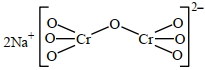
\(2 Na _{2} CrO _{4}+2 H ^{+} \rightarrow \underbrace{ Na _{2} Cr _{2} O _{7}}_{ B }+2 Na ^{+}+ H _{2} O\)
- 45. The products obtained from a reaction of hydrogen peroxide and acidified potassium permanganate are 2022 Medium
- (A) \(Mn ^{4+}, H _{2} O\) only
- (B) \(Mn ^{2+}, H _{2} O\) only
- (C) \(Mn ^{4+}, H _{2} O , O _{2}\) only
- (D) \(Mn ^{2+}, H _{2} O , O _{2}\) only
Show answer and solution
Correct Answer: (D)
\(6 H ^{+}+2 MnO _{4}^{-}+5 H _{2} O _{2} \longrightarrow 2 Mn ^{+2}+8 H _{2} O +5 O _{2}\) - 46. The reaction of \(H _{2} O _{2}\) with potassium permanganate in acidic medium leads to the formation of mainly. 2022 Medium
- (A) \(Mn ^{2+}\)
- (B) \(Mn ^{4+}\)
- (C) \(Mn ^{3+}\)
- (D) \(Mn ^{6+}\)
Show answer and solution
Correct Answer: (A)
\(H _{2} O _{2}+ MnO _{4}^{-} \rightarrow Mn ^{2+}+ O _{2}\) \((unbalanced)\) -
- (A) \(3\)
- (B) \(30\)
- (C) \(0.3\)
- (D) \(56\)
Show answer and solution
Correct Answer: (A)
Most basic oxide is \(V _{2} O _{3}\)\(V ^{+3} \rightarrow\left[A_{ r }\right] 3 d ^{2}\)
\(\mu=\sqrt{2(2+2)}=2.84\, BM\)
\(\approx 3\)
- 48. Dichromate ion is treated with base, the oxidation number of \(Cr\) in the product formed is .... . 2021 Easy
- (A) \(3\)
- (B) \(4\)
- (C) \(5\)
- (D) \(6\)
Show answer and solution
Correct Answer: (D)
\(Cr _{2} O _{7}^{2-}+ OH ^{-} \longrightarrow CrO _{4}^{2-}\)Oxidation state of \(Cr\) in \(CrO _{4}^{2-}\) is \(+6\)
-
- (A) Statement \(I\) is true but statement \(II\) is false
- (B) Both statement \(I\) and statement \(II\) are true
- (C) Statement \(I\) is false but statement \(II\) is true
- (D) Both statement \(I\) and statement \(II\) are false
Show answer and solution
Correct Answer: (A)
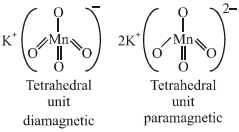
\(2 KMnO _{4} \stackrel{573 K }{\longrightarrow} K _{2} MnO _{4}+ MnO _{2}+ O _{2}\)Potassium Potassium
permanganate \(\quad\) manganate
Statement\(-I\) is correct.
Statement\(-II\) is incorrect
-
- (A) \(170\)
- (B) \(173\)
- (C) \(181\)
- (D) \(141\)
Show answer and solution
Correct Answer: (B)
\(gm\) equi. of \(CrO _{4}^{2-}= S _{2} O _{3}^{2-}\)\(0.154 \times 3 \times v =0.25 \times 40 \times 8\)
\(v =173.16=173 \,ml\)

No questions on this page match these filters.
Other STD 12 - D and f- block elements topics
Frequently asked
How many Compounds of Transitional elements questions came in JEE Mains?
64 questions from 2013–2026, each with the correct answer and a full solution.
How difficult are Compounds of Transitional elements questions?
17% are easy, 44% medium and 39% hard.