


Topics
9 topics- 41Qs Work Done and Internal Energy
- 14Qs First Law of Thermodynamics
- 49Qs Adiabatic Process Most asked
- 7Qs Polytropic Process
- 8Qs Isothermal Process
- 9Qs Isobaric and Isochoric Processes
- 32Qs Heat Engine and Carnot Cycle
- 2Qs Second Law of Thermodynamics and Entropy
- 4Qs Refrigerator
All STD 11 - Thermodynamics questions
Newest firstShowing 1–50 of 166 questions
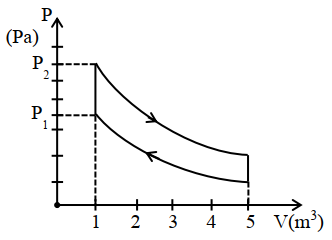
- 1. 10 mole of an ideal gas is undergoing the process shown in the figure. The heat involved in the process from \(P _1\) to \(P _2\) is \(\alpha\) Joule \(\left( P _1=21.7 Pa\right.\) and \(\left.P _2=30 Pa, C _{ v }=21 J / K . mol , R=8.3 J / mol . K \right)\). The value of \(\alpha\) is _________ .
 2026 Hard
- 2. 10 mole of oxygen is heated at constant volume from \(30^{\circ} C\) to \(40^{\circ} C\). The change in the internal energy of the gas is _________ cal. (The molecular specific heat of oxygen at constant pressure, \(C _{ p }=7 cal . / mol ^{\circ} C\) and \(\left.R =2 cal . / mol ^{\circ} C .\right)\) 2026 Medium
- 3. A certain gas is isothermally compressed to \(\left(\dfrac{1}{3}\right)^{rd}\) of its initial volume (\(V_o = 3\) litre) by applying required pressure. If the bulk modulus of the gas is \(3 \times 10^5\) N/m\(^2\), the magnitude of work done on the gas is _______ J. 2026 Hard
- 4. A cylinder with adiabatic walls is closed at both ends and is divided into two compartments by a frictionless adiabatic piston. Ideal gas is filled in both (left and right) the compartments at same \(P, V, T\). Heating is started from left side until pressure changes to \(\dfrac{27P}{8}\). If initial volume of each compartment was \(9\) litres then the final volume in right-hand side compartment is __________ litres. (for this ideal gas \(C_P/C_V = 1.5\)) 2026 Hard
- 5. A diatomic gas \((\gamma=1.4)\) does 100 J of work when it is expanded isobarically. Then the heat given to the gas _________ J. 2026 Easy
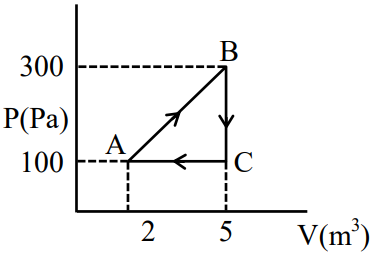
- 6. A thermodynamic system is taken through the cyclic process ABC as shown in the figure (P-V graph : A(2, 100), B(5, 300), C(5, 100). The total work done by the system during the cycle ABC is ___________ J.
 2026 Medium
- 7. A vessel contains \(0.15\) m\(^3\) of a gas at pressure \(8\) bar and temperature \(140°\)C with \(c_p = 3R\) and \(c_v = 2R\). It is expanded adiabatically till pressure falls to \(1\) bar. The work done during this process is _______ kJ. (\(R\) is gas constant) 2026 Hard
- 8. An ideal gas undergoes a process maintaining relation between pressure \((P)\) and volume \((V)\) as \(P = P_o\left(1 + \left(\dfrac{V_o}{V}\right)^2\right)^{-1}\), where \(P_o\) and \(V_o\) are constants. If two samples \(A\) and \(B\) (two moles each) with initial volumes \(V_o\) and \(3V_o\) respectively undergo above mentioned process and attain same pressure, then the difference at the temperatures of these samples, \(T_B - T_A\) is _____. (\(R = \) gas constant) 2026 Hard
- 9. Consider the following statements:
A. Zeroth law of thermodynamics gives concept of temperature
B. First law of thermodynamics gives concept of internal energy
C. In isothermal expansion of ideal gas, \(\Delta Q \neq \Delta W\)
D. Product of intensive and extensive variables is extensive
E. The ratio of any extensive variable to mass will be an extensive variable
Choose the correct combination of statements from the options given below: 2026 Medium - 10. Density of water at \(4^{\circ} C\) and \(20^{\circ} C\) are \(1000 kg / m ^3\) and respectively. The increase in internal energy of 4 kg water when it is heated from \(4{ }^{\circ} C\) to \(20^{\circ} C\) is _________ J.
(Specific heat capacity of water \(=4.2 KJ / kg\). and 1 atmospheric pressure \(=10^5 Pa\) ) 2026 Hard - 11. Given below are two statements: one is labelled as Assertion A and the other is labelled as Reason R
Statement I: Change in internal energy of a system containing \(n\) mole of ideal gas can be written as \(\Delta U = n C_v (T_f - T_i) = \dfrac{nR}{\gamma - 1}(T_f - T_i)\), where \(\gamma = \dfrac{C_p}{C_v}\), \(T_i =\) initial temperature, \(T_f =\) final temperature.
Statement II: Relation between degree of freedom \(f\) and \(\gamma (= C_p/C_v)\) is \(\left(\gamma = 1 + \dfrac{2}{f}\right)\)
Choose the correct answer from the options given below 2026 Medium - 12. Heat is supplied to a diatomic gas at constant pressure. Then the ratio of \(\Delta Q : \Delta U : \Delta W\) is _______. 2026 Medium
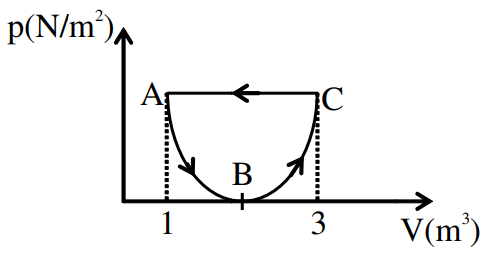
- 13. In the following \(p-V\) diagram the equation of state along the curved path is given by \((V-2)^2=4\) ap where \(a\) is a constant. The total work done in the closed path is
 2026 Medium
- 14. Initial pressure and volume of a monoatomic ideal gas are \(P\) and \(V\). The change in internal energy of this gas in adiabatic expansion to volume \(V_{final}=27V\) is ________ J. 2026 Medium
- 15. One mole of an ideal diatomic gas expands from volume V to 2 V isothermally at a temperature \(27^{\circ} C\) and does W joule of work. If the gas undergoes same magnitude of expansion adiabatically from \(27^{\circ} C\) doing the same amount of work W , then its final temperature will be (close to) ___________ \({ }^{\circ} C\). 2026 Hard
- 16. One mole of diatomic gas having rotational modes only is kept in a cylinder with a piston system. The cross-section area of the cylinder is \(4\) cm\(^2\). The gas is heated slowly to raise the temperature by \(1.2\,^\circ\)C during which the piston moves by \(25\) mm. The amount of heat supplied to the gas is ________ J. (Atmospheric pressure \(=100\) kPa, \(R=8.3\) J/mol·K) (Neglect mass of the piston) 2026 Hard
- 17. The internal energy of a monoatomic gas is 3 nRT . One mole of helium is kept in a cylinder having internal cross section area of \(17 cm^2\) and fitted with a light movable frictionless piston. The gas is heated slowly by suppling 126 J heat. If the temperature rises by \(4^{\circ} C\), then the piston will move ___________ cm.
(atmospheric pressure \(=10^5 Pa\) ) 2026 Medium - 18. The volume of an ideal gas increases 8 times and temperature becomes (1/4) of initial temperature during a reversible change. If there is no exchange of heat in this process (\( \Delta Q=0 \)) then identify the gas from the following options: 2026 Easy
- 19. A Carnot engine \((\mathrm{E})\) is working between two temperatures 473 K and 273 K . In a new system two engines - engine \(E_1\) works between 473 K to 373 K and engine \(E_2\) works between 373 K to 273 K .If \(\eta_{12}, \eta_1\) and \(\eta_2\) are the efficiencies of the engines \(E, E_1\) and \(E_2\), respectively, then 2025 Medium
- 20. A gas is kept in a container having walls which are thermally non-conducting. Initially the gas has a volume of \(800 \mathrm{~cm}^3\) and temperature \(27^{\circ} \mathrm{C}\). The change in temperature when the gas is adiabatically compressed to \(200 \mathrm{~cm}^3\) is :
(Take \(\gamma=1.5: \gamma\) is the ratio of specific heats at constant pressure and at constant volume) 2025 Medium - 21. A monoatomic gas having \(\gamma=\frac{5}{3}\) is stored in a thermally insulated container and the gas is suddenly compressed to \(\left(\frac{1}{8}\right)^{\text {th }}\) of its initial volume. The ratio of final pressure and initial pressure is: ( \(\gamma\) is the ratio of specific heats of the gas at constant pressure and at constant volume) 2025 Medium
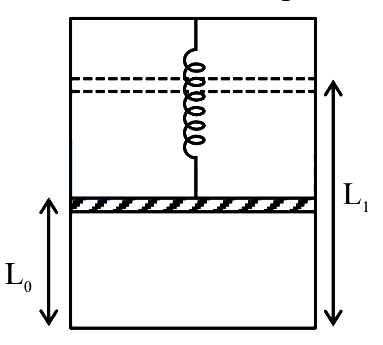
- 22. A piston of mass \(M\) is hung from a massless spring whose restoring force law goes as \(\mathrm{F}=-\mathrm{kx}^3\), where k is the spring constant of appropriate dimension. The piston separates the vertical chamber into two parts, where the bottom part is filled with ' \(n\) ' moles of an ideal gas. An external work is done on the gas isothermally (at a constant temperature T) with the help of a heating filament (with negligible volume) mounted in lower part of the chamber, so that the piston goes up from a height \(\mathrm{L}_0\) to \(\mathrm{L}_1\), the total energy delivered by the filament is (Assume spring to be in its natural length before heating)
 2025 Hard
- 23.
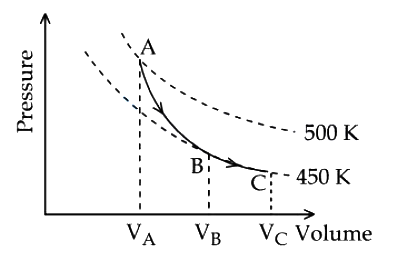
A poly-atomic molecule ( \(C_V=3 R, C_P=4 R\), where \(R\) is gas constant) goes from phase space point \(\mathrm{A}\left(\mathrm{P}_{\mathrm{A}}=10^5 \mathrm{~Pa}, \mathrm{~V}_{\mathrm{A}}=4 \times 10^{-6} \mathrm{~m}^3\right)\) to point \(\mathrm{B}\left(\mathrm{P}_{\mathrm{B}}=5 \times 10^4 \mathrm{~Pa}, \mathrm{~V}_{\mathrm{B}}=6 \times 10^{-6} \mathrm{~m}^3\right)\) to point \(\mathrm{C}\left(\mathrm{P}_{\mathrm{C}}=10^4\right.\) \(\left.\mathrm{Pa}, \mathrm{V}_{\mathrm{C}}=8 \times 10^{-6} \mathrm{~m}^3\right)\). A to B is an adiabatic path and \(B\) to \(C\) is an isothermal path. The net heat absorbed per unit mole by the system is : 2025 Hard - 24. An ideal gas exists in a state with pressure \(P_0\) volume \(\mathrm{V}_0\).It is isothermally expanded to 4 times of its initial volume \(\left(\mathrm{V}_0\right)\), then isobarically compressed to its original volume. Finally the system is heated isochorically to bring it to its initial state. The amount of heat exchanged in this process is : 2025 Medium
- 25. An ideal gas goes from an initial state to final state. During the process, the pressure of gas increases linearly with temperature.
A. The work done by gas during the process is zero.
B. The heat added to gas is different from change in its internal energy.
C. The volume of the gas is increased.
D. The internal energy of the gas is increased.
E. The process is isochoric (constant volume process)
Choose the correct answer from the options given below: 2025 Easy - 26. An ideal gas has undergone through the cyclic process as shown in the figure. Work done by the gas in the entire cycle is ______ \(\times 10^{-1} \mathrm{~J}\).
(Take \(\pi=3.14\))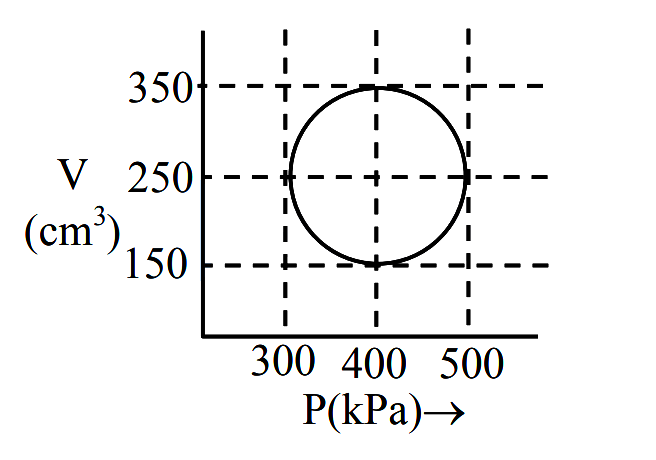 2025 Medium
- 27. An ideal gas initially at \(0^{\circ} \mathrm{C}\) temperature, is compressed suddenly to one fourth of its volume. If the ratio of specific heat at constant pressure to that at constant volume is \(3 / 2\), the change in temperature due to the thermodynamic process is _____ K. 2025 Medium
- 28. During the melting of a slab of ice at 273 K at atmospheric pressure : 2025 Easy
- 29. Given are statements for certain thermodynamic variables,
(A) Internal energy, volume (V) and mass (M) are extensive variables.
(B) Pressure (P), temperature (T) and density ( \(\rho\) ) are intensive variables.
(C) Volume (V), temperature (T) and density ( \(\rho\) ) are intensive variables.
(D) Mass (M), temperature (T) and internal energy are extensive variables.
Choose the correct answer from the options given below : 2025 Easy - 30. Given below are two statements. One is labelled as Assertion (A) and the other is labelled as Reason (R).
Assertion (A) : With the increase in the pressure of an ideal gas, the volume falls off more rapidly in an isothermal process in comparison to the adiabatic process.
Reason (R) : In isothermal process, \(\mathrm{PV}=\) constant, while in adiabatic process \(\mathrm{PV}^\gamma=\) constant. Here \(\gamma\) is the ratio of specific heats, P is the pressure and V is the volume of the ideal gas.
In the light of the above statements, choose the correct answer from the options given below : 2025 Medium - 31. Given below are two statements. One is labelled as Assertion (A) and the other is labelled as Reason (R).
Assertion (A) : In an insulated container, a gas is adiabatically shrunk to half of its initial volume. The temperature of the gas decreases.
Reason (R): Free expansion of an ideal gas is an irreversible and an adiabatic process.
In the light of the above statements, choose the correct answer from the options given below : 2025 Easy - 32. Identify the characteristics of an adiabatic process in a monoatomic gas.
(A) Internal energy is constant.
(B) Work done in the process is equal to the charge in internal energy.
(C) The product of temperature and volume is a constant.
(D) The product of pressure and volume is a constant.
(E) The work done to change the temperature from \(\mathrm{T}_1\) to \(\mathrm{T}_2\) is proportional to \(\left(\mathrm{T}_2-\mathrm{T}_1\right)\)
Choose the correct answer from the options given below : 2025 Medium - 33. In an adiabatic process, which of the following statements is true? 2025 Easy
- 34. Match List-I with List-II.
List-I List-II (A) Isothermal (I) \(\Delta W(\text{work done}) = 0\) (B) Adiabatic (II) \(\Delta Q(\text{supplied heat}) = 0\) (C) Isobaric (III) \(\Delta U(\text{change in internal energy}) \neq 0\) (D) Isochoric (IV) \(\Delta U = 0\)
Choose the correct answer from the options given below : 2025 Easy - 35. Match List-I with List-II.
LIST - I LIST - II (A) Isobaric (I) ΔQ = ΔW (B) Isochoric (II) ΔQ = ΔU (C) Adiabatic (III) ΔQ = zero (D) Isothermal (IV) ΔQ = ΔU + PΔV
\(\Delta \mathrm{Q}=\) Heat supplied
\(\Delta \mathrm{W}=\) Work done by the system
\(\Delta \mathrm{U}=\) Change in internal energy
\(\mathrm{P}=\) Pressure of the system
\(\Delta \mathrm{V}=\) Change in volume of the system
Choose the correct answer from the options given below: 2025 Easy - 36. Match the LIST-I with LIST-II
Choose the correct answer from the options given below: 2025 EasyLIST-I LIST-II A. Pressure varies inversely with volume of an ideal gas I. Adiabatic process B. Heat absorbed goes partly to increase internal energy and partly to do work II. Isochoric process C. Heat is neither absorbed nor released by a system III. Isothermal process D. No work is done on or by a gas IV. Isobaric process - 37. The magnitude of heat exchanged by a system for the given cyclic process ABCA (as shown in figure) is (in SI unit) :
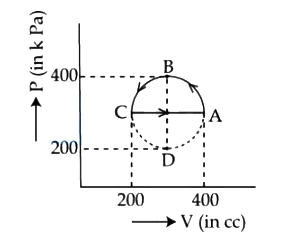
2025 Hard - 38. The temperature of 1 mole of an ideal monoatomic gas is increased by \(50^{\circ} \mathrm{C}\) at constant pressure. The total heat added and change in internal energy are \(E_1\) and \(E_2\), respectively. If \(\frac{E_1}{E_2}=\frac{x}{9}\) then the value of \(x\) is _____ 2025 Hard
- 39. The workdone in an adiabatic change in an ideal gas depends upon only : 2025 Easy
- 40.
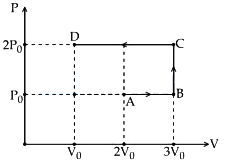
Using the given \(\mathrm{P}-\mathrm{V}\) diagram, the work done by an ideal gas along the path ABCD is : 2025 Easy - 41. Water of mass \(m\) gram is slowly heated to increase the temperature from \(T_1\) to \(T_2\) The change in entropy of the water, given specific heat of water is \(1 \mathrm{Jkg}^{-1} \mathrm{~K}^{-1}\), is : 2025 Medium
- 42. \(0.08 \mathrm{~kg}\) air is heated at constant volume through \(5^{\circ} \mathrm{C}\). The specific heat of air at constant volume is \(0.17 \mathrm{kcal} / \mathrm{kg}^{\circ} \mathrm{C}\) and \(\mathrm{J}=4.18\) joule \(/ \mathrm{cal}\). The change in its internal energy is approximately. 2024 Hard
- 43. A diatomic gas \((\gamma=1.4)\) does \(200 \mathrm{~J}\) of work when it is expanded isobarically. The heat given to the gas in the process is _______. 2024 Hard
- 44. A gas mixture consists of \(8\) moles of argon and \(6\) moles of oxygen at temperature \(T\). Neglecting all vibrational modes, the total internal energy of the system is _______. 2024 Hard
- 45. A real gas within a closed chamber at \(27^{\circ} \mathrm{C}\) undergoes the cyclic process as shown in figure. The gas obeys \(P V^3=\mathrm{RT}\) equation for the path \(A\) to \(B\). The net work done in the complete cycle is _______.(assuming \(R=8 \mathrm{~J} / \mathrm{molK}\) ) 2024 Hard
- 46. A sample of \(1\) mole gas at temperature \(\mathrm{T}\) is adiabatically expanded to double its volume. If adiabatic constant for the gas is \(\gamma=\frac{3}{2}\), then the work done by the gas in the process is _______. 2024 Hard
- 47. A sample of gas at temperature \(\mathrm{T}\) is adiabatically expanded to double its volume. Adiabatic constant for the gas is \(\gamma=3 / 2\). The work done by the gas in the process is _______. \((\mu=1 \mathrm{~mole})\) 2024 Hard
- 48. A thermodynamic system is taken from an original state \(A\) to an intermediate state \(B\) by a linear process as shown in the figure. It's volume is then reduced to the original value from \(B\) to \(C\) by an isobaric process. The total work done by the gas from \(A\) to \(B\) and \(B\) to \(C\) would be :
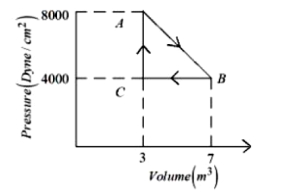 2024 Hard
- 49. A total of \(48 \mathrm{~J}\) heat is given to one mole of helium kept in a cylinder. The temperature of helium increases by \(2^{\circ} \mathrm{C}\). The work done by the gas is _______. (Given, \(\mathrm{R}=8.3 \mathrm{~J} \mathrm{~K}^{-1} \mathrm{~mol}^{-1}\).) 2024 Hard
- 50. Choose the correct statement for processes \(A\) & \(B\) shown in figure.
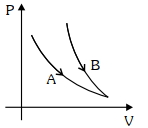 2024 Hard
No questions on this page match these filters.
Frequently asked
How many STD 11 - Thermodynamics questions came in JEE Mains?
166 questions from 2013–2026, each with the correct answer and a full solution.
Which STD 11 - Thermodynamics topic is asked the most?
Adiabatic Process, with 49 questions, followed by Work Done and Internal Energy with 41.
How difficult are STD 11 - Thermodynamics questions?
11% are easy, 56% medium and 33% hard.