


Questions
31 questionsShowing 1–31 of 31 questions
-
- (A) \(40\)
- (B) \(45\)
- (C) \(80\)
- (D) \(90\)
Show answer and solution
Correct Answer: (A)
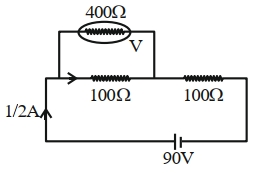
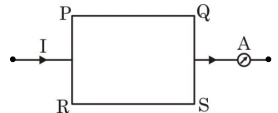
\(R _{ eq }=\frac{400 \times 100}{500}+100\)\(=180\,\Omega\)
\(i =\frac{90}{180}=\frac{1}{2}\,A\)
\(\text { Reading }=\frac{1}{2} \times \frac{400}{500} \times 100\)
\(=40\,volt\)
-
- (A) helical path with the axis perpendicular to the direction of magnetic field \(B\)
- (B) straight along the direction of magnetic field \(B\)
- (C) helical path with the axis along magnetic field \(B\)
- (D) circular path
Show answer and solution
Correct Answer: (C)
Due to component \(v_1\),magnetic force \(F = qv _1 B \sin \theta=0\)
So \(v _1\) remains unchanged
but due to component \(v_2\) magnetic force act towards centre i.e. moving it circular. So path is helical with the axis parallel to magnetic field \(B\).

-
- (A) \(142\)
- (B) \(144\)
- (C) \(141\)
- (D) \(140\)
Show answer and solution
Correct Answer: (B)
\(=\frac{m v}{q B}=\frac{\sqrt{2 k m}}{q B}, m=\frac{r^2 q^2 B^2}{2 k}\)\(m = \frac{\frac{1}{100} \times \frac{3}{100} \times 2 \times 2 \times 4 \times 10^{-3} \times 4 \times 10^{-3} \times 10^{-12}}{2 \times(100) \times 10^{-6}}\)
\(=144 \times 10^{-18}\,kg\)
-
- (A) \(1: 3 \sqrt{2}\)
- (B) \(3 \sqrt{2}: 2\)
- (C) \(2 \sqrt{2}: 1\)
- (D) \(1: \sqrt{2}\)
Show answer and solution
Correct Answer: (C)
Magnetic field due to current carrying circular loop on its axis is given as\(\frac{\mu_0 ir ^2}{2\left( r ^2+ x ^2\right)^{3 / 2}}\)
At centre, \(x=0, B_1=\frac{\mu_0 i }{2 r }\)
At \(x=r, B_2=\frac{\mu_0 i}{2 \times 2 \sqrt{2 r}}\)
\(\frac{ B _1}{ B _2}=2 \sqrt{2}\)
-
- (A) \(1: 2\)
- (B) \(1: 4\)
- (C) \(1: 5\)
- (D) \(1: 3\)
Show answer and solution
Correct Answer: (B)
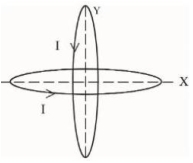
\(F \propto I _1 I _2\)\(F _{ I }: F _{2 I }=1: 4\)
-
- (A) \(1232\)
- (B) \(176\)
- (C) \(352\)
- (D) \(88\)
Show answer and solution
Correct Answer: (B)
\(B =\mu_0 nI\)\(=4 \pi \times 10^{-7} \times 70 \times 10^2 \times 2\)
\(=56 \pi \times 10^{-4}\,T\)
\(=176 \times 10^{-4}\,T\)
-
- (A) Zero in the region \(r < a\) and inversely proportional to \(r\) in the region \(r > a\)
- (B) Inversely proportional to \(r\) in the region \(r < a\) and uniform throughout in the region \(r > a\)
- (C) Directly proportional to \(r\) in the region \(r < a\) and inversely proportional to \(r\) in the region \(r > a\)
- (D) Uniform in the region \(r < a\) and inversely proportional to distance \(r\) from the axis, in the region \(r > a\)
Show answer and solution
Correct Answer: (C)
\(B = \begin{cases}\frac{\mu_0 Ir }{\pi a ^2} & r \leq a \\ \frac{\mu_0 I }{\pi r ^2} & r \geq a \end{cases}\) -
- (A) \(\frac{1}{10}\,V\)
- (B) \(1\,V\)
- (C) \(100\,V\)
- (D) \(10\,V\)
Show answer and solution
Correct Answer: (D)
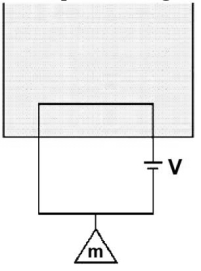
\(F _{ m }= mg\)\(\therefore \quad ILB = mg\)
\(\therefore \quad\left(\frac{ V }{ R }\right) LB = mg\)
\(\therefore \quad V =\frac{ mgR }{ LB }\)
\(=\frac{\left(1 \times 10^{-3}\,kg \right)\left(10\,m / s ^2\right)(10 \Omega)}{(0.1\,m )\left(10^3 \times 10^{-4}\,T \right)}=10\,V\)
-
- (A) \(38\)
- (B) \(41\)
- (C) \(40\)
- (D) \(42\)
Show answer and solution
Correct Answer: (C)
\(B=\frac{\pi}{2} \times 10^{-3}\)\(K E=\frac{1}{2} m V^2\)
\(\Rightarrow V=\sqrt{\frac{2 K E}{m}}\)
\(=v \cos 60^{\circ} \times \frac{2 \pi m}{e B}\)
\(=\sqrt{\frac{2 \times 2 \times 1.6 \times 10^{-19}}{1.6 \times 10^{-27}}} \times \cos 60^{\circ} \times \frac{2 \pi \times 1.6 \times 10^{-27}}{1.6 \times 10^{-19} \times \frac{\pi}{2} \times 10^{-3}}\)
\(=2 \times 10^4 \times \frac{1}{2} \times 4 \times 10^{-5}\)
\(=4 \times 10^{-1} m =40\,cm\)
-
- (A) \(8\)
- (B) \(7\)
- (C) \(9\)
- (D) \(6\)
Show answer and solution
Correct Answer: (C)
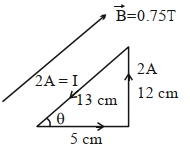
Force on \(5 cm\) side is\(|\overrightarrow{ F }|= ILB \sin \theta\)
\(=(2)\left(5 \times 10^{-2}\right) \times \frac{3}{4} \times \frac{12}{13}=\frac{9}{130}\,N\)
So, \(x=9\)
-
- (A) \(2.5\)
- (B) \(1.0\)
- (C) \(10\)
- (D) \(5\)
Show answer and solution
Correct Answer: (B)
\(\ell=50\,cm\)\(t =1\,sec\)
\(\therefore V =\frac{0.05}{1}=0.05\,m / s\)
\(i =\frac{40 \times 0.05 \times 0.05}{10}=0.01\,A\)
\(F = B { i } l=40 \times 0.01 \times 0.05\)
\(F =0.02\,N\)
\(\therefore \quad W =0.02 \times l=0.02 \times .05\)
\(\therefore \quad W =1 \times 10^{-3}\,J\)
-
- (A) \(4\)
- (B) \(2\)
- (C) \(6\)
- (D) \(8\)
Show answer and solution
Correct Answer: (B)
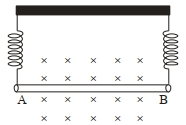
For equilibrium\(Mg = I \ell B\)
\(I =\frac{ mg }{\ell B }=\frac{40 \times 10^{-3} \times 10}{50 \times 10^{-2} \times 0.4}=2\,A\)
-
- (A) \(4\)
- (B) \(6\)
- (C) \(2\)
- (D) \(8\)
Show answer and solution
Correct Answer: (C)
\(B _{\text {at } 0}=\frac{\mu_0 I }{4 R }=\frac{4 \pi \times 10^{-7} \times 14}{4 \times 2.2 \times 10^{-2}}\)\(=2 \times 10^{-4}\,T\)
-
- (A) \(40\)
- (B) \(50\)
- (C) \(30\)
- (D) \(20\)
Show answer and solution
Correct Answer: (A)
Magnetic field due to moving charge\(B =\frac{\mu_0}{4 \pi} \frac{ q \sin \theta}{ r ^2}\)
\(B =\frac{\mu_0}{4 \pi} \frac{ ev \sin (\pi / 2)}{ r ^2}\)
\(B =\frac{10^{-7} \times 1.6 \times 10^{-19} \times 6.76 \times 10^6}{0.52 \times 0.52 \times 10^{-20}}\)
\(B =40\,T\)
-
- (A) \(B, C\) and \(D\) only
- (B) \(B\) and \(C\) only
- (C) \(A\) and \(D\) only
- (D) \(B\) and \(E\) only
Show answer and solution
Correct Answer: (B)
\(\overrightarrow{ F }= q (\overrightarrow{ v } \times \overrightarrow{ B })\) as angle between \(\overrightarrow{ v }\) and \(\overrightarrow{ B }\) is \(0^{\circ}\)\(\overrightarrow{ F }=0\)
-
- (A) \(B\) and \(E\) only
- (B) \(A\) and \(E\) only
- (C) \(C\) and \(D\) only
- (D) \(B\) and \(D\) only
Show answer and solution
Correct Answer: (A)
\(\overrightarrow{ F }=- e (\overrightarrow{ v } \times \overrightarrow{ B })\)Force will be along \(-ve\) \(y-\)axis.
As magnetic force is \(\perp\) to velocity, path of electron must be a circle.
-
- (A) \(4 \sqrt{3} \times 10^{-4} \,T\)
- (B) \(4 \sqrt{3} \times 10^{-5} \,T\)
- (C) \(\sqrt{3} \times 10^{-4}\, T\)
- (D) \(3 \sqrt{3} \times 10^{-5}\,T\)
Show answer and solution
Correct Answer: (D)
\(d \tan 60^{\circ}=2 \sqrt{3}\)\(d =2\,cm\)
\(B =3 \times \frac{\mu_0 i }{2 \pi d } \sin 60^{\circ}\)
\(=3 \times \frac{2 \times 10^{-7} \times 2}{2 \times 10^{-2}} \times \frac{\sqrt{3}}{2}\) \(=3 \sqrt{3} \times 10^{-5}\)
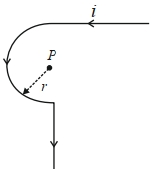
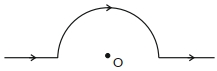
- 18. Find the magnetic field at the point \(P\) in figure. The curved portion is a semicircle connected to two long straight wires.
 2023 Medium
- (A) \(\frac{\mu_0 i}{2 r}\left(1+\frac{2}{\pi}\right)\)
- (B) \(\frac{\mu_0 i}{2 r}\left(1+\frac{1}{\pi}\right)\)
- (C) \(\frac{\mu_0 i}{2 r}\left(\frac{1}{2}+\frac{1}{2 \pi}\right)\)
- (D) \(\frac{\mu_0 i}{2 r}\left(\frac{1}{2}+\frac{1}{\pi}\right)\)
Show answer and solution
Correct Answer: (C)
\(B_{ P }=\left(\frac{\mu_0 i}{4 r}+\frac{\mu_0 i}{4 \pi r}\right)=\frac{\mu_0 i}{2 r}\left(\frac{1}{2}+\frac{1}{2 \pi}\right)\) -
- (A) \(2\)
- (B) \(1\)
- (C) \(1.5\)
- (D) \(0.5\)
Show answer and solution
Correct Answer: (B)
\(\tau= K \theta\)\(NiAB = K \theta\)
\(A =\frac{ K \theta}{ NiB }=\frac{4 \times 10^{-5} \times 0.05}{200 \times 10 \times 10^{-3} \times 0.01}\)
On solving \(A =10^{-4}\,m ^2=1\,cm ^2\)
-
- (A) \((C)\) and \((E)\)
- (B) \((C)\) and \((D)\)
- (C) \((A)\) and \((C)\)
- (D) \((A)\) and \((B)\)
Show answer and solution
Correct Answer: (C)
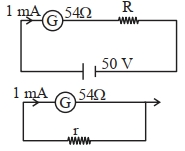
For voltmeter\(R =\frac{ V }{ I _{ g }}- G\)
\(=\frac{50}{10^{-3}}-54 \approx 50\,k \Omega\)
For ammeter
\(S=\frac{I_g G}{I-I_g}=\frac{10^{-3} \times 54}{(10-1) \times 10^{-3}}=6 \Omega( C )\)
-
- (A) Statement \(I\) is false but Statement \(II\) is true
- (B) Both Statement \(I\) and Statement \(II\) are true
- (C) Both Statement \(I\) and Statement \(II\) are false
- (D) Statement \(I\) is true but Statement \(II\) is false
Show answer and solution
Correct Answer: (D)
For a moving coil galvanometer\(\text { BiNA }= k \theta\)
\(\theta=\left(\frac{ BNA }{ k }\right) i ; \text { Current sensitive }=\frac{ BNA }{ k }\)
So, if \(N\) is doubled then current sensitivity is doubled.
Voltage sensitivity
\(B \frac{ V }{ R } NA = k \theta\)
\(V =\frac{ BNA }{ Rk } \theta, \text { as } N \text { is doubled } R \text { is also doubled. }\)
So, no change in voltage sensitivity.
-
- (A) \(A\) is not correct but \(R\) is correct
- (B) Both \(A\) and \(R\) are correct and \(R\) is the correct explanation of \(A\)
- (C) Both \(A\) and \(R\) are correct but \(R\) is not the correct explanation of \(A\)
- (D) \(A\) is correct but \(R\) is not correct
Show answer and solution
Correct Answer: (A)
Error of voltmeter decreases with increase in its resistance. - 23. Math List \(I\) with List \(II\) Choose the correct answer from the option given below:
 2023 Medium
- (A) \(A-III, B-IV, C-I, D-II\)
- (B) \(A-I, B-III, C-IV, D-II\)
- (C) \(A-III, B-I, C-IV, D-II\)
- (D) \(A-II, B-I, C-IV, D-III\)
Show answer and solution
Correct Answer: (C)
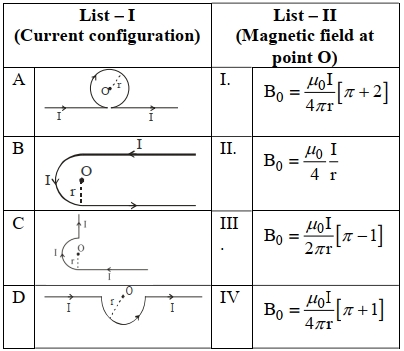
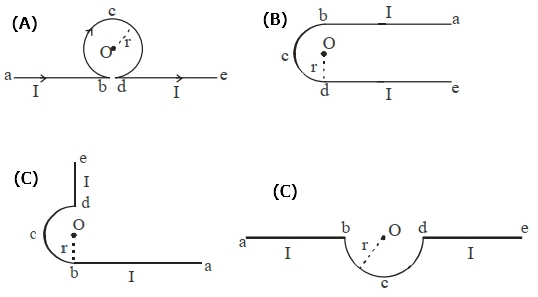
(A)\(B _{ ab }=\frac{\mu_0}{4 \pi} \frac{ I }{ r } \text { (out of the plane) }\)
\(B _{ bcd }=\frac{\mu_0}{4 \pi} \frac{ I }{ r }(2 \pi) \text { (in the plane) }\)
\(B _{ de }=\frac{\mu_0}{4 \pi} \frac{ I }{ r } \text { (out of the plane) }\)
Hence magnetic field at \(O\) is
\(B _0=-\frac{\mu_0}{4 \pi} \frac{ I }{ r }+\frac{\mu_0}{4 \pi} \frac{ I }{ r }(2 \pi)-\frac{\mu_0}{4 \pi} \frac{ I }{ r }\)
\(B _0=\frac{\mu_0}{2 \pi} \frac{ I }{ r }(\pi-1) \ldots \ldots . . \text { (III) }\)
(B)
\(B _{ ab }=\frac{\mu_0}{4 \pi} \frac{ I }{ r } \text { (out of the plane) }\)
\(B _{ bcd }=\frac{\mu_0}{4 \pi} \frac{ I }{ r }(\pi) \text { (out of the plane) }\)
\(B _{ de }=\frac{\mu_0}{4 \pi} \frac{ I }{ r } \text { (out of the plane) }\)
Hence magnetic field at \(O\) is
\(B _0=\frac{\mu_0}{4 \pi} \frac{ I }{ r }+\frac{\mu_0}{4 \pi} \frac{ I }{ r }(\pi)+\frac{\mu_0}{4 \pi} \frac{ I }{ r }\)
\(B _0=\frac{\mu_0}{4 \pi} \frac{ I }{ r }(\pi+2) \ldots .( I )\)
(C)
\(B _{ ab }=\frac{\mu_0}{4 \pi} \frac{ I }{ r } \text { (in the plane) }\)
\(B _{ bcd }=\frac{\mu_0}{4 \pi} \frac{ I }{ r }(\pi) \text { (in the plane) }\)
\(B _{ de }=0 \text { (at the axis) }\)
Hence magnetic field at \(O\) is
\(B _0=\frac{\mu_0}{4 \pi} \frac{ I }{ r }(1+\pi) \ldots(IV)\)
\(B _{ ab }=0 \text { (at the axis) }\)
\(B _{ bcd }=\frac{\mu_0}{4 \pi} \frac{ I }{ r }(\pi) \text { (out of the plane) }\)
\(B _{ de }=0 \text { (at the axis) }\)
Hence magnetic field at \(O\) is
\(B _0=\frac{\mu_0 I }{4 r } \ldots \text { (II) }\)
-
- (A) \(+25\)
- (B) \(-50\)
- (C) \(0\)
- (D) \(-25\)
Show answer and solution
Correct Answer: (A)
\(I _{ s }=\frac{ NBA }{ C } \& V _{ s }=\frac{ NBA }{ CG }\)\(\Rightarrow V_{ s }=\frac{I_s}{G}\), If \(G\) (galvanometer resistance) is constant, then \(V _{ S } \propto I_S\)
so percentage change in \(V_S\) is also \(25 \%\).
-
- (A) \(8\)
- (B) \(4\)
- (C) \(2\)
- (D) \(16\)
Show answer and solution
Correct Answer: (C)
\(B =\frac{\mu_0 i }{2 R } \times 4\)\(B ^{\prime}=\frac{\mu_0 i }{2 R ^{\prime}}\)
\(R ^{\prime}=4 R\)
\(B ^{\prime}=\frac{\mu_0 i }{8 R }\)
\(\frac{ B ^{\prime}}{ B ^{\prime}}=\frac{1}{16}\)
\(B ^{\prime}=2\,T\)
-
- (A) \(2 N _{ A } I _{ A }= N _{ B } I _{ B }\)
- (B) \(N _{ A }=2 N _{ B }\)
- (C) \(N _{ A } I _{ A }=4 N _{ B } I _{ B }\)
- (D) \(4 N _{ A } I _{ A }= N _{ B } I _{ B }\)
Show answer and solution
Correct Answer: (C)
\(M = NIA\)\(M _{ A }= M _{ B }\)
\(N _{ A } I _{ A } A _{ A }= N _{ B } I _{ B } A _{ B }\)
\(N _{ A } I _{ A } \pi(0.1)^2= N _{ B } I _{ B } \pi(0.2)^2\)
\(N _{ A } I _{ A }=4 N _{ B } I _{ B }\)
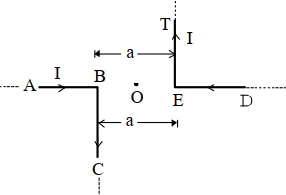
- 27. The magnitude of magnetic induction at mid-point \(O\) due to current arrangement as shown in Fig will be
 2023 Medium
- (A) \(\frac{\mu_0 I}{2 \pi a }\)
- (B) \(0\)
- (C) \(\frac{\mu_0 I }{4 \pi a }\)
- (D) \(\frac{\mu_0 I}{\pi a }\)
Show answer and solution
Correct Answer: (D)
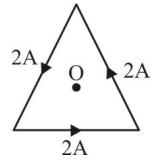
Magnetic field due to current in \(BC\) and \(ET\) are outward at point ' \(O\) '\(B _0=\frac{\mu_0 i }{4 \pi r }+\frac{\mu_0 i }{4 \pi r }=\frac{\mu_0 i }{2 \pi r }=\frac{\mu_0 i }{\pi a }\)
-
- (A) \(689\)
- (B) \(546\)
- (C) \(487\)
- (D) \(628\)
Show answer and solution
Correct Answer: (D)
\(\text { Magnetic field } B_C \text { at center }=\frac{\mu_0 i }{2 r }\)\(=\frac{4 \pi \times 10^{-7}}{2 \times 0.2} \times \sqrt{2}\,T\)
Net magnetic field is
\(B _{ C } \sqrt{2}= \frac{4 \pi \times 10^{-7} \times \sqrt{2}}{2 \times 0.2} \times \sqrt{2} T =2 \pi \times 10^{-6}\,T\)
\(=200 \pi \times 10^{-8}\,T\)
\(=2 \times 314 \times 10^{-8}\,T\)
\(=628 \times 10^{-8}\,T\)
-
- (A) \(65\)
- (B) \(68\)
- (C) \(66\)
- (D) \(67\)
Show answer and solution
Correct Answer: (B)
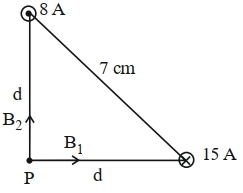
Magnetic fields due to both wires will be perpendicular to each other.\(B _1=\frac{\mu_0 i _1}{2 \pi d } \quad B _2=\frac{\mu_0 i _2}{2 \pi d }\)
\(B _{\text {net }}=\sqrt{ B _1^2+ B _2^2} \Rightarrow \frac{\mu_0}{2 \pi d } \sqrt{ i _1^2+ i _2^2}\)
\(\Rightarrow \frac{4 \pi \times 10^{-7}}{2 \pi \times(7 / \sqrt{2}) \times 10^{-2}} \times \sqrt{8^2+15^2}\left( d =\frac{7}{\sqrt{2}}\,cm \right)\)
\(\Rightarrow 68 \times 10^{-6}\,T\)
-
- (A) \(8 F_1\)
- (B) \(10 F_1\)
- (C) \(F_1 / 8\)
- (D) \(F_1 / 10\)
Show answer and solution
Correct Answer: (A)
Force per unit length between two parallel straight\(\text { wires }=\frac{\mu_0 i_1 i_2}{2 \pi d }\)
\(\frac{ F _1}{ F _2}=\frac{\frac{\mu_0(10)^2}{2 \pi(5\,cm )}}{\frac{\mu_0(20)^2}{2 \pi\left(\frac{5 cm }{2}\right)}}=\frac{1}{8}\)
\(\Rightarrow F_2=8 F_1\)
-
- (A) \(40\)
- (B) \(30\)
- (C) \(50\)
- (D) \(20\)
Show answer and solution
Correct Answer: (C)
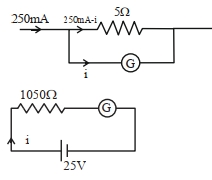
\(\frac{250\,mA \times 5}{5+R_G}=i \dots(i)\)\(i=\frac{25}{1050+R_G} \dots(ii)\)
From \((i)\) and \((ii)\)
\(\frac{25}{1050+R_G}=\frac{5}{4\left(5+R_G\right)}\)
\(100\left(5+R_G\right)=1050 \times 5+R_G \times 5\)
\(95 R_G=4750\)
\(R_G=50\,\Omega\)
No questions on this page match these filters.