


Topics
4 topics- 12Qs Structural isomerism
- 13Qs Optical isomerism Most asked
- 7Qs Conformational isomerism
- 8Qs Geometrical isomerism
All Organic chemistry isomerism questions
Newest firstShowing 1–40 of 40 questions
-
- (A) 52
- (B) 56
- (C) 46
- (D) 40
Show answer and solution
Correct Answer: (A)
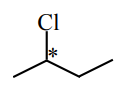 2-Chlorobutane is optically active and chiral molecule
Molecular formula \(\Rightarrow C _4 H _9 Cl\)
Molar mass \(=48+9+35.5=92.5\)
\(\% OC =\frac{48}{92.5} \times 100=51.89 \%\) -
- (A) Both Statement I and Statement II are true
- (B) Both Statement I and Statement II are false
- (C) Statement I is true but Statement II is false
- (D) Statement I is false but Statement II is true
Show answer and solution
Correct Answer: (C)
Statement I: Metamerism arises due to different alkyl chains on either side of a polyvalent functional group. In ketones, the carbonyl group (\(>C=O\)) acts as the polyvalent functional group. In \(2,6\)-diethylcyclohexanone, the alkyl groups attached to the \(\alpha\)-carbons are two ethyl groups. In \(6\)-methyl-\(2\)-n-propylcyclohexanone, the alkyl groups are a methyl group and an n-propyl group. Since the alkyl groups around the carbonyl group are different while the molecular formula remains the same, they are metamers. Thus, Statement I is true.
Statement II: For a ketone to exhibit keto-enol tautomerism, it must have at least one \(\alpha\)-hydrogen atom. In \(2,2,6,6\)-tetramethylcyclohexanone, the \(\alpha\)-carbons (C\(2\) and C\(6\)) are bonded to two methyl groups each. Since there are no \(\alpha\)-hydrogen atoms present, it cannot undergo keto-enol tautomerism. Thus, Statement II is false.
Answer: Statement I is true but Statement II is false -
- (A) Both Statement I and Statement II are false
- (B) Statement I is false but Statement II is true
- (C) Statement I is true but Statement II is false
- (D) Both Statement I and Statement II are true
Show answer and solution
Correct Answer: (D)
Both Statements are correct. -
- (A) B, C and D only
- (B) A, B and C only
- (C) A, B and E only
- (D) C, D and E only
Show answer and solution
Correct Answer: (C)
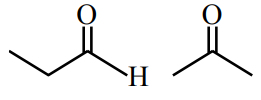 are Functional isomer
\(CH _3- CH = CH - CH _3 \& CH _3- CH _2- CH = CH _2\)
Are Positional isomer
\(CH _3- CH _2- O - CH _2- CH _3 \& CH _3- CH _2- CH _2- O - CH _3\)
are Metamer
\(CH _3- CH = CH - CH _3\) does not have optical isomer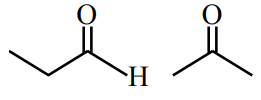 Chain isomer
-
- (A) A-III, B-I, C-IV, D-II
- (B) A-III, B-I, C-II, D-IV
- (C) A-I, B-IV, C-III, D-II
- (D) A-II, B-I, C-IV, D-III
Show answer and solution
Correct Answer: (A)
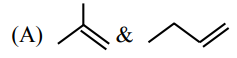
(III) Chain isomer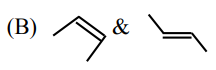
(I) Streoisomers
(IV) Functional isomers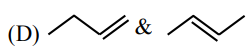
(II) Positional isomers -
- (A) \(3\)
- (B) \(4\)
- (C) \(5\)
- (D) \(6\)
Show answer and solution
Correct Answer: (B)
The structure of n-butane is \(CH_3-CH_2-CH_2-CH_3\).
Monochlorination of n-butane gives two structural isomers: 1-chlorobutane and 2-chlorobutane.
Among these, 2-chlorobutane (\(CH_3-CH_2-C^{*}HCl-CH_3\)) contains a chiral carbon atom and is optically active. Thus, the optically active compound "P" is 2-chlorobutane.
Further chlorination of 2-chlorobutane can take place at any of the four carbon atoms, yielding the following dichloro compounds (ignoring stereoisomers):
1. Chlorination at C-1: \(CH_3-CH_2-CHCl-CH_2Cl\) (1,2-dichlorobutane)
2. Chlorination at C-2: \(CH_3-CH_2-CCl_2-CH_3\) (2,2-dichlorobutane)
3. Chlorination at C-3: \(CH_3-CHCl-CHCl-CH_3\) (2,3-dichlorobutane)
4. Chlorination at C-4: \(CH_2Cl-CH_2-CHCl-CH_3\) (1,3-dichlorobutane)
Therefore, 4 structurally distinct dichloro compounds are obtained.
Answer: \(4\) -
- (A) enantiomers.
- (B) identical molecules.
- (C) diastereomers.
- (D) meso compounds.
Show answer and solution
Correct Answer: (B)
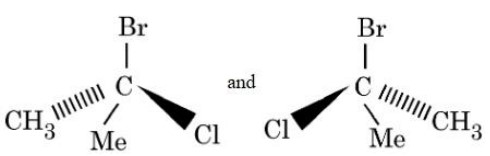
The given structures have a central carbon atom bonded to four groups: \(-\text{Br}\), \(-\text{Cl}\), \(-\text{CH}_3\), and \(-\text{Me}\).
Since \(-\text{CH}_3\) and \(-\text{Me}\) both represent the same alkyl group (methyl), the central carbon atom is bonded to two identical groups.
For a carbon atom to be a chiral center, it must be bonded to four different groups. Because this condition is not met, the central carbon is not a stereocenter and the molecule is achiral.
Both structures represent the same achiral compound (2-bromo-2-chloropropane) drawn in slightly different orientations. Therefore, they are identical molecules.
Answer: identical molecules. -
- (A) Both Statement (I) and Statement (II) are false.
- (B) Both Statement (I) and Statement (II) are true.
- (C) Statement (I) is false but Statement (II) is true.
- (D) Statement (I) is true but Statement (II) is false.
Show answer and solution
Correct Answer: (B)
Explanation:
Let us evaluate the truthfulness of both statements based on the principles of organic isomerism:
1. Analysis of Statement (I):
Methylcyclopentane is a cyclic alkane containing a total of 6 carbon atoms, giving it the molecular formula \( \text{C}_6\text{H}_{12} \). Hex-3-ene is an open-chain alkene with one double bond and 6 carbon atoms, which also gives it the molecular formula \( \text{C}_6\text{H}_{12} \). Since they share the same molecular formula but possess different skeletal connectivity (ring vs. open chain), they are valid ring-chain isomers. Thus, Statement (I) is true.
2. Analysis of Statement (II):
Pentan-1-amine \( (\text{CH}_3\text{CH}_2\text{CH}_2\text{CH}_2\text{CH}_2\text{NH}_2) \) is a primary \( (1^\circ) \) amine with the molecular formula \( \text{C}_5\text{H}_{13}\text{N} \). N-methylbutan-1-amine \( (\text{CH}_3\text{CH}_2\text{CH}_2\text{CH}_2\text{NHCH}_3) \) is a secondary \( (2^\circ) \) amine, which also shares the exact same molecular formula \( \text{C}_5\text{H}_{13}\text{N} \). In organic chemistry, primary, secondary, and tertiary amines containing the same molecular formula are classified as functional group isomers because they contain different functional environments. Thus, the corrected Statement (II) is true.
Hence, Option B is the correct choice. - 9. Identify the correct statements from the following
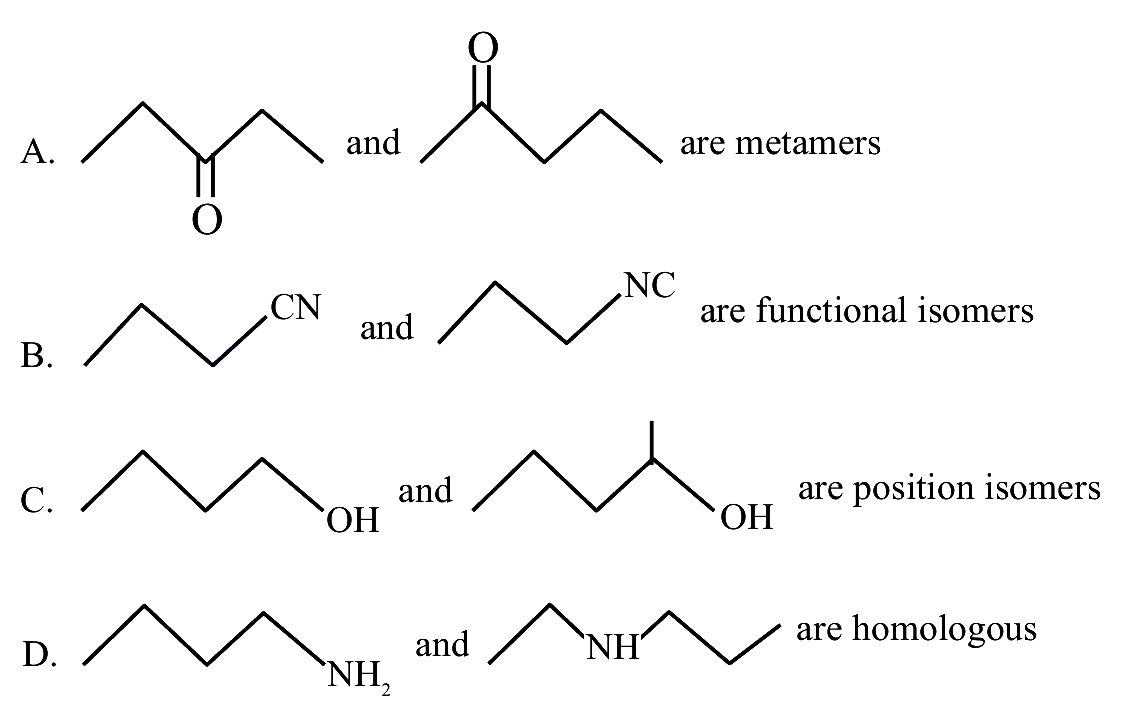
Choose the correct answer from the options given below. 2025 Medium- (A) C & D only
- (B) B & C only
- (C) A & B only
- (D) A,B & C only
Show answer and solution
Correct Answer: (C)
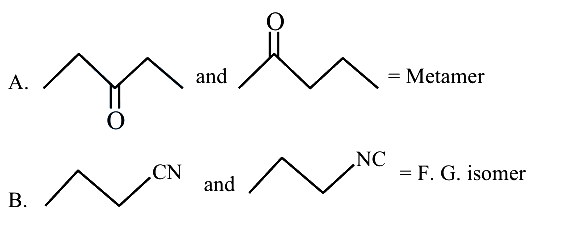
In option C are momologoes to each - other and option D are only organic molecule not isomers. -
- (A) 4
- (B) 6
- (C) 8
- (D) 10
Show answer and solution
Correct Answer: (C)
Since 4 moles of \(\mathrm{H}_2\) is being added for complete hydrogenation the degree of unsaturation \(=4\)
No. of \(\pi\) electrons in \(\mathrm{C}_6 \mathrm{H}_6=4 \times 2=8\) -
- (A) 9
- (B) 6
- (C) 3
- (D) 2
Show answer and solution
Correct Answer: (C)
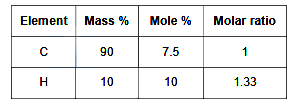
\(\therefore\) Empirical formula is \(\mathrm{C}_3 \mathrm{H}_4\)
Molecular mass \(=80 \mathrm{~g} \mathrm{~mol}^{-1}\).
Molecular formula \(=\left(\mathrm{C}_3 \mathrm{H}_4\right)_{\mathrm{n}}\)
\(\mathrm{n}=\frac{\text { Molecular mass }}{\mathrm{EF} \text { mass }}=\frac{80}{40}=2\)
\(\therefore\) Molecular formula is \(\mathrm{C}_6 \mathrm{H}_8\)
Degree of unsaturation \(=\frac{2 \times 6+2-8}{2}=3\) -
- (A) (A) and (E) Only
- (B) (A), (D) and (E) Only
- (C) (B) and (C) Only
- (D) (C), (D) and (E) Only
Show answer and solution
Correct Answer: (B)
(A) \(\mathrm{CH}_3-\mathrm{CH}=\mathrm{CH}_2\). GI is not possible
(B) Trans isomer has identical atoms/groups on the opposite side of double bond.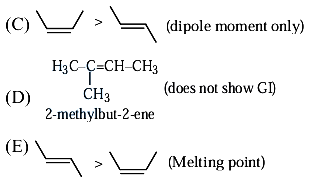
-
- (A) 5
- (B) 4
- (C) 3
- (D) 1
Show answer and solution
Correct Answer: (B)
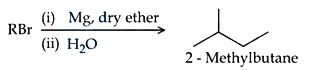
\(\mathrm{RBr} \xrightarrow[\text { dry Ether }]{\mathrm{Mg}} \mathrm{RMgBr} \xrightarrow{\mathrm{H}_2 \mathrm{O}} \mathrm{R}-\mathrm{H}\)
Hence, RBr Can be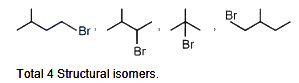
-
- (A) 2
- (B) 4
- (C) 6
- (D) 8
Show answer and solution
Correct Answer: (A)
\(\mathrm{FeCl}_3+\mathrm{KOH}+\mathrm{H}_2 \mathrm{SO}_4 \rightarrow \mathrm{~K}_3\left[\mathrm{Fe}\left(\mathrm{C}_2 \mathrm{O}_4\right)_3\right]\)
\(\Rightarrow\left[\mathrm{Fe}\left(\mathrm{C}_2 \mathrm{O}_4\right)_3\right]^{3-}\) is \(\left[\mathrm{M}(\mathrm{AA})_3\right]\) type complex.
So total optical isomers \(=2\) -
- (A) 6
- (B) 5
- (C) 4
- (D) 3
Show answer and solution
Correct Answer: (C)
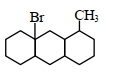
The given compound is 5-phenylpent-4-en-2-ol. Possible stereoisomers are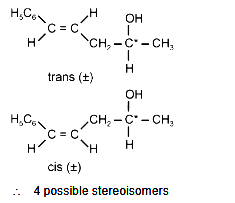
-
- (A) 8
- (B) 10
- (C) 12
- (D) 14
Show answer and solution
Correct Answer: (A)
\(\mathrm{MF}=\mathrm{C}_9 \mathrm{H}_{12}\)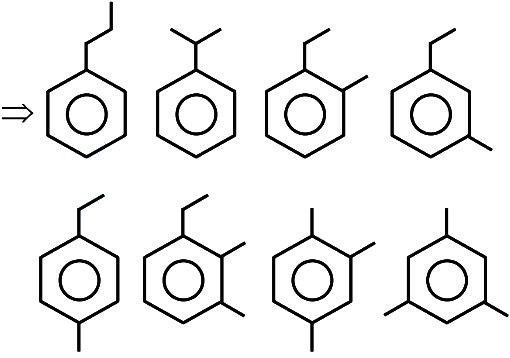
-
- (A) Both \((A)\) and \((R)\) are true but \((R)\) is NOT the correct explanation of \((A)\)
- (B) \((A)\) is true but \((R)\) is false
- (C) Both (\(A\)) and \((R)\) are true and \((R)\) is the correct explanation of\((A)\)
- (D) \((A)\) is false but \((R)\) is true
Show answer and solution
Correct Answer: (C)
Dipole moment is a vector quantity and for compound net dipole moment is the vector sum of all dipoles hence dipole moment of cis form is greater than trans form.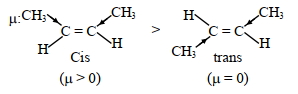
-
- (A) \(3\)
- (B) \(4\)
- (C) \(5\)
- (D) \(6\)
Show answer and solution
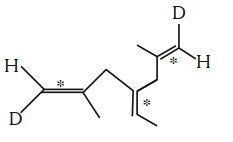
Correct Answer: (B)
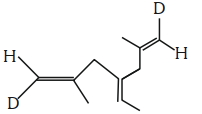
\(3\) stereocenteres, symmetricalTotal Geometrical isomers \(\rightarrow 4\). \(EE, ZZ, EZ\) (two isomers)
-
- (A) 4
- (B) 6
- (C) 8
- (D) 10
Show answer and solution
Correct Answer: (A)
All the following metal ions will respond to flame test.
\(Sr ^{2+}, Ba ^{2+}, Ca ^{2+}, Cu ^{2+}\) -
- (A) \(2\)
- (B) \(4\)
- (C) \(6\)
- (D) \(8\)
Show answer and solution
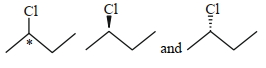
Correct Answer: (A)
There is one chiral centre present in given compound.So, Total optical isomers \(=2\)
-
- (A) Ethane has infinite number of conformations
- (B) The dihedral angle in staggered conformation is \(60^{\circ}\)
- (C) Eclipsed conformation is the most stable conformation.
- (D) The conformations of ethane are interconvertible to one-another.
Show answer and solution
Correct Answer: (C)
Eclipsed conformation is the least stable conformation of ethane. - 22. The incorrect statement regarding the geometrical isomers of \(2\)-butene is _______. 2024 Medium
- (A) cis-\(2\)-butene and trans-\(2\)-butene are not interconvertible at room temperature.
- (B) cis-\(2\)-butene has less dipole moment than trans-\(2\)-butene.
- (C) trans-\(2\)-butene is more stable than cis-\(2\)-butene.
- (D) cis-\(2\)-butene and trans-\(2\)-butene are stereoisomers.
Show answer and solution
Correct Answer: (B)
Cis-but-\(2\)-ene has higher Dipole moment than trans-but-\(2\)-ene.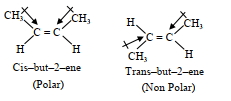
-
- (A) \(30\)
- (B) \(35\)
- (C) \(36\)
- (D) \(32\)
Show answer and solution
Correct Answer: (D)
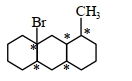
Total chiral centre \(=5\)No. of optical isomers \(=2^5=32\).
-
- (A) \(6\)
- (B) \(5\)
- (C) \(7\)
- (D) \(75\)
Show answer and solution
Correct Answer: (B)
Explanation:
A carbon atom is considered chiral if it is sp3 hybridized and directly bonded to four different atoms or groups. Let us analyze each compound:
1. Compound I: \( \text{CH}_3-\text{CH}_2-\text{CH}^*(\text{NO}_2)-\text{COOH} \) is chiral. The C-2 carbon is bonded to four distinct groups: \( -\text{H} \), \( -\text{NO}_2 \), \( -\text{COOH} \), and \( -\text{CH}_2\text{CH}_3 \).
2. Compound II: \( \text{CH}_3-\text{CH}_2-\text{CHBr}-\text{CH}_2-\text{CH}_3 \) is achiral. The C-3 carbon is attached to two identical ethyl groups, so it lacks a chiral center.
3. Compound III: \( \text{CH}_3-\text{CH}^*(\text{I})-\text{CH}_2-\text{NO}_2 \) is chiral. The C-2 carbon is bonded to four distinct groups: \( -\text{H} \), \( -\text{I} \), \( -\text{CH}_3 \), and \( -\text{CH}_2\text{NO}_2 \).
4. Compound IV: \( \text{CH}_3-\text{CH}_2-\text{CH}^*(\text{OH})-\text{CH}_2\text{OH} \) is chiral. The C-2 carbon is bonded to four distinct groups: \( -\text{H} \), \( -\text{OH} \), \( -\text{CH}_2\text{CH}_3 \), and \( -\text{CH}_2\text{OH} \).
5. Compound V: \( \text{CH}_3-\text{CH}^*(\text{I})-\text{CH}^*(\text{I})-\text{C}_2\text{H}_5 \) (corrected from the incomplete print) is chiral. Both C-2 and C-3 carbons are bonded to four different groups, creating two chiral centers.
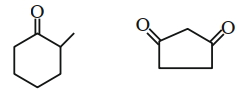
6. Compound VI: 2-Methylcyclohexanone is chiral. The ring carbon bearing the methyl group is attached to four asymmetric paths/groups.
7. Compound VII: Cyclopentane-1,3-dione is achiral due to its internal plane of symmetry and lack of an asymmetric carbon center.
Counting the chiral structures (I, III, IV, V, and VI), we find a total of 5 chiral compounds.
Hence, Option B is the correct choice. -
- (A) \(5\)
- (B) \(8\)
- (C) \(1\)
- (D) \(9\)
Show answer and solution
Correct Answer: (C)
Explanation:
This question requires identifying the number of optically active compounds by analyzing their molecular structures for chiral centers and internal elements of symmetry:
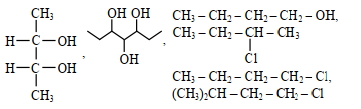
1. Fischer Projection (Butane-2,3-diol):
This structure contains two chiral carbon centers. However, there is a clear horizontal plane of symmetry running through the middle of the molecule that divides it into two mirror-image halves. Due to this internal symmetry, the optical rotation of one half cancels out the other (internal compensation). Therefore, it is a meso compound and is optically inactive.
2. Skeletal Structure (Heptane-3,4,5-triol variant):
This molecule is constitutionally symmetrical from left to right. In the planar zigzag conformation shown, the middle carbon has its \( -\text{OH} \) group pointing downwards, while the two flanking chiral carbons have their \( -\text{OH} \) groups pointing upwards. A vertical plane of symmetry passes directly through the central carbon and its \( -\text{OH} \) group, mirroring the left half perfectly onto the right half. Because of this internal plane of symmetry, it is a meso form and is optically inactive.
3. Analyzing the Condensed Molecular Formulas:
- \( \text{CH}_3-\text{CH}_2-\text{CH}_2-\text{CH}_2-\text{OH} \) (Butan-1-ol): This molecule does not possess any chiral carbon atom (a carbon bonded to four different groups). Thus, it is optically inactive.
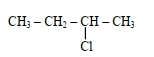
- \( \text{CH}_3-\text{CH}_2-\text{CH}(\text{Cl})-\text{CH}_3 \) (2-chlorobutane): The second carbon atom is asymmetric because it is bonded to four completely different groups: \( -\text{H} \), \( -\text{Cl} \), \( -\text{CH}_3 \), and an ethyl group (\( -\text{CH}_2\text{CH}_3 \)). Since it contains a chiral center and lacks any internal symmetry, it is optically active.
- \( \text{CH}_3-\text{CH}_2-\text{CH}_2-\text{CH}_2-\text{Cl} \) (1-chlorobutane): It contains no asymmetric carbon atom, making it optically inactive.
- \( (\text{CH}_3)_2\text{CH}-\text{CH}_2-\text{CH}_2-\text{Cl} \) (1-chloro-3-methylbutane): It contains no asymmetric carbon atom, making it optically inactive.
4. Conclusion:
Out of all the given configurations, only 2-chlorobutane is chiral and lacks internal symmetry elements. Therefore, the total count of optically active compounds is exactly 1.
Hence, Option C is the correct choice. -
- (A) \(8\)
- (B) \(2\)
- (C) \(4\)
- (D) \(3\)
Show answer and solution
Correct Answer: (A)
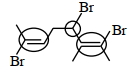
There are three stereo center So No of stereoisomer \(=2^3=8\)
-
- (A) \(41\)
- (B) \(43\)
- (C) \(44\)
- (D) \(42\)
Show answer and solution
Correct Answer: (D)
\(\%\) optical purity \(=\frac{\text { observed rotation of mixture } \times 100}{\text { rotation of pure enantiomer }}\)\(=\frac{+12.6^{\circ}}{+30^{\circ}} \times 100=42\)
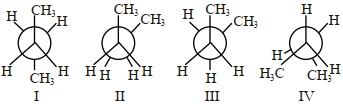
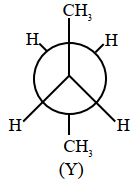
- 28. Arrange the following conformational isomers of \(n-\)butane in order of their increasing potential energy :
 2021 Easy
- (A) \(II <\mathrm{III}<\mathrm{IV}<\mathrm{I}\)
- (B) \(\mathrm{I}<\mathrm{IV}<\mathrm{III}<\mathrm{II}\)
- (C) \(II <\mathrm{IV}<\mathrm{III}<\mathrm{I}\)
- (D) \(\mathrm{I}<\mathrm{III}<\mathrm{IV}<\mathrm{II}\)
Show answer and solution
Correct Answer: (D)
More stable less potential energy.Stability order : \(I>I I I>I V>I I\)
So
Potential energy : \(II >\mathrm{IV}>\mathrm{III}>\mathrm{I}\)
-
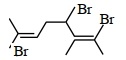
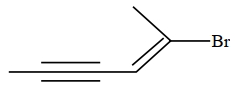
- (A) \((4E)-5-\)Bromo-hex\(-4-\)en\(-2-\)yne
- (B) \((2E)-2-\)Bromo-hex\(-4-\)yn\(-2-\)ene
- (C) \((2E)-2-\)Bromo-hex\(-2-\)en\(-4-\)yne
- (D) \((4E)-5-\)Bromo-hex\(-2-\)en\(-4-\)yne
Show answer and solution
Correct Answer: (C)
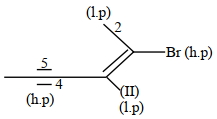
\(h.p.\) \(\Rightarrow\) higher priority\(l.p.\) \(\Rightarrow\) lower priority
\(2 \mathrm{E}-2\) - bromo hex \(-2 -\) en \(-4-\)yne
-
- (A) Positional isomerism
- (B) Both positional isomerism and metamerism
- (C) Metamerism
- (D) Functional group isomerism
Show answer and solution
Correct Answer: (D)
\(C _{3} H _{6} O \Rightarrow CH _{3}- CH _{2}- CH = O\)\(\begin{array}{*{20}{c}} {C{H_3} - C - C{H_3}} \\ {||} \\ O \end{array}\)
They are functional group isomerism.
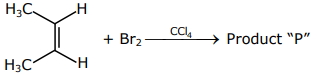
- 31. Consider the above chemical reaction. The total number of stereoisomers possible for product \('\mathrm{P}^{\prime}\) is \(.....\)
 2021 Medium
- (A) \(4\)
- (B) \(3\)
- (C) \(1\)
- (D) \(2\)
Show answer and solution
Correct Answer: (D)
The total number of products possible \(=2\)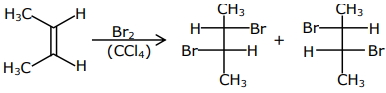
-
- (A) Enantiomers
- (B) Rotamers
- (C) Mirror images
- (D) Polymers
Show answer and solution
Correct Answer: (B)
Staggered and eclipsed conformers of ethane also known as rotamers -
- (A) \(120\)
- (B) \(40\)
- (C) \(50\)
- (D) \(60\)
Show answer and solution
Correct Answer: (D)
\(1,1,1-\)Trichloro ethane \(\left[\mathrm{CCl}_{3}-\mathrm{CH}_{3}\right]\)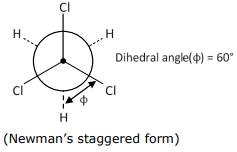
-
- (A) \(3,4 -\)dimethylhex\(-3-\)ene
- (B) \(4-\)Methylhex\(-1-\)ene
- (C) \(3-\)Methylhex\(-1-\)ene
- (D) \(3-\)Ethylhex\(-3-\)ene
Show answer and solution
Correct Answer: (D)
\(3-\)Ethylhex\(-3-\)ene will not show stereo isomerism it's diagram is.\([Image]\)\(\longrightarrow(1)\) Not show geometrical isomerism
\(\quad\quad\quad\quad\quad\quad(2)\) Not show optical isomerism

- 35. In the following skew conformation of ethane, \(H'-C-C-H"\) dihedral angle is......\(^o\)
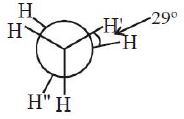 2019 Hard
- (A) \(58\)
- (B) \(120\)
- (C) \(149\)
- (D) \(151\)
Show answer and solution
Correct Answer: (C)
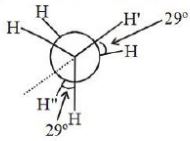
Dihedral angle is then angle between bond pairs present on adjacent atoms.\(H'-C-C-H''\)
Hence angle between
\(H' - C - C - H"\) is
\(({120^o} + {29^o}) = {149^o}\)
- 36. Which of these factors does not govern the stability of a conformation in acyclic compounds? 2019 Medium
- (A) Torsional strain
- (B) Angle strain
- (C) Steric interactions
- (D) Electrostatic forces of interaction
Show answer and solution
Correct Answer: (B)
Angle strain govern stability in cyclic compound. -
- (A) \(2 -\) chloropropanal
- (B) \(2 -\) chlorobutane
- (C) \(2 -\) chloropentane
- (D) \(2 -\) chloro \(- 2-\) methylbutane
Show answer and solution
Correct Answer: (D)
The optically inactive compound must containst achiral carbon atoms \((s)\). Option \((d)\) contains achiral carbon atom\(\underset{2-chloropropanol}{\mathop{\begin{matrix}
\,Cl\, \\
|\,\, \\
C{{H}_{3}}-C-CHO \\
|\,\, \\
H\, \\
\end{matrix}}}\,\) \(\underset{2-chlorobu\tan e\,(chiral)}{\mathop{\begin{matrix}
\,\,\,\,\,\,\,\,\,\,\,\,\,\,\,\,Cl \\
\,\,\,\,\,\,\,\,\,\,\,\,\,\,\,\,\,\,\,\,\,|\,\,\,\,\,\, \\
C{{H}_{3}}-C{{H}_{2}}-C-C{{H}_{3}} \\
\,\,\,\,\,\,\,\,\,\,\,\,\,\,\,| \\
\,\,\,\,\,\,\,\,\,\,\,\,\,\,\,\,H \\
\end{matrix}}}\,\)\(\underset{(chiral)}{\mathop{\underset{2-chloropen\tan e}{\mathop{\begin{matrix}
\,\,\,\,\,\,\,\,\,\,\,\,\,\,\,\,\,\,\,\,\,\,\,\,\,\,\,\,\,\,\,\,\,\,\,\,Cl \\
\,\,\,\,\,\,\,\,\,\,\,\,\,\,\,\,\,\,\,\,\,\,\,\,\,\,\,\,\,\,\,\,\,\,\,| \\
C{{H}_{3}}-C{{H}_{2}}-C{{H}_{2}}-C-C{{H}_{3}} \\
\,\,\,\,\,\,\,\,\,\,\,\,\,\,\,\,\,\,\,\,\,\,\,\,\,\,\,\,\,\,\,\,\,\,| \\
\,\,\,\,\,\,\,\,\,\,\,\,\,\,\,\,\,\,\,\,\,\,\,\,\,\,\,\,\,\,\,\,H \\
\end{matrix}}}\,}}\,\) \(\underset{(achiral)}{\mathop{\underset{2-chloro-2-methylbu\tan e}{\mathop{\begin{matrix}
C{{H}_{3}} \\
| \\
C{{H}_{2}}-C-C{{H}_{3}} \\
| \\
Cl \\
\end{matrix}}}\,}}\,\) -
- (A) \(2 -\) Phenyl \(-1 -\) butene
- (B) \(1, 1 -\) Diphenyl \(- 1 -\) propene
- (C) \(1 -\) Phenyl \(- 2 -\) butene
- (D) \(3 -\) Phenyl \(-1 -\) butene
Show answer and solution
Correct Answer: (C)
\(1 -\) Phenyl- \(2 -\)butene the two groups around each of the doubly bonded carbon Because, all are different. This compound can show \(c i s -\) and \(t r a n s -\) isomerism -
- (A) \(\begin{array}{*{20}{c}}
{C{H_3} - C{H_2} - C{H_2} - C - C{H_3}} \\
{\,\,\,\,\,\,\,\,\,\,\,\,\,\,\,\,\,\,\,\,\,\,\,\,\,\,\,\,\,\,\,\,\,\,\,\,\,||\,} \\
{\,\,\,\,\,\,\,\,\,\,\,\,\,\,\,\,\,\,\,\,\,\,\,\,\,\,\,\,\,\,\,\,\,\,\,\,O}
\end{array}\) and \(\begin{array}{*{20}{c}}
{C{H_3} - C{H_2} - C - C{H_2} - C{H_3}} \\
{\,\,\,\,\,\,\,\,\,\,\,\,\,\,\,\,\,\,\,\,\,\,\,\,\,\,\,\,\,\,\,\,\,\,\,\,\,||\,\,\,\,\,\,\,\,\,\,\,\,\,\,\,\,\,\,\,\,\,\,\,\,\,\,\,\,\,\,\,\,\,\,\,\,} \\
{\,\,\,\,\,\,\,\,\,\,\,\,\,\,\,\,\,\,\,\,\,\,\,\,\,\,\,\,\,\,\,\,\,\,\,\,O\,\,\,\,\,\,\,\,\,\,\,\,\,\,\,\,\,\,\,\,\,\,\,\,\,\,\,\,\,\,\,\,\,\,\,}
\end{array}\) - (B) \(C{H_3} - C{H_2} - C{H_2} - C{H_2} - CHO\) and \(\begin{array}{*{20}{c}}
{\,\,\,\,\,\,\,\,\,\,\,\,\,\,\,\,\,\,\,\,\,\,\,\,\,\,\,\,\,\,\,\,\,\,\,\,\,O} \\
{\,\,\,\,\,\,\,\,\,\,\,\,\,\,\,\,\,\,\,\,\,\,\,\,\,\,\,\,\,\,\,\,\,\,\,\,||} \\
{C{H_3} - C{H_2} - C{H_2} - C - C{H_3}}
\end{array}\) - (C) \(\begin{array}{*{20}{c}}
{C{H_3} - C{H_2} - C{H_2} - C - C{H_3}} \\
{\,\,\,\,\,\,\,\,\,\,\,\,\,\,\,\,\,\,\,\,\,\,\,\,\,\,\,\,\,\,\,\,\,\,\,\,||} \\
{\,\,\,\,\,\,\,\,\,\,\,\,\,\,\,\,\,\,\,\,\,\,\,\,\,\,\,\,\,\,\,\,\,\,\,\,\,O}
\end{array}\) and \(\begin{array}{*{20}{c}}
{C{H_3} - CH - C{H_2} - CHO} \\
{|\,\,\,\,\,\,\,\,\,\,\,\,\,\,\,\,\,\,\,\,\,\,\,\,} \\
{C{H_3}\,\,\,\,\,\,\,\,\,\,\,\,\,\,\,\,\,\,\,}
\end{array}\) - (D) \(\begin{array}{*{20}{c}}
{C{H_3} - C{H_2} - C - C{H_2} - C{H_3}} \\
{\,\,\,\,\,\,\,\,\,\,\,\,\,\,\,\,\,\,\,\,\,\,\,\,\,\,\,\,\,\,\,\,\,\,\,\,||\,\,\,\,\,\,\,\,\,\,\,\,\,\,\,\,\,\,\,\,\,\,\,\,\,\,\,\,\,\,\,\,\,\,\,\,} \\
{\,\,\,\,\,\,\,\,\,\,\,\,\,\,\,\,\,\,\,\,\,\,\,\,\,\,\,\,\,\,\,\,\,\,\,\,\,O\,\,\,\,\,\,\,\,\,\,\,\,\,\,\,\,\,\,\,\,\,\,\,\,\,\,\,\,\,\,\,\,\,\,\,\,\,}
\end{array}\) and \(\begin{array}{*{20}{c}}
{C{H_3}} \\
{C{H_3}}
\end{array} > CH\) \(-CH_2-CHO\)
Show answer and solution
Correct Answer: (A)
Pentan \(-2-\) one and pentan \(-3-\) one are position isomers \((b) , (c) , (d)\) contain different compounds aldehyde and ketones. - (A) \(\begin{array}{*{20}{c}}
-
- (A) Lactic acid
- (B) Tartaric acid
- (C) Maleic acid
- (D) \(\alpha -\) amino acids
Show answer and solution
Correct Answer: (C)
Optical isomers contain an asymmetric (chiral) carbon atom (a carbon atomattached to four different atoms or groups). Therefore all except maleic acid exhibit optical isomerism.
No questions on this page match these filters.
About Organic chemistry isomerism PYQs
Organic chemistry isomerism has 40 questions from 2014–2026. The most came in 2024 (10), 2025 (9) and 2026 (7).
The most asked topics are Optical isomerism, Structural isomerism and Geometrical isomerism.
13% are easy, 50% medium and 38% hard.
Organic chemistry isomerism PYQs by year
Frequently asked
How many Organic chemistry isomerism questions came in JEE Mains?
40 questions from 2014–2026, each with the correct answer and a full solution.
Which Organic chemistry isomerism topic is asked the most?
Optical isomerism, with 13 questions, followed by Structural isomerism with 12.
Which year had the most Organic chemistry isomerism questions?
2024, with 10 questions.
How difficult are Organic chemistry isomerism questions?
13% are easy, 50% medium and 38% hard.