


Questions
Newest firstShowing 1–34 of 34 questions
-
- (A) B and C Only
- (B) A and B Only
- (C) A and D Only
- (D) A and C Only
Show answer and solution
Correct Answer: (D)
The electronic configurations of the given elements are:
Eu (63): [Xe] \(4f^7 6s^2\)
Gd (64): [Xe] \(4f^7 5d^1 6s^2\)
Dy (66): [Xe] \(4f^{10} 6s^2\)
Ho (67): [Xe] \(4f^{11} 6s^2\)
Tm (69): [Xe] \(4f^{13} 6s^2\)
Yb (70): [Xe] \(4f^{14} 6s^2\)
Lu (71): [Xe] \(4f^{14} 5d^1 6s^2\)
Hf (72): [Xe] \(4f^{14} 5d^2 6s^2\)
From the above configurations:
Eu and Gd both have 7 electrons in their \(4f\) orbitals.
Yb and Hf both have 14 electrons in their \(4f\) orbitals.
Dy and Ho have 10 and 11 electrons respectively in their \(4f\) orbitals.
Lu and Tm have 14 and 13 electrons respectively in their \(4f\) orbitals.
Thus, pairs A (Eu and Gd) and C (Yb and Hf) have the same number of electrons in their respective \(4f\) orbitals.
Answer: A and C Only -
- (A) A and B Only
- (B) C and D Only
- (C) B and D Only
- (D) A and C Only
Show answer and solution
Correct Answer: (C)
In d-block elements, the stability of higher oxidation states increases down a group. Therefore, \(Mo(VI)\) and \(W(VI)\) are more stable than \(Cr(VI)\). Statement A is incorrect.
The most stable oxidation state for lanthanoids is \(+3\). Ions like \(Ce^{4+}\) and \(Tb^{4+}\) tend to gain an electron to achieve the \(+3\) state, acting as oxidants. Conversely, \(Eu^{2+}\) and \(Yb^{2+}\) tend to lose an electron to achieve the \(+3\) state, acting as reductants. Statement B is correct.
The electronic configuration of \(Am\) is \([Rn] 5f^{7} 7s^{2}\), which has \(7\) unpaired electrons. The electronic configuration of \(Cm\) is \([Rn] 5f^{7} 6d^{1} 7s^{2}\), which has \(8\) unpaired electrons (\(7\) in \(5f\) and \(1\) in \(6d\)). Statement C is incorrect.
The \(5f\) electrons have a poorer shielding effect compared to \(4f\) electrons. As a result, the effective nuclear charge increases more significantly across the actinoid series, leading to a greater actinoid contraction from element to element than the lanthanoid contraction. Statement D is correct.
Thus, only statements B and D are correct.
Answer: B and D Only -
- (A) \(\mathrm{Nd}^{3+}\) and \(\mathrm{Eu}^{3+}\)
- (B) \(\mathrm{La}^{3+}\) and \(\mathrm{Ce}^{4+}\)
- (C) \(\mathrm{Nd}^{3+}\) and \(\mathrm{Ce}^{4+}\)
- (D) \(\mathrm{Lu}^{3+}\) and \(\mathrm{Eu}^{3+}\)
Show answer and solution
Correct Answer: (B)
\(\mathrm{Ce}:[\mathrm{Xe}] 4 \mathrm{f}^1 5 \mathrm{~d}^1 6 \mathrm{~s}^2 ; \mathrm{Ce}^{4+}\) diamagnetic\(\mathrm{La}:[\mathrm{Xe}] 4 \mathrm{f}^0 5 \mathrm{~d}^1 6 \mathrm{~s}^2 ; \mathrm{La}^{3+}\) diamagnetic
-
- (A) Statement \(I\) is false but Statement \(II\) is true
- (B) Both Statement \(I\) and Statement \(II\) are true
- (C) Statement \(I\) is true but Statement \(II\) is false
- (D) Both Statement \(I\) and Statement \(II\) are false
Show answer and solution
Correct Answer: (B)
Statement \((1)\) is true, \(\mathrm{Ce}^{+4}\) has noble gas electronic configuration.Statement \((2)\) is also true due to high reduction potential for \(\mathrm{Ce}^{4+} / \mathrm{Ce}^{3+}(+1.74 \mathrm{~V})\), and stability of \(\mathrm{Ce}^{3+}, \mathrm{Ce}^{4+}\) acts as strong oxidizing agent.
-
- (A) \(1\)
- (B) \(2\)
- (C) \(5\)
- (D) \(8\)
Show answer and solution
Correct Answer: (B)
\(\mathrm{La}^{+3}-[\mathrm{Xe}] 4 \mathrm{f}^0\)\(\mathrm{Nd}^{+3}-[\mathrm{Xe}] 4 \mathrm{f}^3\)
\(\mathrm{Sm}^{+3}-[\mathrm{Xe}] 4 \mathrm{f}^5\)
\(\mathrm{Eu}^{+3}-[\mathrm{Xe}] 4 \mathrm{f}^6\)
\(\mathrm{Lu}^{+3}-[\mathrm{Xe}] 4 \mathrm{f}^{14}\)
\(\mathrm{La}^{+3}\) and \(\mathrm{Lu}^{+3}\) do not show any colour because no unpaired electron is present.
- 6. The electronic configuration of Einsteinium is _______. (Given atomic number of Einsteinium \(=99\) ) 2024 Medium
- (A) \([\mathrm{Rn}] 5 \mathrm{f}^{12} 6 \mathrm{~d}^0 7 \mathrm{~s}^2\)
- (B) \([\mathrm{Rn}] 5 \mathrm{f}^{11} 6 \mathrm{~d}^0 7 \mathrm{~s}^2\)
- (C) \([\mathrm{Rn}] 5 \mathrm{f}^{13} 6 \mathrm{~d}^0 7 \mathrm{~s}^2\)
- (D) \([\mathrm{Rn}] 5 \mathrm{f}^{10} 6 \mathrm{~d}^0 7 \mathrm{~s}^2\)
Show answer and solution
Correct Answer: (B)
Einsteinium (atomic No \(=99):[\mathrm{Rn}] 5 \mathrm{f}^{11} 6 \mathrm{~d}^0 7 \mathrm{~s}^2\) -
- (A) \(3\)
- (B) \(4\)
- (C) \(1\)
- (D) \(5\)
Show answer and solution
Correct Answer: (C)
\(\mathrm{Cm}\) is Actinide. -
- (A) \(\mathrm{Lu}^{3+}\)
- (B) \(\mathrm{Gd}^{3+}\)
- (C) \(\mathrm{Eu}^{2+}\)
- (D) \(\mathrm{Ce}^{4+}\)
Show answer and solution
Correct Answer: (C)
\(\begin{array}{ll}\mathrm{Eu}^{+2} & \mathrm{Eu}^{+3}+1 \mathrm{e}^{-} \\{[\mathrm{Xe}] 4 \mathrm{f}^7 6 \mathrm{~s}^0} \rightarrow & {[\mathrm{Xe}] 4 \mathrm{f}^6 6 \mathrm{~s}^0}\end{array}\) -
- (A) \(4 f^2 6 s^2\)
- (B) \(4 f^4\)
- (C) \(4 f^3\)
- (D) \(4 f ^4 6 s ^2\)
Show answer and solution
Correct Answer: (B)
\(Nd (60)=[ Xe ] 4 f ^4 5 d ^0 6 s ^2\)\(Nd ^{2+}=[ Xe ] 4 f ^4 5 d ^0 5 s ^0\)
-
- (A) \(Ce ^{4+}\) and \(Eu ^{2+}\)
- (B) \(Ce ^{4+}\) and \(Tb ^{4+}\)
- (C) \(Ce ^{3+}\) and \(Ce ^{4+}\)
- (D) \(Eu ^{2+}\) and \(Ce ^{4+}\)
Show answer and solution
Correct Answer: (D)
Factual - 11. The pair of lanthanides in which both elements have high third-ionization energy is: 2023 Medium
- (A) \(Eu , Gd\)
- (B) \(Eu , Yb\)
- (C) \(Lu , Yb\)
- (D) \(Dy, Gd\)
Show answer and solution
Correct Answer: (B)
\(\left.Eu ^{+2}:[ Xe ] 4 f ^7\right\}\) High IE due to half\(\left.Yb ^{+2}:[ Xe ] 4 f ^{14}\right\}\) filled \& fully filled configurations
-
- (A) \(B\) and \(D\) only
- (B) \(A\) and \(E\) only
- (C) \(A\) and \(B\) only
- (D) \(C\) and \(D\) only
Show answer and solution
Correct Answer: (A)
\(1.\) \({ }_{62} Sm : 4 f ^6 6 s ^2\)\(2.\) \({ }_{64} Gd : 4 f ^7 5 d ^1 6 s ^2\)
\(3.\) \({ }_{63} Eu : 4 f^7 6 s ^2\)
\(4.\) \({ }_{65} Tb : 4 f ^9 6 s ^2\)
\(5.\) \({ }_{61} Pm : 4 f ^5 6 s ^2\)
- 13. Cerium \((IV)\) has a noble gas configuration. Which of the following is correct statement about it? 2022 Medium
- (A) It will not prefer to undergo redox reactions.
- (B) It will prefer to gain electron and act as an oxidizing agent
- (C) It will prefer to give away an electron and behave as reducing agent
- (D) It acts as both, oxidizing and reducing agent.
Show answer and solution
Correct Answer: (B)
Cerium exists in two different oxidation state \(+3\), \(+4\)\(Ce ^{+4}+ e ^{-} \rightarrow Ce ^{3+} \,\quad\quad\,\,\, E ^{0}=+1.61 \,V\)
\(Ce ^{+3}+3 e ^{-} \rightarrow Ce \quad\quad\,\,\, E ^{0}=-2.336 \,V\)
It shows \(Ce ^{+4}\) acts as a strong oxidising agent \(\&\) accepts electron.
-
- (A) \(Eu ^{2+}\) and \(Tm ^{2+}\)
- (B) \(Sm ^{2+}\) and \(Tm ^{3+}\)
- (C) \(Tb ^{4+}\) and \(Yb ^{2+}\)
- (D) \(Dy ^{3+}\) and \(Yb ^{3+}\)
Show answer and solution
Correct Answer: (C)
\(Tb \rightarrow 4 f ^{9} 6 s ^{2}\)\(Tb ^{+4} \rightarrow 4 f ^{7}\)
\(Yb \rightarrow 4 f ^{14} 6 s ^{2}\)
\(Yb ^{+2} \rightarrow 4 f ^{14}\)
-
- (A) \(Ce\) (At. No. \(58\))
- (B) \(La\) (At. No. \(57\))
- (C) \(Lu\) (At. No. \(71\))
- (D) \(Gd\) (At. No. \(64\))
Show answer and solution
Correct Answer: (A)
\(Ce =[ Xe ] 4 f ^{1} 5 d ^{1} 6 s ^{2}\)\(Ce ^{3+}=[ Xe ] 4 f ^{1} 5 d ^{0}\)
\(Ce ^{+4}=[ Xe ] 4 f ^{0} 5 d ^{0}\) (Noble gas configuration)
-
- (A) \(Ce\) (Atomic Number \(58\))
- (B) \(Sm\) (Atomic Number \(62\))
- (C) \(Eu\) (Atomic Number \(63\))
- (D) \(Yb\) (Atomic Number \(70\))
Show answer and solution
Correct Answer: (C)
\(E _{ M ^{3+} / M ^{2+}}^{0} \Rightarrow Eu(-0.35) Yb(-1.05\)Hence, due to more reduction potential in \(Eu\) as compared to \(Yb\), it can concluded that \(Eu ^{2+}\) is more stable than \(Yb ^{2+}\).
-
- (A) \(4\)
- (B) \(6\)
- (C) \(5\)
- (D) \(7\)
Show answer and solution
Correct Answer: (D)
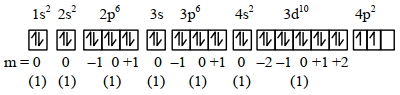
Completely filled orbital with \(\mathrm{m}_{\ell}=0\) are\(=1+1+1+1+1+1+1\)
\(=7\)
So Answer is \(7\)
-
- (A) Statement \(I\) is false but statement \(II\) is true
- (B) Statment \(I\) is true but statement \(II\) is false
- (C) Both statement \(I\) and statement \(II\) are true
- (D) Both statement \(I\) and statement \(II\) are false
Show answer and solution
Correct Answer: (C)
The \(+3\) oxidation state of lanthanide is most stable and therefore lanthanide in \(+4\) oxidation state has strong tendence to gain \(e ^{-}\) and converted into \(+3\) and therefore act as strong oxidizing agent.\(eg Ce ^{+4}\) And there fore \(CeO _{2}\) is used to oxidized alcohol aldehyde and ketones.
Lanthanide in \(+2\) oxidation state has strong tendency to loss \(e ^{-}\) and converted into \(+3\) oxidation state therefore act as strong reducing agent.
\(\therefore EuSO _{4}\) act as strong reducing agent.
-
- (A) Both statement \(I\) and statement \(II\) are correct
- (B) Statement \(I\) is incorrect but statement \(II\) is correct
- (C) Both statement \(I\) and statement \(II\) are incorrect
- (D) Statement \(I\) is correct but statement \(II\) is incorrect
Show answer and solution
Correct Answer: (D)
The \(E ^{\circ}\) value for \(Ce ^{4+} / Ce ^{3+}\) is \(+1.74 V\) because the most stable oxidation state of lanthanide series elements is \(+3\) .It means \(Ce ^{3+}\) is more stable than \(Ce ^{4+}\)
-
- (A) \(10\)
- (B) \(15\)
- (C) \(20\)
- (D) \(36\)
Show answer and solution
Correct Answer: (A)
\(\mathrm{Ho}=[\mathrm{Xe}] 4 \mathrm{f}^{11} 6 \mathrm{~s}^{2}\)\(\mathrm{Ho}^{3+}=[\mathrm{Xe}] 4 \mathrm{f}^{10}\)
So number of \(\mathrm{e}^{-}\)present \(4 \mathrm{f}\) is \(10 .\)
-
- (A) \(4 f^{7} 6 \mathrm{~s}^{2}\)
- (B) \(4 f^{6}\)
- (C) \(4 f^{7}\)
- (D) \(4 f^{6} 6 \mathrm{~s}^{2}\)
Show answer and solution
Correct Answer: (C)
\(\mathrm{Eu} \rightarrow[\mathrm{Xe}] 4 \mathrm{f}^{7} 6 \mathrm{~s}^{2}\)\(\mathrm{Eu}^{2+} \rightarrow[\mathrm{Xe}] 4 \mathrm{f}^{7}\)
-
- (A) \(7\)
- (B) \(6\)
- (C) \(1\)
- (D) \(8\)
Show answer and solution
Correct Answer: (A)
The electronic configuration of\({ }_{64} \mathrm{Gd}:[\mathrm{Xe}] 4 \mathrm{f}^{7} 5 \mathrm{~d}^{1} 6 \mathrm{~s}^{2}\)
So the electronic configuration of
\({ }_{64} \mathrm{Gd}^{2+}:[\mathrm{Xe}] 4 \mathrm{f}^{7} 5 \mathrm{~d}^{1} 6 \mathrm{~s}^{0}\)
\(i.e.\) the number of \(4 \mathrm{f}\) electrons in the ground state electronic configuration of \(\mathrm{Gd}^{2+}\) is \(7\)
- 23. The number of \(f\) electrons in the ground state electronic configuration of \(\mathrm{Np}(\mathrm{Z}=93)\) is ....... . 2021 Easy
- (A) \(2\)
- (B) \(5\)
- (C) \(4\)
- (D) \(6\)
Show answer and solution
Correct Answer: (C)
\(\mathrm{Np}=1 \mathrm{~s}^{2} 2 \mathrm{~s}^{2} 2 \mathrm{p}^{6} 3 \mathrm{~s}^{2} 3 \mathrm{p}^{6} 4 \mathrm{~s}^{2} 3 \mathrm{~d}^{10} 4 \mathrm{p}^{6} 5 \mathrm{~s}^{2} 4 \mathrm{~d}^{10} 5 \mathrm{p}^{6} 6 \mathrm{~s}^{2}\)\(4 \mathrm{f}^{14} 5 \mathrm{~d}^{10} 6 \mathrm{p}^{6} 7 \mathrm{~s}^{2}-5 \mathrm{f}^{4} 6 \mathrm{~d}^{1}\)
Total no. of \('f'\) electron \(=14 \mathrm{e}^{-}+4 \mathrm{e}^{-}=18\)
-
- (A) \(\mathrm{Nd}\)
- (B) \(\mathrm{Yb}\)
- (C) \(\mathrm{La}\)
- (D) \(\mathrm{Ce}\)
Show answer and solution
Correct Answer: (B)
Ytterbium shows \(+2\) oxidation state with diamagnetic nature - 25. Which one of the following lanthanoids does not form \(MO _{2} ?\) [\(M\) is lanthanoid metal] 2021 Easy
- (A) \(\operatorname{Pr}\)
- (B) \(Dy\)
- (C) \(Nd\)
- (D) \(Yb\)
Show answer and solution
Correct Answer: (D)
\(Y b\) is the only element that do not form \(MO _{2}\) type oxide -
- (A) lanthanoid metals
- (B) actinoid metals
- (C) actinoid and transition metals
- (D) lanthanoid and actinoid metals
Show answer and solution
Correct Answer: (A)
Alloys of lanthanides with Fe are called Misch metal, which consists of a lanthanoid metal \((\sim 95 \%)\) and iron \((\sim 5 \%)\) and traces of \(S , C , Ca\) and \(Al\). - 27. The correct electronic configuration and spin only magnetic moment (BM) of \(Gd ^{3+}( Z =64)\), respectively, are 2020 Medium
- (A) \([ Xe ] 5 f ^{7}\) and \(8.9\)
- (B) \([ Xe ] 4 f ^{7}\) and \(7.9\)
- (C) \([ Xe ] 5 f ^{7}\) and \(7.9\)
- (D) \([ X e ] 4 f ^{7}\) and \(8.9\)
Show answer and solution
Correct Answer: (B)
Electronic configuration of \(Gd ^{3+}\) is\(64 Gd ^{3+}=[ Xe ] 4 f ^{7}\)
\(Gd ^{3+}\) having \(7\) unpaired electrons.
Magnetic moment \((\mu)=\sqrt{n(n+2)}\) \(B.M.\)
\(\mu=\sqrt{7(7+2)} B \cdot M\)
\(=7.9 B . M\)
\(n \Rightarrow\) Number of unpaired electrons.

-
- (A) \([\mathrm{Xe}] 4 \mathrm{f}^{4}\) and \([\mathrm{Xe}] 4 \mathrm{f}^{9}\)
- (B) \([\mathrm{Xe}] 4 \mathrm{f}^{7}\) and \([\mathrm{Xe}] 4 \mathrm{f}^{1}\)
- (C) \([\mathrm{Xe}] 4 \mathrm{f}^{7} 6 \mathrm{s}^{2}\) and \([\mathrm{Xe}] 4 \mathrm{f}^{2} 6 \mathrm{s}^{2}\)
- (D) \([\mathrm{Xe}] 4 \mathrm{f}^{2}\) and \([\mathrm{Xe}] 4 \mathrm{f}^{7}\)
Show answer and solution
Correct Answer: (B)
\(\mathrm{Eu}_{63} \Rightarrow[\mathrm{Xe}] 4 \mathrm{f}^{7} 5 \mathrm{d}^{\circ} 6 \mathrm{s}^{2}\)\(\mathrm{Eu}^{2+} \Rightarrow[\mathrm{Xe}] 4 \mathrm{f}^{7}\)
\(\mathrm{Ce}_{58} \Rightarrow[\mathrm{Xe}] 4 \mathrm{f}^{1} 5 \mathrm{d}^{1} 6 \mathrm{s}^{2}\)
\(\mathrm{Ce}^{3+} \Rightarrow[\mathrm{Xe}] 4 \mathrm{f}^{1}\)
-
- (A) Group \(11\) and Group \(4\)
- (B) Actinoids and Group \(4\)
- (C) Actinoids and Group \(6\)
- (D) Group \(6\) and Actinoids
Show answer and solution
Correct Answer: (B)
Element with atomic no. \(101\) is an Actinoid element. -
- (A) Dy
- (B) Eu
- (C) Ce
- (D) Tb
Show answer and solution
Correct Answer: (B)
Fact - 31. The effect of lanthanoid contraction in the lanthanoid series of elements by the large means 2019 Easy
- (A) increase in both atomic and ionic radii
- (B) decrease in atomic radii and increase in ionic radii
- (C) decrease in both atomic and ionic radii
- (D) increase in atomic radii and decrease in ionic radii
Show answer and solution
Correct Answer: (C)
Atomic and ionic radii decreases -
- (A) \(6\) and \(4\)
- (B) \(7\) and \(6\)
- (C) \(4\) and \(6\)
- (D) \(6\) and \(7\)
Show answer and solution
Correct Answer: (D)
The highest oxidation state of \(U\) and \(Pu\) is \(6+\) and \(7+\) respectively. -
- (A) \(Gd^{3+}\)
- (B) \(La^{3+}\)
- (C) \(Lu^{3+}\)
- (D) \(Sm^{3+}\)
Show answer and solution
Correct Answer: (D)
\(Sm^{3+}\,(4f^5) =\) yellow colour, other ions have stable electron configurations with half filled or full-filled electron configuration. -
- (A) berkelium \((Bk)\) and californium \((Cf)\)
- (B) nobelium \((No)\) and lawrencium \((Lr)\)
- (C) actinium \((Ac)\) and thorium \((Th)\)
- (D) neptunium \((Np)\) and plutonium \((Pu)\)
Show answer and solution
Correct Answer: (D)
neptunium \( (Np) \) and plutonium \( (Pu) \)
No questions on this page match these filters.
Other STD 12 - D and f- block elements topics
Frequently asked
How many Lanthanoids and Actinoids questions came in JEE Mains?
34 questions from 2019–2026, each with the correct answer and a full solution.
How difficult are Lanthanoids and Actinoids questions?
29% are easy, 53% medium and 18% hard.