


Questions
Newest firstShowing 1–10 of 10 questions
-
- (A) \(|w_B| > |w_A| > |w_C| > |w_D|\)
- (B) \(|w_C| > |w_D| > |w_A| > |w_B|\)
- (C) \(|w_C| > |w_D| > |w_B| > |w_A|\)
- (D) \(|w_B| > |w_A| > |w_D| > |w_C|\)
Show answer and solution
Correct Answer: (C)
Let State \(1\) have pressure \(P_1\) and volume \(V_1\), and State \(2\) have pressure \(P_2\) and volume \(V_2\). For an isothermal expansion, \(V_2 > V_1\) and \(P_1 > P_2\).
For expansion from State \(1\) to State \(2\):
In a single-stage expansion, the external pressure is constant at the final pressure \(P_2\). The magnitude of work is \(|w_A| = P_2(V_2 - V_1)\).
In a multi-stage expansion, the external pressure is reduced in steps, keeping it closer to the internal pressure of the gas. The work done by the gas increases with the number of stages, reaching a maximum for a reversible process (\(|w_{rev}|\)). Thus, \(|w_{rev}| > |w_B| > |w_A|\).
For compression from State \(2\) to State \(1\):
In a single-stage compression, the external pressure is constant at the final pressure \(P_1\). The magnitude of work is \(|w_C| = P_1(V_2 - V_1)\).
In a multi-stage compression, the external pressure is increased in steps. The work done on the gas decreases with the number of stages, reaching a minimum for a reversible process (\(|w_{rev}|\)). Thus, \(|w_C| > |w_D| > |w_{rev}|\).
Since \(P_1 > P_2\), the single-stage compression work \(|w_C|\) is the largest, and the single-stage expansion work \(|w_A|\) is the smallest. The reversible work magnitude \(|w_{rev}|\) is the same for both expansion and compression between the same states.
Combining these inequalities, we get:
\(|w_C| > |w_D| > |w_{rev}| > |w_B| > |w_A|\)
Therefore, the correct order of the magnitude of work is \(|w_C| > |w_D| > |w_B| > |w_A|\).
Answer: \(|w_C| > |w_D| > |w_B| > |w_A|\) -
- (A) \(3\)
- (B) \(6\)
- (C) \(8\)
- (D) \(2\)
Show answer and solution
Correct Answer: (D)
\(B\) and \(D\) options are correct. -
- (A) \(3\)
- (B) \(2\)
- (C) \(4\)
- (D) \(1\)
Show answer and solution
Correct Answer: (C)
\(A \rightarrow\) Endothermic (Atomisation)\(B \rightarrow\) Endothermic (Atomisation)
\(C \rightarrow\) Endothermic (Vapourisation)
\(D \rightarrow\) Exothermic (Combustion)
\(E \rightarrow\) Endothermic (Dissolution)
-
- (A) \(4\)
- (B) \(8\)
- (C) \(2\)
- (D) \(6\)
Show answer and solution
Correct Answer: (A)
Extensive \(\Rightarrow\) Mole, Volume, Gibbs free energy.Intensive \(\Rightarrow\) Molar mass, Molar heat capacity, Molarity, \(E ^\theta\) cell.
-
- (A)
System \(A\) System \(B\) Adiabatic system Temprature rise - (B)
System \(A\) System \(B\) Temprature falls Diathermic system - (C)
System \(A\) System \(B\) Temprature falls Temprature remains same - (D)
System \(A\) System \(B\) Temprature remains same Temprature rise
Show answer and solution
Correct Answer: (A)
Adiabatic boundary does not allow heat exchange thus heat generated in container can't escape out thereby increasing the temperature.In case of Diathermic container, heat flow can occur to maintain the constant temperature.
- (A)
-
- (A) \(2\)
- (B) \(3\)
- (C) \(4\)
- (D) \(6\)
Show answer and solution
Correct Answer: (B)
Internal energy, volume enthalpy are state variable -
- (A) \(Ar _{( g )}+ e ^{-} \rightarrow Ar _{( g )}^{-}\)
- (B) \(H _{( g )}+ e ^{-} \rightarrow H _{( g )}^{-}\)
- (C) \(Na _{( g )} \rightarrow Na _{( g )}^{+}+ e ^{-}\)
- (D) \(O _{( g )}^{-}+ e ^{-} \rightarrow O _{( g )}^{2-}\)
Show answer and solution
Correct Answer: (B)
\(H _{( g )}+ e ^{-} \rightarrow H ^{-} \quad\) is exothermic rest of all endothermic process. -
- (A) \((b)\) and \((c)\)
- (B) \((b), (c)\) and \((d)\)
- (C) \((a), (b)\) and \((c)\)
- (D) \((a)\) and \((d)\)
Show answer and solution
Correct Answer: (A)
\(\Delta U = q + w\)\(\Delta G = \Delta H - T\Delta S\)
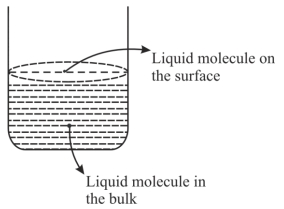
- 9. The following statements relate to the adsorption of gases on a solid surfuce. Identify the incorrect statement among them 2015 Medium
- (A) Enthalpy of adsorption is negative
- (B) Energy appears as heat
- (C) On adsorption, the residual forces on the surface are increased
- (D) Entropy of adsorption is negative
Show answer and solution
Correct Answer: (C)
Adsorption is a phenomena of attracting and retaining the molecules of a substance on the surface of a liquid or a solid resulting into a higher concentration of the molecules on the surface.After adsorption there is a decrease in the residual forces due to bond formation \(\Delta G\), \(\Delta H\) and \(\Delta S\) all are negative in the case of adsorption.
-
- (A) \(280\)
- (B) \(285\)
- (C) \(270\)
- (D) \(15\)
Show answer and solution
Correct Answer: (B)
\(X \to Y;\,\Delta H = - 135\,kJ/mol,\)\({E_a} = 150\,kJ/mol\)
For an exothermic reaction
\({{E}_{a(F.R.)}}=\Delta H+E_{a(B.R.)}'\)
\(150 = - 135 + E_{a(B.R.)}'\)
\(E_{a(B.R.)}' = 285\,kJ/mol\)
No questions on this page match these filters.
Other STD 11 - Thermodynamics and thermochemistry topics
Frequently asked
How many Basic concepts questions came in JEE Mains?
10 questions from 2013–2026, each with the correct answer and a full solution.
How difficult are Basic concepts questions?
10% are easy, 40% medium and 50% hard.