


Questions
20 questionsShowing 1–20 of 20 questions
-
- (A) \(1\)
- (B) \(2\)
- (C) \(\frac{39.9}{2}\)
- (D) \(39.9\)
Show answer and solution
Correct Answer: (A)
Average \(KE\) per molecule \(=\frac{3}{2} kT\)\(\frac{ K _{ AS }}{ K _{ H }}=\frac{1}{1}\)
-
- (A) \(2: 1\)
- (B) \(1: 1\)
- (C) \(1: 4\)
- (D) \(4: 1\)
Show answer and solution
Correct Answer: (B)
\(K _{ av }=\frac{5}{2} kT\)Ratio \(=1: 1\)
-
- (A) \(8\)
- (B) \(16\)
- (C) \(4\)
- (D) \(11\)
Show answer and solution
Correct Answer: (D)
\(\left( C _{ v }\right)_{\operatorname{mix}}=\frac{ n _1 Cv _1+ n _2 Cv _2}{ n _1+ n _2}\)\(\left( C _{ v }\right)_{\operatorname{mix}}=\frac{2 \times \frac{5}{2} R +4 \times \frac{3}{2} R }{2+4}=\frac{11 R }{6}\)
\(\Delta U = n \left( C _{ v }\right)_{\operatorname{mix}} RT =6 \frac{11 R }{6} \times RT =11 R\)
-
- (A) \(\frac{9}{2} R\)
- (B) \(\frac{5}{2} R\)
- (C) \(\frac{3}{2} R\)
- (D) \(\frac{7}{2} R\)
Show answer and solution
Correct Answer: (D)
Diatomic gas molecules have three translational degree of freedom, two rotational degree of freedom and it is given that it has one vibrational mode so there are two additional degree of freedom corresponding to one vibrational mode, so total degree of freedom \(=7\)\(C _{ V }=\frac{ fR }{2}=\frac{7 R }{2}\)
-
- (A) \(32\)
- (B) \(28\)
- (C) \(24\)
- (D) \(27\)
Show answer and solution
Correct Answer: (B)
\(\sqrt{\frac{3 RT }{ M }}=\sqrt{\frac{\alpha+5}{\alpha}} \sqrt{\frac{8}{\pi} \frac{ RT }{ M }}\)\(3=\frac{\alpha+5}{\alpha} \frac{8}{\pi}\)
\(\alpha=28\)
-
- (A) \(-273\)
- (B) \(-100\)
- (C) \(-373\)
- (D) \(-40\)
Show answer and solution
Correct Answer: (A)
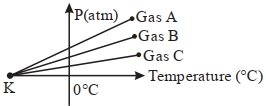
For isochoric process\(\frac{ P }{ T }= n \frac{ R }{ V }= constan t\)
\(P =\frac{ nR }{ V }( t +273)\)
If \(P =0 \Rightarrow t =-273^{\circ}\,C\)
-
- (A) Both statement \(I\) and Statement \(II\) are true
- (B) Statement \(I\) is true but Statement \(II\) is false
- (C) Both Statement \(I\) and Statement \(II\) are false
- (D) Statement \(I\) is false but Statement \(II\) is true
Show answer and solution
Correct Answer: (B)
Statement\(-I\)\(T _1=-73^{\circ}\,C =200\,K\)
\(T _2=527^{\circ}\,C =800\,K\)
\(\frac{ V _1}{ V _2}=\frac{\sqrt{\frac{3 RT _1}{ M }}}{\sqrt{\frac{3 RT _2}{ M }}}=\sqrt{\frac{ T _1}{ T _2}}\)
\(=\sqrt{\frac{200}{800}}=\frac{1}{2}\)
\(V _2=2 V _1 \text { (True) }\)
Statement\(-II\)
\(PV = nRT\)
Translational \(KE =\frac{3}{2} nRT\) (False)
-
- (A) \(751.7\)
- (B) \(451.7\)
- (C) \(651.7\)
- (D) \(551.7\)
Show answer and solution
Correct Answer: (C)
\(V _{ rms }=\sqrt{\frac{3 RT }{ M }} \quad \frac{ v _{ Ar }}{ v _{ Cl }}=\sqrt{\frac{ M _{ Cl }}{ M _{ Ar }}}\)\(\Rightarrow v _{ Ar }=1.33 \times 490=651.7\,m / s\)
-
- (A) \(\frac{27}{35}\)
- (B) \(\frac{35}{27}\)
- (C) \(\frac{25}{21}\)
- (D) \(\frac{21}{25}\)
Show answer and solution
Correct Answer: (C)
For monoatomic gas\(\gamma_1=\frac{5}{3}\)
For diatomic gas at low temperatures
\(\gamma _2=\frac{7}{5}\)
\(\therefore \frac{\gamma_1}{\gamma_2}=\frac{\frac{5}{3}}{\frac{7}{5}}=\frac{25}{21}\)
-
- (A) \((A) - (IV), (B) - (III), (C) - (II), (D) - (I)\)
- (B) \((A) - (IV), (B) - (II), (C) - (I), (D) - (III)\)
- (C) \((A) - (I), (B) - (III), (C) - (IV), (D) - (II)\)
- (D) \((A) - (I), (B) - (IV), (C) - (III), (D) - (II)\)
Show answer and solution
Correct Answer: (C)
Factual -
- (A) proportional to absolute temperature
- (B) proportional to volume
- (C) proportional to pressure
- (D) dependent on the nature of the gas
Show answer and solution
Correct Answer: (A)
Basic theoryTranslational \(K . E\) on average of a molecule is \(\frac{3}{2}\)
\(KT\) which is independent of nature, pressure and volume.
- 12. The correct relation between \(\gamma=\frac{ C _p}{ c _v}\) and temperature \(T\) is : 2023 Medium
- (A) \(\gamma \propto \frac{1}{\sqrt{ T }}\)
- (B) \(\gamma \propto T ^{\circ}\)
- (C) \(\gamma \propto \frac{1}{T}\)
- (D) \(\gamma \propto T\)
Show answer and solution
Correct Answer: (B)
\(\gamma\) is independent of temperature -
- (A) \(1098\)
- (B) \(2049\)
- (C) \(750\)
- (D) \(1500\)
Show answer and solution
Correct Answer: (B)
Mean free path\(\lambda=\frac{ RT }{\sqrt{2} \pi d ^2 N _{ A } P }\)
\(\lambda \propto T\)
\(\frac{1500 d }{\lambda}=\frac{273}{373}\)
\(\lambda=2049\,d\)
-
- (A) \(1.25\)
- (B) \(0.25\)
- (C) \(0.75\)
- (D) \(0.50\)
Show answer and solution
Correct Answer: (B)
Collision frequency,\(\mathrm{f}=\frac{\mathrm{V}}{\lambda}=\frac{\mathrm{V}}{\left(\frac{1}{\sqrt{2} \pi \mathrm{d}^2 \mathrm{n}_\psi}\right)}=\sqrt{2} \pi \mathrm{d}^2 \mathrm{vn}_v\)
\(\therefore \mathrm{f} \propto \mathrm{n}_{\mathrm{v}}, \mathrm{n}_{\mathrm{v}}\) is number density
\(\frac{\mathrm{f}_1}{\mathrm{f}_2}=\frac{\mathrm{n}_{\mathrm{r}_1}}{\mathrm{n}_{r_2}}=\frac{3 \times 10^{19}}{12 \times 10^{-19}}=0.25\)
-
- (A) \(28\)
- (B) \(27\)
- (C) \(8\)
- (D) \(4\)
Show answer and solution
Correct Answer: (A)
\(\sqrt{\frac{3 RT }{ M }}=\left(1+\frac{5}{ x }\right)^{\frac{1}{2}} \sqrt{\frac{8 RT }{\pi M }}\)\(\Rightarrow \frac{3 \times 22}{7 \times 8}=1+\frac{5}{ x }\)
\(\Rightarrow x =28\)
-
- (A) \(523\)
- (B) \(1260\)
- (C) \(91\)
- (D) \(27.4\)
Show answer and solution
Correct Answer: (A)
\(V _{ rms }=\sqrt{\frac{3 k _{ B } T }{ m }}=\sqrt{\frac{3 \times 1.4 \times 10^{-23} \times 300}{4.6 \times 10^{-26}}}=523\,m / s\) -
- (A) Proportional to square of temperature \(\left( T ^2\right)\).
- (B) Inversely proportional to square root of temperature \(\sqrt{\frac{1}{ T }}\).
- (C) Proportional to square root of temperature \(\sqrt{T}\).
- (D) Proportional to temperature \((T)\).
Show answer and solution
Correct Answer: (C)
The rms speed of a gas molecule is\(V _{ RMS }=\sqrt{\frac{3 RT }{ M }}\)
\(V _{ RMS } \alpha \sqrt{ T }\)
-
- (A) \(1227\)
- (B) \(927\)
- (C) \(327\)
- (D) \(627\)
Show answer and solution
Correct Answer: (C)
Kinetic energy \(=\frac{f}{2} kT , T\) is absolute temperature.If \(K _1\) is kinetic energy at \(27^{\circ} C\).
\(K _2\) is kinetic energy at new temperature \(T\).
\(\frac{ K _1}{ K _2}=\frac{ T _1}{ T _2} \Rightarrow \frac{1}{2}=\frac{300}{ T }\)
\(T =600\,K\)
\(T =327^{\circ}\,C\)
-
- (A) \(v _0\)
- (B) \(4 v_0\)
- (C) \(\frac{v_0}{4}\)
- (D) \(2 v _0\)
Show answer and solution
Correct Answer: (D)
\(V _{ rms }=\sqrt{\frac{3 RT }{ M }}\)\(\Rightarrow V _{ rms } \alpha \sqrt{ T }\)
Increasing temperature \(4\) times, rms speed gets doubled.
-
- (A) \(v _{ rms }(\) mono \()= v _{ rms }(\) dia \()= v _{rms}(\) poly \()\)
- (B) \(v _{rms}(\) mono \() > v _{rms}(\) dia \() > v _{rms}\) (poly)
- (C) \(v _{rms}(\) dia \() < v _{rms}(\) poly \() < v _{rms}(\) mono \()\)
- (D) \(v _{ rms }( mono ) < v _{rms}( dia ) < v _{ rms }\) (poly \()\)
Show answer and solution
Correct Answer: (B)
\(v _{ rms }(\text { mono })=\sqrt{\frac{3 RT }{4 \times 10^{-3}}}\)\(v _{ rms }(\text { dia })=\sqrt{\frac{3 RT }{71 \times 10^{-3}}}\)
\(v _{ rms }( ply )=\sqrt{\frac{3 RT }{146 \times 10^{-3}}}\)
So correct relation is
\(v _{ rms }(\text { mono }) > v _{ rms }(\text { dia }) > v _{ rms }(\text { poly })\)
No questions on this page match these filters.