


Questions
Newest firstShowing 1–14 of 14 questions
-
- (A) Only \(I_2\)
- (B) \(\mathrm{Cl}_2, \mathrm{Br}_2\) and \(\mathrm{I}_2\)
- (C) \(\mathrm{F}_2, \mathrm{Cl}_2\) and \(\mathrm{Br}_2\)
- (D) \(\mathrm{F}_2\) and \(\mathrm{Cl}_2\)
Show answer and solution
Correct Answer: (B)
\(F_2\) do not disproportionate because fluorine do not exist in positive oxidation state however \(\mathrm{Cl}_2, \mathrm{Br}_2 \& \mathrm{I}_2\) undergoes disproportionation. -
- (A) Statement \(I\) is false but Statement \(II\) is true.
- (B) Both Statement \(I\) and Statement \(II\) are true.
- (C) Statement \(I\) is true but Statement \(II\) is false.
- (D) Both Statement \(I\) and Statement \(II\) are false.
Show answer and solution
Correct Answer: (D)
Statement \(I\) and \(II\) are False Noble gases have low boiling pointsNoble gases are held together by weak dispersion forces. -
- (A) \(Xe < Kr < Ne < He\)
- (B) \(He < Ne < Kr < Xe\)
- (C) \(He < Xe < Kr < Ne\)
- (D) \(He < Kr < Xe < Ne\)
Show answer and solution
Correct Answer: (C)
From NCRETSo, order is \(Ne > Kr > Xe > He\)
-
- (A) \(4\)
- (B) \(6\)
- (C) \(2\)
- (D) \(8\)
Show answer and solution
Correct Answer: (C)
\(6 XeF _4+12 H _2 O \longrightarrow 2 XeO _3+4 Xe +24 HF +3 O _2\)in \(XeO _3\), Oxidation state of \(Xe =+6\)
in \(XeF _4\), Oxidation state of \(Xe =+4\)
So difference in oxidation state \(=2\)
-
- (A) \(10\)
- (B) \(11\)
- (C) \(12\)
- (D) \(13\)
Show answer and solution
Correct Answer: (B)
\(XeF _4+ SbF _5 \rightarrow\left[ XeF _3\right]^{+}\left[ SbF _6\right]^{-}\)\(m =3\)
\(n =1\)
\(y =6\)
\(z =1\)
\(m + n + y + z =11\)
-
- (A) \((a)-(iv), (b)-(i),(\mathrm{c})-(\mathrm{ii}),(\mathrm{d})-(\mathrm{iii})\)
- (B) \((a) -(\mathrm{iii}),(\mathrm{b})-(\mathrm{iv}),(\mathrm{c})-(\mathrm{ii}),(\mathrm{d})-(\mathrm{i})\)
- (C) \((a) -(\mathrm{iii}),(\mathrm{b})-(\mathrm{ii}),(\mathrm{c})-(\mathrm{iv}),(\mathrm{d})-(\mathrm{i})\)
- (D) \((a)-(iv),(\mathrm{b})-(\mathrm{ii}),(\mathrm{c})-(\mathrm{i}),(\mathrm{d})-(\mathrm{iii})\)
Show answer and solution
Correct Answer: (D)
Species \(\quad\quad\quad\quad\)(Number of lone pairs of electrons on the central atom)
-
- (A) \(He\)
- (B) \(Rn\)
- (C) \(Ne\)
- (D) \(Kr\)
Show answer and solution
Correct Answer: (B)
Noble gases such as Helium (\( \text{He} \)), Neon (\( \text{Ne} \)), Argon (\( \text{Ar} \)), Krypton (\( \text{Kr} \)), and Xenon (\( \text{Xe} \)) are naturally present in the Earth's atmosphere.
Radon (\( \text{Rn} \)) is a radioactive noble gas formed from the decay of radium, and due to its short half-life, it does not occur in the atmosphere in significant amounts. (Oganesson, \( \text{Og} \), is also a synthetic radioactive noble gas that does not occur in the atmosphere).
Hence, the correct option is B. -
- (A) \(5, 3, 0\)
- (B) \(5, 2, 0\)
- (C) \(4,2,2\)
- (D) \(4,4,0\)
Show answer and solution
Correct Answer: (A)
Structure of \(XeO_3F_2\)
-
- (A) \(XeOF_4(+6)\) and \(XeO_3(+6)\)
- (B) \(XeO_2(+4)\) and \(XeO_3(+6)\)
- (C) \(XeOF_4(+6)\) and \(XeO_2F_2(+6)\)
- (D) \(XeO_2F_2(+6)\) and \(XeO_2(+4)\)
Show answer and solution
Correct Answer: (C)
\(Xe{{F}_{6}}\,+\,{{H}_{2}}O\,\xrightarrow[hydrolysis]{particle}\underset{'X'}{\mathop{\overset{+6}{\mathop{Xe}}\,O{{F}_{4}}}}\,\,+\,2HF\)\(Xe\mathop {O{F_4}}\limits_{'X'} \, + {H_2}O\, \to \mathop {\mathop {Xe}\limits^{ + 6} {O_2}{F_2}}\limits_{'Y'} \, + \,2HF\)
-
- (A) \(XeF_2\)
- (B) \(XeF_4\)
- (C) \(XeOF_4\)
- (D) \(XeO_3\)
Show answer and solution
Correct Answer: (C)
\(Xe{F_6}\, + \,{H_2}O\, \to \mathop {XeO{F_4}\, + \,2HF}\limits_{(partial\,\,\,hydrolysis)} \)\(Xe{F_6} + 2{H_2}O\, \to Xe{O_2}{F_2}+ \,4HF\)
\(Si{O_2}\, + \,2Xe{F_6}\, \to \mathop {\,2XeO{F_4}\, + \,Si{F_4}}\limits_{(Xenoneoxy\,\,\,tetra\,\,fluoride)} \)
-
- (A) Instantaneous dipole-induced dipole
- (B) Ion-dipole
- (C) Ionic
- (D) Dipole -dipole
Show answer and solution
Correct Answer: (A)
Instantaneous dipole-induced dipole forces are most responsible in allowing xenon gas to liquify. -
- (A) \(Kr\)
- (B) \(Xe\)
- (C) \(He\)
- (D) \(Ne\)
Show answer and solution
Correct Answer: (B)
As we move down the group, the melting and boiling points show a regular increase due to corresponding increase in the magnitude of their van der waal forces of attraction as the size of the atom increases. - 13. Which of the following xenon-oxo compounds may not be obtained by hydrolysis of xenon fluorides? 2014 Hard
- (A) \(Xe{O_2}{F_2}\)
- (B) \(XeO{F_4}\)
- (C) \(XeO_3\)
- (D) \(XeO_4\)
Show answer and solution
Correct Answer: (D)
\(Xe{F_6}\, + \,{H_2}O\,\xrightarrow{{partial}}XeO{F_4}\, + \,2HF\)\(Xe{F_6}\, + \,2{H_2}O\,\xrightarrow{{partial}}Xe{O_2}{F_2}\, + \,4HF\)
\(Xe{F_6}\, + \,3{H_2}O\,\xrightarrow{{compute}}Xe{O_3}\, + \,6HF\)
-
- (A) \(XeOF_2\)
- (B) \(XeO_3F_2\)
- (C) \(FXeOSO_2F\)
- (D) \([XeF_8]^{2-}\)
Show answer and solution
Correct Answer: (B)
The hybridization of \(XeO_3F_2\) is \(sp^3d\) and its structure is trigonal bipyramidal in which oxygen atoms are situated on the plane and the fluoride atoms are on the top and bottom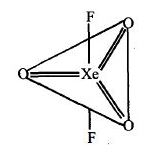
No questions on this page match these filters.
Other STD 12 - P -Block elements - ll topics
Frequently asked
How many Noble gases questions came in JEE Mains?
14 questions from 2013–2024, each with the correct answer and a full solution.
How difficult are Noble gases questions?
7% are easy, 36% medium and 57% hard.