


Questions
Newest firstShowing 1–2 of 2 questions
-
- (A) Both Statement I and Statement II are true
- (B) Statement I is false but Statement II is true
- (C) Both Statement I and Statement II are false
- (D) Statement I is true but Statement II is false
Show answer and solution
Correct Answer: (C)
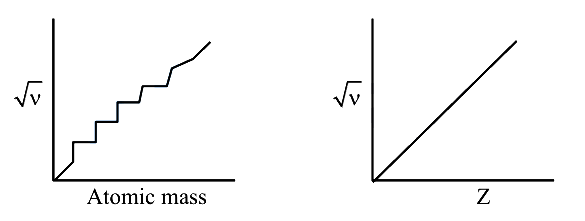
Explanation:
According to Moseley's Law for characteristic X-ray spectra, the relationship between frequency and atomic number is expressed as:
\( \sqrt{\nu} = a(Z - b) \)
Where \( \nu \) represents the frequency of the emitted X-rays, \( Z \) represents the atomic number, and \( a \) and \( b \) are constants.
1. Analysis of Statement (I): The graph plotted between \( \sqrt{\nu} \) and atomic mass is not a straight line; instead, it forms a jagged, irregular curve. This discovery led Henry Moseley to conclude that the atomic number is a far more fundamental property of an element than its atomic mass. Therefore, Statement I is false.
2. Analysis of Statement (II): Moseley's law specifies that the square root of the frequency (\( \sqrt{\nu} \)) is directly proportional to the atomic number, which means a plot of \( \sqrt{\nu} \) versus \( Z \) yields a straight line. Conversely, a plot of frequency (\( \nu \)) versus atomic number (\( Z \)) will yield a parabola (\( \nu \propto Z^2 \)), not a straight line. Therefore, Statement II is also false.
Since both statements are entirely false, Option C is the correct choice. -
- (A) Both Statement (I) and Statement (II) are false.
- (B) Both Statement (I) and Statement (II) are true.
- (C) Statement (I) is false but Statement (II) is true.
- (D) Statement (I) is true but Statement (II) is false.
Show answer and solution
Correct Answer: (A)
Law of octaves was arranged in the increasing order of their atomic weight.
Lothar Meyer plotted the physical properties such as atomic volume, melting point and boiling point against atomic weight.
No questions on this page match these filters.
Other STD 11 - Classification of elements and periodicity in properties topics
Frequently asked
How many History of periodic table questions came in JEE Mains?
2 questions from 2025, each with the correct answer and a full solution.
How difficult are History of periodic table questions?
50% are easy, 50% medium and 0% hard.