


Questions
Newest firstShowing 1–12 of 12 questions
-
- (A) Both Statement I and Statement II are true
- (B) Both Statement I and Statement II are false
- (C) Statement I is true but Statement II is false
- (D) Statement I is false but Statement II is true
Show answer and solution
Correct Answer: (C)
Statement I: Metamerism arises due to different alkyl chains on either side of a polyvalent functional group. In ketones, the carbonyl group (\(>C=O\)) acts as the polyvalent functional group. In \(2,6\)-diethylcyclohexanone, the alkyl groups attached to the \(\alpha\)-carbons are two ethyl groups. In \(6\)-methyl-\(2\)-n-propylcyclohexanone, the alkyl groups are a methyl group and an n-propyl group. Since the alkyl groups around the carbonyl group are different while the molecular formula remains the same, they are metamers. Thus, Statement I is true.
Statement II: For a ketone to exhibit keto-enol tautomerism, it must have at least one \(\alpha\)-hydrogen atom. In \(2,2,6,6\)-tetramethylcyclohexanone, the \(\alpha\)-carbons (C\(2\) and C\(6\)) are bonded to two methyl groups each. Since there are no \(\alpha\)-hydrogen atoms present, it cannot undergo keto-enol tautomerism. Thus, Statement II is false.
Answer: Statement I is true but Statement II is false -
- (A) B, C and D only
- (B) A, B and C only
- (C) A, B and E only
- (D) C, D and E only
Show answer and solution
Correct Answer: (C)
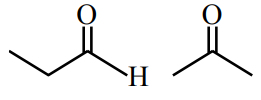 are Functional isomer
\(CH _3- CH = CH - CH _3 \& CH _3- CH _2- CH = CH _2\)
Are Positional isomer
\(CH _3- CH _2- O - CH _2- CH _3 \& CH _3- CH _2- CH _2- O - CH _3\)
are Metamer
\(CH _3- CH = CH - CH _3\) does not have optical isomer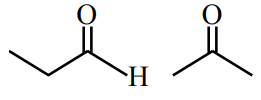 Chain isomer
-
- (A) A-III, B-I, C-IV, D-II
- (B) A-III, B-I, C-II, D-IV
- (C) A-I, B-IV, C-III, D-II
- (D) A-II, B-I, C-IV, D-III
Show answer and solution
Correct Answer: (A)
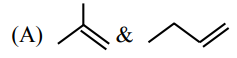
(III) Chain isomer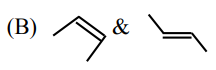
(I) Streoisomers
(IV) Functional isomers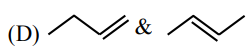
(II) Positional isomers -
- (A) \(3\)
- (B) \(4\)
- (C) \(5\)
- (D) \(6\)
Show answer and solution
Correct Answer: (B)
The structure of n-butane is \(CH_3-CH_2-CH_2-CH_3\).
Monochlorination of n-butane gives two structural isomers: 1-chlorobutane and 2-chlorobutane.
Among these, 2-chlorobutane (\(CH_3-CH_2-C^{*}HCl-CH_3\)) contains a chiral carbon atom and is optically active. Thus, the optically active compound "P" is 2-chlorobutane.
Further chlorination of 2-chlorobutane can take place at any of the four carbon atoms, yielding the following dichloro compounds (ignoring stereoisomers):
1. Chlorination at C-1: \(CH_3-CH_2-CHCl-CH_2Cl\) (1,2-dichlorobutane)
2. Chlorination at C-2: \(CH_3-CH_2-CCl_2-CH_3\) (2,2-dichlorobutane)
3. Chlorination at C-3: \(CH_3-CHCl-CHCl-CH_3\) (2,3-dichlorobutane)
4. Chlorination at C-4: \(CH_2Cl-CH_2-CHCl-CH_3\) (1,3-dichlorobutane)
Therefore, 4 structurally distinct dichloro compounds are obtained.
Answer: \(4\) -
- (A) Both Statement (I) and Statement (II) are false.
- (B) Both Statement (I) and Statement (II) are true.
- (C) Statement (I) is false but Statement (II) is true.
- (D) Statement (I) is true but Statement (II) is false.
Show answer and solution
Correct Answer: (B)
Explanation:
Let us evaluate the truthfulness of both statements based on the principles of organic isomerism:
1. Analysis of Statement (I):
Methylcyclopentane is a cyclic alkane containing a total of 6 carbon atoms, giving it the molecular formula \( \text{C}_6\text{H}_{12} \). Hex-3-ene is an open-chain alkene with one double bond and 6 carbon atoms, which also gives it the molecular formula \( \text{C}_6\text{H}_{12} \). Since they share the same molecular formula but possess different skeletal connectivity (ring vs. open chain), they are valid ring-chain isomers. Thus, Statement (I) is true.
2. Analysis of Statement (II):
Pentan-1-amine \( (\text{CH}_3\text{CH}_2\text{CH}_2\text{CH}_2\text{CH}_2\text{NH}_2) \) is a primary \( (1^\circ) \) amine with the molecular formula \( \text{C}_5\text{H}_{13}\text{N} \). N-methylbutan-1-amine \( (\text{CH}_3\text{CH}_2\text{CH}_2\text{CH}_2\text{NHCH}_3) \) is a secondary \( (2^\circ) \) amine, which also shares the exact same molecular formula \( \text{C}_5\text{H}_{13}\text{N} \). In organic chemistry, primary, secondary, and tertiary amines containing the same molecular formula are classified as functional group isomers because they contain different functional environments. Thus, the corrected Statement (II) is true.
Hence, Option B is the correct choice. - 6. Identify the correct statements from the following
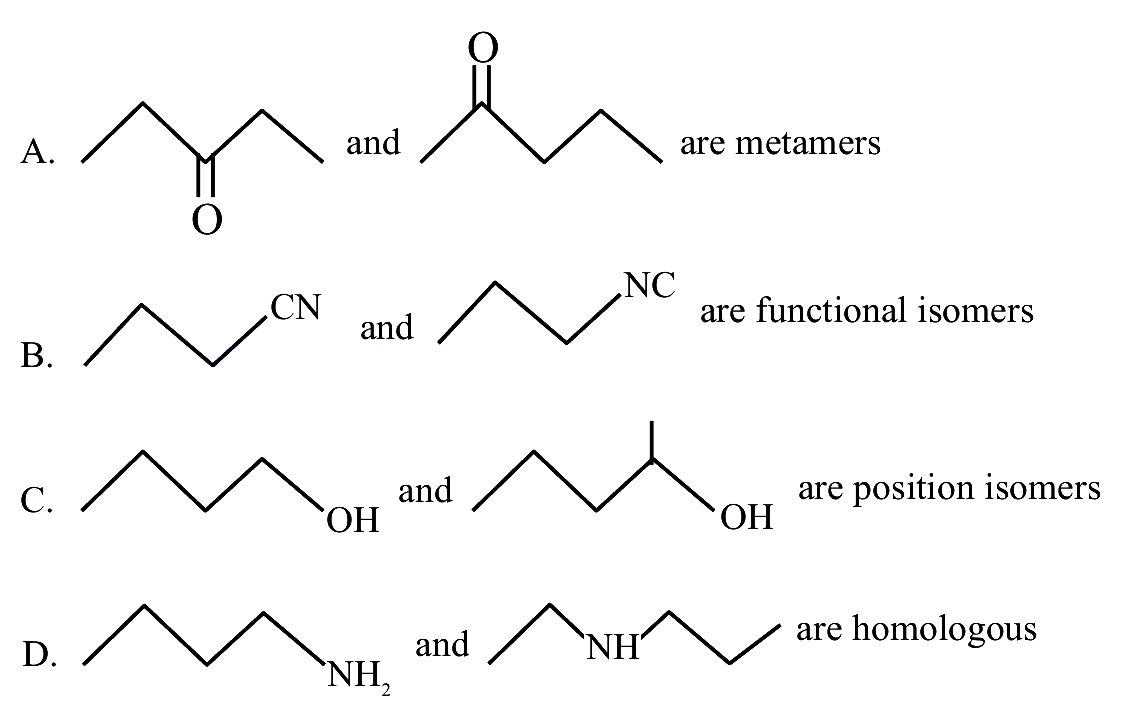
Choose the correct answer from the options given below. 2025 Medium- (A) C & D only
- (B) B & C only
- (C) A & B only
- (D) A,B & C only
Show answer and solution
Correct Answer: (C)
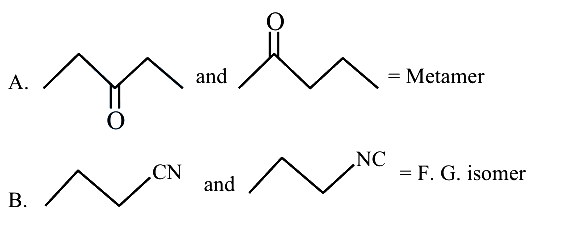
In option C are momologoes to each - other and option D are only organic molecule not isomers. -
- (A) 4
- (B) 6
- (C) 8
- (D) 10
Show answer and solution
Correct Answer: (C)
Since 4 moles of \(\mathrm{H}_2\) is being added for complete hydrogenation the degree of unsaturation \(=4\)
No. of \(\pi\) electrons in \(\mathrm{C}_6 \mathrm{H}_6=4 \times 2=8\) -
- (A) 9
- (B) 6
- (C) 3
- (D) 2
Show answer and solution
Correct Answer: (C)
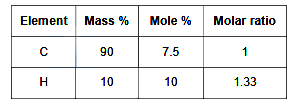
\(\therefore\) Empirical formula is \(\mathrm{C}_3 \mathrm{H}_4\)
Molecular mass \(=80 \mathrm{~g} \mathrm{~mol}^{-1}\).
Molecular formula \(=\left(\mathrm{C}_3 \mathrm{H}_4\right)_{\mathrm{n}}\)
\(\mathrm{n}=\frac{\text { Molecular mass }}{\mathrm{EF} \text { mass }}=\frac{80}{40}=2\)
\(\therefore\) Molecular formula is \(\mathrm{C}_6 \mathrm{H}_8\)
Degree of unsaturation \(=\frac{2 \times 6+2-8}{2}=3\) -
- (A) 5
- (B) 4
- (C) 3
- (D) 1
Show answer and solution
Correct Answer: (B)
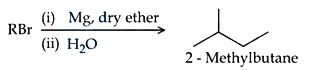
\(\mathrm{RBr} \xrightarrow[\text { dry Ether }]{\mathrm{Mg}} \mathrm{RMgBr} \xrightarrow{\mathrm{H}_2 \mathrm{O}} \mathrm{R}-\mathrm{H}\)
Hence, RBr Can be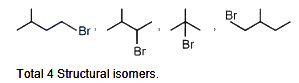
-
- (A) 8
- (B) 10
- (C) 12
- (D) 14
Show answer and solution
Correct Answer: (A)
\(\mathrm{MF}=\mathrm{C}_9 \mathrm{H}_{12}\)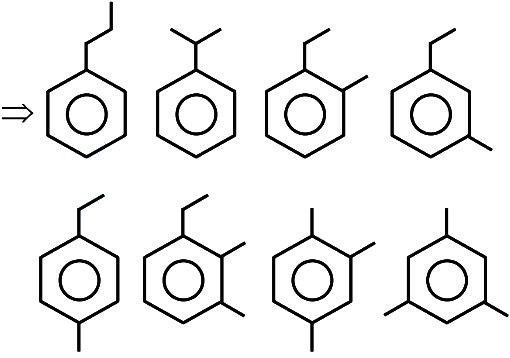
-
- (A) Positional isomerism
- (B) Both positional isomerism and metamerism
- (C) Metamerism
- (D) Functional group isomerism
Show answer and solution
Correct Answer: (D)
\(C _{3} H _{6} O \Rightarrow CH _{3}- CH _{2}- CH = O\)\(\begin{array}{*{20}{c}} {C{H_3} - C - C{H_3}} \\ {||} \\ O \end{array}\)
They are functional group isomerism.
-
- (A) \(\begin{array}{*{20}{c}}
{C{H_3} - C{H_2} - C{H_2} - C - C{H_3}} \\
{\,\,\,\,\,\,\,\,\,\,\,\,\,\,\,\,\,\,\,\,\,\,\,\,\,\,\,\,\,\,\,\,\,\,\,\,\,||\,} \\
{\,\,\,\,\,\,\,\,\,\,\,\,\,\,\,\,\,\,\,\,\,\,\,\,\,\,\,\,\,\,\,\,\,\,\,\,O}
\end{array}\) and \(\begin{array}{*{20}{c}}
{C{H_3} - C{H_2} - C - C{H_2} - C{H_3}} \\
{\,\,\,\,\,\,\,\,\,\,\,\,\,\,\,\,\,\,\,\,\,\,\,\,\,\,\,\,\,\,\,\,\,\,\,\,\,||\,\,\,\,\,\,\,\,\,\,\,\,\,\,\,\,\,\,\,\,\,\,\,\,\,\,\,\,\,\,\,\,\,\,\,\,} \\
{\,\,\,\,\,\,\,\,\,\,\,\,\,\,\,\,\,\,\,\,\,\,\,\,\,\,\,\,\,\,\,\,\,\,\,\,O\,\,\,\,\,\,\,\,\,\,\,\,\,\,\,\,\,\,\,\,\,\,\,\,\,\,\,\,\,\,\,\,\,\,\,}
\end{array}\) - (B) \(C{H_3} - C{H_2} - C{H_2} - C{H_2} - CHO\) and \(\begin{array}{*{20}{c}}
{\,\,\,\,\,\,\,\,\,\,\,\,\,\,\,\,\,\,\,\,\,\,\,\,\,\,\,\,\,\,\,\,\,\,\,\,\,O} \\
{\,\,\,\,\,\,\,\,\,\,\,\,\,\,\,\,\,\,\,\,\,\,\,\,\,\,\,\,\,\,\,\,\,\,\,\,||} \\
{C{H_3} - C{H_2} - C{H_2} - C - C{H_3}}
\end{array}\) - (C) \(\begin{array}{*{20}{c}}
{C{H_3} - C{H_2} - C{H_2} - C - C{H_3}} \\
{\,\,\,\,\,\,\,\,\,\,\,\,\,\,\,\,\,\,\,\,\,\,\,\,\,\,\,\,\,\,\,\,\,\,\,\,||} \\
{\,\,\,\,\,\,\,\,\,\,\,\,\,\,\,\,\,\,\,\,\,\,\,\,\,\,\,\,\,\,\,\,\,\,\,\,\,O}
\end{array}\) and \(\begin{array}{*{20}{c}}
{C{H_3} - CH - C{H_2} - CHO} \\
{|\,\,\,\,\,\,\,\,\,\,\,\,\,\,\,\,\,\,\,\,\,\,\,\,} \\
{C{H_3}\,\,\,\,\,\,\,\,\,\,\,\,\,\,\,\,\,\,\,}
\end{array}\) - (D) \(\begin{array}{*{20}{c}}
{C{H_3} - C{H_2} - C - C{H_2} - C{H_3}} \\
{\,\,\,\,\,\,\,\,\,\,\,\,\,\,\,\,\,\,\,\,\,\,\,\,\,\,\,\,\,\,\,\,\,\,\,\,||\,\,\,\,\,\,\,\,\,\,\,\,\,\,\,\,\,\,\,\,\,\,\,\,\,\,\,\,\,\,\,\,\,\,\,\,} \\
{\,\,\,\,\,\,\,\,\,\,\,\,\,\,\,\,\,\,\,\,\,\,\,\,\,\,\,\,\,\,\,\,\,\,\,\,\,O\,\,\,\,\,\,\,\,\,\,\,\,\,\,\,\,\,\,\,\,\,\,\,\,\,\,\,\,\,\,\,\,\,\,\,\,\,}
\end{array}\) and \(\begin{array}{*{20}{c}}
{C{H_3}} \\
{C{H_3}}
\end{array} > CH\) \(-CH_2-CHO\)
Show answer and solution
Correct Answer: (A)
Pentan \(-2-\) one and pentan \(-3-\) one are position isomers \((b) , (c) , (d)\) contain different compounds aldehyde and ketones. - (A) \(\begin{array}{*{20}{c}}
No questions on this page match these filters.
Other STD 11 - Organic chemistry isomerism topics
Frequently asked
How many Structural isomerism questions came in JEE Mains?
12 questions from 2015–2026, each with the correct answer and a full solution.
How difficult are Structural isomerism questions?
25% are easy, 33% medium and 42% hard.