


Questions
Newest firstShowing 1–23 of 23 questions
- 1. In Young's double slit experiment, the fringe width of the interference pattern produced on the screen is \(2.4\) \(\mu\)m. If the experiment is carried out in another medium having refractive index \(1.2\), the fringe width will be _____ \(\mu\)m. 2026 Easy
- 2. Two coherent monochromatic light beams of intensities 4I and 9I are superimposed. The difference between the maximum and minimum intensities in the resulting interference pattern is xI. The value of \(x\) is ______. 2025 Medium
- 3. Two monochromatic light beams have intensities in the ratio 1:9. An interference pattern is obtained by these beams. The ratio of the intensities of maximum to minimum is _______. 2025 Easy
- 4. Two plane polarized light waves combine at a certain point whose electric field components are :
\(\begin{aligned} & \mathrm{E}_1=\mathrm{E}_0 \sin \omega \mathrm{t} \\ & \mathrm{E}_2=\mathrm{E}_0 \sin \left(\omega \mathrm{t}+\frac{\pi}{3}\right)\end{aligned}\)
Find the amplitude of the resultant wave. 2025 Easy - 5. Width of one of the two slits in a Young's double slit interference experiment is half of the other slit. The ratio of the maximum to the minimum intensity in the interference pattern is _______. 2025 Easy
- 6. Two coherent monochromatic light beams of intensities \(I\) and \(4I\) are superimposed. The difference between maximum and minimum possible intensities in the resulting beam is \(x\)I. The value of \(x\) is _______. 2024 Hard
- 7. Two waves of intensity ratio \(1: 9\) cross each other at a point. The resultant intensities at the point, when (a) Waves are incoherent is \(I_1\) (b) Waves are coherent is \(I_2\) and differ in phase by \(60^{\circ}\). If \(\frac{I_1}{I_2}=\frac{10}{x}\), then \(x=\) _______. 2024 Medium
- 8. The two light beams having intensities I and 9I interfere to produce a fringe pattern on a screen. The phase difference between the beams is \(\frac{\pi}{2}\) at point \(P\) and \(\pi\) at point \(Q\). Then the difference between the resultant intensities at \(P\) and \(Q\) will be.......\(I\) 2022 Medium
- 9. Two beams of light having intensities \(I\) and \(4\,I\) interfere to produce a fringe pattern on a screen. The phase difference between the two beams are \(\pi / 2\) and \(\pi / 3\) at points \(A\) and \(B\) respectively. The difference between the resultant intensities at the two points is \(x I\). The value of \(x\) will be. 2022 Medium
- 10. Two coherent sources of light interfere. The intensity ratio of two sources is \(1: 4\). For this interference pattern if the value of \(\frac{I_{\max }+I_{\min }}{I_{\max _{\max }}-I_{\min }}\) is equal to \(\frac{2 \alpha+1}{\beta+3}\), then \(\frac{\alpha}{\beta}\) will be. 2022 Hard
- 11. Two light beams of intensities \(4\,I\) and \(9\,I\) interfere on a screen. The phase difference between these beams on the screen at point \(A\) is \(zero\) and at point \(B\) is \(\pi\). The difference of resultant intensities, at the point \(A\) and \(B\), will be \(....I\). 2022 Medium
- 12. Two light beams of intensities in the ratio of \(9: 4\) are allowed to interfere. The ratio of the intensity of maxima and minima will be 2022 Medium
- 13. The difference in the number of waves when yellow light propagates through air and vacuum columns of the same thickness is one. The thickness of the air column is \(....\,{mm} .\) [Refractive index of air \(=1.0003\), wavelength of yellow light in vacuum \(=6000 \,\mathring {{A}}\) ] 2021 Hard
- 14. The light waves from two coherent sources have same intensity \({I}_{1}={I}_{2}={I}_{0} .\) In interference pattern the intensity of light at minima is zero.What will be the intensity of light at maxima? 2021 Medium
- 15. Figure here shows \(P\) and \(Q\) as two equally intense coherent sources emitting radiations of wavelength \(20 \,m\). The separation \(PQ\) is \(5.0 \,m\) and phase of \(P\) is ahead of the phase of \(Q\) by \(90^{0}\). \(A, B \) and \( C\) are three distant points of observation equidistant from the mid-point of \(PQ\). The intensity of radiations at \(A, B, C\) will bear the ratio
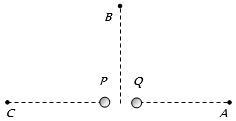 2020 Medium
- 16. Two coherent sources of sound, \(S_{1}\) and \(S_{2}\) produce sound waves of the same wavelength, \(\lambda=1\, m ,\) in phase. \(S_{1}\) and \(S_{2}\) are placed \(1.5\, m\) apart (see fig.) A listener, located at \(L,\) directly in front of \(S_{2}\) finds that the intensity is at a minimum when he is \(2\,m\) away from \(S _{2}\). The listener moves away from \(S _{1},\) keeping his distance from \(S_{2}\) fixed. The adjacent maximum of intensity is observed when the listener is at a distance \(d\) from \(S\)\(_{1}\). Then, \(d\) is\(......m\)
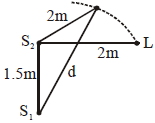 2020 Hard
- 17. Two light waves having the same wavelength \(\lambda\) in vacuum are in phase initially. Then the first wave travels a path \(L _{1}\) through a medium of refractive index \(n_{1}\) while the second wave travels a path of length \(L_{2}\) through a medium of refractive index \(n _{2}\). After this the phase difference between the two waves is: 2020 Medium
- 18. Two coherent sources produce waves of different intensities which interfere. After interference, the ratio of the maximum intensity to the minimum intensity is \(16\). The intensity of the waves are in the ratio 2019 Medium
- 19. Interference pattern is observed at \('P'\) due to superimposition of two rays coming out from a source \('S'\) as shown in the figure. The value of \('I'\) for which maxima is obtained at \('P'\) is: ( \(R\) is perfect reflecting surface)
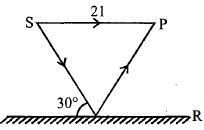 2014 Hard
- 20. Match List \(− I\) (Event) with List \(−II \) (Order of the time interval for happening of the event) and select the correct option from the options given below the lists
2014 MediumList \(- I\) List \(- II\) \((1)\) Rotation period of earth \((i)\) \(10^5\, s\) \((2)\) Revolution period of earth \((ii)\) \(10^7\, s\) \((3)\) Period of light wave \((iii)\) \(10^{-15}\, s\) \((4)\) Period of sound wave \((iv)\) \(10^{-3}\, s\) - 21. Two monochromatic light beams of intensity \(16\) and \(9\) units are interfering . The ratio of intensities of bright and dark parts of the resultant pattern is 2014 Hard
- 22. A ray of light of intensity \(I\) is incident on a parallel glass slab at point \(A\) as shown in diagram. It undergoes partial reflection and refraction. At each reflection, \(25\%\) of incident energy is reflected. The rays \(AB\) and \(A'B'\) undergo interference. The ratio of \(I_{max}\) and \(I_{min}\) is
 2013 Hard
- 23. \(n\) identical waves each of intensity \(I_0\) interfere with each other. The ratio of maximum intensities if the interference is \((i)\) coherent and \((ii)\) incoherent is : 2013 Medium
No questions on this page match these filters.
Other STD 12 - Wave optics topics
- 25Qs Single Slit Diffraction of Light
- 57Qs Young's Double Slit Experiment
- 14Qs Resolving power-Human eye, Microscopes and Telescopes
- 10Qs Brewster's Law and Other methods of polarisation
- 20Qs Polarisation of Light and Malus' Law
- 4Qs Fresnel distance, Diffraction through circular slit, concept of Airy Disc, Rayleigh Criterion of Resolution, Fraunhofer diffraction
- 15Qs Variations in YDSE
- 2Qs Thin film Interference
- 2Qs Huygens' Principle and Wave-fronts
- 1Qs Mix Examples-Wave Optics
- 4Qs Doppler's Effect of Light
Frequently asked
How many Wave Nature and Interference of Light questions came in JEE Mains?
23 questions from 2013–2026, each with the correct answer and a full solution.
How difficult are Wave Nature and Interference of Light questions?
17% are easy, 52% medium and 30% hard.