


Questions
Newest firstShowing 1–28 of 28 questions
-
- (A) 12
- (B) 14
- (C) 16
- (D) 18
Show answer and solution
Correct Answer: (C)
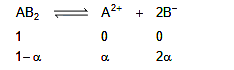
\(\begin{aligned} & \mathrm{i}=1+2 \alpha \\ & =1+2 \times(0.3) \\ & =1.6 \\ & =16 \times 10^{-1}\end{aligned}\) -
- (A) 25
- (B) 50
- (C) 75
- (D) 100
Show answer and solution
Correct Answer: (C)
Normal molar mass of \(\mathrm{MX}_2=164.0 \mathrm{~g} \mathrm{~mol}^{-1}\)
Observed molar mass of \(\mathrm{MX}_2=65.6 \mathrm{~g} \mathrm{~mol}^{-1}\)
\(\begin{aligned}
& \text { Van't Hoff factor }(\mathrm{i})=\frac{\text { Normal molar mass }}{\text { Observed molar mass }} \\
& =\frac{164}{65.6}=2.5
\end{aligned}\)
If \(\alpha\) is the degree of ionisation, then
\(\begin{aligned}
& \underset{1-\alpha}{\mathrm{MX}_2} \rightleftharpoons \mathrm{M}_\alpha^{2+}+\underset{2 \alpha}{2 \mathrm{X}^{-}} \\
& \mathrm{i}=1-\alpha+\alpha+2 \alpha=1+2 \alpha \\
& 1+2 \alpha=2.5 \\
& \alpha=0.75
\end{aligned}\)
\(\therefore\) Percent degree of ionisation \(=75 \%\) -
- (A) 11
- (B) 22
- (C) 33
- (D) 44
Show answer and solution
Correct Answer: (C)
\(\mathrm{MX}_3 \rightarrow \mathrm{M}^{+3}+3 \mathrm{X}^{\ominus}\)
\(\begin{aligned} & \mathrm{i}=1+(\mathrm{n}-1) \alpha \\ & \mathrm{i}=1+(4-1) \alpha=2\end{aligned}\)
\(\alpha=\frac{1}{3}=33.33 \% \approx 33 \%\) -
- (A) \(19\)
- (B) \(20\)
- (C) \(25\)
- (D) \(30\)
Show answer and solution
Correct Answer: (A)
\(\text { Mass of } \mathrm{CH}_3 \mathrm{COOH}=\mathrm{V} \times \mathrm{d}\)\(=5 \mathrm{ml} \times 1.2 \mathrm{~g} / \mathrm{ml}\)
\(=6 \mathrm{gm}\)
\(\mathrm{n}_{\mathrm{CH}_3 \mathrm{COOH}}=\frac{6}{60}=0.1 \mathrm{~mol}\)
\(\mathrm{~m}_{\mathrm{CH}_3 \mathrm{COOH}} \approx \mathrm{M}_{\mathrm{CH}_3 \mathrm{COOH}}=\frac{0.1}{1}=0.1 \mathrm{M}\)
\(\mathrm{CH}_3 \mathrm{COOH} \rightleftharpoons \mathrm{CH}_3 \mathrm{COO}^{-}+\mathrm{H}^{+}\)
\(\mathrm{C}\)
\(\mathrm{C}-\mathrm{C} \alpha\)
\(\mathrm{K}_{\mathrm{a}}=\frac{\mathrm{C} \alpha^2}{1-\alpha}\)
\(1-\alpha \approx 1 \Rightarrow \mathrm{K}_{\mathrm{a}}=\mathrm{C}^2\)
\(\alpha=\sqrt{\frac{\mathrm{Ka}^2}{\mathrm{C}}}=\sqrt{\frac{6.25 \times 10^{-5}}{0.1}}=25 \times 10^{-3}\)
\(\mathrm{~V} . \mathrm{f} .(\mathrm{i})=1+\alpha(\mathrm{n}-1)=1+\alpha(2-1)=1+\alpha\)
\(=1+25 \times 10^{-3}=1.025\)
\(\Delta \mathrm{T}_{\mathrm{r}}=i \mathrm{~K} \mathrm{~m}\)
\(=(1.025)(1.86)(0.1)\)
\(=0.19\)
\(=19 \times 10^{-2}\)
-
- (A) \(15\)
- (B) \(10\)
- (C) \(9\)
- (D) \(8\)
Show answer and solution
Correct Answer: (A)
\(\Delta \mathrm{T}_{\mathrm{f}}=\mathrm{i} \mathrm{K}_{\mathrm{f}} \times \text { molality }\)\(24=(1) \times 1.86 \times \frac{\mathrm{W}}{62 \times 18.6}\)
\(\mathrm{~W}=14880 \mathrm{gm}\)
\(=14.880 \mathrm{~kg}\)
-
- (A) \(i_A < i_B < i_C\)
- (B) \(i_A < i_C < i_B\)
- (C) \(i_A=i_B=i_C\)
- (D) \(i_A>i_B>i_C\)
Show answer and solution
Correct Answer: (A)
Salt Values of \(i\) (for different conc. of a Salt) \(0.1 M\) \(0.01 M\) \(0.001 M\) \(NaCl\) \(1.87\) \(1.94\) \(1.94\) \(i\) approach \(2\) as the solution become very dilute.
-
- (A) \(31\)
- (B) \(30\)
- (C) \(32\)
- (D) \(33\)
Show answer and solution
Correct Answer: (B)
\(i=1+\alpha(\text { for } HA )\)\(=1.3\)
\(\%\) increase \(=\frac{\left(\Delta T _{ f }\right)_{ obs }-\left(\Delta T _{ f }\right)_{ cal }}{\left(\Delta T _{ f }\right)_{ cal }} \times 100\)
\(=\frac{K_f \times i \times m-K_f \times m}{K_f \times m} \times 100\)
\(=\frac{i-1}{1} \times 100=30 \%\)
-
- (A) \(241\)
- (B) \(242\)
- (C) \(256\)
- (D) \(243\)
Show answer and solution
Correct Answer: (D)
\(\Delta T _{ f }= i \cdot K _{ f } \cdot m\)\(\Rightarrow \Delta T _{ f }=2.67 \times 1.8 \times \frac{38}{98} \times \frac{1000}{62}\)
\(\Rightarrow \Delta T _{ f }=30.05\)
\(\therefore \text { F.P. }=243\,K\)
-
- (A) \(A-III, B-I, C-II, D-IV\)
- (B) \(A-III, B-II, C-I, D-IV\)
- (C) \(A-III, B-I, C-IV, D-II\)
- (D) \(A-I, B-III, C-II, D-IV\)
Show answer and solution
Correct Answer: (A)
\((A)\) van't Hoff factor, \(i\)\(i =\frac{\text { Normal molar mass }}{\text { Abnormal molar mass }}\)
\((B)\) \(k _{ f }=\) Cryoscopic constant
\((C)\) Solutions with same osmotic pressure are known as isotonic solutions.
\((D)\) Solutions with same composition of vapour over them are called Azeotrope.
-
- (A) \(2.00\)
- (B) \(6.00\)
- (C) \(8.00\)
- (D) \(4\)
Show answer and solution
Correct Answer: (D)
\(\pi= iCRT\)\(\pi \propto iC\)
\(A, B, D\) and \(E\) have same value of osmatic pressure.
-
- (A) \(41\)
- (B) \(60\)
- (C) \(80\)
- (D) \(98.5\)
Show answer and solution
Correct Answer: (D)
\(0.5\, \%\) solution of \(KCl\)So \(m =\frac{0.5}{74.6} \times \frac{1}{0.1}\)
\(\Delta T _{ f }= i \times m _{ f }\)
\(0.24=i \cdot \frac{0.5}{74.6} \times \frac{1.80}{0.1}\)
\(i=\frac{0.24 \times 74.6}{0.5 \times 1.80} \times 0.1\)
\(=1.989\)
\(1.989=1+\alpha( n -1)\)
\(1.989=1+\alpha\)
\(\alpha=.989\)
\(\% \alpha=98.9 \%\)
Ans \(99 \,\%\)
If mass of \(H _{2} O =99.5\)
\(m =\frac{0.5}{74.5} \times \frac{1}{.0995}\)
\(i =\frac{0.24 \times 74.6 \times .0995}{.5 \times 1.80}\)
\(=1.979\)
\(1.979=1+\alpha( n -1)\)
\(1.979=1+\alpha\)
\(\alpha=.979\)
\(\% \alpha=97.9\, \%\)
\(98\, \%\)
-
- (A) \(4\)
- (B) \(1\)
- (C) \(2\)
- (D) \(3\)
Show answer and solution
Correct Answer: (D)
\(\Delta T _{ b }= i\,K _{ b } \,m\)\(\Delta T _{ f }= i\,K _{ i } \,m\)
\(\frac{4}{4}=\frac{ K _{ b } 1.5}{ K _{ f } 4.5}\)
\(\frac{ K _{ b }}{ K _{ f }}=3\)
-
- (A) \(50\)
- (B) \(60\)
- (C) \(70\)
- (D) \(80\)
Show answer and solution
Correct Answer: (D)
\(\Delta T = i \,k _{ f } \times m\)\(0.2= i \times 1.86 \times \frac{0.7}{93} \times \frac{1000}{42}\)
\(i =\frac{0.2 \times 93 \times 6}{1.86 \times 100}\)
\(i =0.60\)
\(2 A \quad \rightleftharpoons A _{2}\)
\(1-\alpha\)
\(i =1-\alpha+\frac{\alpha}{2}\)
\(i =1-\frac{\alpha}{2}\)
\(1-\frac{\alpha}{2}=0.60\)
\(1-0.60=\frac{\alpha}{2}\)
\(\alpha=0.80\)
-
- (A) \(236\)
- (B) \(654\)
- (C) \(313\)
- (D) \(415\)
Show answer and solution
Correct Answer: (D)
\(\pi= iCRT\)\(=\frac{1 \times 2}{60000 \times 0.2} \times 0.083 \times 300\)
\(=0.00415\) bar \(\quad\left(\because 1\right.\) bar \(\left.=10^{5} Pa \right)\)
So, \(0.00415 \times 10^{5} Pa =415 \,Pa\)
-
- (A) \(370\)
- (B) \(380\)
- (C) \(375\)
- (D) \(385\)
Show answer and solution
Correct Answer: (C)
\(\Delta T _{ b }= iK _{ b } m\)\(=(1+4 \alpha) \times 0.52 \times 1\)
\(=3.4 \times 0.52 \times 1=1.768\)
\(T _{ b }=1.768+313.15=374.918 K\)
\(=375 K\)
-
- (A) \(95\)
- (B) \(85\)
- (C) \(105\)
- (D) \(26\)
Show answer and solution
Correct Answer: (B)
\(\quad \quad \quad \quad \quad K _{4} Fe ( CN )_{6} \rightleftharpoons 4 K ^{+}+ Fe ( CN )_{6}^{4-}\)Initial conc. \(1\, m\quad \quad \quad \quad \quad \quad 0\quad \quad \quad \quad 0\)
Final conc. \((1-0.4) \,m \quad \quad 4 \times 0.4 \quad \quad 0.4\, m\)
\(\quad \quad \quad \quad \quad \quad =0.6\,m \quad \quad \quad =1.6\,m\)
Effective molality \(=0.6+1.6+0.4=2.6 \,m\)
For same boiling point, the molality of another solution should also be \(2.6\, m\).
Now,\(18.1\) weight percent solution means \(18.1\, gm\) solute is present in \(100\, gm\) solution and hence, \((100-18.1=) 81.9 \,gm\) water.
\(\text { Now, } \quad 2.6=\frac{18.1 / M }{81.9 / 1000}\)
\(\therefore\) Molar mass of solute, \(M =85\)
-
- (A) \(50\)
- (B) \(60\)
- (C) \(55\)
- (D) \(65\)
Show answer and solution
Correct Answer: (A)
\(\Delta T _{ f }=(1+\alpha) K _{ f } m\)\(\alpha=0.05=50 \times 10^{-3}\)
-
- (A) \(150\)
- (B) \(125\)
- (C) \(175\)
- (D) \(850\)
Show answer and solution
Correct Answer: (B)
\(\quad\quad\quad\quad\quad\quad2 \mathrm{HA} \rightleftharpoons \mathrm{H}_{2} \mathrm{~A}_{2} \quad \mathrm{HA} \rightleftharpoons \mathrm{H}^{+}+\mathrm{A}\)\(\text { Initial moles } \mathrm{a} \times \frac{50}{100} \quad\quad 0 \quad \mathrm{a} \times \frac{50}{100} \quad0 \quad\quad 0\)
\(\text { Final moles }\quad 0 \quad 0.25 \mathrm{a} \quad\quad\quad0 \quad\quad 0.5 \mathrm{a} \quad\quad 0.5 \mathrm{a}\)
Now, \(i=\frac{\text { final moles }}{\text { initial moles }}=\frac{0.25 a+0.5 a+0.5 a}{0.5 a+0.5 a}\)
\(=1.25=125 \times 10^{-2}\)
- 19. Which one of the following \(0.06\, \mathrm{M}\) aqueous solutions has lowest freezing point? 2021 Medium
- (A) \(\mathrm{C}_{6} \mathrm{H}_{12} \mathrm{O}_{6}\).
- (B) \(\mathrm{K}_{2} \mathrm{SO}_{4}\)
- (C) \(KI\)
- (D) \(\mathrm{Al}_{2}\left(\mathrm{SO}_{4}\right)_{3}\)
Show answer and solution
Correct Answer: (D)
\(\Delta \mathrm{T}_{\mathrm{f}}=\mathrm{i} \mathrm{k}_{\mathrm{f}} \times \mathrm{m}\)\(\Delta \mathrm{T}_{\mathrm{f}} \alpha\) \(i\) but \(F.P\) \(\alpha 1 / \mathrm{i}\)
-
- (A) \(10\)
- (B) \(5\)
- (C) \(12\)
- (D) \(15\)
Show answer and solution
Correct Answer: (B)
\(\Delta T_{b}=i \times K_{b} \times m\)\(i \times 0.1 \times K_{b}=3 \times 0.05 \times K_{b} \times 2\)
\(i=3\)
\(\left[C r\left(N H_{3}\right)_{5} \cdot C l\right] C l_{2} \rightarrow\left[C r\left(N H_{3}\right)_{5} C l\right]^{+2}+2 C l^{-}\)
\(x=5\)
-
- (A) \(48\)
- (B) \(32\)
- (C) \(64\)
- (D) \(16\)
Show answer and solution
Correct Answer: (C)
Let moles of \(H_2O\) separated as ice \(=\,x\,gm\)\(\Delta {T_f}\, = \,\,i\,{K_f}m\)
\(10\, = \,1\, \times \,1.86\,\frac{{\frac{{62}}{{62}}}}{{\frac{{250\, - \,x}}{{1000}}}}\)
\(x\, = \,64\,gm\)
- 22. \(K_2HgI_4\) is \(40\%\) ionized in aqueous solution. The value of its van’t Hoff factor \((i)\) 2019 Hard
- (A) \(1.6\)
- (B) \(1.8\)
- (C) \(2.0\)
- (D) \(2.2\)
Show answer and solution
Correct Answer: (B)
\(\mathop {{K_2}\,[Hg{I_4}]}\limits_{1 - \alpha } \, \rightleftharpoons \,\mathop {2{K^ + }}\limits_\alpha \, + \,\mathop {{{[Hg{I_4}]}^{2 - }}}\limits_\alpha \)Total number of particle \(=\,1+2\alpha \)
Hence, Van't Hoff factor \(=\,\frac {1+2\alpha }{1}\)
\(=\frac {1+2\times 0.4}{1}\) \(=\,1+0.8\) \(\Rightarrow \) \(1.8\)
-
- (A) \(0.12\)
- (B) \(0.36\)
- (C) \(0.18\)
- (D) \(0.24\)
Show answer and solution
Correct Answer: (B)
\({K_f}\, = \,4\,K\,Kg\,mo{l^{ - 1}}\)\(i\, = \,3\)
Molality \(=\,0.03\)
\(\Delta {T_f}\, = \,i{K_f}m\)
\( = \,3(4)\,(0.03)\)
\(\Delta {T_f}\, = \,0.36\,K\)
-
- (A) \(2.4\)
- (B) \(1\)
- (C) \(1.5\)
- (D) \(1.8\)
Show answer and solution
Correct Answer: (A)
\(2A\, \to \,{A_2}\)\(1 - \alpha \) \(\frac{\alpha }{2}\)
\(1 - 0.8\) \(\frac{{0.8}}{2}\)
\(i\, = 1 - 0.8\, + \,\frac{{0.8}}{2}\, = \,0.6\)
\(\Delta {T_f}\, = \,{K_f}\, \times \,\,i\,\, \times \,\,m\) \( = \,5\,\, \times \,0.6\,\, \times \,\frac{X}{{122}}\, \times \,\frac{{1000}}{{30}}\, = \,2\) (Since \(\Delta {T_f}\, = \,2\) )
\(\therefore \,X\, = \,2.44\,g\)
-
- (A) \(15\)
- (B) \(25\)
- (C) \(45\)
- (D) \(65\)
Show answer and solution
Correct Answer: (C)
Molality (experimental)\( = \,\frac{{\Delta {T_f}}}{{{K_f}}}\, = \,\frac{{3.82}}{{1.86}}\, = \,2.054\,mol/1000\,g\) solvent
Molality (theoretical)
\( = \,\frac{{mole\,\,of\,solute}}{{wt.\,of\,solventing\,(g)}} \times 1000\)
\( = \,\frac{{5\,g\,/\,142\,g\,/\,mole}}{x} \times 1000\)
\(N{a_2}S{O_4}\, \to \,2N{a^ + }\, + \,SO_4^{2 - }\)
Moles before dissociation \(1\) \(0\) \(0\)
Moles after dissociation \(1-x\) \(2x\) \(x\)
Von't Hoff Factor \((i) = \,\frac{{Moles\,after\,\,dissociation}}{{Moles\,before\,\,dissociation}}\)
\( = \frac{{(1 - x)\, + \,2x\, + \,x}}{1}\)
\(Na_2SO_4\) is ionised \(81.5\%\) means \(x\,=\,0.815\)
\( = \frac{{(1 - 0.815)\, + \,2 \times 0.815\, + \,0.815}}{1}\)
\(=\,2.63\)
\(i\, = \,\frac{{Observed\,\,molarrity}}{{Calculated\,\,molarity}}\)
\( \Rightarrow \,2.63\, = \,\frac{{2.054}}{{\frac{{0.0352}}{x} \times 1000}}\, = \,45.07\,g\)
-
- (A) \(64.6\)
- (B) \(80.4\)
- (C) \(74.6\)
- (D) \(94.6\)
Show answer and solution
Correct Answer: (D)
\( \quad \quad \quad \quad 2 \mathrm{CH}_{3} \mathrm{COOH} \rightleftharpoons\left(\mathrm{CH}_{3} \mathrm{COOH}\right)_{2} \)\(Initial\; moles\quad \quad 1 \quad \quad \quad \quad 0\)
\(at\; equilibrium \quad 1-\alpha\quad \quad \alpha / 2\)
Total number of moles at equilibrium \(=1-\alpha+\alpha / 2 \Rightarrow i=1-\alpha / 2(\text { association })\)
\(\Delta T_{\mathrm{r}}=K_{\mathrm{r}} \times m \times i\)
\(0.45=(5.12) \times \frac{(0.2 / 60)}{(20 / 1000)} \times\left(1-\frac{\alpha}{2}\right)\)
\(\left(1-\frac{\alpha}{2}\right)=0.527 \Rightarrow \alpha=0.945\)
So, the percentage of acetic acid that dimerizes \(=94.5 \%\)
-
- (A) \(0.50\)
- (B) \(0.33\)
- (C) \(0.67\)
- (D) \(0.80\)
Show answer and solution
Correct Answer: (A)
\((a)\) Van't Hoff factore \((i)\)\(=\,\frac {No.\, of\, particles\, after \,association\, or \,dissociation}{No.\, of\, particles\, before\, association\, or \,dissociation}\)
For \(M{X_2}\, \rightleftharpoons \,{M^{2 + }}\, + \,2{X^ - }\)
\(t\,=\,0\) \(1\) \(0\) \(0\)
at.eq. \(1-\alpha \) \(\alpha \) \(2\alpha \)
Total no. of particles
\(=\,1\,-\,\alpha + \alpha +2\alpha \,=\,1+2\alpha \)
\(\therefore \) \(i\,=\,\frac {1+2\alpha }{1}\) \(=\,2\)
\(\therefore \alpha \,=\,0.50\) or \(50\%\)
-
- (A) \(3\)
- (B) \(5\)
- (C) \(2\)
- (D) \(4\)
Show answer and solution
Correct Answer: (C)
van't Hoff factor \((i)\) and the degree of association are related as below :\(i\, = \,1\, - \,\alpha \,\left( {1 - \,\frac{1}{n}} \right)\)
\(0.9\, = \,1 - \,0.2\,\left( {1 - \frac{1}{n}} \right)\)
On solving,
\(\,\left( {1 - \frac{1}{n}} \right)\, = \,\frac{1}{2}\)
\(\frac{1}{n}\, = \,1\, - \frac{1}{2}\, = \frac{1}{2}\)
\(\therefore \,n = 2\)
No questions on this page match these filters.
Other STD 12 -Solution and colligative properties topics
- 25Qs Depression of freezing point of the solvent
- 4Qs Colligative properties
- 23Qs Osmosis and Osmotic pressure of the solution
- 25Qs Lowering of vapour pressure
- 32Qs Method of expressing concentration of solution
- 25Qs Solubility
- 20Qs Elevation of boiling point of the solvent
- 2Qs Colligative properties of electrolyte
- 2Qs Azeotropic mixture
- 2Qs Ideal and Non-ideal solution
Frequently asked
How many Abnormal molecular mass questions came in JEE Mains?
28 questions from 2013–2025, each with the correct answer and a full solution.
How difficult are Abnormal molecular mass questions?
18% are easy, 43% medium and 39% hard.