


Questions
Newest firstShowing 1–11 of 11 questions
- 1. A particle of mass ' \(m\) ' and charge ' \(q\) ' is fastened to one end ' \(A\) ' of a massless string having equilibrium length \(l\), whose other end is fixed at point ' \(O\) '. The whole system is placed on a frictionless horizontal plane and is initially at rest. If uniform electric field is switched on along the direction as shown in figure, then the speed of the particle when it crosses the x -axis is
 2025 Hard
- 2. An electron is made to enter symmetrically between two parallel and equally but oppositely charged metal plates, each of 10 cm length. The electron emerges out of the electric field region with a horizontal component of velocity \(10^6 \mathrm{~m} / \mathrm{s}\). If the magnitude of the electric field between the plates is \(9.1 \mathrm{~V} / \mathrm{cm}\), then the vertical component of velocity of electron is (mass of electron \(=9.1 \times 10^{-31} \mathrm{~kg}\) and charge of electron \(=1.6 \times 10^{-19} \mathrm{C}\) ) 2025 Medium
- 3. An electron is moving under the influence of the electric field of a uniformly charged infinite plane sheet \(S\) having surface charge density \(+\sigma\). The electron at \(t=0\) is at a distance of 1 m from \(S\) and has a speed of \(1 m s ^{-1}\). The maximum value of \(\sigma\), if the electron strikes \(S\) at \(t=1 s\) is \(\alpha\left[\frac{m \epsilon_0}{e}\right] \frac{ C }{ m ^2}\). The value of \(\alpha\) is __________ . 2024 Medium
- 4. A stream of a positively charged particles having \(\frac{ q }{ m }=2 \times 10^{11} \frac{ C }{ kg }\) and velocity \(\overrightarrow{ v }_0=3 \times 10^7 \hat{ i ~ m} / s\) is deflected by an electric field \(1.8 \hat{ j } kV / m\). The electric field exists in a region of \(10 cm\) along \(x\) direction. Due to the electric field, the deflection of the charge particles in the \(y\) direction is \(...........mm\) 2023 Medium
- 5. A uniform electric field of \(10\,N / C\) is created between two parallel charged plates (as shown in figure). An electron enters the field symmetrically between the plates with a kinetic energy \(0.5\,eV\). The length of each plate is \(10\,cm\). The angle \((\theta)\) of deviation of the path of electron as it comes out of the field is \(.........\)(in degree).
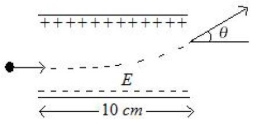 2023 Hard
- 6. A positive charge particle of \(100 \,mg\) is thrown in opposite direction to a uniform electric field of strength \(1 \times 10^{5} \,NC ^{-1}\). If the charge on the particle is \(40 \,\mu C\) and the initial velocity is \(200 \,ms ^{-1}\), how much distance (in \(m\)) it will travel before coming to the rest momentarily 2022 Medium
- 7. A uniform electric field \(E =(8\,m / e ) V / m\) is created between two parallel plates of length \(1 m\) as shown in figure, (where \(m =\) mass of electron and \(e=\) charge of electron). An electron enters the field symmetrically between the plates with a speed of \(2\,m / s\). The angle of the deviation \((\theta)\) of the path of the electron as it comes out of the field will be........
 2022 Hard
- 8. A body having specific charge \(8\,\mu {C} / {g}\) is resting on a frictionless plane at a distance \(10\, {cm}\) from the wall (as shown in the figure). It starts moving towards the wall when a uniform electric field of \(100 \,{V} / {m}\) is applied horizontally toward the wall. If the collision of the body with the wall is perfectly elastic, then the time period of the motion will be \(....\, S.\)
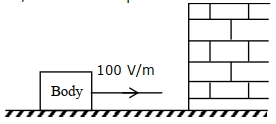 2021 Hard
- 9. An inclined plane making an angle of \(30^{\circ}\) with the horizontal is placed in a uniform horizontal electric field \(200 \, \frac{ N }{ C }\) as shown in the figure. A body of mass \(1\, kg\) and charge \(5\, mC\) is allowed to slide down from rest at a height of \(1\, m\). If the coefficient of friction is \(0.2,\) find the time (in \(s\) )taken by the body to reach the bottom. \(\left[ g =9.8 \,m / s ^{2}, \sin 30^{\circ}=\frac{1}{2}\right.\); \(\left.\cos 30^{\circ}=\frac{\sqrt{3}}{2}\right]\)
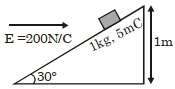 2021 Hard
- 10. A charged particle (mass \(m\) and charge \(q\) ) moves along \(X\) axis with velocity \(V _{0}\). When it passes through the origin it enters a region having uniform electric field \(\overrightarrow{ E }=- E \hat{ j }\) which extends upto \(x = d\). Equation of path of electron in the region \(x > d\) is
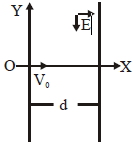 2020 Hard
- 11. A uniform electric field \(\vec E\) exists between the plates of a charged condenser. A charged particle enters the space between the plates and perpendicular to \(\vec E\) . The path of the particle between the plates is a 2013 Hard
No questions on this page match these filters.
Other STD 12 - Electric charges and fields topics
Frequently asked
How many Motion of Charge particle in Electric filed questions came in JEE Mains?
11 questions from 2013–2025, each with the correct answer and a full solution.
How difficult are Motion of Charge particle in Electric filed questions?
0% are easy, 36% medium and 64% hard.