


Questions
Newest firstShowing 1–20 of 20 questions
-
- (A) 7 and 5
- (B) 5 and 6
- (C) 5 and 7
- (D) 6 and 7
Show answer and solution
Correct Answer: (C)
Least metallic \(= F\), valence electrons \(= 7\)
Most metallic \(= P\), valence electrons \(= 5\) -
- (A) Both Statement I and Statement II are true
- (B) Both Statement I and Statement II are false
- (C) Statement I is false but Statement II is true
- (D) Statement I is true but Statement II is false
Show answer and solution
Correct Answer: (D)
Metallic character of s-block elements is greater than p-block elements.
Anionic radius is greater than atomic radius but cationic radius is always less than atomic radius for any element. -
- (A) Both Statement I and Statement II are true
- (B) Both Statement I and Statement II are false
- (C) Statement I is true but Statement II is false
- (D) Statement I is false but Statement II is true
Show answer and solution
Correct Answer: (A)
Statement I:
\(Al_2O_3\) and \(Cr_2O_3\) are both amphoteric oxides.
\(Cl_2O_7\) and \(Mn_2O_7\) are both acidic oxides.
\(Na_2O\) and \(V_2O_3\) are both basic oxides.
\(CO\) and \(N_2O\) are both neutral oxides.
All \(4\) pairs contain oxides of the same nature. Hence, Statement I is true.
Statement II:
\(Na_2O\) is a strongly basic oxide.
\(Al_2O_3\) is an amphoteric oxide.
\(CO\) is a neutral oxide.
\(Cl_2O_7\) is a strongly acidic oxide.
Thus, the most basic oxide is \(Na_2O\) and the most acidic oxide is \(Cl_2O_7\). Hence, Statement II is true.
Both Statement I and Statement II are true.
Answer: Both Statement I and Statement II are true - 4. The correct set that contains all kinds (basic, acidic, amphoteric and neutral) of oxides is: 2026 Medium
- (A) \(Na_2 O, K_2 O, Al_2 O_3\) and \(As_2 O_3\)
- (B) \(Al_2 O_3, As_2 O_3, CO\) and \(NO\)
- (C) \(K_2 O, Cl_2 O_7, As_2 O_3\) and \(NO\)
- (D) \(Na_2 O, N_2 O, Al_2 O_3\) and \(CO\)
Show answer and solution
Correct Answer: (C)
\(K_2O\) is a metallic oxide and is basic in nature.
\(Cl_2O_7\) is a non-metallic oxide with a high oxidation state and is acidic in nature.
\(As_2O_3\) is a metalloid oxide and is amphoteric in nature.
\(NO\) is a neutral oxide.
Thus, the set \(K_2O, Cl_2O_7, As_2O_3\) and \(NO\) contains all kinds of oxides.
Answer: \(K_2 O, Cl_2 O_7, As_2 O_3\) and \(NO\) -
- (A) A, B and D only
- (B) A, B, C and D
- (C) A and B only
- (D) B and C only
Show answer and solution
Correct Answer: (A)
→ On moving left to right in a period IE increases and from top to bottom in a group IE decreases.
\( F>P>S>B \) (IE order)
→ On moving left to right in a period metallic and basic character decreases.
\( K>Mg>Al>B \) (Metallic character order)
On moving top to bottom in a group metallic and basic character increases.
\( K_{2}O>Na_{2}O>MgO>Al_{2}O_{3} \)
→ EA: Group 17 > Group 16 > Group 15
\( Cl>F>S>P \) -
- (A) \(A\) only
- (B) \(A\), \(B\) and \(D\) only
- (C) \(A\) and \(B\) only
- (D) \(B\), \(C\) and \(D\) only
Show answer and solution
Correct Answer: (B)
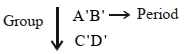
In general along the period from left to right, size decreases and metallic character decrease.In general down the group, size increases and metallic character increases.\(\mathrm{B}^{\prime}<\mathrm{A}^{\prime}(\text { size }) \quad \mathrm{C}^{\prime}>\mathrm{A}^{\prime}(\text { size })\)
\(\mathrm{D}^{\prime}<\mathrm{C}^{\prime}(\text { size }) \quad \mathrm{D}^{\prime}>\mathrm{B}^{\prime}(\text { size })\)
\(\mathrm{B}^{\prime}<\mathrm{A}^{\prime}(\text { metallic character })\)
\(\mathrm{D}^{\prime}<\mathrm{C}^{\prime}(\text { metallic character })\)
\(\mathrm{B}^{\prime+}<\mathrm{A}^{\prime+}(\text { size })\)
\(\mathrm{D}^{\prime+}<\mathrm{C}^{\prime+}(\text { size })\)
\(\therefore \mathrm{C}\) statement is incorrect.
-
- (A) Both statement \(I\) and Statement \(II\) are true.
- (B) Statement \(I\) is true but Statement \(II\) is False.
- (C) Statement \(I\) is false but Statement \(II\) is true.
- (D) Both Statement \(I\) and Statement \(II\) is false.
Show answer and solution
Correct Answer: (C)
Chemical reactivity of elements decreases along the period therefore statement \(-\mathrm{I}\) is false.\(Group -1\) elements from basic nature oxides while group - \(17\) elements form acidic oxides therefore statement \(-\mathrm{II}\) is true.
-
- (A) Both Statement \(I\) and Statement \(II\) are false
- (B) Statement \(I\) is false but Statement \(II\) is true
- (C) Statement \(I\) is true but Statement \(VII\) is false
- (D) Both Statement \(I\) and Statement \(II\) are true
Show answer and solution
Correct Answer: (B)
\(I\). In \(p-\)Block both metals and non metals are present but in \(d\)-Block only metals are present.\(II\). \(EN\) and \(IE\) of non metals are greater than that of metals
\(I\) - False, \(II\)-True
-
- (A) \(Be > Ca > K\)
- (B) \(Ca > K > Be\)
- (C) \(K > Ca > Be\)
- (D) \(K > Be > Ca\)
Show answer and solution
Correct Answer: (C)
On moving from top to bottom metallic character increases while on moving from left to right metallic decreases.\(K > Ca > Be\)
- 10. Which of the following represents the correct order of metallic character of the given elements ? 2023 Medium
- (A) \(Si < Be < Mg < K\)
- (B) \(Be < Si < Mg < K\)
- (C) \(K < Mg < Be < Si\)
- (D) \(Be < Si < K < Mg\)
Show answer and solution
Correct Answer: (A)
Metallic character increases down the group and decreases along the period. -
- (A) \(A,B,C\) and \(D\)
- (B) \(A,C\) and \(D\) Only
- (C) \(B\) and \(D\) Only
- (D) \(A,B\) and \(D\) Only
Show answer and solution
Correct Answer: (B)
Electronegativity of an element depends on the atom with which it is attached.\(NO =\text { neutral oxide }\)
\(Al _2 O _3=\text { amphoteric oxide }\)
-
- (A) \(SO _{3}\)
- (B) \(SiO _{2}\)
- (C) \(CaO\)
- (D) \(Al _{2} O _{3}\)
Show answer and solution
Correct Answer: (C)
\(SO _{3}, SiO _{2}=\) Acidic\(CaO =\) Basic
\(Al _{2} O _{3}=\) Amphoteric
-
- (A) \(0\)
- (B) \(1\)
- (C) \(2\)
- (D) \(3\)
Show answer and solution
Correct Answer: (B)
\(Na _{2} O =\) Basic\(N _{2} O =\) Neutral
\(Cl _{2} O _{7}=\) Acidic
\(As _{2} O _{3}=\) Amphoteric
\(NO =\) Neutral
-
- (A) \(( A )-( IV ),( B )-( III ),( C )-( I ),( D )\)\(-( II )\)
- (B) \(( A )-( IV ),( B )-( II ),( C )-( I ),( D )\)\(-( III )\)
- (C) \(( A )-( II ),( B )-( IV ),( C )-( III ),( D )\)\(-( I )\)
- (D) \(( A )-( I ),( B )-( II ),( C )-( III ),( D )\)\(-( IV )\)
Show answer and solution
Correct Answer: (B)
\(Cl _{2} O _{7} \quad\) Acidic\(Na _{2} O \quad\) Basic
\(Al _{2} O _{3} \quad\) Amphoteric
\(N _{2} O \quad\) Neutral
-
- (A) \(Na > Mg > Be > Si > P\)
- (B) \(P > Si > Be > Mg > Na\)
- (C) \(Si > P > Be > Na > Mg\)
- (D) \(Be > Na > Mg > Si > P\)
Show answer and solution
Correct Answer: (A)
Across a period metallic character decreases -
- (A) \(Be > Mg > Ca > Sr\)
- (B) \(Sr > Ca > Mg > Be\)
- (C) \(Sr > Be > Mg > Ca\)
- (D) \(Be > Sr > Mg > Ca\)
Show answer and solution
Correct Answer: (C)
In \(II'A'\) group density decreases down the group till \(Ca\) and after that it increases.Correct order of density is \(Sr > Be > Mg > Ca\) - 17. The metal that has very low melting point and its periodic position is closer to a metalloid is. 2022 Easy
- (A) \(Al\)
- (B) \(Ga\)
- (C) \(Se\)
- (D) \(In\)
Show answer and solution
Correct Answer: (B)
\(\begin{array}{ll} Al \rightarrow & 933\,K \\ Ga \rightarrow & 303\,K \\ In \rightarrow & 430\,K \\ Se \rightarrow & 490\,K \end{array}\) -
- (A) \((A)\) is false but \((R)\) is true.
- (B) \((A)\) is true but \((R)\) is false
- (C) Both \((A)\) and \((R)\) are correct and \((R)\) is the correct explanation of \((A)\)
- (D) Both \((A)\) and \((R)\) are correct but \((R)\) is not the correct explanation of \((A)\)
Show answer and solution
Correct Answer: (B)
From left to right in periodic table :-Metallic character decreases
Non-metallic character increases
\(\Rightarrow\) It is due to increase in ionization enthalpy and increase in electron gain enthalpy.
-
- (A) \(\mathrm{MgO}, \mathrm{Cl}_{2} \mathrm{O}, \mathrm{Al}_{2} \mathrm{O}_{3}\)
- (B) \(\mathrm{Cl}_{2} \mathrm{O}, \mathrm{CaO}, \mathrm{P}_{4} \mathrm{O}_{10}\)
- (C) \(\mathrm{Na}_{2} \mathrm{O}, \mathrm{SO}_{3}, \mathrm{Al}_{2} \mathrm{O}_{3}\)
- (D) \(\mathrm{N}_{2} \mathrm{O}_{3}, \mathrm{Li}_{2} \mathrm{O}, \mathrm{Al}_{2} \mathrm{O}_{3}\)
Show answer and solution
Correct Answer: (D)
1. \(MgO\) Basic\(\mathrm{Cl}_{2} \mathrm{O}\) Acidic
\(\mathrm{Al}_{2} \mathrm{O}_{3}\) amphoteric
2. \(\mathrm{Cl}_{2} \mathrm{O}\) Acidic
\(\mathrm{CaO}\) Basic
\(\mathrm{P}_{4} \mathrm{O}_{10}\) Acidic
3. \(\mathrm{Na}_{2} \mathrm{O}\) Basic
\(\mathrm{SO}_{3}\) Acidic
\(\mathrm{Al}_{2} \mathrm{O}_{3}\) amphoteric
4. \(\mathrm{N}_{2} \mathrm{O}_{3}\) Acidic
\(\mathrm{Li}_{2} \mathrm{O}\) Basic
\(\mathrm{Al}_{2} \mathrm{O}_{3}\) amphoteric
-
- (A) \(Z < Y < X\)
- (B) \(X < Z < Y\)
- (C) \(X < Y < Z\)
- (D) \(Y < X < Z\)
Show answer and solution
Correct Answer: (C)
When we are moving from left to right in a periodic table acidic character of oxides increases (as well as atomic number of atom increases)\(X < Y < Z\)
\(X < Y < Z \quad \text { (atomic number) }\)
No questions on this page match these filters.
Other STD 11 - Classification of elements and periodicity in properties topics
Frequently asked
How many Chemical Reactivity questions came in JEE Mains?
20 questions from 2020–2026, each with the correct answer and a full solution.
How difficult are Chemical Reactivity questions?
35% are easy, 50% medium and 15% hard.