


Topics
8 topics- 17Qs Properties of alcohol
- 30Qs Properties of Phenols Most asked
- 8Qs Properties of Ethers
- 5Qs General introduction of alcohol, Phenol and Ethers
- 5Qs Preparation of alcohol
- 1Qs Preparation of Phenols
- 3Qs Methanol and Ethanol
- 1Qs Preparation of Ethers
All Alcohol, phenol and ethers questions
Newest firstShowing 1–50 of 70 questions
-
- (A) 2
- (B) 3
- (C) 4
- (D) 5
Show answer and solution
Correct Answer: (B)
The chemical reaction of phenol with zinc dust is given by:
\(C_6H_5OH + Zn \xrightarrow{\Delta} C_6H_6 + ZnO\)
Product X is benzene (\(C_6H_6\)).
Molar mass of phenol (\(C_6H_5OH\)) = \(6 \times 12 + 6 \times 1 + 16 = 94\) g mol\(^{-1}\)
Number of moles of phenol taken = \(\dfrac{4.7}{94} = 0.05\) mol
From the stoichiometry of the reaction, 1 mole of phenol produces 1 mole of benzene.
Theoretical moles of X formed = \(0.05\) mol
Since the reaction goes to \(60\%\) completion, the actual moles of X formed is:
\(0.05 \times \dfrac{60}{100} = 0.03\) mol
This can be written as \(3 \times 10^{-2}\) mol.
Answer: \(3\) -
- (A) 3
- (B) 5
- (C) 2
- (D) 4
Show answer and solution
Correct Answer: (D)
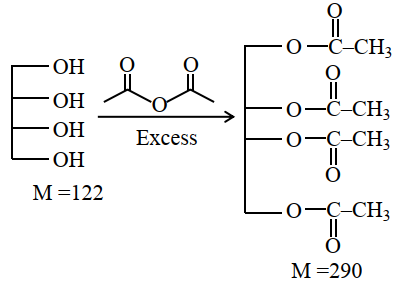
No. of OH groups \(=\frac{290-122}{42}=4\) -
- (A)
D E Conc. H\(_2\)SO\(_4\) CH\(_2 =\) CH \(-\) CH(OH)CH\(_3\) - (B)
D E PCC HO \(-\) CH\(_2\) \(-\) CH\(_2\) \(-\) CH \(=\) CH\(_2\) - (C)
D E PCC CH\(_2 =\) CH \(-\) CH \(=\) CH\(_2\) - (D)
D E Conc. H\(_2\)SO\(_4\) or H\(_3\)PO\(_4\) CH\(_2 =\) CH \(-\) CH \(=\) CH\(_2\)
Show answer and solution
Correct Answer: (D)
Compound A is pentan-1-ol (\(CH_3-CH_2-CH_2-CH_2-CH_2-OH\)) and Compound B is pent-1-ene (\(CH_2=CH-CH_2-CH_2-CH_3\)).
The conversion of an alcohol to an alkene is a dehydration reaction, which requires an acidic dehydrating agent such as concentrated \(H_2SO_4\) or \(H_3PO_4\). Thus, reagent D is concentrated \(H_2SO_4\) or \(H_3PO_4\).
Compound C is butane-1,3-diol (\(HO-CH_2-CH_2-CH(OH)-CH_3\)).
When C is treated with excess dehydrating agent (reagent D), both hydroxyl groups undergo elimination (dehydration). The elimination of two water molecules yields a conjugated diene, which is highly stable due to resonance.
The product E formed is 1,3-butadiene (\(CH_2=CH-CH=CH_2\)).
Answer:D E Conc. H\(_2\)SO\(_4\) or H\(_3\)PO\(_4\) CH\(_2 =\) CH \(-\) CH \(=\) CH\(_2\) - (A)
-
- (A) Both compounds x and y will dissolve in NaOH.
- (B) Compound y will dissolve in \(NaHCO _3\) and evolve a gas.
- (C) Compound x is more acidic than compound y.
- (D) Both compounds x and y will burn with sooty flame.
Show answer and solution
Correct Answer: (C)
\(( X ) \xrightarrow[(2)_3 H _3 O ^{\oplus}]{\text { (1) } CO _2 / NaOH } Y _{\text {Major }}\)
\(76.6 \% C\)
\(6.38 \% H\)
Vapour Density 47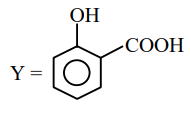
Salicylic acid
Gives colour with \(FeCl _3\)
Soluble in \(NaHCO _3\)
Soluble in NaOH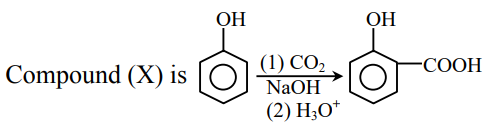
-
- (A) Both Statement I and Statement II are true
- (B) Both Statement I and Statement II are false
- (C) Statement I is true but Statement II is false
- (D) Statement I is false but Statement II is true
Show answer and solution
Correct Answer: (D)
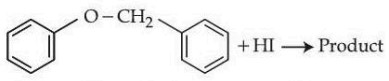
The given reactant is phenyl benzyl ether (\(C_6H_5-O-CH_2-C_6H_5\)).
When it reacts with \(HI\), the ether oxygen is first protonated to form an oxonium ion. The cleavage of the ether linkage then takes place.
The \(C_6H_5-O\) bond has partial double bond character due to the resonance of the oxygen's lone pair with the benzene ring, making it strong and difficult to break. On the other hand, the \(O-CH_2\) bond is a weaker single bond. Moreover, cleavage of the \(O-CH_2\) bond can proceed via a highly stable benzyl carbocation (in an \(S_N1\) mechanism) or undergo facile \(S_N2\) attack by the iodide ion (\(I^-\)) at the less sterically hindered and activated benzylic carbon.
Therefore, the \(I^-\) ion attacks the \(CH_2\) group, cleaving the \(O-CH_2\) bond. The products formed are phenol (\(C_6H_5OH\)) and benzyl iodide (\(C_6H_5CH_2I\)).
Statement I claims the products are benzyl alcohol and iodobenzene, which is incorrect. Thus, Statement I is false.
Statement II claims that the \(-O-CH_2-\) bond is cleaved to give the product, which is correct. Thus, Statement II is true.
Answer: Statement I is false but Statement II is true -
- (A) Five
- (B) Three
- (C) Four
- (D) Two
Show answer and solution
Correct Answer: (B)
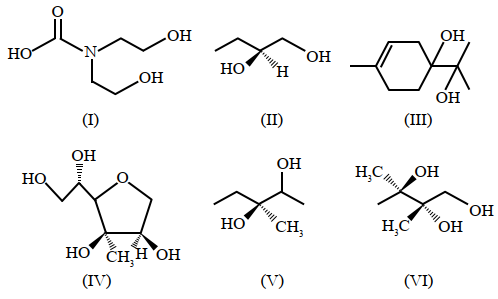
Classification of Alcohols:
Primary \( (1^\circ) \) alcohol: The \( -\text{OH} \) group is attached to a carbon atom that is bonded to only one other carbon atom.
Secondary \( (2^\circ) \) alcohol: The \( -\text{OH} \) group is attached to a carbon atom that is bonded to two other carbon atoms.
Tertiary \( (3^\circ) \) alcohol: The \( -\text{OH} \) group is attached to a carbon atom that is bonded to three other carbon atoms.
Structural Analysis:
- Compound (I): The \( -\text{OH} \) groups are part of terminal \( -\text{CH}_2\text{CH}_2\text{OH} \) chains, making them primary \( (1^\circ) \) alcohols.
- Compound (II): Contains a \( -\text{CH(OH)}- \) group where the hydroxyl-bearing carbon is bonded directly to two neighboring carbon atoms. This is a secondary \( (2^\circ) \) alcohol.
- Compound (III): The alcohol groups are attached to carbons that are bonded to three other carbons, which classifies them as tertiary \( (3^\circ) \) alcohols.
- Compound (IV): Contains secondary \( (2^\circ) \) alcohol groups on both the side chain (\( -\text{CH(OH)}- \)) and the cyclic ring structure.
- Compound (V): Contains a \( -\text{CH(OH)}- \) group attached to two adjacent carbon positions, classifying it as a secondary \( (2^\circ) \) alcohol.
- Compound (VI): Contains only primary \( (1^\circ) \) and tertiary \( (3^\circ) \) alcohol functional groups.
Thus, compounds (II), (IV), and (V) contain at least one secondary alcohol group.
Total number of such compounds = \( 3 \)
Correct Option: B (Three) -
- (A) Both Statement I and Statement II are false
- (B) Statement I is true but Statement II is false
- (C) Both Statement I and Statement II are true
- (D) Statement I is false but Statement II is true
Show answer and solution
Correct Answer: (D)
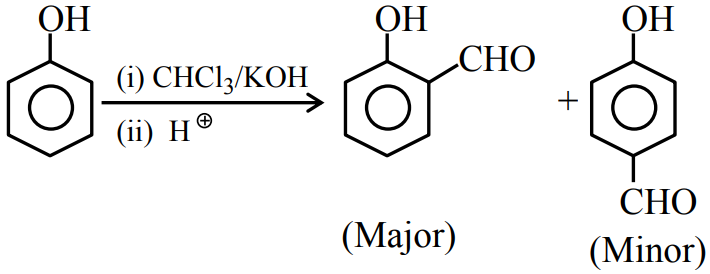
(can be separated by steam distillation) -
- (A) A-III, B-I, C-IV, D-II
- (B) A-III, B-IV, C-I, D-II
- (C) A-I, B-III, C-II, D-IV
- (D) A-I, B-II, C-III, D-IV
Show answer and solution
Correct Answer: (A)
Cyclohexanol is a secondary alcohol, which gives a positive Lucas test.
Cyclohexylamine is a primary aliphatic amine, which reacts with Hinsberg's reagent (benzenesulfonyl chloride) to form a product soluble in alkali.
Cyclohexanecarbaldehyde is an aliphatic aldehyde, which gives a positive Tollen's test (silver mirror test).
Phenol undergoes the phthalein dye test by reacting with phthalic anhydride in the presence of concentrated sulfuric acid to form phenolphthalein, which gives a pink colour in an alkaline medium.
Thus, the correct matching is A-III, B-I, C-IV, D-II.
Answer: A-III, B-I, C-IV, D-II -
- (A) 165
- (B) 170
- (C) 175
- (D) 180
Show answer and solution
Correct Answer: (C)
When phenol is treated with dilute \(\text{HNO}_3\) at \(298\text{ K}\), it undergoes electrophilic aromatic substitution to give a mixture of ortho-nitrophenol and para-nitrophenol.
The mixture is separated by steam distillation. Ortho-nitrophenol is steam volatile due to intramolecular hydrogen bonding, whereas para-nitrophenol is not steam volatile due to intermolecular hydrogen bonding. Thus, the steam volatile compound (X) is ortho-nitrophenol.
Molecular formula of phenol: \(\text{C}_6\text{H}_6\text{O}\)
Molar mass of phenol \(= (6 \times 12) + (6 \times 1) + 16 = 94\text{ g mol}^{-1}\)
Percentage of oxygen in phenol \(= \dfrac{16}{94} \times 100 \approx 17.02\%\)
Molecular formula of ortho-nitrophenol (X): \(\text{C}_6\text{H}_5\text{NO}_3\)
Molar mass of ortho-nitrophenol \(= (6 \times 12) + (5 \times 1) + 14 + (3 \times 16) = 139\text{ g mol}^{-1}\)
Percentage of oxygen in ortho-nitrophenol \(= \dfrac{48}{139} \times 100 \approx 34.53\%\)
Increase in percentage of oxygen \(= 34.53\% - 17.02\% = 17.51\%\)
We need to express this as \(y \times 10^{-1} \%\).
\(17.51\% = 175.1 \times 10^{-1} \%\)
Rounding to the nearest integer, we get \(175\).
Answer: \(175\) -
- (A) A and D Only
- (B) A, C and E Only
- (C) C and D Only
- (D) B, D and E Only
Show answer and solution
Correct Answer: (C)
Reaction given Alcohol
(A) \(CH_{4} + O_{2} \xrightarrow{Mo_{2}O_{3}} HCHO\)
(B) \(2 CH _3 CH _3+3 O _2 \xrightarrow[\Delta]{\left( CH _3 COO \right)_2 Mn } CH _3 COOH\)
(C)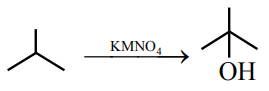
(D) \(2 CH _4+ O _2 \xrightarrow[523 K, 100 atm .]{ Cu } CH _3- OH\)
(E)
-
- (A) 11
- (B) 12
- (C) 13
- (D) 14
Show answer and solution
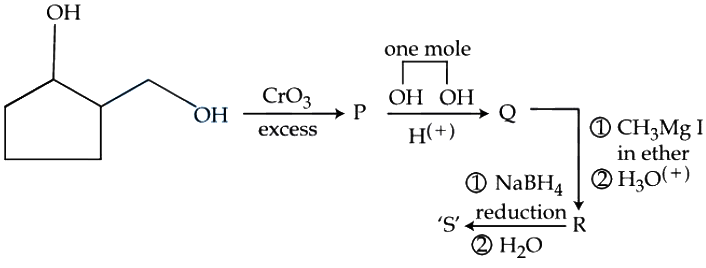
Correct Answer: (C)
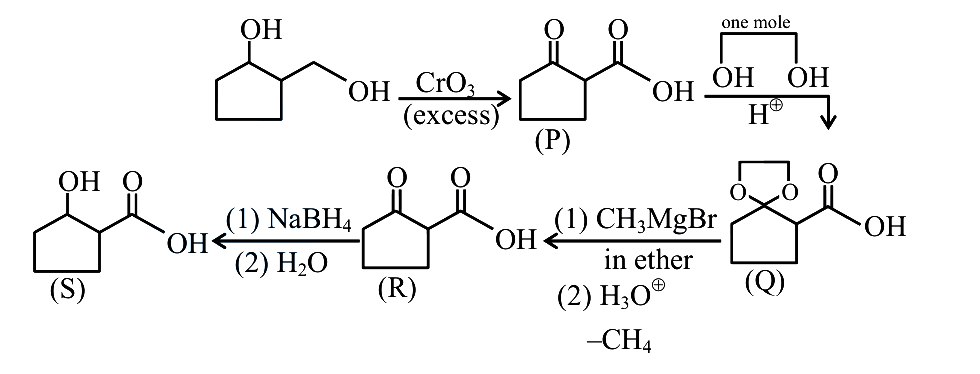
0.1 mole of compound ( S ) weight in gm
\(\begin{aligned}
& =0.1 \times \text { molar mass of compound }(\mathrm{S}) \\
& =0.1 \times 130=13 \mathrm{gm}
\end{aligned}\) -
- (A) Statement I is false but Statement II are true
- (B) Both Statement I and Statement II are false
- (C) Statement I is true but Statement II is false
- (D) Both Statement I and Statement II are true
Show answer and solution
Correct Answer: (D)
St-I : - St-I is correct because both given ether are soluble in water \(\rightarrow\) Di ethyl ether and butan-1-ol are miscible to almost same extent i.e., 7.5 and 9 gm per 100 ml water due to H -bonding St-II : - St. II is also correct because sodium metal is not used with ethyl alcohol as \(\mathrm{H}_2\) gas release with ethyl a below -
- (A) Both Statement I and Statement II are false
- (B) Both Statement I and Statement II are true
- (C) Statement I is false but Statement II is true
- (D) Statement I is true but Statement II is false
Show answer and solution
Correct Answer: (B)
Statement I is correct as boiling point of alcohol phenols increase with increase in the number of C -atoms due to increase in van der Waals forces.
Statement II is correct, since alcohols phenols have intermolecular H -bonding therefore their boiling points are higher in comparison to other class of compounds such as ethers, haloalkanes. -
- (A) (A)-(II), (B)-(III), (C)-(I), (D)-(IV)
- (B) (A)-(III), (B)-(IV), (C)-(II), (D)-(I)
- (C) (A)-(IV), (B)-(III), (C)-(II), (D)-(I)
- (D) (A)-(IV), (B)-(III), (C)-(I), (D)-(II)
Show answer and solution
Correct Answer: (C)
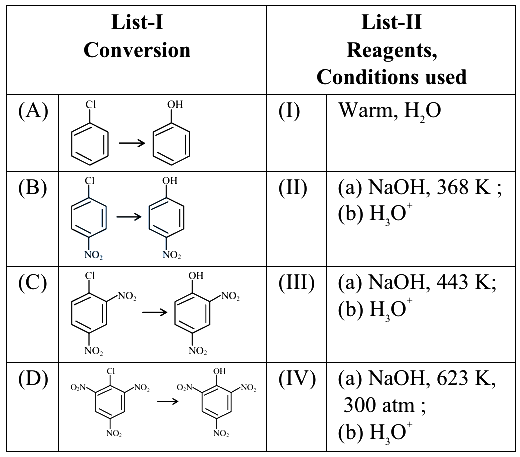
Aromatic halide give nucleophilic substitution reaction at high temperature or in presence of \(-\mathrm{I} /-\) M group rate of reaction high even at low temperature.
A-IV
B-III
C-II
D-I - 15. The steam volatile compounds among the following are _______.
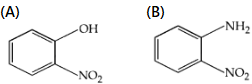
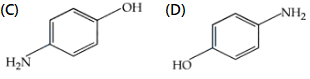
Choose the correct answer from the options given below : 2025 Medium- (A) (B) and (D) Only
- (B) (A) and (C) Only
- (C) (A), (B) and (C) Only
- (D) (A) and (B) Only
Show answer and solution
Correct Answer: (D)
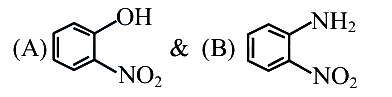
are steam volatile due to intramolecular hydrogen bonding. -
- (A) 20.44 g
- (B) 4.0 g
- (C) 6.0 g
- (D) 10.22 g
Show answer and solution
Correct Answer: (D)
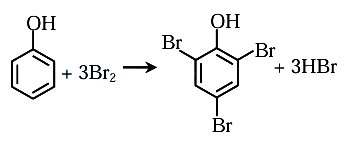
\(\begin{aligned} & \text { Moles of phenol }=\frac{2}{94}=0.021 \\ & \therefore \text { Moles of bromine }=0.021 \times 3=0.064 \\ & \therefore \text { Mass of bromine }=0.064 \times 160=10.22 \mathrm{~g}\end{aligned}\) -
- (A) quinol
- (B) resorcinol
- (C) catechol
- (D) o-cresol
Show answer and solution
Correct Answer: (C)
\(IUPAC\) name : Benzene-\(1,2\)-diolCommon name : catechol

- 18. Consider the given chemical reaction sequence : Total sum of oxygen atoms in Product \(A\) and Product \(B\) are _______.
 2024 Medium
- (A) \(10\)
- (B) \(11\)
- (C) \(15\)
- (D) \(14\)
Show answer and solution
Correct Answer: (D)
Picric acid is prepared by treating phenol first with concentrated sulphuric acid which converts it to phenol\(-2,4-\)disulphonic acid and then with concentrated nitric acid to get \(2,4,6\) trinitrophenol. -
- (A) Statement \(I\) is true but Statement \(II\) is false.
- (B) Both Statement \(I\) and Statement \(II\) are true
- (C) Both Statement \(I\) and Statement \(II\) are false.
- (D) Statement \(I\) is false but Statement \(II\) is true.
Show answer and solution
Correct Answer: (D)
Phenol is a highly activated compound which can undergo bromination directly with Bromine without any lewis acid. -
- (A) \(A\) is true but \(R\) is false.
- (B) A is false but \(R\) is true.
- (C) Both \(A\) and \(R\) are true and \(R\) is the correct explanation of \(A\).
- (D) Both \(A\) and \(R\) are true but \(R\) is NOT the correct explanation of \(A\).
Show answer and solution
Correct Answer: (A)
Phenol is more acidic than ethanol because conjugate base of phenoxide is more stable than ethoxide. -
- (A) \(A\) is false but \(R\) is true.
- (B) \(A\) is true but \(R\) is false.
- (C) Both \(A\) and \(R\) are true and \(R\) is the correct explanation of \(A\).
- (D) Both \(A\) and \(R\) are true but \(R\) is NOT the correct explanation of \(A\)
Show answer and solution
Correct Answer: (D)
As per \(NCERT\), Assertion \((A)\) and Reason \((R)\) is correct but Reason \((R)\) is not the correct explanation. -
- (A) Statement \(I\) is true but Statement \(II\) is false
- (B) Both Statement \(I\) and Statement \(II\) are true
- (C) Both Statement \(I\) and Statement \(II\) are false
- (D) Statement \(I\) is false but Statement \(II\) is true
Show answer and solution
Correct Answer: (A)
Acidic strength
Ethanol give lucas test after long time
Statement\((I)\) \(\rightarrow\) correct
Statement \((II)\) \(\rightarrow\) incorrect
-
- (A) Statement \(I\) is incorrect but Statement \(II\) is correct.
- (B) Both Statement \(I\) and Statement \(II\) are incorrect.
- (C) Statement \(I\) is correct but Statement \(II\) is incorrect.
- (D) Both Statement \(I\) and Statement \(II\) are correct.
Show answer and solution
Correct Answer: (A)
picric acid\((2,4,6\) - trinitrophenol \()\)

- 24. Match List-\(I\) with List-\(II.\) Choose the correct answer from the options given below:
 2024 Hard
- (A) \((A)-(IV)\), \((B)-(I)\), \((C)-(III)\), \((D)-(II)\)
- (B) \((A)-(II)\), \((B)-(III)\), \((C)-(I)\), \((D)-(IV)\)
- (C) \((A)-(II)\), \((B)-(I)\), \((C)-(III)\), \((D)-(IV)\)
- (D) \((A)-(IV)\), \((B)-(III)\), \((C)-(I)\), \((D)-(II)\)
Show answer and solution
Correct Answer: (D)
A \(\rightarrow\) Kolbe Schmidt Reaction
B \(\rightarrow\) Reimer Tiemann Reaction
C \(\rightarrow\) Oxidation of phenol to p-benzoquinone
D \(\rightarrow \mathrm{PhOH}+\mathrm{NaOH} \rightarrow \mathrm{H}_2 \mathrm{O}+\mathrm{PhO}^{-}\)
-
- (A) \(A-I\), \(B-II\), \(C-III\), \(D-IV\)
- (B) \(A-IV\), \(B-I\), \(C-II\), \(D-III\)
- (C) \(A-III\), \(B-IV\), \(C-I\), \(D-II\)
- (D) \(A-II\), \(B-I\), \(C-IV\), \(D-III\)
Show answer and solution
Correct Answer: (D)
Ethanol \(\rightarrow 15.9\)Phenol \(\rightarrow 10\)
M-Nitrophenol \(\rightarrow 8.3\)
P-Nitrophenol \(\rightarrow 7.1\)
-
- (A) Phthalein dye test
- (B) Lucas test
- (C) Tollen’s test
- (D) Carbylamine test
Show answer and solution
Correct Answer: (A)
Carbylamine Test-Identification of primary amines
Lucas Test - Differentiation between \(1^{\circ}, 2^{\circ}\) and \(3^{\circ}\) alcohols
Tollen's Test - Identification of Aldehydes
Phthalein Dye Test - Identification of phenols
Phenol on heating with phthalic anhydride in the presence of concentrated sulphuric acid forms a colourless condensation compound called phenolphthalein. On further reaction with dilute sodium hydroxide solution gives a pink colour fluorescent compound called fluorescein. Characteristic colours are produced by different phenolic compounds which can be viewed under white background. -
- (A) Salicyclic acid
- (B) Benzene-\(1\),\(2\)-diol
- (C) Benzene-\(1\), \(3\)-diol
- (D) \(2\)-Hydroxybenzaldehyde
Show answer and solution
Correct Answer: (D)
It is Reimer Tiemann Reaction
- 28. Which one the following compounds will readily react with dilute \(\mathrm{NaOH}\) ? 2024 Medium
- (A) \(\mathrm{C}_6 \mathrm{H}_5 \mathrm{CH}_2 \mathrm{OH}\)
- (B) \(\mathrm{C}_2 \mathrm{H}_5 \mathrm{OH}\)
- (C) \(\left(\mathrm{CH}_3\right)_3 \mathrm{COH}\)
- (D) \(\mathrm{C}_6 \mathrm{H}_5 \mathrm{OH}\)
Show answer and solution
Correct Answer: (D)
Stronger \(ACID\) than \(\mathrm{H}_2 \mathrm{O}\)
-
- (A) Both \(A\) and \(R\) are correct and \(R\) is the correct explanation of \(A.\)
- (B) \(A\) is correct but \(R\) is not correct.
- (C) \(A\) is not correct but \(R\) is correct.
- (D) Both \(A\) and \(R\) are correct but \(R\) is \(NOT\) the correct explanation of \(A.\)
Show answer and solution
Correct Answer: (A)
Butylated hydroxyl anisole is an antioxidant. -
- (A) \(A\) is false but \(R\) is true
- (B) \(A\) is true but \(R\) is false
- (C) Both \(A\) and \(R\) are true but \(R\) is not the correct explanation of \(A\)
- (D) Both \(A\) and \(R\) are true and \(R\) is the correct explanation of \(A\)
Show answer and solution
Correct Answer: (A)
The acid sensitive alcohol group reacts with \(HCl\), hence Clemmenson reduction is not suitable for above conversion.
-
- (A) Both \(A\) and \(R\) are true and \(R\) is the correct explanation of \(A\)
- (B) \(A\) is true but \(R\) is false
- (C) Both \(A\) and \(R\) are true but \(R\) is not the correct explanation of \(A\)
- (D) \(A\) is false but \(R\) is true
Show answer and solution
Correct Answer: (A)
Butan\(-1-\)ol \(\left( CH _3 CH _2 CH _2 CH _2 OH \right)\) can undergo hydrogen bonding. Ethoxyethane \(\left( CH _3 CH _2-\right.\) \(O - CH _2 CH _3\) ) has no hydrogen (attached with \(F\), \(O , N\) ) which can undergo hydrogen bonding. More is the extent of intermolecular \(H\)-bonding, more will be association of molecules. Thus leading to higher boiling point.Hence both Assertion \((A)\) and Reason\((R)\) are true and \(( R )\) is the correct explanation of \(( A )\). -
- (A) Ozonolysis of alkene.
- (B) Reaction of Ketone with \(RMgBr\) followed by hydrolysis.
- (C) Hydroboration-oxidation of alkene.
- (D) Reaction of alkyl halide with aqueous \(NaOH\).
Show answer and solution
Correct Answer: (A)
Ozonolysis of alkene, gives aldehyde, ketone and carboxylic acid. - 33. The correct order for acidity of the following hydroxyl compound is: Choose the correct answer from the options given below:
 2023 Medium
- (A) \(E > C > D > A > B\)
- (B) \(D > E > C > A > B\)
- (C) \(C > E > D > B > A\)
- (D) \(E > D > C > B > A\)
Show answer and solution
Correct Answer: (A)
\(E > C > D > A > B\) -
- (A) \(c > a > d > b\)
- (B) \(b > d > a > c\)
- (C) \(b > a > d > c\)
- (D) \(a > b > c > d\)
Show answer and solution
Correct Answer: (B)
Due to \(- M\) effect of \(- NO _2\) group, it increases acidity \(+ M\) effect of \(N \left( CH _3\right)_2\) decreases acidity.Hyperconjugation of isopropyl decrease acidity
\(\therefore\) order of acidic strength
\((c) > (a) > (d) > (b)\)
-
- (A) \((C), (D), (E), (B), (A)\)
- (B) \((A), (B), (E), (D), (C)\)
- (C) \((A), (E), (B), (D), (C)\)
- (D) \((C), (E), (D), (B), (A)\)
Show answer and solution
Correct Answer: (B)
Order of acidity for following phenol is\(-M\) and \(-I\) increases acidity
\(+ M\) and \(+ I\) decreases acidity

-
- (A) Ethanol
- (B) Methanoic acid
- (C) Methanal
- (D) Methanol
Show answer and solution
Correct Answer: (D)
\(CO +2 H _2 \stackrel{ Co}{\longrightarrow} CH _3 OH\) -
- (A) \(6\)
- (B) \(5\)
- (C) \(4\)
- (D) \(3\)
Show answer and solution
Correct Answer: (A)
\(R ( OH )_{ x } \rightarrow H _{2}\)\(PoAC\) on \(H -\)
\(x\left(\frac{1.84 \times 10^{-3}}{92}\right)=\frac{1.344}{22.4} \times 2\)
\(x=\frac{1.344 \times 2 \times 92 \times 1000}{1.84 \times 22400}=6\)
\(x=6\)
-
- (A) Both Statement \(I\) and Statement \(II\) are correct.
- (B) Both Statement \(I\) and Statement \(II\) are incorrect
- (C) Statement \(I\) is correct but Statement \(II\) is incorrect.
- (D) Statement \(I\) is incorrect but Statement \(II\) is correct.
Show answer and solution
Correct Answer: (C)
Acrolein has a pungent, suffocating odour.Acrolein is used to detect presence of glycerol -
- (A) Both Statement \(I\) and Statement \(II\) are correct.
- (B) Both Statement \(I\) and Statement \(II\) are incorrect.
- (C) Statement \(I\) is correct but Statement \(II\) is incorrect.
- (D) Statement \(I\) is incorrect but Statement \(I I\) is correct.
Show answer and solution
Correct Answer: (C)
Phenol are weakly acidic. Phenol is more acidic than alcohol and \(H _{2} O\) statement \((I)\) is correct. \((II)\) is incorrect. - 40. The difference in the reaction of phenol with bromine in chloroform and bromine in water medium is due to. 2022 Medium
- (A) Hyperconjugation in substrate
- (B) Polarity of solvent
- (C) Free radical formation
- (D) Electromeric effect of the substrate
Show answer and solution
Correct Answer: (B)
Difference in reactions is observed due to solvent polarity, which\((i)\) Ionizes phenol to make more reactive phenoxide ion
\((ii)\) Increases electrophilicity of bromine.

- 41. Which technique among the following, is most appropriate in separation of a mixture of \(100\,\,mg\) of p-nitrophenol and picric acid? 2022 Medium
- (A) Steam distillation
- (B) \(2-5\) ft long column of silica gel
- (C) Sublimation
- (D) Preparative \(TLC\) (Thin Layer Chromatography)
Show answer and solution
Correct Answer: (D)
Solvent polarity has been related to \(R _{ f }\) value of nitrocompounds.\(100\,mg\) p-nitrophenol and picric acid have different \(R _{ f }\) value on silica gel plate\(\therefore\) Preparative TLC is best to separate \(100\,mg\) of

-
- (A) Both statement \(I\) and statement \(II\) are correct
- (B) Both statement \(I\) and statement \(II\) are incorrect
- (C) Statement \(I\) is correct but Statement \(II\) is incorrect
- (D) Statement \(I\) is incorrect but Statement \(II\) is correct
Show answer and solution
Correct Answer: (C)
Alkane are very less reactive, tertiary hydrogen can oxidise to alcohal with \(KMnO _{4}\).
-
- (A) Both Statement \(I\) and Statement \(II\) are false.
- (B) Statement \(I\) is false but Statement \(II\) is true.
- (C) Statement \(I\) is true but Statement \(I I\) is false.
- (D) Both Statement \(I\) and Statement \(II\) are true.
Show answer and solution
Correct Answer: (C)
Statement \(1\) is trueBut it consume \(3\) moles of \(G\) \(R\)
So statement \(2\) is false.

- 44. The functional groups that are responsible for the ion-exchange property of cation and anion exchange resins, respectively, are : 2021 Medium
- (A) \(- SO _{3} H\) ane \(- NH _{2}\)
- (B) \(- SO _{3} H\) and \(- COOH\)
- (C) \(- NH _{2}\) and \(- COOH\)
- (D) \(- NH _{2}\) and \(- SO _{3} H\)
Show answer and solution
Correct Answer: (A)
Cation exchanger contains \(- SO _{3} H\) or \(- COOH\) groups while anion exchanger contains basic groups like \(- NH _{2}\) -
- (A) \((a)\) and \((c)\) only
- (B) \((b), (c)\) and \((d)\) only
- (C) \((a), (b)\) and \((d)\) only
- (D) \((b)\) and \((d)\) only
Show answer and solution
Correct Answer: (B)
Bromine water gives tribromo products, other gives monbromo products in which para is major product. -
- (A) \(70.56\)
- (B) \(68.85\)
- (C) \(65.52\)
- (D) \(60.75\)
Show answer and solution
Correct Answer: (B)
Molecular weight of \(C _{7} H _{6} O _{2}=122\)\(\% C =\frac{12 \times 7 \times 100}{122}=68.85 \approx 69\)

- 47. Arrange the following compounds in increasing order of \(C-OH\) bond length methanol, phenol, \(p-\)ethoxyphenol 2020 Medium
- (A) phenol < methanol < \(p-\)ethoxyphenol
- (B) phenol < \(p-\)ethoxyphenol < methanol
- (C) methanol < \(p-\)ethoxyphenol < phenol
- (D) methanol < phenol < \(p-\)ethoxyphenol
Show answer and solution
Correct Answer: (B)
\(CH_3 -OH\) (\(100\%\) single bond)
-
- (A) \(C = {H_3}C - \begin{array}{*{20}{c}} {C{H_3}\,\,\,\,\,\,\,\,} \\ |\,\,\,\,\,\,\,\,\,\,\,\,\,\,\,\,\, \\ {C - OH} \\ |\,\,\,\,\,\,\,\,\,\,\,\,\,\,\,\,\, \\ {C{H_3\,\,\,\,\,\,\,\,}} \end{array}\) \(\begin{array}{*{20}{c}} {D = {H_3}C - C{H_2} - CH - C{H_3}} \\ {\,\,\,\,\,\,\,\,\,\,\,\,\,\,\,\,\,\,\,\,\,\,\,\,\,|} \\ {\,\,\,\,\,\,\,\,\,\,\,\,\,\,\,\,\,\,\,\,\,\,\,\,\,\,\,\,\,\,\,OH} \end{array}\)
- (B) \(C = H _{3} C - CH _{2}- C H _{2}- CH _{2}- OH\) \(D = {H_3}C - \begin{array}{*{20}{c}} {C{H_3}\,\,\,\,\,} \\ |\,\,\,\,\,\,\,\,\,\,\,\,\,\,\, \\ {C - OH} \\ |\,\,\,\,\,\,\,\,\,\,\,\,\,\,\, \\ {C{H_3}\,\,\,\,\,} \end{array}\)
- (C) \(\begin{array}{*{20}{c}} {\,\,\,\,\,\,\,\,\,\,\,\,\,\,\,\,\,\,\,\,\,\,\,\,\,\,\,\,\,\,\,\,OH} \\ {\,\,\,\,\,\,\,\,\,\,\,\,\,\,\,\,\,\,\,\,\,\,\,\,\,|} \\ {C = {H_3}C - C{H_2} - CH - C{H_3}} \end{array}\) \(D = {H_3}C - \begin{array}{*{20}{c}} {C{H_3}\,\,\,\,\,} \\ |\,\,\,\,\,\,\,\,\,\,\,\,\,\,\, \\ {C - OH} \\ |\,\,\,\,\,\,\,\,\,\,\,\,\,\,\, \\ {C{H_3}\,\,\,\,\,} \end{array}\)
- (D) \(C = H _{3} C - CH _{2}- CH _{2}- CH _{2}- OH\) \(\begin{array}{*{20}{c}} {D = {H_3}C - C{H_2} - CH - C{H_3}} \\ {\,\,\,\,\,\,\,\,\,\,\,\,\,\,\,\,\,\,|} \\ {\,\,\,\,\,\,\,\,\,\,\,\,\,\,\,\,\,\,\,\,\,\,\,\,\,OH} \end{array}\)
Show answer and solution
Correct Answer: (C)
\(\begin{array}{*{20}{c}} {\,\,\,\,\,\,\,\,\,\,\,\,\,\,\,\,\,\,\,\,\,\,\,\,\,\,O} \\ {\,\,\,\,\,\,\,\,\,\,\,\,\,\,\,\,\,\,\,\,\,\,\,\,\,||} \\ {C{H_3}C - C{H_2} - C - H} \\ {(A)} \end{array}\) \(\xrightarrow{CH_3MgBr}\)\(\begin{array}{*{20}{c}} {\,\,\,\,\,\,\,\,\,\,\,\,\,\,\,\,\,\,\,\,\,\,\,OH} \\ {\,\,\,\,\,\,\,\,\,\,\,\,\,\,\,|} \\ {C{H_3} - C{H_2} - CH - C{H_3}} \\ {\,\,\,\,\,\,\,\,\,\,\,\,\,\,\,\,\,\,\,\,\,\,\,\,\,\,\,\,\,\,\,\,\,\,\,{2^o}\,Alcohol} \\ {\,\,\,\,\,\,\,\,\,\,\,\,\,\,\,\,\,\,\,\,\left( C \right)} \end{array}\)\(CAN\) test for alcohol : \((yes)\)
Iodoform test \(:(yes)\)
\(\begin{array}{*{20}{c}} O\,\,\,\,\,\,\,\,\,\,\,\,\,\,\,\,\,\,\,\,\,\,\,\,\,\,\,\,\, \\ {||\,\,\,\,\,\,\,\,\,\,\,\,\,\,\,\,\,\,\,\,\,\,\,\,\,\,\,\,\,\,\,} \\ {C{H_3} - C - C{H_3}\,\xrightarrow{{C{H_3}MgBr}}} \\ {(B)\,\,\,\,\,\,\,\,\,\,\,\,\,\,\,\,\,\,\,\,\,\,\,\,\,\,\,} \\ {} \end{array}\)\(\begin{array}{*{20}{c}} {\,\,\,\,\,\,\,OH} \\ | \\ {C{H_3} - C - C{H_3}} \\ | \\ {\,\,\,\,\,\,\,\,C{H_3}} \\ {\,\,\,\,\,\,\,\,\,\,\,\,\,\,\,\,\,\,\,{3^o}\,Alcohol} \end{array}\)
\(CAN\) test for alcohol : \((yes)\)
Lucas test : Immediately
Iodoform test : \((no)\)
-
- (A) \(CH_2 = CH_2\)
- (B) \(CH_3 -C \equiv CH\)
- (C) \(CH \equiv CH\)
- (D) \(CH_3 -C \equiv C -CH_3\)
Show answer and solution
Correct Answer: (B)
\(\mathop {C{H_3} - C = C - H}\limits_{(A)} \xrightarrow{{A{g_2}O}}\) \(\mathop {C{H_3} - C \equiv C - Ag}\limits_{Whiteppt.} \downarrow \)\(\mathop {C{H_3} - C = C - H}\limits_{(A)} \xrightarrow{{H{g^{2 + }}\,/{H^ + }}}\) \(\mathop {\begin{array}{*{20}{c}}
O \\
{||} \\
{{H_3}C - C - C{H_3}}
\end{array}}\limits_{(B)} \) \(\xrightarrow{{NaB{H_4}}}\) \(\mathop {\begin{array}{*{20}{c}}
{\begin{array}{*{20}{c}}
{\,\,\,OH} \\
|
\end{array}} \\
{C{H_3} - C - C{H_3}} \\
| \\
H
\end{array}}\limits_{(C)} \) \(\xrightarrow[{Conc.\,HCl}]{{ZnC{l_2}}}\) Turbidity within \(5\) minutes -
- (A) Oleic acid
- (B) \(o -\) Toluidine
- (C) Benzamide
- (D) \(m -\) Cresol
Show answer and solution
Correct Answer: (D)
Oletic acid is also soluble in \(NaHCO_3\)\(o\,-\) toluidine is not soluble in \(NaOH\) as well as \(NaHCO_3\)
Benzamide is also not soluble in \(NaOH\) and \(NaHCO_3\).
\(\therefore \) \(m\,-\) cresol is the right answer.



No questions on this page match these filters.
About Alcohol, phenol and ethers PYQs
Alcohol, phenol and ethers has 70 questions from 2013–2026. The most came in 2024 (12), 2026 (10) and 2023 (8).
The most asked topics are Properties of Phenols, Properties of alcohol and Properties of Ethers.
7% are easy, 43% medium and 50% hard.
Alcohol, phenol and ethers PYQs by year
Frequently asked
How many Alcohol, phenol and ethers questions came in JEE Mains?
70 questions from 2013–2026, each with the correct answer and a full solution.
Which Alcohol, phenol and ethers topic is asked the most?
Properties of Phenols, with 30 questions, followed by Properties of alcohol with 17.
Which year had the most Alcohol, phenol and ethers questions?
2024, with 12 questions.
How difficult are Alcohol, phenol and ethers questions?
7% are easy, 43% medium and 50% hard.