


Questions
Newest firstShowing 1–20 of 20 questions
-
- (A) \(\mathrm{sp}^3\)
- (B) \(\mathrm{dsp}^2\)
- (C) \(\mathrm{sp}^3 \mathrm{~d}^2\)
- (D) \(\mathrm{sp}^3 \mathrm{~d}\)
Show answer and solution
Correct Answer: (D)
\(\begin{array}{|c|c|c|c|}
\hline \text { Molecule } & \text { Hybridisation } & \begin{array}{c}
\text { Dipole } \\
\text { Moment }
\end{array} & \begin{array}{c}
\text { Lone pair on the } \\
\text { central atom }
\end{array} \\
\hline \mathrm{SO}_2 & \mathrm{sp}^2 & \text { Non-zero } & \mathrm{1} \\
\hline \mathrm{NF}_3 & \mathrm{sp}^3 & \text { Non-zero } & \mathrm{1} \\
\hline \mathrm{NH}_3 & \mathrm{sp}^3 & \text { Non-zero } & \mathrm{1} \\
\hline \mathrm{XeF}_2 & \mathrm{sp}^3 \mathrm{~d} & \text { zero } & \mathrm{3} \\
\hline{\mathrm{C} \ell \mathrm{~F}_3}^{\mathrm{SF}_4} & \mathrm{sp}^3 \mathrm{~d} & \text { Non-zero } & \mathrm{2} \\
\hline \mathrm{sp}^3 \mathrm{~d} & \text { Non-zero } & \mathrm{1} \\
\hline
\end{array}\) -
- (A) \(\mathrm{H}_2 \mathrm{~S} \lt \mathrm{HBr} \lt \mathrm{NF}_3 \lt \mathrm{CHCl}_3\)
- (B) \(\mathrm{NF}_3 \lt \mathrm{HBr} \lt \mathrm{H}_2 \mathrm{~S} \lt \mathrm{CHCl}_3\)
- (C) \(\mathrm{HBr} \lt \mathrm{H}_2 \mathrm{~S} \lt \mathrm{NF}_3 \lt \mathrm{CHCl}_3\)
- (D) \(\mathrm{CHCl}_3 \lt \mathrm{NF}_3 \lt \mathrm{HBr} \lt \mathrm{H}_2 \mathrm{~S}\)
Show answer and solution
Correct Answer: (B)
\(\begin{aligned}
& \mu_{\mathrm{HBr}}=0.78 \mathrm{D} \\
& \mu_{\mathrm{H}_2 \mathrm{~S}}=0.95 \mathrm{D} \\
& \mu_{\mathrm{NF}_3}=0.24 \mathrm{D} \\
& \mu_{\mathrm{CHCl}_3}=1.01 \mathrm{D}
\end{aligned}\)
Hence dipole moment of
\(\mathrm{NF}_3 < \mathrm{HBr} < \mathrm{H}_2 \mathrm{~S} < \mathrm{CHCl}_3\) -
- (A) Both Statement I and Statement II are true
- (B) Statement I is true but Statement II is false
- (C) Statement I is false but Statement II is true
- (D) Both Statement I and Statement II are false
Show answer and solution
Correct Answer: (A)
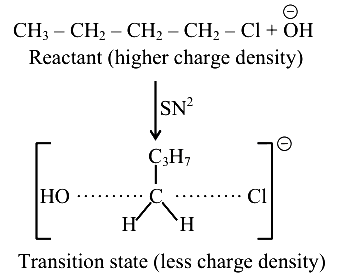
\(\Rightarrow\) This reaction will proceed faster in less polar medium which will not increase the activation energy value.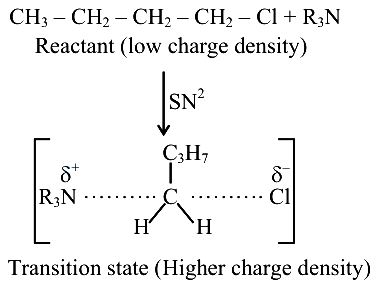
\(\Rightarrow\) This reaction will proceed faster in more polar medium which will decrease the activation energy value. -
- (A) \(0\)
- (B) \(5\)
- (C) \(1\)
- (D) \(-1\)
Show answer and solution
Correct Answer: (A)
\(\mu=1.2 \mathrm{D}=\mathrm{q} \times \mathrm{d}\)\(\Rightarrow 1.2 \times 10^{-10} \mathrm{esu} A=\mathrm{q} \times 1 A\)
\(\therefore \mathrm{q}=1.2 \times 10^{-10} \text { esu }\)
-
- (A) \(\mathrm{CCl}_4\)
- (B) \(\mathrm{CO}_2\)
- (C) \(\mathrm{CH}_2=\mathrm{CH}_2\)
- (D) \(\mathrm{CHCl}_3\)
Show answer and solution
Correct Answer: (D)
\(\mu \neq 0\)
\(\mathrm{CHCl}_3\) is polar molecule and rest all molecules are non-polar.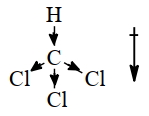
-
- (A) Statement \(I\) is true but Statement \(II\) is false.
- (B) Both Statement \(I\) and Statement \(II\) are false.
- (C) Both statement \(I\) and Statement \(II\) is are true.
- (D) Statement \(I\) is false but Statement \(II\) is are true.
Show answer and solution
Correct Answer: (B)
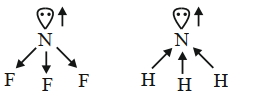
Explanation:
Let us evaluate both statements based on the concepts of chemical bonding and molecular dipole moments:
1. Evaluation of Statement-I: This statement is false. Although Fluorine is highly electronegative, the net dipole moment of \(\text{NH}_3\) (\(\mu = 1.47\text{ D}\)) is significantly greater than that of \(\text{NF}_3\) (\(\mu = 0.23\text{ D}\)). Thus, \(\mu_{\text{NH}_3} > \mu_{\text{NF}_3}\).
2. Evaluation of Statement-II: This statement is also false as it completely reverses the actual directions of the dipoles:
- In \(\text{NH}_3\), Nitrogen is more electronegative than Hydrogen, so the \(\text{N-H}\) bond dipoles point towards Nitrogen (upwards). The lone pair orbital dipole also points upwards. Since they are in the same direction, they reinforce each other.
- In \(\text{NF}_3\), Fluorine is more electronegative than Nitrogen, so the \(\text{N-F}\) bond dipoles point towards Fluorine (downwards). The lone pair orbital dipole points upwards. Since they are in opposite directions, they partially cancel each other out.
Since both Statement-I and Statement-II are false, Option B is the correct choice. -
- (A) \(5\)
- (B) \(6\)
- (C) \(8\)
- (D) \(10\)
Show answer and solution
Correct Answer: (B)
\(\mathrm{H}_2, \mathrm{CO}_2, \mathrm{BF}_3, \mathrm{CH}_4, \mathrm{SiF}_4, \mathrm{BeF}_2\)are symmetrical molecule so dipole moment is zero.
-
- (A) \(3\)
- (B) \(5\)
- (C) \(7\)
- (D) \(8\)
Show answer and solution
Correct Answer: (B)
Polar molecule: \(\mathrm{NF}_3, \mathrm{H}_2 \mathrm{O}, \mathrm{H}_2 \mathrm{~S}, \mathrm{HBr}, \mathrm{HCl}\) \((\mu \neq 0)\)Non Polar molecule: \(\mathrm{BeCl}_2, \mathrm{BCl}_3, \mathrm{XeF}_4, \mathrm{CCl}_4, \mathrm{CO}_2, \mathrm{H}_2\) \((\mu=0)\)
So answer is \(5\) .
-
- (A) \(8\)
- (B) \(4\)
- (C) \(9\)
- (D) \(2\)
Show answer and solution
Correct Answer: (B)
The non-polar molecules are \(\mathrm{CO}_2, \mathrm{H}_2, \mathrm{CH}_4\) and \(\mathrm{BF}_3\) -
- (A) \(1\)
- (B) \(3\)
- (C) \(5\)
- (D) \(6\)
Show answer and solution
Correct Answer: (B)
Molecules with zero dipole moment \(=\mathrm{CO}_2, \mathrm{CH}_4\), \(\mathrm{BF}_3\) -
- (A) \(\mathrm{NF}_3\)
- (B) \(\mathrm{CH}_4\)
- (C) \(\mathrm{NH}_3\)
- (D) \(\mathrm{PF}_5\)
Show answer and solution
Correct Answer: (C)
\(\mathrm{CH}_4 \& \mathrm{PF}_5, \mu_{\text {pet }}=0\) (non polar)
-
- (A) Both Statement \(I\) and Statement \(II\) are correct.
- (B) Statement \(I\) is incorrect but Statement \(II\) is correct.
- (C) Both Statement \(I\) and Statement \(II\) are incorrect.
- (D) Statement \(I\) is correct but Statement \(II\) is incorrect.
Show answer and solution
Correct Answer: (B)
Explanation:
1. Evaluation of Statement I:
In chemistry, by standard convention, the dipole moment is represented by a crossed arrow (\(\mapsto\)) placed over the Lewis structure of a molecule. The cross is situated at the positive (less electronegative) center, and the arrowhead points toward the negative (more electronegative) center. Since Statement I states that the tail is on the negative center and the head points towards the positive center, it is factually incorrect.
2. Evaluation of Statement II:
The crossed arrow representation explicitly symbolizes the direction of the shift of electron density (separation of partial charges) towards the more electronegative atom in the covalent bond. Therefore, Statement II is factually correct.
Hence, Option B is the correct choice. -
- (A) \(3\)
- (B) \(2\)
- (C) \(1\)
- (D) \(4\)
Show answer and solution
Correct Answer: (A)
\(BeF _{2}, BF _{3}\) and \(CCl _{4} \Rightarrow \mu_{\text {net }}=0\)\(H _{2} O , NH _{3}\) and \(HCl \Rightarrow \mu_{\text {net }} \neq 0\)
-
- (A) \(95\)
- (B) \(49\)
- (C) \(22\)
- (D) \(84\)
Show answer and solution
Correct Answer: (B)
\(Fe \rightarrow[ Ar ] 4 s ^{2} 3 d ^{6}\)\(\uparrow \downarrow\) \(\uparrow\) \(\uparrow\) \(\uparrow\) \(\uparrow\) Number of unpaired \(e ^{-}=4\)
\(\mu=\sqrt{4(4+2)} \,B.M.\)
\(\mu=\sqrt{24}\, B.M\)
\(\mu=4.89\, B.M\)
\(\mu=48.9 \times 10^{-1}\, B.M\)
Nearest integer value will be \(49 .\)
-
- (A) \(5.82,0\) and \(0\, BM\)
- (B) \(4.90,0\) and \(1.73\, BM\)
- (C) \(5.92,4.90\) and \(0 \,BM\)
- (D) \(4.90,0\) and \(2.83 \,BM\)
Show answer and solution
Correct Answer: (B)
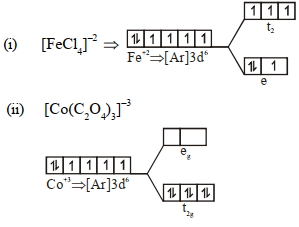
\((i)\) \(\left[ FeCl _{4}\right]^{-2}\)\(\mu =\sqrt{ n ( n +2)} \,BM\)
\(=\sqrt{4(4+2)}\, BM\)
\(=\sqrt{24}\, BM \Rightarrow 4.90\, BM\)
\((ii)\) \(\left[ Co \left( C _{2} O _{4}\right)_{3}\right]^{-3}\)
\(\mu=0\)
\((iii)\) \(MnO _{4}^{-2}\)
\(Mn ^{+6} \Rightarrow[ Ar ] 3 d ^{1} \quad \mu=\sqrt{ n ( n +2)} \,BM\)
\(=\sqrt{1(1+2)} \,BM\)
\(=\sqrt{3} BM \Rightarrow 1.73\, BM\)
- 16. The spin only magnetic moment of a divalent ion in aqueous solution (atomic number 29\()\) is ...... \(BM.\) 2021 Medium
- (A) \(2\)
- (B) \(8\)
- (C) \(6\)
- (D) \(4\)
Show answer and solution
Correct Answer: (A)
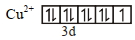
\(Z=29( Cu )\)\(Cu ^{2+}\) form \(\left[ Cu \left( H _{2} O \right)_{4}\right]^{2+}\) complex ion with \(H _{2} O.\)
\(\left[ Cu \left( H _{2} O \right)_{4}\right]^{2+} \Rightarrow Cu ^{2+}[ Ar ] 3 d ^{9}, H _{2} O \rightarrow WFL\)
number of unpaired \(e ^{-}=1\)
\(\mu=\sqrt{1(1+2)}\) \(B.M.\)
\(\mu=\sqrt{3} \Rightarrow 1.73 \,B.M . \Rightarrow \text { round off ans. } \Rightarrow 2\)
-
- (A) \(243\)
- (B) \(1\)
- (C) \(173\)
- (D) \(143\)
Show answer and solution
Correct Answer: (C)
\(\mathrm{B}_{2}^{+} \Rightarrow \sigma_{1 \mathrm{~s}}^{2} \sigma_{1 \mathrm{~s}}^{* 2} \sigma_{2 s}^{2} \sigma_{2 \mathrm{~s}}^{* 2} \pi_{2 \mathrm{py}}^{1} \simeq \pi_{2 \mathrm{pz}}^{0}\)\(\Rightarrow 9 \mathrm{e}^{-}\)
\(\mu=\sqrt{1(1+2)}=\sqrt{3}\, \mathrm{BM}\)
\(=1.73 \,\mathrm{BM}\)
\(=1.73 \times 10^{-2}\, \mathrm{BM}\)
-
- (A) \(C\) and \(D\) only
- (B) \(A\) and \(B\) only
- (C) \(A\) and \(C\) only
- (D) \(B\) and \(C\) only
Show answer and solution
Correct Answer: (B)
Isostructural means same structure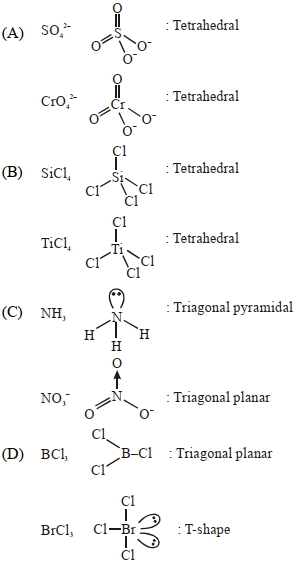
- 19. Which one of the following species doesn't have a magnetic moment of \(1.73\, \mathrm{BM}\). (spin only value)? 2021 Hard
- (A) \(CuI\)
- (B) \(\left[\mathrm{Cu}\left(\mathrm{NH}_{3}\right)_{4}\right] \mathrm{Cl}_{2}\)
- (C) \(\mathrm{O}_{2}^{+}\)
- (D) \(\mathrm{O}_{2}^{-}\)
Show answer and solution
Correct Answer: (A)
Species must not contain single unpaired\(\mathrm{O}_{2}^{+} \rightarrow \sigma_{1 \mathrm{~s}}^{2}<\sigma_{1 \mathrm{~s}}^{*}<\sigma_{2 \mathrm{~s}}^{2}<\sigma_{2 \mathrm{~s}}^{*}<\sigma_{2 \mathrm{pz}}^{2}<\pi_{2 \mathrm{px}}^{2}=\pi_{2 \mathrm{py}}^{2}<\pi_{2 \mathrm{px}}^{*}=\pi_{2 \mathrm{py}}^{*}\)
unpaired \(\mathrm{e}^{-}=1 \ldots \mu=1.73\, \mathrm{BM}\)
\((1)\) \(\mathrm{Cu}^{+} \mathrm{I}^{-} \mathrm{Cu}+\rightarrow[\mathrm{Ar}] 3 \mathrm{~d}^{10} \therefore\) unpaired \(\mathrm{e}^{-}=0\)
\(\mathrm{I}^{-} \rightarrow[\mathrm{Xe}] \therefore\) unpaired \(\mathrm{e}^{-}=0\)
therefore \(\mu=0\)
\(3.\) \(\left[\mathrm{Cu}\left(\mathrm{NH}_{3}\right)_{4}\right] \mathrm{Cl}_{2}\)
\(\mathrm{Cu} \rightarrow[\mathrm{A}] 3 \mathrm{~d}^{3} \therefore\) unpaired \(=1 \quad \therefore \mu=1.73 \,\mathrm{BM}\)
\(4.\) \(\mathrm{O}_{2}^{-} \rightarrow \mathrm{d}\)
\(\sigma_{1 \mathrm{~s}}^{2}<\sigma_{1 \mathrm{~s}}^{* 2}<\sigma_{2 \mathrm{~s}}^{2}<\sigma_{2 \mathrm{~s}}^{* 2}<\sigma_{2 \mathrm{px}}^{2}<\pi_{2 \mathrm{px}}^{2}=\pi_{2 \mathrm{py}}^{2}<\pi_{2 \mathrm{px}}^{*_{1}}=\pi_{2 \mathrm{py}}^{*}\)
\(\left(11 \mathrm{e}^{-}\right)\)
\(\therefore\) unpaired \(\quad \therefore \mu=1.73\, \mathrm{BM}\)
-
- (A) \(0.5\)
- (B) \(0.05\)
- (C) \(0\)
- (D) \(1.0\)
Show answer and solution
Correct Answer: (B)
\(1\,e = 1.602 \times {10^{ - 19}}\,C\)\(1\,esu = 3.33 \times {10^{ - 10}}\,C\)
\(\frac{{1\,e}}{{1\,esu}} = \frac{{1.602 \times {{10}^{ - 19}}\,C}}{{3.33 \times {{10}^{ - 10}}\,C}}\)
\(1\,e = 4.802 \times {10^{ - 10}}\,esu\,\)
Dipole moment \(= q \times \) distance
\( \Rightarrow \,1\,D \approx {10^{ - 18}}\,esu\,cm\)
\(0.38 \times {10^{ - 18}}\,esu\,cm = q \times (1.61 \times {10^{ - 8}}\,cm)\)
\(q = 2.36 \times {10^{ - 11}}\,esu\)
\(q = \frac{{2.36 \times {{10}^{ - 11}}\,esu}}{{4.802 \times {{10}^{ - 10}}\,esu}}\)
\(q = 0.049\)
\(q \approx 0.05\) fractional charge

No questions on this page match these filters.
Other STD 11 - Chemical bonding and molecular structure topics
Frequently asked
How many Dipole moment questions came in JEE Mains?
20 questions from 2015–2025, each with the correct answer and a full solution.
How difficult are Dipole moment questions?
25% are easy, 35% medium and 40% hard.