


Questions
Newest firstShowing 1–43 of 43 questions
-
- (A) \(Ca^{2+}\) and \(SO_4^{2-}\)
- (B) \(Ba^{2+}\) and \(PO_4^{3-}\)
- (C) \(Mn^{2+}\) and \(PO_4^{3-}\)
- (D) \(Ba^{2+}\) and \(SO_4^{2-}\)
Show answer and solution
Correct Answer: (B)
An apple green colour in the flame test indicates the presence of \(Ba^{2+}\) ion.
The group precipitate of \(Ba^{2+}\) is \(BaCO_3\), which dissolves in acetic acid to form barium acetate. Upon treatment with \(K_2CrO_4\), it gives a yellow precipitate of barium chromate (\(BaCrO_4\)), confirming the presence of \(Ba^{2+}\).
When the sodium carbonate extract is heated with conc. \(HNO_3\) and ammonium molybdate, the formation of a canary yellow precipitate indicates the presence of phosphate (\(PO_4^{3-}\)) ion. The canary yellow precipitate is ammonium phosphomolybdate, \((NH_4)_3PO_4 \cdot 12MoO_3\).
Therefore, the cation is \(Ba^{2+}\) and the anion is \(PO_4^{3-}\).
Answer: \(Ba^{2+}\) and \(PO_4^{3-}\) -
- (A) A-III, B-IV, C-II, D-I
- (B) A-III, B-IV, C-I, D-II
- (C) A-IV, B-I, C-II, D-III
- (D) A-IV, B-III, C-II, D-I
Show answer and solution
Correct Answer: (C)
(A)-IV, (B)-I, (C)-II, (D)-III -
- (A) A-IV, B-II, C-I, D-III
- (B) A-IV, B-II, C-III, D-I
- (C) A-II, B-IV, C-I, D-III
- (D) A-II, B-IV, C-III, D-I
Show answer and solution
Correct Answer: (D)
Diethyl amine is a secondary amine and ethyl amine is a primary amine. Primary amines give the carbylamine test with \(CHCl_3\) and \(KOH\) on heating, while secondary amines do not. Thus, A matches with II.
Acetaldehyde is an aldehyde and acetone is a ketone. Aldehydes reduce ammoniacal silver nitrate (Tollens' reagent) to form a silver mirror, while ketones do not. Thus, B matches with IV.
Phenol reacts with neutral \(FeCl_3\) to form a violet-colored complex, whereas ethanol does not react. Thus, C matches with III.
Cinnamic acid contains a carbon-carbon double bond which decolorizes bromine water, whereas benzoic acid does not react with bromine water. Thus, D matches with I.
The correct matching is A-II, B-IV, C-III, D-I.
Answer: A-II, B-IV, C-III, D-I -
- (A) 20
- (B) 40
- (C) 60
- (D) 80
Show answer and solution
Correct Answer: (D)
Organic Compound\(\rightarrow \mathrm{CO}_2\)
Applying POAC on ' C ' (mole) of ' C ' in compound \(=\mathrm{n}_{\mathrm{CO}_2} \times 1\)
So mass of ' C ' in compound \(=\frac{1.46}{44} \times 12\)
So, \(\%\) of ' C ' in compound \(=\frac{1.46}{44} \times \frac{12}{0.5} \times 100\)
\(=79.63\) -
- (A) 14
- (B) 16
- (C) 12
- (D) 10
Show answer and solution
Correct Answer: (C)
Organic compound \(\xrightarrow[\Delta]{\mathrm{CuO}} \mathrm{CO}_2+\mathrm{H}_2 \mathrm{O}\)
\(\begin{aligned} & \mathrm{n}_{\mathrm{CO}_2}=\frac{220 \times 10^{-3}}{44}=5 \times 10^{-3} \mathrm{moles} \\ & \mathrm{m}_{\mathrm{C}}=5 \times 10^{-3} \times 12\end{aligned}\)
\(\% \mathrm{~m}\) carbon \(=\frac{5 \times 10^{-3} \times 12}{500 \times 10^{-3}} \times 100=12 \%\)
Correct answer is \(12\) -
- (A) A, D and E only
- (B) B, D and E only
- (C) A, B and C only
- (D) C, D and E only
Show answer and solution
Correct Answer: (C)
\(2 \mathrm{CuSO}_4+\mathrm{K}_4\left[\mathrm{Fe}(\mathrm{CN})_6\right] \xrightarrow{\mathrm{CH}_3 \mathrm{COOH}}\underset{\text{(Chocolate brown ppt.)}}{\mathrm{Cu}_2\left[\mathrm{Fe}(\mathrm{CN})_6\right]+2 \mathrm{~K}_2 \mathrm{SO}_4}\)
\(4 \mathrm{FeCl}_3+3 \mathrm{~K}_4\left[\mathrm{Fe}(\mathrm{CN})_6\right] \longrightarrow \underset{\text { (Prussian Blue ppt.) }}{\mathrm{Fe}_4\left[\mathrm{Fe}(\mathrm{CN})_6\right]_3}+12 \mathrm{KCl}\)
\(3 \mathrm{ZnCl}_4+2 \mathrm{~K}_4\left[\mathrm{Fe}(\mathrm{CN})_6\right] \xrightarrow{\mathrm{NH}_4 \mathrm{OH}} \underset{\text { (White or bluish white ppt.) }}{\mathrm{K}_2 \mathrm{Zn}_3\left[\mathrm{Fe}(\mathrm{CN})_6\right]_2}+6 \mathrm{KCl}\) -
- (A) 111
- (B) 222
- (C) 333
- (D) 444
Show answer and solution
Correct Answer: (A)
M.wt. of given compound \(=86\)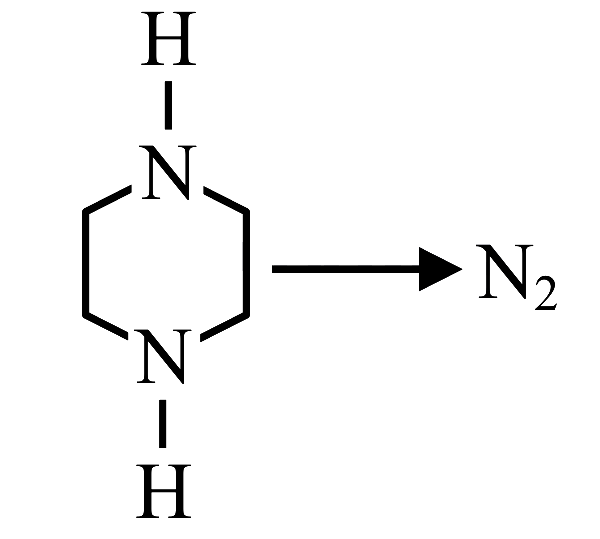
Applying POAC on ' N '
\(\begin{aligned}
& \mathrm{n}_{\mathrm{X}} \times 2=\mathrm{n}_{\mathrm{N}_2} \times 2 \\
& \frac{0.42}{86}=\mathrm{n}_{\mathrm{N}_2} \\
& \Rightarrow(\text { Volume })_{\mathrm{N}_2} \text { at } \mathrm{STP}=\frac{0.42}{86} \times 22.4 \mathrm{~L} \\
& =0.1108 \mathrm{~L}=110.8 \mathrm{~m} \ell
\end{aligned}\) -
- (A) 10
- (B) 20
- (C) 30
- (D) 40
Show answer and solution
Correct Answer: (D)
\(\begin{aligned} & \mathrm{m} \text { mole of } \mathrm{BaSO}_4=\text { mmoles of } \mathrm{S}=\frac{466}{233} \\ & \text { Mass of } \mathrm{S}=\frac{466}{233} \times 32 \mathrm{mg} \\ & =64 \mathrm{mg} \\ & \% \mathrm{~S}=\frac{64}{160} \times 100=40 \%\end{aligned}\) -
- (A) Statement I is true but Statement II is false
- (B) Both Statement I and Statement II are false
- (C) Statement I is false but Statement II is true
- (D) Both Statement I and Statement II are true
Show answer and solution
Correct Answer: (A)
In Dumas method nitrogen present in organic compound is converted into \(\mathrm{N}_2\) gas whose volumetric analysis gives the percentage of nitrogen atom in the organic compound. -
- (A) Statement I is true but Statement II is false
- (B) Both Statement I and Statement II are false
- (C) Both Statement I and Statement II are true
- (D) Statement I is false but Statement II is true
Show answer and solution
Correct Answer: (A)
Lassaigne's test is a general test for detection of halogen, nitrogen and sulphur in an organic compound. These elements covalently bonded to the organic compounds, In order to detect them, these have to converted into ionic forms.
-
- (A) Statement I is false but Statement II is true
- (B) Both Statement I and Statement II are true
- (C) Both Statement I and Statement II are false
- (D) Statement I is true but Statement II is false
Show answer and solution
Correct Answer: (D)
The elements present in the compound are converted from covalent form into ionic form by fusing the compound with sodium in Lassigne's test -
- (A) 20
- (B) 40
- (C) 60
- (D) 80
Show answer and solution
Correct Answer: (A)
\(\begin{aligned} & \mathrm{n}_{\mathrm{Cl}}=\mathrm{n}_{\mathrm{AgCl}}=\frac{143.5 \times 10^{-3}}{143.5}=10^{-3} \\ & \% \mathrm{Cl}=\frac{10^{-3} \times 35.5}{180 \times 10^{-3}} \times 100=19.72\end{aligned}\) -
- (A) 250
- (B) 255
- (C) 260
- (D) 665
Show answer and solution
Correct Answer: (B)
Mass of organic compound \(=0.25 \mathrm{~g}\)
Mass of \(\mathrm{AgBr}=0.15 \mathrm{~g}\)
No. of moles of \(\mathrm{Br}=\) No. of moles of \(\mathrm{AgBr}=\frac{0.15}{188}\)
\(\begin{aligned}
& \text { Mass of } \mathrm{Br}=\frac{0.15 \times 80}{188} \mathrm{~g} \\
& \% \text { of } \mathrm{Br}=\frac{0.15 \times 80 \times 100}{188 \times 0.25} \\
& =25.5 \% \\
& =255 \times 10^{-1} \%
\end{aligned}\) -
- (A) 20
- (B) 18
- (C) 16
- (D) 14
Show answer and solution
Correct Answer: (B)
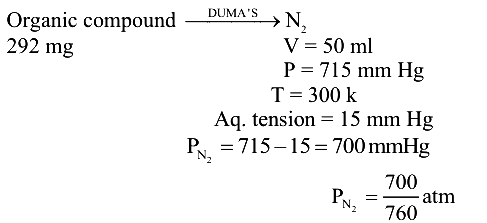
\(\begin{aligned} & \mathrm{n}_{\mathrm{N}_2}=\frac{\mathrm{P}_{\mathrm{N}_2} \cdot \mathrm{~V}}{\mathrm{RT}} \\ & \mathrm{n}_{\mathrm{N}_2}=\frac{700}{760} \times \frac{50}{1000} \times \frac{1}{0.0821 \times 300} \\ & \mathrm{n}_{\mathrm{N}}=2 \times \mathrm{n}_{\mathrm{N}_2} \\ & \text { Mass of } \mathrm{N}=2 \times \mathrm{n}_{\mathrm{N}} \times 14 \\ & \% \mathrm{~N}=\frac{\text { mass of } \mathrm{N}}{\text { mass of organic compound }} \times 100 \\ & \% \mathrm{~N}=\frac{700}{760} \times \frac{50}{1000} \times \frac{2 \times 14}{0.0821 \times 300} \times \frac{1000}{292} \times 100 \\ & \% \mathrm{~N}=18 \%\end{aligned}\) -
- (A) \(15.71 \%\)
- (B) \(20.95 \%\)
- (C) \(17.46 \%\)
- (D) \(7.85 \%\)
Show answer and solution
Correct Answer: (A)
\(\text { Pressure of }
\mathrm{N}_2 \text { gas evolved } =715-15 \\
=700 \mathrm{~mm} \mathrm{Hg} \\
=\frac{700}{760} \mathrm{~atm}.
\)
\(\begin{aligned}
\therefore \text { Mole of } \mathrm{N}_2 \text { evolved } & =\frac{\mathrm{PV}}{\mathrm{RT}} \\
& =\frac{700 \times 60 \times 10^{-3}}{760 \times 0.0821 \times 300} \\
& =0.0022 \mathrm{~mole}
\end{aligned}\)
\(\therefore \mathrm{wt}. \%\) of nitrogen in compound
\(\begin{aligned}
& =\frac{\text { wt. of nitrogen }}{\text { wt. of compound }} \times 100 \\
& =\frac{0.063}{0.4} \times 100 \\
& =15.71 \%
\end{aligned}\) -
- (A) 1.257
- (B) 20.87
- (C) 18.67
- (D) 12.57
Show answer and solution
Correct Answer: (D)
\(\begin{aligned} & \text { Pressure of } \mathrm{N}_2 \text { gas }=(715-15) \\ & \begin{array}{l}=700 \mathrm{mmHg} \\ \mathrm{n}_{\mathrm{N}_2}=\frac{\mathrm{PV}}{\mathrm{RT}} \\ \mathrm{n}_{\mathrm{N}_2}=\frac{700 \times 60 \times 10^{-3}}{760 \times 0.0821 \times 300} \\ \quad=2.24 \times 10^{-3} \mathrm{~mol}\end{array} \\ & \begin{array}{r}\text { Mass of } \mathrm{N}_2=2.24 \times 10^{-3} \times 28 \mathrm{~g} \\ \quad=0.06272 \mathrm{~g}\end{array} \\ & \begin{array}{r}\% \mathrm{~N}_2=\frac{0.06272}{0.5} \times 100 \simeq 12.57\end{array}\end{aligned}\) -
- (A) 22
- (B) 24
- (C) 20
- (D) 18
Show answer and solution
Correct Answer: (C)
Partial pressure of \(\mathrm{N}_2=(900-15)=885 \mathrm{~mm} \mathrm{Hg}\)
Mole of \(\mathrm{N}_2=\frac{\left(\frac{885}{760} \times 0.15\right)}{(0.0821 \times 300)}=0.0071\)
Moles \(\%\) of nitrogen in organic compound
\(\begin{aligned}
& =\frac{(0.0071 \times 28)}{1} \times 10 \\
& =19.85 \%
\end{aligned}\) -
- (A) 250
- (B) 275
- (C) 300
- (D) 325
Show answer and solution
Correct Answer: (B)
\(\begin{array}{ll}\text { Organic Compound } \longrightarrow & \mathrm{BaSO}_4 \\ 0.20 \mathrm{gm} & 0.40 \mathrm{gm} \\ & \frac{0.40}{233} \mathrm{~mol}\left(\mathrm{BaSO}_4\right) \\ & \frac{0.40}{233} \mathrm{~mol} \text { (Sulphur) } \\ & \frac{0.40}{233} \times 32 \mathrm{gm} \text { (sulphur) }\end{array}\)
\(\% \mathrm{~S}=\frac{\frac{0.40 \times 32}{233} \times 100}{0.20}=27.5 \%\) or \(275 \times 10^{-1} \%\) -
- (A) \(\mathrm{Br}\)
- (B) \(\mathrm{N}\)
- (C) \(\mathrm{N}\) and \(\mathrm{S}\)
- (D) \(\mathrm{S}\)
Show answer and solution
Correct Answer: (C)
\(\mathrm{Fe}^{2+} \xrightarrow[\text { Conc. } \mathrm{H}_2 \mathrm{SO}_4]{\mathrm{H}^{+}} \mathrm{Fe}^{+3}\)\(\mathrm{Fe}^{+3} \xrightarrow{-\mathrm{SCN}} \mathrm{Fe}(\mathrm{SCN})_3(\) blood red colour \()\)
Appearance of blood red colour indicates presence of both nitrogen and sulphur.
-
- (A) \(Na _3 PO _4 \cdot 12 MoO _3\)
- (B) \(\left( NH _4\right)_3 PO _4 \cdot 12 MoO _3\)
- (C) \(MoPO _4 \cdot 21 NH _4 NO _3\)
- (D) \(\left( NH _4\right)_3 PO _4 \cdot 12\left( NH _4\right)_2 MoO _4\)
Show answer and solution
Correct Answer: (B)
\(2 P +3 Na _2 O _2+\underset{\text { air }}{ O _2} \xrightarrow{\text { fusion }} 2 Na _3 PO _4\)
\(Na _3 PO _4+12\left( NH _4\right)_3 MoO _4+21 HNO _3 \rightarrow\) \(\left( NH _4\right)_3 PO _4 \cdot \underset{\text { yellow }}{12 MoO _3}+21 NH _4 NO _3+12 H _2 O\) -
- (A) Nitrogen and Sulphur only
- (B) Nitrogen, Sulphur and Phosphorous Only
- (C) Phosphorous and halogens only
- (D) Nitrogen, Sulphur, phosphorous and halogens
Show answer and solution
Correct Answer: (D)
Lassaigne's test is used for detection of all element \(\mathrm{N}, \mathrm{S}, \mathrm{P}, \mathrm{X}\). -
- (A) \(A-III, B-I, C-II, D-IV\)
- (B) \(A-IV, B-I, C-II, D-III\)
- (C) \(A-II, B-III, C-IV, D-I\)
- (D) \(A-I, B-II, C-III, D-IV\)
Show answer and solution
Correct Answer: (A)
\(\mathrm{Fe}_4\left[\mathrm{Fe}(\mathrm{CN})_6\right]_3 \cdot \mathrm{xH}_2 \mathrm{O} \rightarrow \text { Prussian Blue }\)\({\left[\mathrm{Fe}(\mathrm{CN})_5 \mathrm{NOS}\right]^{4-} \rightarrow \text { Violet }}\)
\({[\mathrm{Fe}(\mathrm{SCN})]^{2+} \rightarrow \text { Blood Red }}\)
\(\left(\mathrm{NH}_4\right)_3 \mathrm{PO}_4 \cdot 12 \mathrm{MoO}_3 \rightarrow \text { Yellow }\)
-
- (A) (A)-(IV), (B)-(III), (C)-(I), (D)-(II)
- (B) (A)-(II), (B)-(III), (C)-(IV), (D)-(I)
- (C) (A)-(IV), (B)-(I), (C)-(II), (D)-(III)
- (D) (A)-(III), (B)-(I), (C)-(IV), (D)-(II)
Show answer and solution
Correct Answer: (A)
(A)-(IV), (B)-(III), (C)-(I), (D)-(II) -
- (A) A-III, B-IV, C-I, D-II
- (B) A-I, B-II, C-III, D-IV
- (C) A-IV, B-I, C-II, D-III
- (D) A-II, B-III, C-IV, D-I
Show answer and solution
Correct Answer: (D)
A-II, B-III, C-IV, D-I -
- (A) ammonium sulphide
- (B) lead sulphate
- (C) lead iodide
- (D) ammonium arsinomolybdate
Show answer and solution
Correct Answer: (B)
Lead sulphate - white
Ammonium sulphide -soluble
Lead iodide - Bright yellow
Ammonium arsinomolybdate - yellow - 26. The Lassiagne's extract is boiled with dil \(\mathrm{HNO}_3\) before testing for halogens because, 2024 Hard
- (A) \(\mathrm{AgCN}\) is soluble in \(\mathrm{HNO}_3\)
- (B) Silver halides are soluble in \(\mathrm{HNO}_3\)
- (C) \(\mathrm{Ag}_2 \mathrm{~S}\) is soluble in \(\mathrm{HNO}_3\)
- (D) \(\mathrm{Na}_2 \mathrm{~S}\) and \(\mathrm{NaCN}\) are decomposed by \(\mathrm{HNO}_3\)
Show answer and solution
Correct Answer: (D)
If nitrogen or sulphur is also present in the compound, the sodium fusion extract is first boiled with concentrated nitric acid to decompose cyanide or sulphide of sodium during Lassaigne's test. - 27. Which of the following nitrogen containing compound does not give Lassaigne's test ? 2024 Medium
- (A) Phenyl hydrazine
- (B) Glycene
- (C) Urea
- (D) Hydrazine
Show answer and solution
Correct Answer: (D)
Hydrazine \(\left(\mathrm{NH}_2-\mathrm{NH}_2\right)\) have no carbon so does not show Lassaigne's test. -
- (A) \(A-II, B-IV, C-I, D-III\)
- (B) \(A-IV, B-II, C-I, D-III\)
- (C) \(A-II, B-I, C-IV, D-III\)
- (D) \(A-III, B-I, C-IV, D-II\)
Show answer and solution
Correct Answer: (D)
Nitrogen detection by lassaigne's method\(Na + C + N \rightarrow NaCN\)
\(6 NaCN + FeSO _4 \rightarrow Na _4\left[ Fe ( CN )_6\right]+ Na _2 SO _4\)
\(Na _4\left[ Fe ( CN )_6\right]+ Fe ^{3+} \rightarrow Fe _4\left[ Fe ( CN )_6\right]_3\)
(Prussian blue)
Sulphur detection by Sodium nitroprusside
\(Na _2\left[ Fe ( CN )_5 NO \right]+ Na _2 S \rightarrow Na 4\left[ Fe ( CN )_5 NOS \right]\)
\(\text { [Purple }]\)
Phosphorus detection by ammonium molybdate
\(Na _3 PO _4+3 HNO _3 \rightarrow H _3 PO _4+3 NaNO _3\)
\(H _3 PO _4+12\left( NH _4\right)_2 MoO _4+21 HNO _3 \rightarrow\)
\(\left( NH _4\right)_3 PO _4 .12 MoO _3+21 NH _4 NO _3+12 H _2 O\)
\(\text { (canary yellow) }\)
\(\text { Halogen give specific coloured ppt with }\)
\(AgNO _3( aq )\)
\(NaCl + AgNO _3( aq ) \rightarrow AgCl + NaNO _3\)
\(\text { (White) }\)
\(NaBr + AgNO _3( aq ) \rightarrow AgBr + NaNO _3\)
\(\text { (Pale yellow) }\)
\(NaI + AgNO _3( aq ) \rightarrow AgI + NaNO _3\)
\(\text { (Yellow) }\)
-
- (A) prevent oxidation
- (B) prevent reduction
- (C) prevent hydrolysis
- (D) prevent breaking
Show answer and solution
Correct Answer: (A)
Prolonged heating will cause oxidation of \(Fe ^{+2}\) to \(Fe ^{+3}\). -
- (A) Dimethylglyoxime and \(Ni ^{2+}\)
- (B) Dimethylglyoxime and \(Co ^{2+}\)
- (C) Nessler's reagent and \(Hg ^{2+}\)
- (D) Nessler's reagent and \(Ni ^{2+}\)
Show answer and solution
Correct Answer: (A)
\(Ni ^{2+}+ DMG ^{-} \rightarrow\left[ Ni ( DMG )_{2}\right] \downarrow\)(Bright red precipitate)
- 31. \(Fe ^{3+}\) cation gives a prussian blue precipitate on addition of potassium ferrocyanide solution due to the formation of. 2022 Easy
- (A) \(\left[ Fe \left( H _{2} O \right)_{6}\right]_{2}\left[ Fe ( CN )_{6}\right]\)
- (B) \(Fe _{2}\left[ Fe ( CN )_{6}\right]_{2}\)
- (C) \(Fe _{3}\left[ Fe ( OH )_{2}( CN )_{4}\right]_{2}\)
- (D) \(Fe _{4}\left[ Fe ( CN )_{6}\right]_{3}\)
Show answer and solution
Correct Answer: (D)
\(4 Fe ^{3+}+3\left[ Fe ( CN )_{6}\right]^{-4} \underset{\text { Prussian Blue }}{\longrightarrow} Fe _{4}\left[ Fe ( CN )_{6}\right]_{3}\) -
- (A) Both Statement \(I\) and Statement \(II\) are correct.
- (B) Both Statement \(I\) and Statement \(II\) are incorrect.
- (C) Statement \(I\) is correct but Statement \(II\) is incorrect.
- (D) Statement \(I\) is incorrect but Statement \(II\) is correct.
Show answer and solution
Correct Answer: (A)
Both statement \(I\) and statement \(II\) are correct. - 33. The formula of the purple colour formed in Laissaigne's test for sulphur using sodium nitroprusside is ...... 2022 Medium
- (A) \(NaFe \left[ Fe ( CN )_{6}\right]\)
- (B) \(Na \left[ Cr \left( NH _{3}\right)_{2}\left( NCS _{4}\right]\right.\)
- (C) \(Na _{2}\left[ Fe ( CN )_{5}( NO )\right]\)
- (D) \(Na _{4}\left[ Fe ( CN )_{5}( NOS )\right]\)
Show answer and solution
Correct Answer: (D)
\(Na _{2} S + Na _{2}\left[ Fe ( CN )_{5} NO \right] \rightarrow Na _{4}\left[ Fe ( CN )_{5} NO _{5}\right]\) -
- (A) \(5\)
- (B) \(3\)
- (C) \(8\)
- (D) \(2\)
Show answer and solution
Correct Answer: (D)
\(\frac{ R _{ F _{ A }}}{ R _{ F _{ B }}}=\frac{\frac{2.08}{3.25}}{\frac{1.05}{3.25}}=\frac{2.08}{1.05} \simeq 2\) -
- (A) \(\mathrm{Fe}_{4}\left[\mathrm{Fe}(\mathrm{CN})_{6}\right]_{3}\)
- (B) \(\mathrm{K}_{5} \mathrm{Fe}\left[\mathrm{Fe}(\mathrm{CN})_{6}\right]_{2}\)
- (C) \(\mathrm{HFe}\left[\mathrm{Fe}(\mathrm{CN})_{6}\right]\)
- (D) \(\mathrm{KFe}\left[\mathrm{Fe}(\mathrm{CN})_{6}\right]\)
Show answer and solution
Correct Answer: (D)
\(\mathrm{FeCl}_{3}+\mathrm{K}_{4}\left[\mathrm{Fe}(\mathrm{CN})_{6}\right](\text { excess })\)\(\quad\quad\quad\downarrow\)
\(\mathrm{K} \mathrm{Fe}\left[\mathrm{Fe}(\mathrm{CN})_{6}\right]\)
Colloidal species
- 36. In Carius method, halogen containing organic compound is heated with fuming nitric acid in the presence of : 2021 Hard
- (A) \(\mathrm{AgNO}_{3}\)
- (B) \(\mathrm{HNO}_{3}\)
- (C) \(\mathrm{BaSO}_{4}\)
- (D) \(\mathrm{CuSO}_{4}\)
Show answer and solution
Correct Answer: (A)
Organic compound is heated with fuming nitric acid in the presence of silver nitrate in carius method.Lunar caustic \(\left(\mathrm{AgNO}_{3}\right)\) is used as reagent hare to distinguish \(\mathrm{Cl}^{-}, \mathrm{Br}\) and \(\mathrm{I}^{-}\)respectively as follows.
\(\mathrm{Cl}^{-}(\mathrm{aq}) \stackrel{\mathrm{AgNO}_{3}}{\longrightarrow} \mathrm{AgCl} \downarrow_{\mathrm{ppt}}\) white
\(\mathrm{Br}^{-}(\mathrm{aq})\stackrel{\mathrm{AgNO}_{3}}{\longrightarrow} \mathrm{AgBr} \downarrow_{\mathrm{ppt}} \mathrm{pale}\) yellow
\(\mathrm{I}^{-}(\mathrm{aq}) \stackrel{\mathrm{AgNO}_{3}}{\longrightarrow} \mathrm{AgNO}_{3} \mathrm{AgI} \downarrow_{\mathrm{ppt}}\) Dark yellow
-
- (A) \((a)-(iii), (b)-(i), (c)-(ii), (d)-(iv)\)
- (B) \((a)-(i), (b)-(iv), (c)-(iii), (d)-(ii)\)
- (C) \((a)-(iii), (b)-(i), (c)-(iv),(d)-(ii)\)
- (D) \((a)-(i), (b)-(ii), (c)-(iv), (d)-(iii)\)
Show answer and solution
Correct Answer: (C)
Match List :-\((a)\) Lassaigne's Test \((iii)\) \(N , S , P ,\) and halogen \((b)\) \(Cu ( II )\) oxide \((i)\) Carbon \((c)\) Silver nitrate \((iv)\) Halogen Specifically \((d)\) The sodium fusion extract gives black precipitate with acetic acid and lead acetate \((ii)\) Sulphur - 38. Which of the following compound is added to the sodium extract before addition of silver nitrate for testing of halogens? 2021 Easy
- (A) Nitric acid
- (B) Ammonia
- (C) Hydrochloric acid
- (D) Sodium hydroxide
Show answer and solution
Correct Answer: (A)
For testing of halogens, Nitric acid is added to the sodium extract because if \(CN ^{-}\) or \(S ^{2-}\) are present then they will be oxidised and removed before the test of halides. -
- (A) Carius tube is used in the estimation of sulphur in an organic compound
- (B) Carius method is used for the estimation of nitrogen in an organic compound
- (C) Phosphoric acid produced on oxidation of phosphorus present in an organic compound is precipitated as \(Mg _{2} P _{2} O _{7}\) by adding magnesia mixture.
- (D) Kjeldahl's method is used for the estimation of nitrogen in an organic compound
Show answer and solution
Correct Answer: (B)
Carius method is used in the estimation of halogen in organic compounds. -
- (A) \(48\)
- (B) \(60\)
- (C) \(24\)
- (D) \(36\)
Show answer and solution
Correct Answer: (C)
Mass of substance \(=250 \mathrm{mg}=0.250 \mathrm{g}\)Mass of \(A g B r=141 \mathrm{mg}=0.141 \mathrm{g}\)
\(1\; mole\) of \(A g B r=1\; g\) atom of \(B r\)
\(188 g\) of \(A g B r=80 g\) of \(B r\)
\(188 g\) of \(A g B r\) contain bromine \(=80 g\)
\(0.141 g\) of \(A g B r\) contain bromine \(=\frac{80}{188} \times 0.141\)
This much amount of bromine present in \(0.250 \mathrm{g}\) of organic compound
\(\because \%\) of bromine \(=\frac{80}{188} \times \frac{0.414}{0.250} \times 100=24 \%\)
-
- (A) \(A - (ii); B - (iii) ; C - (i)\)
- (B) \(A - (iii); B - (i) ; C - (ii)\)
- (C) \(A - (iii); B - (ii) ; C - (i)\)
- (D) \(A - (ii); B - (i) ; C - (iii)\)
Show answer and solution
Correct Answer: (C)
\((c)\) In Lassaigne's test, fusion with sodium take place and following species formed respectively.\((a)\) Aniline \(\to \) \(CN^-\)
\((b)\) Benzene sulfonic acid \(\to \) (figure)
\((c)\) Thiourea \(\to \) \(S^{2-}\)
Reaction of \(CN^-\) with hot and acidic solution of \(FeSO_4\) lead to formation of \(Fe_4[Fe(CN)_6]_3\) which is blue in colour. It contains iron in both \(II\) and \(III\) oxidation state.
Reaction of \(S^{2-}\) with sodium nitroprusside
\(N{a_2}S + N{a_2}[Fe{(CN)_5}NO] \to \mathop {N{a_4}[Fe{{(CN)}_5}NOS]}\limits_{(violet\,in\,colour)} \)
Phenoxide ion on reacting with \(FeCl_3\) give red colour with \(FeCl_3\).

- 42. Which of the following compounds is not expected to show Lassaignes' test for nitrogen ? 2013 Hard
- (A) Propanenitrile
- (B) Hydroxylamine hydrochloride
- (C) Nitromethane
- (D) Ethanamine
Show answer and solution
Correct Answer: (B)
Lassaigne's test is used for the detection of nitrogen and given by all nitrogenous compound except diazo \(\rlap{-} (\,\,N = N\rlap{-} )\) compounds.
This test is shown only by the compounds containing \(C\) and \(N\) both hence hydroxyl amine hydrochloride \((H_2NOH .HCl)\) will not perform this test -
- (A) \(Fe^{3+}\) ion also gives blood red colour with \(SCN^-\) ion.
- (B) \(Fe^{2+}\) ion also gives blood red colour with \(SCN^-\) ion.
- (C) On passing \(H_2S\) into \(Na_2ZnO_2\) solution a white ppt of \(ZnS\) is formed.
- (D) Cupric ion reacts with excess of ammonia solution to give deep blue colour of \([Cu(NH_3)_4]^{2+}\) ion
Show answer and solution
Correct Answer: (A)
Only \(Fe^{3+}\) ion gives blood red colouration with \(SCN^-\) ion.\(F{e^{3 + }} + SC{N^ - }\, \to \,\mathop {{{[Fe(SCN)]}^{2 + }}}\limits_{{\text{(dark red)}}} \)
No questions on this page match these filters.
Other STD 11 - Organic chemistry purification and characterization topics
Frequently asked
How many Qualitative Analysis questions came in JEE Mains?
43 questions from 2013–2026, each with the correct answer and a full solution.
How difficult are Qualitative Analysis questions?
19% are easy, 56% medium and 26% hard.