


Questions
Newest firstShowing 1–17 of 17 questions
-
- (A)
D E Conc. H\(_2\)SO\(_4\) CH\(_2 =\) CH \(-\) CH(OH)CH\(_3\) - (B)
D E PCC HO \(-\) CH\(_2\) \(-\) CH\(_2\) \(-\) CH \(=\) CH\(_2\) - (C)
D E PCC CH\(_2 =\) CH \(-\) CH \(=\) CH\(_2\) - (D)
D E Conc. H\(_2\)SO\(_4\) or H\(_3\)PO\(_4\) CH\(_2 =\) CH \(-\) CH \(=\) CH\(_2\)
Show answer and solution
Correct Answer: (D)
Compound A is pentan-1-ol (\(CH_3-CH_2-CH_2-CH_2-CH_2-OH\)) and Compound B is pent-1-ene (\(CH_2=CH-CH_2-CH_2-CH_3\)).
The conversion of an alcohol to an alkene is a dehydration reaction, which requires an acidic dehydrating agent such as concentrated \(H_2SO_4\) or \(H_3PO_4\). Thus, reagent D is concentrated \(H_2SO_4\) or \(H_3PO_4\).
Compound C is butane-1,3-diol (\(HO-CH_2-CH_2-CH(OH)-CH_3\)).
When C is treated with excess dehydrating agent (reagent D), both hydroxyl groups undergo elimination (dehydration). The elimination of two water molecules yields a conjugated diene, which is highly stable due to resonance.
The product E formed is 1,3-butadiene (\(CH_2=CH-CH=CH_2\)).
Answer:D E Conc. H\(_2\)SO\(_4\) or H\(_3\)PO\(_4\) CH\(_2 =\) CH \(-\) CH \(=\) CH\(_2\) - (A)
-
- (A) A-III, B-I, C-IV, D-II
- (B) A-III, B-IV, C-I, D-II
- (C) A-I, B-III, C-II, D-IV
- (D) A-I, B-II, C-III, D-IV
Show answer and solution
Correct Answer: (A)
Cyclohexanol is a secondary alcohol, which gives a positive Lucas test.
Cyclohexylamine is a primary aliphatic amine, which reacts with Hinsberg's reagent (benzenesulfonyl chloride) to form a product soluble in alkali.
Cyclohexanecarbaldehyde is an aliphatic aldehyde, which gives a positive Tollen's test (silver mirror test).
Phenol undergoes the phthalein dye test by reacting with phthalic anhydride in the presence of concentrated sulfuric acid to form phenolphthalein, which gives a pink colour in an alkaline medium.
Thus, the correct matching is A-III, B-I, C-IV, D-II.
Answer: A-III, B-I, C-IV, D-II -
- (A) 11
- (B) 12
- (C) 13
- (D) 14
Show answer and solution
Correct Answer: (C)
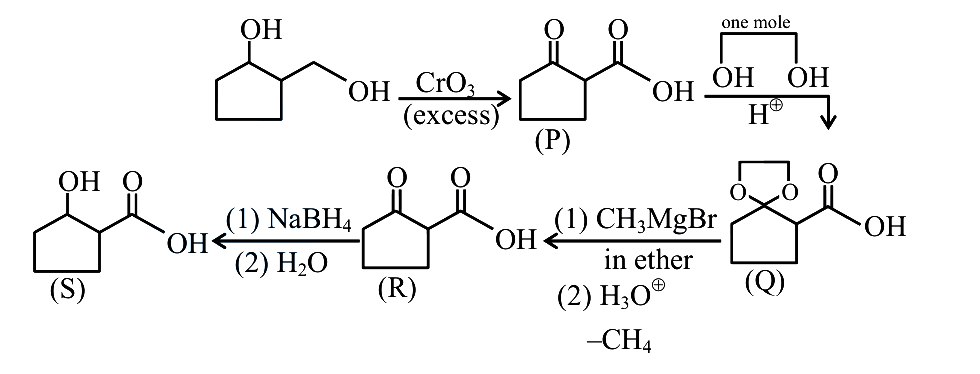
0.1 mole of compound ( S ) weight in gm
\(\begin{aligned}
& =0.1 \times \text { molar mass of compound }(\mathrm{S}) \\
& =0.1 \times 130=13 \mathrm{gm}
\end{aligned}\) -
- (A) Both Statement I and Statement II are false
- (B) Both Statement I and Statement II are true
- (C) Statement I is false but Statement II is true
- (D) Statement I is true but Statement II is false
Show answer and solution
Correct Answer: (B)
Statement I is correct as boiling point of alcohol phenols increase with increase in the number of C -atoms due to increase in van der Waals forces.
Statement II is correct, since alcohols phenols have intermolecular H -bonding therefore their boiling points are higher in comparison to other class of compounds such as ethers, haloalkanes. -
- (A) \(A\) is false but \(R\) is true.
- (B) \(A\) is true but \(R\) is false.
- (C) Both \(A\) and \(R\) are true and \(R\) is the correct explanation of \(A\).
- (D) Both \(A\) and \(R\) are true but \(R\) is NOT the correct explanation of \(A\)
Show answer and solution
Correct Answer: (D)
As per \(NCERT\), Assertion \((A)\) and Reason \((R)\) is correct but Reason \((R)\) is not the correct explanation. -
- (A) \(A\) is false but \(R\) is true
- (B) \(A\) is true but \(R\) is false
- (C) Both \(A\) and \(R\) are true but \(R\) is not the correct explanation of \(A\)
- (D) Both \(A\) and \(R\) are true and \(R\) is the correct explanation of \(A\)
Show answer and solution
Correct Answer: (A)
The acid sensitive alcohol group reacts with \(HCl\), hence Clemmenson reduction is not suitable for above conversion.
-
- (A) Both \(A\) and \(R\) are true and \(R\) is the correct explanation of \(A\)
- (B) \(A\) is true but \(R\) is false
- (C) Both \(A\) and \(R\) are true but \(R\) is not the correct explanation of \(A\)
- (D) \(A\) is false but \(R\) is true
Show answer and solution
Correct Answer: (A)
Butan\(-1-\)ol \(\left( CH _3 CH _2 CH _2 CH _2 OH \right)\) can undergo hydrogen bonding. Ethoxyethane \(\left( CH _3 CH _2-\right.\) \(O - CH _2 CH _3\) ) has no hydrogen (attached with \(F\), \(O , N\) ) which can undergo hydrogen bonding. More is the extent of intermolecular \(H\)-bonding, more will be association of molecules. Thus leading to higher boiling point.Hence both Assertion \((A)\) and Reason\((R)\) are true and \(( R )\) is the correct explanation of \(( A )\). -
- (A) \(6\)
- (B) \(5\)
- (C) \(4\)
- (D) \(3\)
Show answer and solution
Correct Answer: (A)
\(R ( OH )_{ x } \rightarrow H _{2}\)\(PoAC\) on \(H -\)
\(x\left(\frac{1.84 \times 10^{-3}}{92}\right)=\frac{1.344}{22.4} \times 2\)
\(x=\frac{1.344 \times 2 \times 92 \times 1000}{1.84 \times 22400}=6\)
\(x=6\)
-
- (A) Both Statement \(I\) and Statement \(II\) are correct.
- (B) Both Statement \(I\) and Statement \(II\) are incorrect
- (C) Statement \(I\) is correct but Statement \(II\) is incorrect.
- (D) Statement \(I\) is incorrect but Statement \(II\) is correct.
Show answer and solution
Correct Answer: (C)
Acrolein has a pungent, suffocating odour.Acrolein is used to detect presence of glycerol -
- (A) \(C = {H_3}C - \begin{array}{*{20}{c}} {C{H_3}\,\,\,\,\,\,\,\,} \\ |\,\,\,\,\,\,\,\,\,\,\,\,\,\,\,\,\, \\ {C - OH} \\ |\,\,\,\,\,\,\,\,\,\,\,\,\,\,\,\,\, \\ {C{H_3\,\,\,\,\,\,\,\,}} \end{array}\) \(\begin{array}{*{20}{c}} {D = {H_3}C - C{H_2} - CH - C{H_3}} \\ {\,\,\,\,\,\,\,\,\,\,\,\,\,\,\,\,\,\,\,\,\,\,\,\,\,|} \\ {\,\,\,\,\,\,\,\,\,\,\,\,\,\,\,\,\,\,\,\,\,\,\,\,\,\,\,\,\,\,\,OH} \end{array}\)
- (B) \(C = H _{3} C - CH _{2}- C H _{2}- CH _{2}- OH\) \(D = {H_3}C - \begin{array}{*{20}{c}} {C{H_3}\,\,\,\,\,} \\ |\,\,\,\,\,\,\,\,\,\,\,\,\,\,\, \\ {C - OH} \\ |\,\,\,\,\,\,\,\,\,\,\,\,\,\,\, \\ {C{H_3}\,\,\,\,\,} \end{array}\)
- (C) \(\begin{array}{*{20}{c}} {\,\,\,\,\,\,\,\,\,\,\,\,\,\,\,\,\,\,\,\,\,\,\,\,\,\,\,\,\,\,\,\,OH} \\ {\,\,\,\,\,\,\,\,\,\,\,\,\,\,\,\,\,\,\,\,\,\,\,\,\,|} \\ {C = {H_3}C - C{H_2} - CH - C{H_3}} \end{array}\) \(D = {H_3}C - \begin{array}{*{20}{c}} {C{H_3}\,\,\,\,\,} \\ |\,\,\,\,\,\,\,\,\,\,\,\,\,\,\, \\ {C - OH} \\ |\,\,\,\,\,\,\,\,\,\,\,\,\,\,\, \\ {C{H_3}\,\,\,\,\,} \end{array}\)
- (D) \(C = H _{3} C - CH _{2}- CH _{2}- CH _{2}- OH\) \(\begin{array}{*{20}{c}} {D = {H_3}C - C{H_2} - CH - C{H_3}} \\ {\,\,\,\,\,\,\,\,\,\,\,\,\,\,\,\,\,\,|} \\ {\,\,\,\,\,\,\,\,\,\,\,\,\,\,\,\,\,\,\,\,\,\,\,\,\,OH} \end{array}\)
Show answer and solution
Correct Answer: (C)
\(\begin{array}{*{20}{c}} {\,\,\,\,\,\,\,\,\,\,\,\,\,\,\,\,\,\,\,\,\,\,\,\,\,\,O} \\ {\,\,\,\,\,\,\,\,\,\,\,\,\,\,\,\,\,\,\,\,\,\,\,\,\,||} \\ {C{H_3}C - C{H_2} - C - H} \\ {(A)} \end{array}\) \(\xrightarrow{CH_3MgBr}\)\(\begin{array}{*{20}{c}} {\,\,\,\,\,\,\,\,\,\,\,\,\,\,\,\,\,\,\,\,\,\,\,OH} \\ {\,\,\,\,\,\,\,\,\,\,\,\,\,\,\,|} \\ {C{H_3} - C{H_2} - CH - C{H_3}} \\ {\,\,\,\,\,\,\,\,\,\,\,\,\,\,\,\,\,\,\,\,\,\,\,\,\,\,\,\,\,\,\,\,\,\,\,{2^o}\,Alcohol} \\ {\,\,\,\,\,\,\,\,\,\,\,\,\,\,\,\,\,\,\,\,\left( C \right)} \end{array}\)\(CAN\) test for alcohol : \((yes)\)
Iodoform test \(:(yes)\)
\(\begin{array}{*{20}{c}} O\,\,\,\,\,\,\,\,\,\,\,\,\,\,\,\,\,\,\,\,\,\,\,\,\,\,\,\,\, \\ {||\,\,\,\,\,\,\,\,\,\,\,\,\,\,\,\,\,\,\,\,\,\,\,\,\,\,\,\,\,\,\,} \\ {C{H_3} - C - C{H_3}\,\xrightarrow{{C{H_3}MgBr}}} \\ {(B)\,\,\,\,\,\,\,\,\,\,\,\,\,\,\,\,\,\,\,\,\,\,\,\,\,\,\,} \\ {} \end{array}\)\(\begin{array}{*{20}{c}} {\,\,\,\,\,\,\,OH} \\ | \\ {C{H_3} - C - C{H_3}} \\ | \\ {\,\,\,\,\,\,\,\,C{H_3}} \\ {\,\,\,\,\,\,\,\,\,\,\,\,\,\,\,\,\,\,\,{3^o}\,Alcohol} \end{array}\)
\(CAN\) test for alcohol : \((yes)\)
Lucas test : Immediately
Iodoform test : \((no)\)
-
- (A) \(HCHO + PhCH(CH_3)CH_2MgX\)
- (B) \(PhCOCH_2CH_3 + CH_3MgX\)
- (C) \(PhCOCH_3 + CH_3CH_2MgX\)
- (D) \(CH_3CH_2COCH_3 + PhMgX\)
Show answer and solution
Correct Answer: (A)
The reaction in option \((A)\) will yield \(1^o-\) alcohol. -
- (A) \(\begin{array}{*{20}{c}}
{OH\,\,\,\,\,\,\,\,\,\,\,\,\,\,\,\,\,\,\,\,\,\,\,} \\
{|\,\,\,\,\,\,\,\,\,\,\,\,\,\,\,\,\,\,\,\,\,\,\,\,\,\,\,\,} \\
{C{H_3}CH - CH = C{H_2}}
\end{array}\) - (C) \(CH_3CH = CH -CH_2NH_2\)
- (D) \(\begin{array}{*{20}{c}}
{OH\,\,\,\,\,\,\,\,\,\,\,\,\,\,\,\,\,\,\,\,\,\,\,\,\,\,\,\,\,\,\,\,\,\,} \\
{|\,\,\,\,\,\,\,\,\,\,\,\,\,\,\,\,\,\,\,\,\,\,\,\,\,\,\,\,\,\,\,\,\,\,\,\,\,\,\,\,} \\
{C{H_3}CHC{H_2}C{H_2}NHCHO}
\end{array}\)
Show answer and solution
Correct Answer: (D)
\(\begin{matrix}
OH\,\,\,\,\,\,\,\,\,\,\,\,\,\,\,\,\,\,\,\,\,\,\,\,\,\,\,\,\,\,\,\,\,\,\, \\
|\,\,\,\,\,\,\,\,\,\,\,\,\,\,\,\,\,\,\,\,\,\,\,\,\,\,\,\,\,\,\,\,\,\,\,\,\,\,\, \\
C{{H}_{3}}-CH-C{{H}_{2}}-C{{H}_{2}}-N{{H}_{2}} \\
\end{matrix}\) \(\xrightarrow[triethyl\,\,amine]{ethyl\,\,formate\,\,(lequiv.)}\) \(\begin{matrix}
\,\,\,\,\,\,\,\,OH\,\,\,\,\,\,\,\,\,\,\,\,\,\,\,\,\,\,\,\,\,\,\,\,\,\,\,\,\,\,\,\,\,\,\,\,\,\,\,\,\,\,\,\,\,\,\,\,\,\,\,\,\,\,\,\,\,\,\,\,\,\,\,O \\
\,\,\,\,\,\,\,|\,\,\,\,\,\,\,\,\,\,\,\,\,\,\,\,\,\,\,\,\,\,\,\,\,\,\,\,\,\,\,\,\,\,\,\,\,\,\,\,\,\,\,\,\,\,\,\,\,\,\,\,\,\,\,\,\,\,\,\,\,\,\,\,\,\,\,\,\,|| \\
C{{H}_{3}}-CH-C{{H}_{2}}-C{{H}_{2}}-NH-C-H \\
\end{matrix}\)as \(NH_2\) is a better nucleophile than \(OH\).
- (A) \(\begin{array}{*{20}{c}}
- 13. The major product of the following reaction is \(C{H_3}CH = CHC{O_2}C{H_3}\,\xrightarrow{{LiAl{H_4}}}\) 2019 Hard
- (A) \(CH_3CH_2CH_2CHO\)
- (B) \(CH_3CH = CHCH_2OH\)
- (C) \(CH_3CH_2CH_2CO_2CH_3\)
- (D) \(CH_3CH_2CH_2CH_2OH\)
Show answer and solution
Correct Answer: (B)
\(LiAlH_4\) does not reduce double bond it reduces ester in alcohol. -
- (A) Tollen’s reagent
- (B) \(I_2 / NaOH\)
- (C) \(CrO_2 Cl_2 / Cs_2\)
- (D) alkaline \(KMnO_4\)
Show answer and solution
Correct Answer: (B)
Iodoform reaction can be used for this transformation. - 15. Amongst the following alcohols which would react fastest with conc. \(HCl\) and \(ZnCl_2\) ? 2013 Hard
- (A) pentanol
- (B) \(2-\) methyl butanol
- (C) \(2-\) pentanol
- (D) \(2-\) methyl butan \(-2-\) ol
Show answer and solution
Correct Answer: (D)
\(ZnCl_2 +\) cone . \(HCl\) is Lucas reagent . Lucas reagent reacts fastest with tertiary alcohol. \(3^o\) alcohol \(+\) Lucas reagent \(=\) Immediate turbidity -
- (A) \(2^o > 1^o >CH_3OH >3^o\)
- (B) \(3^o > 2^o > 1^o > CH_3OH\)
- (C) \(2^o> 3^o > 1^o > CH_3OH\)
- (D) \(CH_3OH > 1^o >2^o > 3^o\)
Show answer and solution
Correct Answer: (B)
The order of dehydration among three type of alcohols is \(3^o > 2^o > 1^o > CH_3OH\). This behaviour is related to the relative stabilities of carbocations \((3^o > 2^o > 1^o)\). -
- (A) Water \(<\) methyl alcohol \(<\) dimethyl ether \(<\) glycerol
- (B) methyl alcohol \(<\) glycerol \(<\) water \(<\) dimethyl ether
- (C) dimethyl ether \(<\) methyl alcohol \(<\) water \(<\) glycerol
- (D) glycerol \(<\) dimethyl ether \(<\) water \(<\) methyl alcohol
Show answer and solution
Correct Answer: (C)
The correct order of viscosity of the given liquids is dimethyl ether \(<\) methyl alcohol \(<\) water \(<\) glycerol

No questions on this page match these filters.
Other STD 12 - Alcohol, phenol and ethers topics
Frequently asked
How many Properties of alcohol questions came in JEE Mains?
17 questions from 2013–2026, each with the correct answer and a full solution.
How difficult are Properties of alcohol questions?
0% are easy, 41% medium and 59% hard.