


Chapters asked in 2013
28 chapters- 3Qs STD 11 Units, dimensions and measurement
- 2Qs STD 12 Semicondutor electronics
- 3Qs STD 12 Nuclei
- 4Qs STD 12 Atoms
- 4Qs STD 12 Dual nature of radiation and matter
- 7Qs STD 12 Electromagnetic waves Most asked
- 5Qs STD 12 Wave optics
- 5Qs STD 12 Ray optics and optical instruments
- 6Qs STD 12 Alternating current
- 14Qs STD 11 System of particles and rotational motion Most asked
- 7Qs STD 12 Moving charges and magnetism
- 3Qs STD 12 Electromagnetic induction
- 2Qs STD 12 Magnetism and matter
- 6Qs STD 12 Current electricity
- 9Qs STD 12 Electric potential and capacitance Most asked
- 5Qs STD 12 Electric charges and fields
- 6Qs STD 11 Waves and sound
- 6Qs STD 11 Oscillations
- 4Qs STD 11 Kinetic theory of gases
- 3Qs STD 11 Thermodynamics
- 4Qs STD 11 10.1, thermonetry, thermal expansion and calorimetry
- 4Qs STD 11 Mechanical properties of solids
- 3Qs STD 11 Surface tension
- 4Qs STD 11 Fluid mechanics
- 2Qs STD 11 Newtons laws of motion
- 4Qs STD 11 Gravitation
- 3Qs STD 11 Work, energy, power and collision
- 3Qs STD 11 Motion in plane
All JEE Mains 2013 Physics questions
28 chaptersShowing 1–50 of 131 questions
-
- (A) \(\frac{3}{4}\)
- (B) \(\sqrt 3 \)
- (C) \(\frac{3}{2}\)
- (D) \(\frac{2}{3}\)
Show answer and solution
Correct Answer: (C)
\(T=\sqrt{\left(M L^{-3}\right)^{a} r^{b}[M T^ {-2}] c}\)\(= \sqrt{M L^{-3} \quad r^{b} \quad M^{-1} T^{+2}}\)
\(b-3=0\)
\(b=3\)
-
- (A) \(\;{\varepsilon _0}=M^{-1}L^{-3}T^2A\)
- (B) \(\;{\varepsilon _0}=M^{-1}L^{-3}T^4A^2\)
- (C) \(\;{\varepsilon _0}=M^{-1}L^2T^{-1}A^{-2}\)
- (D) \({\varepsilon _0}=M^{-1}L^2T^{-1}A\)
Show answer and solution
Correct Answer: (B)
As we know \(F = \frac{1}{{4\pi {\varepsilon _0}}}\frac{{{q_1}{q_2}}}{{{R^2}}} \Rightarrow {\varepsilon _0} = \frac{{{q_1}{q_2}}}{{4\pi F{R^2}}}\)
Hence \({\varepsilon _0} = \frac{{{{\left[ {AT} \right]}^2}}}{{ML{T^{ - 2}}{L^2}}} = \left[ {{M^{ -1}}{L^{ - 3}}{T^{ 4}}{A^2}} \right]\) -
- (A) \(ML^2T^1A^2 ,\, L^2T^{-2},\, M^{-1}L^{-2}T^2\)
- (B) \(ML^2T^{-2} ,\, L^2T^2,\, M^{-1}L^{-2}T^4A^2\)
- (C) \(ML^2T^{-1} ,\, L^2T^{-2},\, ML^2TA^2\)
- (D) \(ML^2T^{-1} ,\, L^2T^{-2},\, M^{-1}L^{-2}T^4A^2\)
Show answer and solution
Correct Answer: (D)
\(\begin{array}{l}
Angular\,momentum\, = m \times v\, \times r\\
= M{L^2}{T^{ - 1}}\\
Latent\,heat\,L = \frac{Q}{m} = \frac{{M{L^2}{T^{ - 2}}}}{M} = {L^2}{T^{ - 2}}\\
{\rm{Capacitance}}\,C = \frac{{Ch\arg e}}{{p.d}} = {M^{ - 1}}{L^{ - 2}}{T^4}{A^2}
\end{array}\) -
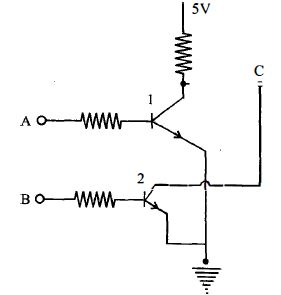
- (A) \(A\,NAND\,B\)
- (B) \(A\) \(OR\) \(B\)
- (C) \(A\) \(AND\) \(B\)
- (D) \(A\) \(NOR\) \(B\)
Show answer and solution
Correct Answer: (A)
The output at \(C\) corresponds to \(A\) \(NAND\) \(B\) or \(\overline {A.B} = C\) -
- (A) 50
- (B) 100
- (C) 60
- (D) 25
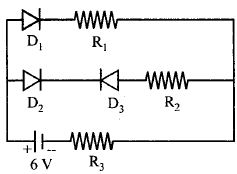
Show answer and solution
Correct Answer: (A)
Here, diodes \(D_1\) and \(D_2\) are forward biased and \(D_3\) is reverse biased. Therefore current through \(R_3\)\(i = \frac{V}{{R'}} = \frac{6}{{120}} = \frac{1}{{20}}A = 50\,mA\)
-
- (A) \(\frac{{{e^2}}}{{4\pi {\varepsilon _0}m{c^2}}}\)
- (B) \(\frac{{4\pi {\varepsilon _0}{e^2}}}{{m{e^2}}}\)
- (C) \(\frac{{m{e^2}}}{{4\pi {\varepsilon _0}{b^2}}}\)
- (D) \(\frac{{4\pi {\varepsilon _0}m{c^2}}}{{{e^2}}}\)
Show answer and solution
Correct Answer: (A)
As \(\mathrm{E}=\mathrm{mc}^{2}\)also \(\mathrm{E}=\mathrm{F} \cdot \mathrm{s}=\frac{\mathrm{k} q \cdot \mathrm{q}}{\mathrm{r}^{2}} \cdot \mathrm{r}\)
Therefore dimensionally
\(\mathrm{mc}^{2}=\frac{1}{4 \pi \epsilon_{0}} \frac{\mathrm{q}^{2}}{\mathrm{r}}\)
\(\Rightarrow r=\frac{e^{2}}{4 \pi \epsilon_{0} m c^{2}}\)
-
- (A) \(A\) and \(B\) decay at the same rate always .
- (B) \(A\) and \(B\) decay at the same rate initially.
- (C) \(A\) will decay at a faster rate than \(B.\)
- (D) \(B\) will decay at a faster rate than \(A\)
Show answer and solution
Correct Answer: (D)
\({\left( {{{\text{T}}_{1/2}}} \right)_{\text{A}}} = {\left( {{{\text{t}}_{{\text{mean}}}}} \right)_{\text{B}}}\)\( \Rightarrow \frac{{0.693}}{{{\lambda _A}}} = \frac{1}{{{\lambda _B}}}\) \( \Rightarrow {\lambda _A} = 0.693{\lambda _B}\)
or \(\quad \lambda_{A} < \lambda_{B}\)
Also rate of decay \(=\lambda \mathrm{N}\)
Initially number of atoms \((N)\) of both are
equal but since \(\lambda_{\mathrm{B}}>\lambda_{\mathrm{A}},\) therefore Bwill decay at a faster rate than \(\mathrm{A}\)
-
- (A) electron
- (B) \(\alpha - \) particle
- (C) neutron
- (D) neutrino
Show answer and solution
Correct Answer: (C)
Nuclear fission equation\({}_{92}{U^{235}} + {}_0{n^1} \to {}_{56}B{a^{141}} + {}_{36}K{r^{92}} + 3\,{}_0{n^1} + Q{\rm{( energy)}}\)
Hence particle \(x\) is neutron
- 9. A \(12.5\, eV\) electron beam is used to bombard gaseous hydrogen at room temperature. It will emit 2013 Hard
- (A) \(2\) lines in the Lyman series and \(1\) line in the Balmar series
- (B) \(3\) lines in the Lyman series
- (C) \(1\) line in the Lyman series and \(2\) lines in the Balmar series
- (D) \(3\) lines in the Balmer series
Show answer and solution
Correct Answer: (A)
\(\mathrm{E}=\frac{\mathrm{hc}}{\lambda} \Rightarrow \lambda=\frac{\mathrm{hc}}{\mathrm{E}}=\frac{6.62 \times 10^{-34} \times 3 \times 10^{8}}{12.5 \times 1.6 \times 10^{-19}}\)\(=993 \mathrm{A}^{\circ}\)
\(\frac{1}{\lambda}=\mathrm{R}\left(\frac{1}{\mathrm{n}_{1}^{2}}-\frac{1}{\mathrm{n}_{2}^{2}}\right)\)
(where Rydberg constant, \(\mathrm{R}=1.097 \times 10^{7}\) )
\(\frac{1}{993 \times 10^{-10}}=1.097 \times 10^{7}\left(\frac{1}{1^{2}}-\frac{1}{n_{2}^{2}}\right)\)
Solving we get \(n_{2}=3\)
Spectral lines
Total number of spectral lines \(=3\)
Two lines in Lyman series for \(n_{1}=1, n_{2}=2\) and \(\mathrm{n}_{1}=1, \mathrm{n}_{2}=3\) and one in Balmer series for \(n_{1}=2, n_{2}=3\)
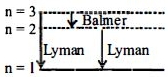
-
- (A) \(\frac{1}{{{n^3}}}\)
- (B) \(\;\frac{1}{n}\)
- (C) \(\;\frac{1}{{{n^2}}}\)
- (D) \(\;\frac{1}{{{n^{\frac{3}{2}}}}}\)
Show answer and solution
Correct Answer: (A)
\(\frac{v}{x}=\frac{1}{\lambda}=R Z^{2}\left[\frac{1}{n_{1}^{2}}-\frac{1}{n_{2}^{2}}\right]\)\([\because n>>1]\)
\(v=R C Z^{2}\left[\frac{1}{(n-1)^{2}}-\frac{1}{n^{2}}\right]\)
\(\operatorname{RCZ}^{2}\left[\frac{2 n-1}{n^{2}(n-1)^{2}}\right]\)
-
- (A) \({r_n} = {a_0}n - \beta \)
- (B) \({r_n} = {a_0}{n^2} + \beta \)
- (C) \({r_n} = {a_0}{n^2} - \beta \)
- (D) \({r_n} = {a_0}n + \beta \)
Show answer and solution
Correct Answer: (C)
As \(F=\frac{m v^{2}}{r}=\frac{e^{2}}{4 \pi \epsilon_{0}}\left(\frac{1}{r^{2}}+\frac{B}{r^{3}}\right)\)and \(\mathrm{mvr}=\frac{\mathrm{nh}}{2 \pi} \Rightarrow \mathrm{v}=\frac{\mathrm{nh}}{2 \pi \mathrm{m} \mathrm{r}}\)
\(\therefore m{\left( {\frac{{{\text{nh}}}}{{2\pi {\text{mr}}}}} \right)^2} \times \frac{1}{{\text{r}}}\) \( = \frac{{{{\text{e}}^2}}}{{4\pi {_0}}}\left( {\frac{1}{{{r^2}}} + \frac{{\text{B}}}{{{{\text{r}}^3}}}} \right)\)
or, \(\frac{1}{r^{2}}+\frac{B}{r^{3}}=\frac{m n^{2} h^{2} 4 \pi \epsilon_{0}}{4 \pi^{2} m^{2} e^{2} r^{3}}\)
or, \(\frac{a_{0} n^{2}}{r^{3}}=\frac{1}{r^{2}}+\frac{B}{r^{3}}\)
\(\left(\because a_{0}=\frac{\epsilon_{0} h^{2}}{m \pi e^{2}} \text { Given }\right)\)
\(\therefore r=a_{0} n^{2}-B\)
-
- (A) \(\left( {\frac{e}{{2m}}\frac{{{n^2}h}}{{2\pi }}} \right)\)
- (B) \(\left( {\frac{e}{{m}}} \right)\frac{{nh}}{{2\pi }}\)
- (C) \(\left( {\frac{e}{{2m}}} \right)\frac{{nh}}{{2\pi }}\)
- (D) \(\left( {\frac{e}{m}} \right)\frac{{{n^2}h}}{{2\pi }}\)
Show answer and solution
Correct Answer: (C)
Magnetic moment of the hydrogen atom, when the electron is in \(\mathrm{n}^{\text {th }}\) excited state, i.e.,\(n^{\prime}=(n+1)\)
As magnetic moment \(\mathrm{M}_{\mathrm{n}}=\mathrm{I}_{\mathrm{n}} \mathrm{A}=\mathrm{i}_{\mathrm{n}}\left(\pi \mathrm{r}_{\mathrm{n}}^{2}\right)\)
\(\mathrm{i}_{\mathrm{n}}=\mathrm{eV}_{\mathrm{n}}=\frac{\mathrm{mz}^{2} \mathrm{e}^{5}}{4 \varepsilon_{0}^{2} \mathrm{n}^{3} \mathrm{h}^{3}}\)
\(r_{n}=\frac{n^{2} h^{2}}{4 \pi^{2} k \pi n e^{2}}\left(k=\frac{1}{4 \pi \epsilon_{0}}\right)\)
Solving we get magnetic moment of the hydrogen atom for \(n^{\text {th }}\) excited state
\(\mathrm{M}_{\mathrm{n}^{*}}=\left(\frac{\mathrm{e}}{2 \mathrm{m}}\right) \frac{\mathrm{nh}}{2 \pi}\)
-
- (A) \(5.5 \times {10^{ - 13}}\,C\)
- (B) \(7.5 \times {10^{ - 13}}\,C\)
- (C) \(4.5 \times {10^{ - 12}}\,C\)
- (D) \(2.5 \times {10^{ - 11}}\,C\)
Show answer and solution
Correct Answer: (A)
Let us assume that,Lost energy of electron is equal to its stopping potential
\(E\, = \,KE\, + \,\Phi \)
\(\frac{12100}{\lambda A}=V+4.47 \mathrm{eV}\)
\(\frac{12100}{2500}=V+4.47\)
\(\frac{124}{25}=V+4.47\)
\(4.95=V+4.47\)
\(\mathrm{V}=4.95-4.47=0.48\)
\(\mathrm{V}_{\text {sphere }}=\frac{K Q}{r}=\frac{9 \times 10^{9} \mathrm{Q}}{100}\)
\(0.48=\frac{9 \times 10^{8} Q}{100}\)
\(Q=\frac{48 \times 10^{9}}{9 \times 100}\)
\(Q=5.5 \times 10^{-13} \mathrm{C}\)
-
- (A) \(\frac{{{\lambda _e}}}{{{\lambda _p}}} = \sqrt {\frac{{{m_p}}}{{{m_e}}}} \)
- (B) \(\frac{{{\lambda _e}}}{{{\lambda _p}}} = \sqrt {\frac{{{m_e}}}{{{m_p}}}} \)
- (C) \(\frac{{{\lambda _e}}}{{{\lambda _p}}} = \frac{1}{2}\sqrt {\frac{{{m_e}}}{{{m_p}}}} \)
- (D) \(\frac{{{\lambda _e}}}{{{\lambda _p}}} = 2\sqrt {\frac{{{m_p}}}{{{m_e}}}} \)
Show answer and solution
Correct Answer: (D)
Energy in joule \((E)\)\(=\) charge \(\times\) potential diff. in volt
\({{\text{E}}_{{\text{electron }}}} = {q_{\text{e}}}{\text{V}}\) and \({{\text{E}}_{{\text{proton }}}} = {q_{\text{p}}}4{\text{V}}\)
de-Broglie wavelength
\(\lambda=\frac{\mathrm{h}}{\mathrm{P}}=\frac{\mathrm{h}}{\sqrt{2 \mathrm{mE}}}\)
\(\lambda_{\mathrm{c}}=\frac{\mathrm{h}}{\sqrt{2 \mathrm{m}_{\mathrm{e}} \mathrm{e} \mathrm{V}}}\) and \(\lambda_{\mathrm{P}}=\frac{\mathrm{h}}{\sqrt{2 \mathrm{m}_{\mathrm{p}} \mathrm{e} 4 \mathrm{V}}}\)
\({\text{(}}\because {q_c} = {q_p}{\text{)}}\)
\(\therefore \frac{{{\lambda _{\text{c}}}}}{{{\lambda _{\text{P}}}}} = \frac{{\frac{{\text{h}}}{{\sqrt {2{{\text{m}}_{\text{e}}}{\text{eV}}} }}}}{{\frac{{\text{h}}}{{\sqrt {2{{\text{m}}_p}{\text{e4V}}} }}}}\) \( = \sqrt {\frac{{2{{\text{m}}_p}{\text{e4V}}}}{{2{{\text{m}}_e}{\text{eV}}}}} \)
\( = 2\sqrt {\frac{{{{\text{m}}_{\text{p}}}}}{{{{\text{m}}_{\text{e}}}}}} \)
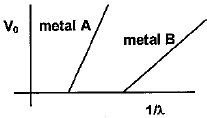
-
- (A) Work function of metal \(B\) is greater than that of metal \(A\)
- (B) For light of certain wavelength falling on both metal, maximum kinetic energy of electrons emitted from \(A\) will be greater than those emitted from \(B\)
- (C) Work function of metal \(A\) is greater than that of metal \(B\)
- (D) Students data is not correct
Show answer and solution
Correct Answer: (D)
\(\frac{\mathrm{hc}}{\lambda}-\phi=\mathrm{eV}_{0}\)\(v_{0}=\frac{h c}{e \lambda}-\frac{\phi}{e}\)
For metal \(A\) For metal \(B\)
\(\frac{{\phi A}}{{hc}} = \frac{1}{\lambda }\) \(\frac{{\phi B}}{{hc}} = \frac{1}{\lambda }\)
As the value of \(\frac{1}{\lambda}\) (increasing and decreasing) is not specified hence we cannot say that which metal has comparatively greater or lesser work function \((\phi)\).
-
- (A) \(n^2\)
- (B) \(n\)
- (C) \(n^{1/2}\)
- (D) \(n^{1/4}\)
Show answer and solution
Correct Answer: (C)
According to the question,\(2 \pi r=n \lambda=\frac{n h}{p}=\frac{n h}{m v}\)
or \(\operatorname{mvr}=\frac{\mathrm{nh}}{2 \pi}\) or \(\mathrm{mv}=\frac{\mathrm{nh}}{2 \pi \mathrm{r}}\)
\(\mathrm{F}=\mathrm{qv}_{\mathrm{B}}=\frac{\mathrm{mv}^{2}}{\mathrm{r}}\)
or, \(\quad \mathrm{q}_{B}=\frac{\mathrm{mv}}{\mathrm{r}}=\frac{\mathrm{nh}}{2 \pi \mathrm{r} \cdot \mathrm{r}}\)
or, \(\quad \mathrm{r}^{2}=\frac{\mathrm{nh}}{2 \pi \mathrm{qB}}\)
or, \(\quad r=\sqrt{\frac{n h}{2 \pi q B}}\)
i.e., \(r\propto n^{1/2}\)
-
- (A) \(\frac{{{m^2}}}{A}\)
- (B) \(\frac{{{m^3}}}{As}\)
- (C) \(\frac{{{m^2}}}{As}\)
- (D) \(\frac{{As}}{{{m^3}}}\)
Show answer and solution
Correct Answer: (B)
According to question\(\mathrm{E}_{\mathrm{y}} \propto \mathrm{J}_{\mathrm{x}} \mathrm{B}_{\mathrm{Z}}\)
\(\therefore \) Constant of proportionality
\(\mathrm{K}=\frac{\mathrm{E}_{\mathrm{y}}}{\mathrm{B}_{\mathrm{Z}} \mathrm{J}_{\mathrm{X}}}=\frac{\mathrm{C}}{\mathrm{J}_{\mathrm{X}}}=\frac{\mathrm{m}^{3}}{\mathrm{A} \mathrm{s}}\)
\(\left[\text { As } \frac{\mathrm{E}}{\mathrm{B}}=\mathrm{C}(\text { speed of light }) \text { and } \mathrm{J}=\frac{1}{\text { Area }}\right]\)
-
- (A) \(2.4\)
- (B) \(5.8\)
- (C) \(8.2\)
- (D) \(4.8\)
Show answer and solution
Correct Answer: (B)
Given equation of wave\(\vec{E}=\vec{E}_{0}(4 \times \overrightarrow{10} x-50 t)\)
Comparing with general equation of wave,
\(\vec{E}=\vec{E}_{0}(k x-w t)\)
we get,
\(w=50\) rad \(/ s . k=4 \times 10^{-7} m^{-1}\)
Thus velocity of wave,
\(v=\frac{w}{k}=\frac{50}{4 \times 10^{-7}}=1.25 \times 10^{8} \mathrm{m} / \mathrm{s}\)
so, refractive index of medium,
\(\mu=\frac{e}{v}=\frac{3 \times 10^{8}}{1.25 \times 10^{8}}=2.4\)
using, \(u^{2}=k m . k e[\mathrm{km}\) and ke are magnetic and dielectric di - constants]
as medium is non diamagnetic, \(k m=1\)
\(\Rightarrow k e=\mu^{2}=(2.4)^{2} \Rightarrow k e=5.76\)
- 19. Photons of an electromagnetic radiation has an energy \(11\, keV\) each. To which region of electromagnetic spectrum does it belong ? 2013 Medium
- (A) \(X-\) ray region
- (B) Ultra violet region
- (C) Infrared region
- (D) Visible region
Show answer and solution
Correct Answer: (A)
\(E=\frac{h c}{\lambda} \Rightarrow \lambda=\frac{h c}{E}\)\(\Rightarrow \lambda=\frac{6.6 \times 10^{-34} \times 3 \times 10^{8}}{11 \times 1000 \times 1.6 \times 10^{-19}}\)
\(=12.4 \,\mathop A\limits^o \)
\(\underrightarrow {Increasing{\text{ }}order{\text{ }}of{\text{ }}frequency}\)
\(x-\) rays, \(u-v\) rays, visible, infrared
wavelength range of visible region is \(4000 \,\mathop A\limits^o \) to \(7800 \,\mathop A\limits^o \)
-
- (A) Electromagnetic waves cannot travel in vacuum
- (B) Electromagnetic waves are longitudinal waves
- (C) Electromagnetic waves are produced by charges moving with uniform velocity
- (D) Electromagnetic waves carry both energy and momentum as they propagate through space
Show answer and solution
Correct Answer: (D)
Electromagnetic waves do not required any medium to propagate. They can travel in vacuum. They are transverse in nature like light. They carry both energy and momentum. A changing electric field produces a changing magnetic field and vice-versa . Which gives rise to a transverse wave known as electromagnetic wave -
- (A) \(3 \)
- (B) \(6 \)
- (C) \(9\)
- (D) \(12\)
Show answer and solution
Correct Answer: (B)
From question,\(\mathrm{B}_{0}=20 \mathrm{nT}=20 \times 10^{-9}\, \mathrm{T}\)
(\(\because\) velocity of light in vacuum \(\mathrm{C}=3 \times 10^{8}\, \mathrm{\,ms}^{-1}\))
\( \overrightarrow{\mathrm{E}}_{0} =\overrightarrow{\mathrm{B}}_{0} \times \overrightarrow{\mathrm{C}} \)
\( | \overrightarrow{\mathrm{E}}_{0} =|\overrightarrow{\mathrm{B}}| \cdot|\overrightarrow{\mathrm{C}}|=20 \times 10^{-9} \times 3 \times 10^{8} \)
\(=6 \,\mathrm{V} / \mathrm{m} \)
-
- (A) Statement \(-1\) is true, Statement \(-2\) is true and
Statement \(-2\) is the correct explanation of Statement \(-1\) - (B) Statement \(- 1\) is false , Statement \(-2\) is true
- (C) Statement \(-1\) is true, Statement \(-2\) is false
- (D) Statement \(- 1\) is true, Statemcnt \(-2\) is true but
Statement \(-2\) is not the correct explanation of Statement \(- 1\)
Show answer and solution
Correct Answer: (C)
Wavelength of radio waves is greater than microwaves hence frequency of radio waves is less than microwaves. The degree of diffraction is greater whose wavelength is greater. - (A) Statement \(-1\) is true, Statement \(-2\) is true and
-
- (A) \(2\,\times 10^4\,V/s\)
- (B) \(4\,\times 10^6\,V/s\)
- (C) \(2\,\times 10^6\,V/s\)
- (D) \(4\,\times 10^4\,V/s\)
Show answer and solution
Correct Answer: (C)
As, \(C=\frac{Q}{V}=\frac{I t}{V}\)\(\Rightarrow \frac{V}{t}=\frac{I}{C}=\frac{2}{1 \times 10^{-6}}\)
\(=2 \times 10^{6}\, \mathrm{V} / \mathrm{s}\)
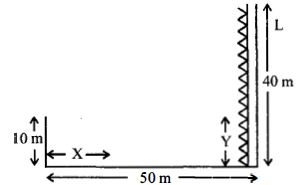
-
- (A) \(25\,m, 10\, m\)
- (B) \(13\,m, 27\, m\)
- (C) \(22\,m, 13\, m\)
- (D) \(17\,m, 20\, m\)
Show answer and solution
Correct Answer: (B)
case of Booster angle where reflected and refracted ray both become polarized. So,\({\mu _1} = \tan {i_B} = \frac{4}{3}\)
From triangle \(ABC,\)
\(\tan (90 - {i_B}) = \frac{{BC}}{{AB}}\)
\(\cot {\mkern 1mu} {i_B} = \frac{{10}}{x}\)
\(\frac{3}{4} = \frac{{10}}{x}\)
\(x = \frac{{40}}{3} = 13{\mkern 1mu} \,m\)
From triangle \(AEF,\)
\(\tan (90 - {i_B}) = \frac{y}{{50 - x}}\)
\(\cot {i_B} = \frac{y}{{50 - 13}}\)
\(\frac{3}{4} = \frac{y}{{37}}\)
\(y=27\;m\)
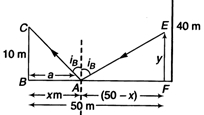
-
- (A) \(49: 1\)
- (B) \(7 : 1\)
- (C) \(4 : 1\)
- (D) \(8 : 1\)
Show answer and solution
Correct Answer: (A)
\(\frac{{{I_{\max }}}}{{{I_{\min }}}} = {\left( {\frac{{\sqrt {{I_1}} + \sqrt {{I_2}} }}{{\sqrt {{I_1}} - \sqrt {{I_2}} }}} \right)^2}\)\({I_1} = \frac{I}{4}:{I_2} = \frac{{91}}{{64}}\)
\(\frac{{{I_{\max }}}}{{{I_{\min }}}}=\frac{{49}}{1}\)
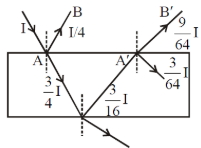
-
- (A) \(n^2\)
- (B) \(\frac{1}{n}\)
- (C) \(\frac{1}{n^2}\)
- (D) \(n\)
Show answer and solution
Correct Answer: (D)
(Maximum intensity) coherent interference \(=\frac{{{n^2}{I_0}}}{{n{I_0}}} = n\) -
- (A) Statement \(-1\) is true, Statement \(-2\) is true and the Statement \(-2\) is correct explanation of the Statement \(- 1.\)
- (B) Statement \(- 1\) is false and the Statement \(-2\) is true.
- (C) Statement \(- 1\) is true Statement \(-2\) is true and the Statement \(-2\) is not correct explanation of the Statement \(- 1\).
- (D) Statement \(-1\) is true and the Statement \(-2\) is false .
Show answer and solution
Correct Answer: (C)
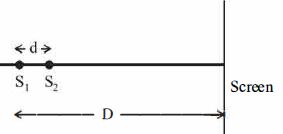
Fringe width \(\mathrm{B}=\frac{\mathrm{D}}{\mathrm{d}} \lambda\)And number of fringes observed in the field
of view is obtaincd by \(\frac{d}{\lambda}\)
-
- (A) concentric circles
- (B) Points
- (C) Staight lines
- (D) semi-circles
Show answer and solution
Correct Answer: (A)
Shape of interferance fringe in \(YDSE -\)\(S_2P-S_1P=constant\)
- wherein
The interference pattern is section of Hyperboloid on screen.
The interference pattern on the screen will be concentric circles
-
- (A) \(1.033\,cm\)
- (B) \(3.581\,cm\)
- (C) \(1.3533\,cm\)
- (D) \(1.90\,cm\)
Show answer and solution
Correct Answer: (C)
Real depth \(=\,5\,cm\,\,+\,\,1\,cm\,=\,6\,cm\)Apparent depth \(=\frac{\mathrm{d}_{1}}{\mu_{1}}+\frac{\mathrm{d}_{2}}{\mu_{2}}+\dots\)
\(=\frac{5}{1.33}+\frac{1}{1.5}\)
\( \simeq 3.8+0.7 \simeq 4.5 \mathrm{cm}\)
\(\therefore \text { Shift }=6 \mathrm{cm}-4.5 \mathrm{cm} \cong 1.5 \mathrm{cm}\)
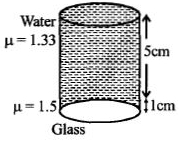
-
- (A) suffer total internal reflection in both cases \((A)\) and \((B)\)
- (B) suffer total internal reflection in case \((B)\) only
- (C) have partial reflection and partial transmission in case \((B)\)
- (D) have \(100\%\) transmission in case \((A)\)
Show answer and solution
Correct Answer: (B)
Velocity of light in medium\({V_{{\text{treat }}}} = \frac{{3\,{\text{cm}}}}{{0.2\,{\text{ns}}}} = \) \(\frac{{3 \times {{10}^{ - 2}}{\text{m}}}}{{0.2 \times {{10}^{ - 9}}{\text{s}}}} = 1.5\,{\text{m}}/{\text{s}}\)
Refractive index of the medium
\(\mu = \frac{{{V_{{\text{air }}}}}}{{{V_{{\text{med }}}}}} = \) \({\frac{{3 \times {{10}^8}}}{{1.5}} = 2\,{\text{m}}/{\text{s}}}\)
As \(\mu=\frac{1}{\sin C}\)
\(\therefore \sin C=\frac{1}{\mu}=\frac{1}{2}=30^o\)
Condition of \(TIR\) is angle of incidence i must be greater than critical angle. Hence ray will suffer \(TIR\) in case of \((B)\) \(\left(i=40^o > 30^o \right)\) only.
-
- (A) \(-4\)
- (B) \(-8\)
- (C) \(+8\)
- (D) \(-2\)
Show answer and solution
Correct Answer: (D)
Given: \(f_{0}=50\, \mathrm{cm}, f_{e}=5\, \mathrm{cm}\)\(\mathrm{d}=25\, \mathrm{cm}, \mathrm{u}_{0}=-200\, \mathrm{cm}\)
Magnification \(\mathrm{M}=?\)
As \(\frac{1}{\mathrm{v}_{0}}-\frac{1}{\mathrm{u}_{0}}=\frac{1}{\mathrm{f}_{0}}\)
\(\Rightarrow \frac{1}{v_{0}}=\frac{1}{f_{0}}+\frac{1}{u_{0}}=\frac{1}{50}-\frac{1}{200}=\frac{4-1}{200}=\frac{3}{200}\)
or \(\quad v_{0}=\frac{200}{3}\, \mathrm{cm}\)
Now \(v_{e}=d=-25\, \mathrm{cm}\)
From. \(\frac{1}{v_{e}}-\frac{1}{u_{e}}=\frac{1}{f_{c}}\)
\(-\frac{1}{u_{k}}=\frac{1}{f_{e}}-\frac{1}{v_{e}}\)
\(=\frac{1}{5}+\frac{1}{25}=\frac{6}{25}\)
or. \(\quad u_{e}=\frac{-25}{6}\, \mathrm{cm}\)
Magnification \(\mathrm{M}=\mathrm{M}_{0} \times \mathrm{M}_{\mathrm{e}}\)
\(=\frac{v_{0}}{u_{0}} \times \frac{v_{c}}{u_{e}}=\frac{-200 / 3}{200} \times \frac{-25}{-25 / 6}\)
\(=-\frac{1}{3} \times 6=-2\)
-
- (A) \(36\)
- (B) \(27\)
- (C) \(60\)
- (D) \(30\)
Show answer and solution
Correct Answer: (D)
If side of object square \(=\ell\)and side of image square \(=\ell^{\prime}\)
From question, \(\frac{\ell^{\prime 2}}{{\ell}^2 }=9\)
or \(\quad \frac{\ell^{\prime}}{\ell}=3\)
i.e., magnificationm \(=3\)
\(\mathrm{u}=-40 \mathrm{cm}\)
\(\mathrm{v}=3 \times 40=120\, \mathrm{cm}\)
\(f=?\)
From formula, \(\frac{1}{v}-\frac{1}{u}=\frac{1}{f}\)
\(\frac{1}{120}-\frac{1}{-40}=\frac{1}{f}\)
or, \(\frac{1}{f}=\frac{1}{120}+\frac{1}{40}=\frac{1+3}{120} \therefore f=30\, \mathrm{cm}\)
-
- (A) Statement \(- 1\) is true and Statement \(-2\) is false.
- (B) Statement \(-1\) is false and Statement \(-2\) is true
- (C) Statement \(- 1\) and statement \(-2\) are true and
Statement \(-2\) is correct explanation for statement \(-1\) - (D) Statements \(-1\) and statement \(-2\) are true and
Statement \(-2\) is not the correct explanation for statement \(- 1\)
Show answer and solution
Correct Answer: (C)
One side of mirror is opaque and another side is reflecting this is not in case of lens
hence, it is easier to provide mechanical support to large size mirrors than large size lenses. Reflecting telescopes are based on the same principle except that the formation of images takes place by reflection instead of refraction. -
- (A) \(\sqrt {\frac{2}{3}} \)
- (B) \(\sqrt {\frac{2}{5}} \)
- (C) \(\sqrt {\frac{3}{2}} \)
- (D) \(\sqrt {\frac{5}{2}} \)
Show answer and solution
Correct Answer: (D)
Power factor \(_{(old)}\)\(=\frac{\mathrm{R}}{\sqrt{\mathrm{R}^{2}+\mathrm{X}_{\mathrm{L}}^{2}}}=\frac{\mathrm{R}}{\sqrt{\mathrm{R}^{2}+(2 \mathrm{R})^{2}}}=\frac{\mathrm{R}}{\sqrt{5 \mathrm{R}}}\)
Power factor \(_{(\text {new })}\)
\(=\frac{\mathrm{R}}{\sqrt{\mathrm{R}^{2}+\left(\mathrm{X}_{\mathrm{L}}-\mathrm{X}_{\mathrm{C}}\right)^{2}}}=\frac{\mathrm{R}}{\sqrt{\mathrm{R}^{2}+(2 \mathrm{R}-\mathrm{R})^{2}}}\)
\(=\frac{\mathrm{R}}{\sqrt{2} \mathrm{R}}\)
\(\therefore\) \(\frac{{New\,power\,factor}}{{Old\,power\,factor}} = \frac{{\frac{{\text{R}}}{{\sqrt {{\text{2R}}} }}}}{{\frac{{\text{R}}}{{\sqrt {5{\text{R}}} }}}} = \sqrt {\frac{5}{2}} \)
-
- (A) \(902\)
- (B) \(143\)
- (C) \(23\)
- (D) \(345\)
Show answer and solution
Correct Answer: (C)
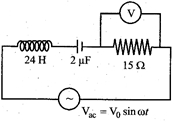
Frequency \(\mathrm{f}=\frac{1}{2 \pi \sqrt{\mathrm{LC}}}\)\(=\frac{1}{2 \times 3.4 \sqrt{24 \times 2 \times 10^{-6}}}\)
\(=23\, \mathrm{Hz}\)
-
- (A) \(10^{-15}\,C\)
- (B) \(10^{-6}\,C\)
- (C) \(10^{-10}\,C\)
- (D) \(10^{-8}\,C\)
Show answer and solution
Correct Answer: (D)
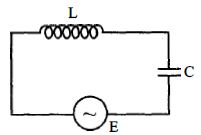
\(\mathrm{C}=10^{-11} \,\mathrm{F}, \mathrm{L}=10^{-5} \,\mathrm{Henry},\) and \(\mathrm{R}=100\) \(ohm\)\({I_{max}}({\text{wL}} - 1/{\text{wC}} + {\text{R}}) = {V_{max}}.........(1)\)
\(\mathrm{wL}=\) inductive reactance
\(1 /{wC}=\) capacitive reactance
\({R}\) is resistance
at resonance: \( w |=1 / w C\)
so equation \((1)\) becomes
\({I_{max}}(\mathrm{R})=V_{max}\)
\(I_{max} =\mathrm{E}_{\mathrm{o}} / \mathrm{R} .........(1)\)
Calculation of Eo
initially the circuit is connected with constant battery source:
at steady state potential across capacitor becomes \(=E=E \circ\)
we know that
\(q=C E \quad\left(\text { Given at steady state } q=10^{-9} \,\mathrm{C}\right)\)
put values and get \(E\) as
\(E=E_{0}=10^{-9} / 10^{-11}=100\,\mathrm{volt}.........(2)\)
Put value of \(Eo\) in \(1\)
Get \(1_{max}\) \(=1\,amp\)
now at resonance \(w=(1 / L C)^{1 / 2}=10^{8}\)
\(Q _{max} ={I_{max}} / w=10^{-8}\)
-
- (A) \(400\)
- (B) \(500\)
- (C) \(100\)
- (D) \(700\)
Show answer and solution
Correct Answer: (C)
Voltage \(E\) of the ac source\(E = V_C - V_L\)
\(=400\,V-300\,V =100\,V\)
- 38. The plot given below is of the average power delivered to an \(LRC\) circuit versus frequency. The quality factor of the circuit is
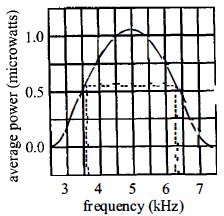 2013 Medium
- (A) \(5\)
- (B) \(2\)
- (C) \(2.5\)
- (D) \(0.4\)
Show answer and solution
Correct Answer: (B)
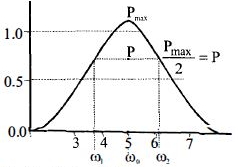
Quality factor of the circuit\(=\frac{\omega_{0}}{\omega_{2}-\omega_{1}}=\frac{5}{2.5}=2.0\)
- 39. When resonance is produced in a series \(LCR\) circuit, then which of the following is not correct ? 2013 Medium
- (A) Current in the circuit is in phase with the applied voltage
- (B) Inductive and capacitive reactances are equal
- (C) lf \(R\) is reduced, the voltage across capacitor wilI increase
- (D) Impedance of the circuit is maximum
Show answer and solution
Correct Answer: (D)
Impedance ( \(Z\) ) ofthe series \(LCR\) circuit is\(\mathrm{Z}=\sqrt{\mathrm{R}^{2}+\left(\mathrm{X}_{\mathrm{L}}-\mathrm{X}_{\mathrm{C}}\right)^{2}}\)
At resonance, \(\mathrm{X}_{\mathrm{L}}=\mathrm{X}_{\mathrm{C}}\)
Therefore, \(Z_{\text {minimun }}=\mathrm{R}\)
-
- (A) \(6.26\times10^3\) Watts at the start
- (B) \(6.26\times10^3\) Watts at take off
- (C) \(6.26\times10^4\) Watts at the start
- (D) \(6.26\times10^4\) Watts at take off
Show answer and solution
Correct Answer: (B)
According to energy conservation , Let be take off speed \(v.\)So,
\(\frac{1}{2}m{v^2} = mgh;\;\)
\(Here\;h = 1\;m\)
\(v = \sqrt {2g} \)
Now Maxium power delivered by musheles is given by
\(P\; = 2Fv = 2 \times mg \times \sqrt {2g} \)
\( = 2 \times 70 \times 10 \times \sqrt {20} \)
\( = 6260.8 = 6.26 \times {10^3}\;W/s\)
-
- (A) \(15\)
- (B) \(12.5\)
- (C) \(15.5\)
- (D) \(17\)
Show answer and solution
Correct Answer: (D)
\(\begin{array}{l}
As\,there\,is\,no\,external\,Force,\,so\,\\
displacement\,oF\,center\,oF\,mass\,oF\\
the\,cart + boy\,system\,parallel\,to\,the\\
surFace\,is\,zero.\\
\Delta {x_{cm}} = \left( {{m_1}\Delta {x_1} + {m_1}\Delta {x_1}} \right)/\left( {{m_1} + {m_2}} \right)\\
0 = \left( {{m_1}\Delta {x_1} + {m_1}\Delta {x_1}} \right)/\left( {{m_1} + {m_2}} \right)\\
Let\,the\,body\,moves\,towards\,\,the\,wall\\
a\,{\rm{distance}}\,10\,m\,and\,the\,cart\,moves\,\\
away\,form\,the\,wall\,a\,{\rm{distance}}\,x\,so,
\end{array}\)\(\begin{array}{l}
displacement\,of\,man\,wrt\,ground\,towards\\
the\,wall\,is\,\Delta {x_1} = 10 - x\\
displacement\,of\,cart\,wrt\,ground\,towards\\
the\,wall\,is\,\Delta {x_2} = - x\\
{m_1}\Delta {x_1} + {m_1}\Delta {x_1} = 0\\
20\left( {10 - x} \right) + 80\left( { - x} \right) = 0\\
100x = 200\\
x = 2\,m\\
displacement\,of\,man\,wrt\,ground\,towards
\end{array}\)\(\begin{array}{l}
the\,wall\,is\,\Delta {x_1} = 10 - 2 = 8m\\
{\bf{Hence}},\,{\bf{the}}\,{\bf{final}}\,{\bf{diatance}}\,{\bf{of}}\,{\bf{the}}\,{\bf{bov}}\\
{\bf{from}}\,{\bf{the}}\,{\bf{wall}}\,{\bf{will}}\,{\bf{be}}\,{\bf{X}} = {\bf{25}} - {\bf{8}} = {\bf{17}}\,{\bf{m}}
\end{array}\) -
- (A) \(6.25\, rad/sec\)
- (B) \(0.625\, rad/sec\)
- (C) \(3.35\, rad/sec\)
- (D) \(0.335\, rad/sec\)
Show answer and solution
Correct Answer: (B)
Angular momentum imparted by the bullet\(L = mv \times r \)\( = \left( {10 \times {{10}^{ - 3}}} \right) \times 500 \times \frac{1}{2} = 2.5\)
\(I = \frac{{M{L^2}}}{3} = \frac{{12 \times {{1.0}^2}}}{3} = 4kg{m^2}\)
\(L = I\omega \)
\(\therefore \omega = \frac{L}{I} = \frac{{2.5}}{4} = 0.625\,rad/\sec \)
-
- (A) \(r\)\({\omega _0}\)
- (B) \(\frac{{{\rm{r}}{\omega _0}}}{4}\)
- (C) \({\rm{\;}}\frac{{{\rm{r}}{\omega _0}}}{3}\)
- (D) \({\rm{\;}}\frac{{{\rm{r}}{\omega _0}}}{2}\)
Show answer and solution
Correct Answer: (D)
From conservation of angular momentum about any fix point on the surface,\(\begin{array}{l}
m{r^2}{\omega _0} = 2m{r^2}\omega \\
\Rightarrow \,\omega = {\omega _0}\backslash 2 \Rightarrow v = \frac{{{\omega _0}r}}{2}
\end{array}\)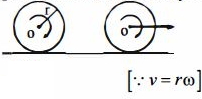
-
- (A) \(r\)\({\omega _0}\)
- (B) \(\frac{{{\rm{r}}{\omega _0}}}{4}\)
- (C) \({\rm{\;}}\frac{{{\rm{r}}{\omega _0}}}{3}\)
- (D) \({\rm{\;}}\frac{{{\rm{r}}{\omega _0}}}{2}\)
Show answer and solution
Correct Answer: (D)
From conservation of angular momentum about any fix point on the surface,\(\begin{array}{l}
m{r^2}{\omega _0} = 2m{r^2}\omega \\
\Rightarrow \,\omega = {\omega _0}\backslash 2 \Rightarrow v = \frac{{{\omega _0}r}}{2}
\end{array}\) -
- (A) \( - 80\hat k\)
- (B) \(\left( {10\hat i - 16\hat j} \right)\)
- (C) \( - 40\hat k\)
- (D) \( 40\hat k\)
Show answer and solution
Correct Answer: (A)
Angular momentum \(L = m\) \((v \times r)\)\(\begin{array}{l}
= 2kg\,\left( {\frac{{dr}}{{dt}} \times r} \right) = 2\,kg\left( {4t\,j \times 5i - 2{t^2}\hat j} \right)\\
= 2\,kg\,\left( { - 20\,t\,\hat k} \right) = 2\,kg \times - 20 \times 2\,{m^{ - 2}}{s^{ - 1}}\hat k\\
= - 80\,\hat k
\end{array}\) -
- (A) \(\frac{{m\left( {M + 2m} \right)}}{M}\,{\omega ^2}{R^2}\)
- (B) \(\frac{{Mm}}{{\left( {M + m} \right)}}\,{\omega ^2}{R^2}\)
- (C) \(\frac{{Mm}}{{\left( {M + 2m} \right)}}\,{\omega ^2}{R^2}\)
- (D) \(\frac{{\left( {M + m} \right)M}}{{\left( {M + 2m} \right)}}\,{\omega ^2}{R^2}\)
Show answer and solution
Correct Answer: (C)
\(\begin{array}{l}
Kinetic\,energ{y_{\left( {rotational} \right)}}{K_R} = \frac{1}{2}I{\omega ^2}\\
kinetic\,energ{y_{(translational)}}{K_r} = \frac{1}{2}M{v^2}\\
\,\,\,\,\,\,\,\,\,\,\,\,\,\,\,\,\,\,\,\,\,\,\,\,\,\,\,\,\,\,\,\,\,\,\,\,\,\,\,\,\,\,\,\,\,\,\,\,\,\,\,\,\,\,\,\,\,\,\,\,\,\,\left( {v = R\omega } \right)\\
M.{\mathop{\rm I}\nolimits} {._{(initial)}}{I_{ring}} = M{R^2};{\omega _{initial}} = \omega \\
M.I{._{\left( {new} \right)}}I{'_{\left( {system} \right)}} = M{R^2} + 2m{R^2}\\
\omega {'_{\left( {system} \right)}} = \frac{{m\omega }}{{M + 2m}}
\end{array}\)Solving we get loss in \(K.E.\)
\( = \frac{{Mm }}{{\left( {M + 2m} \right)}}{\omega ^2}{R^2}\)
No questions on this page match these filters.
Other years
Frequently asked
How many JEE Mains 2013 Physics questions are on ExamBro?
131 questions, each with the correct answer and a full solution.
Which JEE Mains 2013 Physics chapter is asked the most?
System of particles and rotational motion, with 14 questions, followed by Electric potential and capacitance with 9.
How difficult are JEE Mains 2013 Physics questions?
8% are easy, 44% medium and 48% hard.