


Topics
10 topics- 37Qs Solubility product Most asked
- 10Qs Common ion effect
- 20Qs Buffer solution
- 20Qs PH of strong Acids and strong Bases
- 2Qs Electrical conductors and Ostwald's dilution law
- 9Qs PH of weak Acids and weak Bases
- 10Qs Acid and base indicators
- 6Qs Water hydrolysis and pH scale
- 10Qs Salt hydrolysis
- 4Qs Acids and Bases
All Equilibrium - II (icon Equilibrium) questions
Newest firstShowing 1–50 of 128 questions
-
- (A) \(7.0\)
- (B) \(4.75\)
- (C) \(3.5\)
- (D) \(4.82\)
Show answer and solution
Correct Answer: (B)
For complete neutralization of \(20\) mL of acetic acid, the millimoles of NaOH required is:
\(28.4 \times 0.1 = 2.84\) mmol
Thus, \(20\) mL of the acetic acid solution contains \(2.84\) mmol of \(CH_3COOH\).
For the preparation of solution (X), the millimoles of NaOH added is:
\(14.2 \times 0.1 = 1.42\) mmol
The reaction between acetic acid and sodium hydroxide is:
\(CH_3COOH + NaOH \rightarrow CH_3COONa + H_2O\)
Millimoles of \(CH_3COOH\) remaining after the reaction = \(2.84 - 1.42 = 1.42\) mmol
Millimoles of \(CH_3COONa\) formed = \(1.42\) mmol
Since the solution contains a weak acid and its conjugate base, it forms an acidic buffer. Using the Henderson-Hasselbalch equation:
\(pH = pK_a + \log \left( \dfrac{[\text{Salt}]}{[\text{Acid}]} \right)\)
Substituting the values:
\(pH = 4.75 + \log \left( \dfrac{1.42}{1.42} \right)\)
\(pH = 4.75 + \log(1)\)
\(pH = 4.75\)
Answer: \(4.75\) -
- (A) \(B < C < A\)
- (B) \(C < A < B\)
- (C) \(C < B < A\)
- (D) \(A < C < B\)
Show answer and solution
Correct Answer: (C)
For mixture A:
Millimoles of OH\(^{-}\) = \(10 \times 0.2 \times 2 = 4\)
Millimoles of H\(^{+}\) = \(25 \times 0.1 \times 1 = 2.5\)
Remaining OH\(^{-}\) = \(4 - 2.5 = 1.5\) mmol
The solution is basic, so pH \(> 7\).
For mixture B:
Millimoles of H\(^{+}\) = \(10 \times 0.01 \times 2 = 0.2\)
Millimoles of OH\(^{-}\) = \(10 \times 0.01 \times 2 = 0.2\)
The solution is completely neutralized, so pH \(= 7\).
For mixture C:
Millimoles of H\(^{+}\) = \(10 \times 0.1 \times 2 = 2\)
Millimoles of OH\(^{-}\) = \(10 \times 0.1 \times 1 = 1\)
Remaining H\(^{+}\) = \(2 - 1 = 1\) mmol
The solution is acidic, so pH \(< 7\).
Therefore, the increasing order of pH values is C \(<\) B \(<\) A.
Answer: \(C < B < A\) -
- (A) \(0.7 \quad 2.0\)
- (B) \(2.0 \quad 3.3\)
- (C) \(1.1 \quad 2.2\)
- (D) \(3.0 \quad 2.2\)
Show answer and solution
Correct Answer: (B)
For part (a), at the start of the titration, the solution contains only the weak acid HX.
The concentration of HX is \(C = 0.2\) M.
Using the formula for the hydrogen ion concentration of a weak acid with \(\alpha \ll 1\):
\([H^+] = \sqrt{K_a \times C} = \sqrt{5 \times 10^{-4} \times 0.2} = \sqrt{10^{-4}} = 10^{-2}\) M
\(pH = -\log(10^{-2}) = 2.0\)
For part (b), when \(10\) mL of \(0.2\) M NaOH is added to \(20\) mL of \(0.2\) M HX:
Initial millimoles of HX \(= 20 \times 0.2 = 4\) mmol
Millimoles of NaOH added \(= 10 \times 0.2 = 2\) mmol
The added NaOH neutralizes half of the HX to form NaX, creating an acidic buffer.
Millimoles of HX remaining \(= 4 - 2 = 2\) mmol
Millimoles of NaX formed \(= 2\) mmol
Using the Henderson-Hasselbalch equation:
\(pH = pK_a + \log \left( \dfrac{[\text{Salt}]}{[\text{Acid}]} \right)\)
Since the millimoles of salt and acid are equal, \(\log(1) = 0\).
\(pH = pK_a = 3.3\)
Answer: \(2.0 \quad 3.3\) -
- (A) x = 11.1, y = 88.9
- (B) x = 42.7, y = 57.3
- (C) x = 14.3, y = 85.7
- (D) x = 85.7, y = 14.3
Show answer and solution
Correct Answer: (C)
\(\begin{array}{cccc} & HCl & + B \rightarrow BH ^{+}+ Cl ^{-} \\ & 0.02 M & 0.02 M & \\ & x~ml & y~ml & \\ t _{ f } & 0 & 0.02 y -0.02 x & 0.02 x \end{array}\)
\(pOH = pK _{ b }+\log \left[\frac{\text { Salt }}{\text { Base }}\right]\)
\(5=5.699+\log \left[\frac{\text { Salt }}{\text { Base }}\right]\)
\(\frac{x}{y-x}=\frac{1}{5}\)
\(6 x=y\)
\(7 x =100\)
\(x =\frac{100}{7} ml\)
\(\&~y=\frac{600}{7} ml\) -
- (A) 1
- (B) 2
- (C) 3
- (D) 4
Show answer and solution
Correct Answer: (C)
\( pH=\frac{1}{2}[pK_{a}-\log c] \)
\( pH=\frac{1}{2}[4-\log 10^{-2}] \)
\(pH =3\) -
- (A) \( MgCl_{2} \), AgCl and \( AlCl_{3} \)
- (B) AgCl, \( Hg_{2}Cl_{2} \) and \( PbCl_{2} \)
- (C) \( AlCl_{3} \), \( PbCl_{2} \) and \( BaCl_{2} \)
- (D) \( CuCl_{2} \), \(AgCl\) and \( PbCl_{2} \)
Show answer and solution
Correct Answer: (D)
\( MgCl_{2}, AlCl_{3}, CuCl_{2} \) are water soluble at room temperature.
AgCl, \( Hg_{2}Cl_{2} \) are sparingly soluble in water \( PbCl_{2} \) is soluble in hot water. -
- (A) 2
- (B) 3
- (C) 6
- (D) 4
Show answer and solution
Correct Answer: (D)
\(XS ( s ) \rightleftharpoons X ^{+2}(\) aq. \()+ S ^2-(\) aq. \()\)
For precipitation of XS(s)
\(\left[ X ^{+2}\right]\left[ S ^{2-}\right] \geq K _{ SP }( XS )\)
\(\left[ S ^{2-}\right] \geq \frac{1 \times 10^{-22}}{0.01}=10^{-20}\)
\(YS ( s ) \rightleftharpoons Y ^{+2}( aq )+ S ^{2-}( aq )\)
For precipitation of \(YS ( s )\)
\(\left[ Y ^{+2}\right]\left[ S ^{2-}\right] \geq K _{ sp }( YS )\)
\(\left[ S ^{2-}\right] \geq \frac{4 \times 10^{-16}}{10^{-2}}=4 \times 10^{-14}\)
Now, \(H _2 S( aq ) \rightleftharpoons 2 H ^{+}( aq )+ S ^{2-}( aq )\)
\(\frac{\left[ S ^{2-}\right]\left[ H ^{+}\right]^2}{ H _2 S}= K _{ a _1} \times K _{ a _2}=1 \times 10^{-21}\)
\(\left[ S ^{2-}\right]=\frac{1 \times 10^{-21} \times\left[ H _2 S\right]}{\left[ H ^{+}\right]^2} \geq 4 \times 10^{-14}\)
\(\left[ H ^{+}\right]^2 \leq \frac{1}{4} \times 10^{-7} \times 10^{-1}\)
\(\left[ H ^{+}\right] \leq \frac{1}{2} \times 10^{-4} \Rightarrow pH \geq 4.3\) -
- (A) \(\left[K \times c^{x+y-1} x^x y^y\right]^{x+y}\)
- (B) \(\left(\dfrac{K}{c^{x+y-1} x^x y^y}\right)^{\frac{1}{x+y}}\)
- (C) \(\left(\dfrac{c^{x+y-1} x^x y^y}{K}\right)^{x+y}\)
- (D) \(\left(\dfrac{c^{x+y-1} x^x y^y}{K}\right)^{\frac{1}{x+y}}\)
Show answer and solution
Correct Answer: (B)
The dissociation reaction of the weak electrolyte \(A_xB_y\) is:
\(A_xB_y \rightleftharpoons xA^{y+} + yB^{x-}\)
Initial concentrations:
\(c \quad 0 \quad 0\)
Equilibrium concentrations:
\(c(1-\alpha) \quad cx\alpha \quad cy\alpha\)
The dissociation constant \(K\) is given by:
\(K = \dfrac{[A^{y+}]^x [B^{x-}]^y}{[A_xB_y]}\)
\(K = \dfrac{(cx\alpha)^x (cy\alpha)^y}{c(1-\alpha)}\)
\(K = \dfrac{c^{x+y} x^x y^y \alpha^{x+y}}{c(1-\alpha)}\)
\(K = \dfrac{c^{x+y-1} x^x y^y \alpha^{x+y}}{1-\alpha}\)
For a weak electrolyte, the degree of dissociation \(\alpha\) is very small, so \(1-\alpha \approx 1\).
\(K = c^{x+y-1} x^x y^y \alpha^{x+y}\)
Solving for \(\alpha\):
\(\alpha^{x+y} = \dfrac{K}{c^{x+y-1} x^x y^y}\)
\(\alpha = \left(\dfrac{K}{c^{x+y-1} x^x y^y}\right)^{\dfrac{1}{x+y}}\)
Answer: \(\left(\dfrac{K}{c^{x+y-1} x^x y^y}\right)^{\frac{1}{x+y}}\) -
- (A) T \(\quad\) Insulin
- (B) T \(\quad\) Thyroxine
- (C) Y \(\quad\) Thyroxine
- (D) Y \(\quad\) Insulin
Show answer and solution
Correct Answer: (C)
Thyroxine is a thyroid hormone which is an iodinated derivative of the amino acid tyrosine.
The standard one-letter code for the amino acid tyrosine is Y.
Insulin is a peptide hormone and not an iodinated derivative of a single amino acid.
Therefore, the correct pair is Y and Thyroxine.
Answer: Y \(\quad\) Thyroxine - 10. In the Group analysis of cations, \(Ba^{2+}\) & \(Ca^{2+}\) are precipitated respectively as 2026 Hard
- (A) sulphide & sulphide
- (B) hydroxide & carbonate
- (C) carbonate & carbonate
- (D) chromate & sulphide
Show answer and solution
Correct Answer: (C)
To identify \(Ba^{2+} \& Ca^{2+}\)
Reagent \((NH_{4})_{2}CO_{3} + NH_{4}Cl\) is used. \(BaCO_{3}\) & \(CaCO_{3}\) are obtained as precipitates. -
- (A) \(\dfrac{1}{54} \cdot \dfrac{y^4}{x^4}\)
- (B) \(\dfrac{y^5}{108 x^4}\)
- (C) \(108 \cdot \dfrac{x^5}{y^5}\)
- (D) \(\dfrac{1}{108} \cdot \dfrac{y^4}{x^4}\)
Show answer and solution
Correct Answer: (A)
The molar solubility \(S\) of the salt is given by \(S = \dfrac{x}{y}\) mol L\(^{-1}\).
The dissociation of the sparingly soluble salt \(M_3A_2\) is:
\(M_3A_2 \rightleftharpoons 3M^{2+} + 2A^{3-}\)
The molar concentration of the anion \(A^{3-}\) is:
\([A^{3-}] = 2S\)
The solubility product \(K_{sp}\) of the salt is:
\(K_{sp} = [M^{2+}]^3 [A^{3-}]^2 = (3S)^3 (2S)^2 = 27S^3 \times 4S^2 = 108S^5\)
The ratio of the molar concentration of the anion to the solubility product is:
\(\dfrac{[A^{3-}]}{K_{sp}} = \dfrac{2S}{108S^5} = \dfrac{1}{54S^4}\)
Substituting \(S = \dfrac{x}{y}\) into the expression, we get:
\(\text{Ratio} = \dfrac{1}{54 \left(\dfrac{x}{y}\right)^4} = \dfrac{1}{54} \cdot \dfrac{y^4}{x^4}\)
Answer: \(\dfrac{1}{54} \cdot \dfrac{y^4}{x^4}\) -
- (A) \(0.1\) M
- (B) \(9.53 \times 10^{-6}\) M
- (C) \(8.1 \times 10^{-8}\) M
- (D) \(1.0 \times 10^{-13}\) M
Show answer and solution
Correct Answer: (C)
Given:
Weak dibasic acid \(H_2A\) with \(K_{a1} = 8.1 \times 10^{-8}\) and \(K_{a2} = 1.0 \times 10^{-13}\)
Initial concentration: \([H_2A]_0 = 0.1\text{ M}\)
The solution also contains \(0.1\text{ M HCl}\), which dissociates completely to give \([H^+]_0 = 0.1\text{ M}\).
The main source of \(HA^-\) is the first dissociation:
\(H_2A \rightleftharpoons H^+ + HA^-\)
Let \(x\) be the amount of \(H_2A\) that dissociates. Then at equilibrium:
\([H_2A] = 0.1 - x\)
\([H^+] = 0.1 + x\)
\([HA^-] = x\)
Applying the equilibrium expression:
\(K_{a1} = \dfrac{[H^+][HA^-]}{[H_2A]}\)
\(8.1 \times 10^{-8} = \dfrac{(0.1 + x)(x)}{0.1 - x}\)
Since \(K_{a1}\) is very small and the common \(H^+\) ion from HCl suppresses dissociation, \(x \ll 0.1\). Hence:
\(0.1 - x \approx 0.1\) and \(0.1 + x \approx 0.1\)
\(8.1 \times 10^{-8} \approx \dfrac{(0.1)(x)}{0.1} = x\)
Therefore:
\([HA^-] = x = 8.1 \times 10^{-8}\text{ M}\)
The second dissociation (\(K_{a2} = 1.0 \times 10^{-13}\)) is negligible compared to the first, so the \(HA^-\) consumed in that step is insignificant.
Hence, the correct option is \((3)\ 8.1 \times 10^{-8}\text{ M}\). -
- (A) 856
- (B) 756
- (C) 956
- (D) 656
Show answer and solution
Correct Answer: (B)
The given mixture forms a basic buffer solution.
Millimoles of base \(NH_4OH = 5 \times 0.1 = 0.5\) mmol
Millimoles of salt \(NH_4Cl = 250 \times 0.1 = 25\) mmol
Using the Henderson-Hasselbalch equation for a basic buffer:
\(pOH = pK_b + \log \left( \dfrac{[\text{Salt}]}{[\text{Base}]} \right)\)
\(pOH = 4.74 + \log \left( \dfrac{25}{0.5} \right)\)
\(pOH = 4.74 + \log (50)\)
We know that \(\log (50) = \log (5 \times 10) = \log 5 + \log 10 = 0.70 + 1 = 1.70\)
\(pOH = 4.74 + 1.70 = 6.44\)
The pH of the solution is given by:
\(pH = 14 - pOH\)
\(pH = 14 - 6.44 = 7.56\)
\(pH = 756 \times 10^{-2}\)
Answer: \(756\) -
- (A) \(\dfrac{2\sqrt[3]{x}}{y}\)
- (B) \(2\sqrt{\dfrac{x}{y}}\)
- (C) \(\sqrt{\dfrac{x}{y}}\)
- (D) \(\dfrac{\sqrt[3]{x}}{\sqrt{y}}\)
Show answer and solution
Correct Answer: (D)
Let the solubility of \(Ag_2CrO_4\) be \(S_1\).
For \(Ag_2CrO_4 \rightleftharpoons 2Ag^+ + CrO_4^{2-}\)
\(K_{sp} = (2S_1)^2(S_1) = 4S_1^3\)
\(4S_1^3 = 32x \Rightarrow S_1^3 = 8x \Rightarrow S_1 = 2\sqrt[3]{x}\)
Let the solubility of \(AgBr\) be \(S_2\).
For \(AgBr \rightleftharpoons Ag^+ + Br^-\)
\(K_{sp} = S_2^2\)
\(S_2^2 = 4y \Rightarrow S_2 = 2\sqrt{y}\)
The ratio of their molarities is:
\(\dfrac{S_1}{S_2} = \dfrac{2\sqrt[3]{x}}{2\sqrt{y}} = \dfrac{\sqrt[3]{x}}{\sqrt{y}}\)
Answer: \(\dfrac{\sqrt[3]{x}}{\sqrt{y}}\) - 15. Which of the following mixture gives a buffer solution with pH = 9.25?
Given: \(pK_{b} (NH_{4}OH) = 4.75\) 2026 Easy- (A) 0.2M \(NH_{4}OH\) (0.4 L) + 0.1M HCl (1L)
- (B) 0.2M \(NH_{4}OH\) (0.5 L) + 0.1M HCl (0.5 L)
- (C) 0.5M \(NH_{4}OH\) (0.2 L) + 0.2M HCl (0.5 L)
- (D) 0.4M \(NH_{4}OH\) (1 L) + 0.1M HCl (1L)
Show answer and solution
Correct Answer: (B)
\(pOH = pK_{b} + \log\frac{Salt}{Base}\)
\(4.75 = 4.75 + \log\frac{Salt}{Base}\)
Milimoles of [Salt] = milimoles of [Base]
Option (D):
\(NH _4 OH + HCl \rightarrow NH _4 Cl + H _2 O\)
\(0.2 M , 0.5 L \quad 0.1 M , 0.5 L\)
100 mmole \(\quad\) 50 mmole
50 mmole \(\quad-\quad \) 50 mmole
Milimoles of \(NH _4 OH =\) milimoles of \(NH _4 Cl\) - 16. A weak acid HA has degree of dissociation x . Which option gives the correct expression of ( pH - \(\mathrm{pK}_{\mathrm{a}}\) )? 2025 Medium
- (A) 0
- (B) \(\log (1+2 \mathrm{x})\)
- (C) \(\log \left(\frac{1-x}{x}\right)\)
- (D) \(\log \left(\frac{x}{1-x}\right)\)
Show answer and solution
Correct Answer: (D)
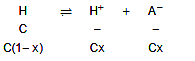
\(\begin{aligned} & \mathrm{K}_{\mathrm{a}}=\frac{\left[\mathrm{H}^{+}\right](\mathrm{x})}{\mathrm{C}(1-\mathrm{x})} \\ & {\left[\mathrm{H}^{+}\right]=\mathrm{K}_{\mathrm{a}} \frac{(1-\mathrm{x})}{\mathrm{x}}} \\ & \log \mathrm{H}^{+}=\log \mathrm{K}_{\mathrm{a}}+\log \left(\frac{1-\mathrm{x}}{\mathrm{x}}\right) \\ & -\log \mathrm{H}^{+}=-\log \mathrm{K}_{\mathrm{a}}-\log \frac{1-\mathrm{x}}{\mathrm{x}} \\ & \mathrm{pH}=\mathrm{pK}_{\mathrm{a}}-\log \frac{1-\mathrm{x}}{\mathrm{x}} \\ & \mathrm{pH}-\mathrm{pK}_{\mathrm{a}}=\log \frac{\mathrm{x}}{1-\mathrm{x}}\end{aligned}\) -
- (A) reduce to \(0.5\)
- (B) increase to \(1.3\)
- (C) remain same
- (D) increase to \(2\)
Show answer and solution
Correct Answer: (B)
\(\mathrm{HCl}_{(\mathrm{aq})} \mathrm{pH}=1 ;\left[\mathrm{H}^{+}\right]=10^{-1}\)
If equal volume of water is added concentration will become half
\(\begin{aligned}& {\left[\mathrm{H}^{+}\right]_{\mathrm{sol}}=\frac{10^{-1}}{2}} \\& \mathrm{pH}=1.3\end{aligned}\) - 18. Arrange the following in increasing order of solubility product :
\(\mathrm{Ca}(\mathrm{OH})_2, \mathrm{AgBr}, \mathrm{PbS}, \mathrm{HgS}\) 2025 Medium- (A) \(\mathrm{HgS} \lt \mathrm{AgBr} \lt \mathrm{PbS} \lt \mathrm{Ca}(\mathrm{OH})_2\)
- (B) \(\mathrm{Ca}(\mathrm{OH})_2 \lt \mathrm{AgBr} \lt \mathrm{HgS} \lt \mathrm{PbS}\)
- (C) \(\mathrm{PbS} \lt \mathrm{HgS} \lt \mathrm{Ca}(\mathrm{OH})_2 \lt \mathrm{AgBr}\)
- (D) \(\mathrm{HgS} \lt \mathrm{PbS} \lt \mathrm{AgBr} \lt \mathrm{Ca}(\mathrm{OH})_2\)
Show answer and solution
Correct Answer: (D)
Based on the Ksp values and salt analysis cation identification, we can say that order of Ksp value is:
\(\mathrm{HgS} < \mathrm{PbS} < \mathrm{AgBr} < \mathrm{Ca}(\mathrm{OH})_2\)
K sp values
\(\begin{aligned}
& \mathrm{HgS} \rightarrow 4 \times 10^{-53} \\
& \mathrm{PbS} \rightarrow 8 \times 10^{-28} \\
& \mathrm{AgBr} \rightarrow 5 \times 10^{-13} \\
& \mathrm{Ca}(\mathrm{OH})_2 \rightarrow 5.5 \times 10^{-6}
\end{aligned}\) -
- (A) CoS
- (B) ZnS
- (C) NiS
- (D) MnS
Show answer and solution
Correct Answer: (A)
Compound \((A)\) in the given reaction sequence is likely to be CoS.
\(\begin{aligned} \mathrm{CoS}+\mathrm{HNO}_3+3 \mathrm{HCl} \rightarrow \mathrm{Co}^{2+} & +\mathrm{S} \downarrow+\mathrm{NOCl} \uparrow \\ & +2 \mathrm{Cl}^{-}+2 \mathrm{H}_2 \mathrm{O}\end{aligned}\)
The above solution is neutralised with \(\mathrm{NH}_4 \mathrm{OH}\).
To a neutral solution of \(\mathrm{Co}^{2+}\), acetic acid and saturated solution of \(\mathrm{KNO}_2\) are added which results in the formation of yellow precipitate of \(\mathrm{K}_3\left[\mathrm{Co}\left(\mathrm{NO}_2\right)_6\right]\)
\(\mathrm{Co}^{2+}+7 \mathrm{NO}_2^{-}+2 \mathrm{H}^{+}+3 \mathrm{~K}^{+} \rightarrow \mathrm{K}_3\left[\mathrm{Co}\left(\mathrm{NO}_2\right)_6\right]+\mathrm{NO} \uparrow+\mathrm{H}_2 \mathrm{O}\) -
- (A) Statement I is true but Statement II is false
- (B) Both Statement I and Statement II are false
- (C) Both Statement I and Statement II are true
- (D) Statement I is false but Statement II is true
Show answer and solution
Correct Answer: (C)
At melting point when ice melts, supplied heat is utilised to overcome intermolecular attraction within the molecules so temperature remain constant. -
- (A) (A), (D) and (E) only
- (B) (D) and (E) only
- (C) (A) and (B) only
- (D) (A) and (C) only
Show answer and solution
Correct Answer: (B)
\(\mathrm{As}_2 \mathrm{~S}_3\) and \(\mathrm{As}_2 \mathrm{~S}_5\) are yellow colour sulphides, \(\left(\mathrm{NH}_4\right)_2 \mathrm{~S}\) is colourless, PbS is black, CuS is black in colour -
- (A) 10
- (B) 17
- (C) 7
- (D) 5
Show answer and solution
Correct Answer: (C)
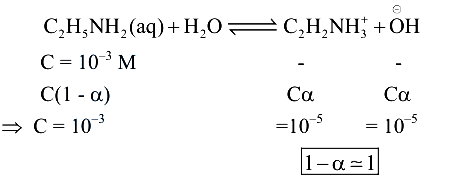
Given, \(\mathrm{P}^{\mathrm{H}}=9 \Rightarrow \mathrm{P}^{\mathrm{OH}}=5 \Rightarrow[\stackrel{\ominus}{\mathrm{OH}}]=10^{-5} \mathrm{M}\)
Now, \(\mathrm{K}_{\mathrm{b}}=\frac{\left[\mathrm{C}_2 \mathrm{H}_5 \mathrm{NH}_3^{+}\right][\stackrel{\ominus}{\mathrm{O}} \mathrm{H}]}{\left[\mathrm{C}_2 \mathrm{H}_5 \mathrm{NH}_2\right]}\)
\(\Rightarrow K_{\mathrm{b}}=\frac{10^{-5} \times 10^{-5}}{10^{-3}}=10^{-7}\) -
- (A) \(3.6 \times 10^{-3} \mathrm{M}~ \mathrm{AB}_2, 5.0 \times 10^{-4} \mathrm{M}~ \mathrm{XY}\)
- (B) \(2.0 \times 10^{-4} \mathrm{M}~ \mathrm{AB}_2, 0.8 \times 10^{-3} \mathrm{M}~ \mathrm{XY}\)
- (C) \(2.0 \times 10^{-2} \mathrm{M}~ \mathrm{AB}_2, 2.0 \times 10^{-2} \mathrm{M}~ \mathrm{XY}\)
- (D) \(1.5 \times 10^{-4} \mathrm{M}~ \mathrm{AB}_2, 1.5 \times 10^{-3} \mathrm{M}~ \mathrm{XY}\)
Show answer and solution
Correct Answer: (C)
When equal volumes are mixed molarity reduce to half.
For precipitation \(\mathrm{Q}_{\mathrm{SP}}=\left[\mathrm{A}^{+2}\right]\left[\mathrm{Y}^{-}\right]^2 \gt \mathrm{K}_{\mathrm{SP}}\)
(1) \(\mathrm{Q}_{\mathrm{SP}}=\left(1.8 \times 10^{-3}\right)\left(\frac{5}{2} \times 10^{-4}\right)^2 \lt \mathrm{K}_{\mathrm{sP}}\)
(2) \(\mathrm{Q}_{\mathrm{SP}}=\left(10^{-4}\right)\left(0.4 \times 10^{-3}\right)^2 \lt \mathrm{K}_{\mathrm{sp}}\)
(3) \(\mathrm{Q}_{\mathrm{SP}}=\left(10^{-2}\right)\left(10^{-2}\right)^2 \gt \mathrm{K}_{\mathrm{sP}}\)
(4) \(\mathrm{Q}_{\mathrm{SP}}=\left(\frac{1.5}{2} \times 10^{-4}\right)\left(\frac{1.5}{2} \times 10^{-3}\right)^2 \lt \mathrm{K}_{\mathrm{sP}}\) - 24. \(\mathrm{K}_{\text {sp }}\) for \(\mathrm{Cr}(\mathrm{OH})_3\) is \(1.6 \times 10^{-30}\). What is the molar solubility of this salt in water? 2025 Medium
- (A) \(\frac{1.8 \times 10^{-30}}{27}\)
- (B) \(\sqrt[5]{1.8 \times 10^{-30}}\)
- (C) \(\sqrt[4]{\frac{1.6 \times 10^{-30}}{27}}\)
- (D) \(\sqrt[2]{1.6 \times 10^{-30}}\)
Show answer and solution
Correct Answer: (C)
\(\begin{aligned} & \mathrm{Cr}(\mathrm{OH})_3 \rightleftharpoons \underset{ \mathrm{s}}{\mathrm{Cr}^{3+}}(\mathrm{aq})+\underset{3 \mathrm{~s}}{3 \mathrm{OH}^{-}(\mathrm{aq})} \\ & \mathrm{K}_{\mathrm{sp}}=\mathrm{s}(3 \mathrm{~s})^3 \\ & 1.6 \times 10^{-30}=27 \mathrm{~s}^4 \\ & \sqrt[4]{\frac{1.6 \times 10^{-30}}{27}}=\mathrm{s}\end{aligned}\) -
- (A) 40
- (B) 48
- (C) 50
- (D) 52
Show answer and solution
Correct Answer: (B)
\(\begin{aligned}
& \mathrm{pOH}=\mathrm{pK}_{\mathrm{b}}+\log \frac{\left[\mathrm{NH}_4^{+}\right]}{\left[\mathrm{NH}_3\right]} \\
& \mathbf{p O H}=4.745
\end{aligned}\)
on adding 0.05 mole HCl
\(\begin{aligned}
& \begin{array}{llll}
\mathrm{NH}_3+ & \mathrm{H}^{\oplus} & \rightarrow & \mathrm{NH}_4^{\oplus} \\
0.1 & 0.05 & & 0.1 \\
0.05 & 0 & & 0.15
\end{array} \\
& \mathrm{pOH}^{\prime}=4.745+\log 3 \\
& \mathrm{pOH}^{\prime}-\mathrm{pOH}=0.477 \\
& 14-\mathrm{pH}^{\prime}-14+\mathrm{pH}=0.477 \\
& \Delta \mathrm{pH}=0.477 \\
& =47.7 \times 10^{-2} \approx 48 \times 10^{-2}
\end{aligned}\) - 26. pH of water is 7 at \(25^{\circ} \mathrm{C}\). If water is heated to \(80^{\circ} \mathrm{C}\)., it's pH will : 2025 Easy
- (A) Decrease
- (B) \(\mathrm{H}^{+}\)concentration increases, \(\mathrm{OH}^{-}\)concentration decreases
- (C) Remains the same
- (D) Increase
Show answer and solution
Correct Answer: (A)
At \(25^{\circ} \mathrm{C}\), pure water has \(\mathrm{pH}=7\)
As temperature increased, water molecules dissociate more into hydrogen ions ( \(\mathrm{H}^{+}\)) and hydroxide ions \(\left(\mathrm{OH}^{-}\right)\).
This increased dissociation leads to slightly decrease in pH .
At \(80^{\circ} \mathrm{C}, \mathrm{pH} \approx 6.93\) -
- (A) \(\left(\frac{\mathrm{K}_{\mathrm{sp}}}{9612}\right)^{\frac{1}{3}}\)
- (B) \(\left(\frac{\mathrm{K}_{\mathrm{sp}}}{6912}\right)^{\frac{1}{7}}\)
- (C) \(\left(\frac{\mathrm{K}_{\mathrm{sp}}}{8435}\right)^{\frac{1}{7}}\)
- (D) \(\left(\frac{\mathrm{K}_{\mathrm{sp}}}{5348}\right)^{\frac{1}{6}}\)
Show answer and solution
Correct Answer: (B)
\(\begin{array}{cc}\mathrm{Zr}_3\left(\mathrm{PO}_4\right)_4(\mathrm{~s}) \rightleftharpoons & 3 \mathrm{Zr}^{+4}(\mathrm{aq})+4 \mathrm{PO}_4^{-3}(\mathrm{aq}) \\ - & 3 \mathrm{~s} \quad 4 \mathrm{~s}\end{array}\)
\(\begin{aligned} & \mathrm{K}_{\text {sp }}=(3 \mathrm{~s})^3(4 \mathrm{~s})^4=6912 \mathrm{~s}^7 \\ & \mathrm{~s}=\left(\frac{\mathrm{K}_{\mathrm{sp}}}{6912}\right)^{1 / 7}\end{aligned}\) -
- (A) Both \(\mathrm{A}(\mathrm{OH})_2\) and \(\mathrm{B}(\mathrm{OH})_3\) do not show precipitation with \(\mathrm{NH}_4 \mathrm{OH}\)
- (B) \(\mathrm{A}(\mathrm{OH})_2\) will precipitate before \(\mathrm{B}(\mathrm{OH})_3\)
- (C) \(\mathrm{B}(\mathrm{OH})_3\) will precipitate before \(\mathrm{A}(\mathrm{OH})_2\)
- (D) \(\mathrm{A}(\mathrm{OH})_2\) and \(\mathrm{B}(\mathrm{OH})_3\) will precipitate together
Show answer and solution
Correct Answer: (C)
Condition for precipitation \(\mathrm{Q}_{\text {ip }}>\mathrm{K}_{\text {sp }}\)
For \(\left[\mathrm{A}(\mathrm{OH})_2\right]\)
\(\begin{aligned}
& {\left[\mathrm{A}^{2+}\right][\mathrm{OH}]^2>9 \times 10^{-10}} \\
& {\left[\mathrm{~A}^{+2}\right]=1 \mathrm{M}} \\
& \Rightarrow\left[\mathrm{OH}^{-}\right]>3 \times 10^{-5} \mathrm{M}
\end{aligned}\)
For \(\left[\mathrm{B}(\mathrm{OH})_3\right]\)
\(\begin{aligned}
& {\left[\mathrm{B}^{3+}\right]\left[\mathrm{OH}^{-}\right]^3>27 \times 10^{-18}} \\
& {\left[\mathrm{~B}^{3+}\right]=1 \mathrm{M}} \\
& \Rightarrow\left[\mathrm{OH}^{-}\right]>3 \times 10^{-6} \mathrm{M}
\end{aligned}\)
So, \(\mathrm{B}(\mathrm{OH})_3\) will precipitate before \(\mathrm{A}(\mathrm{OH})_2\) - 29. Which of the following mixing of 1 M base and 1 M acid leads to the largest increase in temperature? 2025 Hard
- (A) \(30 \mathrm{~mL} \mathrm{CH}_3 \mathrm{COOH}\) and 30 mL NaOH
- (B) 45 mL \(\mathrm{CH}_3\) COOH and 25 mL NaOH
- (C) 30 mL HCl and 30 mL NaOH
- (D) 50 mL HCl and 20 mL NaOH
Show answer and solution
Correct Answer: (C)
The rise in temperature of neutralization reaction will be maximum for maximum number of moles of strong acid and strong base neutralized and lower volume of final solution.
(3) \(\mathrm{HCl}+\mathrm{NaOH} \rightarrow \mathrm{NaCl}+\mathrm{H}_2 \mathrm{O}\)
mmol \(30 \quad 30\)
Final volume of solution \(=60 \mathrm{~mL}\)
Option (1) and (2) have weak acids and in option (4) only 20 mmol of HCl will be neutralized with 70 mL final volume. -
- (A) 3
- (B) 4
- (C) 5
- (D) 6
Show answer and solution
Correct Answer: (A)
\(\begin{aligned}
& \mathrm{pH}=10 \\
& \mathrm{pOH}=4 \\
& {\left[\mathrm{OH}^{-}\right]=10^{-4}}
\end{aligned}\)
no. of moles of \(\mathrm{OH}^{-}=10^{-4}\)
no. of moles of \(\operatorname{Mg}(\mathrm{OH})_2=\frac{10^{-4}}{2}=5 \times 10^{-5}\)
\(\text { mass of } \begin{aligned}
\mathrm{Mg}(\mathrm{OH})_2 & =5 \times 10^{-5} \times 58 \times 10^3 \mathrm{mg} \\
& =2.9
\end{aligned}\) -
- (A) \(0.069 \times 10^{-12}\)
- (B) \(6.91 \times 10^{-12}\)
- (C) \(0.276 \times 10^{-12}\)
- (D) \(27.65 \times 10^{-12}\)
Show answer and solution
Correct Answer: (B)
\( \mathrm{AB}_{2(\mathrm{~s})} \rightleftharpoons \mathrm{A}_{(\mathrm{aq})}^{+2}+2 \mathrm{~B}_{(\mathrm{aq})}^{-} \)\( \mathrm{K}_{\mathrm{sp}}=\left[\mathrm{A}^{+2}\right]\left[\mathrm{B}^{-}\right]^2 \)
\(=1.2 \times 10^{-4} \times\left(2.4 \times 10^{-4}\right)^2 \)
\(=6.91 \times 10^{-12} \mathrm{M}^3\)
-
- (A) Statement \(I\) is false but Statement \(II\) is true
- (B) Both Statement \(I\) and Statement \(II\) is true
- (C) Both Statement \(I\) and Statement \(II\) is false
- (D) Statement \(I\) is true but Statement \(II\) is false
Show answer and solution
Correct Answer: (A)
Buffer solution is a mixture of either weak acid / weak base and its respective conjugate.Blood is a buffer solution of carbonic acid \(\mathrm{H}_2 \mathrm{CO}_3\) and bicarbonate \(\mathrm{HCO}_3^{-}\)
Statement \(1\) is false but Statement \(II\) is true.
-
- (A) Both Statement \(I\) and Statement \(II\) are correct
- (B) Statement \(I\) is correct but Statement \(II\) is incorrect
- (C) Both Statement \(I\) and Statement \(II\) are incorrect
- (D) Statement \(I\) is incorrect but Statement \(II\) is correct
Show answer and solution
Correct Answer: (A)
Aqueous solution of \(\left(\mathrm{NH}_4\right)_2 \mathrm{CO}_3\) is Basic
\(\mathrm{pH}\) of salt of weak acid and weak base depends on \(\mathrm{Ka}\) and \(\mathrm{Kb}\) value of acid and the base forming it -
- (A) Both Statement I and Statement II are correct
- (B) Statement I is correct but Statement II is incorrect
- (C) Both Statement I and Statement II are incorrect
- (D) Statement I is incorrect but Statement II is correct
Show answer and solution
Correct Answer: (B)
Statement I is correct but Statement II is incorrect
-
- (A) Both Statement I and Statement II are correct
- (B) Statement I is correct but Statement II is incorrect
- (C) Statement I is incorrect but Statement II is correct
- (D) Both Statement I and Statement II are incorrect
Show answer and solution
Correct Answer: (A)
Potassium hydrogen phthalate is used to standardize NaOH solutions.
Phenolphthalein is used as an indicator to detect completion of titrations -
- (A) \(5\)
- (B) \(7\)
- (C) \(8\)
- (D) \(10\)
Show answer and solution
Correct Answer: (B)
\(\mathrm{pH}=\frac{\mathrm{pK}_{\mathrm{w}}+\mathrm{pK}_{\mathrm{a}}-\mathrm{pK}_{\mathrm{b}}}{2}\)\(\mathrm{pK}_{\mathrm{a}}=\mathrm{pK}_{\mathrm{b}}\)
\(\Rightarrow \mathrm{pH}=\frac{\mathrm{pK}_{\mathrm{W}}}{2}=7\)
-
- (A) \(\text { A-IV, B-III, C-II, D-I }\)
- (B) \(\text { A-IV, B-III, C-I, D-II }\)
- (C) \(\text { A-III, B-IV, C-I, D-II }\)
- (D) \(\text { A-III, B-IV, C-II, D-I }\)
Show answer and solution
Correct Answer: (C)
Theory based question -
- (A) \(10^7\left(\frac{\mathrm{W}}{\mathrm{M}}\right)^3\)
- (B) \(10^7\left(\frac{\mathrm{W}}{\mathrm{M}}\right)^5\)
- (C) \(10^3\left(\frac{\mathrm{W}}{\mathrm{M}}\right)^5\)
- (D) \(10^5\left(\frac{\mathrm{W}}{\mathrm{M}}\right)^5\)
Show answer and solution
Correct Answer: (B)
\(\mathrm{S}=\frac{\mathrm{W} \times 10}{\mathrm{M}}\)\(\mathrm{Ca}_3\left(\mathrm{PO}_4\right)_2(\mathrm{~s}) \underset{3 \mathrm{~s}}{\rightleftharpoons} 3 \mathrm{Ca}^{2+}(\text { aq. })+2 \mathrm{PO}_4^{3-}(\text { aq. })\)
\(\mathrm{S}=\frac{\mathrm{W} \times 1000}{\mathrm{M} \times 100}=\frac{\mathrm{W} \times 10}{\mathrm{M}}\)
\(\mathrm{K}_{\mathrm{sp}}=(3 \mathrm{~s})^3(2 \mathrm{~s})^2\)
\(=108 \mathrm{~s}^5\)
\(=108 \times 10^5 \times\left(\frac{\mathrm{W}}{\mathrm{M}}\right)^{\mathrm{s}}\)
\(=1.08 \times 10^7\left(\frac{\mathrm{W}}{\mathrm{M}}\right)^5\)
-
- (A) \(08\)
- (B) \(09\)
- (C) \(10\)
- (D) \(11\)
Show answer and solution
Correct Answer: (B)
Precipitation when \(Q_{s p}=K_{s p}\)\({\left[\mathrm{Mg}^{2+}\right][\mathrm{OH}]^2=10^{-11}}\)
\(0.1 \times\left[\mathrm{OH}^{-}\right]^2=10^{-11} \Rightarrow\left[\mathrm{OH}^{-}\right]=10^{-5}\)
\(\Rightarrow \mathrm{pOH}=5 \quad \Rightarrow \mathrm{pH}=9\)
-
- (A) \(100\)
- (B) \(200\)
- (C) \(300\)
- (D) \(400\)
Show answer and solution
Correct Answer: (A)
\(\text { 1M Benzoic acid }+1 \mathrm{M} \text { Sodium Benzoate }\)\(\left(\mathrm{V}_{\mathrm{a}} \mathrm{ml}\right)\) \(\left(\mathrm{V}_{\mathrm{s}} \mathrm{ml}\right)\)
Millimole \(\mathrm{V}_{\mathrm{a}} \times 1\) \(\mathrm{~V}_{\mathrm{s}} \times1\)
\(\mathrm{pH}=4.5\)
\(\mathrm{pH}=\mathrm{pka}+\log \frac{[\text { salt }]}{[\text { acid }]}\)
\(4.5=4.2+\log \left(\frac{\mathrm{V}_{\mathrm{s}}}{\mathrm{V}_{\mathrm{a}}}\right)\)
\(\frac{\mathrm{V}_{\mathrm{s}}}{\mathrm{V}_{\mathrm{a}}}=2\) \(.....(1)\)
\(\mathrm{~V}_{\mathrm{s}}+\mathrm{V}_{\mathrm{a}}=300\) \(....(2)\)
\(\mathrm{~V}_{\mathrm{a}}=100 \mathrm{ml}\)
-
- (A) \(487\)
- (B) \(430\)
- (C) \(438\)
- (D) \(458\)
Show answer and solution
Correct Answer: (D)
\(CH _3 COOH + NaOH \rightarrow CH _3 COONa + H _2 O\)\(pH = pKa +\log _{10} \frac{[ salt ]}{[\text { acid }]}\)
\(pH =4.76+\log _{10} \frac{2}{3}\)
\(pH =4.58=458 \times 10^{-2}\)
-
- (A) \(2\)
- (B) \(3\)
- (C) \(5\)
- (D) \(4\)
Show answer and solution
Correct Answer: (C)
\({\left[ Ba ^{+2}\right]=\frac{25 \times 0.05}{50}=0.025 M }\)\({\left[ F ^{-}\right]=\frac{25 \times 0.02}{50}=0.01 M }\)
\({\left[ Ba ^{+2}\right]\left[ F ^{-}\right]^2=25 \times 10^{-7}}\)
\(K _{ sp }=5 \times 10^{-7} \text { (given) }\)
\(\text { Ratio }=\frac{\left[ Ba ^{+2}\right]\left[ F ^{-}\right]^2}{ K _{ sp }}=5\)
-
- (A) \(185\)
- (B) \(186\)
- (C) \(184\)
- (D) \(183\)
Show answer and solution
Correct Answer: (B)
Total milimoles of \(H ^{+}=(600 \times 0.01)+(400 \times 0.01 \times 2)\)\(=14\)
\(\left[ H ^{+}\right]=\frac{14}{1000}=14 \times 10^{-3}\)
\(pH =3-\log 14\)
\(=1.86\)
\(=186 \times 10^{-2}\)
-
- (A) \(9080\)
- (B) \(9079\)
- (C) \(9081\)
- (D) \(9082\)
Show answer and solution
Correct Answer: (B)
In resultant solution\(n _{ NH _3}=0.1-0.02=0.08\)
\(n _{ NH _4 Cl }= n _{ NH _4^{+}}=0.1+0.02=0.12\)
\(pOH = pK _{ b }+\log \frac{\left[ NH _4^{+}\right]}{\left[ NH _3\right]}\)
\(=4.745+\log \frac{0.12}{0.08}\)
\(=4.745+\log \frac{3}{2}\)
\(=4.745+0.477-0.301\)
\(pOH =4.921\)
\(pH =14- pH\)
\(=9.079\)
-
- (A) \(8000\)
- (B) \(9000\)
- (C) \(7000\)
- (D) \(6000\)
Show answer and solution
Correct Answer: (B)
\(\left(M_1 \times V_1\right)=\left(M_2 \times V_2\right)\)\(V _2=10\,L\)
\(\text { Water added }=10-1\)
\(=9 \text { Litre }\)
\(=9000\,mL\)
-
- (A) \(9\)
- (B) \(8\)
- (C) \(10\)
- (D) \(7\)
Show answer and solution
Correct Answer: (C)
\(AgCl ( s ) \rightarrow Ag _{ S }^{+} \text {(aq.) }+ Cl ^{-} \text {(aq.) }\)\(K _{ sp }= S ^2=\left(\frac{1.43}{143.4} \times 10^{-3}\right)^2=10^{-10}\)
\(-\log K _{ sp }=10\)
-
- (A) \(\left(\frac{ K _{ eq }}{108 c ^4}\right)^{\frac{1}{5}}\)
- (B) \(\left(\frac{ K _{ eq }}{6 c ^5}\right)^{\frac{1}{5}}\)
- (C) \(\left(\frac{K_{e q}}{5 c^4}\right)^{\frac{1}{5}}\)
- (D) \(\left(\frac{ K _{ eq }}{25 c ^2}\right)^{\frac{1}{5}}\)
Show answer and solution
Correct Answer: (A)
\(A _2 B _3 \text { (aq.) } \rightleftharpoons 2 A _{\text {(aq.) }}^{3+}+3 B _{\text {(aq) }}^{2-}\)\(K _{ eq }=\frac{\left[ A ^{3+}\right]^2\left[ B ^{2-}\right]^3}{\left[ A _2 B _3\right]}=\frac{4 c ^2 \alpha^2 \times 27 c ^3 \alpha^3}{ c (1-\alpha)}\)
\(K _{ eq }=\frac{108 c ^5 \alpha^5}{ c } \alpha=\left(\frac{ K _{ eq }}{108 c ^4}\right)^{\frac{1}{5}}\)
-
- (A) \(KHg _2 I _2\)
- (B) \(KHgI _3\)
- (C) \(K _2 Hg _4\)
- (D) \(HgI _2\)
Show answer and solution
Correct Answer: (C)
Nessler's reagent is \(K _2 HgI _4\). -
- (A) Statement \(I\) is correct but Statement \(II\) is incorrect.
- (B) Statement \(I\) is incorrect but statement \(II\) is correct.
- (C) Both Statement \(I\) and Statement \(II\) are incorrect.
- (D) Both statement \(I\) and Statement \(II\) are correct.
Show answer and solution
Correct Answer: (C)
Methyl orange is weak base .Benzenoid structure (Yellow Coloured) \(\rightleftharpoons\) Quinonoid structure (Red Coloured)
Statement \(I\) - FALSE
Statement \(II\) - FALSE
-
- (A) \(85\)
- (B) \(84\)
- (C) \(83\)
- (D) \(82\)
Show answer and solution
Correct Answer: (A)
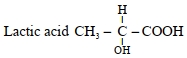
Concentration of calcium lactate \(=0.005\,M ,:\) concentration of lactate ion \(=(2 \times 0.005)\,M\). Calcium lactate is a salt of weak acid \(+\) strong base \(\therefore\) Salt hydrolysis will take place.\(pH =7+\frac{1}{2}( pKa +\log C )\)
\(=7+\frac{1}{2}(5+\log (2 \times 0.005))\)
\(=7+\frac{1}{2}[5-2 \log 10]=7+\frac{1}{2} \times 3=8.5=85 \times 10^{-1}\)
No questions on this page match these filters.
About Equilibrium - II (icon Equilibrium) PYQs
Equilibrium - II (icon Equilibrium) has 128 questions from 2013–2026. The most came in 2023 (19), 2022 (16) and 2021 (16).
The most asked topics are Solubility product, Buffer solution and PH of strong Acids and strong Bases.
10% are easy, 48% medium and 41% hard.
Equilibrium - II (icon Equilibrium) PYQs by year
Frequently asked
How many Equilibrium - II (icon Equilibrium) questions came in JEE Mains?
128 questions from 2013–2026, each with the correct answer and a full solution.
Which Equilibrium - II (icon Equilibrium) topic is asked the most?
Solubility product, with 37 questions, followed by Buffer solution with 20.
Which year had the most Equilibrium - II (icon Equilibrium) questions?
2023, with 19 questions.
How difficult are Equilibrium - II (icon Equilibrium) questions?
10% are easy, 48% medium and 41% hard.