


Questions
Newest firstShowing 1–50 of 86 questions
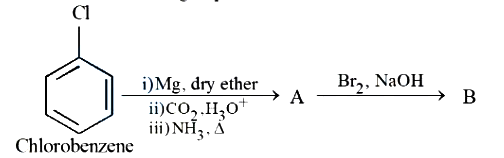
-
- (A) 5
- (B) 8
- (C) 4
- (D) 7
Show answer and solution
Correct Answer: (D)
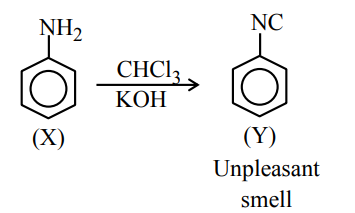
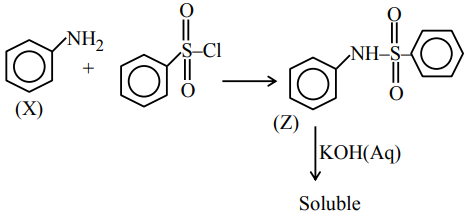
Number of different H atom in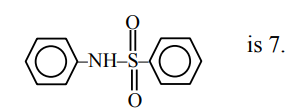
-
- (A) Benzoic acid, benzamide, aniline
- (B) Toluic acid, methylbenzamide, 2-methylaniline
- (C) Benzoic acid, 4-methylbenzamide, 4-methylaniline.
- (D) Phenylethanoic acid, phenylethanamide, benzamine
Show answer and solution
Correct Answer: (A)
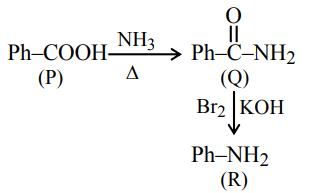
Explanation:
1. Step 1: Formation of Compound (Q)
When a carboxylic acid is treated with aqueous ammonia (\( \text{NH}_3 \)) and heated, it undergoes amidation to form an amide. Here, benzoic acid (\( \text{C}_6\text{H}_5\text{COOH} \), compound P) reacts with ammonia under hot conditions to yield benzamide (\( \text{C}_6\text{H}_5\text{CONH}_2 \), compound Q):
\( \text{C}_6\text{H}_5\text{COOH} + \text{NH}_3 \xrightarrow{\Delta} \text{C}_6\text{H}_5\text{CONH}_2 + \text{H}_2\text{O} \)
2. Step 2: Formation of Compound (R)
When benzamide (Q) is heated with bromine (\( \text{Br}_2 \)) and potassium hydroxide (\( \text{KOH} \)), it undergoes the Hofmann bromamide degradation reaction. This reaction degrades the amide to a primary amine containing one less carbon atom than the parent amide. Thus, benzamide converts into aniline (\( \text{C}_6\text{H}_5\text{NH}_2 ), compound R):
\text{C}_6\text{H}_5\text{CONH}_2 + \text{Br}_2 + 4\text{KOH} \xrightarrow{\Delta} \text{C}_6\text{H}_5\text{NH}_2 + \text{K}_2\text{CO}_3 + 2\text{KBr} + 2\text{H}_2\text{O} \)
3. Molecular Formula Verification:
The molecular formula of aniline (\( \text{C}_6\text{H}_5\text{NH}_2 \)) is gathered as \( \text{C}_6\text{H}_7\text{N} \), which completely matches the molecular formula of the product.
Hence, Option A is the correct choice. -
- (A) \(C < B < A < D\)
- (B) \(D < C < B < A\)
- (C) \(C < D < B < A\)
- (D) \(D < B < A < C\)
Show answer and solution
Correct Answer: (C)
Boiling point depends on the strength of intermolecular forces.
\(n\text{-C}_4\text{H}_{10}\) (C) is a nonpolar alkane with only weak van der Waals forces, resulting in the lowest boiling point.
\(n\text{-C}_4\text{H}_9\text{OH}\) (A) is an alcohol that forms strong intermolecular hydrogen bonds due to the high electronegativity of oxygen, giving it the highest boiling point.
Both \(n\text{-C}_4\text{H}_9\text{NH}_2\) (B) and \(\text{C}_2\text{H}_5\text{NHC}_2\text{H}_5\) (D) are amines and form hydrogen bonds, which are weaker than those in alcohols because nitrogen is less electronegative than oxygen.
Between the primary amine (B) and the secondary amine (D), the primary amine has two \(\text{N-H}\) bonds available for hydrogen bonding and less steric hindrance, leading to stronger intermolecular forces and a higher boiling point than the secondary amine.
The increasing order of boiling points is \(C < D < B < A\).
Answer: \(C < D < B < A\) - 4.
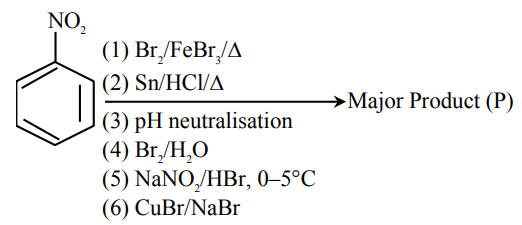
Consider the above sequence of reactions. The number of bromine atom(s) in the final product (P) will be: 2026 Medium- (A) 1
- (B) 6
- (C) 5
- (D) 3
Show answer and solution
Correct Answer: (C)
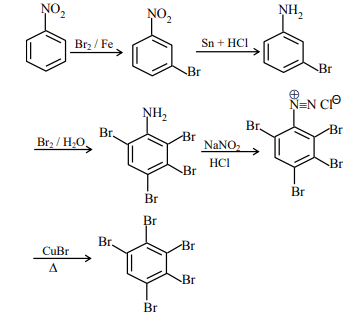
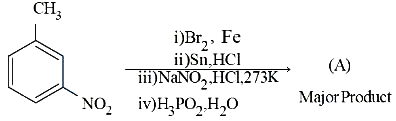
Number of Br atom in major product \(( P )=5\) -
- (A) Benzene
- (B) Phenol
- (C) Propanol
- (D) Chlorobenzene
Show answer and solution
Correct Answer: (A)
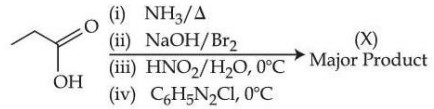
The starting material is propanoic acid (\(CH_3CH_2COOH\)).
In step (i), propanoic acid reacts with \(NH_3\) upon heating to form propanamide.
\(CH_3CH_2COOH \xrightarrow{NH_3, \Delta} CH_3CH_2CONH_2\)
In step (ii), propanamide undergoes Hoffmann bromamide degradation with \(NaOH\) and \(Br_2\) to form ethylamine.
\(CH_3CH_2CONH_2 \xrightarrow{NaOH, Br_2} CH_3CH_2NH_2\)
In step (iii), ethylamine reacts with nitrous acid (\(HNO_2\)) to form an unstable diazonium salt, which hydrolyzes to give ethanol.
\(CH_3CH_2NH_2 \xrightarrow{HNO_2, H_2O} CH_3CH_2OH\)
In step (iv), ethanol reacts with benzenediazonium chloride (\(C_6H_5N_2Cl\)). Ethanol reduces the diazonium salt to benzene, while getting oxidized to ethanal.
\(CH_3CH_2OH + C_6H_5N_2Cl \rightarrow C_6H_6 + CH_3CHO + N_2 + HCl\)
The final major product (X) is benzene.
Answer: Benzene -
- (A) 1
- (B) 2
- (C) 3
- (D) 4
Show answer and solution
Correct Answer: (A)
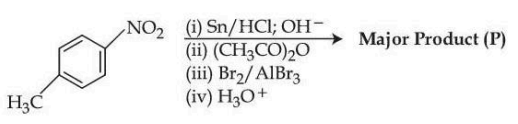
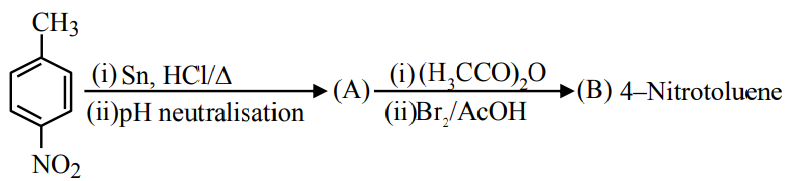
The given reactant is p-nitrotoluene.
Step (i): Reduction with Sn/HCl followed by \(OH^-\) converts the \(-NO_2\) group to an \(-NH_2\) group, yielding p-toluidine.
Step (ii): Reaction with acetic anhydride, \((CH_3CO)_2O\), protects the amino group by forming N-(4-methylphenyl)acetamide.
Step (iii): Bromination with \(Br_2/AlBr_3\) directs the incoming bromine to the ortho position relative to the strongly activating \(-NHCOCH_3\) group (the para position is blocked by the methyl group). This yields 2-bromo-4-methylacetanilide.
Step (iv): Acid hydrolysis with \(H_3O^+\) removes the acetyl group, yielding 2-bromo-4-methylaniline as the major product (P).
The molecular formula of product P (2-bromo-4-methylaniline) is \(C_7H_8NBr\).
Molar mass of P = \((7 \times 12) + (8 \times 1) + 14 + 80 = 186 \text{ g mol}^{-1}\).
In Carius analysis, the bromine in the organic compound is quantitatively converted to silver bromide (AgBr).
Molar mass of AgBr = \(108 + 80 = 188 \text{ g mol}^{-1}\).
Since one molecule of P contains one bromine atom, 1 mole of P produces 1 mole of AgBr.
Moles of P in \(1.0 \text{ g} = \dfrac{1.0}{186} \text{ mol}\).
Moles of AgBr produced = \(\dfrac{1.0}{186} \text{ mol}\).
Mass of AgBr produced = \(\dfrac{1.0}{186} \times 188 \text{ g} \approx 1.01 \text{ g}\).
Rounding to the nearest integer, the mass of the AgBr precipitate is 1 g.
Answer: \(1\) -
- (A) 301
- (B) 146
- (C) 228
- (D) 208
Show answer and solution
Correct Answer: (C)
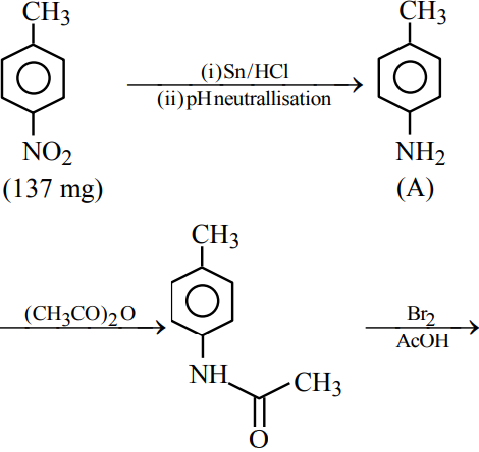
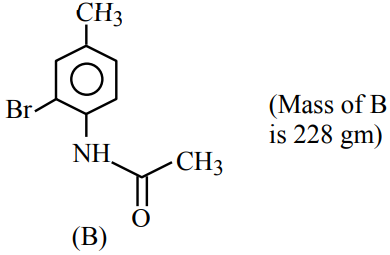
Mole \(=\frac{137 \times 10^{-3}}{137}=0.001 mole\)
Mole of product \(=0.001\) mole
Mass of product \(=0.001 \times 228 gm\)
\(=0.228 gm =228 mg\) -
- (A) 18
- (B) 21
- (C) 24
- (D) 28
Show answer and solution
Correct Answer: (B)
The given starting material is diazoaminobenzene (\(C_6H_5-N=N-NH-C_6H_5\)).
When diazoaminobenzene is treated with an acid catalyst (HCl) and excess aniline, and warmed to \(40-45^\circ \text{C}\), it undergoes a rearrangement reaction (or dissociation followed by coupling) to form \(p\)-aminoazobenzene.
The reaction sequence is as follows:
1. Diazoaminobenzene reacts with HCl to form benzenediazonium chloride and aniline.
2. The benzenediazonium ion then couples with the excess aniline at the para position to yield \(p\)-aminoazobenzene.
3. Cooling and adding acetic acid helps in precipitating the free base, \(p\)-aminoazobenzene, which is a yellow dye (often called Aniline Yellow).
The structure of the yellow product (X), \(p\)-aminoazobenzene, is \(C_6H_5-N=N-C_6H_4-NH_2\).
The molecular formula of \(p\)-aminoazobenzene is \(C_{12}H_{11}N_3\).
Let's calculate its molar mass:
Molar mass \(= (12 \times 12) + (11 \times 1) + (3 \times 14)\)
Molar mass \(= 144 + 11 + 42 = 197 \text{ g mol}^{-1}\)
The mass of nitrogen in one mole of the compound is \(3 \times 14 = 42 \text{ g}\).
The percentage of nitrogen in the product is:
\(\% \text{ N} = \dfrac{42}{197} \times 100 \approx 21.32\%\)
Rounding to the nearest integer, we get \(21\).
Answer: \(21\) -
- (A) Both Statement I and Statement II are false
- (B) Statement I is true but Statement II is false
- (C) Both Statement I and Statement II are true
- (D) Statement I is false but Statement II is true
Show answer and solution
Correct Answer: (C)
Statement-I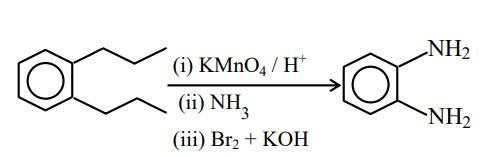
Statement-II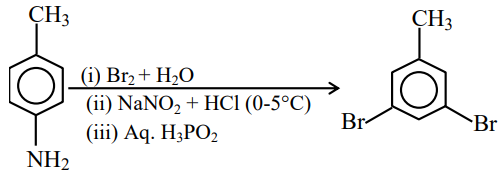
Both statement (I) and (II) are true. -
- (A) Both Statement I and Statement II are true
- (B) Both Statement I and Statement II are false
- (C) Statement I is true but Statement II is false
- (D) Statement I is false but Statement II is true
Show answer and solution
Correct Answer: (D)
Statement I describes the Hoffmann bromamide degradation reaction. When benzamide (\(C_6H_5CONH_2\)) is heated with bromine in an ethanolic solution of sodium hydroxide, it produces aniline (\(C_6H_5NH_2\)), not benzylamine. Thus, Statement I is false.
Statement II describes the nitration of aniline. Direct nitration of aniline with \(HNO_3/H_2SO_4\) yields a mixture of \(p\)-nitroaniline (\(51\%\)), \(m\)-nitroaniline (\(47\%\)), and \(o\)-nitroaniline (\(2\%\)). The significant formation of the meta derivative is due to the protonation of aniline in the strongly acidic medium to form the anilinium ion, which is meta-directing. Since \(47\% > 2\%\), \(m\)-nitroaniline is produced in a higher amount than \(o\)-nitroaniline. Thus, Statement II is true.
Answer: Statement I is false but Statement II is true -
- (A) Both Statement I and Statement II are false
- (B) Both Statement I and Statement II are true
- (C) Statement I is true but Statement II is false
- (D) Statement I is false but Statement II is true
Show answer and solution
Correct Answer: (D)
Statement I: False
\(R - NC \xrightarrow{ H _3 O ^{+}} R - NH _2+ HCOOH\)
Statement II: True
\(R - CN \xrightarrow{ H _3 O ^{+}} RCOOH \xrightarrow{ SOCl _2} RCOCl\)
\(\xrightarrow{ NH _3} RCONH _2 \xrightarrow{ NaOCl / OH ^{-}} RNH _2\)
\(\xrightarrow{ CHCl _3+ KOH } R - NC\) - 12. Identify the incorrect statements.
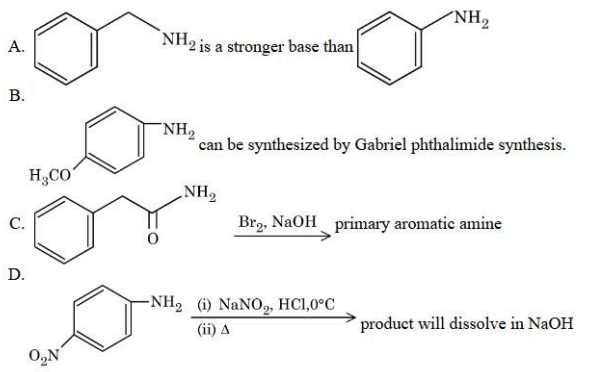
Choose the correct answer from the options given below: 2026 Hard- (A) A and D Only
- (B) A and C Only
- (C) B and C Only
- (D) A and B Only
Show answer and solution
Correct Answer: (C)
Statement A: In benzylamine (\(C_6H_5CH_2NH_2\)), the lone pair of electrons on the nitrogen atom is localized and not involved in resonance. In aniline (\(C_6H_5NH_2\)), the lone pair is delocalized over the benzene ring. Hence, benzylamine is a stronger base than aniline. Statement A is correct.
Statement B: Gabriel phthalimide synthesis involves the nucleophilic substitution (\(S_N2\)) of an alkyl halide by the phthalimide anion. Aryl halides do not undergo nucleophilic substitution easily due to the partial double bond character of the C-X bond. Therefore, primary aromatic amines (like p-methoxyaniline) cannot be synthesized by this method. Statement B is incorrect.
Statement C: The reaction of 2-phenylacetamide (\(C_6H_5CH_2CONH_2\)) with \(Br_2\) and \(NaOH\) is the Hoffmann bromamide degradation, which yields benzylamine (\(C_6H_5CH_2NH_2\)). Benzylamine is a primary aliphatic (aralkyl) amine, not a primary aromatic amine (where the \(-NH_2\) group must be directly attached to the benzene ring). Statement C is incorrect.
Statement D: p-Nitroaniline undergoes diazotization with \(NaNO_2\) and \(HCl\) at \(0^\circ C\) to form p-nitrobenzenediazonium chloride. Heating this aqueous solution (\(\Delta\)) yields p-nitrophenol. Since p-nitrophenol is acidic, it dissolves in aqueous \(NaOH\) to form a soluble sodium salt. Statement D is correct.
The incorrect statements are B and C.
Answer: B and C Only -
- (A) 1-Bromo-4-nitrobenzene
- (B) 1, 3, 5-Tribromo-2-nitrobenzene
- (C) 4-Bromo-1-nitrobenzene
- (D) 1, 3, 5-Tribromobenzene
Show answer and solution
Correct Answer: (B)
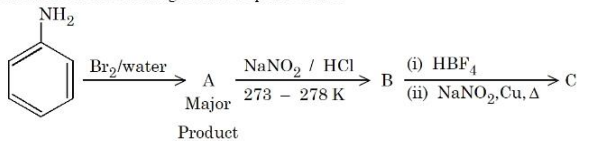
Aniline on reaction with bromine water gives 2,4,6-tribromoaniline (A) as the major product due to the strong activating nature of the \(-\text{NH}_2\) group.
Reaction of (A) with \(\text{NaNO}_2/\text{HCl}\) at \(273-278\text{ K}\) (diazotization) yields 2,4,6-tribromobenzenediazonium chloride (B).
Treatment of (B) with \(\text{HBF}_4\) forms 2,4,6-tribromobenzenediazonium fluoroborate. Heating this intermediate with \(\text{NaNO}_2\) and \(\text{Cu}\) replaces the diazonium group with a nitro group, forming 2,4,6-tribromonitrobenzene (C).
To assign the IUPAC name, we number the ring to give the lowest locant set to the substituents. The set (1, 2, 3, 5) is lower than (1, 2, 4, 6). Therefore, the nitro group is at position 2, and the bromo groups are at positions 1, 3, and 5. The correct IUPAC name is 1,3,5-tribromo-2-nitrobenzene.
Answer: 1, 3, 5-Tribromo-2-nitrobenzene -
- (A) A > B > C > D
- (B) C > D > B > A
- (C) A > C > D > B
- (D) C > A > D > B
Show answer and solution
Correct Answer: (C)
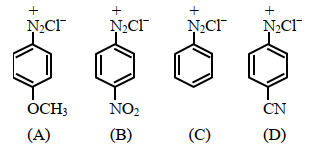
Correct order of stability
\(\underset {+M} {A} > C > \underset {-M} {D} > \underset {-M} {B} \)
EDG increases stability
EWG decreases stability -
- (A) 8
- (B) 10
- (C) 12
- (D) 15
Show answer and solution
Correct Answer: (B)
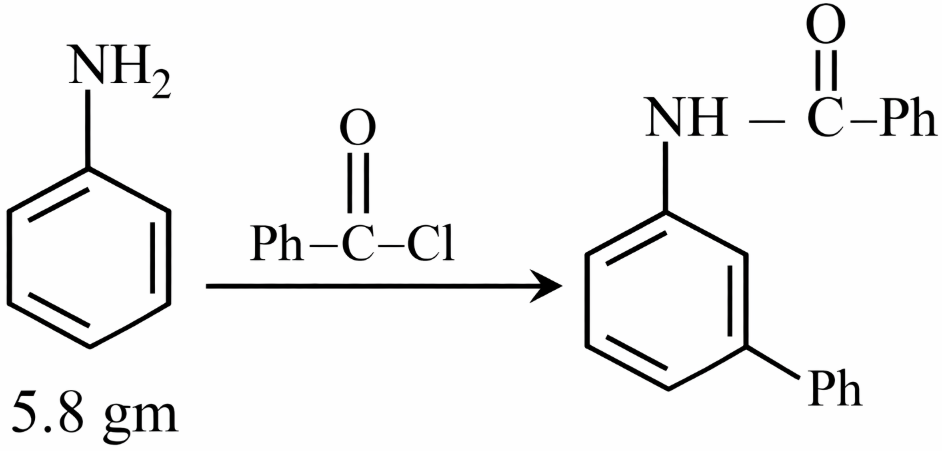
\(n=\frac{5.8}{93}\)
\(n=0.0623\)
\(n =0.0623 \times \frac{82}{100}\)
\(mass =0.051 \times 197\)
\(mass =10.047\) -
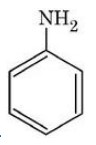
- (A) aniline
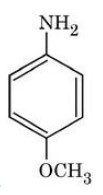
- (B) \(4\)-methoxyaniline
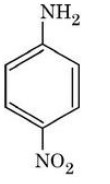
- (C) \(4\)-nitroaniline
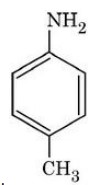
- (D) \(4\)-methylaniline (p-toluidine)
Show answer and solution
Correct Answer: (C)
The strength of a conjugate acid is inversely proportional to the basic strength of its corresponding base. Thus, the weakest base will form the strongest conjugate acid.
The basicity of anilines depends on the availability of the lone pair on the nitrogen atom. Electron-withdrawing groups decrease basicity by withdrawing electron density, while electron-donating groups increase basicity.
In \(4\)-nitroaniline, the \(-\text{NO}_2\) group is a strong electron-withdrawing group due to its \(-R\) and \(-I\) effects. This strongly delocalizes the lone pair of electrons on the nitrogen atom, making \(4\)-nitroaniline the weakest base among the given options.
In contrast, \(-\text{OCH}_3\) (\(+R\) effect) and \(-\text{CH}_3\) (\(+I\) and hyperconjugation) are electron-donating groups that increase basicity, making \(4\)-methoxyaniline and \(4\)-methylaniline stronger bases than aniline.
Since \(4\)-nitroaniline is the weakest base, its conjugate acid is the strongest.
Answer: \(4\)-nitroaniline - (A) aniline
-
- (A) 90
- (B) 93
- (C) 96
- (D) 99
Show answer and solution
Correct Answer: (B)
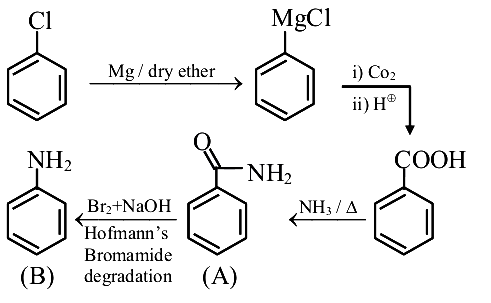
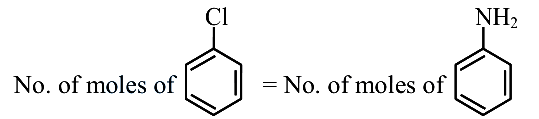
\(\begin{aligned} & \frac{11.25 \times 10^{-3}}{112.5}=\frac{x \times 10^{-1} \times 10^{-3}}{93} \\ & x \times 10^{-1}=93 \times 0.1 \\ & x=93 \mathrm{mg}\end{aligned}\) - 18. Consider the following sequence of reactions :
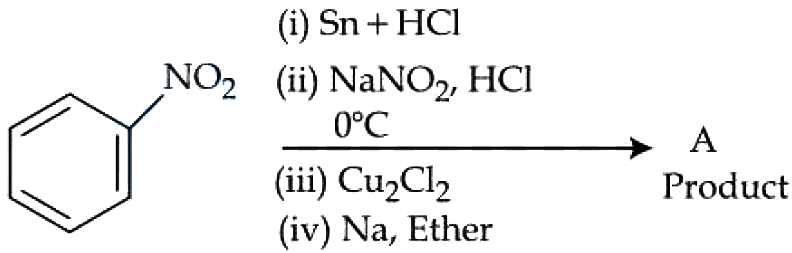
Molar mass of the product formed (A) is _______ \(\mathrm{g} \mathrm{mol}^{-1}\). 2025 Medium- (A) 151
- (B) 152
- (C) 153
- (D) 154
Show answer and solution
Correct Answer: (D)
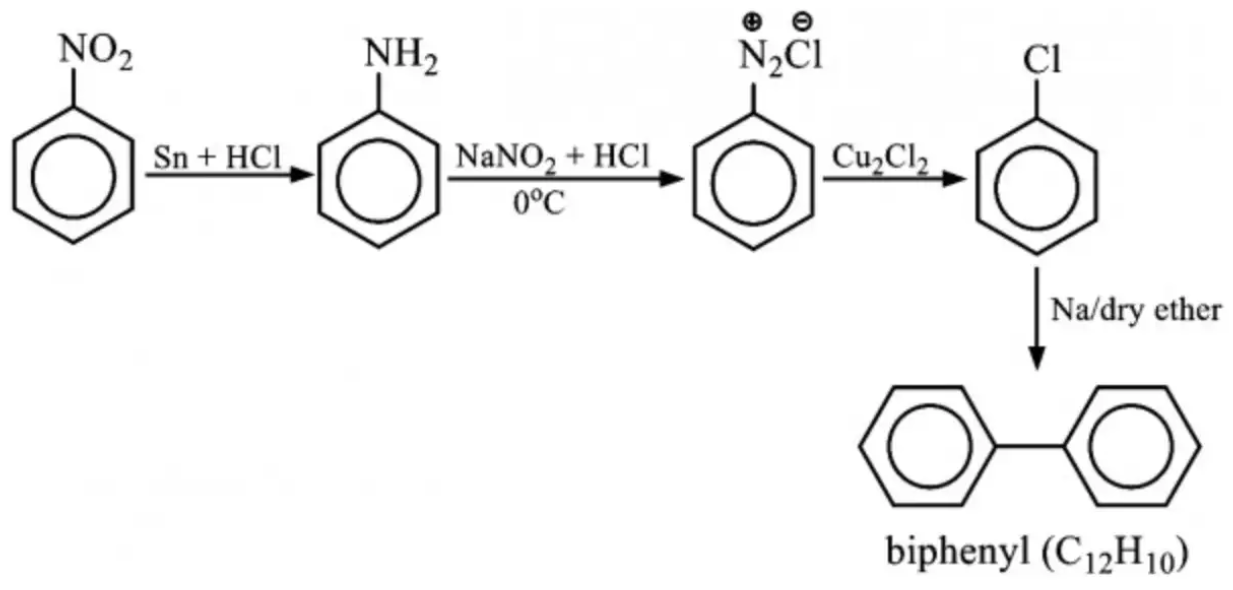
Molar mass \(=120 \times 12+10 \times 1=154\) -
- (A) 141
- (B) 161
- (C) 171
- (D) 181
Show answer and solution
Correct Answer: (C)
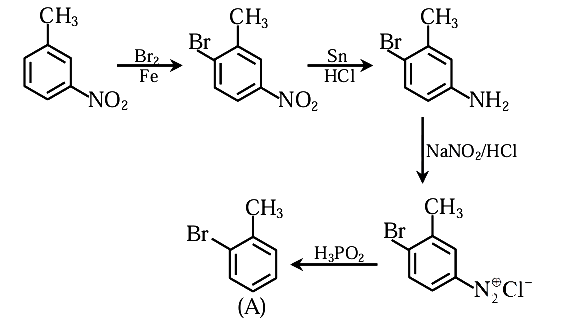
Molar mass of product \(\left(\mathrm{C}_7 \mathrm{H}_7 \mathrm{Br}\right)(\mathrm{A})\) is \(171 \mathrm{~g} \mathrm{~mol}^{-1}\) -
- (A) Statement I is incorrect but Statement II is correct
- (B) Both Statement I and Statement II are correct
- (C) Statement I is correct but Statement II is incorrect
- (D) Both Statement I and Statement II are incorrect
Show answer and solution
Correct Answer: (C)
\(\mathrm{CH}_3-\mathrm{C} \equiv \mathrm{CH}+\mathrm{Na} \rightarrow \mathrm{CH}_3-\mathrm{C} \equiv \mathrm{C}^{-} \mathrm{Na}^{+}+\frac{1}{2} \mathrm{H}_2\)
Statement-l is correct.
Moles of \(\mathrm{C}_3 \mathrm{H}_4=\frac{4}{40}=0.1\) mole
\(\mathrm{CH}_3-\mathrm{C} \equiv \mathrm{CH}+\mathrm{NaNH}_2 \rightarrow \mathrm{CH}_3-\mathrm{C} \equiv \mathrm{C}^{-} \mathrm{Na}^{+}+\mathrm{NH}_3\)
0.1 mole
0.1 mole
Volume of \(\mathrm{NH}_3=(0.1)(22.4)=2.24 \mathrm{~L}\)
Statement-II is incorrect. -
- (A) Statement I is incorrect but Statement II is correct
- (B) Statement I is correct but Statement II is incorrect
- (C) Both Statement I and Statement II are correct
- (D) Both Statement I and Statement II are incorrect
Show answer and solution
Correct Answer: (C)
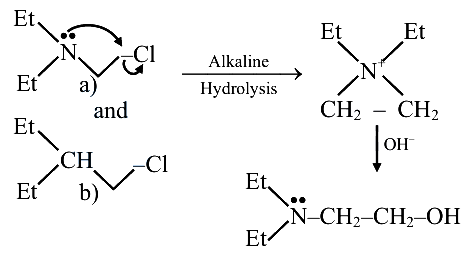
Rate of (a) is faster than rate of (b) because it is a intramolecular substitution. -
- (A) 20
- (B) 40
- (C) 60
- (D) 80
Show answer and solution
Correct Answer: (C)
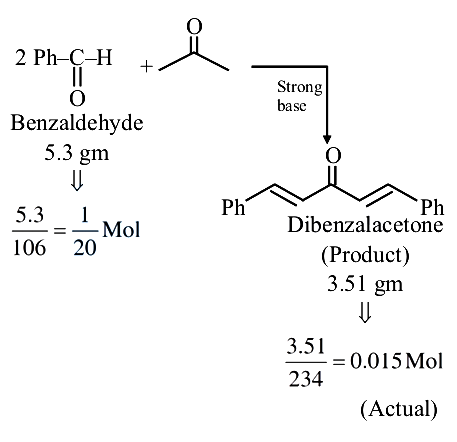
\(\begin{aligned} & \text { Theoretical }=\frac{1}{40} \mathrm{Mol} \\ & \% \text { yield }=\frac{0.015}{1 / 40} \times 100 \\ & \Rightarrow 60 \%\end{aligned}\) -
- (A) \(\mathrm{NH}_3 \lt \mathrm{H}_2 \mathrm{~N}-\mathrm{NH}_2 \lt \left(\mathrm{CH}_3 \mathrm{CH}_2\right)_3 \mathrm{~N} \lt \) \(\mathrm{CH}_3 \mathrm{CH}_2 \mathrm{NH}_2 \lt \left(\mathrm{CH}_3 \mathrm{CH}_2\right)_2 \mathrm{NH}\)
- (B) \(\mathrm{NH}_3 \lt \mathrm{H}_2 \mathrm{~N}-\mathrm{NH}_2 \lt \mathrm{CH}_3 \mathrm{CH}_2 \mathrm{NH}_2 \lt \) \(\left(\mathrm{CH}_3 \mathrm{CH}_2\right)_2 \mathrm{NH} \lt \left(\mathrm{CH}_3 \mathrm{CH}_2\right)_3 \mathrm{~N}\)
- (C) \(\mathrm{H}_2 \mathrm{~N}-\mathrm{NH}_2 \lt \mathrm{NH}_3 \lt \left(\mathrm{CH}_3 \mathrm{CH}_2\right)_3 \mathrm{~N} \lt \) \(\mathrm{CH}_3 \mathrm{CH}_2 \mathrm{NH}_2 \lt \left(\mathrm{CH}_3 \mathrm{CH}_2\right)_2 \mathrm{NH}\)
- (D) \(\mathrm{NH}_2-\mathrm{NH}_2 \lt \mathrm{NH}_3 \lt \mathrm{CH}_3 \mathrm{CH}_2 \mathrm{NH}_2 \lt \) \(\left(\mathrm{CH}_3 \mathrm{CH}_2\right)_3 \mathrm{~N} \lt \left(\mathrm{CH}_3 \mathrm{CH}_2\right)_2 \mathrm{NH}\)
Show answer and solution
Correct Answer: (D)
Basic strength of amine depends on hydrogen bonding and electronic inductive effect.
\(\mathrm{NH}(\mathrm{Et})_2 \gt \mathrm{N}(\mathrm{Et})_3 \gt \mathrm{NH}_2 \mathrm{Et} \gt \mathrm{\stackrel{\cdot \cdot}{N}H}_3 \gt \mathrm{NH}_2-\mathrm{NH}_2\) - 24. The descending order of basicity of following amines is _______.
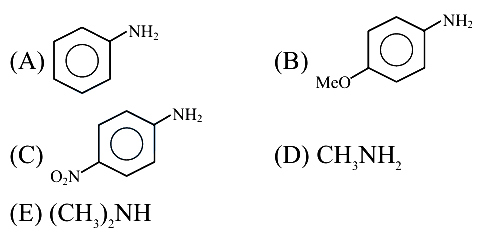
Choose the correct answer from the options given below : 2025 Hard- (A) \(\mathrm{B} \gt \mathrm{E} \gt \mathrm{D} \gt \mathrm{A} \gt \mathrm{C}\)
- (B) \(\mathrm{E} \gt \mathrm{D} \gt \mathrm{B} \gt \mathrm{A} \gt \mathrm{C}\)
- (C) \(\mathrm{E} \gt \mathrm{D} \gt \mathrm{A} \gt \mathrm{B} \gt \mathrm{C}\)
- (D) \(\mathrm{E} \gt \mathrm{A} \gt \mathrm{D} \gt \mathrm{C} \gt \mathrm{B}\)
Show answer and solution
Correct Answer: (B)
\(\mathrm{E} \gt \mathrm{D} \gt \mathrm{B} \gt \mathrm{A} \gt \mathrm{C}\)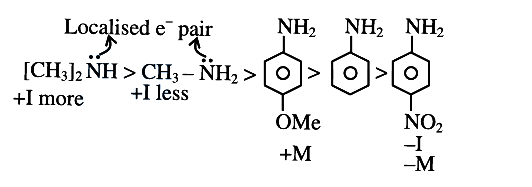
-
- (A) 343
- (B) 330
- (C) 33
- (D) 66
Show answer and solution
Correct Answer: (C)
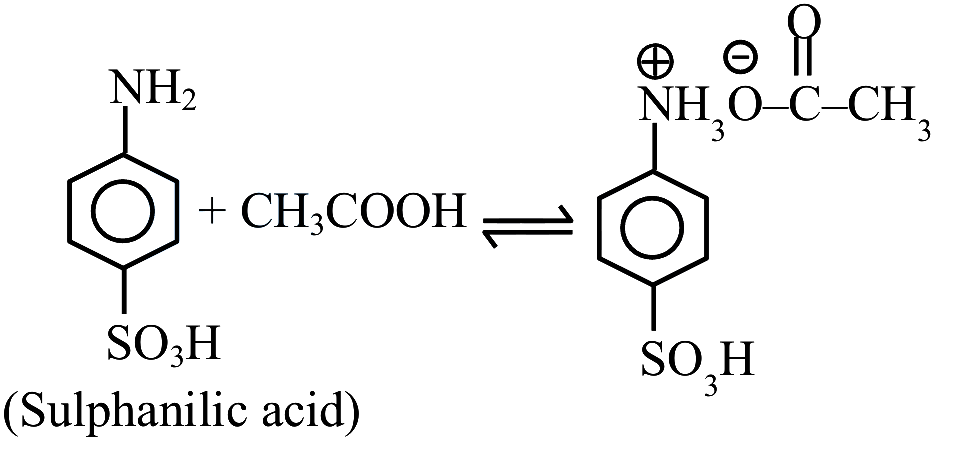
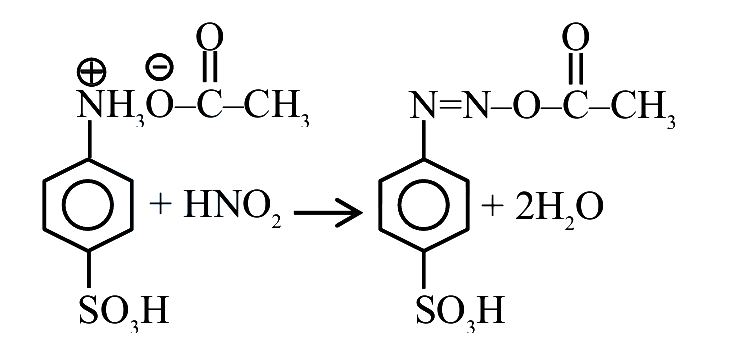
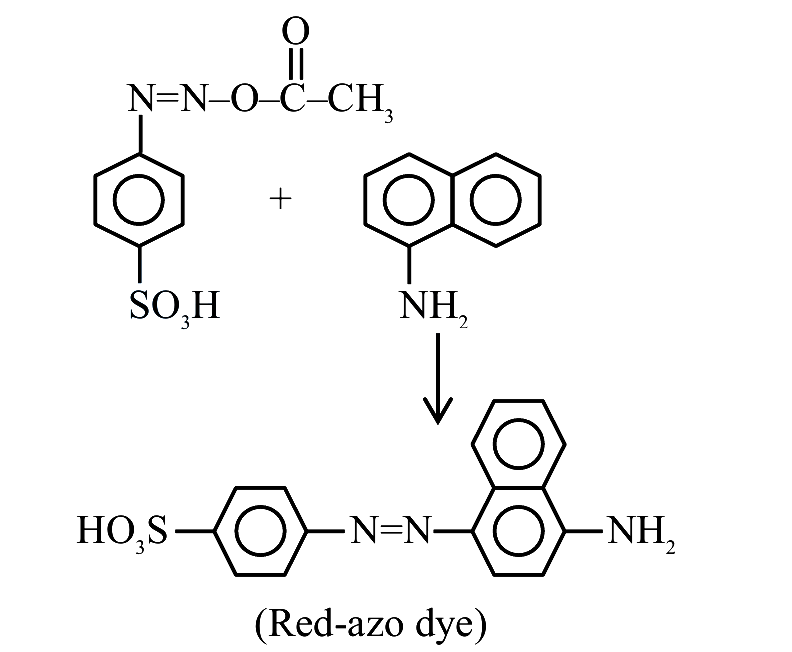
0.1 mole of red-azo dye \((\) Molar Mass \(=327 \mathrm{gm} / \mathrm{mol})\) will have 32.7 gm mass. Nearly 33 gm. - 26. Which among the following react with Hinsberg's reagent?
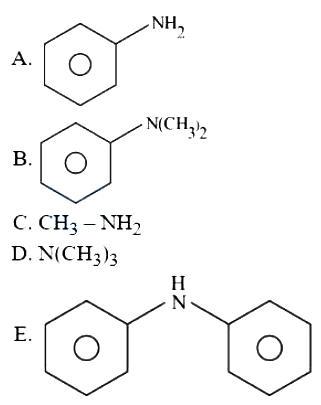
Choose the correct answer from the options given below: 2025 Easy- (A) A, B and E Only
- (B) A, C and E Only
- (C) C and D Only
- (D) B and D Only
Show answer and solution
Correct Answer: (B)
B and D are \(3^{\circ}\) amine which does not have replaceable H on N , So does not react. -
- (A) 1
- (B) 2
- (C) 3
- (D) 4
Show answer and solution
Correct Answer: (C)
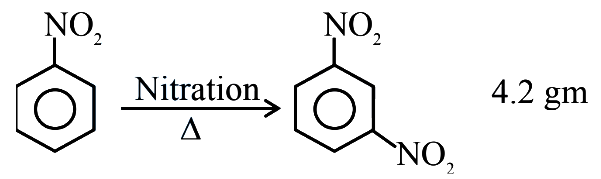
\(\begin{array}{ll}\mathrm{C}_6 \mathrm{H}_5 \mathrm{NO}_2 & \mathrm{MF}=\mathrm{C}_6 \mathrm{H}_4 \mathrm{~N}_2 \mathrm{O}_4 \\ \mathrm{MW}=123 & \mathrm{MW}=168 \\ & \therefore \frac{4.2}{168}=0.025 \mathrm{~mol}\end{array}\)
\(\because\) required gm of nitro benzene
\(\begin{aligned}
& =123 \times 0.025 \\
& =3.075
\end{aligned}\)
\(\therefore\) Nearest integer is 3 -
- (A) \(135\)
- (B) \(136\)
- (C) \(132\)
- (D) \(147\)
Show answer and solution
Correct Answer: (A)
\( \mathrm{n}_{\text {Acetan ilide }}=\mathrm{n}_{\text {Aniline }} \)\( \Rightarrow \frac{\mathrm{m}}{135}=\frac{9.3}{93} \)
\( \Rightarrow \mathrm{m}=13.5 \mathrm{~g}\)

-
- (A) \(70\)
- (B) \(80\)
- (C) \(90\)
- (D) \(100\)
Show answer and solution
Correct Answer: (B)
\(93 \mathrm{~g}\) of aniline produces \(330 \mathrm{~g}\) of \(2,4,6-\) tribromoaniline. Hence \(9.3 \mathrm{~g}\) of aniline should produce \(33 \mathrm{~g}\) of \(2, 4, 6-\)tribromoaniline. Hence percentage yield \(\frac{26.4 \times 100}{33}=80 \%\)
-
- (A) \(20\)
- (B) \(25\)
- (C) \(30\)
- (D) \(35\)
Show answer and solution
Correct Answer: (A)
Reaction suggests that \(1\) mole of aniline give \(1\) mole of orange dye.\(\text { so }(\mathrm{mol})_{\text {aniline }}=(\mathrm{mole})_{\text {orange dye }}\)
\(\frac{9.3 \mathrm{~g}}{93 \mathrm{~g} \mathrm{~mol}^{-1}}=\frac{\text { mass of orange dye }}{199 \mathrm{~g} \mathrm{~mol}^{-1}}\)
\(\text { mass of orange dye }=19.9 \mathrm{~g} \simeq 20 \mathrm{~g}\)

-
- (A) \(10\)
- (B) \(11\)
- (C) \(2\)
- (D) \(4\)
Show answer and solution
Correct Answer: (C)
ImageGain in molecular weight after acylation with one \(-\mathrm{NH}_2\) group is 42 .
Total increase in molecular weight \(=84\)
\(\therefore\) Number of amino group in \(\mathrm{x}=\frac{84}{42}=2\)

-
- (A) Pyrrole \(>\) Piperidine \(>\) Pyridine
- (B) Pyrrole \(>\) Pyridine \(>\) Piperidine
- (C) Pyridine \(>\) Piperidine \(>\) Pyrrole
- (D) Piperidine \(>\) Pyridine \(>\) Pyrrole
Show answer and solution
Correct Answer: (D)
\(N\left(s p^3\right.\), localized lone pair \()>N\left(s p^2\right.\), localized lone pair \()>N\left(s p^2\right.\), delocalized lone pair, aromatic)
\(\therefore\) Piperidine > Pyridine > Pyrrole - 33. From \(6.55 \mathrm{~g}\) of aniline, the maximum amount of acetanilide that can be prepared will be _______ \(\times 10^{-1} \mathrm{~g}\). 2024 Medium
- (A) \(90\)
- (B) \(96\)
- (C) \(97\)
- (D) \(95\)
Show answer and solution
Correct Answer: (D)
\(93 \mathrm{~g}\) aniline form \(135 \mathrm{gm}\) acetanlideso \(6.55 \mathrm{~g}\) anilne form \(\frac{135}{93} \times 6.55=9.5\)
\(95 \times 10^1\)
-
- (A) Statement I is false but Statement II is true
- (B) Statement I is true but Statement II is false
- (C) Both Statement I and Statement II are true
- (D) Both Statement I and Statement II are false
Show answer and solution
Correct Answer: (D)
P - tolenesulfonyl chloride is Heisenberg reagent.
⇒ gives reaction with Primary and secondary amines not with tertiary.
⇒ Product of \(1^{\circ}\) Amine ⇒ Soluble in Base (NaOH)
Product of \(2^{\circ}\) Amine ⇒ Soluble in acid \(( HCl )\) -
- (A) Both Statement \(I\) and Statement \(II\) are correct
- (B) Both Statement \(I\) and Statement \(II\) are incorrect
- (C) Statement \(I\) is incorrect but Statement \(II\) is correct
- (D) Statement \(I\) is correct but Statement \(II\) is incorrect
Show answer and solution
Correct Answer: (A)
The \(\mathrm{NH}_2\) group in Aniline is ortho and para directing and a powerful activating group as \(\mathrm{NH}_2\) has strong \(+\mathrm{M}\) effect.Aniline does not undergo Friedel-Craft's reaction (alkylation and acylation) as Aniline will form complex with \(\mathrm{AlCl}_3\) which will deactivate the benzene ring.
-
- (A) \(8\)
- (B) \(5\)
- (C) \(3\)
- (D) \(4\)
Show answer and solution
Correct Answer: (D)
Compounds which can not undergo Friedel Crafts reaction are\(Image\)

-
- (A) \(39\)
- (B) \(40\)
- (C) \(45\)
- (D) \(50\)
Show answer and solution
Correct Answer: (C)
\(\underset{\substack{\text { Mol..wt.45g }}}{\mathrm{CH}_3 \mathrm{CH}_2 \mathrm{NH}_2} \xrightarrow{\mathrm{N}_2 \mathrm{NO}_2+\mathrm{HCl}} \xrightarrow{\mathrm{H}_2 \mathrm{O}} \mathrm{CH}_3 \mathrm{CH}_2-\mathrm{OH}+\underset{14 \mathrm{~g}}{\mathrm{~N}_2}\)given: \(\mathrm{N}_2\) evolved is \(2.24 \mathrm{~L}\) i.e. \(0.1 \mathrm{~mole}\).
1.e. \(\mathrm{CH}_3 \mathrm{CH}_2 \mathrm{NH}_2\) (ethyl amine) will be \(4.5 \mathrm{~g}\)
\((=0.1 \mathrm{~mole})\)
Hence the answer \(=45 \times 10^{-1} \mathrm{~g}\)
- 38. Following tetrapeptide can be represented as \(( F , L , D , Y , I , Q , P\) are one letter codes for amino acids)
 2023 Hard
- (A) \(FIQY\)
- (B) \(FLDY\)
- (C) \(YQLF\)
- (D) \(PLDY\)
Show answer and solution
Correct Answer: (B)
Hydrolysis of the given tetrapeptide will give the following:
-
- (A) Both Statement \(I\) and Statement \(II\) are incorrect
- (B) Both Statement \(I\) and Statement \(II\) are correct
- (C) Statement \(I\) is correct but Statement \(II\) is incorrect
- (D) Statement \(I\) is incorrect but Statement \(II\) is correct
Show answer and solution
Correct Answer: (C)
Statement \(-1\) is (True)Pure aniline is colourless liquid
Statement \(-2\) is (False)
Aniline becomes dark brown due to action of air and light [oxidation]
- 40. The correct order in aqueous medium of basic strength in case of methyl substituted amines is : 2023 Medium
- (A) \(Me _2 NH > MeNH _2 > Me _3 N > NH _3\)
- (B) \(Me _2 NH > Me _3 N > MeNH _2 > NH _3\)
- (C) \(NH _3 > Me _3 N > MeNH _2 > Me _2 NH\)
- (D) \(Me _3 N > Me _2 NH > MeNH _2 > NH _3\)
Show answer and solution
Correct Answer: (A)
In aqueous medium basic strength is dependent on electron density on nitrogen as well as solvation of cation formed after accepting \(H ^{+}\). After considering all these factors overall basic strength order is\(Me _2 NH > MeNH _2 > Me _3 N > NH _3\)
-
- (A) The electrophile involved in the reaction is \(NO ^{+}\)
- (B) ' \(B\) ' is N-nitroso ammonium compound
- (C) The reaction occurs at low temperature
- (D) The product ' \(B\) ' formed in the above reaction is p-nitroso compound at low temperature
Show answer and solution
Correct Answer: (B)
\(NaNO _2+ HX \rightarrow HNO _2+ NaX\)\(P -\) Nitroso product

-
- (A) nitrile
- (B) alcohol
- (C) diazonium salt
- (D) secondary amine
Show answer and solution
Correct Answer: (B)
\(R - NH _{2} \underset{+HCl}{\stackrel{NaNO _{2}}{\longrightarrow}} R - N _{2}^{+} \rightarrow R ^{+} \underset{ H _{2} O }{\longrightarrow} R - OH\) -
- (A) \(63\)
- (B) \(90\)
- (C) \(104\)
- (D) \(142\)
Show answer and solution
Correct Answer: (D)
\(M.P.\) \(142^{\circ} C\)
-
- (A) Both \((A)\) and \((R)\) are true and \((R)\) is the correct explanation of \((A)\).
- (B) Both \((A)\) and \((R)\) are true but \((R)\) is not the correct explanation of \((A)\).
- (C) \((A)\) is true, but \((R)\) is false.
- (D) \((A)\) is false, but \((R)\) is true.
Show answer and solution
Correct Answer: (C)
Friedel Craft Alkylation does not occur on this deactivated ring.
-
- (A) Both \(A\) and \(R\) are true and \(R\) is the correct explanation of \(A\)
- (B) Both \(A\) and \(R\) are true but \(R\) is \(NOT\) the correct explanation of \(A\)
- (C) \(A\) is true but \(R\) is false.
- (D) \(A\) is false but \(R\) is true.
Show answer and solution
Correct Answer: (A)
Due to formation of anilinium ion in acidic medium meta product is also obtained in significant amount.
-
- (A) \(A-IV, B-III, C-II, D-I\)
- (B) \(A-IV, B-II, C-I, D-III\)
- (C) \(A-III, B-IV, C-I, D-II\)
- (D) \(A-IV, B-III, C-I, D-II\)
Show answer and solution
Correct Answer: (C)
Benzen sulphonyl chloride\((B)\) Hoffmann bromamide reaction \(\rightarrow\) known reaction of isocynates
\(R - CO - NH _{2}+ X _{2}+4 NaOH \rightarrow R - NH _{2}+\)
\(2 NaX + Na _{2} CO _{3}+2 H _{2} O\)
Intermediate : \(R - N = C = O\) (isocyanate)
\((C)\) Carbylamine reaction \(\rightarrow\) Test for primary amine
\(R - NH _{2}\) or \(Ar - NH _{2}+ CHCl _{3}+3 KOH \rightarrow RNC\) or \(Ar - NC +3 KCl +3 H _{2} O\)
\((D)\) Hoffmann orientation \(\rightarrow\) Anti saytzeff (Formation of less substituted alkene as major product)

-
- (A) \(( A ) > ( B ) > ( C ) > ( D )\)
- (B) \(( A ) > ( C ) > ( D ) > ( B )\)
- (C) \(( C ) > ( A ) > ( D ) > ( B )\)
- (D) \(( C ) > ( D ) > ( B ) > ( A )\)
Show answer and solution
Correct Answer: (B)
Since diazonium ion is a cation hence it is stabilized by electron donating groups and destabilized by electron withdrawing group.Hence Stability order should be \(A > C > D > B\). -
- (A) \(221\)
- (B) \(243\)
- (C) \(222\)
- (D) \(313\)
Show answer and solution
Correct Answer: (B)
\(M=98\quad \quad \quad \quad \quad\quad \quad \quad \quad \quad M=135\)\(C _{6} H _{5} NH _{2}\) \(\xrightarrow{{90\,\% \,efficiency}}\) \(\begin{array}{*{20}{c}} {\,\,\,\,\,\,\,\,\,\,\,\,\,\,\,\,\,\,\,\,\,O} \\ {\,\,\,\,\,\,\,\,\,\,\,\,\,\,\,\,\,\,\,\,\,||} \\ {{C_6}{H_5} - NH - C - C{H_3}} \end{array}\)
(Aniline)\(\quad \quad \quad \quad \quad\quad \quad \quad\) (Acetanilide)
Given \(1.86 \,g\)
\(\Rightarrow\) \(1\, mol\) \(C _{6} H _{5} NH _{2}\) give \(1\, mol\) \(\begin{array}{*{20}{c}} {\,\,\,\,\,\,\,\,\,\,\,\,\,\,\,\,\,\,\,\,\,O} \\ {\,\,\,\,\,\,\,\,\,\,\,\,\,\,\,\,\,\,\,\,\,||} \\ {{C_6}{H_5} - NH - C - C{H_3}} \end{array}\)
\(\therefore\) moles of \(C _{6} H _{5} NH _{2}=\) moles of \(C _{6} H _{5} NH _{2}\) give \(1\, mol\) \(\begin{array}{*{20}{c}} {\,\,\,\,\,\,\,\,\,\,\,\,\,\,\,\,\,\,\,\,\,O} \\ {\,\,\,\,\,\,\,\,\,\,\,\,\,\,\,\,\,\,\,\,\,||} \\ {{C_6}{H_5} - NH - C - C{H_3}} \end{array}\)
\(\Rightarrow \frac{1.86}{93}=\frac{ W _{\text {acetanilide }}}{135}\)
\(\Rightarrow W_{\text {acelanilide }}=\frac{1.86 \times 135}{93}\, g =2.70\, g\)
But efficiency of reaction is \(90\, \%\) only
\(\therefore\) Mass of acetanilide produced \(=2.70 \times \frac{90}{100} \,g\)
\(=2.43\, g\)
\(=243 \times 10^{-2}\, g\)
\(\Rightarrow x =243\)
-
- (A) \(A > C > B > D\)
- (B) \(D > C > B > A\)
- (C) \(D > B > C > A\)
- (D) \(A > B > C > D\)
Show answer and solution
Correct Answer: (D)
\(B.S.\) order \(( A ) > ( B ) > ( C ) > ( D )\)
-
- (A) to remove basic impurities
- (B) to activate \(NH _{3}\) used in the reaction
- (C) to remove acidic impurities
- (D) to increase the reactivity of alkyl halide
Show answer and solution
Correct Answer: (C)
So the purpose of \(NaOH\) in the above reactions in to remove acidic impurities.

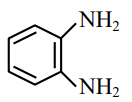 can be synthesized from
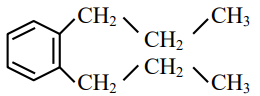 using simpler reagents in the order i) Acidic \(KMnO _4\), ii) Ammonia, iii) Bromine and alkali
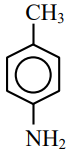 can be converted into
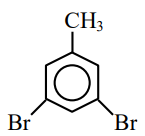 using reagents in the order (i) Bromine- \(H _2 O\) (ii) \(NaNO _2 / HCl \left(0-5^{\circ} C \right)\) (iii) aq. \(H _3 PO _2\).
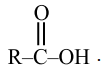
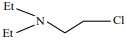 will undergo alkaline hydrolysis at a faster rate than
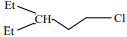
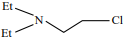 substitution takes place first by involving lone pair of electrons on nitrogen.
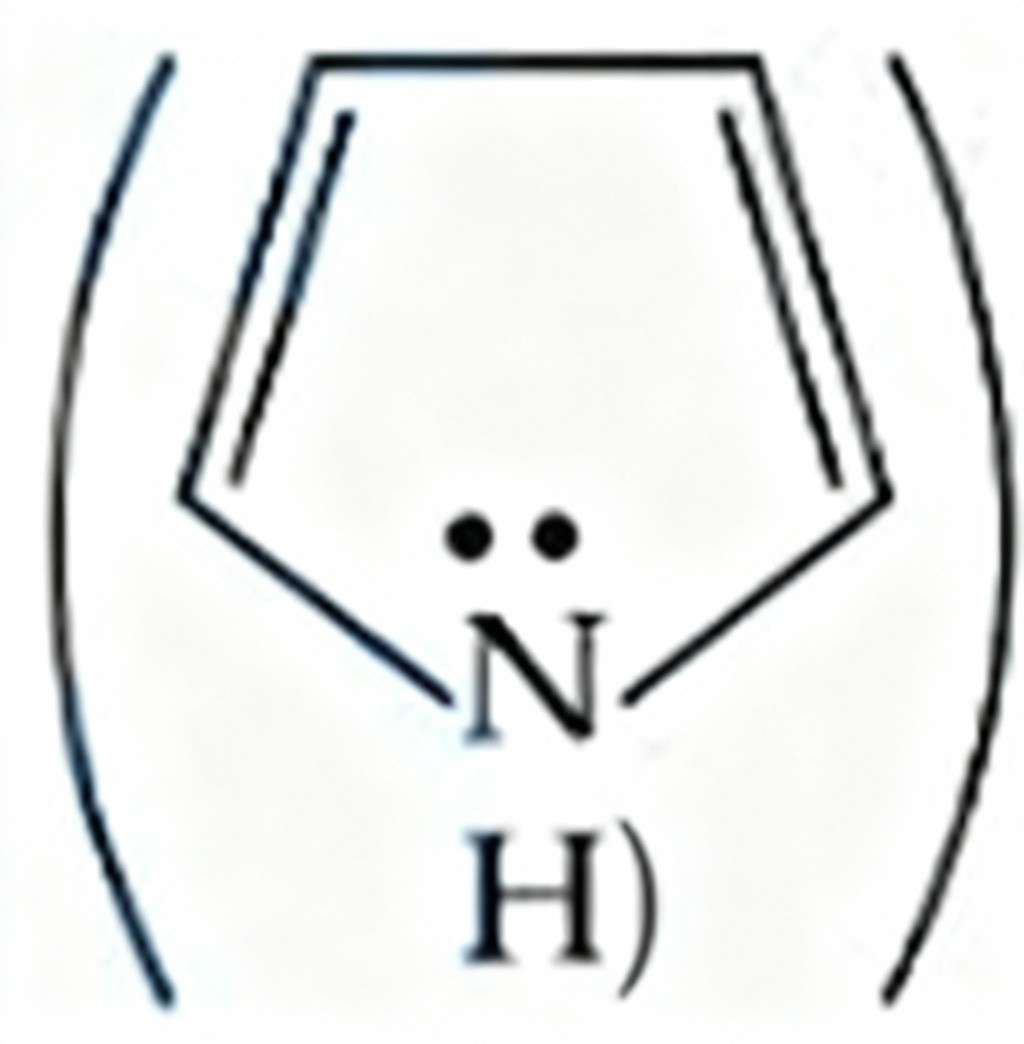 ,Pyridine
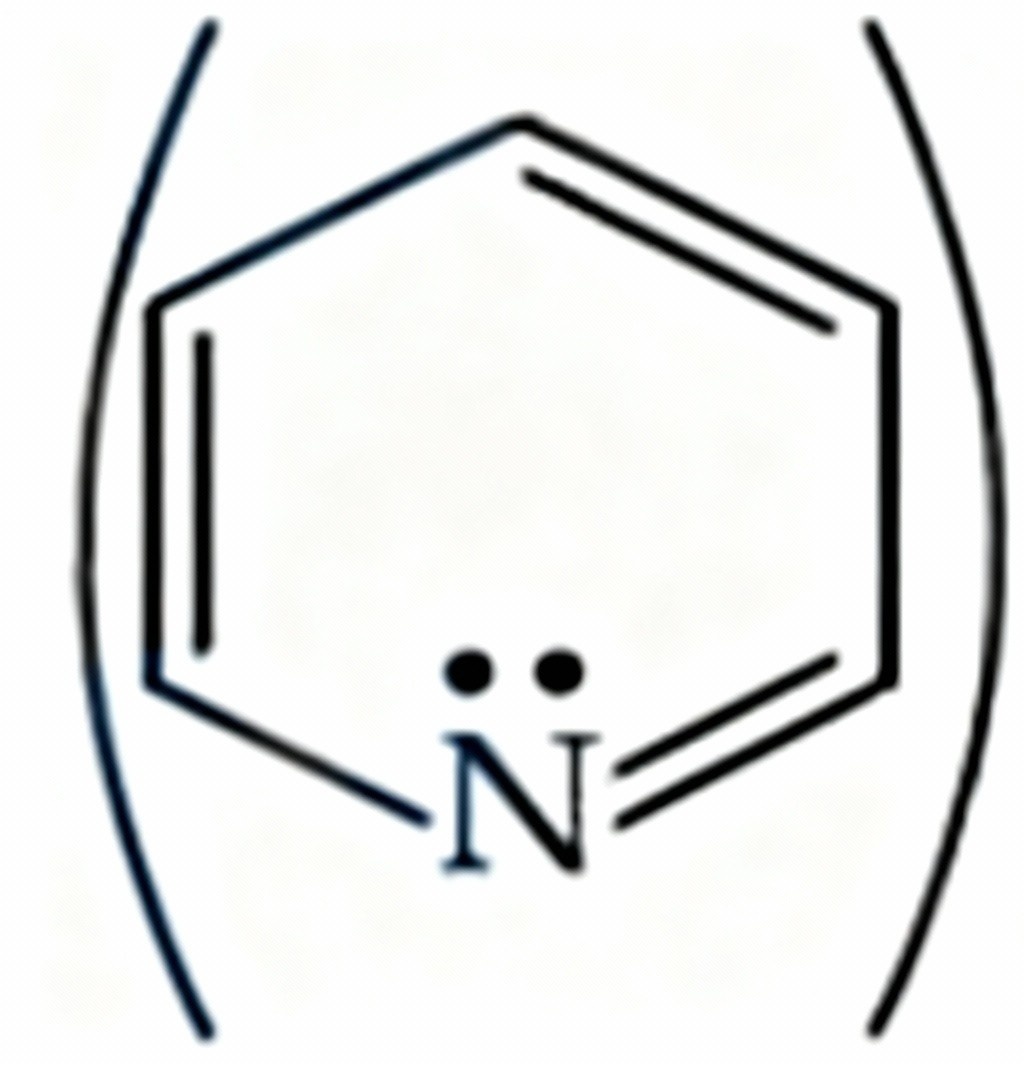 ,and Piperidine
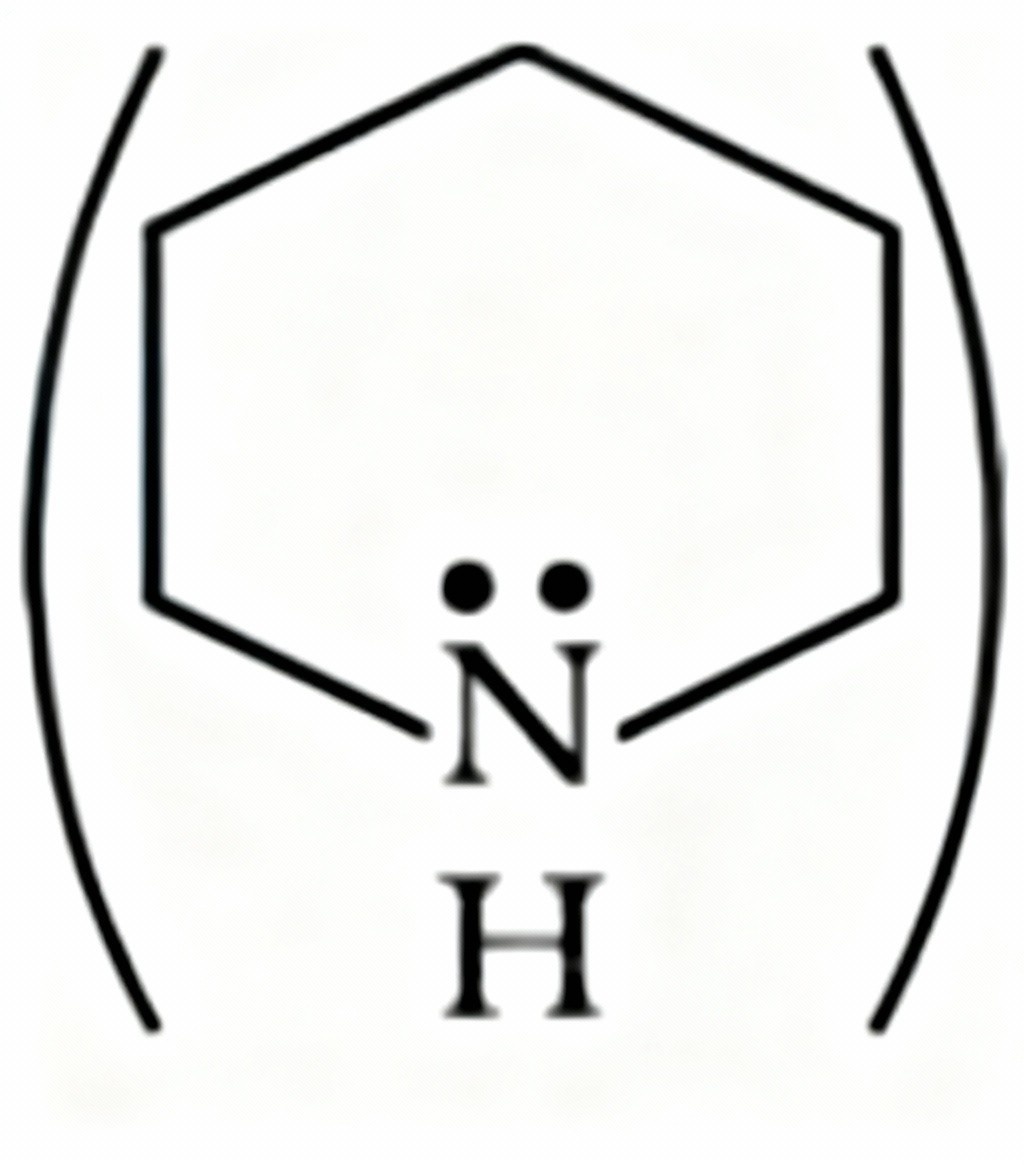 is _______.


No questions on this page match these filters.
Other STD 12 - Amines topics
Frequently asked
How many Properties of Amines questions came in JEE Mains?
86 questions from 2013–2026, each with the correct answer and a full solution.
How difficult are Properties of Amines questions?
8% are easy, 50% medium and 42% hard.