


Questions
Newest firstShowing 1–14 of 14 questions
- 1. Given below are two statements: one is labelled as Assertion A and the other is labelled as Reason \(\mathrm{R}\)
Assertion A: In photoelectric effect, on increasing the intensity of incident light the stopping potential increases.
Reason R : Increase in intensity of light increases the rate of photoelectrons emitted, provided the frequency of incident light is greater than threshold frequency.
In the light of the above statements, choose the correct answer from the options given below 2025 Medium - 2. In photoelectric effect an em-wave is incident on a metal surface and electrons are ejected from the surface. If the work function of the metal is 2.14 eV and stopping potential is 2 V , what is the wavelength of the em-wave ?
(Given hc \(=1242 \mathrm{eVnm}\) where h is the Planck's constant and c is the speed of light in vaccum.) 2025 Easy - 3. The work functions of cesium (Cs) and lithium (Li) metals are 1.9 eV and 2.5 eV , respectively. If we incident a light of wavelength 550 nm on these two metal surfaces, then photo-electric effect is possible for the case of 2025 Medium
- 4. Given below are two statements: one is labelled as Assertion \(A\) and the other is labelled as Reason \(R\). \(Assertion\) \(A\) : Number of photons increases with increase in frequency of light. \(Reason\) \(R\) : Maximum kinetic energy of emitted electrons increases with the frequency of incident radiation. In the light of the above statements, choose the most appropriate answer from the options given below : 2024 Hard
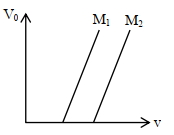
- 5. Given below are two statements: Statement-\(I\): Figure shows the variation of stopping potential with frequency \((v)\) for the two photosensitive materials \(M_1\) and \(M_2\). The slope gives value of \(\frac{h}{e}\), where \(h\) is Planck's constant, \(e\) is the charge of electron. Statement-\(II\): \(M_2\) will emit photoelectrons of greater kinetic energy for the incident radiation having same frequency. In the light of the above statements, choose the most appropriate answer from the options given below.
 2024 Hard
- 6. Which of the following phenomena does not explain by wave nature of light? \((A)\) reflection \((B)\) diffraction \((C)\) photoelectric effect \((D)\) interference \((E)\) polarization Choose the most appropriate answer from the options given below : 2024 Hard
- 7. Which of the following statement is not true about stopping potential \(\left(\mathrm{V}_0\right)\)? 2024 Hard
- 8. From the photoelectric effect experiment, following observations are made. Identify which of these are correct \(A.\) The stopping potential depends only on the work function of the metal. \(B.\) The saturation current increases as the intensity of incident light increases. \(C.\) The maximum kinetic energy of a photo electron depends on the intensity of the incident light. \(D.\) Photoelectric effect can be explained using wave theory of light. Choose the correct answer from the options given below: 2023 Medium
- 9. The variation of stopping potential \(\left(V_0\right)\) as a function of the frequency \(\nu \left(\times 10^{14} Hz\right).\) of the incident light for a metal is shown in figure. The work function of the surface is \(...........\,eV\)
 2023 Medium
- 10. Given below are two statements: one is labelled as Assertion \(A\) and the other is labelled as Reason \(R\). Assertion \(A\) : The photoelectric effect does not take place, if the energy of the incident radiation is less than the work function of a metal. Reason \(R\) : Kinetic energy of the photoelectrons is zero, if the energy of the incident radiation is equal to the work function of a metal. In the light of the above statements, choose the most appropriate answer from the options given below 2022 Medium
- 11. In a photoelectric experiment, increasing the intensity of incident light : 2021 Medium
- 12. In a photoelectric effect experiment, the graph of stopping potential \(V\) versus reciprocal of wavelength obtained is shown in the figure. As the intensity of incident radiation is increased
 2020 Medium
- 13. The stopping potential \(V_0\) (in \(volt\)) as a function of frequency \((v)\) for a sodium emitter, is shown in the figure. The work function of sodium, from the data plotted in the figure, will be : ................. \(eV\) (Given : Planck's constant \((h) = 6.63 \times 10^{-34}\, Js\), electron charge \(e = 1.6 \times 10^{-19}\, C\))
 2019 Medium
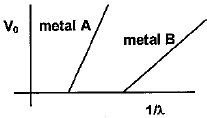
- 14. In an experiment on photoelectric effect, a student plots stopping potential \(V_0\) against reciprocal of the wavelength \(\lambda \) of the incident light for two different metals \(A\) and \(B\). These are shown in the figure Looking at the graphs, you can most appropriately say that
 2013 Hard
No questions on this page match these filters.
Other STD 12 - Dual nature of radiation and matter topics
Frequently asked
How many Photoelectric Effect by Lenard and it's Observations questions came in JEE Mains?
14 questions from 2013–2025, each with the correct answer and a full solution.
How difficult are Photoelectric Effect by Lenard and it's Observations questions?
7% are easy, 57% medium and 36% hard.