


Questions
Newest firstShowing 1–48 of 48 questions
-
- (A) Haloform test
- (B) Lucas test
- (C) Silver mirror test
- (D) Benedict test
Show answer and solution
Correct Answer: (A)
The optically active alkyl bromide \(\text{C}_4\text{H}_9\text{Br}\) is \(2\)-bromobutane, \(\text{CH}_3\text{CH}(\text{Br})\text{CH}_2\text{CH}_3\).
Reaction with ethanolic \(\text{KOH}\) undergoes dehydrohalogenation to form but-\(2\)-ene as the major product [A] (Zaitsev's rule).
But-\(2\)-ene [A] reacts with \(\text{Br}_2\) to form \(2,3\)-dibromobutane [B], \(\text{CH}_3\text{CH}(\text{Br})\text{CH}(\text{Br})\text{CH}_3\).
Compound [B] undergoes double dehydrohalogenation with ethanolic \(\text{KOH}\) and \(\text{NaNH}_2\) to give but-\(2\)-yne [C], \(\text{CH}_3\text{C}\equiv\text{CCH}_3\).
Hydration of but-\(2\)-yne [C] with \(\text{HgSO}_4\) and dilute \(\text{H}_2\text{SO}_4\) yields butan-\(2\)-one [D], \(\text{CH}_3\text{COCH}_2\text{CH}_3\).
Since compound [D] is a methyl ketone, its functional group is confirmed by the haloform test.
Answer: Haloform test -
- (A) 2
- (B) 3
- (C) 4
- (D) 5
Show answer and solution
Correct Answer: (B)
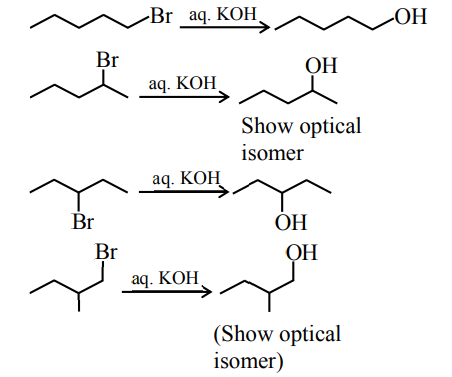
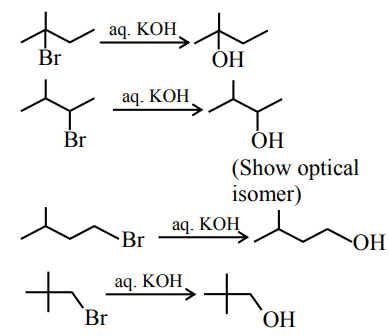
Explanation:
Let us analyze all the structural isomers and their respective substitution products step-by-step to find the ones that exhibit optical isomerism:
1. Understanding the Reaction:
Reaction of alkyl halides with aqueous KOH is a nucleophilic substitution reaction where the bromine atom \((-\text{Br})\) is replaced by a hydroxyl group \((-\text{OH})\) to form an alcohol without any skeletal rearrangement.
2. Identifying all 8 Structural Isomers and their Products:
There are a total of 8 structural isomers for the molecular formula \(C_5H_{11}Br\). Let us check the alcohol products formed by each:
- 1-Bromopentane \(\rightarrow\) Pentan-1-ol (Achiral)
- 2-Bromopentane \(\rightarrow\) Pentan-2-ol (Chiral, contains a stereocenter at C-2) → Product 1
- 3-Bromopentane \(\rightarrow\) Pentan-3-ol (Achiral)
- 1-Bromo-2-methylbutane \(\rightarrow\) 2-Methylbutan-1-ol (Chiral, contains a stereocenter at C-2) → Product 2
- 2-Bromo-2-methylbutane \(\rightarrow\) 2-Methylbutan-2-ol (Achiral)
- 2-Bromo-3-methylbutane \(\rightarrow\) 3-Methylbutan-2-ol (Chiral, contains a stereocenter at C-2) → Product 3
- 1-Bromo-3-methylbutane \(\rightarrow\) 3-Methylbutan-1-ol (Achiral)
- 1-Bromo-2,2-dimethylpropane \(\rightarrow\) 2,2-Dimethylpropan-1-ol (Achiral)
3. Conclusion:
Out of the 8 distinct structural products formed, exactly 3 products contain an asymmetric chiral carbon atom bonded to four different groups, meaning only 3 products can exhibit optical isomerism. Therefore, Option B is absolutely correct.
Hence, Option B is the correct choice. -
- (A) A, B and C Only
- (B) B and D Only
- (C) A and E Only
- (D) D and E Only
Show answer and solution
Correct Answer: (C)
Statement A is correct. Alcoholic KOH provides alkoxide ions which are stronger bases than hydroxide ions. Furthermore, alcohol is a less polar solvent than water, which decreases the solvation of the base, making it more effective for elimination reactions over substitution.
Statement B is incorrect. The reactivity towards the \(S_N^1\) mechanism depends on the stability of the intermediate carbocation. The carbocation \(C_6H_5-\overset{+}{C}H-C_6H_5\) is more stable than \(C_6H_5-\overset{+}{C}H_2\) due to extended resonance stabilization from two phenyl rings. Thus, \(C_6H_5-CHCl-C_6H_5\) is more reactive than \(C_6H_5-CH_2-Cl\).
Statement C is incorrect. Aryl halides are much less reactive towards nucleophilic substitution than alkyl halides due to the partial double bond character of the C-X bond arising from resonance, as well as the \(sp^2\) hybridization of the carbon atom.
Statement D is incorrect. Allyl chloride (\(CH_2=CH-CH_2-Cl\)) contains a carbon-carbon double bond, making it a haloalkene, not a haloalkyne.
Statement E is correct. Alkyl chlorides (\(R-Cl\)) can be easily prepared from alcohols (\(R-OH\)) using \(SOCl_2\). However, phenols (\(Ar-OH\)) do not react with \(SOCl_2\) to give aryl chlorides because the C-O bond in phenol has a partial double bond character due to resonance, making it difficult to cleave.
Therefore, only statements A and E are correct.
Answer: A and E Only -
- (A) Statement I is false but Statement II is true
- (B) Both Statement I and Statement II are true
- (C) Both Statement I and Statement II are false
- (D) Statement I is true but Statement II is false
Show answer and solution
Correct Answer: (D)
Statement - I :
C - Cl bond is strong in vinyl chloride because of double bond character.
Statement - II :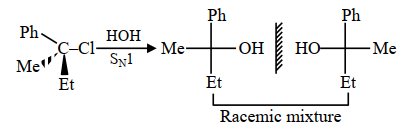
Racemic mixture is optically inactive, which can not rotate PPL. -
- (A) Both Statement I and Statement II are true
- (B) Both Statement I and Statement II are false
- (C) Statement I is true but Statement II is false
- (D) Statement I is false but Statement II is true
Show answer and solution
Correct Answer: (A)
The rate of \(S_N1\) reaction depends on the stability of the carbocation intermediate formed during the rate-determining step.
Benzyl chloride undergoes ionization to form a benzyl carbocation (\(C_6H_5CH_2^+\)), whereas ethyl chloride forms an ethyl carbocation (\(CH_3CH_2^+\)). The benzyl carbocation is highly stabilized by the delocalization of the positive charge over the benzene ring through resonance. On the other hand, the ethyl carbocation is stabilized only by hyperconjugation involving three \(\alpha\)-hydrogens.
Since resonance provides significantly greater stabilization than hyperconjugation, the benzyl carbocation is much more stable than the ethyl carbocation. Consequently, benzyl chloride reacts faster in the \(S_N1\) mechanism than ethyl chloride. Thus, Statement I is true.
Statement II correctly explains that the ethyl carbocation intermediate is less stabilized by hyperconjugation compared to the resonance stabilization of the benzyl carbocation. Thus, Statement II is also true.
Both Statement I and Statement II are true.
Answer: Both Statement I and Statement II are true -
- (A) Both Statement I and Statement II are true
- (B) Both Statement I and Statement II are false
- (C) Statement I is true but Statement II is false
- (D) Statement I is false but Statement II is true
Show answer and solution
Correct Answer: (A)
Statement I is true because as the size of the alkyl group increases, the molecular mass and surface area increase. This leads to an increase in the magnitude of van der Waals forces, which in turn increases the boiling point. Thus, the correct order of boiling points is \(\text{CH}_3\text{CH}_2\text{CH}_2\text{I} > \text{CH}_3\text{CH}_2\text{I} > \text{CH}_3\text{I}\).
Statement II is true because para-dichlorobenzene is more symmetrical than ortho-dichlorobenzene, allowing it to pack more efficiently in the crystal lattice, which results in a higher melting point. However, ortho-dichlorobenzene has a higher dipole moment than para-dichlorobenzene (which has a dipole moment of zero). The stronger dipole-dipole interactions in ortho-dichlorobenzene lead to a higher boiling point compared to para-dichlorobenzene.
Both Statement I and Statement II are true.
Answer: Both Statement I and Statement II are true -
- (A) \(I^{-}>C_{6}H_{5}O^{-}>F^{-}>C_{2}H_{5}O^{-}\)
- (B) \(I^{-}>C_{2}H_{5}O^{-}>C_{6}H_{5}O^{-}>F^{-}\)
- (C) \(I^{-}>C_{2}H_{5}O^{-}>F^{-}>C_{6}H_{5}O^{-}\)
- (D) \(I^{-}>F^{-}>C_{6}H_{5}O^{-}>C_{2}H_{5}O^{-}\)
Show answer and solution
Correct Answer: (B)
Order of nucleophilicity:
\(I ^{\ominus}> C _2 H _5 O ^{\ominus}> PhO ^{\ominus}> F ^{\ominus}\) -
- (A) 60
- (B) 66
- (C) 70
- (D) 75
Show answer and solution
Correct Answer: (B)
\(C _6 H _{10} \xrightarrow{ Br _2} C _6 H _{10} Br _2\)
Molecular mass of \(C _6 H _{10} Br _2\) is :
\(12 \times 6+10+160\)
\(72+10+160=242\)
\(\%\) of \(Br =\frac{160}{242} \times 100\)
\(\%\) of \(Br =66.11 \% \approx 66 \%\) -
- (A) 180
- (B) 184
- (C) 188
- (D) 192
Show answer and solution
Correct Answer: (B)
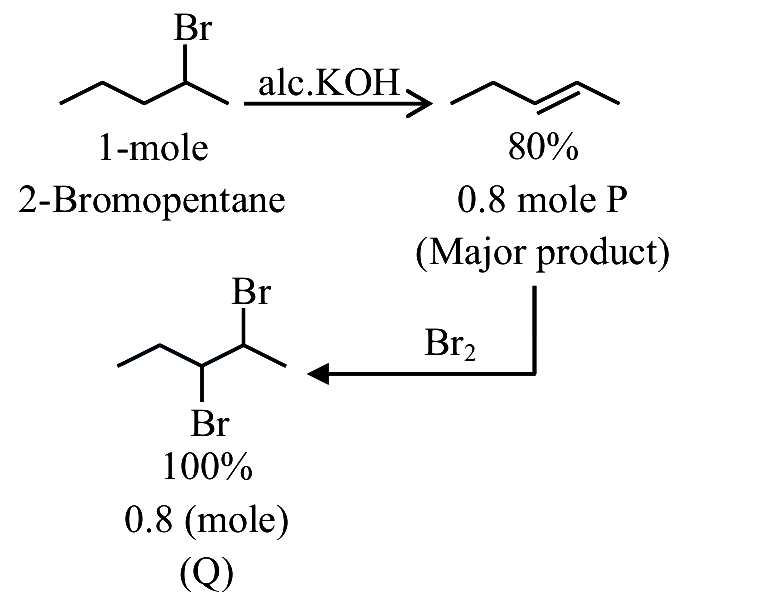
\(\begin{aligned} & \text { Molecular mass of } \mathrm{Q}=230 \mathrm{~g} \mathrm{~mol}^{-1} \\ & \begin{aligned} \text { Mass of } \mathrm{Q} & =0.8 \times 230 \\ & =184 \mathrm{~g}\end{aligned}\end{aligned}\) -
- (A) Both Statement I and Statement II are incorrect
- (B) Statement I is incorrect but Statement II is correct
- (C) Statement I is correct but Statement II is incorrect
- (D) Both Statement I and Statement II are correct
Show answer and solution
Correct Answer: (B)
Statement (I) :
\(\mathrm{R}-\mathrm{Cl} \xrightarrow{(\text { aq. } \mathrm{KOH})} \mathrm{R}-\mathrm{OH}\left(\mathrm{S}_{\mathrm{N}}\right.\) reaction \()\)
Statement (II) :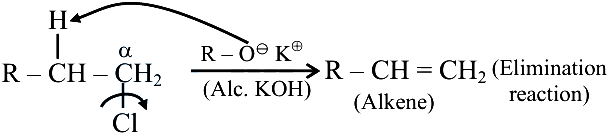
-
- (A) Both Statement I and Statement II are incorrect
- (B) Both Statement I and Statement II are correct
- (C) Statement I is incorrect but Statement II is correct
- (D) Statement I is correct but Statement II is incorrect
Show answer and solution
Correct Answer: (B)
1. Analysis of Statement I (True):
- Generally, primary alkyl halides do not undergo \( \text{S}_\text{N}1 \) reactions because primary carbocations are highly unstable.
- However, for \( \text{CH}_3-\text{O}-\text{CH}_2-\text{Cl} \), the loss of the chloride ion forms the carbocation \( \text{CH}_3-\ddot{\text{O}}-\overset{+}{\text{C}}\text{H}_2 \).
- This specific carbocation is exceptionally stabilized by resonance due to the lone pair of electrons on the adjacent oxygen atom:
\( \text{CH}_3-\ddot{\text{O}}-\overset{+}{\text{C}}\text{H}_2 \longleftrightarrow \text{CH}_3-\overset{+}{\text{O}}=\text{CH}_2 \)
- In the canonical structure on the right, every single atom (including both carbon and oxygen) satisfies the octet rule. This high resonance stabilization lowers the activation energy barrier for the \( \text{S}_\text{N}1 \) pathway remarkably, allowing it to proceed rapidly despite being a primary halide.
2. Analysis of Statement II (True):
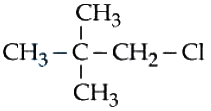
- Neopentyl chloride is a primary alkyl halide. For an \( \text{S}_\text{N}2 \) reaction to occur, a nucleophile must perform a backside attack on the electrophilic carbon carrying the leaving group.
- In neopentyl chloride, the \( \alpha \)-carbon bonded to chlorine is directly attached to a highly bulky tert-butyl group (\( -\text{C(CH}_3)_3 \)).
- This extreme steric hindrance completely shields the backside approach of the nucleophile. Consequently, neopentyl chloride is practically inert to \( \text{S}_\text{N}2 \) substitution reactions under standard laboratory conditions.
Since both Statement I and Statement II are factually correct, Option B is definitively the correct choice. -
- (A) benzoic acid
- (B) benzoic acid and aniline
- (C) benzoic acid and chlorobenzene
- (D) chlorobenzene and aniline
Show answer and solution
Correct Answer: (D)
Organic layer in funnel are mixture of chloro benzene and aniline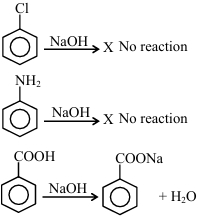
- 13. The ascending order of relative rate of solvolysis of following compounds is _______.
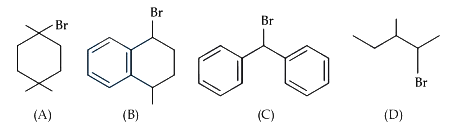
2025 Medium- (A) \((\mathrm{C}) \lt (\mathrm{B}) \lt (\mathrm{A}) \lt (\mathrm{D})\)
- (B) \((\mathrm{D}) \lt (\mathrm{A}) \lt (\mathrm{B}) \lt (\mathrm{C})\)
- (C) \((\mathrm{D}) \lt (\mathrm{B}) \lt (\mathrm{A}) \lt (\mathrm{C})\)
- (D) \((\mathrm{C}) \lt (\mathrm{D}) \lt (\mathrm{B}) \lt (\mathrm{A})\)
Show answer and solution
Correct Answer: (B)
Solvolysis or \(\mathrm{S}_{\mathrm{N}} 1 \propto\) stability of carboccation Stability order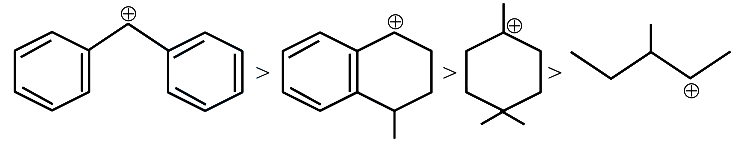
-
- (A) \(\mathrm{NaCN}\)
- (B) \(\mathrm{NH}_4 \mathrm{CN}\)
- (C) \(\mathrm{KCN}\)
- (D) \(\mathrm{AgCN}\)
Show answer and solution
Correct Answer: (D)
Covalent character of \(\mathrm{AgCN}\). - 15. Compound \(\mathrm{A}\) formed in the following reaction reacts with \(B\) gives the product \(C\). Find out \(A\) and \(B\).
 2024 Hard
- (A) \(\mathrm{A}=\mathrm{CH}_5-\mathrm{C} \equiv \overline{\mathrm{CNa}}{ }^{+}, \mathrm{B}=\mathrm{CH}_5-\mathrm{CH}_2-\mathrm{CH}_2-\mathrm{Br}\)
- (B) \(\mathrm{A}=\mathrm{CH}_3-\mathrm{CH}=\mathrm{CH}_2, \mathrm{~B}=\mathrm{CH}_3-\mathrm{CH}_2-\mathrm{CH}_2-\mathrm{Br}\)
- (C) \(\mathrm{A}=\mathrm{CH}_3-\mathrm{CH}_2-\mathrm{CH}_3, \mathrm{~B}=\mathrm{CH}_3-\mathrm{C} \equiv \mathrm{CH}\)
- (D) \(\mathrm{A}=\mathrm{CH}_3-\mathrm{C} \equiv \overline{\mathrm{CN}} \stackrel{+}{+}, \mathrm{B}=\mathrm{CH}_3-\mathrm{CH}_2-\mathrm{CH}_3\)
Show answer and solution
Correct Answer: (A)
\(\mathrm{CH}_3-\mathrm{C}=\mathrm{CH} \xrightarrow{\mathrm{Na}} \mathrm{CH}_3-\mathrm{C}=\mathrm{C}^{-} \mathrm{Na}^{+} \xrightarrow{\mathrm{CH}_3 \mathrm{CH}_2 \mathrm{CH}_2-\mathrm{Br}} \downarrow\)\(\mathrm{NaBr}+\mathrm{CH}_3-\mathrm{C}=\mathrm{C}-\mathrm{CH}_2 \mathrm{CH}_2 \mathrm{CH}_3\)
-
- (A) \((A)\) is correct but \((R)\) is not correct
- (B) Both \((A)\) and \((R)\) are correct but \((R)\) is not the correct explanation of \((\mathrm{A})\)
- (C) \((A)\) is not correct but \((R)\) is correct
- (D) Both \((A)\) and \((R)\) are correct and \((R)\) is the correct explanation of \((A)\)
Show answer and solution
Correct Answer: (A)
\(\mathrm{AgCN}\) is mainly covalent in nature and nitrogen is available for attack, so alkyl isocyanide is formed as main product.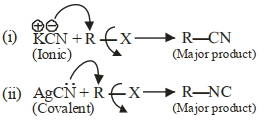
-
- (A) \((A)\) is not correct but \((R)\) is correct
- (B) Both \((A)\) and \((R)\) are correct but \((R)\) is not the correct explanation of \((A)\)
- (C) Both \((A)\) and \((R)\) are correct and \((R)\) is the correct explanation of \((A)\)
- (D) \((A)\) is correct but \((R)\) is not correct
Show answer and solution
Correct Answer: (C)
The benzyl group acts in much the same way using the \(\pi\)-system of the benzene ring for conjugation with the p-orbital in the transition state.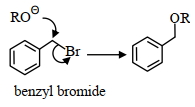
-
- (A) Statement \(I\) is true but Statement \(II\) is false
- (B) Statement \(I\) is false but Statement \(II\) is true.
- (C) Both statement \(I\) and Statement \(II\) are false.
- (D) Both statement \(I\) and Statement \(II\) are true.
Show answer and solution
Correct Answer: (D)
Statement - \(I\): Rate of \(\mathrm{S}_{\mathrm{N}} 2 \propto[\mathrm{R}-\mathrm{X}]\left[\mathrm{Nu}^{-}\right]\)\(\mathrm{S}_{\mathrm{N}} 2\) reaction is favoured by high concentration of nucleophile \(\left(\mathrm{Nu}^{-}\right)\)& less crowding in the substrate molecule.
Statement - \(II\): Solvolysis follows \(\mathrm{S}_{\mathrm{N}} 1\) path.
Both are correct Statements.
-
- (A) Statement \(I\) is true but Statement \(II\) is false
- (B) Statement \(I\) is false but Statement \(II\) is true
- (C) Both Statement \(I\) and Statement \(II\) is true
- (D) Both Statement \(I\) and Statement \(II\) is false
Show answer and solution
Correct Answer: (C)
\(\mathrm{SN}^2 \rightarrow\) Inversion\(\mathrm{SN}^1 \rightarrow\) Racemisation
- 20. Identify the correct set of reagents or reaction conditions ' \(\mathrm{X}\) ' and ' \(\mathrm{Y}\) ' in the following set of transformation.
 2024 Medium
- (A) \(\mathrm{X}=\) conc.alc. \(\mathrm{NaOH}, 80^{\circ} \mathrm{C}, \mathrm{Y}=\mathrm{Br}_2 / \mathrm{CHCl}_3\)
- (B) \(\mathrm{X}=\) dil.aq. \(\mathrm{NaOH}, 20^{\circ} \mathrm{C}, \mathrm{Y}=\mathrm{HBr}\) /acetic acid
- (C) \(\mathrm{X}=\) conc.alc. \(\mathrm{NaOH}, 80^{\circ} \mathrm{C}, \mathrm{Y}=\mathrm{HBr}\) /acetic acid
- (D) \(\mathrm{X}=\) dil.aq. \(\mathrm{NaOH}, 20^{\circ} \mathrm{C}, \mathrm{Y}=\mathrm{Br}_2 / \mathrm{CHCl}_3\)
Show answer and solution
Correct Answer: (C)
\(1\). \(\mathrm{CH}_3-\mathrm{CH}_2-\mathrm{CH}_2-\mathrm{Br} \xrightarrow[80^{\circ} \mathrm{C}]{\mathrm{X}=\text { conc.alc.NaOH }}\)\(\mathrm{CH}_3-\mathrm{CH}=\mathrm{CH}_2 \xrightarrow{\mathrm{Y}=\mathrm{HBr} / \mathrm{Acetic} \text { acid }} \mathrm{CH}_3-\mathrm{CHBr}-\mathrm{CH}_3\)
- 21. The correct statement regarding nucleophilic substitution reaction in a chiral alkyl halide is ; 2024 Hard
- (A) Retention occurs in \(\mathrm{S}_{\mathrm{N}} 1\) reaction and inversion occurs in \(\mathrm{S}_{\mathrm{N}} 2\) reaction.
- (B) Racemisation occurs in \(\mathrm{S}_{\mathrm{N}} \mathrm{l}\) reaction and retention occurs in \(\mathrm{S}_{\mathrm{N}} 2\) reaction.
- (C) Racemisation occurs in both \(\mathrm{S}_{\mathrm{N}} 1\) and \(\mathrm{S}_{\mathrm{N}} 2\) reactions.
- (D) Racemisation occurs in \(\mathrm{S}_{\mathrm{N}} 1\) reaction and inversion occurs in \(\mathrm{S}_{\mathrm{N}} 2\) reaction.
Show answer and solution
Correct Answer: (D)
\(\mathrm{SN}^1\) - Racemisation\(\mathrm{SN}^2\) - Inversion
- 22. The total number of hydrogen atoms in product \(\mathrm{A}\) and product \(B\) is _______.
 2024 Hard
- (A) \(5\)
- (B) \(10\)
- (C) \(15\)
- (D) \(20\)
Show answer and solution
Correct Answer: (B)
Explanation:
This question involves understanding the dual behavior of hydroxide ions (\( \text{OH}^- \)) acting either as a strong base or as a nucleophile depending on the nature of the solvent:
1. Reaction in Ethanol Solvent (Product A):
When sodium hydroxide (\( \text{NaOH} \)) is dissolved in ethanol (\( \text{C}_2\text{H}_5\text{OH} \)), it forms an alcoholic solution. Hydroxide ions react with ethanol to form ethoxide ions (\( \text{C}_2\text{H}_5\text{O}^- \)), which act as a powerful strong base. This environment strongly favors \( \text{E}2 \) elimination (dehydrohalogenation) over substitution. The elimination of \( \text{HBr} \) from ethyl bromide (\( \text{CH}_3\text{CH}_2\text{Br} \)) yields ethene (\( \text{CH}_2=\text{CH}_2 \)) as the major product.
- Molecular formula of Product A (Ethene): \( \text{C}_2\text{H}_4 \)
- Number of hydrogen atoms in Product A = 4
2. Doubt Clearing regarding Ether Formation:
While nucleophilic substitution by ethoxide ions can technically form a small amount of diethyl ether (\( \text{C}_2\text{H}_5\text{OC}_2\text{H}_5 \)) as a side product at lower temperatures, standard textbook and competitive exam conventions treat \( \text{NaOH}/\text{C}_2\text{H}_5\text{OH} \) strictly as an elimination reagent that produces an alkene. Furthermore, if diethyl ether (10 hydrogen atoms) were assumed as Product A, the total number of hydrogens would be \( 10 + 6 = 16 \), which is completely absent from the given options (5, 10, 15, 20). This confirms that ethene is the intended product.
3. Reaction in Water Solvent (Product B):
When \( \text{NaOH} \) is dissolved in water (\( \text{H}_2\text{O} \)), it forms an aqueous solution. In this medium, hydroxide ions are highly stabilized by hydration, which minimizes their basicity while keeping them highly nucleophilic. Thus, the reaction proceeds via nucleophilic substitution (\( \text{S}_\text{N}2 \)), substituting the bromide ion to produce ethanol (\( \text{CH}_3\text{CH}_2\text{OH} \)) as the main product.
- Molecular formula of Product B (Ethanol): \( \text{C}_2\text{H}_5\text{OH} \)
- Number of hydrogen atoms in Product B = 6
4. Total Count of Hydrogen Atoms:
Summing up the hydrogen atoms contained in both major products:
\( \text{Total Hydrogen Atoms} = 4 \text{ (from ethene)} + 6 \text{ (from ethanol)} = 10 \)
Hence, Option B is the correct choice.
-
- (A) \(A\) is false but \(R\) is true
- (B) \(A\) is true but \(R\) is false
- (C) Both \(A\) and \(R\) are true and \(R\) is the correct explanation of \(A\)
- (D) Both \(A\) and \(R\) are true but \(R\) is \(NOT\) the correct explanation of \(A\)
Show answer and solution
Correct Answer: (C)
The rate of hydrolysis of alkyl chloride improves because of better Nucleophilicity of \(I ^{-}\). - 24. Choose the halogen which is most reactive towards \(SN1\) reaction in the given compounds \((A, B, C , D)\)
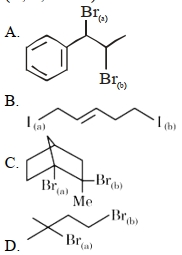 2023 Medium
- (A) \(A - Br _{(b)} ; B - I _{( b )} ; C - Br _{( b )} ; D - Br _{( b )}\)
- (B) \(A - Br _{( a )} ; BI _{( a )} ; C - Br _{( b )} ; D - Br _{( a )}\)
- (C) \(A - Br _{( b )} ; B - I _{( a )} ; C - Br _{( a )} ; D - Br _{( a )}\)
- (D) \(A - Br _{( b )} ; B - I _{( a )} ; C - Br _{( a )} ; D - Br _{( a )}\)
Show answer and solution
Correct Answer: (B)
Stable is the carbocation, faster will be rate of \(SN1\) reaction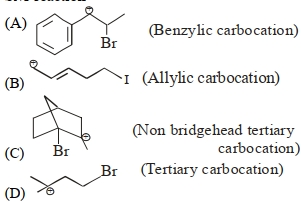
-
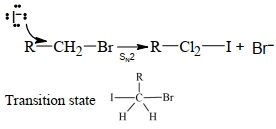
- (A) The transition state formed in the above reaction is less polar than the localised anion.
- (B) The reaction can occur in acetic acid also.
- (C) The solvent used in the reaction solvates the ions formed in rate determining step.
- (D) \(Br ^{-}\)can act as competing nucleophile.
Show answer and solution
Correct Answer: (A)
This is finkelstein reactionClearly, the transition state is less polar than free anions. \(Br ^{-}\)and \(I ^{-}\)
Acetic acid is protic which does not support \(S _{ N } 2\)
Acetone does not solvate anion
\(Br ^{-}\)gets precipitated and hence can not compete with \(I\)
-
- (A) (A), (B) and (D) only
- (B) (A), (B), (C) and (D)
- (C) (A), (C) and (D) only
- (D) (B), (C) and (D) only
Show answer and solution
Correct Answer: (B)
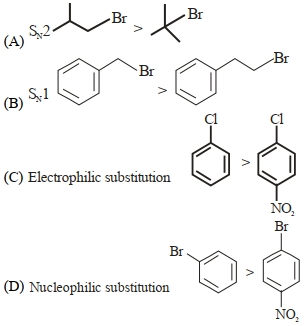
All are correct\((A)\) \(S _{ N } 2\) reaction decreases with increase in steric crowding.
\((B)\) \(S _{ N } 1\) reaction increases with stability of carbocation.
\((C)\) EAS reaction decreases with decrease in electron density.
\((D)\) Presence of electron withdrawing group at ortho and para-position to a halogen in haloarene increase nucleophilic aryl substitution.
-
- (A) \(A-IV,B-III,C-II,D-I\)
- (B) \(A-III,B-I,C-IV,D-II\)
- (C) \(A-I,B-II,C-III,D-IV\)
- (D) \(A-I,B-III,C-IV,D-II\)
Show answer and solution
Correct Answer: (B)
\(CH _3- CH _2- CH _2- Br + KOH ( Alc ) \rightarrow CH _3-\underset{\text { (Alkene) }}{ CH }= CH _2\)\(CH _3- CH _2- CH _2- Br + KCN ( Alc ) \rightarrow CH _3- CH _2- CH _2- CN\)
\(CH _3- CH _2- CH _2- Br + AgNO _2 \rightarrow CH _3- CH _2- CH _2- COO _2+ AgBr \downarrow\)
\(\left. CH _3- CH _2- CH _2- Br + CH _3- COOAg _2 \rightarrow CH _3- COO - CH _2\right)= CH _2- CH _3+ AgBr \downarrow\)
-
- (A) \(4\)
- (B) \(6\)
- (C) \(2\)
- (D) \(8\)
Show answer and solution
Correct Answer: (C)
Benzylic and tertiary carbocations are stable. -
- (A) \(4\)
- (B) \(2\)
- (C) \(1\)
- (D) \(5\)
Show answer and solution
Correct Answer: (A)
Total Possible Isomeric product \(=1+3=4\)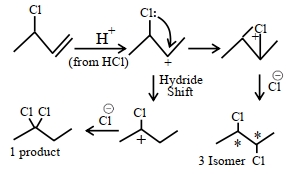
-
- (A) \(2\)
- (B) \(1\)
- (C) \(3\)
- (D) \(4\)
Show answer and solution
Correct Answer: (C)
\(W = n \times M\)\(=10^{-4} \times 30=3\,mg\)

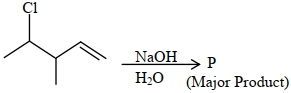
- 31. Consider the above reaction. The number of \(\pi\) electrons present in the product ' \(P\) ' is ...... .
 2022 Easy
- (A) \(1\)
- (B) \(2\)
- (C) \(3\)
- (D) \(5\)
Show answer and solution
Correct Answer: (B)
Number of \(\pi\) electron \(=2\)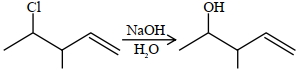
-
- (A) \(a - ii , b - i , c - iv , d - iii\)
- (B) \(a-i i i, b-i v, c-i i, d-i\)
- (C) \(a-iii, b-i, c-i v, d-i i\)
- (D) \(a - ii , b - iv , c - i , d - iii\)
Show answer and solution
Correct Answer: (B)
\((a)\) Alcoholic potassium hydroxide \(\rightarrow\) used for \(\beta-\) elimination\((b)\) \(Pd / BaSO _{4} \rightarrow\) Lindlar's catalyst
\((c)\) \(BHC\) (Benzene hexachloride) \(\rightarrow\) Obtained by addition reactions
\((d)\) Polyacetylene \(\rightarrow\) Electrodes in batteries
- 33. The correct order of the following compounds showing increasing tendency towards nucleophilic substitution reaction is :-
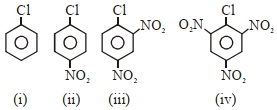 2021 Easy
- (A) \(( iv ) < ( iii ) < ( ii ) < ( i )\)
- (B) \(( iv ) < ( i ) < ( ii ) < ( iii )\)
- (C) \(( iv ) < ( i ) < ( iii ) < ( ii )\)
- (D) \(( i ) < ( ii ) < ( iii ) < ( iv )\)
Show answer and solution
Correct Answer: (D)
For nucleophile substitution in aromatic halidesCorrect order is :
\(( i ) < ( ii ) < ( iii ) < ( iv )\)
More No. of \(NO _{2}\) substituted aromatic halide, increase the rate of nucleophile substitution reaction in aromatic halides.
- 34. The decreasing order of reactivity of the following organic molecules towards \(AgNO\) \(_{3}\) solution is :
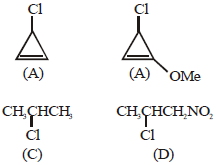 2020 Medium
- (A) \(( A )>( B )>( D )>( C )\)
- (B) \(( A )>( B )>( C )>( D )\)
- (C) \((C)>(D)>(A)>(B)\)
- (D) \((B)>(A)>(C)>(D)\)
Show answer and solution
Correct Answer: (D)
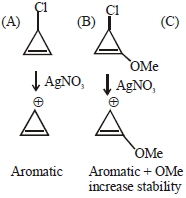
\((C)\) \(\begin{gathered} \begin{array}{*{20}{c}} {C{H_3} - CH - C{H_3}} \\ {|\,\,\,\,\,\,\,\,\,\,\,\,} \\ {Cl\,\,\,\,\,\,\,\,\,\,} \\ {\,\,\,\,\,\,\,\,\,\, \downarrow AgN{O_3}} \end{array} \hfill \\ \begin{array}{*{20}{c}} { \oplus \,\,\,\,} \\ {C{H_3} - CH - C{H_3}} \\ {({2^o}\,Cation)} \end{array} \hfill \\ \end{gathered} \)\((D)\) \(\begin{gathered} \begin{array}{*{20}{c}} {C{H_3} - CH - C{H_3}} \\ {|\,\,\,\,\,\,\,\,\,\,\,\,} \\ {Cl\,\,\,\,\,\,\,\,\,\,} \\ {\,\,\,\,\,\,\,\,\, \downarrow AgN{O_3}} \end{array} \hfill \\ \begin{array}{*{20}{c}} { \oplus \,\,\,\,\,\,\,\,\,\,\,\,\,\,\,\,\,\,\,\,} \\ {C{H_3} - CH - C{H_2} - N{O_2}} \\ {{2^o}\,Cation\,and\,\left( { - I\,of\,N{O_2}} \right)} \end{array} \hfill \\ \end{gathered}\)
- 35. The decreasing order of reactivity towards dehydrohalogenation \((E_1)\) reaction of the following compounds is
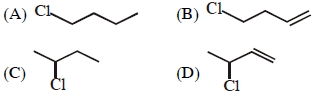 2020 Hard
- (A) \(B > D > A > C\)
- (B) \(B > D > C > A\)
- (C) \(D > B > C > A\)
- (D) \(B > A > D > C\)
Show answer and solution
Correct Answer: (C)
Reactivity \(D > B > C > A\) Carbocation formed from \(D\) is most stable Carbocation formed from \(A\) is least stable - 36. Which of the following compounds will show retention in configuration on nucleophic substitution by \(OH ^{-}\) ion \(?\) 2020 Medium
- (A) \(\begin{array}{*{20}{c}} {C{H_3} - CH - C{H_2}Br} \\ {|\,\,\,\,\,\,\,\,\,\,\,\,} \\ {{C_2}{H_5}\,\,\,\,} \end{array}\)
- (B) \(\begin{array}{*{20}{c}} {C{H_3} - CH - Br} \\ {|\,\,\,} \\ {\,\,\,\,\,\,\,{C_6}{H_5}} \end{array}\)
- (C) \(\begin{array}{*{20}{c}} {C{H_3} - CH - Br} \\ {|\,\,\,} \\ {\,\,\,\,C{H_3}} \end{array}\)
- (D) \(\begin{array}{*{20}{c}} {\,\,\,\,\,\,Br} \\ {\,\,\,|\,} \\ {C{H_3} - C - H} \\ {\,\,\,|} \\ {\,\,\,\,\,\,\,\,\,\,\,\,\,\,\,{C_6}{H_{13}}} \end{array}\)
Show answer and solution
Correct Answer: (A)
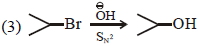
\((1)\)\(\begin{array}{*{20}{c}} { * \,\,\,\,\,\,\,\,\,\,\,\,\,\,\,\,\,\,\,\,\,\,\,\,\,\,\,\,\,\,\,} \\ {C{H_3} - CH - C{H_2} - Br\,\xrightarrow[{{S_{{N^2}}}}]{{\mathop O\limits^ \ominus H}}} \\ {|\,\,\,\,\,\,\,\,\,\,\,\,\,\,\,\,\,\,\,\,\,\,\,\,\,\,\,\,\,\,\,\,} \\ {Et\,\,\,\,\,\,\,\,\,\,\,\,\,\,\,\,\,\,\,\,\,\,\,\,\,\,\,\,\,} \end{array}\)\(\begin{array}{*{20}{c}} { * \,\,\,\,\,\,\,\,\,\,\,\,} \\ {C{H_3} - CH - C{H_2}OH} \\ {|\,\,\,\,\,\,\,\,\,\,\,\,\,\,} \\ {Et\,\,\,\,\,\,\,\,\,\,\,} \end{array}\)\((2)\)\(\begin{array}{*{20}{c}} {C{H_3} - CH - Br\,\xrightarrow[{{S_{{N^2}}}}]{{\mathop O\limits^ \ominus H}}} \\ {|\,\,\,\,\,\,\,\,\,\,\,\,\,\,\,\,\,\,\,} \\ {ph\,\,\,\,\,\,\,\,\,\,\,\,\,\,\,} \end{array}\)\(\begin{array}{*{20}{c}} {ph - CH - OH} \\ {|\,\,\,\,\,\,\,\,} \\ {C{H_3}} \end{array}\)
\((4)\)\(\begin{array}{*{20}{c}} {C{H_3} - CH - Br\,\xrightarrow[{{S_{{N^2}}}}]{{\mathop O\limits^ \ominus H}}} \\ {|\,\,\,\,\,\,\,\,\,\,\,\,\,\,\,\,\,\,\,} \\ {{C_6}{H_{13}\,\,\,\,\,\,}} \end{array}\)\(\begin{array}{*{20}{c}} {C{H_3} - CH - OH} \\ {|\,\,\,\,\,} \\ {\,\,\,\,{C_6}{H_3}} \end{array}\)
As language given, we have to go with option \((1)\) as stereochemistry of chiral centre is not distortet.
-
- (A) \((A) < (B) < (C) < (D)\)
- (B) \((A) < (B) < (D) < (C)\)
- (C) \((B) < (A) < (D) < (C)\)
- (D) \((B) < (A) < (C) < (D)\)
Show answer and solution
Correct Answer: (D)
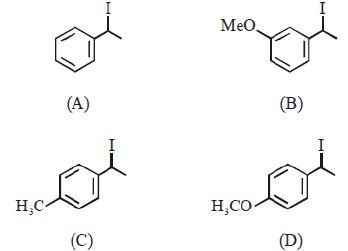
Rate of \(S_N1\) reaction \(\alpha \) stability of \({C^ \oplus } - I.M\) -
- (A) \(CH_2 = CH -Cl\)
- (B) \(CHCl_3\)
- (C) \((CH_3)_3CCl\)
- (D) \(CCl_4\)
Show answer and solution
Correct Answer: (C)
\((CH_3)_3CCl\) will give \(Cl^-\) and most stable carbocation. Hence \((CH_3)_3CCl\) likely to give a precipitate with \(AgNO_3\) solution -
- (A) \(\begin{array}{*{20}{c}}
{C{H_2} - CH - C{H_3}} \\
{|\,\,\,\,\,\,\,\,\,\,\,\,\,\,\,\,\,\,|\,\,\,\,\,\,\,\,\,\,\,\,\,\,\,\,\,\,\,\,\,\,\,\,\,} \\
{Cl\,\,\,\,\,\,\,\,\,\,\,\,\,Cl\,\,\,\,\,\,\,\,\,\,\,\,\,\,\,\,\,\,\,\,\,\,}
\end{array}\) - (B) \(\begin{array}{*{20}{c}}
{C{H_2} - C{H_2} - C{H_2}\,\,\,\,\,\,\,\,\,\,\,\,\,\,\,\,\,\,\,\,\,\,\,\,\,\,\,\,} \\
{\,|\,\,\,\,\,\,\,\,\,\,\,\,\,\,\,\,\,\,\,\,\,\,\,\,\,\,\,\,\,\,\,\,\,\,\,\,\,\,\,|\,\,\,\,\,\,\,\,\,\,\,\,\,\,\,\,\,\,\,\,\,\,\,\,\,\,\,\,\,\,\,\,\,\,\,} \\
{\,\,\,\,\,\,\,\,\,\,\,\,\,\,\,Cl\,\,\,\,\,\,\,\,\,\,\,\,\,\,\,\,\,\,\,\,\,\,\,\,\,\,\,\,\,\,\,\,\,Cl\,\,\,\,\,\,\,\,\,\,\,\,\,\,\,\,\,\,\,\,\,\,\,\,\,\,\,\,\,\,\,\,\,\,\,\,\,\,\,\,\,\,\,\,\,\,\,\,\,}
\end{array}\) - (C) \(\begin{array}{*{20}{c}}
{CH - CH - C{H_2} - C{H_3}} \\
{\,\,\,|\,\,\,\,\,\,\,\,\,\,\,\,\,\,\,\,\,\,\,\,\,\,\,\,\,\,\,\,\,\,\,} \\
{Cl\,\,\,\,\,\,\,\,\,\,\,\,\,\,\,\,\,\,\,\,\,\,\,\,}
\end{array}\) - (D) \(\begin{array}{*{20}{c}}
{Cl} \\
| \\
{C{H_3} - C - C{H_3}} \\
| \\
{Cl}
\end{array}\)
Show answer and solution
Correct Answer: (D)
\(\underset{(I)}{\mathop{\underset{({{C}_{3}}{{H}_{6}}C{{l}_{2}})}{\mathop{\begin{matrix}
\begin{matrix}
\,\,Cl \\
| \\
\end{matrix} \\
{{H}_{3}}C-C-C{{H}_{3}} \\
| \\
\,\,Cl \\
\end{matrix}}}\,}}\,\) \(\xrightarrow[{(aq.)}]{{KOH}}\) \(\mathop {\mathop {\begin{array}{*{20}{c}}
{\begin{array}{*{20}{c}}
{\,\,\,\,OH} \\
|
\end{array}} \\
{C{H_3} - C - C{H_3}} \\
| \\
{\,\,\,\,OH}
\end{array}}\limits_{Unstable} }\limits \xrightarrow{{{H_2}O}}\) \(\mathop {\begin{array}{*{20}{c}}
O \\
{||} \\
{C{H_3} - C - C{H_3}}
\end{array}}\limits_{(II)} \) \(\xrightarrow[{(II)\,{H_2}O\,/\,{H^ \oplus }}]{{(I)\,C{H_3}MgBr}}\) \({\mathop {\begin{array}{*{20}{c}}
{\begin{array}{*{20}{c}}
{\,\,\,\,OH} \\
|
\end{array}} \\
{C{H_3} - C - C{H_3}} \\
| \\
{\,\,\,\,C{H_3}}
\end{array}}\limits_{{3^0}\,alcohol} }\) \(\xrightarrow[{Lucas\,\,\,Test}]{{Anhy.\,ZnC{l_3}\, + \,HCl}}\) Gives turbidity immediately - (A) \(\begin{array}{*{20}{c}}
-
- (A) \((III) < (II) < (I)\)
- (B) \((II) < (I) < (III)\)
- (C) \((I) < (III) < (II)\)
- (D) \((II) < (III) < (I)\)
Show answer and solution
Correct Answer: (B)
Secondary, tertiary and benzylic halides appear to react by a mechanism that involves the formation of a carbocation and proceeds through \(\mathrm{S}_{\mathrm{N}} 1\) mechanism which takes place in two steps. The first step is the slow step \(-\) it is the rate-determining step. In this step, a molecule of alkyI halide ionizes and becomes an alkyl cation. Therefore, greater the stability of carbocation greater will be its tendency to react via \(S_{N} 1\) mechanism.\(\mathrm{R}-\mathrm{X} \rightleftharpoons \mathrm{R}^{+}+\mathrm{X}^{-}\)
In the second step, the intermediate alkyl cation reacts rapidly with water to produce alcohol.
\(\mathrm{R}^{+}+\mathrm{H}_{2} \mathrm{O} \rightleftharpoons \mathrm{ROH}\)
Hence, the order of reactivity of halides for the \(\mathrm{S}_{\mathrm{N}} 1\) mechanism is \(\mathrm{II}<\mathrm{I}<\mathrm{III}\).
-
- (A) \(CH_2 = CHCH_2CH = CHCH_3\)
- (B) \(CH_2= CHCH = CHCH_2CH_3\)
- (C) \(CH_3CH = C = CHCH_2CH_3\)
- (D) \(CH_3CH = CH - CH = CHCH_3\)
Show answer and solution
Correct Answer: (D)
\(\,\begin{array}{*{20}{c}}
{C{H_3} - CH - C{H_2} - CH - C{H_2} - C{H_3}}\\
{\,\,\,\,\,\,\,\,\,\,\,\,\,\,\,\,\,\,\,\,\,\,\,\,\,\,\,\,\,\,|\,\,\,\,\,\,\,\,\,\,\,\,\,\,\,\,\,\,\,\,\,\,\,\,\,\,\,\,\,\,\,\,\,\,\,|\,\,\,\,\,\,\,\,\,\,\,\,\,\,\,\,\,\,\,\,\,\,\,\,\,\,\,\,\,\,\,\,\,\,\,\,\,\,\,\,\,\,\,\,\,\,\,\,\,\,\,\,}\\
{\,\,\,\,\,\,\,\,\,Br\,\,\,\,\,\,\,\,\,\,\,\,\,\,\,\,\,\,\,\,\,\,\,\,\,\,\,\,\,\,\,Br\,\,\,\,\,\,\,\,\,\,\,\,\,\,\,\,\,\,\,\,\,\,\,\,\,\,\,\,\,\,}
\end{array}\) \(\xrightarrow[{{E_2}}]{{KOH,\,C{H_3}OH\,\Delta }}\) \(\mathop {C{H_3} - CH = CH - CH = CH - C{H_3}}\limits_{{\text{(Saytzeff product)}}} \) -
- (A) \(NaI\)
- (B) \(NaOEt/ EtOH\)
- (C) \(NaOH/H_2O\)
- (D) \(NaOH /H_2O-EtOH\)
Show answer and solution
Correct Answer: (A)
Alkyl chloride or bromide undergo substitution and get converted to an alkyl iodide on treatment with a solution of sodium iodide in acetone. e.g.\(CH_3CH_2CH_2Br + NaI\) \(\xrightarrow{{acetone}}\) \(CH_3CH_2CH_2I\) + \(NaBr\)
This reaction is also known as Finkelstein Reaction
-
- (A) \(C_6H_5CHC_6H_5Br\)
- (B) \(C_6H_5CH_2Br\)
- (C) \(C_6H_5CHCH_3Br\)
- (D) \(C_6H_5CCH_3C_6H_5Br\)
Show answer and solution
Correct Answer: (C)
\(C_6H_5CHCH_3Br\) being an optically active secondary alkyl bromide undergoes \(S_N2\) nucleophilic substitution reaction. Hence it undergoes complete inversion of configuration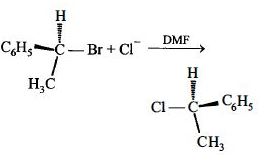
- 44. In \({S_{{N^2}}}\) reactions, the correct order of reactivity for the following compounds : 2014 Medium
- (A) \(CH_3Cl > (CH_3)_2CHCl > CH_3CH_2Cl > ( CH_3)_3CCl\)
- (B) \(CH_3Cl > CH_3CH_2 Cl > (CH_3)_2CHCl > (CH_3)_3CCl\)
- (C) \(CH_3CH_2 Cl > CH_3Cl > (CH_3)_2CHCl > (CH_3)_3CCl\)
- (D) \((CH_3 )_2CHCl > CH_3CH_2Cl > CH_3Cl > (CH_3)_3CCl\)
Show answer and solution
Correct Answer: (B)
Rate of \({S_{{N^2}}} \propto \frac{1}{\text { Steric crowding of }^{\prime} C^{\prime}}\)As steric hindrance (crowding) increases, the rate of \({S_{{N^2}}}\) reaction decreases.
The order of reactivity towards \({S_{{N^2}}}\) reaction for alkyl halides is
Primary halides \(>\) Secondary halides \(>\) Tertiary halides
- 45. The major organic compound formed by the reaction of \(1, 1, 1-\) trichloroethane with silver powder is : 2014 Hard
- (A) Acetylene
- (B) Ethene
- (C) \(2 -\) Butyne
- (D) \(2 -\) Butene
Show answer and solution
Correct Answer: (C)
\(2 \mathrm{CH}_{3}-\mathrm{CCl}_{3} \stackrel{6 \mathrm{Ag}}{\longrightarrow} \mathrm{CH}_{3}-\mathrm{C} \equiv \mathrm{C}-\mathrm{CH}_{3}+6 \mathrm{AgCl}\) -
- (A) secondary alcohol by \({S_{{N^1}}}\)
- (B) tertiary alcohol by \({S_{{N^1}}}\)
- (C) secondary alcohol by \({S_{{N^2}}}\)
- (D) tertiary alcohol by \({S_{{N^2}}}\)
Show answer and solution
Correct Answer: (B)
The reaction of alcohol with Lucas reagent is mostly an \({S_{{N^1}}}\) reaction and the rate of reaction is directly proportional to the stability of carbocation formed in the reaction. Since \(3^{o} R-O H\) forms \(3^{o}\) carbocation (most stable), hence it will react fastest. -
- (A) \(Br^- > I^->Cl^-\)
- (B) \({I^ - } > B{r^ - } > C{l^{^ - }}\)
- (C) \(C{l^{^ - }} > B{r^ - } > {I^ - }\)
- (D) \(C{l^{^ - }} > {I^ - } > B{r^ - }\)
Show answer and solution
Correct Answer: (B)
Since the leaving group breaks away as a base, it is easier to displace weaker bases as compared to stronger bases. Thus less basic the substituent. the more easily it is displaced. Since the basic strength of the given groups is in order.\({I^ - } < B{r^ - } < Cl^-\)
Thus the order of halogen leaving groups is
\({I^ - } > B{r^ - } > C{l^{^ - }}\)
-
- (A) \(RI > RBr > RCl\)
- (B) \(RCl > RBr> RI\)
- (C) \(RBr >RCl >RI\)
- (D) \(RBr > RI > RCl\)
Show answer and solution
Correct Answer: (A)
For a given alkyl group, the order of reactivity is\(\mathop {\underline {R - I\, > \,R\, - \,Br\, > \,R\, - \,Cl\, > \,R\, - \,F} }\limits_{\;{\text{ }}increasing{\text{ }}bond{\text{ }}energy} \)
decreasing halogen reactivity.
This order depends on the carbon-halogen bond energy; the carbon-fluorine bond energy is maximum and thus fluorides are least reactive while carbon - iodide bond energy is maximum hence iodides are most reactive.

No questions on this page match these filters.
Other STD 12 - Haloalkanes and Haloarenes topics
Frequently asked
How many Properties of Haloalkanes questions came in JEE Mains?
48 questions from 2013–2026, each with the correct answer and a full solution.
How difficult are Properties of Haloalkanes questions?
8% are easy, 48% medium and 44% hard.