


Questions
Newest firstShowing 1–14 of 14 questions
-
- (A) 70
- (B) 80
- (C) 90
- (D) 100
Show answer and solution
Correct Answer: (C)
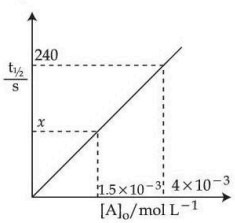
From the given graph, the plot of half-life \(t_{1/2}\) versus initial concentration \([A]_0\) is a straight line passing through the origin.
This indicates that \(t_{1/2}\) is directly proportional to \([A]_0\), which means \(t_{1/2} \propto [A]_0\).
Therefore, the ratio \(\dfrac{t_{1/2}}{[A]_0}\) is constant.
Using the coordinates from the graph, we get:
\(\dfrac{240}{4 \times 10^{-3}} = \dfrac{x}{1.5 \times 10^{-3}}\)
Solving for \(x\):
\(x = \dfrac{240 \times 1.5 \times 10^{-3}}{4 \times 10^{-3}}\)
\(x = 60 \times 1.5 = 90\)
The value of \(x\) is \(90\).
Answer: \(90\) -
- (A) C > B > A > D
- (B) A > D > C > B
- (C) A > D > B > C
- (D) C > A > D > B
Show answer and solution
Correct Answer: (D)
Correct order of acidic strength of major product formed in the given reaction is
(A)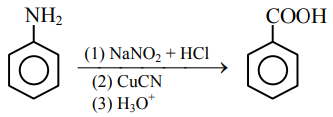
(B) \(CH _3 CH _2- CHO \xrightarrow[\Delta]{ Ag \left( NH _3\right)_2 OH } CH _3- CH _2- COOH\)
(C) \(CH _4+ O _2 \xrightarrow[ Na _2 Cr _2 O _7 / H ^{+}]{ MO _2 O _3} HCOOH\)
(D) \(Ph - CH _2 MgBr + CO _2 \xrightarrow[ H _3 O ^{\oplus}]{\text { Dryether }} Ph - CH _2- COOH\) -
- (A) \(3\)
- (B) \(\frac{1}{9}\)
- (C) \(9\)
- (D) \(\frac{1}{3}\)
Show answer and solution
Correct Answer: (C)
Since, the reaction is elementary
\(\text { Rate }=k[A]^1[B]^1\)
When V is reduced to \(\frac{1}{3} \mathrm{~V}\), concentration will be tripled.
Hence, rate \(=9 \times(\text { rate })_{\text {initial }}\)
\(x=9\) -
- (A) \(\frac{4}{3}\)
- (B) \(\frac{3}{2}\)
- (C) \(\frac{3}{4}\)
- (D) \(\frac{2}{3}\)
Show answer and solution
Correct Answer: (D)
For \(\mathrm{I}^{\text {st }}\) order reaction
When \(\mathrm{C}_{\mathrm{t}}=\mathrm{Co} / 4\)
\(\begin{aligned}
& \mathrm{t}_1=2 \mathrm{t}_{50 \%}. \\
& \text { when } \mathrm{C}_{\mathrm{t}}=\mathrm{Co} / 8 \\
& \mathrm{t}_2=3 \mathrm{t}_{50 \%} \\
& \text { so } \frac{\mathrm{t}_1}{\mathrm{t}_2}=\frac{2}{3}
\end{aligned}\) -
- (A) \(2^{(n-m)}\)
- (B) \((n-m)\)
- (C) \((m+n)\)
- (D) \(\frac{1}{2^{m+n}}\)
Show answer and solution
Correct Answer: (A)
\(\mathrm{r}_1=\mathrm{k}[\mathrm{~A}]^{\mathrm{n}}[\mathrm{~B}]^{\mathrm{m}}\)
Now A is doubled \& B is halved in concentration
\(\Rightarrow \mathrm{r}_2=\mathrm{k} 2^{\mathrm{n}}[\mathrm{~A}]^{\mathrm{n}} \cdot \frac{[\mathrm{~B}]^{\mathrm{m}}}{2^{\mathrm{m}}}\)
Now \(\frac{r_2}{r_1}=2^{(n-m)}\) -
- (A) \(16\)
- (B) \(17\)
- (C) \(18\)
- (D) \(19\)
Show answer and solution
Correct Answer: (B)
Rate of reaction (ROR)\(=-\frac{1}{2} \frac{\Delta\left[\mathrm{N}_2 \mathrm{O}_5\right]}{\Delta \mathrm{t}}=\frac{1}{4} \frac{\left[\mathrm{NO}_2\right]}{\Delta \mathrm{t}}=\frac{\Delta\left[\mathrm{O}_2\right]}{\Delta \mathrm{t}}\)
\(\mathrm{ROR}=-\frac{1}{2} \frac{\Delta\left[\mathrm{N}_2 \mathrm{O}_5\right]}{\Delta \mathrm{t}}=-\frac{1}{2} \frac{(2.75-3)}{30} \mathrm{molL}^{-1} \mathrm{~min}^{-1}\)
\(\mathrm{ROR}=-\frac{1}{2} \frac{(-0.25)}{30} \mathrm{molL}^{-1} \mathrm{~min}^{-1}\)
\(\text { ROR }=\frac{1}{240} \mathrm{molL}^{-1} \mathrm{~min}^{-1}\)
\(\text { Rate of formation of } \mathrm{NO}_2=\frac{\Delta\left[\mathrm{NO}_2\right]}{\Delta \mathrm{t}}=4 \times \mathrm{ROR}\)
\(=\frac{4}{240}=16.66 \times 10^{-3} \mathrm{molL}^{-1} \mathrm{~min}^{-1} \simeq 17 \times 10^{-3}\)
-
- (A) \(2\)
- (B) \(4\)
- (C) \(6\)
- (D) \(8\)
Show answer and solution
Correct Answer: (A)
Only option \((B)\) is correct as order cannot be determined -
- (A) \(620\)
- (B) \(623\)
- (C) \(622\)
- (D) \(625\)
Show answer and solution
Correct Answer: (B)
\(A + B \rightarrow P\)\(\begin{array}{ll} t =0 & 7\,g \\ t = t & 2\, g \end{array}\)
at constant volume
\(t =\frac{2.303}{ K } \log \frac{[ A ]_0}{[ A ]_{ t }}\)
\(=\frac{2 \cdot 303}{2 \cdot 011 \times 10^{-3}} \log \frac{7}{2}\)
\(=\frac{2 \cdot 303 \times 0 \cdot 544}{2 \cdot 011 \times 10^{-3}}\)
\(=622.989\)
\(\approx 623\)
-
- (A) \(25\)
- (B) \(20\)
- (C) \(1\)
- (D) \(10\)
Show answer and solution
Correct Answer: (C)
\(\gamma_{1} A +\gamma_{2} B \longrightarrow \gamma_{3} C +\gamma_{4} D\)Given : \(+\frac{ d [ D ]}{ dt }=\frac{-3}{2} \frac{ d [ B ]}{ dt }\)
\(\Rightarrow \frac{-1}{2} \frac{ d [ B ]}{ dt }=\frac{+1}{3} \frac{ d [ D ]}{ dt }\)
\(-\frac{ d [ B ]}{ dt }=-2 \frac{ d [ A ]}{ dt } \Rightarrow-\frac{1}{2} \frac{ d [ B ]}{ dt }=\frac{- d ( A )}{ dt }\)
\(+\frac{ d [ B ]}{ dt }=9 m\,mol\,dm ^{-3} s ^{-1}\)
\(\frac{+ d [ C ]}{ dt }=\frac{20-10}{10}=1 \,m\,mol\,dm ^{-3} s ^{-1}\)
\(\frac{+ d [ C ]}{ dt }=\frac{1}{9} \times \frac{+ d [ D ]}{ dt }\)
\(1 A +2 B \longrightarrow \frac{1}{3} C +3 D\)
\(\Rightarrow 3 A +6 B \longrightarrow C +9 D\)
Rate of reaction \(=\frac{+ d [ C ]}{ dt }=1\, m\,mol \,dm ^{-3} s ^{-1}\)
-
- (A) \(C_2H_2\) and \(C_6H_6\)
- (B) \(n-\) Butane and Iso-butane
- (C) \(N_2O_4\) and \(NO_2\)
- (D) \(C_2H_4\) and \(C_4H_8\)
Show answer and solution
Correct Answer: (D)
The correct option is \(B C _2 H _4\) and \(C _4 H _8\)\(\log \frac{- d [ A ]}{ dt }=\log \frac{ d [ B ]}{ dt }+0.3010 \)
\(\frac{- d [ A ]}{ dt }=2 \times \frac{ d [ B ]}{ dt } \)
\(\frac{1}{2} \times \frac{- d [ A ]}{ dt }=\frac{ d [ B ]}{ dt } \)
\(2 A \rightarrow B \)
\(2 C _2 H _4 \rightarrow C _4 H _8\)
-
- (A) \(1.667\times10^{-2}\)
- (B) \(4.167\times10^{-3}\)
- (C) \(8.333\times10^{-3}\)
- (D) \(2.083\times10^{-3}\)
Show answer and solution
Correct Answer: (A)
\(2N_2O_5 (g) \to 4NO_2 (g) + O_2 (g)\)\(t=0\) \(3.0\,M\)
\(t=30\) \(2.75\,M\)
\(\frac{{ - \,\Delta \,[{N_2}{O_5}]}}{{\Delta t}}\, = \,\frac{{0.25}}{{30}}\)
\(\frac{1}{2}\, \times \frac{{ - \,\Delta \,[{N_2}{O_5}]}}{{\Delta t}}\, = \frac{1}{4}\, \times \frac{{ - \,\Delta \,[N{O_2}]}}{{\Delta t}}\)
\(\frac{{\Delta \,[N{O_2}]}}{{\Delta t}}\, = \,\frac{{0.25}}{{30}}\, \times \,2\, = \,1.66\, \times \,{10^{ - 2}}\,M/\min \)
-
- (A) \(\frac{1}{3}\frac{{d\left[ A \right]}}{{dt}} = \frac{{d\left[ C \right]}}{{dt}} = k{\left[ A \right]^n}{\left[ B \right]^m}\)
- (B) \( - \frac{{d\left[ A \right]}}{{dt}} = \frac{{d\left[ C \right]}}{{dt}} = k{\left[ A \right]^n}{\left[ B \right]^m}\)
- (C) \( + \frac{1}{3}\frac{{d\left[ A \right]}}{{dt}} = - \frac{{d\left[ C \right]}}{{dt}} = k{\left[ A \right]^n}{\left[ B \right]^m}\)
- (D) \( - \frac{1}{3}\frac{{d\left[ A \right]}}{{dt}} = \frac{{d\left[ C \right]}}{{dt}} = k{\left[ A \right]^n}{\left[ B \right]^m}\)
Show answer and solution
Correct Answer: (D)
For the reaction\(3A+2B\to C+D\)
Rate of disappearance of \(A\,=\) Rate of appearance of \(C\) reation
\( = \, - \,\frac{1}{3}\,\frac{{d[A]}}{{dt}}\, = \,\frac{{d[C]}}{{dt}}\, = \,k\,{[A]^n}\,{[B]^m}\)
-
- (A) \(- 1.25\times10^{-4}\)
- (B) \(- 2.50\times10^{-4}\)
- (C) \(- 3.75\times10^{-4}\)
- (D) \(-5.00\times10^{-4}\)
Show answer and solution
Correct Answer: (D)
From rate law\( - \frac{1}{2}\frac{{dS{O_2}}}{{dt}}\, - \,\frac{{d{O_2}}}{{dt}} - \frac{1}{2}\frac{{dS{O_3}}}{{dt}}\)
\(\therefore \,\,\frac{{dS{O_2}}}{{dt}}\, = -\,2 \times \frac{{d{O_2}}}{{dt}}\)
\(=\,-\,2\times 2.5\times 10^{-4}\)
\(=\,-\,5\times 10^{-4}\,mol\,L^{-1}\,s^{-1}\)
-
- (A) \(0.0456\)
- (B) \(1.14\)
- (C) \(0.114\)
- (D) \(0.57\)
Show answer and solution
Correct Answer: (B)
Given \( - \,\frac{{dMnO_4^ - }}{{dt}}\, = \,4.56\, \times {10^{ - 3}}\,M{s^{ - 1}}\)From the reaction given,
\( - \frac{1}{2}\,\frac{{dMnO_4^ - }}{{dt}}\, = \,\frac{{4.56 \times {{10}^{ - 3}}}}{2}\,M{s^{ - 1}}\)
\( - \frac{1}{2}\,\frac{{dMnO_4^ - }}{{dt}}\, = \,\frac{1}{5}\,\frac{{d{I_2}}}{{dt}}\)
\(\therefore \,\, - \frac{5}{2}\,\frac{{dMnO_4^ - }}{{dt}}\,\, = \frac{{d{I_2}}}{{dt}}\)
On substituting the given value
\(\therefore \frac{{d{I_2}}}{{dt}}\, = \,\frac{{4.56\, \times {{10}^{ - 3}} \times 5}}{2}\, = \,1.14\, \times \,{10^{ - 2}}\,M/s\)
No questions on this page match these filters.
Other STD 12 - Chemical kinetics topics
Frequently asked
How many Rate of a reaction questions came in JEE Mains?
14 questions from 2013–2026, each with the correct answer and a full solution.
How difficult are Rate of a reaction questions?
21% are easy, 29% medium and 50% hard.