


Questions
Newest firstShowing 1–50 of 72 questions
-
- (A) B, C and D Only
- (B) C, D and E Only
- (C) A, C and E Only
- (D) A and E Only
Show answer and solution
Correct Answer: (D)
Statement A is correct. Nitrogen in oxidation states from \(+1\) to \(+4\) tends to disproportionate in acidic medium. For example, \(3HNO_2 \rightarrow HNO_3 + H_2O + 2NO\).
Statement B is incorrect. Nitrogen does not have d-orbitals in its valence shell, so it cannot form \(d\pi - p\pi\) multiple bonds. It forms \(p\pi - p\pi\) multiple bonds.
Statement C is incorrect. The N-N single bond is weaker than the P-P single bond due to high interelectronic repulsion between the non-bonding electrons, which arises from the small N-N bond length.
Statement D is incorrect. Density increases down the group in group 15. Nitrogen is a gas and has the lowest density in its group, while bismuth has the highest.
Statement E is correct. Nitrogen has only four valence orbitals (one 2s and three 2p orbitals) available for bonding. Therefore, its maximum covalency is restricted to four.
Thus, only statements A and E are correct.
Answer: A and E Only -
- (A) N & As
- (B) As & Bi
- (C) Bi & N
- (D) As & Sb
Show answer and solution
Correct Answer: (A)
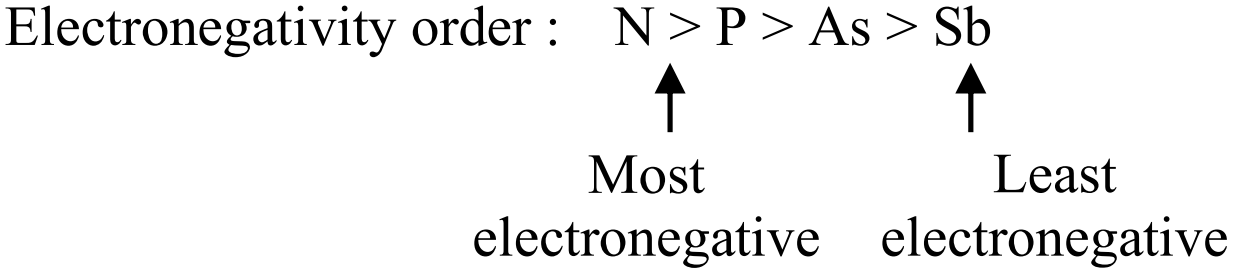
Element EN N 3.0 P 2.1 As 2.0 Sb 1.9 Bi 1.9
X = Nitrogen (N)
Y = Arsenic (As) -
- (A) A and B only
- (B) B and C only
- (C) A, B, C and D
- (D) A, C and D Only
Show answer and solution
Correct Answer: (C)
Statement A: The reducing nature of group 15 hydrides depends on the E-H bond strength. As the size of the central atom increases down the group, the E-H bond dissociation enthalpy decreases. Hence, the reducing character increases from NH\(_3\) to BiH\(_3\). This statement is correct.
Statement B: The basic character or the tendency to donate a lone pair of electrons depends on the electron density on the central atom. As the size of the central atom increases down the group, the electron density decreases. Thus, the basicity decreases from NH\(_3\) to BiH\(_3\). This statement is correct.
Statement C: Due to the decrease in E-H bond dissociation enthalpy down the group, the thermal stability of the hydrides decreases from NH\(_3\) to BiH\(_3\). This statement is correct.
Statement D: The H-E-H bond angle decreases down the group because the electronegativity of the central atom decreases and the size increases, causing the bond pairs to move further away from the central atom. This decreases the bond pair-bond pair repulsion. The bond angles are NH\(_3\) (\(107.8^{\circ}\)), PH\(_3\) (\(93.6^{\circ}\)), AsH\(_3\) (\(91.8^{\circ}\)), and SbH\(_3\) (\(91.3^{\circ}\)). This statement is correct.
All statements A, B, C, and D are correct.
Answer: A, B, C and D -
- (A) Both Statement-I and Statement-II are true.
- (B) Statement-I is true but Statement-II is false.
- (C) Both Statement-I and Statement-II are false.
- (D) Statement-I is false but Statement-II is true.
Show answer and solution
Correct Answer: (B)
\(X = N \quad X _2 O _3= N _2 O _3(\text { Acidic })\)
\(Y = Sb \quad Y _2 O _3= Sb _2 O _3(\text { Amphoteric })\)
Statement-I is true.
\(BCl_{3} + 3H_{2}O \rightarrow B(OH)_{3} + 3HCl\).
Statement-II is false. -
- (A) Both Statement I and Statement II are true.
- (B) Statement I is false but Statement II is true.
- (C) Both Statement I and Statement II are false.
- (D) Statement I is true but Statement II is false.
Show answer and solution
Correct Answer: (C)
\(HF < HCl < HBr < HI\) (bond length order)
\(F < Cl < Br < I\) (radius order)
\(PH _3< AsH _3< NH _3< SbH _3< BiH _3\) (Boiling point order)
Maximum possible covalency of phosphorous is 6 -
- (A) A, B & C only
- (B) A & D only
- (C) A, B, C & D
- (D) B & C only
Show answer and solution
Correct Answer: (A)
Stability: \( NH_{3}>PH_{3}>AsH_{3}>SbH_{3}>BiH_{3} \)
Basicity: \( NH_{3}>PH_{3}>AsH_{3}>SbH_{3}>BiH_{3} \)
Reducing character : \(NH _3< PH _3< AsH _3< SbH _3< BiH _3\)
Boiling point: \(PH _3< AsH _3< NH _3< SbH _3< BiH _3\) -
- (A) 10
- (B) 15
- (C) 20
- (D) 25
Show answer and solution
Correct Answer: (B)
Phosphorus belongs to \(15^{\text {th }}\) group and forms \(\mathrm{d} \pi-\mathrm{d} \pi\) bond with transition metal and \(\mathrm{PH}_3\) is strongest base among the other group members except \(\mathrm{NH}_3\). -
- (A) Statement I is true but Statement II is false
- (B) Both Statement I and Statement II are false
- (C) Statement I is false but Statement II is true
- (D) Both Statement I and Statement II are true
Show answer and solution
Correct Answer: (D)
In oxide of nitrogen it can achieve +5 oxidation state because it can form \(\mathrm{p} \pi-\mathrm{p} \pi\) bond with oxygen e.g. \(\mathrm{N}_2 \mathrm{O}_5\)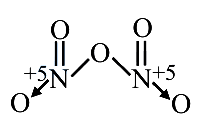
Nitrogen cannot form halide in +5 oxidation state because it does not contain d-orbital.
e.g. \(\mathrm{NX}_5\) does not exist
\(\mathrm{X}=\text { halide }\) -
- (A) Statement I is true but statement II is false
- (B) Both statement I and statement II are false
- (C) Statement I is false but statement II is true
- (D) Both statement I and statement II are true
Show answer and solution
Correct Answer: (B)
\(\ddot{\mathrm{N}}-\ddot{\mathrm{N}}\) single bond weaker than \(\ddot{\mathrm{P}}-\ddot{\mathrm{P}}\) due to more \(\ell \mathrm{p}-\ell \mathrm{p}\) repulsion.
Bond length \(\Rightarrow d_{p-p} \gt d_{N-N}(\operatorname{size} \uparrow\), B.L. \(\uparrow)\)
In group 15 elements only N & P show disproportionation in +3 oxidation state, As, Sb & Bi have almost inert for disproportionation in +3 oxidation state.
So both statements are false. -
- (A) \(\mathrm{PH}_3\) shows lower proton affinity than \(\mathrm{NH}_3\).
- (B) \(\mathrm{SO}_2\) can act as an oxidizing agent, but not as a reducing agent.
- (C) \(\mathrm{PF}_3\) exists but \(\mathrm{NF}_5\) does not.
- (D) \(\mathrm{NO}_2\) can dimerise easily.
Show answer and solution
Correct Answer: (B)
\(\stackrel{+4}{\mathrm{SO}_2}\) can acts as both oxidising agent as well reducing agents because due to intermediate oxidation state, it can oxidise and reduce as well. - 11. The maximum covalency of a non-metallic group 15 element ' E ' with weakest \(\mathrm{E}-\mathrm{E}\) bond is _______. 2025 Easy
- (A) 4
- (B) 6
- (C) 3
- (D) 5
Show answer and solution
Correct Answer: (A)
\(\mathrm{N}-\mathrm{N} < \mathrm{P}-\mathrm{P}\) : single \((\sigma)\) bond strength
Due to L.P.-L.P. replusion and maximum possible covalency of nitrogen is 4 . -
- (A) \(B\) and \(C\) only
- (B) \(C\) and \(D\) only
- (C) \(A\) and \(B\) only
- (D) \(A \)and \(D\) only
Show answer and solution
Correct Answer: (C)
On moving down the group, bond strength of \(\mathrm{M}-\mathrm{H}\) bond decreases, which reduces the thermal stability but increases reducing nature of hydrides, hence \(A\) and \(B\) are correct statements. -
- (A) \((A)\) is false but \((R)\) is true
- (B) Both \((A)\) and \((R)\) are true but \((R)\) is not the correct explanation of \((\mathrm{A})\)
- (C) \((A)\) is true but \((R)\) is false
- (D) Both \((A)\) and \((R)\) are true and \((R)\) is the correct explanation of \((A)\)
Show answer and solution
Correct Answer: (B)
According to \(NCERT\),Statement-\(I\) : Factual data,
Statement-\(II\) is true.
But correct explanation is presence of completely filled \(d\) and f-orbitals of heavier members.
-
- (A) Both \((A)\) and \((R)\) are correct and \((R)\) is not the correct explanation of \((A)\)
- (B) \((A)\) is not correct but \((R)\) is correct
- (C) Both \((A)\) and \((R)\) are correct but \((R)\) is the correct explanation of \((A)\)
- (D) \((A)\) is correct but \((R)\) is not correct
Show answer and solution
Correct Answer: (D)
Unlike \(\mathrm{NH}_3, \mathrm{PH}_3\) molecules are not associated through hydrogen bonding in liquid state. That is why the boiling point of \(\mathrm{PH}_3\) is lower than \(\mathrm{NH}_3\). -
- (A) \((A)\), \((B)\), \((D)\) only
- (B) \((A)\), \((C)\), \((E)\) only
- (C) \((B)\), \((D)\), \((E)\) only
- (D) \((D)\) and \((E)\) only
Show answer and solution
Correct Answer: (D)
\((D)\) Due to inert pair effect lower oxidation state is more stable.\((E)\) Nitrogen belongs to \(2^{\text {nd }}\) period and cannot expand its octet.
- 16. In the precipitation of the iron group (III) in qualitative analysis, ammonium chloride is added before adding ammonium hydroxide to : 2024 Medium
- (A) increase concentration of \(Cl ^{-}\)ions
- (B) increase concentration of \(NH _4{ }^{+}\)ions
- (C) prevent interference by phosphate ions
- (D) decrease concentration of \({ }^{-} OH\) ions
Show answer and solution
Correct Answer: (D)
\(NH _4 OH \rightleftharpoons NH _4^{+}+ OH ^{-}\)
\(NH _4 Cl \rightarrow NH _4^{+}+ Cl\)
Due to common ion effect of \(NH _4^{+}\),
[ \(OH ^{-}\)] decreases in such extent that only group-III cation can be precipitated, due to their very low \(K_{s p}\) in the range of \(10^{-38}\). -
- (A) \(\left[3\left(\mathrm{Ca}_3\left(\mathrm{PO}_4\right)_2\right) \cdot \mathrm{CaF}_2\right]\)
- (B) \(\left[3\left(\mathrm{Ca}_2\left(\mathrm{PO}_4\right)_2\right) \cdot \mathrm{Ca}(\mathrm{OH})_2\right]\)
- (C) \(\left[3\left(\mathrm{Ca}_3\left(\mathrm{PO}_4\right)_3\right) \cdot \mathrm{CaF}_2\right]\)
- (D) \(\left[3\left(\mathrm{Ca}_3\left(\mathrm{PO}_4\right)_2\right) \cdot \mathrm{Ca}(\mathrm{OH})_2\right]\)
Show answer and solution
Correct Answer: (A)
Fluoroapatite \(\Rightarrow\left[3 \mathrm{Ca}_3\left(\mathrm{PO}_4\right)_2 \cdot \mathrm{CaF}_2\right]\) -
- (A) \(\mathrm{NH}_3\)
- (B) \(\mathrm{SbH}_3\)
- (C) \(\mathrm{BiH}_3\)
- (D) \(\mathrm{PH}_3\)
Show answer and solution
Correct Answer: (C)
Strongest reducing agent : \(\mathrm{BiH}_3\) explained by its low bond dissociation energy. -
- (A) \(NO _2, N _2 O _5\)
- (B) \(NO _2, N _2 O _4\)
- (C) \(NO , NO _2\)
- (D) \(N _2 O _3, NO _2\)
Show answer and solution
Correct Answer: (C)
\(4 NH _3+5 O _2 \stackrel{\Delta}{\longrightarrow} 4 NO +6 H _2 O\)\(2 NO + O _2 \longrightarrow 2 NO _2\)
-
- (A) \(A-II, B-IV, C-III, D-I\)
- (B) \(A-II, B-I, C-III, D-IV\)
- (C) \(A-III, B-I, C-IV, D-II\)
- (D) \(A-III, B-I, C-II, D-IV\)
Show answer and solution
Correct Answer: (D)
\(N _2 O _4\)
-
- (A) \(PCl _3, S _2 Cl _2\) and \(4\)
- (B) \(POCl _3, S _2 Cl _2\) and \(4\)
- (C) \(PCl _3, S _2 Cl _2\) and \(2\)
- (D) \(POCl _3, S _2 Cl _2\) and \(2\)
Show answer and solution
Correct Answer: (A)
\(P _4+8 SOCl _2 \rightarrow 4 PCl _5+2 S _2 Cl _2+4 SO _2\) -
- (A) \(P _4 O _6\) and \(H _3 PO _3\)
- (B) \(PCl _3\) and \(H _3 PO _3\)
- (C) \(PCl _5\) and \(H _3 PO _4\)
- (D) \(POCl _3\) and \(H _3 PO _4\)
Show answer and solution
Correct Answer: (B)
\(P _4+8 SOCl _2 \rightarrow 4 PCl _3+4 SO _2+2 S _2 Cl _2\)\(PCl _3+3 H _2 O \rightarrow H _3 PO _3+3 HCl\)
-
- (A) the equilibrium will shift in the forward direction and more of \(Cl _2\) and \(PCl _3\) gases will be produced.
- (B) the equilibrium will go backward due to suppression of dissociation of \(PCl _5\).
- (C) helium will deactivate \(PCl _5\) and reaction will stop.
- (D) addition of helium will not affect the equilibrium.
Show answer and solution
Correct Answer: (D)
Addition of an inert gas (helium) to a gaseous equilibrium at constant volume does not change the partial pressures of the reacting gases.
Therefore, it does not affect the equilibrium position.
-
- (A) \(2\)
- (B) \(8\)
- (C) \(6\)
- (D) \(4\)
Show answer and solution
Correct Answer: (D)
\(H _4 P _2 O _6\)\(O.S.\) of \(P\) is \(+4\)

-
- (A) \(6\)
- (B) \(8\)
- (C) \(5\)
- (D) \(4\)
Show answer and solution
Correct Answer: (A)
\(\frac{\sigma}{\pi}=\frac{12}{2}=6\)So, Answer is \(6\)

- 26. Total number of acidic oxides among \(N _2 O _3, NO _2, N _2 O , Cl _2 O _7, SO _2, CO , CaO , Na _2 O\) and \(NO\) is \(...........\) 2023 Medium
- (A) \(8\)
- (B) \(2\)
- (C) \(4\)
- (D) \(9\)
Show answer and solution
Correct Answer: (C)
Acidic oxides are \(N _2 O _3, NO _2, Cl _2 O _7, SO _2\) -
- (A) It is a crystalline solid.
- (B) It is associated with more than one \(pK _{ a }\) values.
- (C) It has a fairly high melting point.
- (D) It has high solubility in benzene.
Show answer and solution
Correct Answer: (D)
Arginine exist is zwitterion, so solid in nature and soluble in polar solvent.
- 28. Which of the Phosphorus oxoacid can create silver mirror from \(AgNO _3\) solution ? 2023 Medium
- (A) \(\left( HPO _3\right)_{ n }\)
- (B) \(H _4 P _2 O _5\)
- (C) \(H _4 P _2 O _6\)
- (D) \(H _4 P _2 O _7\)
Show answer and solution
Correct Answer: (B)
Oxyacid having \(P - H\) bond can reduce \(AgNO _3\) to \(Ag\).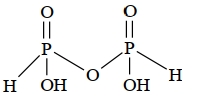
-
- (A) \(HI , NO _{2}\) and \(H _{2} O\)
- (B) \(HIO _{2}, N _{2} O\) and \(H _{2} O\)
- (C) \(HIO _{3}, NO _{2}\) and \(H _{2} O\)
- (D) \(HIO _{4}, N _{2} O\) and \(H _{2} O\)
Show answer and solution
Correct Answer: (C)
\(I _{2}+10\,HNO _{3(\text { conc) }} \Rightarrow 2 HIO _{3}+10 NO _{2}+4 H _{2} O\) -
- (A) \(1\)
- (B) \(2\)
- (C) \(3\)
- (D) \(4\)
Show answer and solution
Correct Answer: (B)
\(PCl _{3}+ H _{2} O \underset{\text { hydrolysis }}{\stackrel{\text { Partial }}{\longrightarrow}} PCl _{2}( OH )\) (or) \(PCl ( OH )_{2}+HCl\)\([Image]\)
no. of ionisable protons in \(B =2\)

- 31. Dinitrogen and dioxygen. the main constituents of air do not react with each other in atmosphere to form oxides of nitrogen because 2022 Medium
- (A) \(N _{2}\) is unreactive in the condition of atmosphere.
- (B) Oxides of nitrogen are unstable.
- (C) Reaction between them can occur in the presence of a catalyst.
- (D) The reaction is endothermic and require very high temperature.
Show answer and solution
Correct Answer: (D)
\(N _{2}+ O _{2} \stackrel{(1483-2000\,K )}{\longrightarrow} 2 NO\)(Endothermic and feasible at high temperature)
-
- (A) Both Statement \(I\) and Statement \(II\) are true.
- (B) Both Statement \(I\) and Statement \(II\) are false.
- (C) Statement \(I\) true. but statement \(II\) is false.
- (D) Statement \(I\) is false but statement \(II\) is true.
Show answer and solution
Correct Answer: (D)
As +ve oxidation state increases, \(EN\) of element increases hence acidic character increases. Down the group, non-metallic character decreases, acidic character decreases.Acidic character : \(E _{2} O _{5}> E _{2} O _{3}\)
Down the group, acidic character of \(E _{2} O _{3}\) decreases
-
- (A) \(Na _{3} P\) and \(H _{2} O\)
- (B) \(H _{3} PO\) and \(NaH\)
- (C) \(P ( OH )_{3}\) and \(NaH _{2} PO _{4}\)
- (D) \(PH _{3}\) and \(NaH _{2} PO _{2}\)
Show answer and solution
Correct Answer: (D)
\(P _{4}+3 NaOH +3 H _{2} O \rightarrow 3 NaH _{2} PO _{2}+ PH _{3}\) -
- (A) In this molecule, orbitals of phosphorous are assumed to undergo \(sp ^{3} d\) hybridization.
- (B) The geometry of \(PCl _{5}\) is trigonal bipyramidal.
- (C) \(PCl _{5}\) has two axial bonds stronger than three equatorial bonds.
- (D) The three equatorial bonds of \(PCl _{5}\) lie in a plane.
Show answer and solution
Correct Answer: (C)
In \(PCl _{5}\), axial bonds are weaker than equatorial. -
- (A) \(Ba \left( NO _{3}\right)_{2}\)
- (B) \(Ba \left( N _{3}\right)_{2}\)
- (C) \(NaNO _{2}\)
- (D) \(NaNO _{3}\)
Show answer and solution
Correct Answer: (B)
\(Ba \left( N _{3}\right)_{2} \rightarrow Ba +3 N _{2}\) -
- (A) nitrogen is less reactive than phosphorous.
- (B) nitrogen doesn't have \(d-\)orbitals in its valence shell
- (C) catenation tendency is weaker in nitrogen than phosphorous.
- (D) size of phosphorous is larger than nitrogen.
Show answer and solution
Correct Answer: (B)
\(PCl _{5}\) forms five bonds by using the d-orbitals to "expand the octet". But \(NCl _{5}\) does not exist because there are no \(d\)-orbitals in the valence shell \(\left(2^{\text {nd }}\right.\) shell). Therefore there is no way to expand the octet. - 37. The gas produced by treating an aqueous solution of ammonium chloride with sodium nitrite is .... . 2022 Medium
- (A) \(NH _{3}\)
- (B) \(N _{2}\)
- (C) \(N _{2} O\)
- (D) \(Cl _{2}\)
Show answer and solution
Correct Answer: (B)
\(NH _{4} Cl + NaNO _{2} \rightarrow NH _{4} NO _{2}+ NaCl \rightarrow N _{2}+2 H _{2} O\) - 38. The highest industrial consumption of molecular hydrogen is to produce compounds of element ...... . 2022 Easy
- (A) Carbon
- (B) Nitrogen
- (C) Oxygen
- (D) Chlorine
Show answer and solution
Correct Answer: (B)
Nitrogen.Around \(55\, \%\) of hydrogen around would goes to ammonia production.
-
- (A) \(NF _{3}\)
- (B) \(NCl _{3}\)
- (C) \(NBr _{3}\)
- (D) \(NI _{3}\)
Show answer and solution
Correct Answer: (A)
Order of stability: -\(NF _{3}\,>\, NCl _{3}\,>\, NBr _{3}\,>\, NI _{3}\)
-
- (A) \(0\)
- (B) \(1\)
- (C) \(2\)
- (D) \(3\)
Show answer and solution
Correct Answer: (A)
\(Pb \left( NO _{3}\right)_{2} \frac{\Delta}{673 K } PbO + NO _{2}+ O _{2}\)\(2 NO _{2} \stackrel{\text { Dimerise }}{\longrightarrow} N _{2} O _{4}\)

-
- (A) \(9\)
- (B) \(2\)
- (C) \(4\)
- (D) \(3\)
Show answer and solution
Correct Answer: (B)
\(C _{2} H _{5} OH + PCl _{3} \longrightarrow C _{2} H _{5} Cl + H _{3} PO _{3}\)\(H _{3} PO _{3}+ PCl _{3} \longrightarrow H _{4} P _{2} O _{5}+ HCl\)

- 42. The oxoacid of phosphorus that is easily obtained from a reaction of alkali and white phosphorus and has two \(P-H\) bonds, is 2022 Medium
- (A) Phosphonic acid
- (B) Phosphinic acid
- (C) Pyrophosphorus acid
- (D) Hypophosphoric acid
Show answer and solution
Correct Answer: (B)
\(P _{4}+3 NaOH +3 H _{2} O \rightarrow PH _{3}+3 NaH _{2} PO _{2}\)oxoacid \(= H _{3} PO _{2}\) (hypo phosphorus acid) or (phosphinic acid)
- 43. The total number of acidic oxides from the following list is: \(NO , N _{2} O , B _{2} O _{3}, N _{2} O _{5}, CO\), \(SO _{3}, P _{4} O _{10}\) 2022 Medium
- (A) \(3\)
- (B) \(4\)
- (C) \(5\)
- (D) \(6\)
Show answer and solution
Correct Answer: (B)
Neutral Oxides - \(N _{2} O , NO , CO\)Acidic Oxides - \(B _{2} O _{3}, N _{2} O _{5}, SO _{3}, P _{4} O _{10}\)
- 44. Which oxoacid of phosphorous has the highest number of oxygen atoms present in its chemical formula? 2022 Medium
- (A) Pyrophosphorous acid
- (B) Hypophosphoric acid
- (C) Phosphoric acid
- (D) Pyrophosphoric acid
Show answer and solution
Correct Answer: (D)
Pyrophosphoric acidPyrophosphorous acid \(\rightarrow H _{4} P _{2} O _{5}\).
Hypophosphoric acid \(\rightarrow H _{4} P _{2} O _{6}\)
Phosphoric acid \(\rightarrow H _{3} PO _{4}\)
Pyrophosphoric acid \(\rightarrow H _{4} P _{2} O _{7}\).
-
- (A) A dark brown ring is formed at the junction of two solutions.
- (B) Ring is formed due to nitroferrous sulphate complex.
- (C) The brown complex is \(\left[ Fe \left( H _{2} O \right)_{5}( NO )\right] SO _{4}\).
- (D) Heating the nitrate salt with conc. \(H _{2} SO _{4}\), light brown fumes are evolved.
Show answer and solution
Correct Answer: (B)
Ring is formed due to formation of nitrosoferrous sulphate -
- (A) \(PCl _{5}, SO _{2}\) and \(S _{2} Cl _{2}\)
- (B) \(PCl _{3} . SO _{2}\) and \(S _{2} Cl _{2}\)
- (C) \(PCl _{3}, SO _{2}\) and \(Cl _{2}\)
- (D) \(PCl _{5}, SO _{2}\) and \(Cl _{2}\)
Show answer and solution
Correct Answer: (B)
\(P _{4}+8 SOCl _{2} \rightarrow 4 PCl _{3}+4 SO _{2}+2 S _{2} Cl _{2}\) - 47. A group \(15\) element, which is a metal and forms a hydride with strongest reducing power among group \(15\) hydrides. The element is 2021 Medium
- (A) \(Sb\)
- (B) \(p\)
- (C) \(As\)
- (D) \(Bi\)
Show answer and solution
Correct Answer: (D)
In group \(15\)\(\left.\begin{array}{l} N \\ p \end{array}\right] \rightarrow\) Non metal
\(\left.\begin{array}{l} As \\ Sb \end{array}\right] \rightarrow\) Metalloid
\(Bi ] \rightarrow\) Metal
Hydrides of group \(15\) elements are \(NH _{3}\)
\(PH _{3}\)
\(AsH _{3}\)
\(SbH _{3}\)
\(BiH _{3}\)
In \(NH _{3}\), hydrogen atom gets partial positive charge due to less electronegativity.
But in \(BiH _{3},\) hydrogen atom gets partial negative charge because hydrogen is more electronegative than bismuth.
i.e. \(BiH _{3}\) is a strong reducing agent than others because we know that \(H\) is a strong reducing agent.
-
- (A) acidic
- (B) amphoteric
- (C) neutral
- (D) basic
Show answer and solution
Correct Answer: (A)
\(4 \mathrm{HNO}_{3}+\mathrm{P}_{4} \mathrm{O}_{10} \rightarrow 2 \mathrm{~N}_{2} \mathrm{O}_{5}+\left(\mathrm{HPO}_{3}\right)_{4}\)\(\mathrm{N}_{2} \mathrm{O}_{5}\) is acidic in nature.
-
- (A) \((a)-(v),(b)-(i),(c)-(ii),(d)-(iii)\)
- (B) \((a)-(iv), (b)-(i), (c)-(ii), (d)-(iii)\)
- (C) \((a)-(iv), (b)-(v), (c)-(ii), (d)-(iii)\)
- (D) \((a)-(v), (b)-(iv), (c)-(ii), (d)-(iii)\)
Show answer and solution
Correct Answer: (A)
\((a)\) Hypophosphorus acid : \(H _{3} PO _{2}\)\((+1) 3+x+(-2) 2=0\)
\(x=+1\)
\((b)\) Orthophosphoric acid : \(H _{3} PO _{4}\)
\((+1) 3+x+(-2) 4=0\)
\(x =+4\)
\((d)\) Orthophosphorous acid: \(H _{3} PO _{3}\)
\((+1) 3+x+(-2) 3=0\)
\(x=+3\)
- 50. The number of non-ionisable hydrogen atoms present in the final product obtained from the hydrolysis of \(\mathrm{PCl}_{5}\) is : 2021 Medium
- (A) \(0\)
- (B) \(2\)
- (C) \(1\)
- (D) \(3\)
Show answer and solution
Correct Answer: (A)
\(\mathrm{PCl}_{5}+\mathrm{H}_{2} \mathrm{O} \rightarrow \mathrm{POCl}_{3}+2 \mathrm{HCl}\)\(\quad\quad\quad\quad\quad\quad\quad\quad\downarrow+3 \mathrm{H}_{2} \mathrm{O}\)
\(\quad\quad\quad\quad\quad\quad\quad\quad\mathrm{H}_{3} \mathrm{PO}_{4}+3 \mathrm{HCl}\)
\([Image]\)
all hydrogens are ionisable
\(\therefore\) Ans is zero.

No questions on this page match these filters.
Other STD 12 - P -Block elements - ll topics
Frequently asked
How many Nitrogen family questions came in JEE Mains?
72 questions from 2014–2026, each with the correct answer and a full solution.
How difficult are Nitrogen family questions?
17% are easy, 56% medium and 28% hard.