


Questions
Newest firstShowing 1–11 of 11 questions
- 1. Potential energy (V) versus distance (x) is given by the graph, Rank various regions as per the magnitudes of the force (F) acting on a particle from high to low.
 2026 Hard
- 2. Which one of the following forces cannot be expressed in terms of potential energy? 2025 Easy
- 3. The potential energy function (in J) of a particle in a region of space is given as \(U=\left(2 x^2+3 y^3+2 z\right)\). Here \(\mathrm{x}, \mathrm{y}\) and \(\mathrm{z}\) are in meter. The magnitude of \(\mathrm{x}\) - component of force (in \(\mathrm{N}\) ) acting on the particle at point \(\mathrm{P}(1,2,3)\ \mathrm{m}\) is: 2024 Hard
- 4. A \(0.4\,kg\) mass takes \(8 s\) to reach ground when dropped from a certain height ' \(P\) ' above surface of earth. The loss of potential energy in the last second of fall is \(..............J\). [Take \(g =10\,m / s ^2\) ] 2023 Medium
- 5. For a body projected at an angle with the horizontal from the ground, choose the correct statement. 2023 Medium
- 6. Potential energy as a function of \(r\) is given by \(U=\frac{ A }{ r ^{10}}-\frac{ B }{ r ^{5}}\), where \(r\) is the interatomic distance, \(A \) and \(B\) are positive constants. The equilibrium distance between the two atoms will be 2022 Medium
- 7. Given below is the plot of a potential energy function \(U(x)\) for a system, in which a particle is in one dimensional motion, while a conservative force \(F(x)\) acts on it. Suppose that \(E_{\text {mech }}=8\, {J}\), the incorrect statement for this system is:
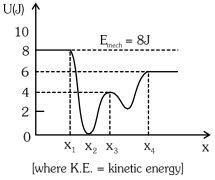 2021 Hard
- 8. The potential energy \((U)\) of a diatomic molecule is a function dependent on \(r\) (interatomic distance) as \(U =\frac{\alpha}{ r ^{10}}-\frac{\beta}{ r ^{5}}-3\) where, \(\alpha\) and \(\beta\) are positive constants. The equilibrium distance between two atoms will be \(\left(\frac{2 \alpha}{\beta}\right)^{\frac{a}{b}},\) where a \(=\) .......... 2021 Hard
- 9. If the potential energy between two molecules is given by \(U =\frac{-A }{ r ^{6}}+\frac{ B }{ r ^{12}},\) then at equilibrium, separation between molecules, and the potential energy are 2020 Hard
- 10. person trying to lose weight by burning fat lifts a mass of \(10\ kg\) upto a height of \(1\ m\) \(1000\) times. Assume that the potential energy lost each time he lowers the mass is dissipated. How much fat will he use up considering the work done only when the weight is lifted up? Fat supplies \(3.8 \times 10^7\ J\) of energy per kg which is converted to mechanical energy with a \(20\%\) efficiency rate. Take \(g=9.8\) \(ms^{-2}\) 2016 Medium
- 11. A particle is moving in a circle of radius \(r\) under the action of a force \(F\, = \alpha r^2\) which is directed towards centre of the circle. Total mechanical energy (kinetic energy + potential energy) of the particle is (take potential energy \(= 0\) for \(r\, = 0\)) 2015 Hard
No questions on this page match these filters.
Other STD 11 - Work,energy,power and collision topics
- 37Qs Work-Energy Theorem
- 9Qs Work Done by Constant Force
- 20Qs Power
- 7Qs Conservation of Energy and Momentum
- 10Qs Vertical Circular Motion
- 3Qs Conservative and Non-Conservative
- 14Qs Perfectly Inelastic Collision
- 11Qs Work Done by Spring and Potential Energy of Spring
- 33Qs Elastic and Inelastic collision
- 14Qs Work Done by Variable Force
- 22Qs Kinetic Energy
Frequently asked
How many Potential Energy questions came in JEE Mains?
11 questions from 2015–2026, each with the correct answer and a full solution.
How difficult are Potential Energy questions?
9% are easy, 36% medium and 55% hard.