


Questions
Newest firstShowing 1–10 of 10 questions
- 1. A vessel with square cross-section and height of 6 m is vertically partitioned. A small window of \(100 \mathrm{~cm}^2\) with hinged door is fitted at a depth of 3 m in the partition wall. One part of the vessel is filled completely with water and the other side is filled with the liquid having density \(1.5 \times 10^3 \mathrm{~kg} / \mathrm{m}^3\). What force one needs to apply on the hinged door so that it does not get opened ?
(Acceleration due to gravity \(=10 \mathrm{~m} / \mathrm{s}^2\)) 2025 Easy - 2. Two cylindrical vessels of equal cross sectional area of \(2 \mathrm{~m}^2\) contain water up to height 10 m and 6 m , respectively. If the vessels are connected at their bottom then the work done by the force of gravity is : (Density of water is \(10^3 \mathrm{~kg} / \mathrm{m}^3\) and \(\mathrm{g}=10 \mathrm{~m} / \mathrm{s}^2\)) 2025 Medium
- 3. An air bubble of volume \(1\,cm ^3\) rises from the bottom of a lake \(40\,m\) deep to the surface at a temperature of \(12^{\circ}\,C\). The atmospheric pressure is \(1 \times 10^5 Pa\), the density of water is \(1000\,kg / m ^3\) and \(g =10\,m / s ^2\). There is no difference of the temperature of water at the depth of \(40\,m\) and on the surface. The volume of air bubble when it reaches the surface will be \(..........\,cm^{3}\) 2023 Medium
- 4. A pressure-pump has a horizontal tube of cross-sectional area \(10\,cm ^{2}\) for the outflow of water at a speed of \(20\,m / s\). The force exerted on the vertical wall just in front of the tube which stops water horizontally flowing out of the tube, is \(...N\) [given : density of water \(=1000\,kg / m ^{3}\) ] 2022 Medium
- 5. Two cylindrical vessels of equal cross-sectional area \(16\,cm ^{2}\) contain water upto herghts \(100\,cm\) and \(150\,cm\) respectively. The vessels are interconnected so that the water levels in them become equal. The work done by the force of gravity during the process, is \(......J\) [Take density of water \(=10^{3}\,kg / m ^{3}\) and \(g =10\,ms ^{-2}\) ] 2022 Hard
- 6. A light cylindrical vessel is kept on a horizontal surface. Area of base is A. A hole of crosssectional area \('a'\) is made just at its bottom side. The minimum coefficient of friction necessary to prevent sliding the vessel due to the impact force of the emerging liquid is \((a\,<\,<\,A)\)
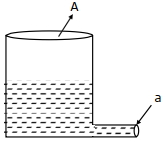 2021 Hard
- 7. Two identical cylindrical vessels are kept on the ground and each contain the same liquid of density \(d.\) The area of the base of both vessels is \(S\) but the height of liquid in one vessel is \(x_{1}\) and in the other, \(x_{2}\). When both cylinders are connected through a pipe of negligible volume very close to the bottom, the liquid flows from one vessel to the other until it comes to equilibrium at a new height. The change in energy of the system in the process is 2020 Hard
- 8. A thin uniform tube is bent into a circle of radius \(r\) in the virtical plane. Equal volumes of two immiscible liquids, whose densities are \({\rho _1}\) and \({\rho _2}\left( {{\rho _1} > {\rho _2}} \right)\) fill half the circle. The angle \(\theta\) between the radius vector passing through the common interface and the vertical is 2018 Hard
- 9. An open glass tube is immersed in mercury in such a way that a length of \(8\ cm\) extends above the mercury level. The open end of the tube is then closed and sealed and the tube is raised vertically up by additional \(46\ cm\). What will be length of the air column above mercury in the tube now ....... \(cm\) ? ( Atmospheric pressure = \(76\ cm\) of \(Hg\)) 2014 Medium
- 10. There is a circular tube in a vertical plane. Two liquids which do not mix and of densities \(d_1\) and \(d_2\) are filled in the tube. Each liquid subtends \(90^o\) angle at centre. Radius joining their interface makes an angle \(\alpha\) with vertical. Ratio \(\frac{{{d_1}}}{{{d_2}}}\) is
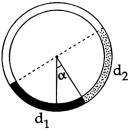 2014 Hard
No questions on this page match these filters.
Other STD 11 - Fluid mechanics topics
- 12Qs Buoyancy, Archimedes' Principle and Laws of Floatation
- 7Qs Newton's Law of Viscosity
- 7Qs Types of Flow, Equation of Continuity and Flow Rate
- 9Qs Velocity of Efflux and Torricelli's law
- 22Qs Bernoulli's Theorem and Applications of Bernoulli's Theory
- 23Qs Viscosity and Stoke's Law and Terminal
- 10Qs Pressure and Density
- 5Qs Pascal's Law
- 10Qs Reynold's Number and Poiseuille's Equation
Frequently asked
How many Pressure due to Liquid Column and Barometer questions came in JEE Mains?
10 questions from 2014–2025, each with the correct answer and a full solution.
How difficult are Pressure due to Liquid Column and Barometer questions?
10% are easy, 40% medium and 50% hard.