


Questions
Newest firstShowing 1–6 of 6 questions
-
- (A) Both Statement I and Statement II are true
- (B) Both Statement I and Statement II are false
- (C) Statement I is true but Statement II is false
- (D) Statement I is false but Statement II is true
Show answer and solution
Correct Answer: (C)
In fractional distillation, the temperature of the fractionating column decreases from bottom to top. As the vapours of the mixture rise, they cool and undergo condensation.
The component with the higher boiling point condenses at a higher temperature, meaning it condenses earlier (lower down the column) than the component with the lower boiling point. Thus, Statement I is true.
As the vapours rise up the fractionating column, the higher boiling component continuously condenses and falls back as liquid, while the lower boiling (more volatile) component remains in the vapour phase and continues to rise. Therefore, the vapours rising up the column become richer in the lower boiling component, not the high boiling component. Thus, Statement II is false.
Hence, Statement I is true but Statement II is false.
Answer: Statement I is true but Statement II is false -
- (A) 1,1-Dimethylcyclopropane
- (B) 2,2-Dimethylpropane
- (C) 2-Methylbutane
- (D) n-pentane
Show answer and solution
Correct Answer: (C)
Let the hydrocarbon be an alkane with general formula \(C_nH_{2n+2}\).
Molar mass \(= 14n + 2 = 72 \Rightarrow 14n = 70 \Rightarrow n = 5\)
The molecular formula is \(C_5H_{12}\).
The structural isomers of \(C_5H_{12}\) are:
n-pentane: \(CH_3-CH_2-CH_2-CH_2-CH_3\) (2 primary carbons)
2-methylbutane: \(CH_3-CH(CH_3)-CH_2-CH_3\) (3 primary carbons)
2,2-dimethylpropane: \(C(CH_3)_4\) (4 primary carbons)
The hydrocarbon with exactly three primary carbon atoms is 2-methylbutane.
Answer: 2-Methylbutane -
- (A) 431
- (B) 432
- (C) 433
- (D) 435
Show answer and solution
Correct Answer: (D)
Mass of the organic compound (X) can be calculated as:
\(\text{Mass of X} = \text{Moles} \times \text{Molar mass}\)
\(\text{Mass of X} = 2.0 \times 10^{-3} \text{ mol} \times 76 \text{ g mol}^{-1} = 0.152 \text{ g}\)
In the Carius method for sulphur estimation, the mass of sulphur in the given mass of \(\text{BaSO}_4\) is:
\(\text{Mass of S} = \dfrac{32}{233} \times \text{Mass of BaSO}_4\)
\(\text{Mass of S} = \dfrac{32}{233} \times 0.4813 \text{ g} \approx 0.0661 \text{ g}\)
The percentage of sulphur in the organic compound is given by:
\(\text{\% of S} = \dfrac{\text{Mass of S}}{\text{Mass of X}} \times 100\)
\(\text{\% of S} = \dfrac{0.0661}{0.152} \times 100 \approx 43.487 \text{ \%}\)
To express this in the requested format:
\(43.487 \text{ \%} = 434.87 \times 10^{-1} \text{ \%}\)
Rounding to the nearest integer, we get \(435\).
Answer: \(435\) -
- (A) Benzenoid aromatic
- (B) Benzenoid non-aromatic
- (C) Acyclic
- (D) Alicyclic
Show answer and solution
Correct Answer: (D)
is Alicyclic
-
- (A) \(Cl-CH=CH-OCH_3\)
- (B) \(Cl-CH=CH-CH_3\)
- (C) \(Cl-CH=CH_2\)
- (D) \(Cl-CH=CH-NO_2\)
Show answer and solution
Correct Answer: (D)
Explanation:
Let us analyze the bond length of the given vinyl chloride derivatives step-by-step using electronic effects in organic chemistry:
1. Resonance in Vinylic Halides:
In all the given options, the chlorine atom is directly attached to an \(sp^2\) hybridized carbon atom belonging to a carbon-carbon double bond (\(C=C\)). The lone pairs of electrons on the chlorine atom can undergo delocalization with the adjacent pi-bond through resonance (mesomeric effect). This resonance introduces a partial double bond character into the \(C-Cl\) bond, making it shorter and stronger than a standard single bond.
2. Role of the Substituent Group:
The degree of partial double bond character depends heavily on the nature of the substituent group attached at the opposite end of the conjugated system.
Effect in Option D:
The nitro group (\(-NO_2\)) is a very strong electron-withdrawing group via the resonance (\(-M\)) effect. It pulls electron density away from the double bond, which strongly facilitates the push of electrons from the chlorine lone pair into the conjugated system.
Impact of Delocalization:
This extensive delocalization significantly enhances the stability and contribution of the resonating structure containing the \(C=Cl^+\) double bond.
3. Comparison:
Because the \(-M\) effect of the \(-NO_2\) group maximizes the double-bond character of the \(C-Cl\) linkage, it results in the greatest contraction of bond distance. In contrast, groups like \(-OCH_3\) (Option A) and \(-CH_3\) (Option B) are electron-donating and oppose this delocalization.
Therefore, \(Cl-CH=CH-NO_2\) has the shortest \(C-Cl\) bond length.
Hence, Option D is the correct choice.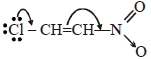
-
- (A) \((A)-(s); (B)-(r); (C)-(q); (D)-(p)\)
- (B) \((A)-(r); (B)-(s); (C)-(p); (D)-(q)\)
- (C) \((A)-(r); (B)-(s); (C)-(q); (D)-(p)\)
- (D) \((A)-(s); (B)-(r); (C)-(p); (D)-(q)\)
Show answer and solution
Correct Answer: (B)
\(\to \) Phenelzine contains hydrazine
\(\to \) Chloroxylenol contains phenol
\(\to \) Uracil is the pyrimidine base
\(\to \) Ranitidine contains furan ring

No questions on this page match these filters.
Other STD 11 - Organic chemistry Nomenclature of organic compounds topics
Frequently asked
How many Classification of organic compounds questions came in JEE Mains?
6 questions from 2018–2026, each with the correct answer and a full solution.
How difficult are Classification of organic compounds questions?
0% are easy, 67% medium and 33% hard.