


Questions
Newest firstShowing 1–14 of 14 questions
-
- (A) 2472
- (B) 2473
- (C) 2474
- (D) 2475
Show answer and solution
Correct Answer: (C)
Let the initial moles of \(N_2O_5\) be \(2\).
The given reaction is:
\(2N_2O_5(g) \rightleftharpoons 2N_2O_4(g) + O_2(g)\)
Since \(N_2O_5\) is \(50\%\) dissociated (degree of dissociation \(\alpha = 0.5\)), the moles at equilibrium are:
Moles of \(N_2O_5 = 2(1 - 0.5) = 1\)
Moles of \(N_2O_4 = 2(0.5) = 1\)
Moles of \(O_2 = 0.5\)
Total moles at equilibrium \(= 1 + 1 + 0.5 = 2.5\)
Given the total pressure \(P = 2\) atm, the partial pressures of the gases are:
\(P_{N_2O_5} = \dfrac{1}{2.5} \times 2 = 0.8\) atm
\(P_{N_2O_4} = \dfrac{1}{2.5} \times 2 = 0.8\) atm
\(P_{O_2} = \dfrac{0.5}{2.5} \times 2 = 0.4\) atm
The equilibrium constant \(K_p\) is:
\(K_p = \dfrac{(P_{N_2O_4})^2 \cdot P_{O_2}}{(P_{N_2O_5})^2} = \dfrac{(0.8)^2 \times 0.4}{(0.8)^2} = 0.4\)
The standard free energy change \(\Delta G^\circ\) is given by:
\(\Delta G^\circ = -RT \ln K_p\)
Using the given values:
\(\ln(0.4) = 2.303 \log(0.4) = 2.303 (\log 4 - \log 10)\)
\(\ln(0.4) = 2.303 (2 \log 2 - 1) = 2.303 (2 \times 0.30 - 1) = 2.303 (-0.4) = -0.9212\)
Now, substituting the values into the \(\Delta G^\circ\) equation (\(T = 50^\circ C + 273 = 323\) K):
\(\Delta G^\circ = -8.314 \times 323 \times (-0.9212)\)
\(\Delta G^\circ = 2473.81\) J mol\(^{-1}\)
The magnitude of the standard free energy change to the nearest integer is \(2474\) J mol\(^{-1}\).
Answer: \(2474\) -
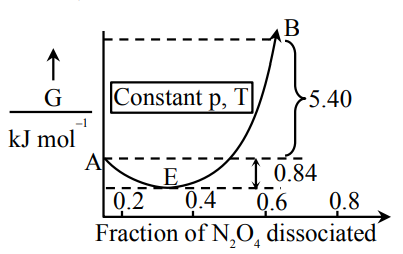
- (A) D and E only
- (B) C and E only
- (C) A and D only
- (D) B and C only
Show answer and solution
Correct Answer: (A)

(A) \( \Delta_{r}G^{\circ} = G^{\circ}_{B} - G^{\circ}_{A} = +ve \)
(B) \( \Delta_{r}G^{\circ} = +ve \). \( N_{2}O_{4} \) will partially dissociate into \( NO_{2} \).
(C) For reverse reaction, It is partially completed as there is equilibrium at E.
(D) For 1 mole \( N_{2}O_{4} \) ; \( \Delta_{r}G^{\circ} = -0.84 \, kJ \, mol^{-1} \).
(E) For 2 mole \( NO_{2} \) ; \( \Delta G^{\circ} = -5.4 - 0.84 = -6.24 \, kJ \, mol^{-1} \). -
- (A) 8
- (B) 10
- (C) 12
- (D) 14
Show answer and solution
Correct Answer: (A)
The given equilibrium reaction is:
\(\text{X}_2\text{Y}_4(g) \rightleftharpoons 2\text{XY}_2(g)\)
Initial moles: \(1\)
Degree of dissociation, \(\alpha = 0.75\)
Moles of \(\text{X}_2\text{Y}_4\) at equilibrium \(= 1 - \alpha = 1 - 0.75 = 0.25\)
Moles of \(\text{XY}_2\) at equilibrium \(= 2\alpha = 2 \times 0.75 = 1.5\)
Total moles at equilibrium \(= 0.25 + 1.5 = 1.75\)
Given total pressure, \(P = 1\) atm.
Partial pressure of \(\text{X}_2\text{Y}_4\), \(P_{\text{X}_2\text{Y}_4} = \dfrac{0.25}{1.75} \times 1 = \dfrac{1}{7}\) atm
Partial pressure of \(\text{XY}_2\), \(P_{\text{XY}_2} = \dfrac{1.5}{1.75} \times 1 = \dfrac{6}{7}\) atm
The equilibrium constant \(K_p\) is given by:
\(K_p = \dfrac{(P_{\text{XY}_2})^2}{P_{\text{X}_2\text{Y}_4}} = \dfrac{(\dfrac{6}{7})^2}{\dfrac{1}{7}} = \dfrac{36}{7}\)
The standard Gibbs free energy change is:
\(\Delta_r G^{\ominus} = -RT \ln K_p = -2.3 RT \log K_p\)
Calculating \(\log K_p\):
\(\log \left(\dfrac{36}{7}\right) = \log 36 - \log 7 = \log (2^2 \times 3^2) - \log 7\)
\(\log \left(\dfrac{36}{7}\right) = 2 \log 2 + 2 \log 3 - \log 7\)
\(\log \left(\dfrac{36}{7}\right) = 2(0.3) + 2(0.48) - 0.84 = 0.6 + 0.96 - 0.84 = 0.72\)
Substituting the values into the \(\Delta_r G^{\ominus}\) equation:
\(\Delta_r G^{\ominus} = -2.3 \times 8.3 \times 600 \times 0.72\)
\(\Delta_r G^{\ominus} = -8246.88 \text{ J mol}^{-1} = -8.24688 \text{ kJ mol}^{-1}\)
The magnitude of \(\Delta_r G^{\ominus}\) is \(8.24688 \text{ kJ mol}^{-1}\).
Rounding to the nearest integer, we get \(8\).
Answer: \(8\) -
- (A) 60
- (B) 70
- (C) 80
- (D) 90
Show answer and solution
Correct Answer: (B)
\(A _2+ B _2 \xrightarrow{500 K} 2 AB \log K =2.2\)
\(\Delta H ^{\circ}=(2 \times 32)-(6+ x )=(58- x ) kJ\)
\(\Delta S ^{\circ}=(2 \times 222)-(146+280)=18\) Joule
\(\Delta G ^{\circ}=- RT \ln K\)
\(\Delta G ^{\circ}=-\frac{8.314 \times 500 \times 2.2 \times 2.303}{1000}\)
\(\Delta G ^{\circ}=-21.06\)
\(58-x-500\left(\frac{18}{1000}\right)=-21.06\)
\(x =70.06 KJ / mol\) -
- (A) \(150\)
- (B) \(165\)
- (C) \(160\)
- (D) \(163\)
Show answer and solution
Correct Answer: (D)
\(\frac{3}{2} \mathrm{O}_{2(\mathrm{~g})} \rightleftharpoons \mathrm{O}_{3(\mathrm{~g})} \cdot \mathrm{K}_{\mathrm{P}}=2.47 \times 10^{-29}\)\(\Delta_{\mathrm{r}} \mathrm{G}^{\ominus}=-\mathrm{RT} \ln \mathrm{K}_{\mathrm{P}}\)
\(=-8.314 \times 10^{-3} \times 298 \times \ln \left(2.47 \times 10^{-29}\right)\)
\(=-8.314 \times 10^{-3} \times 298 \times(-65.87)\)
\(=163.19 \mathrm{~kJ}\)
-
- (A) \(70\)
- (B) \(60\)
- (C) \(80\)
- (D) \(57\)
Show answer and solution
Correct Answer: (D)
\(\Delta \mathrm{G}^{\circ}=-\mathrm{RT}(\mathrm{n} \mathrm{K}\)\(=-8.314 \times 300 \ell \mathrm{n}(10)\)
\(=5744.14 \mathrm{~J} / \mathrm{mole}\)
\(=57.44 \times 10^{-1} \mathrm{~kJ} / \mathrm{mole}\)
-
- (A) \(102\)
- (B) \(243\)
- (C) \(747\)
- (D) \(545\)
Show answer and solution
Correct Answer: (C)
\(2 O _{3} \rightleftharpoons 3 O _{2}( g )\)\(\frac{2}{5} \quad\quad\quad \frac{3}{5}\)
\(k _{ p }=\frac{ P _{ O _{2}}^{3}}{ P _{ O _{3}}^{2}}\)
\(k_{p}=1.35\)
\(\Delta G ^{\circ}=- RT \ln k _{ p }\)
\(=-8.3 \times 300 \times \ln 1.35\)
\(=-747 \,J / mol\)
-
- (A) \(8945\)
- (B) \(945\)
- (C) \(1400\)
- (D) \(2735\)
Show answer and solution
Correct Answer: (D)
\(\quad\quad HI \quad\quad\quad\rightleftharpoons \frac{1}{2} H _{2}+\frac{1}{2} I _{2}\)\(t _{ i } \,\quad\quad 1\)
\(\text { teq } \quad 1-0.4 \quad\quad \frac{0.4}{2} \quad\quad\quad \frac{0.4}{2}\)
\(K _{ p }= \frac{(0.2)^{\frac{1}{2}}(0.2)^{\frac{1}{2}}}{1-0.4}=\frac{0.2}{0.6}=\frac{1}{3}\)
\(\Delta G =\Delta G ^{\circ}+ RT \ln K =0\)
\(\Delta G ^{\circ} =- RT \ln K \Rightarrow-8.31 \times 300 \times 2.3 \times \log \left(\frac{1}{3}\right)\)
\(=2735\, J / mol\)
-
- (A) \(1255\)
- (B) \(1460\)
- (C) \(1380\)
- (D) \(1290\)
Show answer and solution
Correct Answer: (C)
\(\Delta G^{\circ}=-R T \ln K p\)\(=- R (300)(2) \ln (10)\)
\(=- R (300 \times 2 \times 2.3)\)
\(\Delta G^{\circ}=-1380 R\)
-
- (A) \(141\)
- (B) \(166\)
- (C) \(206\)
- (D) \(111\)
Show answer and solution
Correct Answer: (B)
Using formula\(\Delta_{ r } G ^{0}=- RT \ln K _{ p }\)
\(25200=-2.3 \times 8.3 \times 400 \log \left( K _{ p }\right)\)
\(K _{ p }=10^{-3.3}=10^{-3} \times 0.501\)
\(=5.01 \times 10^{-4} \,Bar ^{-1}\)
\(=5.01 \times 10^{-9}\, Pa ^{-1}\)
\(=\frac{ K _{ C }}{8.3 \times 400}\)
\(K _{ C }=1.66 \times 10^{-5}\, m ^{3} / mole\)
\(=1.66 \times 10^{-2}\, L / mol\)
Ans \(=2\)
-
- (A) \(\mathrm{Q} < \mathrm{K}_{\mathrm{sp}}\)
- (B) \(\mathrm{Q} > \mathrm{K}_{\mathrm{sp}}\)
- (C) \(\mathrm{Q} = \mathrm{K}_{\mathrm{sp}}\)
- (D) Not enough data provided
Show answer and solution
Correct Answer: (B)
\(\left[\mathrm{Pb}^{2+}\right] =\frac{300 \times 0.134}{400}\)\(=1.005 \times 10^{-1} \mathrm{M}\)
\(\left[\mathrm{C}^{-}\right] =\frac{100 \times 0.4}{400}\)
\(=10^{-1} \mathrm{M}\)
\(\mathrm{PbCl}_{2(3)} \rightleftharpoons \mathrm{Pb}_{(a q)}^{+2}+2 \mathrm{Cl}_{(aq.)^{2}}^{+2}\)
\(\mathrm{Q}=\left[\mathrm{Pb}^{2+}\right] \times\left[\mathrm{Cl}^{-}\right]^{2}\)
\(=1.005 \times 10^{-3} > \mathrm{k}_{\mathrm{sp}}\)
-
- (A) \(100\)
- (B) \(-80\)
- (C) \(80\)
- (D) \(-100\)
Show answer and solution
Correct Answer: (C)
\(\Delta {G^o} = - 2.303RT\,\log \,{K_{eq}}\)\( = - 2.303 \times 8.314 \times 298\,\log \,{10^{ - 14}}\)
\( = - 2.303 \times 8.314 \times 298 \times - 14\)
\( = 79,881.87\)
\( \simeq 80\,KJ\,mo{l^{ - 1}}\)
-
- (A) \(1844\)
- (B) \(2068\)
- (C) \(4281\)
- (D) \(4763\)
Show answer and solution
Correct Answer: (C)
In the reaction \({A_2} \leftrightarrow 2A\)Initially, Let \([{A_2}] = 1\,M\) and \([A] = 0\,M\)
After \(20\%\) dissociation , \(80\%\) of \(A_2\) remains.
\([{A_2}] = 1 \times \frac{{80}}{{100}} = 0.8\,M\)
\(20\%\) of \(1\,M\) is
\(1 \times \frac{{20}}{{100}} = 0.2.\,[A] = 2 \times 0.2 = 0.4\,M\)
The equilibrium constant
\(K = \frac{{{{[A]}^2}}}{{[{A_2}]}};\) \(K = \frac{{{{[0.4]}^2}}}{{[0.8]}} = 0.2\)
\(\Delta {G^o} = - RT\,\ln \,K = - 8.314\,J{K^{ - 1}}\,mo{l^{ - 1}}\)
\( \times 320\,K \times \ln \,0.2 = 4281\,J/mol\)
-
- (A) forward direction because \(Q < K_c\)
- (B) reverse direction because \(Q < K_c\)
- (C) forward direction because \(Q > K_c\)
- (D) reverse direction because \(Q > K_c\)
Show answer and solution
Correct Answer: (D)
\(\Delta G^{\circ}=2494.2 \,J\)\(2 A \rightleftharpoons B+C\)
\(R=8.314 \,J / K / \mathrm{\,mol}\)
\(e=2.718\)
\([A]=\frac{1}{2},[B]=2\)
\([C]=\frac{1}{2} ; Q=\frac{|B||C|}{|A|^{2}}\)
\(=\frac{2 \times 1 / 2}{\left(\frac{1}{2}\right)^{2}}=4\)
\(\Delta G^{\circ}=-2.303 R T \log K_{c}\)
\(2494.2 \,J=-2.303 \times(8.314 \,J / K /\, m o l) \times(300 K) \log K_{c}\)
\(\Rightarrow \log K_{e}\)
\(=-\frac{2494.2 \,J}{2.303 \times 8.314 \,J / K /\, m o l \times 300 \,K}\)
\(\Rightarrow \log K_{c}=-0.4341 ; K_{c}=0.37 ; Q>K_{c}\)
No questions on this page match these filters.
Other STD 11 - Equilibrium - 1 (chemical Equilibrium) topics
Frequently asked
How many Standard free energy questions came in JEE Mains?
14 questions from 2015–2026, each with the correct answer and a full solution.
How difficult are Standard free energy questions?
7% are easy, 43% medium and 50% hard.