


Questions
Newest firstShowing 1–15 of 15 questions
-
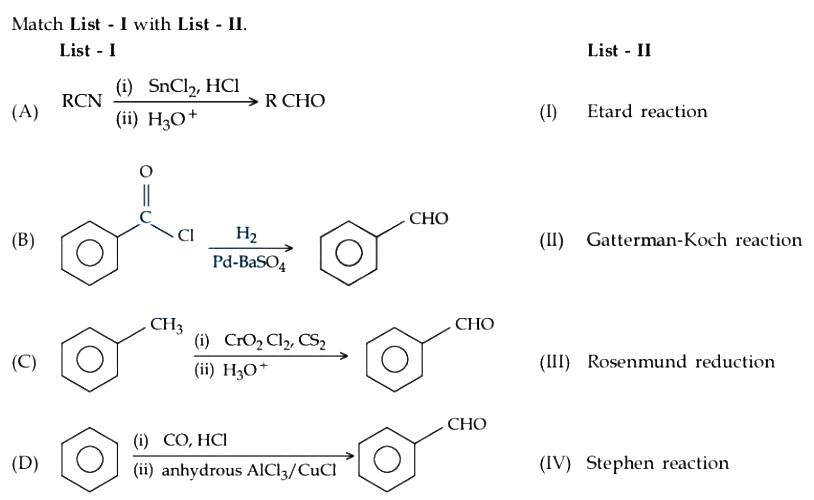
- (A) A-II, B-III, C-IV, D-I
- (B) A-IV, B-III, C-I, D-II
- (C) A-IV, B-I, C-II, D-III
- (D) A-II, B-IV, C-I, D-III
Show answer and solution
Correct Answer: (D)
A-II, B-IV, C-I, D-III -
- (A) 2-Methylpent-4-en-3-one
- (B) 4-Methylpent-3-en-2-one
- (C) 4-Methylpent-1-ene
- (D) 2-Methylpent-3-one
Show answer and solution
Correct Answer: (B)
Hydrolysis of prop-1-yne in the presence of \(HgSO_4\) and dilute \(H_2SO_4\) yields acetone.
\(CH_3-C \equiv CH + H_2O \xrightarrow{Hg^{2+}, H^+} CH_3-CO-CH_3\)
Thus, \(x\) is acetone.
Reaction of ethane nitrile (\(CH_3CN\)) with methyl magnesium bromide (\(CH_3MgBr\)) followed by hydrolysis also yields acetone.
\(CH_3-C \equiv N + CH_3MgBr \rightarrow CH_3-C(CH_3)=NMgBr \xrightarrow{H_3O^+} CH_3-CO-CH_3\)
Thus, \(y\) is acetone.
Reaction of \(x\) and \(y\) (both acetone) in the presence of \(Ba(OH)_2\) followed by heating results in an aldol condensation.
\(2 CH_3-CO-CH_3 \xrightarrow{Ba(OH)_2} CH_3-C(OH)(CH_3)-CH_2-CO-CH_3\)
Heating causes dehydration to form an unsaturated ketone.
\(CH_3-C(OH)(CH_3)-CH_2-CO-CH_3 \xrightarrow{\Delta} CH_3-C(CH_3)=CH-CO-CH_3\)
Numbering the principal carbon chain to give the lowest locant to the ketone group, the IUPAC name of the product is 4-methylpent-3-en-2-one.
Answer: 4-Methylpent-3-en-2-one -
- (A) 4
- (B) 8
- (C) 16
- (D) 32
Show answer and solution
Correct Answer: (C)
Benzene reacts with \(CO\) and \(HCl\) in the presence of \(CuCl\) to give benzaldehyde (\(x\)) via the Gattermann-Koch reaction.
Benzene reacts with ethanoyl chloride (\(CH_3COCl\)) in the presence of anhydrous \(AlCl_3\) to give acetophenone (\(y\)) via Friedel-Crafts acylation.
Heating benzaldehyde (\(x\)) and acetophenone (\(y\)) in the presence of alkali results in a crossed aldol condensation to form benzalacetophenone (\(z\)).
\(C_6H_5CHO + CH_3COC_6H_5 \xrightarrow{OH^-, \Delta} C_6H_5-CH=CH-CO-C_6H_5 + H_2O\)
The structure of \(z\) (\(C_6H_5-CH=CH-CO-C_6H_5\)) contains two phenyl rings (\(6\) \(\pi\) bonds), one \(C=C\) double bond (\(1\) \(\pi\) bond), and one \(C=O\) double bond (\(1\) \(\pi\) bond).
Total number of \(\pi\) bonds = \(6 + 1 + 1 = 8\)
Total number of \(\pi\) electrons = \(8 \times 2 = 16\)
Answer: \(16\) -
- (A) (A)-(III), (B)-(IV), (C)-(II), (D)-(I)
- (B) (A)-(I), (B)-(III), (C)-(II), (D)-(IV)
- (C) (A)-(III), (B)-(IV), (C)-(I), (D)-(II)
- (D) (A)-(IV), (B)-(III), (C)-(I), (D)-(II)
Show answer and solution
Correct Answer: (D)
(A) \(\mathrm{RCN} \xrightarrow[\text { (i) } \mathrm{H}_3 \mathrm{O}^{+}]{\text {(i) } \mathrm{SnCl}_2, \mathrm{HCl}} \mathrm{RCHO}\)
Stephen reaction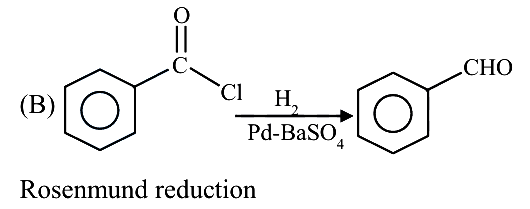
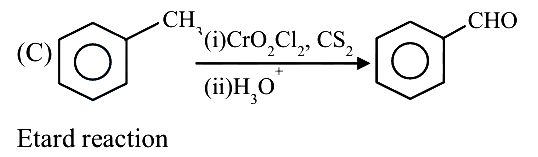
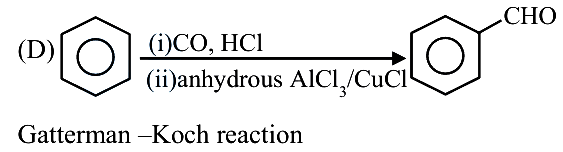
-
- (A) 5
- (B) 6
- (C) 7
- (D) 8
Show answer and solution
Correct Answer: (C)
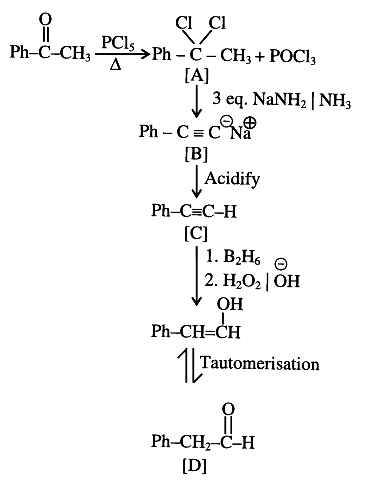
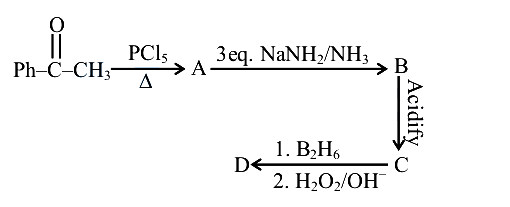
\(\Rightarrow\) Number of \(\mathrm{sp}^2 \mathrm{C}\)-atoms in product \(\mathrm{D}=7\)
NTA Ans. \(=7\)
ALLEN Ans. \(=7\) -
- (A) Stephen reaction
- (B) Etard reaction
- (C) Gatterman-koch reaction
- (D) Rosenmund reduction
Show answer and solution
Correct Answer: (C)
Gatterman-Koch reaction
-
- (A) Rosenmund reduction
- (B) Wolff-Kishner reduction
- (C) Stephen reduction
- (D) Etard reduction
Show answer and solution
Correct Answer: (A)
It is known as rosenmund reduction that is the partial reduction of acid chloride to aldehyde.
-
- (A) \(PCC\) oxidation
- (B) Ozonolysis
- (C) \(BH _{3}, H _{2} O _{2} /{ }^{-} OH\) followed by \(PCC\) oxidation
- (D) \(HBr\), hydrolysis followed by oxidation by \(K _{2} Cr _{2} O _{7}\).
Show answer and solution
Correct Answer: (C)
\(BH _{3}, H _{2} O _{2} / OH\) followed by \(PCC\) oxidation.
-
- (A) \(2,4 -\) Dimethyl pentan-\(3-\)one
- (B) \(3-\)Methyl cyclohexane carbaldehyde
- (C) \(2 -\)Methyl cyclohexanone
- (D) \(4 -\)Methyl pent\(- 3-en- 2 -\)one
Show answer and solution
Correct Answer: (D)
\(IUPAC [4-\)Methylpent\(-3-\)en\(-2-\)one]
-
- (A) \(- CHO\)
- (B) \(-\mathrm{CONH}_{2}\)
- (C) \(-\mathrm{CH}_{2} \mathrm{NH}_{2}\)
- (D) \(-\mathrm{COOH}\)
Show answer and solution
Correct Answer: (A)
\(\mathrm{R}-\mathrm{C} \equiv \mathrm{N} \xrightarrow[\text { (ii) } \mathrm{H}_{2} \mathrm{O}]{\text { (i) DIBAL-H }}\) \(\begin{array}{*{20}{c}} {{\rm{R}} - {\rm{C}} - {\rm{H}}}\\ {||}\\ O \end{array}\)Here \(Y\) is \(\begin{array}{*{20}{c}} { - {\rm{C}} - {\rm{H}}}\\ {||\,\,\,\,\,\,}\\ {O\,\,\,\,\,\,} \end{array}\) Aldehyde.
- 11. The major product of the following reaction is: \(CH _{3} CH _{2} CH = CH _{2}\) \(\xrightarrow[{Rh\,\,catalyst}]{{{H_2}/CO}}\) 2021 Medium
- (A) \(CH _{3} CH _{2} CH = CH - CHO\)
- (B) \(\begin{array}{*{20}{c}} {C{H_3}C{H_2}C = C{H_2}} \\ {\,\,\,\,\,\,\,\,|} \\ {\,\,\,\,\,\,\,\,\,\,\,\,\,\,\,\,\,CHO} \end{array}\)
- (C) \(CH _{3} CH _{2} CH _{2} CH _{2} CHO\)
- (D) \(CH _{3} CH _{2} CH _{2} CHO\)
Show answer and solution
Correct Answer: (C)
OXO PROCESS (Hydroformylation) :\(CH _{3}- CH _{2}- CH = CH _{2}+ CO + H _{2}\) \(\xrightarrow[{Catalyst}]{{Rh}}\) \([Image]\)

-
- (A) Manganese acetate
- (B) Copper at high temperature and pressure
- (C) Molybdenum oxide
- (D) Potassium permanganate
Show answer and solution
Correct Answer: (C)
\(CH _{3}- CH _{2}- CH _{3} \stackrel{ M 0_{2} O _{3}}{\longrightarrow} CH _{3}- CH _{2}- CH = O\)The reagent used will be \(MO _{2} O _{3}\)
-
- (A) \(\begin{array}{*{20}{c}} {\,\,\,\,\,\,O} \\ {\,\,\,\,\,\,||} \\ {C{H_3} - C - H} \end{array}\)
- (C) \(\begin{array}{*{20}{c}} {\,\,\,\,\,\,\,\,\,\,\,\,\,\,\,\,\,\,O} \\ {\,\,\,\,\,\,\,\,\,\,\,\,\,\,\,\,\,\,\,||} \\ {C{H_3} - C{H_2} - C - H} \end{array}\)
- (D) \(\begin{array}{*{20}{c}} {O\,\,\,\,\,\,\,\,\,} \\ {||\,\,\,\,\,\,\,\,\,\,} \\ {C{H_3} - C - C{H_2}C{H_3}} \end{array}\)
Show answer and solution
Correct Answer: (C)
Reaction of \(HgSO _{4} / dil H _{2} SO _{4}\) with alkyne gives addition of water as per markonikoff's rule.\((1)\) \(HC \equiv CH\) \(\xrightarrow[{{H_2}S{O_4}}]{{HgS{O_4}}}\) \(\begin{array}{*{20}{c}} {\,\,\,\,\,\,\,\,\,\,\,\,\,\,\,\,\,\,\,\,\,\,\,\,\,\,\,\,\,\,\,\,\,\,\,\,\,\,\,O} \\ {\,\,\,\,\,\,\,\,\,\,\,\,\,\,\,\,\,\,\,\,\,\,\,\,\,\,\,\,\,\,\,\,\,\,\,\,\,\,\,\,||} \\ {C{H_2} - CH \rightleftharpoons C{H_3} - CH} \\ {|\,\,\,\,\,\,\,\,\,\,\,\,\,\,\,\,\,\,\,} \\ {OH\,\,\,\,\,\,\,\,\,\,\,\,\,\,\,} \end{array}\)
\((2)\) \([Image]\)
\((3)\,CH_3-C\equiv CH\) \(\xrightarrow[{{H_2}S{O_4}}]{{HgS{O_4}}}\) \(\begin{array}{*{20}{c}} {\,\,\,\,\,\,\,\,\,\,\,\,\,\,\,\,\,\,\,\,\,\,\,\,\,\,\,\,\,\,\,\,\,\,\,\,\,\,\,\,O} \\ {\,\,\,\,\,\,\,\,\,\,\,\,\,\,\,\,\,\,\,\,\,\,\,\,\,\,\,\,\,\,\,\,\,\,\,\,\,\,\,\,\,||} \\ {C{H_3} - C = C{H_2} \rightleftharpoons C{H_3} - C - C{H_3}} \\ {|\,\,\,\,\,\,\,\,\,\,\,\,\,\,\,\,\,\,\,\,\,\,\,\,\,\,\,\,\,\,\,\,\,\,\,\,\,\,\,\,\,} \\ {OH\,\,\,\,\,\,\,\,\,\,\,\,\,\,\,\,\,\,\,\,\,\,\,\,\,\,\,\,\,\,\,\,\,\,\,\,} \end{array}\)
\((4)\) \((4)\,CH_3-C\equiv C-CH_3\) \(\xrightarrow[{{H_2}S{O_4}}]{{HgS{O_4}}}\) \(\begin{array}{*{20}{c}} {C{H_3} - C = CH - C{H_3}} \\ {|\,\,\,\,\,\,\,\,\,\,\,\,\,} \\ {OH\,\,\,\,\,\,\,\,\,} \end{array}\) \(\Updownarrow\) \(\begin{array}{*{20}{c}}
{C{H_3} - C - C{H_2} - C{H_3}} \\
{||\,\,\,\,\,\,\,\,\,\,\,\,\,\,\,} \\
{O\,\,\,\,\,\,\,\,\,\,\,\,\,\,\,}
\end{array}\)
-
- (A) \(C_6H_5CH_2OH\)
- (B) \(C_6H_5CHO\)
- (C) \(C_6H_5COOH\)
- (D) \(C_6H_5CH_3\)
Show answer and solution
Correct Answer: (B)
Toluene undergoes oxidation with \(K M n O_{4},\) fonns benzoic acid. In this conversion, alkyl part of toluene converts into carboxylic group. Further, benzoic acid reacts with thionyl chloride \(\left(S O C l_{2}\right)\) to give benzoyl chloride which upon reduction with \(H_{2} / P d\) or \(B a S O_{4}\) forms benzaldehyde (Rosenmund reduction)
-
- (A) Perkin reaction
- (B) Gatterman-Koch Formylation
- (C) Kolbe's reaction
- (D) Gattermann reaction
Show answer and solution
Correct Answer: (D)
The given reaction is known as Gattermann reaction.In this reaction, aromatic compound such as benzene or phenol is treated with a mixture of \(HCN\) and dry \(HCl\) gas under pressure and in the presence of anhydrous aluminum chloride or zinc chloride to introduce a formyl group in the aromatic nucleus.


No questions on this page match these filters.
Other STD 12 -Aldehydes and ketones topics
Frequently asked
How many Preparation questions came in JEE Mains?
15 questions from 2014–2026, each with the correct answer and a full solution.
How difficult are Preparation questions?
7% are easy, 47% medium and 47% hard.