


Questions
Newest firstShowing 1–50 of 58 questions
-
- (A) D < C < A < B
- (B) A < B < C < D
- (C) C < D < B < A
- (D) D < A < C < B
Show answer and solution
Correct Answer: (D)
Series \(n _1\) \(n _2\) (A) Paschen ( \(1^{\text {st }}\) line) 3 4 (B) Balmer ( \(2^{\text {nd }}\) line) 2 4 (C) Paschen ( \(3^{\text {rd }}\) line) 3 6 (D) Bracket \(\left(4^{\text {th }}\right.\) line) 4 8
So correct ascending order of energy of above lines is :
D < A < C < B - 2. If shortest wavelength of hydrogen atom in Lyman series is \(x\), then longest wavelength in Balmer series of \(\text{He}^+\) is: 2026 Medium
- (A) \(\dfrac{9x}{5}\)
- (B) \(\dfrac{36x}{5}\)
- (C) \(\dfrac{x}{4}\)
- (D) \(\dfrac{5x}{9}\)
Show answer and solution
Correct Answer: (A)
For the shortest wavelength in the Lyman series of the hydrogen atom (\(Z=1\)), the transition is from \(n_2 = \infty\) to \(n_1 = 1\).
\(\dfrac{1}{x} = R(1)^2 \left(\dfrac{1}{1^2} - \dfrac{1}{\infty^2}\right) = R\)
This gives \(R = \dfrac{1}{x}\).
For the longest wavelength in the Balmer series of \(\text{He}^+\) (\(Z=2\)), the transition is from \(n_2 = 3\) to \(n_1 = 2\).
\(\dfrac{1}{\lambda} = R(2)^2 \left(\dfrac{1}{2^2} - \dfrac{1}{3^2}\right)\)
\(\dfrac{1}{\lambda} = 4R \left(\dfrac{1}{4} - \dfrac{1}{9}\right)\)
\(\dfrac{1}{\lambda} = 4R \left(\dfrac{5}{36}\right) = \dfrac{5R}{9}\)
Substituting \(R = \dfrac{1}{x}\):
\(\dfrac{1}{\lambda} = \dfrac{5}{9x}\)
\(\lambda = \dfrac{9x}{5}\)
Answer: \(\dfrac{9x}{5}\) -
- (A) \(\text{Li}^{2+}, 3\)
- (B) \(\text{He}^+, 3\)
- (C) \(\text{He}^+, 2\)
- (D) \(\text{Li}^{2+}, 2\)
Show answer and solution
Correct Answer: (D)
The radius of the \(n\)-th Bohr orbit for a hydrogen-like species is given by the formula:
\(r_n = a_0 \dfrac{n^2}{Z}\)
where \(a_0\) is the Bohr radius of the hydrogen atom (\(52.9\) pm), \(n\) is the principal quantum number, and \(Z\) is the atomic number.
Given \(r_n = 70.53\) pm, we can write:
\(70.53 = 52.9 \times \dfrac{n^2}{Z}\)
\(\dfrac{n^2}{Z} = \dfrac{70.53}{52.9} = 1.333 = \dfrac{4}{3}\)
Checking the given options:
For \(\text{Li}^{2+}\) and \(n = 3\), \(Z = 3 \Rightarrow \dfrac{n^2}{Z} = \dfrac{9}{3} = 3\)
For \(\text{He}^+\) and \(n = 3\), \(Z = 2 \Rightarrow \dfrac{n^2}{Z} = \dfrac{9}{2} = 4.5\)
For \(\text{He}^+\) and \(n = 2\), \(Z = 2 \Rightarrow \dfrac{n^2}{Z} = \dfrac{4}{2} = 2\)
For \(\text{Li}^{2+}\) and \(n = 2\), \(Z = 3 \Rightarrow \dfrac{n^2}{Z} = \dfrac{4}{3}\)
The ratio matches for \(\text{Li}^{2+}\) and \(n = 2\).
Answer: \(\text{Li}^{2+}, 2\) - 4. The energy of first (lowest) Balmer line of H atom is x J. The energy (in J) of second Balmer line of H atom is: 2026 Medium
- (A) \(x^{2}\)
- (B) \(\frac{x}{1.35}\)
- (C) 2x
- (D) 1.35x
Show answer and solution
Correct Answer: (D)
Transition of first Balmer line
\(n_1=2 ; n_2=3\)
\(\Delta E=x=13.6(1)^2\left[\frac{1}{2^2}-\frac{1}{3^2}\right] \quad\ldots(i)\)
Transition of \(2^{\text {nd }}\) Balmer line
\(n_1=2 ; n_2=4\)
\(\Delta E=13.6(1)^2\left[\frac{1}{2^2}-\frac{1}{4^2}\right]\quad\ldots(ii)\)
Divide Eq. (ii) by eq. (i)
\(\frac{\Delta E }{ x }=\frac{\frac{1}{4}-\frac{1}{16}}{\frac{1}{4}-\frac{1}{9}}\)
\(\frac{\Delta E }{ x }=\frac{\frac{3}{16}}{\frac{5}{36}}\)
\(\frac{\Delta E }{ x }=\frac{27}{20}\)
\(\Delta E =1.35 x\). -
- (A) \(1.635\times10^{-18}\)
- (B) \(9.835\times10^{5}\)
- (C) \(9.835\times10^{12}\)
- (D) \(1.635\times10^{-11}\)
Show answer and solution
Correct Answer: (B)
\(E_{n}=-R_{H}\times\frac{Z^{2}}{n^{2}}\)
\(\Delta E=2.18\times10^{-11}\times10^{-7}\times1^{2}[\frac{1}{1^{2}}-\frac{1}{2^{2}}]\)
\(=1.635\times10^{-18} Joule/atom\)
\(=1.635\times10^{-18}\times6.02\times10^{23} Joule/mole\)
\(=9.835\times10^{5} Joule/mole\) -
- (A) 27
- (B) 54
- (C) 108
- (D) 36
Show answer and solution
Correct Answer: (B)
\( \Delta E(L_1) = 13.6 \times Z^2 (\frac{1}{1^2} - \frac{1}{2^2}) = 13.6Z^2 \times \frac{3}{4} \)
\( \Delta E(B_1) = 13.6 \times Z^2 (\frac{1}{2^2} - \frac{1}{3^2}) = 13.6Z^2 \times {\frac{5}{4 \times 9}} \)
\(\frac{\Delta E \left( L _1\right)}{\Delta E \left( B _1\right)}=\frac{3}{5} \times 9=\frac{27}{5}= x\)
\(x=\left(\frac{27}{5} \times 10\right) \times 10^{-1}=54 \times 10^{-1}\) -
- (A) A and C Only
- (B) A and E Only
- (C) B and E Only
- (D) C and D Only
Show answer and solution
Correct Answer: (B)
According to Bohr's theory, the radius of the \(n\)-th orbit of a hydrogen-like species is given by \(r_n = 0.529 \times \dfrac{n^2}{Z} \text{ \AA}\).
For \(H\) (first orbit), \(n = 1\), \(Z = 1 \Rightarrow r = 0.529 \times \dfrac{1^2}{1} = 0.529 \text{ \AA}\).
For \(He^+\) (first orbit), \(n = 1\), \(Z = 2 \Rightarrow r = 0.529 \times \dfrac{1^2}{2} = 0.2645 \text{ \AA}\).
For \(He^+\) (second orbit), \(n = 2\), \(Z = 2 \Rightarrow r = 0.529 \times \dfrac{2^2}{2} = 1.058 \text{ \AA}\).
For \(Li^{2+}\) (first orbit), \(n = 1\), \(Z = 3 \Rightarrow r = 0.529 \times \dfrac{1^2}{3} = 0.176 \text{ \AA}\).
For \(Be^{3+}\) (second orbit), \(n = 2\), \(Z = 4 \Rightarrow r = 0.529 \times \dfrac{2^2}{4} = 0.529 \text{ \AA}\).
The radii of \(H\) (first orbit) and \(Be^{3+}\) (second orbit) are identical. Therefore, species A and E have identical radii.
Answer: A and E Only -
- (A) \( \frac{5R}{36}, \frac{3R}{16}, \frac{21R}{100} \)
- (B) \( \frac{5R}{36}, \frac{8R}{9}, \frac{15R}{16} \)
- (C) \( \frac{7R}{144}, \frac{3R}{16}, \frac{16R}{255} \)
- (D) \( \frac{3R}{4}, \frac{3R}{16}, \frac{7R}{144} \)
Show answer and solution
Correct Answer: (A)
Balmer series line \(\Rightarrow \bar{v}= R _{ H } z ^2\left[\frac{1}{2^2}-\frac{1}{ n ^2}\right]\)
if \(n=3 \Rightarrow \bar{v}=R(1)^2\left[\frac{1}{2^2}-\frac{1}{3^2}\right]=\frac{5 R}{36}\)
if \(n=4 \Rightarrow \bar{v}=\frac{3 R}{16}\)
if \(n=5 \Rightarrow \bar{v}=\frac{21 R}{100}\) -
- (A) \(2.28 \times 10^{-7} cm\)
- (B) \(2.28 \times 10^{-6} cm\)
- (C) \(1.14 \times 10^{-7} cm\)
- (D) \(1.14 \times 10^{-6} cm\)
Show answer and solution
Correct Answer: (D)
\(n _1 \rightarrow\) lower energy level
\(n _2 \rightarrow\) higher energy level
\(n _1+ n _2=4, \quad n _2=3\)
\(n _2- n _1=2, n _1=1\)
Rydberg's formula :
\(\frac{1}{\lambda}= R _{ H } Z ^2\left[\frac{1}{ n _1^2}-\frac{1}{ n _2^2}\right]\)
\(\frac{1}{\lambda}= R _{ H }(3)^2\left[\frac{1}{1^2}-\frac{1}{3^2}\right]\)
\(\frac{1}{\lambda}=8 R _{ H }\)
\(\lambda=\frac{1}{8 R _{ H }}\)
\(\lambda=\frac{1}{8 \times 1.1 \times 10^5}\)
\(\lambda=\frac{1000}{8.8} \times 10^{-8} cm\)
\(\lambda=113.63 \times 10^{-8} cm\)
\(\lambda \simeq 1.14 \times 10^{-6} cm\) -
- (A) \(8.72 \times 10^{-18}\)
- (B) \(1.962 \times 10^{-18}\)
- (C) \(1.962 \times 10^{-17}\)
- (D) \(6.54 \times 10^{-17}\)
Show answer and solution
Correct Answer: (C)
The given process \(Li^{2+}(g) \rightarrow Li^{3+}(g) + e^-\) represents the ionization of the hydrogen-like ion \(Li^{2+}\) from its ground state.
The ionization energy for a hydrogen-like species is given by the formula:
\(IE = IE_{H} \times Z^2\)
For \(Li^{2+}\), the atomic number \(Z = 3\).
Given the ionization energy of the hydrogen atom \(IE_{H} = 2.18 \times 10^{-18}\) J atom\(^{-1}\).
Substituting the values:
\(IE = 2.18 \times 10^{-18} \times (3)^2\)
\(IE = 2.18 \times 10^{-18} \times 9\)
\(IE = 19.62 \times 10^{-18}\) J atom\(^{-1}\)
\(IE = 1.962 \times 10^{-17}\) J atom\(^{-1}\)
Answer: \(1.962 \times 10^{-17}\) - 11. What is the ratio of wave number of first line (lowest energy line) of Balmer series of H atomic spectrum to first line of its Brackett series? 2026 Medium
- (A) \(5:1\)
- (B) \(5:0.81\)
- (C) \(5:1.75\)
- (D) \(5:27\)
Show answer and solution
Correct Answer: (B)
The wave number \(\bar{\nu}\) of a spectral line in the hydrogen emission spectrum is given by the Rydberg formula:
\(\bar{\nu} = R_H \left( \dfrac{1}{n_1^2} - \dfrac{1}{n_2^2} \right)\)
For the first line (lowest energy) of the Balmer series, the transition is from \(n_2 = 3\) to \(n_1 = 2\):
\(\bar{\nu}_{Balmer} = R_H \left( \dfrac{1}{2^2} - \dfrac{1}{3^2} \right) = R_H \left( \dfrac{1}{4} - \dfrac{1}{9} \right) = \dfrac{5R_H}{36}\)
For the first line of the Brackett series, the transition is from \(n_2 = 5\) to \(n_1 = 4\):
\(\bar{\nu}_{Brackett} = R_H \left( \dfrac{1}{4^2} - \dfrac{1}{5^2} \right) = R_H \left( \dfrac{1}{16} - \dfrac{1}{25} \right) = \dfrac{9R_H}{400}\)
Taking the ratio of the two wave numbers:
\(\dfrac{\bar{\nu}_{Balmer}}{\bar{\nu}_{Brackett}} = \dfrac{\dfrac{5R_H}{36}}{\dfrac{9R_H}{400}} = \dfrac{5}{36} \times \dfrac{400}{9} = \dfrac{500}{81}\)
To express this ratio in the form \(5 : x\), we divide the numerator and the denominator by \(100\):
\(\dfrac{500}{81} = \dfrac{5}{0.81}\)
The ratio is \(5 : 0.81\).
Answer: \(5:0.81\) - 12. Which of the following statements regarding the energy of the stationary state is true in the following one-electron system ? 2026 Easy
- (A) \(-1.09\times10^{-18}J\) for second orbit of H atom.
- (B) \(+2.18 \times 10^{-18} J\) for second orbit of \(He ^{+}\)ion
- (C) \(+8.72 \times 10^{-18} J\) for first orbit of \(He ^{+}\)ion
- (D) \(-2.18 \times 10^{-18} J\) for third orbit of \(Li ^{2+}\) ion
Show answer and solution
Correct Answer: (D)
\(E_{n}=-2.18\times10^{-18}\frac{Z^{2}}{n^{2}}J/atom.\)
For \(3^{rd}\) orbit of \(Li^{-2}\) ion
\(=-2.18\times10^{-18}\times\frac{3^{2}}{3^{2}}=-2.18\times10^{-18}J.\) - 13. According to Bohr's model of hydrogen atom, which of the following statement is incorrect? 2025 Easy
- (A) Radius of \(3^{\text {rd }}\) orbit is nine times larger than that of \(1^{\text {st }}\) orbit.
- (B) Radius of \(8^{\text {th }}\) orbit is four times larger than that of \(4^{\text {th }}\) orbit.
- (C) Radius of \(6^{\text {th }}\) orbit is three time larger than that of \(4^{\text {th }}\) orbit.
- (D) Radius of \(4^{\text {th }}\) orbit is four times larger than that of \(2^{\text {nd }}\) orbit.
Show answer and solution
Correct Answer: (C)
\(\mathrm{r} \propto \mathrm{n}^2\)
(1) \(\frac{\mathrm{r}_3}{\mathrm{r}_1}=\frac{9}{1}\)
(2) \(\frac{\mathrm{r}_8}{\mathrm{r}_4}=\frac{64}{16}=4\)
(3) \(\frac{\mathrm{r}_6}{\mathrm{r}_4}=\left(\frac{6}{4}\right)^2=\frac{9}{4}\)
(4) \(\frac{\mathrm{r}_4}{\mathrm{r}_2}=\left(\frac{4}{2}\right)^2=4\) -
- (A) Balmer series, \(\infty \rightarrow 2\)
- (B) Lyman series, \(\infty \rightarrow 1\)
- (C) Paschen series, \(\infty \rightarrow 3\)
- (D) Paschen series, \(5 \rightarrow 3\)
Show answer and solution
Correct Answer: (C)
\(\begin{aligned}
& \lambda=900 \mathrm{~nm} \quad \text { H-atom }(\mathrm{Z}=1) \\
& =9 \times 10^{-5} \mathrm{~cm} \\
& \mathrm{R}_{\mathrm{H}}=10^5 \mathrm{~cm}^{-1} \\
& \text { Ryderg eq. }=\frac{1}{\lambda}=\mathrm{R}_{\mathrm{H}} \mathrm{Z}^2 \times\left(\frac{1}{\mathrm{n}_1^2}-\frac{1}{\mathrm{n}_2^2}\right) \\
& \Rightarrow \frac{1}{\lambda \times \mathrm{R}_{\mathrm{H}}}=\frac{1}{\mathrm{n}_1^2}-\frac{1}{\mathrm{n}_2^2} \\
& \Rightarrow \frac{1}{9 \times 10^{-5} \mathrm{~cm} \times 10^5 \mathrm{~cm}^{-1}}=\left(\frac{1}{\mathrm{n}_1^2}-\frac{1}{\mathrm{n}_2^2}\right) \\
& \Rightarrow \frac{1}{\mathrm{n}_1^2}-\frac{1}{\mathrm{n}_2^2}=\frac{1}{9}
\end{aligned}\)
It is possible when \(\mathrm{n}_1=3, \mathrm{n}_2=\infty\)
Possible series : \(\infty \rightarrow 3\) -
- (A) \(\frac{8 \pi a_0}{n}\)
- (B) \(\frac{2 a_0}{n \pi}\)
- (C) \(\frac{4 \mathrm{n}}{\pi \mathrm{a}_0}\)
- (D) \(\frac{4 \pi a_0}{n}\)
Show answer and solution
Correct Answer: (A)
Explanation:
The radius of the \( n \)-th orbit of a hydrogen-like atom is given by the formula:
\( r_n = \frac{a_0 n^2}{Z} \)
1. Atomic Number of Hydrogen: For a hydrogen atom, the atomic number is \( Z = 1 \). Substituting this value into the equation yields the radius of the orbit:
\( r_n = a_0 n^2 \)
2. De-Broglie Relationship: According to the Bohr orbit quantization criteria, the total circumference of the stationary orbit must equal an integral multiple of the electron's de-Broglie wavelength:
\( 2\pi r_n = n\lambda \)
Substituting the value of \( r_n \) from our first step into this relationship gives:
\( 2\pi (a_0 n^2) = n\lambda \)
Simplifying the expression by canceling \( n \) from both sides results in:
\( \lambda = 2\pi a_0 n \)
3. Evaluating for Second Orbit: For the second orbit, the principal quantum number is \( n = 2 \). Substituting this directly gives the absolute wavelength value:
\( \lambda = 2\pi a_0 (2) = 4\pi a_0 \)
To match the general representation format used in the provided options, we can intentionally multiply and divide the expression by \( 2 \):
\( \lambda = \frac{8\pi a_0}{2} \)
Since \( n = 2 \), substituting \( n \) back into the denominator yields:
\( \lambda = \frac{8\pi a_0}{n} \)
Hence, Option A is the correct choice. -
- (A) \(\mathrm{r}=4 \mathrm{a}_0\)
- (B) \(\mathrm{r}=2 \mathrm{a}_0\)
- (C) \(r=\frac{a_0}{2}\)
- (D) \(r=\frac{a_0}{4}\)
Show answer and solution
Correct Answer: (B)
\(\begin{aligned} & \mathrm{r}=\mathrm{a}_0\left(\frac{\mathrm{n}^2}{\mathrm{z}}\right) \\ & \mathrm{r}=\frac{\mathrm{a}_0(2)^2}{(2)} \\ & \mathrm{r}=2 \mathrm{a}_0\end{aligned}\) - 17. Which of the following postulate of Bohr's model of hydrogen atom in not in agreement with quantum mechanical model of an atom ? 2025 Medium
- (A) An atom in a stationary state does not emit electromagnetic radiation as long as it stays in the same state
- (B) An atom can take only certain distinct energies \(\mathrm{E}_1, \mathrm{E}_2, \mathrm{E}_3\), etc. These allowed states of constant energy are called the stationary states of atom
- (C) When an electron makes a transition from a higher energy stationary state to a lower energy stationary state, then it emits a photon of light
- (D) The electron in a H atom's stationary state moves in a circle around the nucleus
Show answer and solution
Correct Answer: (D)
The electron in a H-atom's stationary state moves in a spherical path. -
- (A) \(34\)
- (B) \(40\)
- (C) \(45\)
- (D) \(50\)
Show answer and solution
Correct Answer: (A)
\(34\) -
- (A) \(A-II\), \(B-III\), \(C-I\), \(D-IV\)
- (B) \(A-I\), \(B-III\), \(C-II\), \(D-IV\)
- (C) \(A-II\), \(B-IV\), \(C-III\), \(D-I\)
- (D) \(A-I\), \(B-II\), \(C-III\), \(D-IV\)
Show answer and solution
Correct Answer: (C)
\(A - II\), \(B - IV\), \(C - III\), \(D - I\)Fact based.
-
- (A) \(11\)
- (B) \(10\)
- (C) \(12\)
- (D) \(13\)
Show answer and solution
Correct Answer: (B)
\(5^{\text {th }} \text { excited state } \Rightarrow n_1=6\)\(1^{\text {st }} \text { excited state } \Rightarrow n_2=2\)
\(\Delta n=n_1-n_2=6-2=4\)
Maximum number of spectral lines
\(=\frac{\Delta \mathrm{n}(\Delta \mathrm{n}+1)}{2}=\frac{4(4+1)}{2}=10\)
-
- (A) \(22\)
- (B) \(25\)
- (C) \(30\)
- (D) \(35\)
Show answer and solution
Correct Answer: (A)
\(\mathrm{V}=2.18 \times 10^6 \times \frac{\mathrm{Z}}{\mathrm{n}}\)\(=21.8 \times 10^5 \times \frac{1}{1} \approx 22 \times 10^5 \text { (nearest) }\)
-
- (A) \(170\)
- (B) \(180\)
- (C) \(270\)
- (D) \(250\)
Show answer and solution
Correct Answer: (C)
\(r \propto \frac{ n ^2}{ Z }\)\(r _{ He ^{+}} = r _{ H } \times \frac{ n ^2}{ Z }\)
\(r _{ He ^{+}} =0.6 \times \frac{(3)^2}{2}\)
\(=2.7 \mathring A\)
\(r _{ He ^{+}} =270\,pm\)
-
- (A) Both Statement \(I\) and Statement \(II\) are correct.
- (B) Statement \(I\) is correct but Statement \(II\) is incorrect.
- (C) Statement \(I\) is incorrect but Statement \(II\) is correct
- (D) Both Statement \(I\) and Statement \(II\) are incorrect.
Show answer and solution
Correct Answer: (A)
According to Bohr's model the angular momentum is quantised and equal to \(\frac{ nh }{2 \pi}\).Heisenberg uncertainty principle explains orbital concept, which is based on probability of finding electron.
-
- (A) \(2\)
- (B) \(3\)
- (C) \(1\)
- (D) \(4\)
Show answer and solution
Correct Answer: (C)
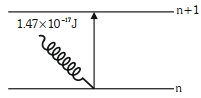
\(\Delta E = R _{ H } Z ^2\left(\frac{1}{ n _1^2}-\frac{1}{ n _2^2}\right)\)\(1.47 \times 10^{-17}=2.18 \times 10^{-15} \times 9\left(\frac{1}{n^2}-\frac{1}{(n+1)^2}\right)\)
\(\frac{1.47}{1.96}=\frac{3}{4}=\frac{1}{n^2}-\frac{1}{(n+1)^2}\)
So, \(n =1\)
-
- (A) \(\frac{1}{27}\) of this value
- (B) One third of this value
- (C) Three times of this value
- (D) \(\frac{1}{9}\) th of this value
Show answer and solution
Correct Answer: (D)
\(E _{ n }=\frac{-2.18 \times 10^{-18} Z ^2}{ n ^2}\)\(\text { i.e. } E _{ n } \propto \frac{1}{ n ^2}\)
-
- (A) \(2\)
- (B) \(1\)
- (C) \(3\)
- (D) \(0\)
Show answer and solution
Correct Answer: (B)
(A) This statement is correct. Line emission spectra (or atomic emission spectra) are indeed used to study the electronic structure of atoms. These spectra are produced when photons are emitted from atoms as excited electrons return to a lower energy level. Each line corresponds to a particular quantum leap between energy levels. (B) This statement is incorrect. The emission spectra of atoms in the gas phase do not show a continuous spread of wavelength from red to violet. Instead, they show distinct lines corresponding to specific electron transitions, hence they are known as line emission spectra. (C) This statement is correct. An absorption spectrum is like the photographic negative of an emission spectrum. In an absorption spectrum, light passes through a cold, dilute gas and atoms in the gas absorb at characteristic frequencies; since the re-emitted light is unlikely to be emitted in the same direction as the absorbed photon, this gives rise to dark lines (absence of light) in the spectrum. (D) This statement is correct. The element helium was indeed discovered in the sun through spectroscopy before it was found on Earth. The name helium comes from Helios, the Greek name for the sun. So, the number of incorrect statements is 1. - 27. The orbital angular momentum of an electron in \(3 s\) orbital is \(\frac{x h}{2 \pi}\). The value of.\(x\) is \(..........\). 2023 Easy
- (A) \(1\)
- (B) \(2\)
- (C) \(3\)
- (D) \(0\)
Show answer and solution
Correct Answer: (D)
\(l\) for \(3s\) orbital is \(0\).
Orbital angular momentum \(=\) \(\sqrt{l(l+1)} \frac{h}{2\pi}\)
\(= \sqrt{0(0+1)} \frac{h}{2\pi} = 0\)
Given \(=\) \(\frac{x h}{2 \pi}\)
\(x = 0\)
-
- (A) \(\frac{9}{4} x\)
- (B) \(\frac{4}{9} x\)
- (C) \(\frac{27}{16} x\)
- (D) \(\frac{16}{27} x\)
Show answer and solution
Correct Answer: (C)
\(Li ^{2+}\)\(r _2= x = k \times \frac{2^2}{3}=\frac{4 k }{2}\)
\(Be ^{3+}\)
\(r _3= y = k \times \frac{3^2}{4}\)
\(\frac{y}{x}=\frac{9}{4} \times \frac{3}{4}=\frac{27}{16}\)
\(y=\frac{27}{16} x\)
-
- (A) \(\frac{5}{9 \lambda}\)
- (B) \(\frac{9 \lambda}{5}\)
- (C) \(\frac{36 \lambda}{5}\)
- (D) \(\frac{5 \lambda}{9}\)
Show answer and solution
Correct Answer: (B)
For \(H : \frac{1}{\lambda}= R _{ H } \times 1^2\left(\frac{1}{1^2}-\frac{1}{\infty^2}\right)\)\(\frac{1}{\lambda_{ He ^{+}}}= R _{ H } \times 2^2 \times\left(\frac{1}{4}-\frac{1}{9}\right)\)
From \((1)\) and \((2)\) \(\frac{\lambda_{ He ^{+}}}{\lambda}=\frac{9}{5}\)
\(\lambda_{ He ^{+}}=\lambda \times \frac{9}{5}\)
\(\lambda_{ He ^{+}}=\frac{9 \lambda}{5}\)
-
- (A) \(n =2\) to \(n =1\)
- (B) \(n =1\) to \(n =3\)
- (C) \(n =1\) to \(n =2\)
- (D) \(n =3\) to \(n =4\)
Show answer and solution
Correct Answer: (A)
\(He ^{+}\)ion :\(\frac{1}{\lambda( H )}= R (1)^2\left[\frac{1}{ n _1^2}-\frac{1}{ n _2^2}\right]\)
\(\frac{1}{\lambda\left( He ^{+}\right)}= R (2)^2\left[\frac{1}{2^2}-\frac{1}{4^2}\right]\)
Given \(\lambda( H )=\lambda\left( He ^{+}\right)\)
\(R (1)^2\left[\frac{1}{ n _1^2}-\frac{1}{ n _2^2}\right]= R (4)\left[\frac{1}{2^2}-\frac{1}{4^2}\right]\)
\(\frac{1}{ n _1^2}-\frac{1}{ n _2^2}=\frac{1}{1^2}-\frac{1}{2^2}\)
On comparing \(n _1=1\) and \(n _2=2\)
-
- (A) \(r _{4}=\frac{9}{16} r_{3}\)
- (B) \(r_{4}=\frac{16}{9} r_{3}\)
- (C) \(r_{4}=\frac{3}{4} r_{3}\)
- (D) \(r_{4}=\frac{4}{3} r_{3}\)
Show answer and solution
Correct Answer: (B)
\(r =0.529 \times \frac{ n ^{2}}{ Z }\)\(r _{3}=0.529 \times \frac{3^{2}}{1}\)
\(r_{4}=0.529 \times \frac{4^{2}}{1}\)
\(\frac{r_{4}}{r_{3}}=\frac{4^{2}}{3^{2}}=\frac{16}{9}\)
\(r _{4}=\frac{16 r _{3}}{9}\)
-
- (A) \(1\)
- (B) \(3\)
- (C) \(2\)
- (D) \(0\)
Show answer and solution
Correct Answer: (C)
\(\lambda=\frac{ h }{\sqrt{2 mK }}\)\(K =\frac{ h ^{2}}{2 m \lambda^{2}}\)
\(K =\frac{ h ^{2}}{2 m \lambda^{2}}=\frac{43.9 \times 10^{-68}}{2 \times 9.1 \times 10^{-31} \times 10.89 \times 10^{-20}}\)
\(K =2.215 \times 10^{-18}\)
\(E _{ abs }= E _{\text {req }}+ K\)
\(\frac{ E _{\text {abs }}}{ E _{\text {req }}}=1+\frac{ K }{ E _{\text {req }}}=1+\frac{2.215 \times 10^{-18}}{13.6 \times 1.602 \times 10^{-19}}=2.0166\)
-
- (A) \(3\)
- (B) \(4\)
- (C) \(2\)
- (D) \(1\)
Show answer and solution
Correct Answer: (B)
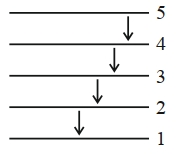
We can not calculate \(I.E.\) of lithium atom. - 34. When the excited electron of a \(H\) atom from \(n =5\) drops to the ground state, the maximum number of emission lines observed are\(.......\) 2022 Medium
- (A) \(15\)
- (B) \(16\)
- (C) \(10\)
- (D) \(8\)
Show answer and solution
Correct Answer: (C)
Maximum number of emission lines from \(\mathrm{n}^{\text {th }}\) energy state to ground state is given by:\(=\frac{\mathrm{n}(\mathrm{n}-1)}{2}=\frac{5(5-1)}{2}=\frac{20}{2}=10 \text { lines. }\)
-
- (A) \((C)\) Only
- (B) \((A)\) Only
- (C) \((A), (C)\) and \((D)\) only
- (D) \((A)\) and \((D)\) only
Show answer and solution
Correct Answer: (D)
According to Bohr's theory :\((A)\) \(KE =13.6 \frac{ z ^{2}}{ n ^{2}} \frac{ eV }{\text { atom }} \Rightarrow KE \alpha \frac{ z ^{2}}{ n ^{2}}\)
\((B)\) speed of \(e ^{-} \alpha \frac{ z }{ n }\)
\(\therefore \quad v \times n \alpha z\)
\((C)\) Frequency of revolution of \(e ^{-}=\frac{ v }{2 \pi r }\)
\(\therefore\) frequency \(\alpha \frac{z^{2}}{n^{3}}\)
\((D)\) \(F =\frac{ kq _{1} q _{2}}{ r ^{2}}=\frac{ kze ^{2}}{ r ^{2}} \quad\left\{ r \alpha \frac{ n ^{2}}{ z }\right.\)
\(\Rightarrow F \alpha \frac{ Z }{\left(\frac{ n ^{2}}{ Z }\right)^{2}}\)
\(\Rightarrow F \alpha \frac{ z ^{3}}{ n ^{4}}\)
-
- (A) Both Statement \(I\) and Statement \(II\) are false
- (B) Both Statement \(I\) and Statement \(II\) are true
- (C) Statement \(I\) is false but Statement \(II\) is true
- (D) Statement \(I\) is true but Statement \(II\) is false
Show answer and solution
Correct Answer: (C)
Velocity of electron in Bohr's atom is given by\(\mathrm{V} \propto \frac{\mathrm{Z}}{\mathrm{n}}\)
\(Z=\) atomic number of atom, corresponds to \(+v e\) charge so as \(Z\) increase velocity increases so statement\(-I\) is wrong.
and as \('n'\) decreases velocity increases so statement\(-II\) is correct.
-
- (A) Both statement \(I\) and statement \(II\) are true.
- (B) Statement \(I\) is false but statement \(II\) is true.
- (C) Both statement \(I\) and statement \(II\) are false.
- (D) Statement \(I\) is true but statement \(II\) is false.
Show answer and solution
Correct Answer: (B)
Statement\(-I\) is false since Bohr's theory accounts for the stability and spectrum of single electronic species \(\left( eg : He ^{+}, Li ^{2+}\right.\) etc \()\)Statement\(-II\) is true.
-
- (A) Statement \(\mathrm{I}\) is false but statement \(II\) is true.
- (B) Both statement \(I\) and statement \(II\) are false.
- (C) Statement \(\mathrm{I}\) is true but statement \(II\) is false.
- (D) Both statement \(\mathrm{I}\) and statement \(II\) are true.
Show answer and solution
Correct Answer: (D)
Rutherford's gold foil experiment only proved that electrons are held towards nucleus by electrostatic forces of attraction and move in circular orbits with very high speeds.Bohr's model gave exact formula for simultaneous calculation of speed \(\&\) distance of electron from the nucleus, something which was deemed impossible according to Heisenberg.
- 39. If the Thomson model of the atom was correct, then the result of Rutherford's gold foil experiment would have been: 2021 Medium
- (A) \(\alpha\)-Particles pass through the gold foil deflected by small angles and with reduced speed.
- (B) All \(\alpha\)-particles get bounced back by \(180^{\circ}\).
- (C) \(\alpha\)-Particles are deflected over a wide range of angles.
- (D) All of the \(\alpha\)-particles pass through the gold foil without decrease in speed
Show answer and solution
Correct Answer: (A)
As in Thomson model, protons are diffused (charge is not centered) \(\alpha\)-particles deviate by small angles and due to repulsion from protons, their speeddecreases. -
- (A) \(1010\)
- (B) \(6135\)
- (C) \(3155\)
- (D) \(3845\)
Show answer and solution
Correct Answer: (C)
\(\operatorname{mvr}=\frac{\mathrm{nh}}{2 \pi}\)\(\text { K.E. }=\frac{\mathrm{n}^{2} \mathrm{~h}^{2}}{8 \pi^{2} \mathrm{mr}^{2}} \quad=\frac{4 \mathrm{~h}^{2}}{8 \pi^{2} \mathrm{~m}\left(4 \mathrm{a}_{0}\right)^{2}}\)
\(\quad\quad\quad\quad\quad\quad\quad\quad=\left(\frac{4}{8 \pi^{2} \times 16}\right) \frac{\mathrm{h}^{2}}{\mathrm{ma}_{0}^{2}}\)
\(\Rightarrow \mathrm{x}=315.507\)
\(\Rightarrow 10 \mathrm{x}=3155 \text { (nearest integer) }\)
-
- (A) \((II), (III), (IV)\)
- (B) \((I), (II), (III)\)
- (C) \((I), (III), (IV)\)
- (D) \((I), (II), (IV)\)
Show answer and solution
Correct Answer: (B)
For balmer : \(\mathrm{n}_{1}=2, \mathrm{n}_{2}=3,4,5, \ldots \infty\)\(\bar{v}=\frac{1}{\lambda}=R_{H}\left[\frac{1}{2^{2}}-\frac{1}{n_{2}^{2}}\right]\)
\(\frac{1}{\lambda_{\text {longest }}}=\mathrm{R}_{\mathrm{H}}\left[\frac{1}{2^{2}}-\frac{1}{3^{2}}\right]\)
-
- (A) \(8:3\)
- (B) \(3:2\)
- (C) \(3:8\)
- (D) \(2:3\)
Show answer and solution
Correct Answer: (D)
\(\frac{\Delta R _{1}}{\Delta R _{2}}=\frac{\left( r _{4}- r _{3}\right)_{4^{2+}}}{\left( r _{4}- r _{3}\right)_{ He ^{+}}}=\frac{\frac{4^{2}}{3}-\frac{3^{2}}{3}}{\frac{4^{2}}{2}-\frac{3^{2}}{2}}=\frac{7 / 3}{7 / 2}=\frac{2}{3}\) -
- (A) Visible
- (B) Microwave
- (C) Ultraviolet
- (D) Infrared
Show answer and solution
Correct Answer: (A)
Balmer series give visible lines For \(H\)\(-\)atom -
- (A) \(\frac{5 \lambda_{1}}{9}\)
- (B) \(\frac{27 \lambda_{1}}{5}\)
- (C) \(\frac{9 \lambda_{1}}{5}\)
- (D) \(\frac{36 \lambda_{1}}{5}\)
Show answer and solution
Correct Answer: (C)
As we know \(\Delta E=\frac{h c}{\lambda}\)So \(\quad \lambda=\frac{ hc }{\Delta E } \quad\) for \(\lambda\) minimum i.e.
shortest; \(\Delta E=\) maximum
for Lyman series \(n=1 \&\) for \(\Delta E_{\text {max }}\)
Transition must be form \(n=\infty\) to \(n=1\)
So \(\quad \frac{1}{\lambda}= R _{ H } Z^{2}\left(\frac{1}{ n _{1}^{2}}-\frac{1}{ n _{2}^{2}}\right)\)3
\(\frac{1}{\lambda}= R _{ H } Z^{2}(1-0)\)
\(\frac{1}{\lambda}= R \times(1)^{2} \Rightarrow \lambda_{1}=\frac{1}{ R }\)
For longest wavelength \(\Delta E =\) minimum for Balmer series \(n =3\) to \(n =2\) will have \(\Delta E\) minimum
for \(He ^{+} Z =2\)
So \(\frac{1}{\lambda_{2}}= R _{ H } \times Z^{2}\left(\frac{1}{ n _{1}^{2}}-\frac{1}{ n _{2}^{2}}\right)\)
\(\frac{1}{\lambda_{2}}= R _{ H } \times 4\left(\frac{1}{4}-\frac{1}{9}\right)\)
\(\frac{1}{\lambda_{2}}= R _{ H } \times \frac{5}{9}\)
\(\lambda_{2}=\lambda_{1} \times \frac{9}{5}\)
-
- (A) \(5:4\)
- (B) \(4:1\)
- (C) \(9:4\)
- (D) \(27:5\)
Show answer and solution
Correct Answer: (C)
\(\Delta {{\bar V}_{Lymann}} = \frac{{{R_H}}}{4}\)\(\Delta {{\bar V}_{Balmer}} = \frac{{{R_H}}}{9}\)
\( \Rightarrow \frac{{\Delta {{\bar V}_{Lymann}}}}{{\Delta {{\bar V}_{Balmer}}}} = \frac{9}{4}\)
Formula
\(\bar V = {R_H}\left[ {\frac{1}{{n_1^2}} - \frac{1}{{n_2^{2}}}} \right]\)
-
- (A) Linear with intercept \(- R_H\)
- (B) Non linear
- (C) Linear with slope \(R_H\)
- (D) Linear with slope \(-R_H\)
Show answer and solution
Correct Answer: (D)
For emission line \(n_f < n_i\)\(\therefore \,\bar v = R{Z^2}\left[ {\frac{1}{{n_i^2}} - \frac{1}{{n_f^2}}} \right] = R\left[ {\frac{1}{{{8^2}}} - \frac{1}{{{n^2}}}} \right]\)
or, \(\bar v = {R_H}\left( {\frac{1}{{64}} - \frac{1}{{{n^2}}}} \right)\)
\( = \frac{{{R_H}}}{{64}} - \frac{{{R_H}}}{{{n^2}}}\)
\(\bar v = - {R_H}\left( {\frac{1}{n^2}} \right) + \frac{{{R_H}}}{{64}}\)
\(\therefore \,y = mx + c\)
Slope \(= -R_H\)
-
- (A) Paschen, \(\infty \, \to \,3\)
- (B) Paschen, \(5 \to 3\)
- (C) Balmer, \(\infty \, \to \,2\)
- (D) Lyman, \(\infty \, \to \,1\)
Show answer and solution
Correct Answer: (A)
\([i]\,\,900\,nm = 9000\,\mathop A\limits^o \)
It is in far infra red region hence paschen. - 48. The ground state energy of hydrogen atom is \(-13.6\, eV\). The energy of second excited state of \(He^+\) ion in \(eV\) is 2019 Medium
- (A) \(-54.4\)
- (B) \(-3.4\)
- (C) \(-6.04\)
- (D) \(-27.2\)
Show answer and solution
Correct Answer: (C)
\(E = - 13.6\frac{{{z^2}}}{{{n^2}}}\,eV\)\(E_{He}^ + = - 13.6\frac{4}{9}\)
- 49. The ratio of the shortest wavelength of two spectral series of hydrogen spectrum is found to be about \(9\). The spectral series are 2019 Medium
- (A) Lyman and Paschen
- (B) Brackett and Pfund
- (C) Paschen and Pfund
- (D) Balmer and Brackett
Show answer and solution
Correct Answer: (A)
\(\frac{{\frac{1}{{{\lambda _2}}} = {R_H}\left( {\frac{1}{{n_1^2}} - \frac{1}{{n_2^2}}} \right){Z^2}}}{{\frac{1}{{{\lambda _1}}} = {R_H}\left( {\frac{1}{{n_1^2}} - \frac{1}{{n_2^2}}} \right){Z^2}}}\)As for shortest wavelength both \(n_1\) and \(n_2^1\) are \(\infty \)
\(\therefore \,\frac{{{\lambda _1}}}{{{\lambda _2}}} = \frac{9}{1} = \frac{{n_1^1}}{{n_1^2}}\)
Now if \(n_1^1=3\) and \(n_1\) is \(1\) it will justify the statement hence Lyman and Paschen is correct.
-
- (A) Splitting of spectral lines in electrical field is called Stark effect
- (B) Frequency of emitted radiation from a black body goes from a lower wavelength to higher wavelength as the temperature increases
- (C) Photon has momentum as well as wavelength
- (D) Rydberg constant has unit of energy
Show answer and solution
Correct Answer: (B)
When temperature is increased, black bodyemit high energy radiation, from higher wavelength to lower wavelength . Rydberg constant has unit of length i.e. \(cm^{-1}\)
No questions on this page match these filters.
Other STD 11 - Structure of atom topics
Frequently asked
How many Atomic models and Planck's quantum theory questions came in JEE Mains?
58 questions from 2013–2026, each with the correct answer and a full solution.
How difficult are Atomic models and Planck's quantum theory questions?
14% are easy, 62% medium and 24% hard.