


Topics
5 topics- 4Qs Dipole moment, resonance and reaction intermediates
- 9Qs Types of organic reactions
- 28Qs Electronic Displacement in covalent bond Most asked
- 13Qs Reactive Intermediates
- 10Qs Attacking reagents
All Organic chemistry reaction mechanism questions
Newest firstShowing 1–50 of 64 questions
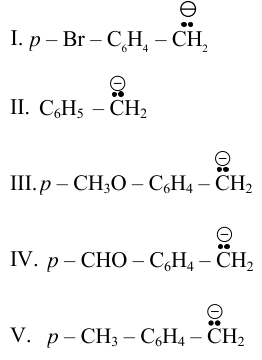
-
- (A) I > II > IV > V > III
- (B) I > IV > II > V > III
- (C) IV > I > II > V > III
- (D) IV > II > I > III > V
Show answer and solution
Correct Answer: (C)
Electron withdrawing groups increases stability of carbanion and electron donating groups decreases stability of carbanion. - 2. Consider the following compounds
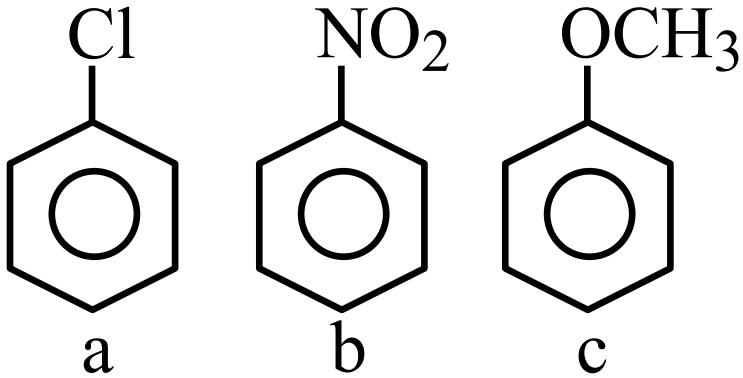
Arrange these compounds in the increasing order of reactivity with nitrating mixture. 2026 Hard- (A) \(c < a < b\)
- (B) \(b < c < a\)
- (C) \(c < b < a\)
- (D) \(b < a < c\)
Show answer and solution
Correct Answer: (D)
In Ph-OMe, -OMe is an electron donor group (+M).
\(Ph-NO_{2}\), \(-NO_{2}\) is strong withdrawing group (-M).
Ph-Cl, -Cl is a electron withdrawing group. -
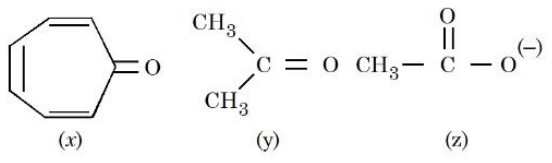
- (A) \(x>y>z\)
- (B) \(y>z>x\)
- (C) \(z>x>y\)
- (D) \(x>z>y\)
Show answer and solution
Correct Answer: (C)
In acetone \((y)\), the carbon-oxygen bond is a localized double bond with a bond order of approximately \(2\).
In the acetate ion \((z)\), there are two equivalent resonance structures that delocalize the negative charge equally over both oxygen atoms. This results in a carbon-oxygen bond order of exactly \(1.5\).
In tropone \((x)\), the carbon-oxygen double bond is conjugated with the \(\pi\) system of the seven-membered ring. Polarization of the \(C=O\) bond leads to a resonance structure with a single \(C-O^{-}\) bond and a positive charge on the ring, forming an aromatic tropylium cation. This aromatic stabilization gives the \(C=O\) bond significant single-bond character. However, because this resonance structure involves charge separation, its contribution is less than that of the neutral structure. Thus, the bond order in tropone is between \(1.5\) and \(2\).
Since bond length is inversely proportional to bond order, the carbon-oxygen bond length is longest for the acetate ion (bond order \(1.5\)), followed by tropone (bond order between \(1.5\) and \(2\)), and shortest for acetone (bond order \(2\)).
Therefore, the correct order of carbon-oxygen bond length is \(z > x > y\).
Answer: \(z>x>y\) -
- (A) 11
- (B) 12
- (C) 13
- (D) 14
Show answer and solution
Correct Answer: (D)
The hydrocarbon with molecular formula \(C_5H_{10}\) has a degree of unsaturation of \(1\). Since its isomers do not decolourise \(KMnO_4\) solution, they do not contain any carbon-carbon double bonds. Thus, they must be cycloalkanes.
The possible structural isomers of cyclic \(C_5H_{10}\) and the number of their monochloro structural isomers are as follows:
1. Cyclopentane:
All carbon atoms are equivalent. Chlorination gives \(1\) monochloro product (chlorocyclopentane).
2. Methylcyclobutane:
There are \(4\) different types of hydrogen atoms (on the methyl group, on \(C_1\), on \(C_2/C_4\), and on \(C_3\)). Chlorination gives \(4\) monochloro products.
3. Ethylcyclopropane:
There are \(4\) different types of hydrogen atoms (on the \(CH_3\) of ethyl, on the \(CH_2\) of ethyl, on \(C_1\) of the ring, and on \(C_2/C_3\) of the ring). Chlorination gives \(4\) monochloro products.
4. 1,1-Dimethylcyclopropane:
There are \(2\) different types of hydrogen atoms (on the two equivalent methyl groups, and on the two equivalent \(CH_2\) groups of the ring). Chlorination gives \(2\) monochloro products.
5. 1,2-Dimethylcyclopropane:
There are \(3\) different types of hydrogen atoms (on the two equivalent methyl groups, on the two equivalent \(CH\) groups of the ring, and on the \(CH_2\) group of the ring). Chlorination gives \(3\) monochloro products.
Since each of these cycloalkanes has a different carbon skeleton, their monochloro derivatives will all be distinct structural isomers.
Total number of monochloro compounds (structural isomers only) = \(1 + 4 + 4 + 2 + 3 = 14\).
Answer: \(14\) -
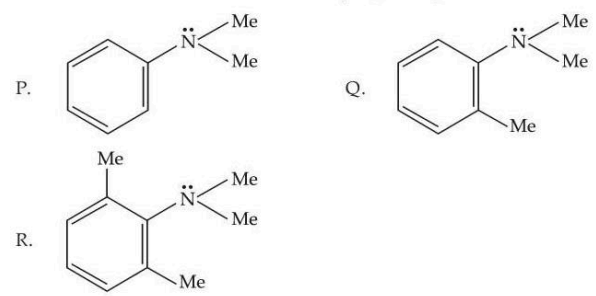
- (A) \(P > Q > R\)
- (B) \(R > P > Q\)
- (C) \(R > Q > P\)
- (D) \(P > R > Q\)
Show answer and solution
Correct Answer: (A)
The reaction of the given aromatic compounds with benzenediazonium chloride (\(Ph-N_2^+ Cl^-\)) is an azo coupling reaction, which is a type of electrophilic aromatic substitution.
The electrophile, the diazonium ion (\(Ph-N_2^+\)), is a weak electrophile and requires a strongly activated aromatic ring to undergo coupling. The reactivity of the ring depends on its electron density, which is enhanced by the \(+M\) (mesomeric) effect of the \(-NMe_2\) group.
1. In molecule P (N,N-dimethylaniline), the \(-NMe_2\) group is coplanar with the benzene ring. The lone pair on the nitrogen atom is fully delocalized into the ring, providing a strong \(+M\) effect and making the ring highly electron-rich and reactive.
2. In molecule Q, there is one methyl group at the ortho position to the \(-NMe_2\) group. This causes steric hindrance, forcing the \(-NMe_2\) group slightly out of the plane of the benzene ring. This phenomenon is known as Steric Inhibition of Resonance (SIR). As a result, the delocalization of the nitrogen lone pair into the ring is reduced, decreasing the \(+M\) effect and making it less reactive than P.
3. In molecule R, there are two methyl groups at the ortho positions. This causes severe steric repulsion, forcing the \(-NMe_2\) group almost completely out of the plane of the ring. The \(+M\) effect is minimized because the lone pair can no longer effectively overlap with the \(\pi\)-system of the ring. Consequently, the ring is the least activated among the three.
Therefore, the electron density on the aromatic ring and the reactivity towards electrophilic substitution follow the order: P \(>\) Q \(>\) R.
Answer: \(P > Q > R\) - 6. CORRECT order of stability for the following is
\( CH_{2}=CH^{-}, CH_{3}-CH_{2}^{-}, CH\equiv C^{-} \) 2026 Hard- (A) \( CH_{3}-CH_{2}^{-}>CH_{2}=CH^{-}>CH\equiv C^{-} \)
- (B) \( CH_{2}=CH^{-}>CH\equiv C^{-}>CH_{3}-CH_{2}^{-} \)
- (C) \( CH\equiv C^{-}>CH_{2}=CH^{-}>CH_{3}-CH_{2}^{-} \)
- (D) \( CH\equiv C^{-}>CH_{3}-CH_{2}^{-}>CH_{2}=CH^{-} \)
Show answer and solution
Correct Answer: (C)
\(CH _2= C \overline{ H }~CH _3= C _2~CH \equiv \overline{ C }\)
Stability \( \propto \) %S
Order of stability:
\( CH\equiv\overline{C}>CH_{2}=\overline{CH}>CH_{3}-C\overline{H}_{2} \) -
- (A) A, D & E only
- (B) B, D & E only
- (C) A, C & D only
- (D) B & D only
Show answer and solution
Correct Answer: (D)
Statement B & D are not true - 8. For the given molecule, "\(x\)", the preferred site for the attack of the electrophile is :
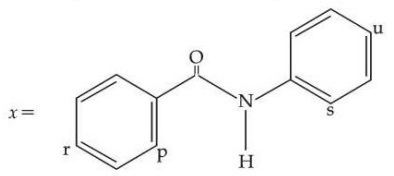 2026 Medium
- (A) Predominantly at "r"
- (B) "r" and "u"
- (C) "p" and "s"
- (D) Predominantly at "u"
Show answer and solution
Correct Answer: (D)
The given molecule, benzanilide, contains two phenyl rings with different reactivities towards electrophilic aromatic substitution.
The left phenyl ring is attached to the carbonyl carbon of the amide group (\(-C(=O)NHPh\)). The carbonyl group is electron-withdrawing due to its \(-M\) and \(-I\) effects, which deactivates this ring towards electrophilic attack.
The right phenyl ring is attached to the nitrogen atom of the amide group (\(-NHC(=O)Ph\)). The nitrogen atom possesses a lone pair of electrons that can delocalize into the ring via resonance (\(+M\) effect). This electron donation activates the right ring, making it significantly more reactive than the left ring.
The \(-NHC(=O)Ph\) group is an ortho/para directing group. The possible sites for electrophilic attack on the activated ring are the ortho position ('s') and the para position ('u').
Due to the large steric bulk of the \(-NHC(=O)Ph\) group, the ortho position ('s') experiences significant steric hindrance. Therefore, the electrophile will preferentially attack the less hindered para position.
Thus, the preferred site for the attack of the electrophile is predominantly at 'u'.
Answer: Predominantly at "u" -
- (A) Statement I is true but Statement II is false
- (B) Both Statement I and Statement II are true
- (C) Both Statement I and Statement II are false
- (D) Statement I is false but Statement II is true
Show answer and solution
Correct Answer: (A)
S-1 : \(\left( CH _3\right)_3 C ^{+}>\stackrel{+}{ C } H _3\); due to hyperconjugation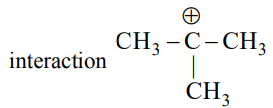
S-2 : False -
- (A) Both Statement I and Statement II are correct
- (B) Both Statement I and Statement II are incorrect
- (C) Statement I is correct but Statement II is incorrect
- (D) Statement I is incorrect but Statement II is correct
Show answer and solution
Correct Answer: (C)
Statement I is correct because alkyl groups exert a +I effect (electron-donating inductive effect). This increases the electron density on the negatively charged carbon atom, destabilizing the carbanion. Thus, as the number of alkyl groups increases, the stability of the carbanion decreases. The order of stability is \(\text{CH}_3^- > \text{CH}_3\text{CH}_2^- > (\text{CH}_3)_2\text{CH}^- > (\text{CH}_3)_3\text{C}^-\).
Statement II is incorrect because allyl and benzyl carbanions are highly stabilized by the resonance effect, where the negative charge is delocalized over the adjacent \(\pi\) bonds or the benzene ring, rather than by the inductive effect.
Answer: Statement I is correct but Statement II is incorrect -
- (A) B and D Only
- (B) C and A Only
- (C) A and D Only
- (D) B and C Only
Show answer and solution
Correct Answer: (D)
Presence of \(NO_{2}\) group in Benzene ring deactivate ring towards electrophilic substitution reaction due to -M effective & activate ring towards nucleophilic substitution. - 12. Increasing order of electron withdrawing power of following functional groups is:
a. \(-CN\)
b. \(-COOH\)
c. \(-NO_2\)
d. \(-I\) 2026 Easy- (A) \(c < b < d < a\)
- (B) \(c < a < b < d\)
- (C) \(d < b < a < c\)
- (D) \(a < b < c < d\)
Show answer and solution
Correct Answer: (C)
The electron withdrawing power (\(-I\) effect) of various functional groups follows the standard experimental order:
\(-NO_2 > -CN > -COOH > -F > -Cl > -Br > -I\)
Based on this series, the increasing order of electron withdrawing power for the given groups is:
\(-I < -COOH < -CN < -NO_2\)
This corresponds to the sequence \(d < b < a < c\).
Answer: \(d < b < a < c\) -
- (A) A-III, B-I, C-II, D-IV
- (B) A-III, B-IV, C-II, D-I
- (C) A-III, B-IV, C-I, D-II
- (D) A-I, B-III, C-IV, D-II
Show answer and solution
Correct Answer: (C)
Williamson synthesis involves the reaction of an alkyl halide with a sodium alkoxide to form an ether, which proceeds via a nucleophilic substitution (\(S_N2\)) mechanism. Thus, A matches with III.
Friedel-Crafts reaction involves the alkylation or acylation of an aromatic ring in the presence of a Lewis acid catalyst, which proceeds via an electrophilic substitution mechanism. Thus, B matches with IV.
Bromination of vinyl benzene (styrene) involves the addition of bromine across the carbon-carbon double bond, which proceeds via an electrophilic addition mechanism. Thus, C matches with I.
Chlorination of toluene in the presence of sunlight (or UV light) involves the substitution of hydrogen atoms in the methyl group by chlorine, which proceeds via a free radical substitution mechanism. Thus, D matches with II.
The correct matching is A-III, B-IV, C-I, D-II.
Answer: A-III, B-IV, C-I, D-II - 14. The correct order of reactivity of the following benzyl halides towards reaction with KCN is:
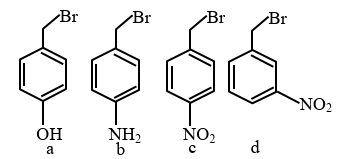 2026 Medium
- (A) a > b > c > d
- (B) b > a > d > c
- (C) b > a > c > d
- (D) a > b > d > c
Show answer and solution
Correct Answer: (B)
This is \(S_{N}1\) reaction.
Rate of \(S_{N}1\) reaction \(\propto\) stability of carbocation. -
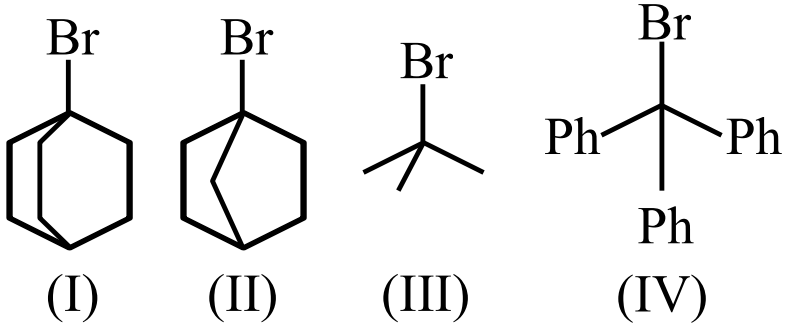
- (A) \(IV < III < II < I\)
- (B) \(III < I < II < IV\)
- (C) \(II < I < III < IV\)
- (D) \(I < II < III < IV\)
Show answer and solution
Correct Answer: (C)
Rate of \(S_{N}1\propto\) Stability of \(C^{\oplus}\) fromed
(I) and (II) are unstable due to Bredt's rule, (I) has more +I effect.
\((II) < (I) < (III) < (IV)\). -
- (A) \(PhO^{-} > ^{-}OH > CH_{3}COO^{-} > ClO_{4}^{-}\)
- (B) \(ClO_{4}^{-} > CH_{3}COO^{-} > ^{-}OH > PhO^{-}\)
- (C) \(CH_{3}COO^{-} > PhO^{-} > ^{-}OH > ClO_{4}^{-}\)
- (D) \({ }^{-} OH > PhO ^{-}> CH _3 COO ^{-}> ClO _4^{-}\)
Show answer and solution
Correct Answer: (D)
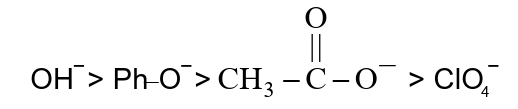
Stability order of anion: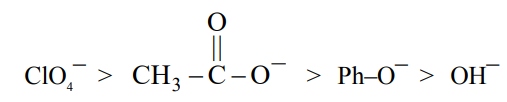 and nucleophlicity order reverse of stability of anion.
-
- (A) II, IV
- (B) III, II
- (C) I, IV
- (D) II, I
Show answer and solution
Correct Answer: (D)
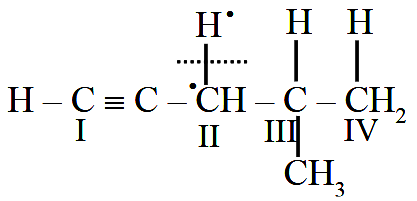
II most stable carbon radical due to resonance stablise
I least stable carbon radical due to no stabilising factor. -
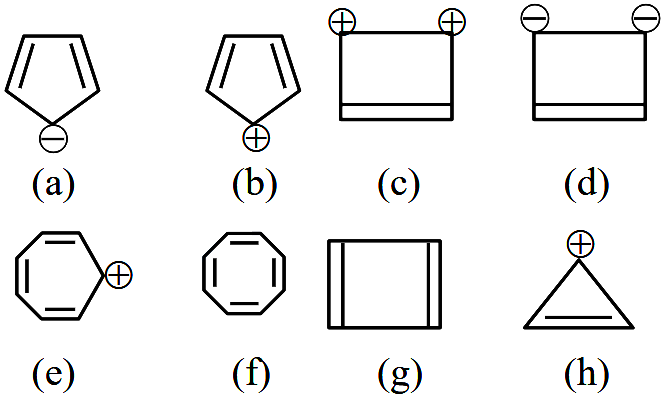
- (A) \(e, g\) aromatic and \(a, b, c, d, f, h\) not aromatic
- (B) \(b, e, f, g\) aromatic and \(a, c, d, h\) not aromatic
- (C) \(a, b, c, d\) aromatic and \(e, f, g, h\) not aromatic
- (D) \(a, c, d, e, h\) aromatic and \(b, f, g\) not aromatic
Show answer and solution
Correct Answer: (D)
Aromatic compounds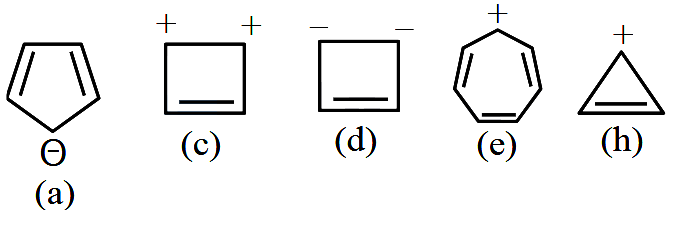
a, c, d, e, h follow Huckel's rule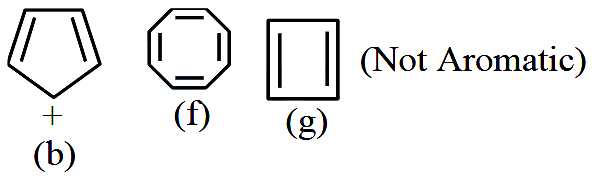
\(b, f, g\), are not aromatic, these compounds do not follow Huckel's rule. -
- (A) Statement I is true but Statement II is false
- (B) Both Statement I and Statement II are false
- (C) Statement I is false but Statement II is true
- (D) Both Statement I and Statement II are true
Show answer and solution
Correct Answer: (C)
Hyper conjugation is permanent effect because external reagent is not required, so Statement-I is false and Statement-II is true. because moore alkyl group, more \(\alpha-H\), so more hyperconjugation which results more stability of carbocation. -
- (A) Statement I is false but Statement II is true
- (B) Both Statement I and Statement II are false
- (C) Statement I is true but Statement II is false
- (D) Both Statement I and Statement II are true
Show answer and solution
Correct Answer: (C)
Statement-I :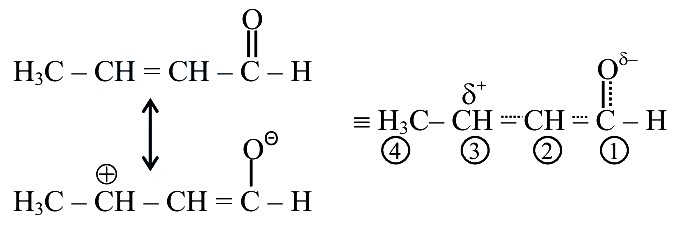
\(\mu=\mathrm{q} \times \mathrm{d}\)
More charges and more distance between charges than other compound so more dipole moment. Statement-I is true.
Statement-II :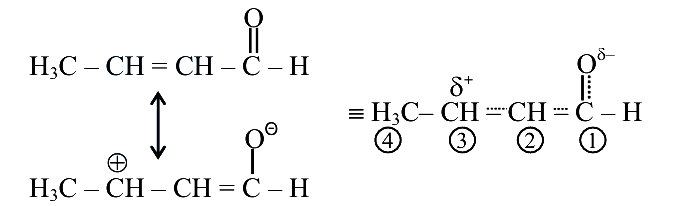
\(\mathrm{C}_1-\mathrm{C}_2\) bond has partial double bond character that means lesser bond length than \(\mathrm{C}_1-\mathrm{C}_2\) bond of other compound. Statement-II is false. -
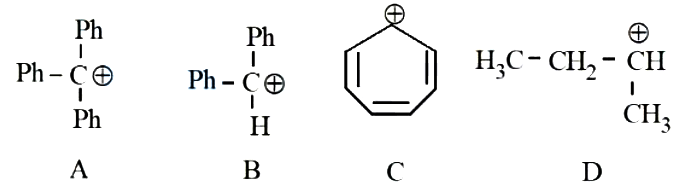
- (A) \(\mathrm{C}\gt\mathrm{B}\gt\mathrm{A}\gt\mathrm{D}\)
- (B) \(\mathrm{A}\gt\mathrm{B}\gt\mathrm{C}\gt\mathrm{D}\)
- (C) \(\mathrm{B}\gt\mathrm{C}\gt\mathrm{A}\gt\mathrm{D}\)
- (D) \(\mathrm{C}\gt\mathrm{A}\gt\mathrm{B}\gt\mathrm{D}\)
Show answer and solution
Correct Answer: (D)
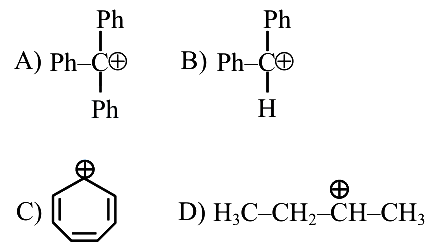
Solution :-
C is aromatic due to \(\oplus \mathrm{ve}\) charge hence it is most stable
A have more resonance structure
B have less resonance structure
D have only hyper conjugation
Consider First Aromaticity \(>\) Resonance \(>\) Hyper conjugation
Ans. D \( < \) B \( < \) A \( < \) C -
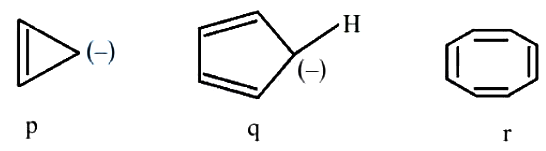
- (A) \(q\gt r\gt p\)
- (B) \(r\gt q\gt p\)
- (C) \(q\gt p\gt r\)
- (D) \(\mathrm{p}\gt\mathrm{q}\gt\mathrm{r}\)
Show answer and solution
Correct Answer: (A)
q is aromatic
r is non-aromatic
p is antiaromatic
\(\mathrm{q}>\mathrm{r}>\mathrm{p}\) (order of stability)
Aromatic > non-aromatic > antiaromatic -
- (A) 7
- (B) 4
- (C) 6
- (D) 5
Show answer and solution
Correct Answer: (D)
Total five nucleophiles are present
\(\mathrm{NH}_3, \mathrm{PhSH},\left(\mathrm{H}_3 \mathrm{C}\right)_2 \mathrm{~S}, \mathrm{CH}_2=\mathrm{CH}_2, \stackrel{\ominus}{\mathrm{O}} \mathrm{H}\) -
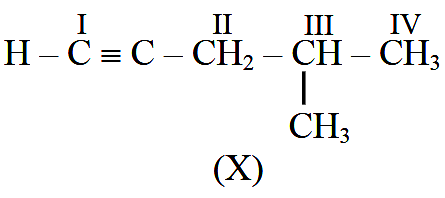
- (A) \(3\)
- (B) \(2\)
- (C) \(4\)
- (D) \(1\)
Show answer and solution
Correct Answer: (C)
\(-\mathrm{NO}_2,-\mathrm{C} \equiv \mathrm{N},-\mathrm{COR},-\mathrm{COOH}\)are meta directing.
-
- (A) \(c>b>d>a\)
- (B) \(a>b>c>d\)
- (C) \(d>a>c>b\)
- (D) \(d>c>b>a\)
Show answer and solution
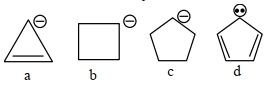
Correct Answer: (D)
As we know compound (\(d\)) is aromatic and the compound (\(a\)) is anti-aromatic. Hence compound(\(d\))is most stable and compound (\(a\)) is least stable among these in compound (\(b\)) and (\(c\)) carbon atom of that positive charge is \(\mathrm{sp}^3\) hybridised they on the basis of angle strain theory compound (\(c\)) is more stable than compound (\(b\)).
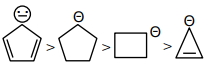
- 26. For the given compounds, the correct order of increasing \(\mathrm{pK}_{\mathrm{a}}\) value:
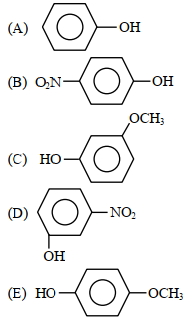 2024 Medium
- (A) (E) < (D) < (C) < (B) < (A)
- (B) (D) < (E) < (C) < (B) < (A)
- (C) (E) < (D) < (B) < (A) < (C)
- (D) (B) < (D) < (C) < (A) < (E)
Show answer and solution
Correct Answer: (D)
Acidic strength order :-\(\mathrm{B}>\mathrm{D}>\mathrm{C}>\mathrm{A}>\mathrm{E}\)
Correct \(\mathrm{pKa}\) Order :
\(\text { B }<\text { D }<\text { C }<\text { A }<\text { E }\)
-
- (A) \((A)\) only
- (B) \((C)\) only
- (C) \((B)\) only
- (D) \((D)\) and \((E)\) only
Show answer and solution
Correct Answer: (C)
Heterolytic cleavage of Bond lead to formation of ions. - 28. Number of carbocations from the following that are not stabilized by hyperconjugation is _______.
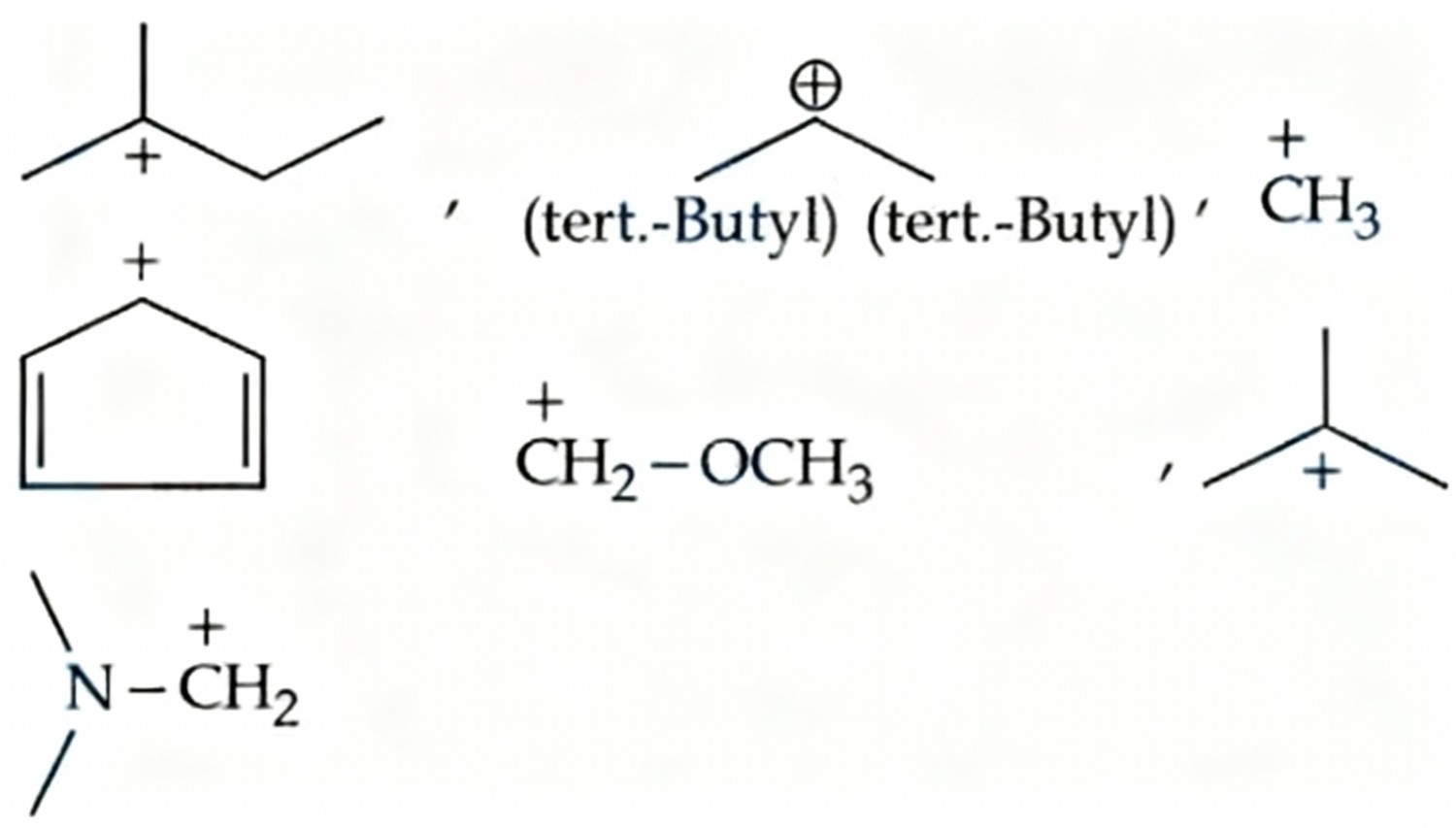 2024 Medium
- (A) 3
- (B) 5
- (C) 7
- (D) 9
Show answer and solution
Correct Answer: (A)
3 -
- (A) \((I) \)>\( (III) \)>\( (II)\)
- (B) \((I) \)>\( (II) \)>\( (III)\)
- (C) \((II) \)>\( (I) \)>\( (III)\)
- (D) \((III) \)>\( (II) \)>\( (I)\)
Show answer and solution
Correct Answer: (B)
\((1)\) Neutral structures are more stable than charged ones. Therefore \(I\) is more stable than \(II\) and \(III\).\((2)\) +ve charge on less electronegative atom is more stable i.e., \(\mathrm{C}^{\oplus}\) is more stable than \(\mathrm{O}^{\oplus}\)
\(\therefore\) Order is \(\mathrm{I}>\) II \(>\) \(III\)
-
- (A) \(C < D < B < A\)
- (B) \(A < B < C < D\)
- (C) \(A < B < D < C\)
- (D) \(D < C < B < A\)
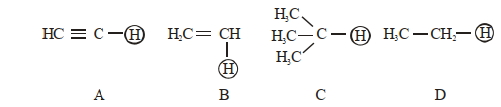
Show answer and solution
Correct Answer: (A)
\(Image\)Stability of conjugate base \(\alpha\) acidic strength \(\mathrm{C}<\mathrm{D}<\mathrm{B}<\mathrm{A}\)

- 31. The correct order of reactivity in electrophilic substitution reaction of the following compounds is _______.
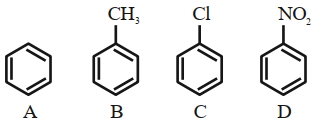 2024 Hard
- (A) \(\mathrm{B}>\mathrm{C}>\mathrm{A}>\mathrm{D}\)
- (B) \(\mathrm{D}>\mathrm{C}>\mathrm{B}>\mathrm{A}\)
- (C) \(\mathrm{A}>\mathrm{B}>\mathrm{C}>\mathrm{D}\)
- (D) \(B>A>C>D\)
Show answer and solution
Correct Answer: (D)
\(-\mathrm{CH}_3\) shows \(+\mathrm{M}\) and \(+\mathrm{I}\).\(-\mathrm{Cl}\) shows \(+\mathrm{M}\) and \(-\mathrm{I}\) but inductive effect dominates.
\(-\mathrm{NO}_2\) shows \(-\mathrm{M}\) and \(-\mathrm{I}\).
Electrophilic substitution \(\alpha \frac{1}{-\mathrm{M} \text { and }-\mathrm{I}}\)
\(\alpha+\mathrm{M} \text { and }+\mathrm{I}\)
Hence, order is \(\mathrm{B}>\mathrm{A}>\mathrm{C}>\mathrm{D}\).
-
- (A) \(\left(\mathrm{CH}_3\right)_3 \mathrm{C}^{+}>\mathrm{CH}_3-\stackrel{+}{\mathrm{C}} \mathrm{H}_2>\left(\mathrm{CH}_3\right)_2 \stackrel{+}{\mathrm{C}} \mathrm{H}>\stackrel{+}{\mathrm{C}} \mathrm{H}_3\)
- (B) \(\stackrel{+}{\mathrm{C}} \mathrm{H}_3>\left(\mathrm{CH}_3\right)_2 \stackrel{+}{\mathrm{C}} \mathrm{H}>\mathrm{CH}_3-\stackrel{+}{\mathrm{C}} \mathrm{H}_2>\left(\mathrm{CH}_3\right)_3 \stackrel{+}{\mathrm{C}}\)
- (C) \(\left(\mathrm{CH}_3\right)_3 \stackrel{+}{\mathrm{C}}>\left(\mathrm{CH}_3\right)_2 \stackrel{+}{\mathrm{C}} \mathrm{H}>\mathrm{CH}_3-\stackrel{+}{\mathrm{C}} \mathrm{H}_2>\stackrel{+}{\mathrm{C}} \mathrm{H}_3\)
- (D) \(\stackrel{+}{\mathrm{C}} \mathrm{H}_3>\mathrm{CH}_3-\stackrel{+}{\mathrm{C}} \mathrm{H}_2>\mathrm{CH}_3-\stackrel{+}{\mathrm{C}} \mathrm{H}>\left(\mathrm{CH}_3\right) \mathrm{C}^{+}\stackrel{+}{\mathrm{C}} \mathrm{H}_3\)
Show answer and solution
Correct Answer: (C)
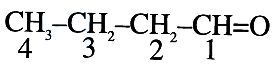
More no. of hyperconjugable Hydrogens, more stable is the carbocations. - 33. The correct stability order of the following resonance structures of \(\mathrm{CH}_3-\mathrm{CH}=\mathrm{CH}-\mathrm{CHO}\) is _______.
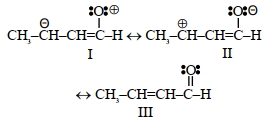 2024 Medium
- (A) \(II\) \(>\) \(III\) \(>\) \(I\)
- (B) \(III\) \(>\) \(II\) \(>\) \(I\)
- (C) \(I\) \(>\) \(II\) \(>\) \(III\)
- (D) \(II\) \(>\) \(I\) \(>\) \(III\)
Show answer and solution
Correct Answer: (B)
\(Image\)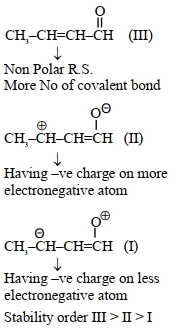
-
- (A) electromeric energy
- (B) resonance energy
- (C) ionization energy
- (D) hyperconjugation energy
Show answer and solution
Correct Answer: (B)
The difference in energy between the actual structure and the lowest energy resonance structure for the given compound is known as resonance energy. - 35. The interaction between \(\pi\) bond and lone pair of electrons present on an adjacent atom is responsible for: 2024 Hard
- (A) Hyperconjugation
- (B) Inductive effect
- (C) Electromeric effect
- (D) Resonance effect
Show answer and solution
Correct Answer: (D)
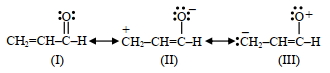
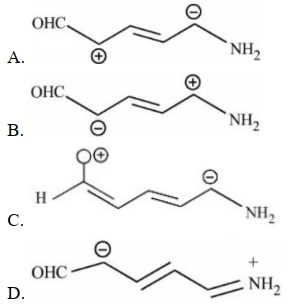
It is a type of conjugation responsible for resonance. - 36. The order of relative stability of the contributing structure is: Choose the correct answer from the options given below:
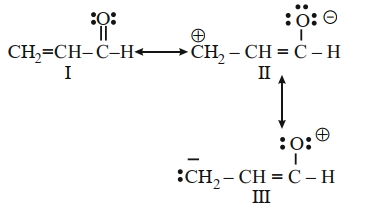 2024 Hard
- (A) \( I > II > III\)
- (B) \(II > I > III\)
- (C) \(\mathrm{I}=\mathrm{II}=\mathrm{III}\)
- (D) \(III > II > I\)
Show answer and solution
Correct Answer: (A)
\(I\) \(>\) \(II\) \(>\) \(III\), since neutral resonating structures are more stable than charged resonating structure. \(II\) \(>\) \(III\), since stability of structure with -ve charge on more electronegative atom is higher. -
- (A) \(-\mathrm{CN},-\mathrm{NH}_2,-\mathrm{NHR},-\mathrm{OCH}_3\)
- (B) \(-\mathrm{NO}_2,-\mathrm{NH}_2,-\mathrm{COOH},-\mathrm{COOR}\)
- (C) \(-\mathrm{NO}_2,-\mathrm{CHO},-\mathrm{SO}_3 \mathrm{H},-\mathrm{COR}\)
- (D) \(-\mathrm{CN},-\mathrm{CHO},-\mathrm{NHCOCH}_3,-\mathrm{COOR}\)
Show answer and solution
Correct Answer: (C)
All are \(-\mathrm{M}\), Hence meta directing groups.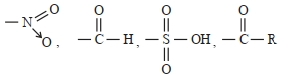
-
- (A) \(\mathrm{C} \overline{1}>\mathrm{OH}>\mathrm{R} \overline{\mathrm{O}}>\mathrm{CH}_3 \mathrm{CO} \overline{\mathrm{O}}\)
- (B) \(\mathrm{R} \overline{\mathrm{O}}>-\mathrm{OH}>\mathrm{CH}_3 \mathrm{CO} \overline{\mathrm{O}}>\mathrm{C} \overline{1}\)
- (C) \({ }^{-} \mathrm{OH}>\mathrm{R} \overline{\mathrm{O}}>\mathrm{CH}_3 \mathrm{CO} \overline{\mathrm{O}}>\mathrm{C} \overline{1}\)
- (D) \(\mathrm{C}_{\overline{1}}>\mathrm{R} \overline{\mathrm{O}}>-{ }^{-} \mathrm{OH}>\mathrm{CH}_3 \mathrm{CO} \overline{\mathrm{O}}\)
Show answer and solution
Correct Answer: (B)
Strong acid have weak conjugate base Acidic strength :\(\mathrm{H}-\mathrm{Cl}>\mathrm{CH}_3 \mathrm{COOH}>\mathrm{H}_2 \mathrm{O}>\mathrm{R}-\mathrm{OH}\)
Conjugate base strength :
\(\mathrm{Cl}^{-}<\mathrm{CH}_3 \mathrm{COO}^{-}<\overline{\mathrm{O}} \mathrm{H}<\mathrm{RO}^{-}\)
-
- (A) Electromeric effect dominates over inductive effect
- (B) The electromeric effect is, temporary effect
- (C) The organic compound shows electromeric effect in the presence of the reagent only
- (D) Hydrogen ion \(\left(\mathrm{H}^{+}\right)\)shows negative electromeric effect
Show answer and solution
Correct Answer: (D)
Hydrogen ion \(\left(\mathrm{H}^{+}\right)\)shows positive electromeric effect. - 40. Arrange the following compounds in increasing order of rate of aromatic electrophilic substitution reaction
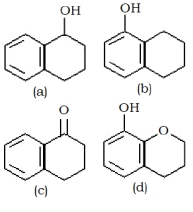 2023 Hard
- (A) \(d, b, c, a\)
- (B) \(b, c, a, d\)
- (C) \(c, a, b, d\)
- (D) \(d, b, a, c\)
Show answer and solution
Correct Answer: (C)
Benzene becomes more reactive towards EAS when any substituent raises the electron density.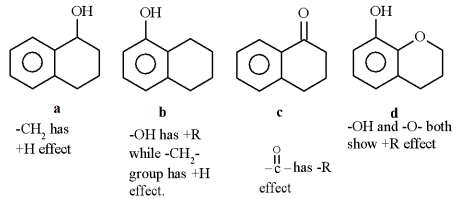
- 41. Decreasing order of reactivity towards electrophilie substitution for the following compounds is:
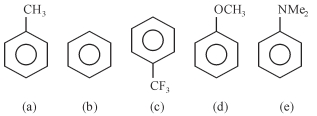 2023 Medium
- (A) \(c > b > a > d > e\)
- (B) \(e > d > a > b > c\)
- (C) \(a > d > e > b > c\)
- (D) \(d > a > e > c > b\)
Show answer and solution
Correct Answer: (B)
Higher the electron density on Benzene Ring, Higher its Reactivity towards electrophilic substitution Reaction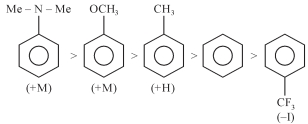
-
- (A) \(A\) is false but \(R\) is true
- (B) Both \(A\) and \(R\) are correct and \(R\) is the correct explanation of \(A\)
- (C) Both \(A\) and \(R\) are correct but \(R\) is NOT the correct explanation of \(A\)
- (D) \(A\) is true but \(R\) is false
Show answer and solution
Correct Answer: (C)
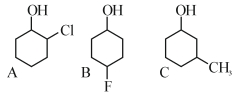
Acidic strength \(\alpha-\) I effect\(\alpha \frac{1}{+ I }\) effect
\(F , Cl\) exerts \(- I\) effect, Methyl exerts \(+ I\) effect, \(C\) is least acidic.
Among \(A\) and \(B\); since inductive effect is distance dependent, Extent of \(- I\) effect is higher in \(A\) followed by \(B\) even though \(F\) is stronger electron withdrawing group than \(Cl\). Thus, \(A\) is more acidic than \(B\).
-
- (A) \(C , D , B , A\)
- (B) \(C, A, B, D\)
- (C) \(D, C, A, B\)
- (D) \(D , C , B , A\)
Show answer and solution
Correct Answer: (B)
Based on Theory -
- (A) \(A-I, B-IV, C-II, D-III\)
- (B) \(A-III, B-II, C-I, D-IV\)
- (C) \(A-III, B-II, C-IV, D-I\)
- (D) \(A-III, B-II, C-IV, D-I\)
Show answer and solution
Correct Answer: (D)
Basic Strength \(\alpha \frac{1}{ pK _{ b }}\) Order for \(pK _{ b }: A > B > D > C\)
- 45. The decreasing order of hydride affinity for following carbocations is: Choose the correct answer from the options given below:
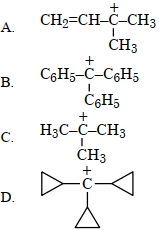 2023 Medium
- (A) \(A,C,B,D\)
- (B) \(C,A,B,D\)
- (C) \(C,A,D,B\)
- (D) \(A,C,D,B\)
Show answer and solution
Correct Answer: (B)
Stability order of cations is: \(C < A < B < D\) -
- (A) \(c\)
- (B) \(d\)
- (C) \(b\)
- (D) \(a\)
Show answer and solution
Correct Answer: (A)
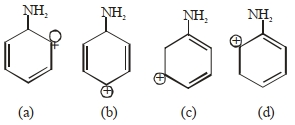
The \(+ M\) effect of \(NH _2\) is stabilizing the carbocation.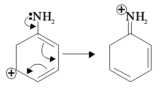
-
- (A) \(C < D < E < A < B\)
- (B) \(D < B < E < A < C\)
- (C) \(D < C < E < A < B\)
- (D) \(C < D < E < B < A\)
Show answer and solution
Correct Answer: (B)
\(- NO _{2}\) is strongly deactivating \(- Br -\) deactivating \(- CH _{3}\)-activating group \(D < B < E < A < C\)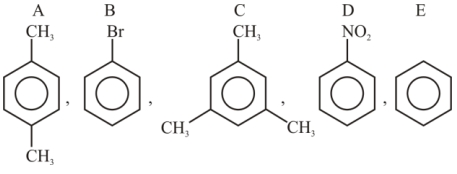
- 48. \(\dot{ Cl }+ CH _{4} \rightarrow A + B\) \(A\) and \(B\) in the above atmospheric reaction step are. 2022 Easy
- (A) \(C _{2} H _{6}\) and \(Cl _{2}\)
- (B) \(\dot{ C } HCl_2\) and \(H _{2}\)
- (C) \(\dot{ C } H _{3}\) and \(HCl\)
- (D) \(C _{2} H _{6}\) and \(HCl\)
Show answer and solution
Correct Answer: (C)
\(Cl + CH _{4} \longrightarrow \dot{ CH }_{3}+ HCl\) -
- (A) \(F ^{-}> OH ^{-}\)
- (B) \({{H}_{2}}\underset{\scriptscriptstyle\centerdot\centerdot}{\ddot{O}} > OH ^{-}\)
- (C) \(R \underset{\scriptscriptstyle\centerdot\centerdot}{\ddot{O}} H> RO ^{-}\)
- (D) \(NH _{2}^{-}> NH _{3}\)
Show answer and solution
Correct Answer: (D)
Nucleophilicity \(\propto\) electro density on donor atom\(\propto\) size of donor atom (in gas)
\(\propto \frac{1}{\text { EN of atom }}\) (for period)
-
- (A) \(CH _{3} CH _{2} \stackrel{\oplus}{ CH _{2}}\)
- (B) \(CH _{3} \stackrel{\oplus}{ C } H _{2}\)
- (C) \(CH _{3}-\stackrel{\oplus}{ C } H - CH _{3}\)
Show answer and solution
Correct Answer: (C)
\(CH _{3}-\stackrel{\oplus}{ CH - CH _{3}}\) is formed in the above reaction

No questions on this page match these filters.
About Organic chemistry reaction mechanism PYQs
Organic chemistry reaction mechanism has 64 questions from 2013–2026. The most came in 2026 (16), 2024 (16) and 2025 (7).
The most asked topics are Electronic Displacement in covalent bond, Reactive Intermediates and Attacking reagents.
14% are easy, 47% medium and 39% hard.
Organic chemistry reaction mechanism PYQs by year
Frequently asked
How many Organic chemistry reaction mechanism questions came in JEE Mains?
64 questions from 2013–2026, each with the correct answer and a full solution.
Which Organic chemistry reaction mechanism topic is asked the most?
Electronic Displacement in covalent bond, with 28 questions, followed by Reactive Intermediates with 13.
Which year had the most Organic chemistry reaction mechanism questions?
2026, with 16 questions.
How difficult are Organic chemistry reaction mechanism questions?
14% are easy, 47% medium and 39% hard.