


Questions
22 questionsShowing 1–22 of 22 questions
-
- (A) \(2\)
- (B) \(1\)
- (C) \(3\)
- (D) \(4\)
Show answer and solution
Correct Answer: (C)
According to Bohr's postulates, an electron makes jump to higher energy orbital if it absorbs a photon of energy equal to difference between the energies of an excited state and the ground state. Assuming that collided electron takes energy equal to \(10.2\,eV\) or \(12.09\,eV\) from incoming electron beam (some part lost due to collision). The maximum excited state is \(n =3\). So, number of spectral lines is \(\frac{3(3-1)}{2}=3\) -
- (A) \(800\)
- (B) \(828\)
- (C) \(830\)
- (D) \(895\)
Show answer and solution
Correct Answer: (B)
In the ground state energy \(=-13.6\,eV\)So energy
\(\quad \frac{-13.6 eV }{n^2}=-13.6+12.75\)
\(\frac{-13.6 eV }{n^2}=-0.85\)
\(\quad n=\sqrt{16}\)
\(\qquad n=4\)
\(\text { Angular momentum }=\frac{n h}{2 \pi}=\frac{4 h}{2 \pi}=\frac{2 h}{\pi}\)
\(\text { Angular momentum }=\frac{2}{\pi} \times 4.14 \times 10^{-15}\)
\(\qquad=\frac{828 \times 10^{-17}}{\pi} eVs\)
-
- (A) \(2\)
- (B) \(3\)
- (C) \(4\)
- (D) \(8\)
Show answer and solution
Correct Answer: (B)
\(6={ }^4 C _2 \quad \Rightarrow n _2=4\)\(h v= E _4- E _1\)
\(\therefore v=13.6\left(\frac{1}{1^2}-\frac{1}{4^2}\right) \times \frac{1}{4.25 \times 10^{-15}}\)
\(=3 \times 10^{15}\,Hz\)
-
- (A) \(94.1\)
- (B) \(941\)
- (C) \(97.4\)
- (D) \(99.3\)
Show answer and solution
Correct Answer: (A)
\(\frac{ hc }{\lambda}=\left[1-\frac{1}{16}\right](13.6\,eV )\)So, \(\lambda=94.1\,nm\)
-
- (A) \(\sqrt{n}\)
- (B) \(n\)
- (C) \(n^2\)
- (D) \(\frac{1}{n}\)
Show answer and solution
Correct Answer: (A)
\(U=\frac{1}{2} m \omega^2 r^2\)\(F=-\frac{d v}{d r}=-m \omega^2 r\)
Now \(m \omega^2 r=\frac{m v^2}{r} \Rightarrow v=\omega v^{\prime}\)
\(m vr=\frac{n h}{2 \pi} \ldots (ii)\)
From \((i)\) and \((ii)\)
\(m \omega r^2=\frac{n h}{2 \pi}\)
\(\Rightarrow r \propto \sqrt{n}\)
-
- (A) \(4124\)
- (B) \(4125\)
- (C) \(4123\)
- (D) \(4122\)
Show answer and solution
Correct Answer: (B)
\(E = E _1- E _2=\frac{ hc }{\lambda_1}-\frac{ hc }{\lambda_2}= hc \left(\frac{1}{\lambda_1}-\frac{1}{\lambda_2}\right)\)\(=6.6 \times 10^{-34} \times 3 \times 10^8\left(\frac{1}{500 \times 10^{-9}}-\frac{1}{600 \times 10^{-9}}\right)\)
\(=6.6 \times 10^{-20}\,J\)
\(=\frac{6.6 \times 10^{-20}}{1.6 \times 10^{-19}} eV =4.125 \times 10^{-1}\,eV\)
\(=4125 \times 10^{-4}\,eV\)
-
- (A) \(13.6\)
- (B) \(10.5\)
- (C) \(3.4\)
- (D) \(40.8\)
Show answer and solution
Correct Answer: (D)
\(\Delta E =13.6 Z ^2\left[\frac{1}{2^2}-\frac{1}{4^2}\right]\,eV\)\(=13.6 \times(4)^2\left(\frac{1}{4}-\frac{1}{16}\right)\,eV\)
\(=13.6[4-1]\,eV\)
\(=13.6 \times 3=40.8\,eV\)
-
- (A) \(5\)
- (B) \(10\)
- (C) \(15\)
- (D) \(20\)
Show answer and solution
Correct Answer: (A)
As \(\frac{1}{\lambda}=R Z^2\left[\frac{1}{ n _1^2}-\frac{1}{ n _2^2}\right]\)\(\frac{1}{\lambda_1}=R(1)^2\left[\frac{1}{(2)^2}-\frac{1}{(3)^2}\right]=R\left(\frac{5}{36}\right)\)
\(\frac{1}{\lambda_2}=R(1)^2\left[\frac{1}{(3)^2}-\frac{1}{(4)^2}\right]=R\left(\frac{7}{144}\right)\)
\((ii) \div (i)\) gives
\(\frac{\lambda_1}{\lambda_2}=\frac{7 / 144}{5 / 36}=\frac{7}{20}=\frac{7}{4 \times 5}\)
\(\therefore n =5\)
-
- (A) \(27\)
- (B) \(26\)
- (C) \(25\)
- (D) \(24\)
Show answer and solution
Correct Answer: (A)
\(\frac{1}{\lambda}= Rz ^2\left[\frac{1}{ n _1^2}-\frac{1}{ n _2^2}\right]\)\(\frac{1}{\lambda_1}= Rz ^2\left[\frac{1}{1^2}-\frac{1}{3^2}\right]=\frac{8}{9} Rz ^2\)
\(\frac{1}{\lambda_2}= Rz ^2\left[\frac{1}{1^2}-\frac{1}{2^2}\right]=\frac{3}{4} Rz ^2\)
\(1 / 2 \Rightarrow \frac{\lambda_2}{\lambda_1}=\frac{8}{9} \times \frac{4}{3}=\frac{32}{27}\)
\(\frac{\lambda_1}{\lambda_2}=\frac{27}{32}\)
Ans.\(27\)
- 10. If \(917 \mathring A\) be the lowest wavelength of Lyman series then the lowest wavelength of Balmer series will be .......\(\mathring A\). 2023 Medium
- (A) \(3667\)
- (B) \(3365\)
- (C) \(3668\)
- (D) \(3658\)
Show answer and solution
Correct Answer: (C)
For lowest wavelength of Lyman series\(\frac{1}{\lambda}=R Z^2\left[\frac{1}{1^2}-\frac{1}{\infty^2}\right]=R Z^2\)
For lowest wavelength of Balmer series
\(\frac{1}{\lambda^{\prime}} = RZ ^2\left[\frac{1}{2^2}-\frac{1}{\infty^2}\right]=\frac{ RZ ^2}{4}\)
\(\lambda^{\prime} =\frac{4}{R Z^2}=4 \times 917\)
\(=3668 \mathring A\)
-
- (A) \(1.8\)
- (B) \(7.5\)
- (C) \(3.6\)
- (D) \(8.4\)
Show answer and solution
Correct Answer: (D)
\(V _{ n } \propto \frac{ Z }{ n }\)\(Z =1, \therefore V _{ n } \propto \frac{1}{ n }\)
\(\therefore \frac{ V _3}{ V _7}=\frac{7}{3}\)
\(\therefore V _3 =\frac{7}{3} V _7\)
\(=\frac{7}{3} \times 3.6 \times 10^6\,m / s\)
\(=8.4 \times 10^6\,m / s\)
-
- (A) \(\frac{L}{2}\)
- (B) \(0\)
- (C) \(L\)
- (D) \(2L\)
Show answer and solution
Correct Answer: (C)
\(L = mvr , \quad r \propto n ^2, \quad v \propto \frac{1}{ n }\)\(\therefore L \propto n\)
\(\text { Also, } L =\frac{ nh }{2 \pi}, \text { Bohr orbit is, } L _1= L =\frac{1 . h }{2 \pi}\)
\(L _2=2[ L ]=2 L\)
\(L _2=\frac{2 h }{2 \pi}\)
So, change \(= L _2- L _1=2 L - L = L\)
-
- (A) \(B\)
- (B) \(A\)
- (C) \(C\)
- (D) \(D\)
Show answer and solution
Correct Answer: (D)
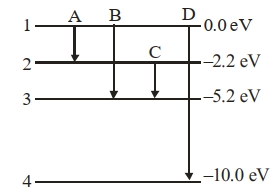
\(\lambda=\frac{ hc }{\Delta E }\)\(\Delta E _{ A }=2.2\,eV\)
\(\Delta E _{ B }=5.2\,eV\)
\(\Delta E _{ C }=3\,eV\)
\(\Delta E _{ D }=10\,eV\)
\(\lambda_{ A }=\frac{6.62 \times 10^{-34} \times 3 \times 10^8}{2.2 \times 1.6 \times 10^{-19}}\)
\(=\frac{12.41 \times 10^{-7}}{2.2}\,m\)
\(=\frac{1241}{2.2}\,nm =564\,nm\)
\(\lambda_{ B }=\frac{1241}{5.2}\,nm =238.65\,nm\)
\(\lambda_{ C }=\frac{1241}{3}\,nm =413.66\,nm\)
\(\lambda_{ D }=\frac{1241}{10}=124.1\,nm\)
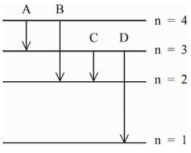
- 14. The energy levels of an hydrogen atom are shown below. The transition corresponding to emission of shortest wavelength is
 2023 Medium
- (A) \(C\)
- (B) \(D\)
- (C) \(B\)
- (D) \(A\)
Show answer and solution
Correct Answer: (B)
\(\Delta E =\frac{ hc }{\lambda} \Rightarrow \lambda \alpha \frac{1}{\Delta E }\)For shortest wavelength, energy gap should be maximum.
So, correct choice is transition from \(n =3\) to \(n =1\).
-
- (A) \(-3.4\)
- (B) \(-54.4\)
- (C) \(-13.6\)
- (D) \(-27.2\)
Show answer and solution
Correct Answer: (C)
\(E _{ n }=\frac{-13.6 Z ^2}{ n ^2}=\frac{-13.6 \times 4}{4}=-13.6\,eV\) -
- (A) \(4\)
- (B) \(6\)
- (C) \(2\)
- (D) \(10\)
Show answer and solution
Correct Answer: (C)
\(r \propto \frac{ n ^2}{ z }\)\(\frac{ r _{ He ^{+}}}{ r _{ Be ^{3+}}}=\frac{2^2 \times 4}{2 \times 4 \times 4}=\frac{1}{2}\)
- 17. The radius of electron's second stationary orbit in Bohr's atom is \(R\). The radius of the third orbit will be 2023 Medium
- (A) \(3 R\)
- (B) \(2.25 R\)
- (C) \(9 R\)
- (D) \(\frac{R}{3}\)
Show answer and solution
Correct Answer: (B)
(b) \( r \propto {n^2}\) ==> \(\frac{{{r_{(n = 2)}}}}{{{r_{(n = 3)}}}} = \frac{4}{9}\) ==> \({r_{(n = 3)}} = \frac{9}{4}R = 2.25\,R\) - 18. The radius of electron's second stationary orbit in Bohr's atom is \(R\). The radius of \(3 rd\) orbit will be \(.........R\) 2023 Easy
- (A) \(\frac{1}{3}\)
- (B) \(2.25\)
- (C) \(3\)
- (D) \(9\)
Show answer and solution
Correct Answer: (B)
\(r =0.529 \times \frac{ n ^2}{ z }\)\(r \propto n ^2\)
\(R \propto(2)^2\)
\(R _1 \propto(3)^2\)
\(\frac{ R _1}{ R }=\frac{4}{9}\)
\(R _{ l }=\frac{9 R }{4}\)
\(R _1=2.25 R\)
- 19. The radius of fifth orbit of the \(L ^{++}\)is \(.........\times 10^{-12}\,m\). Take : radius of hydrogen atom \(=0.51 \mathring A\) 2023 Medium
- (A) \(424\)
- (B) \(423\)
- (C) \(422\)
- (D) \(425\)
Show answer and solution
Correct Answer: (D)
\(r _{ n }= r _0 \frac{ n ^2}{ z } \rightarrow r _{ n }=0.51 \times \frac{25}{3} \mathring A=4.25 \times 10^{-10}\,m\)\(=425 \times 10^{-12}\,m\)
-
- (A) \(27\)
- (B) \(26\)
- (C) \(25\)
- (D) \(24\)
Show answer and solution
Correct Answer: (A)
\(\frac{1}{\lambda}= R \left[\frac{1}{ n _1{ }^2}-\frac{1}{ n _2{ }^2}\right]\) for \(H\)-atomFor balmer series, \(n _1=2\)
\(\frac{1}{\lambda}= R \left[\frac{1}{4}-\frac{1}{ n _2^2}\right]\)
For \(H _{ i }, n _2=3\)
\(H _\beta, n _2=4\)
\(\frac{1}{\lambda_{ H _{ \alpha }}}= R \left[\frac{1}{4}-\frac{1}{9}\right]=\frac{5 R }{36}\)
\(\frac{1}{\lambda_{ H _{ \beta }}}= R \left[\frac{1}{4}-\frac{1}{16}\right]=\frac{3 R }{16}\)
\(\frac{\frac{1}{\lambda_{H_\alpha}}}{\frac{1}{\lambda_{H_\beta}}}=\frac{\frac{5 R }{36}}{\frac{3 R }{16}}\)
\(\frac{\lambda_{H_{\alpha}}}{\lambda_{ H _{\beta}}}=\frac{27}{20}=\frac{ x }{20}\)
\(x=27\)
-
- (A) \(22\)
- (B) \(21\)
- (C) \(20\)
- (D) \(27\)
Show answer and solution
Correct Answer: (D)
Second excited state \(\rightarrow\) first excited state\(n =3 \rightarrow n =2\)
\(\frac{ hc }{\lambda_0}=13.6\left(\frac{1}{2^2}-\frac{1}{3^2}\right) \ldots \ldots \text { (i) }\)
Third excited state \(\rightarrow\) second orbit
\(n =4 \rightarrow n =2\)
\(\frac{ hc }{\left(20 \lambda_0 / x \right)}=13.6\left(\frac{1}{2^2}-\frac{1}{4^2}\right) \text {. }\)
\((ii)\) \(\div\) \((i)\)
\(\frac{x}{20}=\frac{\frac{1}{2^2}-\frac{1}{4^2}}{\frac{1}{2^2}-\frac{1}{3^2}}\)
\(x=27\)
-
- (A) Microwaves
- (B) \(X-\)rays
- (C) Infrared rays
- (D) Radio Waves
Show answer and solution
Correct Answer: (B)
\(X\) rays are emitted when target metal is bombarded with high energy electron.
No questions on this page match these filters.