


All JEE Mains 2023 Physics questions
32 chaptersShowing 601–644 of 644 questions
-
- (A) \(124\)
- (B) \(123\)
- (C) \(125\)
- (D) \(122\)
Show answer and solution
Correct Answer: (C)
\(a=\omega^2 R=\left(\frac{28 \times 2 \pi}{60}\right)^2 \times 1.8\)\(=\left(\frac{56}{60} \times \frac{22}{7}\right)^2 \times 1.8\)
\(=\frac{(44)^2}{225} \times 1.8\)
\(=\frac{1936 \times 1.8}{225}\)
\(x=125\)
-
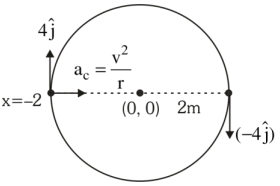
- (A) \(v =4 \hat{ i }\,m / s , a =8 \hat{ j }\,m / s ^2\)
- (B) \(v =4 \hat{ j }\,m / s , a =8 \hat{ i }\,m / s ^2\)
- (C) \(v =-4 \hat{ j }\,m / s , a =8 \hat{ i }\,m / s ^2\)
- (D) \(v =-4 \hat{ i }\,m / s , a =-8 \hat{ j }\,m / s ^2\)
Show answer and solution
Correct Answer: (B)
\(a _{ c }=\frac{ V ^2}{ r }=\frac{4^2}{2}=\frac{16}{2}=8\,m / s ^2\)\(\overrightarrow{ V }=4 \hat{ j }\)
\(\rightarrow a _{ c }=8 \hat{ i }\)
-
- (A) \(\pi\, m / s\)
- (B) \(\sqrt{3}\,m / s\)
- (C) \(2 \sqrt{3}\,m / s\)
- (D) \(1.5 \sqrt{3}\,m / s\)
Show answer and solution
Correct Answer: (D)
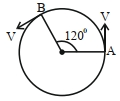
\(|\langle\vec{v}\rangle|=\frac{\left|\vec{r}_f-\vec{r}_i\right|}{\Delta t}\)\(=\frac{2 R \cos \left[\frac{\pi-\theta}{2}\right]}{\frac{2 \pi R}{3 v}}=3 \cos 30^{\circ}\)
\(1.5 \sqrt{3}\,m / s\)
-
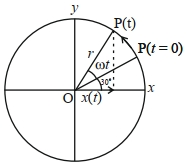
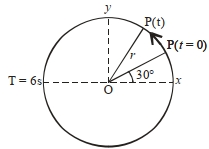
- (A) \(x(t)=r \cos \left(\omega t+\frac{\pi}{6}\right)\)
- (B) \(x(t)=r \cos (\omega t)\)
- (C) \(x(t)=r \sin \left(\omega t+\frac{\pi}{6}\right)\)
- (D) \(x(t)=r \cos \left(\omega t-\frac{\pi}{6} \omega\right)\)
Show answer and solution
Correct Answer: (A)
\(x ( t )=r \cos \left(\omega t +30^{\circ}\right)\)\(x ( t )=r \cos (\omega t +\pi / 6)\)
-
- (A) Both \(A\) and \(R\) are correct but \(R\) is NOT the correct explanation of \(A\)
- (B) Both \(A\) and \(R\) are correct \(R\) is the correct explanation of \(A\)
- (C) \(A\) is true but \(R\) is false
- (D) \(A\) is false but \(R\) is true
Show answer and solution
Correct Answer: (B)
\(R =\frac{ u ^2}{ g } \sin 2 \theta\)\(R\) is maximum for \(2 \theta=90^{\circ}\).
-
- (A) \(\frac{ u }{2 g }\)
- (B) \(\frac{ u }{ g }\)
- (C) \(\frac{2 u }{ g }\)
- (D) \(\frac{\sqrt{3} u }{ g }\)
Show answer and solution
Correct Answer: (B)
\(u \cos \theta=\frac{\sqrt{3} u }{2} \Rightarrow \cos \theta=\frac{\sqrt{3}}{2}\)\(\Rightarrow \theta=30^{\circ}\)
\(T =\frac{2 u \sin 30^{\circ}}{ g }=\frac{ u }{ g }\)
-
- (A) \(192\)
- (B) \(136\)
- (C) \(272\)
- (D) \(68\)
Show answer and solution
Correct Answer: (C)
\(H _{\max }=\frac{ v ^2}{2 g }=136\,m\)\(R _{\max }=\frac{ v ^2}{ g }=2 H _{\max }\)
\(=2(136)\)
\(=272\,m\)
-
- (A) \(50\)
- (B) \(50 \sqrt{2}\)
- (C) \(100\)
- (D) \(100 \sqrt{2}\)
Show answer and solution
Correct Answer: (C)
\(R =\frac{ v ^2 \sin 2 \theta}{ g }\)\(R \propto \sin (2 \theta)\)
\(\frac{ R _1}{ R _2}=\frac{\sin \left(2 \theta_1\right)}{\sin \left(2 \theta_2\right)}=\frac{\sin (2 \times 15)}{\sin (2 \times 45)}=\frac{\sin 30^{\circ}}{\sin 90^{\circ}}\)
\(\frac{50}{ R _2}=\frac{1}{2}\)
\(R _2=100\,m\)
-
- (A) \(3\)
- (B) \(2\)
- (C) \(1\)
- (D) \(30\)
Show answer and solution
Correct Answer: (A)
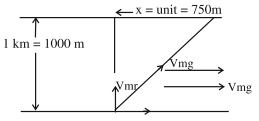
time to cross the River width \(\omega=1000\,m\)\(\text { is }=\frac{1\,km }{4\,km / h }\)
Drift \(x = Vm / g \times t\)
Where \(Vm / g\) is velocity of River w.r. to ground.
\(x = Vm / g \times \frac{1}{4}=750\,m =\frac{3}{4}\,km\)
\(Vm / g =3 km / hr\)
Ans is \(3\,km / hr\).
-
- (A) \(5\)
- (B) \(10 \sqrt{2}\)
- (C) \(200\)
- (D) \(10\)
Show answer and solution
Correct Answer: (A)
\(y=x-\frac{x^2}{20}\)For maximum height,
\(\frac{ dy }{ dx }=0 \Rightarrow 1-\frac{2 x }{20}=0\)
\(x=10\)
So, \(y _{\max }=10-\frac{100}{20}=5\,m\)
-
- (A) \(4: 1\)
- (B) \(2: 1\)
- (C) \(1: 2\)
- (D) \(1: 1\)
Show answer and solution
Correct Answer: (D)
\(\text { Range }=\frac{ u ^2 \sin 2 \theta}{ g }\)Range for projection angle " \(\alpha\) "
\(R _1=\frac{ u ^2 \sin 2 \alpha}{ g }\)
Range for projection angle " \(\beta\) "
\(R _2=\frac{ u ^2 \sin 2 \beta}{ g }\)
\(\alpha+\beta=90^{\circ}(\text { Given })\)
\(\Rightarrow \beta=90^{\circ}-\alpha\)
\(R _2=\frac{ u ^2 \sin 2\left(90^{\circ}-\alpha\right)}{ g }\)
\(R _2=\frac{ u ^2 \sin \left(180^{\circ}-2 \alpha\right)}{ g }\)
\(R _2=\frac{ u ^2 \sin 2 \alpha}{ g }\)
\(\Rightarrow \frac{ R _1}{ R _2}=\frac{\left(\frac{ u ^2 \sin 2 \alpha}{ g }\right)}{\left(\frac{ u ^2 \sin 2 \alpha}{ g }\right)}=\frac{1}{1}\)
-
- (A) \(\sqrt{3}: 2\)
- (B) \(2: \sqrt{3}\)
- (C) \(1:1\)
- (D) \(4:9\)
Show answer and solution
Correct Answer: (D)
\(R_1=\frac{u_1^2 \sin 2 \theta_1}{ g } ; R_2=\frac{ u _2^2 \sin 2 \theta_2}{ g }\)\(\frac{R_1}{R_2}=\frac{u_1^2}{u_2^2} \frac{\sin 2 \theta_1}{\sin 2 \theta_2}=\frac{40^2 \sin \left(2 \times 30^{\circ}\right)}{60^2 \sin \left(2 \times 60^{\circ}\right)}=\frac{4}{9}\)
-
- (A) \(2: \sqrt{3}\)
- (B) \(\sqrt{3}: 1\)
- (C) \(1: 3\)
- (D) \(1: \sqrt{3}\)
Show answer and solution
Correct Answer: (C)
\(H _{\max }=\frac{ u ^2 \sin ^2 \theta}{2 g }\)\(\frac{ H _1}{ H _2}=\frac{\sin ^2 \theta_1}{\sin ^2 \theta_2}=\frac{1}{3}\)
-
- (A) \(6\)
- (B) \(5\)
- (C) \(-5\)
- (D) \(10\)
Show answer and solution
Correct Answer: (B)
\(\overrightarrow{ V }=\overrightarrow{ u }+\overrightarrow{ a t}\)\(V =150-10 t\)
\(V (3)=150-30=120\)
\(V (5)=150-50=100\)
\(\frac{120}{100}=\frac{ x +1}{ x }=\frac{6}{5} \Rightarrow x =5\)
-
- (A) \(\frac{ v _1 v _2}{2\left( v _1+ v _2\right)}\)
- (B) \(\frac{v_1+v_2}{2}\)
- (C) \(\frac{2 x }{ v _1+ v _2}\)
- (D) \(\frac{2 v _1 v _2}{ v _1+ v _2}\)
Show answer and solution
Correct Answer: (D)
\(\text { Average velocity }=\frac{\text { Total displacement }}{\text { Total time }}\)\(=\frac{ x + x }{\frac{ x }{ v _1}+\frac{ x }{ v _2}}=\frac{2 v _1 v _2}{ v _1+ v _2}\)

-
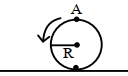
- (A) \(R \sqrt{\left(\pi^2+4\right)}\)
- (B) \(R \sqrt{\left(\pi^2+1\right)}\)
- (C) \(2 R\)
- (D) \(2 R \sqrt{\left(1+4 \pi^2\right)}\)
Show answer and solution
Correct Answer: (A)
Displacement \(=\sqrt{(2 R)^2+(\pi R)^2}=R \sqrt{4+\pi^2}\)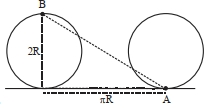
-
- (A) \(25\)
- (B) \(20\)
- (C) \(26\)
- (D) \(50\)
Show answer and solution
Correct Answer: (D)
\(t _{ AB }=\frac{ x }{5 m / s }\)In motion \(BC\)
\(x = d _1+ d _2\)
where \(d _1 , d _2\) we the distance travelled with \(10\,m / s\) and \(15\,m / s\) respectively in equal time intervals
\(\frac{' t^{\prime}}{2} \text { each }\)
\(d_1=\frac{10 t}{2}, d_2=\frac{15 t }{2}\)
\(d_1+d_2=x=\frac{t}{2}(10+15)=\frac{25 t }{2}\)
\(< v >=\frac{2 x }{\frac{ x }{5}+\frac{2 x }{25}}=\frac{2 \times 25}{5+2}=\frac{50}{7} m / s\)
Ans. : \(50\)
-
- (A) \(6\)
- (B) \(3\)
- (C) \(30\)
- (D) \(25\)
Show answer and solution
Correct Answer: (D)
\(v=u+a t\)\(60=10+2\,t\)
\(t=25\,sec\)
-
- (A) \(80\)
- (B) \(200\)
- (C) \(120\)
- (D) \(320\)
Show answer and solution
Correct Answer: (D)
Velocity of train \(A\)\(V _{ A }=90 \frac{ km }{ hr }=90 \times \frac{5}{18}=25\,m / s\)
Velocity of train \(B\)
\(V _{ B }=54 \frac{ km }{ hr }=54 \times \frac{5}{18}=15\,m / s\)
Velocity of train B w.r.t. \(\operatorname{train} A=\overrightarrow{ V }_{ B }-\overrightarrow{ V }_{ A }\)
\(=15-(-25)\,m / s\)
\(=40\,m / s\)
\(\text { Time of crossing }=\frac{\text { length of train }}{\text { relative velocity }}\)
\((8)=\frac{\ell}{40}\)
\(\ell=8 \times 40=320 \text { meter. }\)
-
- (A) \(v=v_1+v_2\)
- (B) \(v =\frac{ v _1+ v _2}{2}\)
- (C) \(\frac{2}{ v }=\frac{1}{ v _1}+\frac{1}{ v _2}\)
- (D) \(\frac{1}{ v }=\frac{1}{ v _1}+\frac{1}{ v _2}\)
Show answer and solution
Correct Answer: (C)
Average velocity \(=\frac{ x + x }{\frac{ x }{ v _1}+\frac{ x }{ v _2}}= v\)\(\frac{1}{ v _1}+\frac{1}{ v _2}=\frac{2}{ v }\)
-
- (A) \(120\)
- (B) \(121\)
- (C) \(122\)
- (D) \(189\)
Show answer and solution
Correct Answer: (A)
Explanation:
1. Find the velocity of the ball just before it strikes the floor (\( v_i \)):
Using the third equation of motion for a freely falling body:
\( v_i = \sqrt{2gh_i} \)
Given initial height, \( h_i = 9.8 \text{ m} \) and \( g = 10 \text{ ms}^{-2} \):
\( v_i = \sqrt{2 \times 10 \times 9.8} = \sqrt{196} = 14 \text{ m/s} \) (directed downwards)
2. Find the velocity of the ball just after it rebounds from the floor (\( v_f \)):
Using the same principle for the rebound height:
\( v_f = \sqrt{2gh_f} \)
Given final height, \( h_f = 5.0 \text{ m} \):
\( v_f = \sqrt{2 \times 10 \times 5.0} = \sqrt{100} = 10 \text{ m/s} \) (directed upwards)
3. Calculate the average acceleration (\( a_{avg} \)):
Let us choose the upward direction as positive and the downward direction as negative:
Initial velocity, \( v_i = -14 \text{ m/s} \)
Final velocity, \( v_f = +10 \text{ m/s} \)
The change in velocity (\( \Delta v \)) is given by:
\( \Delta v = v_f - v_i = 10 - (-14) = 24 \text{ m/s} \)
The average acceleration during the contact time interval \( \Delta t = 0.2 \text{ s} \) is:
\( a_{avg} = \frac{\Delta v}{\Delta t} = \frac{24}{0.2} = 120 \text{ m/s}^2 \)
Hence, Option A is the correct choice. - 622. A vehicle travels \(4\,km\) with speed of \(3\,km / h\) and another \(4\,km\) with speed of \(5\,km / h\), then its average speed is \(..........km/h\) 2023 Medium
- (A) \(4.25\)
- (B) \(3.50\)
- (C) \(4.00\)
- (D) \(3.75\)
Show answer and solution
Correct Answer: (D)
\(\frac{2}{ V _{ av }}=\frac{1}{3}+\frac{1}{5}=\frac{8}{15}\)\(V _{ av }=\frac{15}{4}=3.75\,km / h\)
-
- (A) \(\frac{\left(v_1+v_2+v_3\right)}{3}\)
- (B) \(\frac{v_1 v_2 v_3}{3\left(v_1 v_2+v_2 v_3+v_3 v_1\right)}\)
- (C) \(\frac{3 v_1 v_2 v_3}{v_1 v_2+v_2 v_3+v_3 v_1}\)
- (D) \(\frac{\left(v_1+v_2+v_3\right)}{3 v_1 v_2 v_3}\)
Show answer and solution
Correct Answer: (C)
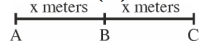
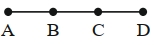
\(AB =x\)\(BC =x\)
\(2 x+ CD =3 x\)
\(CD =x\)
\(\ < v > =\frac{3 x}{\frac{x}{v_1}+\frac{x}{v_2}+\frac{x}{v_3}}=\frac{3 v_1 v_2 v_3}{v_2 v_3+v_1 v_3+v_1 v_2}\)
-
- (A) \(100\)
- (B) \(101\)
- (C) \(520\)
- (D) \(200\)
Show answer and solution
Correct Answer: (D)
\(u =20\,m / s , S _1=500 m , v =0\)By third equation of mation
\(0=(20)^2-2 a .500 \Rightarrow a =\frac{4}{10}\,m / s ^2\)
\(u =20\,m / s , S _2=250 m , v =?\)
\(v ^2=(20)^2-2 a .250\)
\(= v =\sqrt{200}\,m / s\)
\(x =200\)
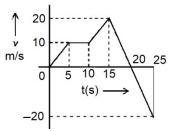
- 625. From the \(v\) - \(t\) graph shown. the ratio of distance to displacement in \(25\,s\) of motion
 2023 Medium
- (A) \(\frac{3}{5}\)
- (B) \(\frac{1}{2}\)
- (C) \(\frac{5}{3}\)
- (D) \(1\)
Show answer and solution
Correct Answer: (C)
Area under the graph from \(t=0\) to \(t=20\,sec =200\,m\)Area under the graph from \(t=20\) to \(t=25\,sec =50\,m\)
So distance covered \(=(200+50) m =250\,m\)
Displacement \(=(200-50) m =150\,m\)
\(\frac{250}{150}=\frac{5}{3}\)
-
- (A) Both Statement \(I\) and Statement \(II\) are true.
- (B) Statement \(I\) is correct but Statement \(II\) is false.
- (C) Statement \(I\) is incorrect but Statement \(II\) is true.
- (D) Both Statement \(I\) and Statement \(II\) are False.
Show answer and solution
Correct Answer: (C)
Area under velocity time graph gives displacement of body in given time.Area under acceleration time graph gives change in velocity in the given time.
So Statement \(I\) false,Statement \(II\) True.
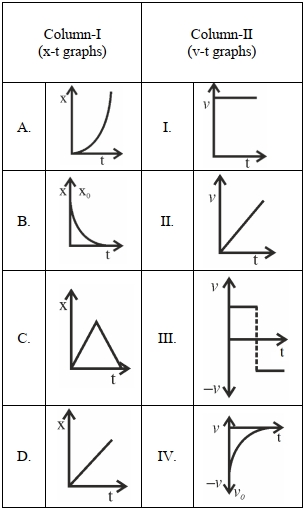
- 627. Match Column\(-I\) with Column\(-II :\) Choose the correct answer from the options given below:
 2023 Medium
- (A) \((A)-(II), (B)-(IV), (C)-(III), (D)-(I)\)
- (B) \((A)-( I), (B)-(II), (C)-(III), (D)-(IV)\)
- (C) \((A)-( II), (B)-(III), (C)-(IV), (D)-(I)\)
- (D) \((A)-(I), (B)-(III), (C)-(IV), (D)-(II)\)
Show answer and solution
Correct Answer: (A)
\(\frac{d x}{d t}=\text { slope } \geq 0 \text { always increasing }\)\(\text { (A - II) }\)
\(\frac{d x}{d t} < 0 \text {; and at } t \rightarrow \infty \frac{ dx }{ dt } \rightarrow 0\)
\(( B - IV )\)
\(\frac{ dx }{ dt } > 0 \text { for first half } \frac{ dx }{ dt } < 0 \text { for second half. }\)
\(\text { (C - III) }\)
\(\frac{ dx }{ dt }=\text { constant }\)
\(\text { (D - I) }\)
-
- (A) \(40\)
- (B) \(25\)
- (C) \(20\)
- (D) \(8\)
Show answer and solution
Correct Answer: (A)
\(x =4 t ^2\)\(v =\frac{ dx }{ dt }=8 t\)
At \(t =5\,sec\)
\(v =8 \times 5=40\,m / s\)
-
- (A) \(12.5\)
- (B) \(62.5\)
- (C) \(5\)
- (D) \(25\)
Show answer and solution
Correct Answer: (D)
Distance \((s)=(2.5) t^2\)Speed \(( v )=\frac{ ds }{ dt }=\frac{ d }{ dt }\left\{(2.5) t ^2\right\}\)
\(v =5\,t\)
At \(t =5, v =5 \times 5=25\,m / s\)
-
- (A) \(10\)
- (B) \(14\)
- (C) \(16\)
- (D) \(06\)
Show answer and solution
Correct Answer: (C)
\(x=5 t^2-4 t+5\)\(v=10 t-4\)
\(\text { At } t=2 s \quad v=16\,m / s\)
-
- (A) \((A)\) and \((E)\) only
- (B) \((B)\) and \((E)\) only
- (C) \((A), (C)\) and \((E)\) only
- (D) \((A), (C)\) and \((D)\) only
Show answer and solution
Correct Answer: (A)
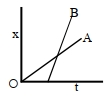
As slope of \(B\) > Slope of \(A\)\(\therefore V_B > V_A\)
Also, \(t _{ B } < t _{ A }\)
-
- (A) \(1: 1\)
- (B) \(1: 4\)
- (C) \(1: 2\)
- (D) \(1: 3\)
Show answer and solution
Correct Answer: (D)
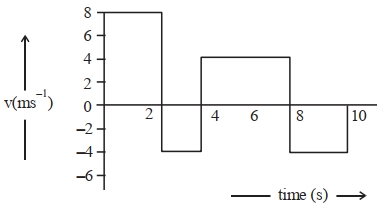
\(Displacement=\Sigma \text { area }=16-8+16-8=16\,m\)\(Distanc =\Sigma \mid \text { area } \mid=48\,m\)
\(\frac{\text { displacement }}{\text { Distance }}=\frac{1}{3}\)
-
- (A) \(1200\)
- (B) \(2700\)
- (C) \(1800\)
- (D) \(900\)
Show answer and solution
Correct Answer: (C)
\(\frac{60 \ell+4 \ell}{20}-\frac{61 \ell}{30}=35\)\(\Rightarrow \ell=\frac{1050}{35}\)
\(\Rightarrow L=60 \ell=\frac{1050}{35} \times 60=1800\,m\)
-
- (A) \(28\)
- (B) \(22\)
- (C) \(20\)
- (D) \(21\)
Show answer and solution
Correct Answer: (A)
By average form of Newton's law of cooling\(\frac{20}{6}= k (50-10)\)
\(\frac{40- T }{6}= K \left(\frac{40+ T }{2}-10\right)\)
From equation \((i)\) and \((ii)\)
\(\frac{20}{40- T }=\frac{40}{10+ T / 2}\)
\(10+\frac{ T }{2}=80-2\,T\)
\(\frac{5 T }{2}=70 \Rightarrow T =28^{\circ}\,C\)
-
- (A) \(500\)
- (B) \(\frac{25}{3}\)
- (C) \(450\)
- (D) \(420\)
Show answer and solution
Correct Answer: (A)
Rate of cooling \(\alpha\) Temperature difference\(\frac{80-60}{5}=k\{70-20\}\)
\(\frac{60-40}{t}=k[50-20]\)
\(\frac{4 t}{20}=\frac{50}{30}\)
\(t=\frac{25}{3} min =500\,sec\)
\(\Rightarrow t=500 \text { seconds }\)
-
- (A) \(32^{\circ}\,C\)
- (B) \(30^{\circ}\,C\)
- (C) \(28^{\circ}\,C\)
- (D) \(34^{\circ}\,C\)
Show answer and solution
Correct Answer: (C)
using average rate of Newton's law of cooling\(\frac{T_1-T_2}{t}=K\left(\frac{T_1+T_2}{2}-T_s\right)\)
Given \(\frac{60-40}{7}=K(50-10) \ldots\) (i)
\(\frac{40-T}{7}=K\left(\frac{40+T}{2}-10\right) \ldots\) (ii)
From \((i)\) and \((ii)\)
\(T =28^{\circ}\,C\)
-
- (A) \(2\)
- (B) \(1.4\)
- (C) \(0.5\)
- (D) \(1\)
Show answer and solution
Correct Answer: (B)
\(\frac{\Delta Q }{\Delta t }=- K \left( T - T _0\right)\)\(\frac{\Delta Q }{\Delta t }=- K \left( T _{ avg }- T _0\right)\)
\((i)\) \(\frac{ ms \times 12}{2}=- K \left(\frac{98+86}{2}-22\right)\)
\(6=-\frac{ K }{ ms }\left[\frac{98+86}{2}-22\right]\)
\(6=-\frac{ K }{ ms }[70]..........(i)\)
\((ii)\) \(\frac{ ms \times 6}{\Delta t }=- K \left(\frac{75+69}{2}-22\right)\) \(\frac{6}{\Delta t }=-\frac{ K }{ ms }(50) \ldots \ldots \ldots \ldots\) (ii)
\((ii)\) \(\div\) \((i)\)
\(\frac{6}{\Delta t (6)}=\frac{50}{70}\)
\(\Delta t =\frac{7}{5}=1.4\,min\)
-
- (A) \(20\)
- (B) \(40\)
- (C) \(60\)
- (D) \(80\)
Show answer and solution
Correct Answer: (B)
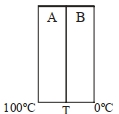
Let the temperature of contact surface is \(T\), then\(H _{ A }= H _{ B }\)
\(\frac{ K _{ A } A\left(T_A-T\right)}{L}=\frac{ K _{ B } A \left( T - T _{ B }\right)}{ L }\)
\(84(100-T)=126( T -0)\)
\(2(100-T)=3\,T\)
\(200-2\,T =3\,T\)
\(T =40^{\circ}\,C\)
-
- (A) \(\frac{1}{\sqrt{3}}\)
- (B) \(6\)
- (C) \(\sqrt{3}\)
- (D) \(2\)
Show answer and solution
Correct Answer: (D)
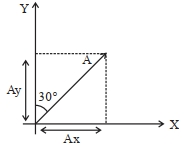
\(A _y= A \cos 30^{\circ}=2 \sqrt{3}\)\(\Rightarrow A \frac{\sqrt{3}}{2}=2 \sqrt{3}\)
\(\Rightarrow A =4\)
Now \(A_x=A \sin 30^{\circ}=4 \times \frac{1}{2}=2\)
-
- (A) \(3\)
- (B) \(2\)
- (C) \(1\)
- (D) \(4\)
Show answer and solution
Correct Answer: (D)
If \(\overrightarrow{ P }=3 \hat{ i }+\sqrt{3} \hat{ j }+2 \hat{ k }\) and \(\overrightarrow{ Q }=4 \hat{ i }+\sqrt{3} \hat{ j }+2.5 \hat{ k }\) then, The unit vector in the direction of \(\overrightarrow{ P } \times \overrightarrow{ Q }\) is \(\frac{1}{x}(\sqrt{3} \hat{i}+\hat{j}-2 \sqrt{3} \hat{k})\). The value of \(x\) is
\(\begin{array}{l}\overrightarrow{ P } \times \overrightarrow{ Q }=\left|\begin{array}{ccc}\hat{ i } & \hat{ j } & \hat{ k } \\ 3 & \sqrt{3} & 2 \\ 4 & \sqrt{3} & 2.5\end{array}\right|=\sqrt{3} \frac{\hat{ i }}{2}+\frac{\hat{ j }}{2}-\sqrt{3} \hat{ k } \\ \Rightarrow \frac{\overrightarrow{ P } \times \overrightarrow{ Q }}{|\overrightarrow{ P } \times \overrightarrow{ Q }|}=\frac{1}{2}\left(\sqrt{3} \frac{\hat{ i }}{2}+\frac{\hat{ j }}{2}-\sqrt{3} \hat{ k }\right)\end{array}\)
\( =\frac{1}{4}(\sqrt{3} \hat{ i }+\hat{ j }-2 \sqrt{3} \hat{ k })\)
The unit vector in the direction of \(\overrightarrow{ P } \times \overrightarrow{ Q }\) is \(\frac{1}{x}(\sqrt{3} \hat{i}+\hat{j}-2 \sqrt{3} \hat{k})\)
hence \( x=4\) -
- (A) \(1\)
- (B) \(-1\)
- (C) \(-3\)
- (D) \(2\)
Show answer and solution
Correct Answer: (D)
\(\overrightarrow{ P } \cdot \overrightarrow{ Q }=0\)\((\hat{i}+2 m \hat{j}+m \hat{k}) \cdot(4 \hat{i}-2 \hat{j}+m \hat{k})=0\)
\(\Rightarrow 4-4 m+m^2=0\)
\(\Rightarrow( m -2)^2=0 \Rightarrow m=2\)
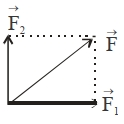
- 642. Two forces having magnitude \(A\) and \(\frac{ A }{2}\) are perpendicular to each other. The magnitude of their resultant is 2023 Easy
- (A) \(\frac{\sqrt{5}\,A }{4}\)
- (B) \(\frac{5\,A }{2}\)
- (C) \(\frac{\sqrt{5}\,A ^2}{2}\)
- (D) \(\frac{\sqrt{5}\,A }{2}\)
Show answer and solution
Correct Answer: (D)
\(\overrightarrow{ F }=\left(\overrightarrow{ F }_1+\overrightarrow{ F }_2\right)\)\(|\overrightarrow{ F }|=\sqrt{ F _1^2+ F _2^2+2 F _1 F _2 \cos 90^{\circ}}\)
\(=\sqrt{ A ^2+\frac{ A ^2}{4}}=\frac{ A \sqrt{5}}{2}\)
-
- (A) \(1\)
- (B) \(2\)
- (C) \(3\)
- (D) \(4\)
Show answer and solution
Correct Answer: (A)
For two perpendicular vectors\((a \hat{i}+b \hat{j}+\hat{k}) \cdot(2 \hat{i}-3 \hat{j}+4 \hat{k})=0\)
\(2 a-3 b+4=0\)
On solving, \(2 a-3 b=-4\)
Also given
\(3 a+2 b=7\)
We get \(a =1, b =2\)
\(\frac{ a }{ b }=\frac{ x }{2} \Rightarrow x =\frac{2 a }{ b }=\frac{2 \times 1}{2}\)
\(\Rightarrow x =1\)
-
- (A) \(\sqrt{13}\)
- (B) \(\sqrt{33}\)
- (C) \(\sqrt{6}\)
- (D) \(\sqrt{5}\)
Show answer and solution
Correct Answer: (B)
\(\overrightarrow{ B }-\overrightarrow{ A }=2 j\)\(\overrightarrow{ B }=2 \hat{ i }+5 \hat{ j }+2 \hat{ k }\)
\(|\overrightarrow{ B }|=\sqrt{33}\)
No questions on this page match these filters.