


Questions
Newest firstShowing 1–33 of 33 questions
- 1. A small bob A of mass m is attached to a massless rigid rod of length 1m pivoted at point P and kept at an angle of \( 60^{\circ} \) with vertical as shown in figure. At distance of 1m below point P, an identical bob B is kept at rest on a smooth horizontal surface that extends to a circular track of radius R as shown in figure. If bob B just manages to complete the circular path of radius R upto a point Q after being hit elastically by both A, then radius R is ___________m.
 2026 Hard
- 2. As shown below, bob \(A\) of a pendulum having massless string of length ' \(R\) ' is released from \(60^{\circ}\) to the vertical. It hits another bob \(B\) of half the mass that is at rest on a friction less table in the center. Assuming elastic collision, the magnitude of the velocity of bob A after the collision will be (take g as acceleration due to gravity.)
 2025 Hard
- 3. A body starts falling freely from height \(\mathrm{H}\) hits an inclined plane in its path at height \(\mathrm{h}\). As a result of this perfectly elastic impact, the direction of the velocity of the body becomes horizontal. The value of \(\frac{\mathrm{H}}{\mathrm{h}}\) for which the body will take the maximum time to reach the ground is _______. 2024 Hard
- 4. If a rubber ball falls from a height \(h\) and rebounds upto the height of \(h / 2\). The percentage loss of total energy of the initial system as well as velocity ball before it strikes the ground, respectively, are _______. 2024 Hard
- 5. A ball of mass \(200\,g\) rests on a vertical post of height \(20\,m\). A bullet of mass \(10\,g\), travelling in horizontal direction, hits the centre of the ball. After collision both travels independently. The ball hits the ground at a distance \(30\,m\) and the bullet at a distance of \(120\,m\) from the foot of the post. The value of initial velocity of the bullet will be \(............m/s\) (if \(\left.g =10 m / s ^2\right)\) 2023 Hard
- 6. A body is dropped on ground from a height \(h_1\) and after hitting the ground, it rebounds to a height \(h _2\) If the ratio of velocities of the body just before and after hitting ground is \(4\), then percentage loss in kinetic energy of the body is \(\frac{x}{4}\). The value of \(x\) is \(.......\) 2023 Hard
- 7. A body of mass \(1\,kg\) collides head on elastically with a stationary body of mass \(3\,kg\). After collision, the smaller body reverses its direction of motion and moves with a speed of \(2\,m / s\). The initial speed of the smaller body before collision is \(..........ms ^{-1}\) 2023 Medium
- 8. As per the given figure, a small ball \(P\) slides down the quadrant of a circle and hits the other ball \(Q\) of equal mass which is initially at rest. Neglecting the effect of friction and assume the collision to be elastic, the velocity of ball \(Q\) after collision will be \(............\,m/s\) \(:\left( g =10\,m / s ^2\right)\)
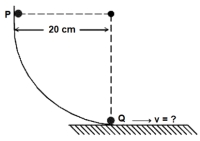 2023 Medium
- 9. What percentage of kinetic energy of a moving particle is transferred to a stationary particle when it strikes the stationary particle of \(5\) times its mass? (Assume the collision to be head-on elastic collision) 2022 Hard
- 10. A ball of mass \(10\, kg\) moving with a velocity \(10 \sqrt{3}\, ms ^{-1}\) along \(X-\)axis, hits another ball of mass \(20\, kg\) which is at rest. After collision, the first ball comes to rest and the second one disintegrates into two equal pieces. One of the pieces starts moving along \(Y-\) axis at a speed of \(10\, m / s\). The second piece starts moving at a speed of \(20\, m / s\) at an angle \(\theta\) (degree) with respect to the \(X-\)axis. The configuration of pieces after collision is shown in the figure. The value of \(\theta\) to the nearest integer is
 2021 Hard
- 11. A body of mass \(2\, {kg}\) moving with a speed of \(4\, {m} / {s}\). makes an elastic collision with another body at rest and continues to move in the original direction but with one fourth of its initial speed. The speed of the two body centre of mass is \(\frac{x}{10} \,{m} / {s}\). Then the value of \(x\) is ..... . 2021 Hard
- 12. A body of mass \({M}\) moving at speed \({V}_{0}\) collides elastically with a mass \('m'\) at rest. After the collision, the two masses move at angles \(\theta_{1}\) and \(\theta_{2}\) with respect to the initial direction of motion of the body of mass \({M}\). The largest possible value of the ratio \({M} / {m}\), for which the angles \(\theta_{1}\) and \(\theta_{2}\) will be equal, is : 2021 Hard
- 13. A bullet of \(10\, {g}\), moving with velocity \(v\), collides head-on with the stationary bob of a pendulum and recoils with velocity \(100 \, {m} / {s}\). The length of the pendulum is \(0.5\, {m}\) and mass of the bob is \(1\, {kg}\). The minimum value of \(v=\) \(....{m} / {s}\) so that the pendulum describes a circle. (Assume the string to be inextensible and \({g}=10\, {m} / {s}^{2}\) )
 2021 Hard
- 14. A large block of wood of mass \(M =5.99\, kg\) is hanging from two long massless cords. A bullet of mass \(m =10\, g\) is fired into the block and gets embedded in it. The (block \(+\) bullet) then swing upwards, their centre of mass rising a vertical distance \(h =9.8\,cm\) before the (block \(+\) bullet) pendulum comes momentarily to rest at the end of its arc. The speed of the bullet just before collision is: (Take \(g =9.8\, ms ^{-2}\) ) (in \(m/s\))
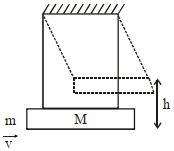 2021 Hard
- 15. A rubber ball is released from a height of \(5\, m\) above the floor. It bounces back repeatedly, always rising to \(\frac{81}{100}\) of the height through which it falls. Find the average speed of the ball. (Take \(g =10 ms ^{-2}\) ) (in \(ms ^{-1}\)) 2021 Hard
- 16. An object of mass \(m _{1}\) collides with another object of mass \(m _{2}\), which is at rest. After the collision the objects move with equal speeds in opposite direction. The ratio of the masses \(m _{2}: m _{1}\) is 2021 Medium
- 17. Given below are two statements: one is labelled as Assertion \(A\) and the other is labelled as Reason \(R\). Assertion \(A\) : Body \('P'\) having mass \(M\) moving with speed \('u'\) has head-on collision elastically with another body \('Q'\) having mass \('m'\) initially at rest. If \(m< < M,\) body \('Q'\) will have a maximum speed equal to \('2u'\) after collision. Reason \(R\) : During elastic collision, the momentum and kinetic energy are both conserved. In the light of the above statements, choose the most appropriate answer from the options given below: 2021 Hard
- 18. Three objects \(A, B\) and \(C\) are kept in a straight line on a frictionless horizontal surface. The masses of \({A}, {B}\) and \({C}\) are \({m}, 2\, {m}\) and \(2\, {m}\) respectively. \(A\) moves towards \({B}\) with a speed of \(9\) \({m} / {s}\) and makes an elastic collision with it. Thereafter \(B\) makes a completely inelastic collision with \(C.\) All motions occur along same straight line. The final speed of \(C\) is \(....\,{m} / {s}\)
 2021 Hard
- 19. A body \(A,\) of mass \(m=0.1\; kg\) has an initial velocity of \(3 \hat{\mathrm{i}}\; \mathrm{ms}^{-1} .\) It collides elastically with another body, \(\mathrm{B}\) of the same mass which has an initial velocity of \(5 \hat{\mathrm{j}} \;\mathrm{ms}^{-1}\). After collision. A moves with a velocity \(\overline{\mathrm{v}}=4(\hat{\mathrm{i}}+\hat{\mathrm{j}})\). The energy of \(\mathrm{B}\) after collision is written as \(\frac{\mathrm{x}}{10} \;\mathrm{J}\) The value of \(x\) is 2020 Medium
- 20. A particle of mass \(m\) is moving along the \(x\) -axis with initial velocity \(u \hat i\). It collides elastically with a particle of mass \(10\, m\) at rest and then moves with half its initial kinetic energy (see figure). If \(\sin \theta_{1}=\sqrt{n} \sin \theta_{2}\) then value of \(n\) is.....
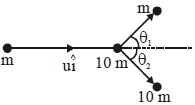 2020 Hard
- 21. A particle of mass \(m\) with an initial velocity \(u\hat i\) collides perfectly elastically with a mass \(3m\) at rest. It moves with a velocity \(v\hat j\) after collision, then, \(v\) is given by 2020 Hard
- 22. Blocks of masses \(m , 2 m , 4 m\) and \(8 m\) are arranged in a line on a frictionless floor. Another block of mass \(m ,\) moving with speed \(v\) along the same line (see figure) ollides with mass \(m\) in perfectly inelastic manner. All the subsequent collisions are also perfectly inelastic. By the time the last block of mass \(8 m\) starts moving the total energy loss is \(p \%\) of the original energy. Value of \('p'\) is close to
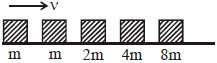 2020 Hard
- 23. Two particles of equal mass \(\mathrm{m}\) have respective initial velocities \(u\hat{i}\) and \(u\left(\frac{\hat{\mathrm{i}}+ \hat{\mathrm{j}}}{2}\right) .\) They collide completely inelastically. The energy lost in the process is 2020 Hard
- 24. A body of mass \(2\,kg\) makes an elastic collision with a second body at rest and continues to move in the original direction but with one fourth of its original speed. What is the mass of the second body? ................ \( \mathrm{kg}\) 2019 Medium
- 25. A particle of mass \(m\) is moving with speed \(2\, v\) collides with a mass \(2\,m\) moving with speed \(v\) in the same direction. After collision, the first mass is stopped completely while the second one splits into two particles each of mass \(m\), which move at angle \(45^o\) with respect to the original direction. The speed of each of the moving particle will be 2019 Medium
- 26. A simple pendulum, made of a string of length \(l\) and a bob of mass \(m\) , is released from a small angle \(\theta_0\). It strikes a block of mass \(M\), kept on a horizontal surface at its lowest point of oscillations, elastically. It bounces back and goes up to an angle \(\theta_1\). Then \(M\) is given by 2019 Hard
- 27. An alpha-particle of mass \(m\) suffers \(1-\) dimensional elastic collision with a nucleus at rest of unknown mass. It is scattered directly backwards losing, \(64\%\) of its initial kinetic energy. The mass of the nucleus is .......... \(\mathrm{m}\) 2019 Hard
- 28. Two particles, of masses \(M\) and \(2M\), moving as shown, with speeds of \(10\, m/s\) and \(5\, m/s\), collide elastically at the origin. After the collision, they move along the indicated directions with speeds \(v_1\) and \(v_2\) respectively. The value of \(v_1\) and \(v_2\) are nearly
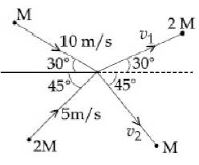 2019 Hard
- 29. A proton of mass \(m\) collides elastically with a particle of unknown mass at rest. After the collision, the proton and the unknown particle are seen moving at an angle of \(90^o\) with respect to each other. The mass of unknown particle is 2018 Hard
- 30. In a collinear collision, a particle with an initial speed \(v_0\) strikes a stationary particle of the same mass. If the final total kinetic energy is \(50\%\) greater than the original kinetic energy, the magnitude of the relative velocity between the two particles, after collision, is: 2018 Medium
- 31. It is found that if a neutron suffers an elastic collinear collision with deuterium at rest, fractional loss of its energy is \(p_d \) ; while for its similar collision with carbon nucleus at rest, fractional loss of energy is \(P_c\). The values of \(P_d\) and \(P_c\) are respectively 2018 Hard
- 32. An object is dropped from a height \(h\) from the ground. Every time it hits the ground it looses \(50\%\) of its kinetic energy. The total distance covered as \(t \to \infty \) is 2017 Hard
- 33. This question has statement \(1\) and statement \(2\) . Of the four choices given after the statements, choose the one that best describes the two statements.
Statement \(- 1\): A point particle of mass m moving with speed \(u\) collides with stationary point particle of mass \(M\). If the maximum energy loss possible is given as \(f\) \(\left( {\frac{1}{2}m{v^2}} \right)\) then \( f = \left( {\frac{m}{{M + m}}} \right)\) Statement \(-2\): Maximum energy loss occurs when the particles get stuck together as a result of the collision. 2013 Medium
No questions on this page match these filters.
Other STD 11 - Work,energy,power and collision topics
- 37Qs Work-Energy Theorem
- 9Qs Work Done by Constant Force
- 20Qs Power
- 7Qs Conservation of Energy and Momentum
- 10Qs Vertical Circular Motion
- 3Qs Conservative and Non-Conservative
- 14Qs Perfectly Inelastic Collision
- 11Qs Work Done by Spring and Potential Energy of Spring
- 11Qs Potential Energy
- 14Qs Work Done by Variable Force
- 22Qs Kinetic Energy
Frequently asked
How many Elastic and Inelastic collision questions came in JEE Mains?
33 questions from 2013–2026, each with the correct answer and a full solution.
How difficult are Elastic and Inelastic collision questions?
0% are easy, 24% medium and 76% hard.