


Questions
Newest firstShowing 1–36 of 36 questions
-
- (A) A and C only
- (B) A and D only
- (C) C and D only
- (D) B and D only
Show answer and solution
Correct Answer: (C)
(A) \(B ^{+3}< Al ^{+3}< Ga ^{+3}< In ^{+3}< Tl ^{+3}\) : ionic size
(B) \(B > Tl > In > Ga > Al : EN\)
(C) \(B > Tl > Ga > Al > In :\) IE
(D) Trichlorides and triiodides of group \(13^{\text {th }}\) elements are covalent in nature -
- (A) A and C Only
- (B) B and C Only
- (C) B and D Only
- (D) A and D Only
Show answer and solution
Correct Answer: (C)
The electronegativity of Ge on the Pauling scale is \(1.8\). In Group 13, the electronegativity values are B (\(2.0\)), Al (\(1.5\)), Ga (\(1.6\)), In (\(1.7\)), and Tl (\(1.8\)). Thus, the element 'E' is Thallium (Tl).
Due to the inert pair effect, the \(+1\) oxidation state is much more stable than the \(+3\) oxidation state for the heavier elements of Group 13, especially Thallium. Therefore, \(Tl^+\) is more stable than \(Tl^{3+}\). This makes statement C incorrect.
Since \(Tl^{3+}\) is relatively unstable, it readily accepts two electrons to form the more stable \(Tl^+\) ion (\(Tl^{3+} + 2e^- \rightarrow Tl^+\)). Because it undergoes reduction easily, \(Tl^{3+}\) acts as a strong oxidizing agent. This makes statement A incorrect and statement B correct.
The standard electrode potential for the reduction of \(Tl^{3+}\) to Tl (\(E^{\circ}_{Tl^{3+}/Tl}\)) is \(+1.26\text{ V}\), which is a positive value. This makes statement D correct.
Therefore, only statements B and D are correct. -
- (A) Both \(sp^{3}\)
- (B) \(sp^{2}\) and \(sp^{3}\)
- (C) \(sp^{3}\) and \(sp^{2}\)
- (D) Both \(sp^{2}\)
Show answer and solution
Correct Answer: (B)
\(XF_{3}=BF_{3}; \ sp^{2}\)
\(YF_{3}=NF_{3};\ sp^{3}\) -
- (A) 31
- (B) 49
- (C) 13
- (D) 81
Show answer and solution
Correct Answer: (A)
Size order
\(\begin{aligned}
& \mathrm{Al} \gt \mathrm{Ga} \\
& \mathrm{Al}^{3+} \lt \mathrm{Ga}^{3+}
\end{aligned}\)
Atomic number of Ga is 31 -
- (A) B and D Only
- (B) A and C Only
- (C) C and D Only
- (D) A and B Only
Show answer and solution
Correct Answer: (A)
Property B Al Ga In Tl Atomic radius (pm) 88 143 135 167 170 Electronegativity 2 1.5 1.6 1.7 1.8 Density (g/cm³) 2.35 2.7 5.9 7.31 11.85 Ionisation Energy (kJ/mol) 801 577 579 558 589
Radius Order \( \mathrm{T} \ell \gt \mathrm{In} \gt \mathrm{A} \ell \gt \mathrm{Ga} \gt \mathrm{B}\)
EN Order \(\mathrm{B} \gt \mathrm{T} \ell \gt \mathrm{In} \gt \mathrm{Ga} \gt \mathrm{Al}\)
Density Order \(\mathrm{T} \ell \gt \mathrm{In} \gt \mathrm{Ga} \gt \mathrm{A} \ell \gt \mathrm{B}\)
\(\mathrm{IE}_1\) Order \(\mathrm{B} \gt \mathrm{T} \ell \gt \mathrm{Ga} \gt \mathrm{A} \ell \gt \mathrm{In}\) -
- (A) Octahedral
- (B) Square Planar
- (C) Tetrahedral
- (D) Trigonal bipyramidal
Show answer and solution
Correct Answer: (A)
\(\mathrm{AlCl}_3\) in acidified aqueous solution forms octahedral geometry \(\left[\mathrm{Al}\left(\mathrm{H}_2 \mathrm{O}\right)_6\right]^{3+}\) -
- (A) Both \(A\) and \(R\) are true, but \(R\) is not the correct explanation of \(A.\)
- (B) Both \(A\) and \(R\) are true, but \(R\) is the correct explanation of \(A.\)
- (C) \(A \) is true, but \(R\) is false
- (D) \(A\) is false, but \(R\) is true
Show answer and solution
Correct Answer: (B)
Solid Boron has very strong crystalline lattice so its melting point unusually high in group \(13\) elements -
- (A) Both \(A\) and \(R\) are true and \(R\) is the correct explanation of \(A\).
- (B) \(A\) is true but \(R\) is false.
- (C) Both \(A\) and \(R\) are true but \(R\) is \(NOT\) the correct explanation of \(A\).
- (D) \(A\) is false but \(R\) is true.
Show answer and solution
Correct Answer: (A)
The relative stability of +\(1\) oxidation state progressively increases for heavier elements due to inert pair effect.\(\therefore\) Stability of \(A \ell^{+1}<\mathrm{Ga}^{+1}<\mathrm{In}^{+1}<\mathrm{T} \ell^{+1}\)
-
- (A) Both Statement \(I\) and Statement \(II\) are false.
- (B) Statement \(I\) is false but Statement \(II\) is true.
- (C) Both Statement \(I\) and Statement \(II\) are true.
- (D) Statement \(I\) is true but Statement \(II\) is false.
Show answer and solution
Correct Answer: (D)
Statement - \(I\) \(\Rightarrow\) CorrectStatement - \(II\) \(\Rightarrow\) False
\(\mathrm{Ga}\) is used to measure high temperature
-
- (A) Statement \(I\) is true but statement \(II\) is false
- (B) Statement \(I\) is false but statement \(II\) is true
- (C) Both statement \(I\) and statement \(II\) are false
- (D) Both statement \(I\) and statement \(II\) are true
Show answer and solution
Correct Answer: (D)
In trivalent state most of the compounds being covalent are hydrolysed in water. Trichlorides on hydrolysis in water form tetrahedral \(\left[\mathrm{M}(\mathrm{OH})_4\right]^{-}\) species, the hybridisation state of element \(\mathrm{M}\) is \(\mathrm{sp}^3\).In case of aluminium, acidified aqueous solution forms octahedral \(\left[\mathrm{Al}\left(\mathrm{H}_2 \mathrm{O}\right)_6\right]^{3+}\) ion.
-
- (A) Statement \(I\) is incorrect but Statement \(II\) is correct
- (B) Both Statement \(I\) and Statement \(II\) are correct
- (C) Both Statement \(I\) and Statement \(II\) are incorrect
- (D) Statement \(I\) is correct but Statement \(II\) is incorrect
Show answer and solution
Correct Answer: (D)
Statement \(I\) : Number of \(d\) & f electrons, increases down the group and due to poor shielding of \(d\) & \(f\) \(\mathrm{e}^{-}\), stability of lower oxidation states increases down the groupStatement \(II\) : The atomic size of aluminum is greater than that of gallium.
-
- (A) \(A-III, B-IV, C-I, D-II\)
- (B) \(A-II, B-III, C-IV, D-I\)
- (C) \(A-IV, B-I, C-II, D-III\)
- (D) \(A-I, B-II, C-III, D-IV\)
Show answer and solution
Correct Answer: (C)
Melting point : \(\mathrm{B}>\mathrm{A} \ell>\mathrm{T} \ell>\mathrm{In}>\mathrm{Ga}\)Ionic radius \(\left(\mathrm{M}^{+3} / \mathrm{pm}\right): \mathrm{T} \ell>\mathrm{In}>\mathrm{Ga}>\mathrm{A} \ell>\mathrm{B}\)
\(\left(\Delta_{\mathrm{IE}} \mathrm{H}\right)_1\left[\frac{\mathrm{kJ}}{\mathrm{mol}}\right]: \mathrm{B}>\mathrm{T} \ell>\mathrm{A} \ell \approx \mathrm{Ga}>\mathrm{In}\)
Atomic radius (in \(\mathrm{pm}\) ) : \(\mathrm{T} \ell>\mathrm{In}>\mathrm{A} \ell>\mathrm{Ga}>\mathrm{B}\)
-
- (A) \((C)\) and \((E)\) only
- (B) \((A)\), \((C)\) and \((E)\) only
- (C) \((A)\), \((B)\), \((C)\) and \((E)\) only
- (D) \((A)\) and \((C)\) only
Show answer and solution
Correct Answer: (A)
\(A\). size order \(\mathrm{T} \ell>\mathrm{In}>\mathrm{Al}>\mathrm{Ga}>\mathrm{B}\)\(B\). Electronegativity order \(\mathrm{B}>\mathrm{Al}<\mathrm{Ga}<\operatorname{In}<\mathrm{T} \ell\)
\(D\). \(\mathrm{B}, \mathrm{Al}\) are more stable in \(+3\) oxidation state
So, only \(C, E\) statements are correct.
-
- (A) \(4\)
- (B) \(6\)
- (C) \(3\)
- (D) \(9\)
Show answer and solution
Correct Answer: (D)
\(\text { More abundant isotope }=\mathrm{B}^{11}\)\({[\text { Number of neutrons }=6]}\)
\(\mathrm{x}=6\)
\(\mathrm{~B}+\mathrm{O}_2 \rightarrow \mathrm{B}_2 \mathrm{O}_3\)
Oxidation state of \(\mathrm{B}\) in \(\mathrm{B}_2 \mathrm{O}_3=+3\)
So, \(\mathrm{y}=3\)
Hence \(x+y=9\)
- 15. \(Be ( OH )_2\) react with \(Sr ( OH )_2\) to yield an ionic salt. Choose the incorrect option related to this reaction from the following: 2023 Medium
- (A) Be is tetrahedrally coordinated in the ionic salt.
- (B) The reaction is an example of acid - base neutralization reaction.
- (C) Both \(Sr\) and \(Be\) elements are present in the ionic salt.
- (D) The elements \(Be\) is present in the cationic part of the ionic salt.
Show answer and solution
Correct Answer: (D)
\(Be ( OH )_2\) is amphoteric in nature.\(Sr ( OH )_2\) is basic in nature.
These two undergo acid - base reaction to form a salt.
\(Be ( OH )_2+ Sr ( OH )_2 \rightarrow Sr \left[ Be ( OH )_4\right]\)
(salt)
-
- (A) Strong ionic bond in Boric acid
- (B) Strong van der Waal's interaction in Boric acid
- (C) Strong hydrogen bond in Boric acid
- (D) Strong covalent bond in \(BF _3\)
Show answer and solution
Correct Answer: (C)
Boric acid has strong hydrogen bonding while \(BF _3\) does not. Therefore boric acid is solid. -
- (A) \(Cu _3 B _2\)
- (B) \(Cu\)
- (C) \(Cu \left( BO _2\right)_2\)
- (D) \(CuO\)
Show answer and solution
Correct Answer: (C)
Blue green colour is due to formation of \(Cu \left( BO _2\right)_2\)\(CuSO _4 \stackrel{\Delta}{\longrightarrow} CuO + SO _3\)
\(CuO + B _2 O _3 \rightarrow Cu \left( BO _2\right)_2\)
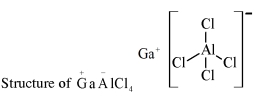
- 18. For compound having the formula \(GaAlCl _4\), the correct option from the following is 2023 Medium
- (A) \(Ga\) is more electronegative than \(Al\) and is present as a cationic part of the salt \(GaAlCl _4\)
- (B) Oxidation state of \(Ga\) in the salt \(GaAlC _4\) is \(+3\).
- (C) \(Cl\) forms bond with both \(Al\) and \(Ga\) in \(GaAlCl _4\)
- (D) \(Ga\) is coordinated with \(Cl\) in \(GaAlCl _4\)
Show answer and solution
Correct Answer: (A)
Gallous tetrachloro aluminate \(Ga ^{+} AlCl _4^{-}\)\(2 Ga + Ga ^{+} GaCl _4^{-}+2 Al _2 Cl _6 \stackrel{190^{\circ}}{\longrightarrow} 4 Ga ^{+} AlCl _4^{-}\)
Ga is cationic part of salt \(GaAlCl _4\).
-
- (A) Statement \(I\) is incorrect but Statement \(II\) is correct
- (B) Both Statement \(I\) and Statement \(II\) is correct
- (C) Statement \(I\) is correct but Statement \(II\) is incorrect
- (D) Both Statement \(I\) and Statement \(II\) is incorrect
Show answer and solution
Correct Answer: (B)
Boron is non- metallic in nature. It is extremely hard and black coloured solid. It exists in many allotropic forms. Due to very strong crystalline lattice, boron has unusually high melting point and boiling point.Element \(B\) \(Al\) \(Ga\) \(In\) \(TI\) Melting point \(2453\) \(933\) \(303\) \(430\) \(576\) Boiling point \(3923\) \(2740\) \(2676\) \(2353\) \(1730\) -
- (A) Statement \(I\) is incorrect but statement \(II\) is correct.
- (B) Both the statements \(I\) and \(II\) are correct
- (C) Statement \(I\) is correct but statement \(II\) is incorrect
- (D) Both the statements \(I\) and \(II\) are incorrect
Show answer and solution
Correct Answer: (B)
The first ionization energies (as in NCERT) are as follows:\(B\) : \(801\,kJ / mol\)
\(Al : 577\,kJ / mol\)
Ga : \(579\,kJ / mol\)
\(Ga :[ Ar ] 3 d ^{10} 4 s ^2 4 p ^1\)
-
- (A) Both Statement \(I\) and Statement \(II\) are true
- (B) Statement \(I\) is true but Statement \(II\) is false
- (C) Both Statement \(I\) and Statement \(II\) are false
- (D) Statement \(I\) is false but Statement \(I\) is true
Show answer and solution
Correct Answer: (C)
(Borax Bead Test)On treatment with metal salt, boric anhydride forms metaborate of the metal which gives different colours in oxidising and reducing flame.
For example, in the case of copper sulphate, following reactions occur.
\(CuSO _4+ B _2 O _3 \longrightarrow Cu \left( BO _2\right)_2+ SO _3\)
Two reactions may take place in reducing flame (Luminous flame)
\((i)\) The blue-green \(Cu \left( BO _2\right)_2\) is reduced to colourless cuprous metaborate as :
\(2 Cu ( BO _2 )_2+2 NaBO _2+ C \underset{\text { flame }}{\stackrel{\text { Luminous }}{\longrightarrow}} 2 CuBO _2+\) \( Na _2 B _4 O _7+ CO\)
\((ii)\) Cupric metaborate may be reduced to metallic copper and bead appears red opaque.
\(2 Cu \left( BO _2\right)_2+4 NaBO _2+2 C \underset{\text { fuminous }}{\stackrel{\text { flame }}{\longrightarrow}} 2 Cu +\) \(2 Na _2 B _4 O _7+2 CO\)
-
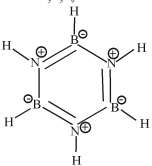
- (A) It has electronic delocalization
- (B) It contains banana bonds.
- (C) It can react with water.
- (D) It is a cyclic compound.
Show answer and solution
Correct Answer: (C)
Borazine is \(B _3 N _3 H _8\)\(B _8 N _3 H _6+9 H _2 O \rightarrow 3 NH _3+3 H _8 BO _3+3 H _2\)
-
- (A) \(BBr _3 > BI _3 > BCI _3 > BF _3\)
- (B) \(BCl _3 > BF _3 > BBr _3 > BI _3\)
- (C) \(BF _3 > BCl _3 > BBr _3 > BI _3\)
- (D) \(BI _3 > BBr _3 > BCl _3 > BF _3\)
Show answer and solution
Correct Answer: (D)
Extent of back bonding, reduces down the group leading to more Lewis acidic strength \(BF _3 > BCl _3 > BBr _3 > BI _3\) (extent of back bonding) \((2 p-2 p)(2 p-3 p)(2 p-4 p)(2 p-5 p)\)\(BF _3 < BCl _3 < BBr _3 < BI _3\) (lewis acidic nature)
-
- (A) \((A)\) and \((E)\) only
- (B) \((B), (C)\) and \((E)\) only
- (C) \((C)\) and \((D)\) only
- (D) \((C)\) and \((E)\) only
Show answer and solution
Correct Answer: (C)
\((A)\, (B)\) Two \(3\) centre \(-2\)-electron bonds\((C)\) \(B _{2} H _{6}\) is \(e ^{-}\)deficient species
\((E)\) \(B _{2} H _{6}\) is non - Planar molecule
\((D)\) \(BF _{3}+ LiAlH _{4} \rightarrow 2 B _{2} H _{6}+3 LiF +3 AlF _{3}\)
\(NaBH _{4}+ I _{2} \rightarrow B _{2} H _{6}+2 NaI + H _{2}\)

- 25. When borax is heated with \(CoO\) on a platinum loop, blue coloured bead formed is largely due to 2022 Medium
- (A) \(B _{2} O _{3}\)
- (B) \(Co \left( BO _{2}\right)_{2}\)
- (C) \(CoB _{4} O _{7}\)
- (D) \(Co [ B _{4} O _{5}( OH )_{4}]\)
Show answer and solution
Correct Answer: (B)
\(Na _{2} B _{4} O _{7} \cdot 10 H _{2} O \stackrel{\Delta}{\longrightarrow} Na _{2} B _{4} O _{7}+10 H _{2} O\)\(Na _{2} B _{4} O _{7} \stackrel{\Delta}{\longrightarrow} 2 NaBO _{2} \text { (sodium meta borate) }+ B _{2} O _{3}\)
\(B _{2} O _{3}+ CoO \rightarrow Co \left( BO _{2}\right)_{2} \text { (cobalt (II) meta borate) }\)
\(\quad\quad\quad\quad\quad\quad\quad\)Blue Bead
-
- (A) \((c)\) and \((d)\) only
- (B) \((c)\) only
- (C) \((a)\) only
- (D) \((a)\) and \((b)\) only
Show answer and solution
Correct Answer: (C)
Diborane is prepared by the reaction of \(\mathrm{NaBH}_{4}\) with \(\mathrm{I}_{2}\).\(2 \mathrm{NaBH}_{4}+\mathrm{I}_{2} \rightarrow \mathrm{B}_{2} \mathrm{H}_{6}+2 \mathrm{NaI}+\mathrm{H}_{2}\)
In diborane, ' \(B^{\prime}\) is \(\mathrm{sp}^{3}\) hybrid, it is Non-planar and two \(3 \mathrm{c}-2 \mathrm{e}^{-}\)bonds are present.
-
- (A) \((a)-(ii), (b)-(ii), (c)-(iii), (d)-(ii), (e)-(iii)\)
- (B) \((a)-(ii), (b)-(iii), (c)-(ii), (d)-(i), (e)-(iii)\)
- (C) \((a)-(ii), (b)-(ii), (c)-(iii), (d)-(i), (e)-(iii)\)
- (D) \((a)-(ii), (b)-(i), (c)-(ii), (d)-(iii), (e)-(iii)\)
Show answer and solution
Correct Answer: (B)
\(\mathrm{NaOH} \longrightarrow\) Basic\(\mathrm{Be}(\mathrm{OH})_{2} \longrightarrow\) Amphoteric
\(\mathrm{Ca}(\mathrm{OH})_{2} \longrightarrow\) Basic
\(\mathrm{B}(\mathrm{OH})_{3} \longrightarrow\) Acidic
\(\mathrm{Al}(\mathrm{OH})_{3} \longrightarrow\) Amphoteric
-
- (A) \([\mathrm{Xe}]{5} \mathrm{~d}^{10} 6 \mathrm{~s}^{2} 6 \mathrm{p}^{2}\)
- (B) \([\mathrm{Kr}] 4 \mathrm{~d}^{10} 5 \mathrm{~s}^{2} 5 \mathrm{p}^{2}\)
- (C) \([\mathrm{Kr}] 3 \mathrm{~d}^{10} 4 \mathrm{~s}^{2} 4 \mathrm{p}^{2}\)
- (D) \( [Ar]\) \(3 d^{10} 4 s^{2} 4 p^{2}\)
Show answer and solution
Correct Answer: (B)
The element \(\mathrm{E}\) is \(\mathrm{Ga}\) and the diagonal element of \(5^{\mathrm{th}}\) period is \({ }_{50} \mathrm{Sn}\) having outer electronic configuration will be \([\mathrm{Kr}] \,5 \mathrm{~s}^{2} \,4 \mathrm{~d}^{10}\, 5 \mathrm{p}^{2}\). -
- (A) Boron nitride and \(MeBr\)
- (B) Borazine and \(MeMgBr\)
- (C) Borazine and \(MeBr\)
- (D) Diborane and \(MeMgBr\)
Show answer and solution
Correct Answer: (B)
\(\mathrm{H}_{3} \mathrm{N}_{3} \mathrm{B}_{3} \mathrm{Cl}_{3} (A)+3 \mathrm{LiBH}_{4} \xrightarrow [(T.H.F.)]{\text { In terahydrofurane }} \)\(\mathrm{H}_{3} \mathrm{N}_{3} \mathrm{B}_{3} \mathrm{H}_{3}(B)+3LiCl+3BH_3THF\)\(\mathrm{H}_{3} \mathrm{N}_{3} \mathrm{B}_{3} \mathrm{Cl}_{3}(A)+3 MeMgBr(C)\rightarrow\)\( \mathrm{H}_{3} \mathrm{N}_{3} \mathrm{B}_{3} \mathrm{(CH_3)}_{3}+3MgBrCl\)
- 30. Diborane \((B_2H_6)\) reacts independently with \(O_2\) and \(H_2O\) to produce, respectively 2019 Hard
- (A) \(H_3BO_3\) and \(B_2O_3\)
- (B) \(B_2O_3\) and \(H_3BO_3\)
- (C) \(HBO_2\) and \(H_3BO_3\)
- (D) \(B_2O_3\) and \([BH_4]^-\)
Show answer and solution
Correct Answer: (B)
\(B_2H_6 + 3H_2O \longrightarrow 2H_3BO_3 + 3H_2\)\(B_2H_6 + 3O_2 \longrightarrow B_2O_3 + 3H_2O\)
-
- (A) \(I, II\) and \(III\)
- (B) \(II\) and \(III\) only
- (C) \(I\) and \(III\) only
- (D) \(I\) and \(II\) only
Show answer and solution
Correct Answer: (A)
\(B_2O_3\) is acidic in nature
\(Al_2O_3\) and \(Ga_2O_3\) are amphoteric
Oxides of \(In\) and \(Tl\) are basic in nature. Because the metallic character of the elements increases on moving down the group. -
- (A) carbon
- (B) boron
- (C) beryllium
- (D) lithium
Show answer and solution
Correct Answer: (C)
E. N. of \(Al =(1.5) \approx \operatorname{Be}(1.5)\)Both Al and Be has diagonal relation to each other.
-
- (A) \(B\)
- (B) \(Al\)
- (C) \(In\)
- (D) \(Ga\)
Show answer and solution
Correct Answer: (A)
\(BCl_3\)\(B+C{{l}_{2}}\to \underset{\begin{smallmatrix}
[does\,not\,dimerise\,due\,to\, \\
(p\pi -p\pi )back\,bonding]
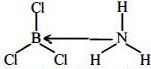
\end{smallmatrix}}{\mathop{BC{{l}_{3}}}}\,\xrightarrow{N{{H}_{3}}}\)\(BCl_3\) is electron deficient but it does not form dimer like \(Al,Ga\) or \(In\) because its electron deficiency is complemented by the formation of co-ordinate bond between lone pair of electron of chlorine and empty unhybridized \(p-\) orbital of boron forming \(p\pi -p\pi\) bonding.
-
- (A) \(LiCl,AlH_3\) and \(SiH_4\)
- (B) \(LiCl, AlCl_3\) and \(SiH_4\)
- (C) \(LiH,AlCl_3\) and \(SiCl_2\)
- (D) \(LiH, AlH_3\) and \(SiH_4\)
Show answer and solution
Correct Answer: (B)
\(SiCl_4 + LiAlH_4\to LiCl + AlCl_3 + SiH_4\) -
- (A) Reaction of lithium hydride with \(B_2H_6\)
- (B) Electrolysis of acidified water using \(Pt\) electrodes
- (C) Reaction of zinc with aqueous alkali
- (D) Allowing a solution of sodium in liquid ammonia to stand
Show answer and solution
Correct Answer: (A)
Lithium hydride react with diborane to produce lithiumborohydride\(2LiH + B_2H_6 \longrightarrow 2Li[BH_4]\)
-
- (A) \(1\) and \(2\)
- (B) \(1\) and \(3\)
- (C) \(2\) and \(4\)
- (D) \(3\) and \(4\)
Show answer and solution
Correct Answer: (B)
Aluminium oxide is amphoteric oxide because it shows the properties of the both acidic and basic oxides . It reacts with both acids and bases to form salt and water.\(Al_2O_3 . xH_2O + 2NaOH \longrightarrow NaAlO_2 +H_2O\)
\(Al_2O_3 . xH_2O+HCl \longrightarrow AlCl_3 + H_2O\)
No questions on this page match these filters.
Other STD 11 -P-Block elements - I topics
Frequently asked
How many Boron family questions came in JEE Mains?
36 questions from 2014–2026, each with the correct answer and a full solution.
How difficult are Boron family questions?
17% are easy, 47% medium and 36% hard.