


Questions
Newest firstShowing 1–20 of 20 questions
- 1. A point charge of \(10^{-8} C\) is placed at origin. The work done in moving a point charge \(2 \mu C\) from point \(A (4,4,2) m\) to \(B (2,2,1) m\) is _________ J. 2026 Easy
- 2. Consider two identical metallic spheres of radius \(R\) each having charge \(Q\) and mass \(m\). Their centers have an initial separation of \(4 R\). Both the spheres are given an initial speed of \(u\) towards each other. The minimum value of \(u\), so that they can just touch each other is:
(Take \(k=\frac{1}{4 \pi \epsilon_0}\) and assume \(k Q^2>G m^2\) where G is the Gravitational constant) 2026 Easy - 3. Two point charges of 1 nC and 2 nC are placed at the two corners of equilateral triangle of side 3 cm. The work done in bringing a charge of 3 nC from infinity to the third corner of the triangle is ________ \(\mu\)J.
(\(\frac{1}{4\pi\epsilon_{0}} = 9 \times 10^{9}\ N.m^{2}/C^{2}\)) 2026 Hard - 4. A motor operating on 100 V draws a current of 1 A. If the efficiency of the motor is \(91.6 \%\), then the loss of power in units of \(\mathrm{cal} / \mathrm{s}\) is 2025 Easy
- 5.
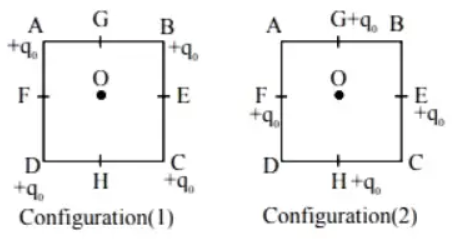
In the first configuration (1) as shown in the figure, four identical charges \(\left(q_0\right)\) are kept at the corners \(A, B, C\) and \(D\) of square of side length 'a'. In the second configuration (2), the same charges are shifted to mid points \(\mathrm{G}, \mathrm{E}, \mathrm{H}\) and F, of the square, If \(\mathrm{K}=\frac{1}{4 \pi \varepsilon_0}\), the difference between the potential energies of configuration (2) and (1) is given by : 2025 Hard - 6. Two charges \(7 \mu \mathrm{c}\) and \(-4 \mu \mathrm{c}\) are placed at \((-7 \mathrm{~cm}, 0,0)\) and \((7 \mathrm{~cm}, 0,0)\) respectively. Given, \(\epsilon_0=8.85 \times 10^{-12} \mathrm{C}^2 \mathrm{~N}^{-1} \mathrm{~m}^{-2}\), the electrostatic potential energy of the charge configuration is : 2025 Medium
- 7. Two charges \(\mathrm{q}_1\) and \(\mathrm{q}_2\) are separated by a distance of 30 cm. A third charge \(q_3\) initially at ' C ' as shown in the figure, is moved along the circular path of radius 40 cm from C to D. If the difference in potential energy due to movement of \(q_3\) from \(C\) to \(D\) is given by \(\frac{\mathrm{q}_3 \mathrm{~K}}{4 \pi \epsilon_0}\), the value of K is :
 2025 Easy
- 8. Two point charges \(-4 \mu c\) and \(4 \mu c\), constituting an electric dipole, are placed at \((-9,0,0) \mathrm{cm}\) and \((9,0,0) \mathrm{cm}\) in a uniform electric field of strength \(10^4 \mathrm{NC}^{-1}\). The work done on the dipole in rotating it from the equilibrium through \(180^{\circ}\) is : 2025 Hard
- 9. A point charge \(2 \times 10^{-2}\,C\) is moved from \(P\) to \(S\) in a uniform electric field of \(30\,NC ^{-1}\) directed along positive \(x\)-axis. If coordinates of \(P\) and \(S\) are \((1,2\), \(0) m\) and \((0,0,0) m\) respectively, the work done by electric field will be \(.........\,mJ\) 2023 Medium
- 10. An \(\alpha\) particle and a proton are accelerated from rest through the same potential difference. The ratio of linear momenta acquired by above two particals will be. 2022 Medium
- 11. In an electrical circuit, a battery is connected to pass \(20\, C\) of charge through it in a certain given time. The potential difference between two plates of the battery is maintained at \(15\, V\). The work done by the battery is ........... \(J\). 2021 Easy
- 12. A particle of charge \(q\) and mass \(m\) is subjected to an electric field \(E = E _{0}\left(1- ax ^{2}\right)\) in the \(x-\)direction, where \(a\) and \(E _{0}\) are constants. Initially the particle was at rest at \(x=0 .\) Other than the initial position the kinetic energy of the particle becomes zero when the distance of the particle from the origin is 2020 Hard
- 13. A solid sphere of radius \(R\) carries a charge \((Q+q)\) distributed uniformly over its volume. A very small point like piece of it of mass \(m\) gets detached from the bottom of the sphere and falls down vertically under gravity. This piece carries charge \(q.\) If it acquires a speed \(v\) when it has fallen through a vertical height \(y\) (see figure), then : (assume the remaining portion to be spherical).
 2020 Hard
- 14. A two point charges \(4 q\) and \(-q\) are fixed on the \(x-\)axis at \(x=-\frac{d}{2}\) and \(x=\frac{d}{2},\) respectively. If a third point charge \('q'\) is taken from the origin to \(x = d\) along the semicircle as shown in the figure, the energy of the charge will
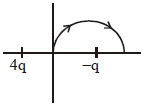 2020 Hard
- 15. Hydrogen ion and singly ionized helium atom are accelerated, from rest, through the same potential difference. The ratio of final speeds of hydrogen and helium ions is close to...... 2020 Medium
- 16. A positive point charge is released from rest at a distance \(r_0\) from a positive line charge with uniform density. The speed \((v)\) of the point charge, as a function of instantaneous distance \(r\) from line charge, is proportional to
 2019 Hard
- 17. A uniformly charged ring of radius \(3a\) and total charge \(q\) is placed in \(xy-\) plane centered at origin. A point charge \(q\) is moving towards the ring along the \(z-\) axis and has speed \(v\) at \(z = 4a\). The minimum value of \(v\) such that it crosses the origin is 2019 Hard
- 18. For equal point charges \(Q\) each are placed in the \(xy\) plane at \((0, 2), (4, 2), (4, -2)\) and \((0, -2)\). The work required to put a fifth change \(Q\) at the origin of the coordinate system will be 2019 Hard
- 19. In free space, a particle \(A\) of charge \(1\,\mu C\) is held fixed at a point \(P.\) Another particle \(B\) of the same charge and mass \(4\,\mu g\) is kept at a distance of \(1\,mm\) from \(P\). If \(B\) is released, then its velocity at a distance of \(9\,mm\) from \(P\) is [ Take \(\frac{1}{{4\pi {\varepsilon _0}}} = 9 \times {10^9}\,N{m^2}{C^{ - 2}}\) ] 2019 Hard
- 20. Three charges \(Q, +q\) and \(+q\) are placed at the vertices of a right -angle isosceles triangle as shown below. The net electrostatic energy of the configuration is zero, if the value of \(Q\) is
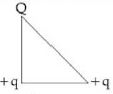 2019 Hard
No questions on this page match these filters.
Other STD 12 - Electric potential and capacitance topics
- 14Qs Charging and Discharging of Capacitance and RC circuit
- 9Qs Parallel Plate Capacitor
- 26Qs Energy Stored in a Capacitor
- 38Qs Combination of Capacitor and Sharing of Charge
- 54Qs Effect of Dielectric and Dielectric Inside Capacitor and Polarisation
- 10Qs Conductor, Electrostatic Shielding, Induced Charge and Charge Redistribution
- 9Qs Electric Field and Potential and Potential Gradient
- 12Qs Electric potential and Potential Energy and dipole
- 32Qs Electric potential
- 4Qs Equipotential Surface
- 5Qs Capacitance
Frequently asked
How many Potential Energy and Work Done questions came in JEE Mains?
20 questions from 2019–2026, each with the correct answer and a full solution.
How difficult are Potential Energy and Work Done questions?
25% are easy, 20% medium and 55% hard.