


Questions
Newest firstShowing 1–16 of 16 questions
-
- (A) \(+3\)
- (B) \(+4\)
- (C) \(+2\)
- (D) \(+7\)
Show answer and solution
Correct Answer: (D)
The group reagent \(H_2S\) in the presence of \(NH_4OH\) is used for the precipitation of Group IV cations in qualitative analysis.
Among the given ions, \(Mn^{2+}\) belongs to Group IV and is precipitated as \(MnS\).
\(Pb^{2+}\) and \(Cu^{2+}\) belong to Group II and are precipitated by \(H_2S\) in an acidic medium.
\(Fe^{3+}\) belongs to Group III and is precipitated as \(Fe(OH)_3\) by \(NH_4OH\) in the presence of \(NH_4Cl\).
The metal corresponding to the precipitated ion is Manganese (\(Mn\)).
The electronic configuration of \(Mn\) is \([Ar] 3d^5 4s^2\). By losing all its valence electrons, it can exhibit a maximum oxidation state of \(+7\) (for example, in \(KMnO_4\)).
Answer: \(+7\) -
- (A) +2 and +2
- (B) +2 and +1
- (C) +1 and +2
- (D) +1 and +1
Show answer and solution
Correct Answer: (B)
\(Na_2 B_4 O_7 \xrightarrow{\Delta}\left(2 NaBO_2\right)+B_2 O_3\)
\(CuSO _4+ B _2 O _3 \xrightarrow[\text { Non-Luminous flame }]{\Delta} \underset{\substack{\text { (Blue bead) } \\( Z )}}{\stackrel{+2}{ Cu }\left( BO _2\right)_2}+ SO _3\)
\(2 Cu \left( BO _2\right)_2+2 NaBO _2+\) \(C \xrightarrow[\text { Luminous Flame }]{\Delta}\)
\(2 \underset{\substack{\text { Colorless } \\( Q )}}{\stackrel{+1}{ Cu }} BO _2+ Na _2 B_4 O _7+ CO\) -
- (A) \(+4,+2,0,+2\)
- (B) \(+2,0,+2,+4\)
- (C) \(0,+2,+4,+2\)
- (D) \(+2,0,0,+4\)
Show answer and solution
Correct Answer: (B)
For charging of lead storage battery cell reaction is \(2 \mathrm{PbSO}_4(\mathrm{~s})+2 \mathrm{H}_2 \mathrm{O}(\mathrm{l}) \rightarrow \mathrm{Pb}(\mathrm{s})+\mathrm{PbO}_2(\mathrm{~s})+2 \mathrm{H}_2 \mathrm{SO}_4(\mathrm{aq})\) At anode \(\mathrm{PbSO}_4\) reduced back to Pb and at cathode \(\mathrm{PbSO}_4\) oxidised back to \(\mathrm{PbO}_2\).
\(\begin{aligned}
& \because \quad \mathrm{x}_1=+2, \mathrm{y}_1=0 \\
& \mathrm{x}_2=+2, \mathrm{y}_2=4
\end{aligned}\) -
- (A) Bromine
- (B) Iodine
- (C) Chlorine
- (D) Fluorine
Show answer and solution
Correct Answer: (D)
Fluorine does not show variable oxidation state. -
- (A) \(2\)
- (B) \(3\)
- (C) \(9\)
- (D) \(11\)
Show answer and solution
Correct Answer: (B)
Compounds \(\mathrm{SO}_3\) \(\mathrm{H}_2 \mathrm{SO}_3\) \(\mathrm{SOCl}_2\) \(\mathrm{SF}_4\) \(\mathrm{BaSO}_4\) \(\mathrm{H}_2 \mathrm{~S}_2 \mathrm{O}_7\) \(O.S.\) of sulphur \(+6\) \(+4\) \(+4\) \(+4\) \(+6\) \(+6\) -
- (A) \(6\)
- (B) \(5\)
- (C) \(4\)
- (D) \(3\)
Show answer and solution
Correct Answer: (A)
\(CrO _2 Cl _2 x -4-2=0\)Oxidation State \(=+6\)
- 7. The sum of oxidation state of the metals in \(Fe ( CO )_5, VO ^{2+}\) and \(WO _3\) is \(.........\). 2023 Medium
- (A) \(10\)
- (B) \(8\)
- (C) \(6\)
- (D) \(4\)
Show answer and solution
Correct Answer: (A)
So, Sum of oxidation state \(=0+4+6=10\) - 8. The difference in oxidation state of chromium in chromate and dichromate salts is .... . 2022 Easy
- (A) \(1\)
- (B) \(0\)
- (C) \(2\)
- (D) \(3\)
Show answer and solution
Correct Answer: (B)
\(Cr=+6\)\(Cr O_{4}^{2-}, Cr _{2} O _{7}^{2-}\) difference is zero.
-
- (A) \(12\)
- (B) \(25\)
- (C) \(19\)
- (D) \(22\)
Show answer and solution
Correct Answer: (C)
\(K _{2} Cr _{2} O _{7}\)\(2(+1)+2 x+7(-2)=0\)
\(x=+6\)
In \(K _{2} Cr _{2} O _{7},\) Transition metal \(( Cr )\) present in +6
oxidation state.
\(KMnO _{4}\)
\((+1)+y+4(-2)=0\)
\(x=+7\)
In \(KMnO _{4}\), transition metal (Mn) present in \(+7\) oxidation state
\(K _{2} FeO _{4}\)
\(2(+1)+z+4(-2)=0\)
\(x=+6\)
In \(K _{2} FeO _{4},\) transition metal (Fe) present in \(+6\) oxidation state
So \(x=+6\)
\(y=+7\)
\(z=+6\)
____________
\(x+y+z=19\)
- 10. The sum of the total number of bonds between chromium and oxygen atoms in chromate and dichromate ions is 2020 Hard
- (A) \(12\)
- (B) \(13\)
- (C) \(14\)
- (D) \(15\)
Show answer and solution
Correct Answer: (A)
Total number of bonds between chromium and oxygen in both structures are \(18\)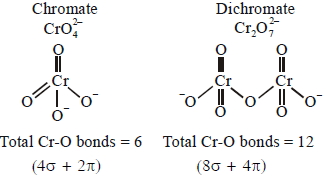
- 11. The correct order of the oxidation states of nitrogen in \(NO, N_2O, NO_2\) and \(N_2O_3\) is 2019 Hard
- (A) \(N_2O < N_2O_3 < NO < NO_2\)
- (B) \(NO_2 < NO < N_2O_3 < N_2O\)
- (C) \(NO_2 < N_2O_3 < NO < N_2O\)
- (D) \(N_2O < NO < N_2O_3 < NO_2\)
Show answer and solution
Correct Answer: (D)
\(\mathop {NO}\limits^{ + 2} ,{\mkern 1mu} \mathop {{N_2}}\limits^{ + 1} O{\mkern 1mu} ,{\mkern 1mu} \mathop {{\text{ }}N}\limits^{ + 4} {O_2},\mathop {{N_2}}\limits^{ + 3} {O_3}\) - 12. In \(KO_2\), the nature of oxygen species and the oxidation state of oxygen atom are, respectively 2018 Hard
- (A) Superoxide and \(-1\)
- (B) Superoxide and \(-1/2\)
- (C) Peroxide and \(-1/2\)
- (D) Oxide and \(-2\)
Show answer and solution
Correct Answer: (B)
In \(KO_2\), the nature of oxygen species and the oxidation state of oxygen atom are superoxide (superoxide ion is \(O_2^-\)) and \(-1/2\) respectively.Let \(x\) be oxidation state of oxygen. The oxidation state of \(K\) is \(+1.\) Hence
\(+1+2(x)=0\)
\(2x=-1\)
\(x=-\frac {1}{2}\)
-
- (A) \(MnO_4 ^-\) and \(CrO_2Cl_2\)
- (B) \([NiCl_4]^{2-}\) and \([CoCl_4]^{2-}\)
- (C) \([Fe(CN)_6]^{3-}\) and \([Cu(CN)_2]^{2-}\)
- (D) \([FeCl_4]^-\) and \(Co_2O_3\)
Show answer and solution
Correct Answer: (A)
\((1)\,Cr\mathop {{O_2}}\limits^{2 - } \mathop {C{l_2}}\limits^{ - 1} \,\,Cr = + 6;\,Mn\mathop {{O_2}}\limits^{2 - } \,\,Mn = + 4\)(Highest oxidation state)
\((2)\,{[Ni\mathop {C{l_4}}\limits^{ - 1} ]^{2 - }}\,\,Ni = + 2;\,{[Co\mathop {C{l_4}}\limits^{ - 1} ]^{2 - }}\,\,Co = + 2\)
\((3)\,{[Fe{(\mathop {CN}\limits^{ - 1} )_6}]^{3 - }}\,\,Fe = + 3;\,{[Cu{(\mathop {CN}\limits^{ - 1} )_4}]^{2 - }}\,\,Cu = + 2\)
\((4)\,{[Fe\mathop {C{l_4}}\limits^{ - 1} ]^ - }\,\,Fe = + 3;\,C{o_2}\mathop {{O_3}}\limits^{ - 2} \,Co = + 3\)
-
- (A) \(Sn^{4+}\) is the oxidizing agent because it undergoes oxidation
- (B) \(Sn^{4+}\) is the reducing agent because it undergoes oxidatio
- (C) \(H_2SO_3\) is the reducing agent because it undergoes oxidation
- (D) \(H_2SO_3\) is the reducing agent because it undergoes reduction
Show answer and solution
Correct Answer: (C)
\(\mathop {{H_2}S{O_3}}\limits^{ + 4} (aq) + \mathop {Sn^{+4}} (aq) + {H_2}O(l) \to S{n^{2 + }}(aq) + \mathop {HS{O_4}^ - }\limits^{ + 6} (aq) + 3{H^ + }\) Hence \(H_2SO_3\) is the reducing agent because it undergoes oxidation -
- (A) \(3\)
- (B) \(4\)
- (C) \(6\)
- (D) \(5\)
Show answer and solution
Correct Answer: (C)
Oxidation state of Cr in \(C{r_2}O_7^{2-}\): \(+6\)
Oxidation state of Cr in \(C{r^{3+}}\): \(+3\)
Electrons gained by Cr per mole of \(C{r_2}O_7^{2-}\): \(2 \times (+6 - +3) = 6e^-\)
Oxidation state of Fe in \(F{e^{2+}}\): \(+2\)
Oxidation state of Fe in \(F{e^{3+}}\): \(+3\)
Electrons lost by Fe per mole of \(F{e^{2+}}\): \(+3 - +2 = 1e^-\)
Oxidation state of C in \({C_2}O_4^{2-}\): \(+3\)
Oxidation state of C in \(C{O_2}\): \(+4\)
Electrons lost by C per mole of \({C_2}O_4^{2-}\): \(2 \times (+4 - +3) = 2e^-\)
For the reaction to be balanced, total electrons gained = total electrons lost.
Let the coefficient for \(F{e^{2+}}\) be \(x\) and for \({C_2}O_4^{2-}\) be \(y\).
\(1 \times 6 = x \times 1 + y \times 2\)
\(6 = x + 2y\)
The smallest integer solution is \(x=4, y=1\).
Total electrons involved: \(6\)
-
- (A) It is diamagnetic in nature
- (B) It is derivative of \(H_2O_2\)
- (C) \(Na_2O_2\) oxidises \(Cr^{3+}\) to \(CrO_4^{2-}\) in acid medium
- (D) It is the super oxide of sodium
Show answer and solution
Correct Answer: (D)
Explanation:
Let us evaluate each statement regarding sodium peroxide (\( \text{Na}_2\text{O}_2 \)):
1. Diamagnetic Nature: The peroxide ion (\( \text{O}_2^{2-} \)) has a total of 18 electrons. According to Molecular Orbital Theory, all electrons are completely paired up in its molecular orbitals, which makes it diamagnetic in nature. This statement is correct.
2. Derivative of \( \text{H}_2\text{O}_2 \): Sodium peroxide reacts readily with water or dilute acids at low temperatures to produce hydrogen peroxide (\( \text{H}_2\text{O}_2 \)). Therefore, it behaves as a stable salt derivative of hydrogen peroxide. This statement is correct.
3. Oxidation of Chromium: In an alkaline (basic) medium, sodium peroxide acts as a strong oxidizing agent and converts trivalent chromium (\( \text{Cr}^{3+} \)) into yellow chromate ions (\( \text{CrO}_4^{2-} \)). Option C has been modified to reflect this correct chemical environment.
4. Peroxide vs Superoxide: \( \text{Na}_2\text{O}_2 \) is the peroxide of sodium where oxygen exists in a \( -1 \) oxidation state as the \( \text{O}_2^{2-} \) ion. On the other hand, sodium superoxide has the chemical formula \( \text{NaO}_2 \) containing the \( \text{O}_2^- \) ion. Thus, statement D is completely incorrect.
Since the question asks for the statement that is not correct, Option D is the correct choice.
No questions on this page match these filters.
Other STD 11 - Redox reactions topics
Frequently asked
How many Oxidation number and Oxidation state questions came in JEE Mains?
16 questions from 2014–2026, each with the correct answer and a full solution.
How difficult are Oxidation number and Oxidation state questions?
13% are easy, 31% medium and 56% hard.