


All JEE Mains 2023 Physics questions
32 chaptersShowing 101–150 of 644 questions
-
- (A) \(A-III, B-I, C-II, D-IV\)
- (B) \(A-III, B-IV, C-I, D-II\)
- (C) \(A-II, B-IV, C-III, D-I\)
- (D) \(A-I, B-III, C-IV, D-II\)
Show answer and solution
Correct Answer: (B)
(A) Planck's constant\(h v= E\)
\(h =\frac{ E }{v}=\frac{ M ^1 L ^2 T ^{-2}}{ T ^{-1}}= M ^1 L ^2 T ^{-1}\)
(B) \(E = qV\)
\(V=\frac{E}{q}=\frac{M^1 L^2 T^{-2}}{A^1 T^1}=M^1 L^2 T^{-3} A^{-1} \text { (IV) }\)
(C) \(\phi\) (work function) \(=\) energy
\(= M ^1 L ^2 T ^{-2}\)
(D) Momentum (p) = F.t
\(= M ^1 L ^1 T ^{-2} T ^1\)
\(= M ^1 L ^1 T ^{-1}\)
-
- (A) \(1: 43\)
- (B) \(43: 1\)
- (C) \(1: 1849\)
- (D) \(1: 1\)
Show answer and solution
Correct Answer: (D)
De Broglie wavelength is \(\lambda=\frac{h}{ mv }\)\(\lambda_{ p }=\lambda_{ e } \Rightarrow m _{ p } v _{ p }= m _{ e } v _{ e } \Rightarrow p _{ p }= p _{ e }\)
-
- (A) \(\frac{1}{\sqrt{2}} \lambda_1\)
- (B) \(2 \lambda_1\)
- (C) \(\frac{1}{2} \lambda_1\)
- (D) \(\sqrt{2} \lambda_1\)
Show answer and solution
Correct Answer: (A)
From K.T.G.\(v _{ RMS }=\sqrt{\frac{3 k _{ B } T }{ m }}\)
\(v _{ RMS } \propto \sqrt{ T }\)
\(\text { and } \frac{ h }{ m v_{ RMS }}=\lambda \text { i.e., } \lambda \propto \frac{1}{\sqrt{ T }}\)
\(\frac{\lambda_2}{\lambda_1}=\sqrt{\frac{ T _1}{ T _2}}=\sqrt{\frac{300}{600}}=\frac{1}{\sqrt{2}}\)
\(\lambda_2=\frac{\lambda_1}{\sqrt{2}}\)
-
- (A) \(\frac{\lambda}{\sqrt{2}}\)
- (B) \(\frac{\lambda}{2}\)
- (C) \(2 \lambda\)
- (D) \(\sqrt{2} \lambda\)
Show answer and solution
Correct Answer: (C)
\(\lambda=\frac{ h }{\sqrt{2 mE }}\)\(\lambda^{\prime}=\frac{ h }{\sqrt{2 m \left(\frac{ E }{4}\right)}}=\frac{2 h }{\sqrt{2 mE }}=2 \lambda\)
-
- (A) \(264\)
- (B) \(138\)
- (C) \(276\)
- (D) \(540\)
Show answer and solution
Correct Answer: (B)
\(\lambda_{ A }=\left(\frac{1242}{9}\right)=138\,nm\)\(\lambda_{ B }=\left(\frac{1242}{4.5}\right)=276\,nm\)
\(\lambda_{ B }-\lambda_{ A }=138\,nm\)
-
- (A) \(\lambda \alpha=\lambda p < \lambda e\)
- (B) \(\lambda \alpha > \lambda p > \lambda e\)
- (C) \(\lambda \alpha < \lambda p < \lambda e\)
- (D) \(\lambda \alpha=\lambda p>\lambda e\)
Show answer and solution
Correct Answer: (C)
\(Electron\) \(Alpha\) \(Proton\) \(Mass:\) \(\frac{m}{1840}\) \(4m\) \(m\) \(Charge:\) \(e\) \(2e\) \(e\) \(Kinetic energy:\) \(4K\) \(2K\) \(K\) \(\lambda=\frac{h}{\sqrt{2 mK }}\) \(\frac{ h }{\sqrt{2 \cdot \frac{ m }{1840} \cdot 4 K }}\) \(\frac{h}{\sqrt{2.4 m.2K }}\) \(\frac{h}{\sqrt{2 mK }}\) \(\lambda_\alpha < \lambda_p < \lambda_e\)
-
- (A) \(4\)
- (B) \(16\)
- (C) \(8\)
- (D) \(2\)
Show answer and solution
Correct Answer: (C)
\(\frac{\lambda_\alpha}{\lambda_{ p }}=\frac{ h }{\frac{\sqrt{2 m _\alpha q _\alpha V }}{ h }}\)\(\frac{\sqrt{2 m _{ p } q _{ p } V }}{\lambda_{ p }}=\sqrt{\frac{1}{8}}\)
\(m =8\)
- 108. The ratio of the de-Broglie wavelengths of proton and electron having same kinetic energy: (Assume \(m_p=m_e \times 1849\) ) 2023 Medium
- (A) \(1: 43\)
- (B) \(1: 30\)
- (C) \(1: 62\)
- (D) \(2: 43\)
Show answer and solution
Correct Answer: (A)
\(\lambda \propto \frac{1}{\sqrt{ m }} \Rightarrow \frac{\lambda_{ p }}{\lambda_e}=\sqrt{\frac{ m _e}{ m _{ p }}}=1: 43\) -
- (A) \(\frac{v_1}{v_2}=\frac{1}{2}\)
- (B) \(\frac{v_1}{v_2}=\frac{1}{8}\)
- (C) \(\frac{v_1}{v_2}=\frac{1}{16}\)
- (D) \(\frac{v_1}{v_2}=\frac{1}{4}\)
Show answer and solution
Correct Answer: (A)
\(K _{\max }= hf - hf _0\)For \(f =2 f _0\)
\(\frac{1}{2} m V _1^2=2 h f _0- hf _0= hf f _0\)
For \(f =5 f _0\)
\(\frac{1}{2} m V _2^2=5 h \textrm {f } _ { 0 } - hf _0=4 h _0\)
\(\frac{ V _1}{ V _2}=\frac{1}{2}\)
-
- (A) \(B\) and \(C\) only
- (B) \(A\) and \(D\) only
- (C) \(C\) only
- (D) \(C\) and \(D\) only
Show answer and solution
Correct Answer: (D)
\(\lambda < 5500\, \mathring A\) for photoelectric emission.\(\lambda_{ uv } < 5500\, \mathring A\)
-
- (A) \(18.6\)
- (B) \(2.98\)
- (C) \(2.07\)
- (D) \(1.36\)
Show answer and solution
Correct Answer: (C)
\(eV _0= h v-\phi\)\(0= h v-\phi\)
\(\phi= h v\)
\(=6.6 \times 10^{-34} \times 5 \times 10^{14}\)
\(=33 \times 10^{-20}\,J\)
\(\phi=\frac{33 \times 10^{-20}}{1.6 \times 10^{-19}}=2.07\,eV\)
-
- (A) \(1.24\)
- (B) \(2\)
- (C) \(1\)
- (D) \(1.5\)
Show answer and solution
Correct Answer: (C)
\(eV _{ s }= k _{\max }\)\(V_x=\left\{\frac{h}{e}\right\} f+\left\{\frac{-\phi}{e}\right\}\)
Slope is independent of nature of metal
\(\operatorname{slope}\left(V_s\right)^{\text {Gold }}=\operatorname{slope}\left(V_s\right)^{\text {Alumiun }}\)
-
- (A) \(-2.2 \times 10^{-8} \hat{ i }\,T\)
- (B) \(2.2 \times 10^{-8} \hat{ k }\,T\)
- (C) \(-2.2 \times 10^{-8} \hat{ k }\,T\)
- (D) \(2.2 \times 10^{-8} \hat{ i }\,T\)
Show answer and solution
Correct Answer: (B)
\(\overrightarrow{ E }=6.6 \hat{ j }\)\(v=20\,MHz\)
\(\overrightarrow{ c }=3 \times 10^8 \hat{ i }\)
\(|\overrightarrow{ B }|=\frac{|\overrightarrow{ E }|}{ c }=2.2 \times 10^{-8}\,T\)
\(\hat{ E } \times \hat{ B }=\hat{ c }\)
\(\overrightarrow{ B }=2.2 \times 10^{-8} \hat{ k }\,T\)
-
- (A) \(\frac{1}{2 \pi} \frac{ W }{ m ^2}\)
- (B) \(\frac{1}{40 \pi} \frac{ W }{ m ^2}\)
- (C) \(\frac{1}{10 \pi} \frac{W}{ m ^2}\)
- (D) \(\frac{1}{20 \pi} \frac{ W }{ m ^2}\)
Show answer and solution
Correct Answer: (B)
\(I _{ EF }=\frac{1}{2} \times \frac{5}{4 \pi \times 5^2}\)\(=\frac{1}{40 \pi}\,W / m ^2\)
-
- (A) Positive direction of \(x\)
- (B) Positive direction of \(z\)
- (C) Negative direction of \(x\)
- (D) Negative direction of \(y\)
Show answer and solution
Correct Answer: (A)
As, poynting vector\(\overrightarrow{ S }=\overrightarrow{ E } \times \overrightarrow{ H }\)
Given energy transport \(=\) negative \(z\) direction Electric field \(=\) positive \(y\) direction
\((-\hat{ k })=(+\hat{ j }) \times[\hat{ i }]\)
Hence according to vector cross product magnetic field should be positive \(x\) direction.
-
- (A) \(1\)
- (B) \(\frac{1}{2}\)
- (C) \(2\)
- (D) \(4\)
Show answer and solution
Correct Answer: (A)
\(\frac{\text { Electric energy density }}{\text { Magnetic energy density }}=\frac{\frac{1}{2} \in_0 \mathrm{E}_{\mathrm{rms}}^2}{\left(\frac{\mathrm{B}_{\mathrm{rms}}^2}{2 \mu_0}\right)}\)\(=\left(\frac{\mathrm{E}_{\mathrm{rms}}}{\mathrm{B}_{\mathrm{rms}}}\right)^2 \cdot \mu_0 \in_0 \quad\left[\mathrm{C}=\frac{1}{\mu_0 \epsilon_0}\right]\)
\(=\frac{\mathrm{C}^2}{\mathrm{C}^2}=1\)
-
- (A) \(A\) is false but \(R\) is true
- (B) \(A\) is true but \(R\) is false
- (C) Both \(A\) and \(R\) true but \(R\) is \(NOT\) the correct explanation of \(A\)
- (D) Both \(A\) and \(R\) true and \(r\) is the correct explanation of \(A\)
Show answer and solution
Correct Answer: (A)
Optical communication is performed in the frequency range of \(1\,THz\) to \(1000\,THz\).(Microwave to \(UV\))
So,\(EM\) waves used for optical communication have shorter wavelength than that of microwaves used in \(RADAR.\)
Also, \(v_{\text {INFRARED }}>v_{\text {MICROWAVE }}\)
\(\therefore\) Infrared \(EM\) waves are more energetic than microwave
-
- (A) Statement \(I\) is true but statement \(II\) is false
- (B) Both Statement \(I\) and Statement \(II\) are true
- (C) Statement \(I\) is false but statement \(II\) is true.
- (D) Both Statement \(I\) and Statement \(II\) are false.
Show answer and solution
Correct Answer: (A)
Statement\(-I\) is correct as \(EMW\) are neutral.Statement\(-II\) is wrong.
\(E _0=\sqrt{\frac{1}{\mu_0 \varepsilon_0}} B _0\)
-
- (A) Micro waves
- (B) Ultraviolet rays
- (C) Gamma rays
- (D) Radio waves
Show answer and solution
Correct Answer: (C)
Energy of one photon \(=\frac{\text { Power }}{\text { Photon frequency }}\)\(E=h \nu=\frac{15 \times 10^3}{10^{16}}\)
\(v=\frac{15 \times 10^{-13}}{6 \times 10^{-34}}=2.5 \times 10^{21}\)
-
- (A) \(\frac{1}{\omega}(\overrightarrow{ K } \times \overrightarrow{ E })\)
- (B) \(\omega(\vec{E} \times \vec{K})\)
- (C) \(\omega(\overrightarrow{ K } \times \overrightarrow{ E })\)
- (D) \(\overrightarrow{ K } \times \overrightarrow{ E }\)
Show answer and solution
Correct Answer: (A)
Magnetic field vector will be in the direction of \(\hat{ K } \times \hat{ E }\)magnitude of \(B =\frac{ E }{ C }=\frac{ K }{\omega} E\) Or \(\overrightarrow{ B }=\frac{1}{\omega}(\overrightarrow{ K } \times \overrightarrow{ E })\)
-
- (A) at \(45^{\circ}\) angle from positive \(y\)-axis
- (B) negative \(y\)-axis
- (C) positive \(z-\) axis
- (D) positive \(y\)-axis
Show answer and solution
Correct Answer: (B)
Direction of propagation of \(EM\) wave will be in the direction of \(\overrightarrow{ E } \times \overrightarrow{ B }\). -
- (A) \((A)-(III), (B)-(IV), (C)-(I), (D)-(II)\)
- (B) \((A)-(II), (B)-(IV), (C)-(III), (D)-(I)\)
- (C) \((A)-(II), (B)-(I), (C)-(IV), (D)-(III)\)
- (D) \((A)-(II), (B)-(IV), (C)-(I), (D)-(III)\)
Show answer and solution
Correct Answer: (D)
Based on theory -
- (A) \(A-III, B-IV, C-II, D-I\)
- (B) \(A-I, B-II, C-IV, D-III\)
- (C) \(A-I, B-IV, C-III, D-II\)
- (D) \(A-III, B-II, C-I, D-IV\)
Show answer and solution
Correct Answer: (A)
NCERT fact based -
- (A) A-II, B-I, C-IV, D-III
- (B) A-IV, B-III, C-I, D-II
- (C) A-II, B-III, C-I, D-IV
- (D) A-I, B-III, C-II, D-IV
Show answer and solution
Correct Answer: (A)
A. AM Broadcast → II ( \(5 4 0 - 1 6 0 0 ~ k H z\) )
B. FM Broadcast \(\rightarrow\) I ( \(8 8 - 1 0 8 ~ M H z\) )
C. Television → IV ( \(5 4 - 5 9 0 ~ M H z\) )
D. Satellite Communication → III \((3.7-4.2 GHz )\) -
- (A) \((A)-(I), (B)-(IV), (C)-(II), (D)-(III)\)
- (B) \((A)-(IV), (B)-(I), (C)-(II), (D)-(III)\)
- (C) \((A)-(IV), (B)-(II), (C)-(I), (D)-(III)\)
- (D) \((A)-(IV), (B)-(I), (C)-(III), (D)-(II)\)
Show answer and solution
Correct Answer: (B)
Increasing order of wave length\(\begin{array}{ll}\text { X-ray } & 1\,nm \text { to } 10^{-3}\,nm \\ \text { Ultra Violet } & 400\,nm \text { to } 1\,nm \\ \text { Intra red } & 1\,mm \text { to } 700\,nm \\ \text { Micro wave } & 0.1\,m \text { to } 1\,mm \end{array}\)
-
- (A) \(A-I, B-II, C-III, D-IV\)
- (B) \(A-IV, B-I, C-II, D-III\)
- (C) \(A-I, B-III, C-IV, D-II\)
- (D) \(A-IV, B-III, C-II, D-I\)
Show answer and solution
Correct Answer: (B)
Based on theory. -
- (A) \(5 \times 10^{14}\,Vm ^{-1}\)
- (B) \(180\,Vm ^{-1}\)
- (C) \(2 \times 10^{15}\,Vm ^{-1}\)
- (D) \(6.0 \times 10^{-7}\,Vm ^{-1}\)
Show answer and solution
Correct Answer: (B)
\(\frac{E}{B}=C\)\(E=B C\)
\(=6 \times 10^{-7} \times 3 \times 10^8\)
\(=18 \times 10\)
\(E =180\,Vm ^{-1}\)
-
- (A) \(kE _0=\omega B _0\)
- (B) \(E _0 B _0=\omega k\)
- (C) \(\omega E _0= kB _0\)
- (D) \(E _0= kB _0\)
Show answer and solution
Correct Answer: (A)
\(C =\frac{\omega}{ k }=\frac{ E _0}{ B _0}\) -
- (A) \(28.5\)
- (B) \(17.7\)
- (C) \(8.85\)
- (D) \(88.5\)
Show answer and solution
Correct Answer: (C)
\(\overrightarrow{ E }=20 \sin \omega\left( t -\frac{ x }{ C }\right) \hat{ j } / C\)Average energy density of an em wave \(=\frac{1}{2} \epsilon_0 E_0^2\)
\(\text { Energy stored }=\left(\frac{1}{2} \epsilon_0 E _0^2\right)(\text { volume })\)
\(=\frac{1}{2} \times 8.85 \times 10^{-12} \times(20)^2 \times\left(5 \times 10^{-4}\right) \,J\)
\(=8.85 \times 10^{-13}\,J\)
-
- (A) \(U _{ E }=\frac{ E ^2}{2 \epsilon_0}, U _{ B }=\frac{ B ^2}{2 \mu_0}\)
- (B) \(U _{ E }=\frac{ E ^2}{2 \epsilon_0}, U _{ B }=\frac{\mu_0 B ^2}{2}\)
- (C) \(U _{ E }=\frac{\epsilon_0 E ^2}{2}, U _{ B }=\frac{\mu_0 B ^2}{2}\)
- (D) \(U _{ E }=\frac{\epsilon_0 E ^2}{2}, U _{ B }=\frac{ B ^2}{2 \mu_0}\)
Show answer and solution
Correct Answer: (D)
\(U _{ E }=\frac{1}{2} \epsilon_0 E ^2, U _{ B }=\frac{ B ^2}{2 \mu_0}\) -
- (A) zero frequency
- (B) half the frequency of the wave
- (C) double the frequency of the wave
- (D) the frequency of the wave
Show answer and solution
Correct Answer: (C)
\(E=E_0 \sin (\omega t-k x)\)Energy density \(\left(\frac{d u}{d v}\right)=\varepsilon_0 E_0^2 \sin ^2(\omega t-k x)\)
\(\frac{\varepsilon_0 E _0^2}{2}[1-\cos (2 \omega t -2 kx )]\)
- 132. The ratio of average electric energy density and total average energy density of electromagnetic wave is: 2023 Easy
- (A) \(2\)
- (B) \(1\)
- (C) \(3\)
- (D) \(\frac{1}{2}\)
Show answer and solution
Correct Answer: (D)
\(\left\langle u _{ E }\right\rangle=\left\langle u _{ B }\right\rangle=\frac{1}{2}\left\langle u _{\text {total }}\right\rangle\)So \(\frac{\left\langle u_E\right\rangle}{\left\langle u_{\text {total }}\right\rangle}=\frac{1}{2}\)
- 133. Which of the following Maxwell's equations is valid for time varying conditions but not valid for static conditions 2023 Medium
- (A) \(\oint \vec{B} \cdot dl =\mu_0 I\)
- (B) \(\oint \overrightarrow{ E } \cdot dl =0\)
- (C) \(\oint \overrightarrow{ E } \cdot dl =-\frac{\partial \phi_{ B }}{\partial t }\)
- (D) \(\oint \vec{D} \cdot \overrightarrow{d A}=Q\)
Show answer and solution
Correct Answer: (C)
Based on equations of Maxwell -
- (A) \(461\)
- (B) \(460\)
- (C) \(462\)
- (D) \(469\)
Show answer and solution
Correct Answer: (C)
\(d =2.5\,mm , D =150\,cm\)Fringe width \(\beta=\frac{\lambda D}{d}\)
Let \(n^{\text {th }}\) bright tringle of \(\lambda_1\) match with \(m ^{\text {th }}\) bright triangle of \(\lambda_2\)
\(\Rightarrow n \beta_1=m \beta_2\)
\(\Rightarrow n \lambda_1=m \lambda_2 \Rightarrow \frac{n}{m}=\frac{\lambda_2}{\lambda_1}=\frac{5500}{7000}\)
\(\Rightarrow \frac{n}{m}=\frac{11}{14}\)
Distance where bright fringe will match
\(=n \beta_1=\frac{11 \times 7000 \mathring A \times 150\, cm }{0.25\,cm }\)
\(=462 \times 10^{-5}\)
-
- (A) Increase the wave length of the light.
- (B) Increase the refractive index of the medium between the object and objective lens.
- (C) Decrease the focal length of the eye piece.
- (D) Decrease the diameter of the objective lens.
Show answer and solution
Correct Answer: (B)
\(P=\frac{2 \mu \sin \theta}{1.22 \lambda}\) -
- (A) \(0.6\)
- (B) \(1.2\)
- (C) \(1.8\)
- (D) \(3\)
Show answer and solution
Correct Answer: (B)
As for first minima\(a \sin \theta=\lambda\)
\(\Rightarrow a \sin 30^{\circ}=600 \times 10^{-9}\)
\(\Rightarrow a =1200 \times 10^{-9}\,m\)
\(\Rightarrow a =1.2\,\mu m\)
-
- (A) \(24\)
- (B) \(23\)
- (C) \(22\)
- (D) \(21\)
Show answer and solution
Correct Answer: (A)
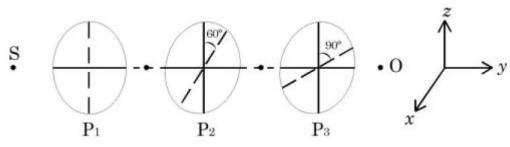
By first polaroid \(P_1\) intensity will be halved then \(P_2\) and \(P_3\) will make intensity \(\cos ^2\left(60^{\circ}\right)\) and \(\cos ^2\left(30^{\circ}\right)\) times respectively.\(\text { Intensity out }=\frac{256}{2} \times \frac{1}{4} \times\left(\frac{\sqrt{3}}{2}\right)^2=\frac{256 \times 3}{2 \times 4 \times 4}= 2 4\)
-
- (A) \(2\)
- (B) \(3\)
- (C) \(6\)
- (D) \(4\)
Show answer and solution
Correct Answer: (D)
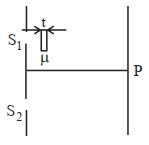
\(\text { Fringe shift }=\frac{ t (\mu-1)}{\lambda} B\)\(=\frac{10 \times 10^{-6}(1.2-1)}{5 \times 10^{-7}} B\)
\(=\frac{10^{-5} \times 0.2}{5 \times 10^{-7}}=4\)
-
- (A) Both Statements \(I\) and Statement \(II\) are true.
- (B) Statement \(I\) is true but Statement \(II\) is false.
- (C) Both Statement \(I\) and Statement \(II\) are false.
- (D) Statement \(I\) is false but Statement \(II\) is true.
Show answer and solution
Correct Answer: (B)
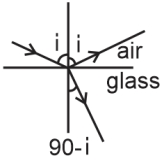
\(\mu_{ a } \sin i_1=\mu_{ g } \sin \left(90- i _1\right)\)\(\tan i _1=\frac{\mu_{ g }}{\mu_{ a }}\)
When going from glass to air
\(\tan i_2=\frac{\mu_{ a }}{\mu_{ g }}=\cot i_1\)
Hence
\(i_2=\frac{\pi}{2}-i_1\)
-
- (A) \(2\)
- (B) \(1\)
- (C) \(3\)
- (D) \(4\)
Show answer and solution
Correct Answer: (C)
\(I =4 I _0 \cos ^2\left(\frac{\Delta \phi}{2}\right)\)\(I _1=4 I _0 \cos ^2\left(\frac{\pi}{4}\right)=2 I _0\)
\(I _2=4 I _0 \cos ^2\left(\frac{2 \pi}{3}\right)= I _0\)
\(\Rightarrow \frac{ I _1+ I _2}{ I _0}=3\)
-
- (A) \(0.4\)
- (B) \(0.5\)
- (C) \(0.2\)
- (D) \(0.1\)
Show answer and solution
Correct Answer: (C)
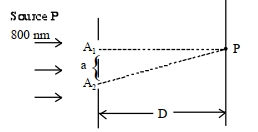
\(A _2 P - A _1 P =\frac{\lambda}{2} \quad \text { (Condition of minima) }\)\(\sqrt{ D ^2+ a ^2}- D =\frac{\lambda}{2}\)
\(D \left(1+\frac{ a ^2}{ D ^2}\right)^{1 / 2}- D =\frac{\lambda}{2}\)
\(D \left(1+\frac{1}{2} \times \frac{ a ^2}{ D ^2}\right)- D =\frac{\lambda}{2}\)
\(\frac{ a ^2}{2 D }=\frac{\lambda}{2} \Rightarrow a =\sqrt{\lambda . D }\)
\(=\sqrt{800 \times 10^{-6} \times 50}\)
\(a =0.2\,mm\)
-
- (A) \(9: 4\)
- (B) \(9: 1\)
- (C) \(2: 1\)
- (D) \(25: 9\)
Show answer and solution
Correct Answer: (B)
Given that \(\frac{ A _1}{ A _2}=\frac{2}{1}\)\(\frac{I_{\max }}{I_{\min }}=\left(\frac{ A _1+ A _2}{ A _1- A _2}\right)^2=\frac{9}{1}=9: 1\)
-
- (A) \(11\)
- (B) \(9\)
- (C) \(7\)
- (D) \(10\)
Show answer and solution
Correct Answer: (D)
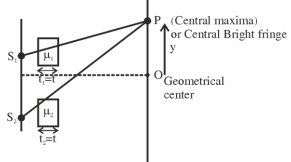
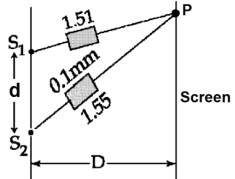
Path difference at \(P\) be \(\Delta x\)\(\Delta x =\left(\mu_2-\mu_1\right) t\)
\(=(1.55-1.51) 0.1\,mm\)
\(=0.04 \times 10^{-4}\)
\(\Delta x =4 \times 10^{-6}=4\,\mu m\)
\(y =\frac{\Delta xD }{ d }=4 \times 10^{-6} \frac{ D }{ d }\)
\(\{ y\) is the distance of central maxima from geometric center \(\}\)
fringe width \((\beta)=\frac{\lambda D}{d}=4 \times 10^{-6} m \frac{ D }{ d }=4\,\mu m \frac{ D }{ d }\)
Central bright fringe spot will shift by ' \(x\) '
Number of shift \(=\frac{y}{\beta}\)
\(=\frac{4 \times 10^{-6} D / d }{4 \times 10^{-7} D / d }=10\,Ans\)
-
- (A) \(60\)
- (B) \(48\)
- (C) \(12\)
- (D) \(36\)
Show answer and solution
Correct Answer: (A)
Given\(D =1\,m\)
\(\lambda=600 \times 10^{-9}\,m\)
\(n =5\)
\(\text { As } y _{ nth }=\frac{ n \lambda D }{ d }\)
\(\Rightarrow \frac{5 \times 600 \times 10^{-9} \times 1}{ d }=5 \times 10^{-2}\)
\(\Rightarrow d =\frac{5 \times 600 \times 10^{-9} \times 1}{5 \times 10^{-2}}=60 \times 10^{-6}\,m\)
\(\Rightarrow d =60\,\mu m\)
-
- (A) \(3\)
- (B) \(6\)
- (C) \(5\)
- (D) \(4\)
Show answer and solution
Correct Answer: (B)
After passing through first sheet\(I_1=\frac{I}{2}\)
After passing through second sheet
\(I_2=I_1 \cos ^2\left(45^{\circ}\right)=\frac{I}{4}\)
After passing through \(n^{\text {th }}\) sheet
\(I_{ n }=\frac{I}{2^{ n }}=\frac{I}{64}\)
\(n=6\)
-
- (A) \(1: 3\)
- (B) \(3: 1\)
- (C) \(3: 2\)
- (D) \(2: 3\)
Show answer and solution
Correct Answer: (C)
\(I _{ vet }= I _1+ I _2+2 \sqrt{ I _1 I _2} \cos \phi\)\(= I _0+ I _0+2 I _0 \cos \frac{\pi}{3}\)
\(=2 I _0+2 I _0 \times \frac{1}{2}=3 I _0\)
\(I _{\text {net }}= I _0+ I _0+2 I _0 \cos 90^{\circ}=2 I _0\)
\(\text { Ratio }=\frac{3}{2}\)
-
- (A) \(4\)
- (B) \(1.33\)
- (C) \(3\)
- (D) \(2\)
Show answer and solution
Correct Answer: (C)
\(\text { Fringe width }(\beta)=\frac{ D \lambda}{ d }\)\(\Rightarrow \frac{\beta_2}{\beta_1}=\frac{\lambda_2}{\lambda_1}\)
\(\Rightarrow \frac{\beta_2}{2\,mm }=\frac{600\,nm }{400\,nm }=\frac{3}{2}\)
\(\Rightarrow \beta_2=3\,mm\)
-
- (A) \(45\)
- (B) \(46\)
- (C) \(48\)
- (D) \(47\)
Show answer and solution
Correct Answer: (C)
Correct answer is \(\mathbf{4 8}\)\(\omega_1=\frac{\lambda_1 D}{d} \& \omega_2=\frac{\lambda_2 D}{d} \)
\(\omega_1=16 \mathrm{~mm} \& \omega_2=12 \mathrm{~mm} \)
\(\text { so LCM }\left(\omega_1, \omega_2\right)=48 \mathrm{~mm}\)
so at 48 mm distance both bright fringes will be found.
-
- (A) \(\frac{I_0}{4}\)
- (B) \(\frac{I_0}{2}\)
- (C) \(\frac{I_0}{8}\)
- (D) \(Zero\)
Show answer and solution
Correct Answer: (C)
\(I _{ A }=\frac{ I _{ o }}{2}\)\(I_C =\frac{ I _{\circ}}{2} \cos ^2 45=\frac{ I _{\circ}}{4}\)
\(I _{ B }= I _{ C } \cos ^2 45=\frac{ I _{\circ}}{8}\)
-
- (A) \(20\)
- (B) \(40\)
- (C) \(90\)
- (D) \(30\)
Show answer and solution
Correct Answer: (D)
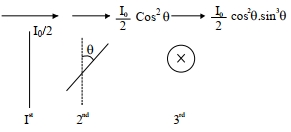
\(I _{\text {net }}=3=\frac{32}{2} \cos ^2 \theta \cdot \sin ^2 \theta\)\(\frac{3}{4}=4 \sin ^2 \theta \cdot \cos ^2 \theta=(\sin 2 \theta)^2\)
\(\frac{\sqrt{3}}{2}=\sin (2 \theta)\)
Hence, \(\theta=30^{\circ}\) and \(60^{\circ}\)

No questions on this page match these filters.