


Questions
Newest firstShowing 1–44 of 44 questions
-
- (A) 0.35 mol of \( H_{2} \) gas is evolved.
- (B) 7.84 L of \( H_{2} \) gas is evolved.
- (C) 33.3 g of \( CaCl_{2} \) is produced.
- (D) The limiting reagent is calcium metal.
Show answer and solution
Correct Answer: (C)
\(\underset{\frac{14}{40}}{ Ca _{( s )}}+\underset{\text { excess }}{2 HCl _{( g )}} \longrightarrow \underset{-}{ CaCl _{2(s)}}+\underset{-}{ H _{2(g)}}\)
\(=0.35 mole \quad 0.35 mole \quad 0.35 mole\)
Volume of \(H _{2(g)}\) evolved \(=0.35 \times 22.4=7.84 L\)
(3) is wrong because weight of \( CaCl_{2} = .35 \times 111 = 38.85 \) gm. -
- (A) C and D only
- (B) A and C only
- (C) B and D only
- (D) A and B only
Show answer and solution
Correct Answer: (C)
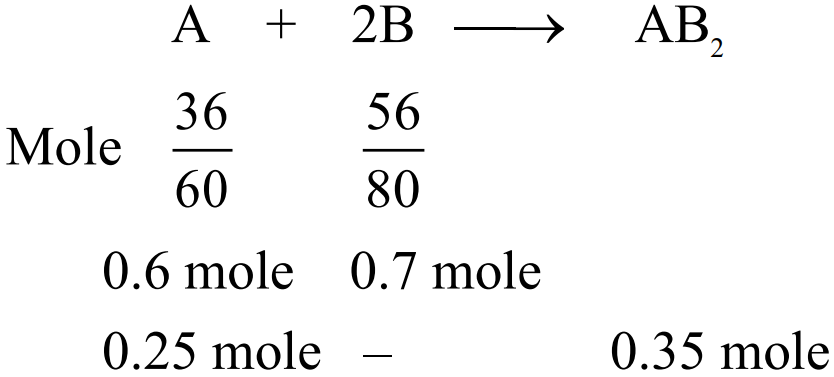
(A) Molecular wt. of \(AB_{2}\) is
\(60 + 2 \times 80 = 220~g/mol\)
(B) LR is AB.
(C) Wt. of A remaining = \(0.25 \times 60 = 15~g\)
(D) wt. of \(AB_{2}\) formed = \(0.35 \times 220 = 77~gm\). -
- (A) 64.97 g of HCl remains unreacted
- (B) 32.85 g of \(CaCO_{3}\) remains unreacted
- (C) 97.30 g of HCl reacted
- (D) 60.32 g of HCl remains unreacted
Show answer and solution
Correct Answer: (A)
Density of HCl solution \(( d )=1.13 g / ml\)
\(V =300 ml\)
Wt. of HCl solution \(=339 g\)
Wt. of \(HCl =339 \times \frac{38.55}{100}=130.68 g\)
(LR)
\(CaCO_3+2 HCl \rightarrow CaCl_2+H_2 O+CO_2\)
\(\frac{90}{100} \quad \frac{130.68}{36.5}\)
\(=0.90 mole \quad=3.58 mole\)
Moles of HCl remained \(=1.78\) mole.
Mass of HCl remained \(=64.97 g\). -
- (A) 11.2 L \(H_{2}(g)\) at STP is produced for every mole of HCl consumed.
- (B) 67.2 L \(H_{2}(g)\) at STP is produced for every mole of Al that reacts.
- (C) 12 L \(HCl(aq)\) is consumed for every 6L \(H_{2}(g)\) produced.
- (D) 33.6 L \(H_{2}(g)\) is produced regardless of temperature and pressure for every mole of Al that reacts.
Show answer and solution
Correct Answer: (A)
\(2Al (s) + 6HCl (aq) \rightarrow 2Al^{3+} (aq) + 6Cl^{-} (aq) + 3H_{2}(g)\)
Mole of \(H_{2}\) produced
\(=2 \times\) mole of HCl used
\(=\frac{2}{3} \times\) mole of Al used -
- (A) \(20\)
- (B) \(14\)
- (C) \(30\)
- (D) \(13\)
Show answer and solution
Correct Answer: (B)
\(\mathrm{CxHy}\) \((10 \mathrm{ml})\)\(+\mathrm{O}_2 \rightarrow \mathrm{CO}_2+\mathrm{H}_2 \mathrm{O}\)\(\mathrm{CxHy}+\left(\mathrm{x}+\frac{\mathrm{y}}{4}\right) \mathrm{O}_2 \rightarrow \mathrm{xCO}_2+\frac{\mathrm{y}}{2} \mathrm{H}_2 \mathrm{O}\)
\(\text { 10x } 5 \mathrm{y}\)
\(10 x=40\)
\(\mathrm{x}=4\)
\(5 y=50\)
\(\mathrm{y}=10\)
\(\mathrm{C}_4 \mathrm{H}_{10}\)
-
- (A) \(1.187 \mathrm{~g} \mathrm{CaCO}_3+1.023 \mathrm{~g} \mathrm{MgCO}_3\)
- (B) \(1.023 \mathrm{~g} \mathrm{CaCO}_3+1.023 \mathrm{~g} \mathrm{MgCO}_3\)
- (C) \(1.187 \mathrm{~g} \mathrm{CaCO}_3+1.187 \mathrm{~g} \mathrm{MgCO}_3\)
- (D) \(1.023 \mathrm{~g} \mathrm{CaCO}_3+1.187 \mathrm{~g} \mathrm{MgCO}_3\)
Show answer and solution
Correct Answer: (A)
\(\mathrm{CaCO}_3(\mathrm{~s}) \xrightarrow{\Delta} \mathrm{CaO}(\mathrm{s})+\mathrm{CO}_2(\mathrm{~g})\)\(\mathrm{MgCO}_3(\mathrm{~s}) \xrightarrow{\Delta} \mathrm{MgO}(\mathrm{s})+\mathrm{CO}_2(\mathrm{~g})\)
Let the weight of \(\mathrm{CaCO}_3\) be \(\mathrm{x} \mathrm{gm}\)
\(\therefore\)weight of \(\mathrm{MgCO}_3=(2.21-\mathrm{x}) \mathrm{gm}\)
Moles of \(\mathrm{CaCO}_3\) decomposed \(=\) moles of \(\mathrm{CaO}\) formed
\(\frac{\mathrm{x}}{100}=\) moles of \(\mathrm{CaO}\) formed
\(\therefore\) weight of \(\mathrm{CaO}\) formed \(=\frac{\mathrm{x}}{100} \times 56\)
Moles of \(\mathrm{MgCO}_3\) decomposed \(=\) moles of \(\mathrm{MgO}\) formed
\(\frac{(2.21-x)}{84}=\text { moles of } \mathrm{MgO} \text { formed }\)
\(\therefore \text { weight of } \mathrm{MgO} \text { formed }=\frac{2.21-\mathrm{x}}{84} \times 40\)
\(\Rightarrow \frac{2.21-\mathrm{x}}{84} \times 40+\frac{\mathrm{x}}{100} \times 56=1.152\)
\(\therefore \mathrm{x}=1.1886 \mathrm{~g}=\text { weight of } \mathrm{CaCO}_3\)
& weight of \(\mathrm{MgCO}_3=1.0214 \mathrm{~g}\)
-
- (A) \(480\)
- (B) \(960\)
- (C) \(800\)
- (D) \(32\)
Show answer and solution
Correct Answer: (B)
Balanced equation: C6H12O6 + 6O2 → 6CO2 + 6H2O
Molar mass of glucose = (6×12 + 12×1 + 6×16) = 180 g
180 g glucose requires 6×32 = 192 g O2
900 g glucose = (900/180) = 5 moles
O2 required = 5×192 = 960 g
-
- (A) \(24\)
- (B) \(22\)
- (C) \(25\)
- (D) \(30\)
Show answer and solution
Correct Answer: (A)
Limiting Reagent is \(\mathrm{PbCl}_2\) \(\mathrm{mmol}\) of \(\mathrm{Pb}_5\left(\mathrm{PO}_4\right)_2\) formed\(=\frac{\mathrm{mmol} \text { of } \mathrm{PbCl}_2 \text { reacted }}{3}\)
\(=24 \mathrm{mmol}\)
-
- (A) \(5\)
- (B) \(9\)
- (C) \(8\)
- (D) \(12\)
Show answer and solution
Correct Answer: (C)
\(\mathrm{CH}_4+2 \mathrm{O}_2 \rightarrow \mathrm{CO}_2+2 \mathrm{H}_2 \mathrm{O}\)Moles of \(\mathrm{CO}_2=\frac{22}{44}=0.5\)
So, required moles of \(\mathrm{CH}_4=0.5\)
\(\text { Mass }=0.5 \times 16=8 \mathrm{gm}\)
-
- (A) \(30\)
- (B) \(40\)
- (C) \(50\)
- (D) \(60\)
Show answer and solution
Correct Answer: (C)
\(\mathrm{CH}_{4(\mathrm{~g})}+2 \mathrm{O}_{2(\mathrm{~g})} \rightarrow \mathrm{CO}_{2(\mathrm{~g})}+2 \mathrm{H}_2 \mathrm{O}_{(\ell)}\)\(\mathrm{n}_{\mathrm{CO}_2}=\frac{22}{44}=0.5 \mathrm{moles}\)
So moles of \(\mathrm{CH}_4\) required \(=0.5\) moles i.e. \(50 \times 10^{-2} \mathrm{~mole}\)
x = \(50\)
-
- (A) \(0.75\)
- (B) \(0.25\)
- (C) \(0.35\)
- (D) \(0.5\)
Show answer and solution
Correct Answer: (B)
\(\mathrm{C}_{\mathrm{n}} \mathrm{H}_{2 \mathrm{an} 2}+\frac{3 \mathrm{n}+1}{2} \mathrm{O}_2 \longrightarrow \mathrm{nCO}_2+(\mathrm{n}+1) \mathrm{H}_2 \mathrm{O}\)\(\underset{4 \mathrm{gm}}{\mathrm{CH}_4+2 \mathrm{O}_2} \longrightarrow \underset{11 \mathrm{gm}}{\mathrm{CO}_2+2 \mathrm{H}_2 \mathrm{O}}\)
\(0.25 \text { mole } \quad 0.25 \text { mole }\)
\(\left.0.25 \text { mole } \mathrm{CH}_4 \text { gives } 0.25 \text { mole (or } 11 \mathrm{gm}\right) \mathrm{CO}_2\)
-
- (A) \(200\)
- (B) \(300\)
- (C) \(50\)
- (D) \(100\)
Show answer and solution
Correct Answer: (D)
\(\underset{1\,gm }{ M _2 CO _3}+\underset{\text { Excess }}{2 HCl } \rightarrow \underset{0.02 \text { mole }}{2 MCl }+ H _2 O +\underset{0.01 \text { mole }}{ CO _2}\)From principle of atomic conservation of carbon atom,
Mole of \(M _2 CO _3 \times 1=\) Mole of \(CO _2 \times 1\)
\(\frac{1 gm }{\text { molar mass of } M _2 CO _3}=0.01 \times 1\)
\(\text { Molar mass of } M _2 CO _3=100\,gm / mole\)
-
- (A) \(51\)
- (B) \(52\)
- (C) \(56\)
- (D) \(53\)
Show answer and solution
Correct Answer: (C)
Moles of \(CO _2=\frac{0.22}{44}=\frac{1}{200}\)\(\therefore\) Moles of carbon
\(=\left(\text { Moles of } CO _2\right) \times 1\)
\(=\frac{1}{200}\)
\(\therefore\) wt. of \(C =\frac{1}{200} \times 12=0.06\)
\(\text { \% of } C =\frac{0.06}{ W } \times 100=24\)
\(( W = Wt \text {. of Organic Compound })\)
\(W =0.25\)
Moles of \(H _2 O =\frac{0.126}{18}=0.007\)
\(\therefore \text { Moles of } H \text { atom }=2 \times 0.007=0.014\)
\(\%\) of Hydrogen \(=\frac{0.014 \times 1}{ W } \times 100\)
\(=\frac{0.014 \times 1}{0.25} \times 100\)
\(=5.6\)
\(=56 \times 10^{-1}\)
-
- (A) \(226\)
- (B) \(223\)
- (C) \(227\)
- (D) \(229\)
Show answer and solution
Correct Answer: (C)
\(2 C ( s )+ O _2( g ) \rightarrow 2 CO ( g )\)\(1\,mol \qquad 1.5\,mol\)
Limiting reagent is carbon. One mole carbon produces one mole CO. Hence, volume at STP is \(227 \times 10^{-1}\) litre
-
- (A) \(2\)
- (B) \(3\)
- (C) \(4\)
- (D) \(1\)
Show answer and solution
Correct Answer: (D)
\(3 BaCl _2+2 Na _3 PO _4 \rightarrow Ba _3\left( PO _4\right)_2+6 NaCl\)\(Na _3 PO _4\) is limiting reagent.
\(2\) mole \(Na _3 PO _4\) gives \(1\) mole of \(Ba _3\left( PO _4\right)_2\)
-
- (A) \(4\)
- (B) \(5\)
- (C) \(3\)
- (D) \(2\)
Show answer and solution
Correct Answer: (B)
\(Na _2 O + H _2 O \rightarrow 2 NaOH\)\(Cl _2 O _7+ H _2 O \rightarrow 2 HClO _4\)
\(1+4=5\)
-
- (A) \(14\)
- (B) \(12\)
- (C) \(15\)
- (D) \(13\)
Show answer and solution
Correct Answer: (C)
Mole of \(Na =\frac{0.69}{23}=3 \times 10^{-2}\)\(Na + H _2 O \longrightarrow NaOH +\frac{1}{2} H _2\)
By using \(POAC\)
Moles of \(NaOH =3 \times 10^{-2}\)
\(NaOH\) reacts with \(HCl\)
No. of equivalent of \(NaOH = No\). of equivalent of \(HCl\)
\(3 \times 10^{-2} \times 1=\frac{73}{36.5} \times V (\text { in L }) \times 1\)
\(V =1.5 \times 10^{-2}\,L\)
Volume of \(HCl =15\,ml\).
-
- (A) \(C _9 H _8\)
- (B) \(C _{11} H _4\)
- (C) \(C _5 H _8\)
- (D) \(C _{11} H _8\)
Show answer and solution
Correct Answer: (A)
\(C _{ x } H _{ y }+\left( x +\frac{ y }{4}\right) O _2 \rightarrow xCO _2+\frac{ y }{2} H _2 O\)\(\frac{ y }{2}=4 \therefore y =8\)
\(x +\frac{8}{4}=11\)
\(\therefore x =9\)
\(\therefore \text { Hydrocarbon will be }= C _9 H _8\)
-
- (A) \(33\)
- (B) \(32\)
- (C) \(31\)
- (D) \(30\)
Show answer and solution
Correct Answer: (A)
\(ROH + CH _{3} MgI \rightarrow ROMgI + CH _{4}( g )\)moles of \(CH _{4}=\) moles of \(ROH\)
\(\frac{ V }{22400}=\frac{ m }{ M \cdot M }\) (Assuming NTP Condition)
\(\frac{3.1}{22400}=\frac{4.5 \times 10^{-3}}{ M.M }\)
\(MM =32.51\)
Nearest Integer \(=33\)
-
- (A) \(143\)
- (B) \(134\)
- (C) \(167\)
- (D) \(189\)
Show answer and solution
Correct Answer: (A)
\(CH _{4}+2 O _{2} \rightarrow CO _{2}+2 H _{2} O\)Mole \(\frac{100}{16} \quad \frac{208}{32}\)
\(= 6.25\quad=6.5\)
\(\frac{\text { Mole }}{\text { Stoi. Coeff. }} \frac{6.25}{1} \quad \frac{6.5}{2}=3.25\)
So, \(O _{2}\) is limiting reagent
Mole-Mole analysis
\(\frac{ n _{ O _{2}}}{2}=\frac{ n _{ co _{2}}}{1}\)
\(\frac{6.5}{2}= n _{ co _{2}}\)
Mass of \(CO _{2}=\frac{6.5}{2} \times 44=143\, gm\)
-
- (A) \(32.2\)
- (B) \(69.4\)
- (C) \(91.5\)
- (D) \(162.5\)
Show answer and solution
Correct Answer: (C)
\(4 HNO _{3}(\ell)+3 KCl ( s ) \rightarrow Cl _{2}( g )+ NOCl\) \(( g )+2 H _{2} O ( g )+3 KNO _{3}( g )\)\(x \;g m \quad \quad 110\; gm\)
\(\frac{ x }{63} \quad \quad Mole =\frac{110}{101}\)
\(4 \rightarrow 3\)
\(1 \rightarrow \frac{3}{4}\)
\(\frac{x}{63} \rightarrow \frac{3}{4} \times \frac{x}{63}=\frac{110}{101}\)
\(x =\frac{110 \times 63 \times 4}{101 \times 3}=91.5 \;gm\)
-
- (A) \(1188 \,g\) and \(1296 \,g\)
- (B) \(2376 \,g\) and \(2592 \,g\)
- (C) \(2592\, g\) and \(2376 \,g\)
- (D) \(3429\, g\) and \(3142 \,g\)
Show answer and solution
Correct Answer: (C)
\(C _{15} H _{30}+\frac{45}{2} O _{2} \rightarrow 15 CO _{2}+15 H _{2} O\)Mass of fuel \(=0.756 \times 1000 \,g\)
No. of moles of fuel \(=\frac{0.756 \times 1000}{210}\)
Wt. of oxygen \(=\frac{0.756 \times 1000}{210} \times \frac{45}{2} \times 32=2592 \,g\)
Wt of \(CO _{2}=\frac{0.756 \times 1000}{210} \times 15 \times 44=2376 \,g\)
-
- (A) \(1\)
- (B) \(3\)
- (C) \(0\)
- (D) \(2\)
Show answer and solution
Correct Answer: (D)
\(\underset{1 mol }{ X }+\underset{1 mol }{ Y }+\underset{0.05 mol }{3 Z } \rightleftharpoons X Y Z _{ 3 }\)\(Z\) is L.R.
\(\frac{0.05}{3}=1\,mole\) of \(XYZ _{3}\)
Mass of \(XYZ _{3}=\frac{0.05}{3} \times(10+20+30 \times 3)\)
\(=2\,g\)
-
- (A) \(H _{2}, 1.42 \;moles\)
- (B) \(H _{2}, 0.71\; moles\)
- (C) \(N _{2}, 1.42\; moles\)
- (D) \(N _{2}, 0.71\; moles\)
Show answer and solution
Correct Answer: (C)
\(N _{2}( g )+3 H _{2}( g ) \rightleftharpoons 2 NH _{3}( g )\)\(W _{2}=20 g \quad 5 g\)
\(n =\frac{20}{28} \quad \frac{5}{2}\)
Stoichiometric Amount
\(N _{2} \rightarrow \frac{20 / 28}{1}=\frac{20}{28} \quad H _{2} \rightarrow \frac{5 / 2}{3}=\frac{5}{6}\)
\(\therefore N _{2}\) is the Limiting Reagent.
\(\therefore \quad n \left( NH _{3}\right) =2 \times n \left( N _{2}\right)=2 \times \frac{20}{28}\)
\(=1.42\)
-
- (A) \(1400\)
- (B) \(2200\)
- (C) \(3360\)
- (D) \(4200\)
Show answer and solution
Correct Answer: (C)
Moles of \(Fe _{3} O _{4}=\frac{4.640 \times 10^{3}}{232}=20\)Moles of \(CO =\frac{2.52 \times 10^{3}}{28}=90\)
So limiting Reagent \(= Fe _{3} O _{4}\)
So moles of \(Fe\) formed \(=60\)
Weight of \(Fe =60 \times 56=3360\, gms\)
-
- (A) \(16\)
- (B) \(8\)
- (C) \(4\)
- (D) \(2\)
Show answer and solution
Correct Answer: (C)
Let \(n\left( SO _{2} Cl _{2}\right)= x\) moles\(\therefore n \left( H _{2} SO _{4}\right)= x , n ( HCl )=2 x\)
\(n \left( H ^{+}\right)=4\,x\)
For Neutralisation
\(n \left( H ^{+}\right)= n \left( OH ^{-}\right)\)
\(4 x =16\)
\(x =4\)
-
- (A) \(780\)
- (B) \(225\)
- (C) \(652\)
- (D) \(456\)
Show answer and solution
Correct Answer: (B)
\(CH _{4}+2 O _{2} \rightarrow CO _{2}+2 H _{2} O\)POAC on \(H\) atom
\(n _{ CH_4} \times 4= n _{ H_2 O } \times 2\)
\(n _{ CH _{4}}=\frac{81}{18} \times 2 \times \frac{1}{4}=\frac{81}{36}\)
\(n _{ CH _{4}}=2.25\)
\(=225 \times 10^{-2}\)
Nearest Integers \(=225\)
-
- (A) \(24\)
- (B) \(22\)
- (C) \(20\)
- (D) \(18\)
Show answer and solution
Correct Answer: (D)
moles of ethane \(=\frac{3 \mathrm{~g}}{30 \mathrm{~g} / \mathrm{mol}}=0.1 \mathrm{~mol} \)\(\mathrm{C}_2 \mathrm{H}_6+3.5 \mathrm{O}_2 \rightarrow 2 \mathrm{CO}_2+3 \mathrm{H}_2 \mathrm{O}\)
\(1 \mathrm{~mol}\) of ethane gives \(3 \mathrm{~mol}\) of water
\(0.1 \mathrm{~mol}\) ethane gives \(0.3 \mathrm{~mol}\) of water
Number of molecules in \(0.3 \mathrm{~mol}\) water
\(=0.3 \times 6 \times 10^{23}=18 \times 10^{22}\) molecules
value of \(x\) is 18
-
- (A) \(123\)
- (B) \(742\)
- (C) \(652\)
- (D) \(464\)
Show answer and solution
Correct Answer: (D)
\(\mathrm{C}_{4} \mathrm{H}_{10}+\frac{13}{2} \mathrm{O}_{2} \longrightarrow 4 \mathrm{CO}_{2}+5 \mathrm{H}_{2} \mathrm{O}\)Moles of \(\mathrm{H}_{2} \mathrm{O}=\frac{72}{18}=4\)
Moles of \(\mathrm{C}_{4} \mathrm{H}_{10}\) used \(=\frac{1}{5} \times 4\)
Weight of \(\mathrm{C}_{4} \mathrm{H}_{10}\) used \(=\frac{4}{5} \times 58\)
\(=46.4\, \mathrm{gm} \Rightarrow 464 \times 10^{-1}\, \mathrm{gm}\)
-
- (A) \(75\)
- (B) \(78\)
- (C) \(81\)
- (D) \(96\)
Show answer and solution
Correct Answer: (B)
Moles of \(\mathrm{C}_{6} \mathrm{H}_{6}=10 / 78\)moles of toluene \(=10 / 78\)
\(\mathrm{w}_{\mathrm{t}}\) of toluene should be \(=10 / 78 \times 92\)
\(\%\) yield \(=\frac{9.2}{\frac{10}{78} \times 92} \times 100=78\, \%\)
-
- (A) \(13\)
- (B) \(10\)
- (C) \(8\)
- (D) \(5\)
Show answer and solution
Correct Answer: (C)
Combustion \(rx ^{ n }:\)
\(C _{ x } H _{ y ( g )}+\left( x +\frac{ y }{4}\right) O _{2}( g ) \rightarrow \)\(x CO _{2}( g )+\frac{ y }{2} H _{2} O (\ell)\)
\(V\,\quad\quad\quad\quad\quad6V\quad\quad\quad\quad\quad\quad-\)
\(-\,\quad\quad\quad\quad\quad-\quad\quad\quad\quad\quad Vx=4V\)
\(\Rightarrow x=4\)
Sinc: \((I)\) \(Vo _{2}=6 \times V _{ c _{ x } H _{y}}\)
\(\Rightarrow V \left( x +\frac{ y }{4}\right)=6 V\)
\(\left.\Rightarrow\left( x +\frac{ y }{4}\right)=6\right] \Rightarrow 4+\frac{ y }{4}=6\)
\(\Rightarrow y =8\) - 32. The mass of ammonia in grams produced when \(2.8\, kg\) of dinitrogen quantitatively reacts with \(1\, kg\) of dihydrogen is............. 2020 Medium
- (A) \(3400\)
- (B) \(3425\)
- (C) \(3390\)
- (D) \(3000\)
Show answer and solution
Correct Answer: (A)
\(N _{2} \quad+\) \(3 H _{2} \rightarrow\) \(2 NH _{3}\) \(\frac{2.8}{28} K mol\) \(\frac{1}{2} K mol\) \(=0.1 K mol\) \(0.5 K mol\) \(-\) \(0\) \(0.2 K mol\) \(0.2 K mol\) mass \(\left( NH _{3}\right)=0.2 \times 17 Kg\)
\(=3.4 Kg\)
\(=3400 gm\)
-
- (A) \(8\)
- (B) \(10\)
- (C) \(12\)
- (D) \(5\)
Show answer and solution
Correct Answer: (D)
\(C : H =4: 1\)\(C: O=3: 4\)
Mass ratio
\(C : H : O =12: 3: 16\)
Mole ratio
\(C : H : O =1: 3: 1\)
Empirical formula \(= CH _{3} O\)
Molecular formula \(= C _{2} H _{6} O _{2}\)
(saturated acyclic organic compound)
\(C _{2} H _{6} O _{2}+\frac{5}{2} O _{2} \longrightarrow 2 CO _{2}+3 H _{2} O\)
\(2\, mole\) \(5 \,mol\)
Moles of \(O _{2}\) required \(=5\) moles
-
- (A) \(0.84\)
- (B) \(33.6\)
- (C) \(16.8\)
- (D) \(8.4\)
Show answer and solution
Correct Answer: (A)
Let \(NaHCO_3 = x\,gm\)Then, \(H_2C_2O_4 = (10-x)\,gm\)
\(\therefore \,{n_{NaHC{O_3}}} = \frac{x}{{84}}\)
\(2NaHC{O_3} \to N{a_2}C{O_3} + {H_2}O + C{O_2}\)
\(\therefore {n_{C{O_2}}} = \frac{x}{{168}}\)
Total \(C{O_2} = \frac{x}{{168}} + \frac{{10 - x}}{{90}} = \frac{{0.25}}{{25}}\)
On solving \('x'\)
\(\% = \frac{x}{{10}} \times 100 = 10\,x\)
\({n_{{H_2}{C_2}{O_4}}} = \left( {\frac{{10 - x}}{{90}}} \right)\)
\({H_2}{C_2}{O_4} \to {H_2}O + C{O_2} + CO\)
\(\therefore {n_{C{O_2}}} = \left( {\frac{{10 - x}}{{90}}} \right)\)
-
- (A) \(C_4H_{10}\)
- (B) \(C_4H_6\)
- (C) \(C_4H_7Cl\)
- (D) \(C_4H_8\)
Show answer and solution
Correct Answer: (B)
\(\mathop {{C_x}{H_y}}\limits_{10} + \mathop {\left( {x + \frac{y}{4}} \right){O_2}}\limits_{10\left( {x + \frac{y}{4}} \right)} \to \mathop {xC{O_2}}\limits_{10x} + \frac{y}{2}{H_2}O\)By given data, \(10\left( {x + \frac{y}{4}} \right) = 55....(1)\)
\(10x = 40....(2)\)
\(\therefore x = 4,\,y = 6 \Rightarrow {C_4}{H_6}\)
-
- (A) \(490\)
- (B) \(445\)
- (C) \(495\)
- (D) \(890\)
Show answer and solution
Correct Answer: (C)
\(2{C_{57}}{H_{110}}{O_6}(s) + 163{O_2}(g) \to \) \(114C{O_2}(g) + 110{H_2}O(l)\)\(\frac{{Moles\,of\,{C_{57}}{H_{110}}{O_6}}}{2} = \frac{{Moles\,of\,{H_2}O}}{{110}}\)
\(\frac{{\frac{{445}}{{890}}}}{2} = \frac{{\frac{{Mass\,of\,{H_2}O}}{{18}}}}{{110}}\)
Mass of \(H_2O = 495\,g\)
-
- (A) \(C_3H_8(g) + 5O_2(g) \to 3CO_2(g) + 4H_2O(l)\)
- (B) \(P_4(s) + 5O_2(g) \to P_4O_{10}(s)\)
- (C) \(4Fe(s) + 3O_2(g) \to 2Fe_2O_3(s)\)
- (D) \(2Mg(s) + O_2(g) \to 2MgO(s)\)
Show answer and solution
Correct Answer: (C)
\(4\,mol\) of \(Fe\) require \(3 \times 32\,gram\)\(\frac {1}{56}\,mol\) of \(Fe\) require \(=\frac {3\times 32}{4}\,\times \frac {1}{56}\,=\,0.428\,g\)
-
- (A) \(0.35\)
- (B) \(0.54\)
- (C) \(0.41\)
- (D) \(0.48\)
Show answer and solution
Correct Answer: (D)
No of moles of oxygen in \(0.16\,g\) of oxygen molecule\( = \frac{{0.16\,g}}{{32\,g/mol}} = 0.005\,mole\)
\(2NaCl{O_3}\xrightarrow{\Delta }2NaCl + 3{O_2}\)
According to the reaction,
\(3\) moles of \(O_2\) \(=\) \(2\) moles of \(NaCl\) \(=\) \(2\) moles of \(AgCl\)
Molar mass of \(AgCl = 143.5\,g/mol\)
\(0.005\) moles of \(O_2\) will ppt. \( = 0.005 \times \frac{2}{3}\) moles \(AgCl\)
\(= 0.0033\) moles of \(AgCl\)
\(\therefore \) Mass of \(AgCl\) (in \(g\)) obtained will be
\(= 143.5\,g/mol \times 0.0033\) \(moles\) \(= 0.48\,g\)
-
- (A) \(0.25\)
- (B) \(0.50\)
- (C) \(0.333\)
- (D) \(0.125\)
Show answer and solution
Correct Answer: (D)
\(\underset{1\,moles}{\mathop{\underset{2\,moles\,}{\mathop{2{{H}_{3}}As{{O}_{4}}}}\,}}\,+5{{H}_{2}}S\xrightarrow{Conc.HCl}\underset{1/2\,moles}{\mathop{\underset{1\,mole}{\mathop{A{{s}_{2}}{{S}_{5}}}}\,}}\,+8{{H}_{2}}O\)\(\therefore \) number of moles of \(H_3AsO_4\)
\(=\frac{35.5}{142}=0.25\)
\(\therefore \) number of moles of \(As_2S_5\)
\(=\frac{0.25}{2}=0.125\,mol.\)
-
- (A) \(50\)
- (B) \(60\)
- (C) \(70\)
- (D) \(40\)
Show answer and solution
Correct Answer: (A)
\(A+3B+3C\rightleftharpoons A{{B}_{2}}{{C}_{3}}.....(1)\)No. of moles of \(A=\frac{6.0\,g}{60\,g/mol}=0.1\,mol\)
No. of moles of \(B=\frac{6.00\times {{10}^{23}}}{6.000\times {{10}^{23}}}=1\,mol\)
No. of moles of \(C = 0.036\)
\(AB_2C_3\) formed accordingly to \(C\) which is a limiting reagent.
Since \(3\) moles of \(C\) are used in \((1)\)
So it gives \(1\) mole of \(AB_2C_3\)
\(n_{A{{B}_{2}}{{C}_{3}}}=\frac{0.036}{3}=0.012\)
\(=\frac{Given\,mass\,(4.8)}{Molecular\,mass\,(M.M)}\)
Mol.mass \(=\frac{4.8}{0.012}=400\)
\(\Rightarrow 400=60+(2\times x)+(80\times 3)\)
\(\Rightarrow x=50\)
-
- (A) \(BaC{l_2}.4{H_2}O\)
- (B) \(BaC{l_2}.3{H_2}O\)
- (C) \(BaC{l_2}.{H_2}O\)
- (D) \(BaC{l_2}.2{H_2}O\)
Show answer and solution
Correct Answer: (D)
Weight of hydrated \(BaCl_2 = 61\,g\)Weight of anhydrous \(BaCl_2 = 52\,g\)
Loss in mass \(= 9\,g\)
Assuming \(BaCl_2.xH_2O\) as hydrate mass of \(H_2O = 9\,g\)
Moles of \({{H}_{2}}O=\frac{9}{18}=0.5\)
Grass molecular let of \(BaCl_2 = 208\)
\(\%\) of \(H_2O\) in this hydrated \(BaC{{l}_{2}}=\frac{9}{61}\times 100\)
\(=14.75\%\)
\(=\frac{18x}{208+18x}\times 100\) on solving \(x = 2\)
This percentage is present in \(BaCl_2.2H_2O\)
-
- (A) \(11.65\)
- (B) \(23.3\)
- (C) \(30.6\)
- (D) \(33.2\)
Show answer and solution
Correct Answer: (A)
Explanation:
Let us determine the mass of the precipitate formed step-by-step using the concept of limiting reagents:
1. Calculate the mass and moles of \(\text{BaCl}_2\):
- Molar mass of \(\text{BaCl}_2 = 137 + 2(35.5) = 208\text{ g mol}^{-1}\)
- Mass of \(\text{BaCl}_2\) in \(100\text{ mL}\) of \(20.8\%\) solution \(= \frac{20.8}{100} \times 100 = 20.8\text{ g}\)
- Moles of \(\text{BaCl}_2 = \frac{20.8}{208} = 0.1\text{ mol}\)
2. Calculate the mass and moles of \(\text{H}_2\text{SO}_4\):
- Molar mass of \(\text{H}_2\text{SO}_4 = 2(1) + 32 + 4(16) = 98\text{ g mol}^{-1}\)
- Mass of \(\text{H}_2\text{SO}_4\) in \(50\text{ mL}\) of \(9.8\%\) solution \(= \frac{9.8}{100} \times 50 = 4.9\text{ g}\)
- Moles of \(\text{H}_2\text{SO}_4 = \frac{4.9}{98} = 0.05\text{ mol}\)
3. Identify the Limiting Reagent:
The balanced chemical equation for the precipitation reaction is:
\(\text{BaCl}_2 + \text{H}_2\text{SO}_4 \rightarrow \text{BaSO}_4 \downarrow + 2\text{HCl}\)
According to the stoichiometry, \(1\text{ mol}\) of \(\text{BaCl}_2\) reacts completely with \(1\text{ mol}\) of \(\text{H}_2\text{SO}_4\).
Since we have \(0.1\text{ mol}\) of \(\text{BaCl}_2\) and only \(0.05\text{ mol}\) of \(\text{H}_2\text{SO}_4\), \(\text{H}_2\text{SO}_4\) is the limiting reagent and will determine the amount of product formed.
4. Calculate the mass of \(\text{BaSO}_4\) formed:
- Molar mass of \(\text{BaSO}_4 = 137 + 32 + 4(16) = 233\text{ g mol}^{-1}\)
- Moles of \(\text{BaSO}_4\) produced = Moles of limiting reagent \(= 0.05\text{ mol}\)
- Mass of \(\text{BaSO}_4 = 0.05 \times 233 = 11.65\text{ g}\)
Hence, Option A is the correct choice. -
- (A) Ethene
- (B) \(2-\) Butene
- (C) \(1-\) Butene
- (D) Propene
Show answer and solution
Correct Answer: (B)
\(2-\) Butene -
- (A) \(C_2H_4\)
- (B) \(C_3H_4\)
- (C) \(C_6H_5\)
- (D) \(C_7H_8\)
Show answer and solution
Correct Answer: (D)
\(18 \mathrm{g} \mathrm{H}_{2} \mathrm{O}\) contain \(2 \mathrm{g} \mathrm{H}\)\(\therefore 0.72 \mathrm{g} \mathrm{H}_{2} \mathrm{O}\) contain \(0.08 \mathrm{g} \mathrm{H}\)
\(44 \mathrm{g} \mathrm{CO}_{2}\) contain \(12 \mathrm{g} \mathrm{C}\)
\(\therefore 3.08 \mathrm{g} \mathrm{CO}_{2}\) contain \(0.84 \mathrm{g} \mathrm{C}\)
\(C: H=\frac{0.84}{12}: \frac{0.08}{1}=0.07: 0.08=7: 8\)
\(\therefore\) Empirical formula \(=\mathrm{C}_{7} \mathrm{H}_{8}\)
No questions on this page match these filters.
Other STD 11 - Some basic concept of chemistry topics
Frequently asked
How many Chemical equation and limiting reagent questions came in JEE Mains?
44 questions from 2013–2026, each with the correct answer and a full solution.
How difficult are Chemical equation and limiting reagent questions?
7% are easy, 25% medium and 68% hard.