


Questions
Newest firstShowing 1–50 of 57 questions
-
- (A) \(\frac{X+Y+2Z}{4}\)
- (B) \(\frac{X+Y+4Z}{2}\)
- (C) \(X+Y+Z\)
- (D) \(\frac{-X+Y+Z}{4}\)
Show answer and solution
Correct Answer: (A)
\(C ( s )+2 H _2(g) \rightarrow CH _4(g)\)
\(-x=\left(\Delta H_{\text {sub }}\right.\) of carbon \()+2 \times(\) B.E. of \(H-H)\)
\(-4 \times(\) B.E. of \(C - H )\)
\(-x=y+2 z-4(\) B.E. of \(C-H)\)
B.E. of \(C - H =\frac{ y +2 z + x }{4}\). -
- (A) 1000
- (B) 1031
- (C) 1150
- (D) 950
Show answer and solution
Correct Answer: (B)
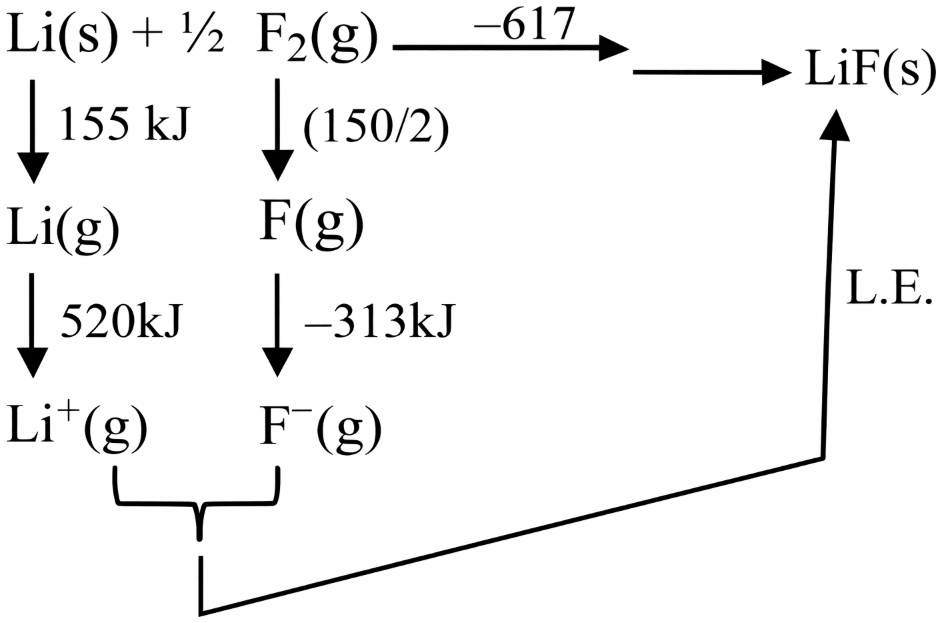
\(-594=155+520+\frac{150}{2}-313+(\) L.E. \()\)
L.E. \(=-1031 kJ / mol\) -
- (A) \(\frac{hc}{1000}(\frac{y-6x}{4})^{-1}\)
- (B) \(\frac{N_{A}hc}{250(4y-6x)}\)
- (C) \(\frac{N_{A}hc}{250(y-6x)}\)
- (D) \(N_{A}hc(y-\frac{6x}{4})^{-1}\)
Show answer and solution
Correct Answer: (B)
\(CH _4(g) \rightarrow C ( g )+4 H ( g ) ; \quad \Delta_{ r } H = x kJ / mole\)
\(C _2 H _6(g) \rightarrow 2 C ( g )+6 H ( g ) ; \Delta_{ r } H = y kJ / mole\)
\(1000 x =4 \times \varepsilon_{ C - H }\)
\(1000 y =1 \times \varepsilon_{ C - C }+6 \times \varepsilon_{ C - H }\)
\(\varepsilon_{ C - C }=\left[ y -\frac{3 x }{2}\right] \times 1000=\frac{ hc }{\lambda} \cdot N _{ A }\)
\(\left(' \lambda^{\prime}\right)\) wavelength of photon \(=\frac{ hc N _{ A }}{[4 y -6 x ] \times 250}\) -
- (A) \(x+y \mathrm{kcal}\)
- (B) \(y-2 x \mathrm{kcal}\)
- (C) \(\frac{2 x}{y} \mathrm{kcal}\)
- (D) \(2 x+y \mathrm{kcal}\)
Show answer and solution
Correct Answer: (B)
(i) \(\mathrm{S}(\mathrm{g})+\frac{3}{2} \mathrm{O}_2(\mathrm{~g}) \rightarrow \mathrm{SO}_3(\mathrm{~g})+2 x\) kcal \(\Delta \mathrm{H}_1\)
(ii) \(\mathrm{SO}_2(\mathrm{~g})+\frac{1}{2} \mathrm{O}_2(\mathrm{~g}) \rightarrow \mathrm{SO}_3(\mathrm{~g})+y\) kcal \(\Delta \mathrm{H}_2\)
(i) - (ii)
\(\begin{aligned}
& \mathrm{S}(\mathrm{~g})+\mathrm{O}_2(\mathrm{~g}) \rightarrow \mathrm{SO}_2(\mathrm{~g}) \Delta \mathrm{H} \\
& \Delta \mathrm{H}=\Delta \mathrm{H}_1-\Delta \mathrm{H}_2 \\
& =-2 x-(-y)=(y-2 x) \mathrm{kcal}
\end{aligned}\) -
- (A) \(\mathrm{ED}\gt\mathrm{EC}\gt\mathrm{EB}\gt\mathrm{EA}\)
- (B) \(\mathrm{EA}\gt\mathrm{EB}\gt\mathrm{EC}\gt\mathrm{ED}\)
- (C) \(\mathrm{EB}\gt\mathrm{EA}\gt\mathrm{EC}\gt\mathrm{ED}\)
- (D) \(\mathrm{ED}\gt\mathrm{EC}\gt\mathrm{EA}\gt\mathrm{EB}\)
Show answer and solution
Correct Answer: (C)
The element having high value of Electron gain enthalpy (magnitude) will form a compound having higher ionic character so order of ionic character
\(E B>E A>E C>E D\) -
- (A) 140
- (B) 147
- (C) 138
- (D) 146
Show answer and solution
Correct Answer: (C)
\(\begin{aligned}
& \mathrm{C}_4 \mathrm{H}_{10}+\frac{13}{2} \mathrm{O}_2 \rightarrow 4 \mathrm{CO}_2+5 \mathrm{H}_2 \mathrm{O} \\
& 3 \times 10^3 \quad 10 \times 10^3
\end{aligned}\)
Moles of \(\mathrm{H}_2 \mathrm{O}\) formed \(=\mathrm{n}_{\mathrm{H}_2 \mathrm{O}}=5 \times \frac{2}{13} \times 10 \times 10^3\)
Then \(\mathrm{w}_{\mathrm{H}_2 \mathrm{O}}=\frac{10^5}{13} \times 18\)
\(=1.3846 \times 10^5 \mathrm{~g}\)
Volume of \(\mathrm{H}_2 \mathrm{O}\) will be \(=138.46\) litre.
Ans. 138 -
- (A) 90
- (B) 100
- (C) 95
- (D) 97
Show answer and solution
Correct Answer: (C)
\(\begin{aligned} & 2 \mathrm{C}_{\text {(graphite) }}+3 \mathrm{H}_2(\mathrm{~g}) \rightarrow \mathrm{C}_2 \mathrm{H}_6(\mathrm{~g}) \quad \Delta \mathrm{H}_{\mathrm{f}}=? \\ & \mathrm{C}_2 \mathrm{H}_6(\mathrm{~g})+\frac{7}{2} \mathrm{O}_2(\mathrm{~g}) \rightarrow 2 \mathrm{CO}_2(\mathrm{~g})+3 \mathrm{H}_2 \mathrm{O}(l) \\ & \quad \Delta \mathrm{H}_1=-1550 \\ & \mathrm{C}_{\text {(graphite) }}+\mathrm{O}_2(\mathrm{~g}) \rightarrow \mathrm{CO}_2(\mathrm{~g}) \Delta \mathrm{H}_2=-393.5 \\ & \mathrm{H}_2(\mathrm{~g})+\frac{1}{2} \mathrm{O}_2(\mathrm{~g}) \rightarrow \mathrm{H}_2 \mathrm{O}(/) \Delta \mathrm{H}_3=-286 \\ & \Delta \mathrm{H}_{\mathrm{f}}=2 \Delta \mathrm{H}_2+3 \Delta \mathrm{H}_3-\Delta \mathrm{H}_1 \\ & \quad=95 \mathrm{~kJ} / \mathrm{mole}^2\end{aligned}\) -
- (A) 46
- (B) 47
- (C) 48
- (D) 49
Show answer and solution
Correct Answer: (C)
\(\begin{aligned} & \Delta \mathrm{H}_{\mathrm{f}}\left[\mathrm{CO}_2(\mathrm{~g})\right]=-393.5 \mathrm{~kJ} / \mathrm{mole} \\ & \Delta \mathrm{H}_{\mathrm{f}}\left[\mathrm{H}_2 \mathrm{O}(\ell)\right]=-286.0 \mathrm{~kJ} / \mathrm{mole} \\ & \Delta \mathrm{H}_{\mathrm{c}}\left[\mathrm{C}_6 \mathrm{H}_6\right]=-3267.0 \mathrm{~kJ} / \mathrm{mole} \\ & \Delta \mathrm{H}_{\mathrm{f}} \mathrm{C}_6 \mathrm{H}_6=(?) \\ & \mathrm{C}_6 \mathrm{H}_6+\frac{15}{2} \mathrm{O}_2(\mathrm{~g}) \longrightarrow 6 \mathrm{CO}_2(\mathrm{~g})+3 \mathrm{H}_2 \mathrm{O}(\ell) \\ & \Delta \mathrm{H}_{\mathrm{R}}=\Delta \mathrm{H}_{\mathrm{C}}=\Sigma \Delta \mathrm{H}_{\mathrm{f}}(\mathrm{P})-\Sigma \Delta \mathrm{H}_{\mathrm{f}}(\mathrm{R}) \\ & -3267=6 \times(-393.5)+3(-286)-\Delta \mathrm{H}_{\mathrm{f}}\left(\mathrm{C}_6 \mathrm{H}_6\right) \\ & \Delta \mathrm{H}_{\mathrm{f}}\left(\mathrm{C}_6 \mathrm{H}_6\right)=48 \mathrm{~kJ} / \mathrm{mole}\end{aligned}\) -
- (A) Dissolution of gas in water is an endothermic process
- (B) The heat of solution depends on the amount of solvent.
- (C) The heat of dilution for the \(\mathrm{HCl}\left(\mathrm{HCl} \cdot 10 \mathrm{H}_2 \mathrm{O}\right.\) to \(\left.\mathrm{HCl}.40 \mathrm{H}_2 \mathrm{O}\right)\) is \(3.78 \mathrm{~kJ} \mathrm{~mol}^{-1}\).
- (D) The heat of formation of HCl solution is represented by both (a) and (b)
Show answer and solution
Correct Answer: (B)
From the given information
\(\Delta \mathrm{H}\) is negative so it means dissolution of gas \(\mathrm{HCl}(\mathrm{g})\) is exothermic.
\(\mathrm{HCl}(\mathrm{g})+10 \mathrm{H}_2 \mathrm{O}(\mathrm{l}) \rightarrow \mathrm{HCl}.10 \mathrm{H}_2 \mathrm{O}\) ...(1)
\(\Delta \mathrm{H}_1=-69.01 \frac{\mathrm{~kJ}}{\mathrm{~mol}}\)
\(\mathrm{HCl}(\mathrm{g})+40 \mathrm{H}_2 \mathrm{O}(\mathrm{l}) \rightarrow \mathrm{HCl}.40 \mathrm{H}_2 \mathrm{O}\) ...(2)
\(\Delta \mathrm{H}_2=-72.79 \frac{\mathrm{~kJ}}{\mathrm{~mol}}\)
Hence heat of solution depends upon amount of solvent
By equation..(2) - equation
\(\mathrm{HCl}.10 \mathrm{H}_2 \mathrm{O}+30 \mathrm{H}_2 \mathrm{O}(\ell) \rightarrow \mathrm{HCl} \cdot 40 \mathrm{H}_2 \mathrm{O}\)
So Heat of dilution \(=-72.79-(-69.01)\)
\(=-3.78 \frac{\mathrm{~kJ}}{\mathrm{~mol}}\)
Hence option (3) is incorrect.
For heat of formation reactant should be in elemental form hence option (4) is incorrect -
- (A) 30
- (B) 35
- (C) 20
- (D) 25
Show answer and solution
Correct Answer: (D)
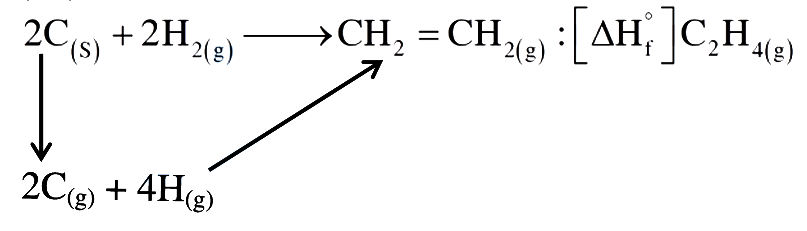
\(\left[\Delta H _{ f }^{ o }\right]_{ C _2 H _{(4)}}=2 \times\left[\Delta H _{ sub }^{ o }\right]_{ C _{( s )}}+2 \times \Delta H _{ H - H }^{ o }\) \(-1 \times \Delta H _{ C = C }^{ o }-4 \times \Delta H _{ CH }^{ o }\)
\(\Rightarrow\left[\Delta H _{ f }^{ o }\right]_{ C _2 H _{4(g)}}=(2 \times 710)+(2 \times 436)\) \(-611-4 \times 414\)
\(\Rightarrow {\left[\Delta \mathrm{H}_{\mathrm{f}}^{\mathrm{o}}\right]_{\mathrm{C}_2 \mathrm{H}_{4(\mathrm{~g})}}=25 \mathrm{~kJ} / \mathrm{mol} }\) -
- (A) 800
- (B) 900
- (C) 1000
- (D) 700
Show answer and solution
Correct Answer: (D)
\(\begin{aligned} & \frac{1}{2} \mathrm{X}_2+\frac{5}{2} \mathrm{Y}_2 \rightleftharpoons \mathrm{XY}_5 \\ & \Delta \mathrm{~S}_{\mathrm{Rxn}}^0=110-\left[\left(\frac{1}{2} \times 70\right)+\left(\frac{5}{2} \times 50\right)\right] \\ & =110-160=-50 \mathrm{JK}^{-1} \mathrm{~mol}^{-1} \\ & \Delta \mathrm{G}^0=0 \text { at eqb } \\ & \Delta \mathrm{G}^0=\Delta \mathrm{H}^0-\mathrm{T} \Delta \mathrm{S}^0 \\ & 0=-35000-\mathrm{T}(-50) \\ & \mathrm{T}=700 \mathrm{Kelvin}\end{aligned}\) -
- (A) 250
- (B) 100
- (C) 200
- (D) 105
Show answer and solution
Correct Answer: (C)
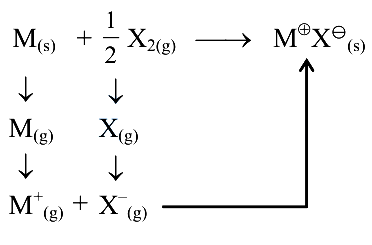
\(\therefore \Delta \mathrm{H}_{\mathrm{f}}(\mathrm{MX})= \)
\( \Delta \mathrm{H}_{\text {sub }}(\mathrm{M})+\text { I.E. }(\mathrm{M})+\frac{1}{2}[\text { B.E. }(\mathrm{X}-\mathrm{X})] +\mathrm{EG}(\mathrm{X})+\text { L.E. }(\mathrm{MX})\)
\( -400=(100)+(500)+\frac{1}{2}(\text { B.E. })+(-300)+(-800)\)
\(\therefore \text { B.E. }=200 \mathrm{~kJ} \mathrm{~mole}^{-1}\) -
- (A) The term 'standard state' implies that the temperature is \(0^{\circ} \mathrm{C}\)
- (B) The standard state of pure gas is the pure gas at a pressure of 1 bar and temperature 273 K
- (C) \(\Delta_{\mathrm{f}} \mathrm{H}_{298}^\theta\) is zero for \(\mathrm{O}(\mathrm{g})\)
- (D) \(\Delta_{\mathrm{f}} \mathrm{H}_{500}^\theta\) is zero for \(\mathrm{O}_2(\mathrm{~g})\)
Show answer and solution
Correct Answer: (D)
For standard state \(\Rightarrow\) pressure \(=1\) bar and temperature is specified only
\(\Rightarrow\left(\Delta \mathrm{H}_{\mathrm{f}}^{\mathrm{o}}\right)_{\mathrm{O}_{2,(\mathrm{~g})}}=0\) -
- (A) 460
- (B) 466
- (C) 450
- (D) 444
Show answer and solution
Correct Answer: (B)
\(\begin{aligned} & \frac{1}{2} \mathrm{H}_{2(\mathrm{~g})} \rightarrow \mathrm{H}(\mathrm{g}) \quad ; \quad \Delta_{\mathrm{f}} \mathrm{H}\left(\mathrm{H}_{(\mathrm{g})}\right)=220 \mathrm{KJ} / \mathrm{mol} \\ & \frac{1}{2} \mathrm{O}_{2(\mathrm{~g})} \rightarrow \mathrm{O}(\mathrm{g}) \quad ; \quad \Delta_{\mathrm{f}} \mathrm{H}\left(\mathrm{O}_{(\mathrm{g})}\right)=250 \mathrm{KJ} / \mathrm{mol}\end{aligned}\)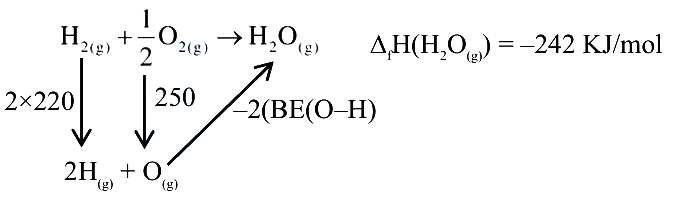
\(\begin{aligned} & \Delta \mathrm{H}_{\mathrm{f}}\left(\mathrm{H}_2 \mathrm{O}_{(\mathrm{l})}\right)=-242=440+250-2(\mathrm{~B} . \mathrm{E} .(\mathrm{O}-\mathrm{H})) \\ & \mathrm{BE}(\mathrm{O}-\mathrm{H})=466 \mathrm{KJ} / \mathrm{mol}\end{aligned}\) -
- (A) \(+x-y-z\)
- (B) \(x+y+z\)
- (C) \(z-(x+y)\)
- (D) \(-\mathrm{z}-(\mathrm{x}+\mathrm{y})\)
Show answer and solution
Correct Answer: (C)
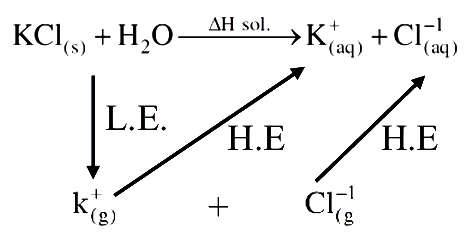
\(\begin{aligned} \Delta \mathrm{H}_{\text {Sol}^{\mathrm{n}}.} & =\mathrm{L} \cdot \mathrm{E} \cdot+(\mathrm{H} \cdot \mathrm{E})_{\mathrm{K}_{(\mathrm{g})}^{+}}+(\mathrm{HE})_{\mathrm{Cl}_{(\mathrm{g})}^{-1}} \\ & =\mathrm{Z}-\mathrm{x}-\mathrm{y} \\ & =\mathrm{z}-(\mathrm{x}+\mathrm{y})\end{aligned}\) -
- (A) \(-x-10 y-10 z\)
- (B) \(-10(100 x+y+z)\)
- (C) \(10(100 x+y+z)\)
- (D) \(x-10 y-10 z\)
Show answer and solution
Correct Answer: (B)
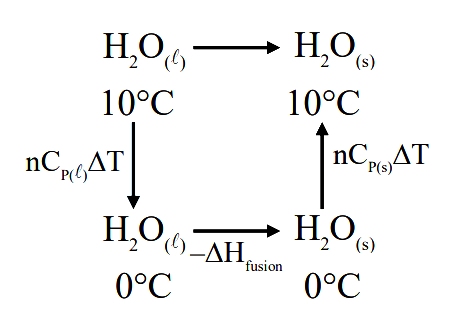
\(\begin{aligned} & \Delta H=1 \times y(0-10)-x \times 1000+1 \times z\left(-10^{\circ}-0^{\circ}\right) \\ & \Delta H=-10(100 x+y+z) \text { Joule. }\end{aligned}\) -
- (A) \(6535\)
- (B) \(6540\)
- (C) \(6545\)
- (D) \(6550\)
Show answer and solution
Correct Answer: (A)
\(6 \mathrm{C} \text { (graphite) }+3 \mathrm{H}_2(\mathrm{~g}) \rightarrow \mathrm{C}_6 \mathrm{H}_6(\ell) ; \Delta \mathrm{H}=48.5 \mathrm{~kJ} / \mathrm{mol}\)\(\mathrm{C} \text { (graphite) }+\mathrm{O}_2(\mathrm{~g}) \rightarrow \mathrm{CO}_2(\mathrm{~g}) ; \Delta \mathrm{H}=-393.5 \mathrm{~kJ} / \mathrm{mol}\)
\(\mathrm{H}_2^{(\mathrm{g})}+\frac{1}{2}(\mathrm{~g}) \longrightarrow \mathrm{H}_2 \mathrm{O}(\ell) ; \Delta \mathrm{H}=-286 \mathrm{~kJ} / \mathrm{mol}\)
\(\text { equation }-(1) \times 1+(2) \times 6+(3) \times 3\)
\(-48.5-6 \times 393.5-3 \times 286\)
\(=-3267.5 \mathrm{~kJ} \text { for } 1 \mathrm{~mol}\)
\(=-6535 \mathrm{~kJ} \text { for } 2 \mathrm{~mol}\)
Ans. \(6535 \mathrm{~kJ}\)
-
- (A) (\(A\)) is true but (\(R\)) is false
- (B) Both (\(A\)) and (\(R\)) are true and (\(R\)) is the correct explanation of (\(A\))
- (C) (\(A\)) is false but (\(R\)) is true
- (D) Both (\(A\)) and (\(R\)) are true but (\(R\)) is not the correct explanation of (\(A\))
Show answer and solution
Correct Answer: (B)
Enthalpy of neutralization of \(SA \)& \(SB\) is always \(-57 \mathrm{~kJ} / \mathrm{mol}\) because strong monoacid gives one mole of \(\mathrm{H}^{+}\)and strong mono base gives one mole of \(\mathrm{OH}^{-}\)which form one mole of water. -
- (A) \(78\)
- (B) \(12\)
- (C) \(46\)
- (D) \(56\)
Show answer and solution
Correct Answer: (D)
\( \Delta \mathrm{H}_{\text {vap }}^0 \mathrm{CCl}_4=30.5 \mathrm{~kJ} / \mathrm{mol} \)\( \text { Mass of } \mathrm{CCl}_4=284 \mathrm{gm} \)
\( \text { Molar mass of } \mathrm{CCl}_4=154 \mathrm{~g} / \mathrm{mol} \)
\( \text { Moles of } \mathrm{CCl}_4=\frac{284}{154}=1.844 \mathrm{~mol} \)
\( \Delta \mathrm{H}_{\text {vap }}{ }^{\circ} \text { for } 1 \mathrm{~mole}=30.5 \mathrm{~kJ} / \mathrm{mol} \)
\( \Delta \mathrm{H}_{\text {vap }}{ }^{\circ} \text { for } 1.844 \mathrm{~mol}=30.5 \times 1.844 \)
\( \quad=56.242 \mathrm{~kJ}\)
-
- (A) \(125\)
- (B) \(128\)
- (C) \(130\)
- (D) \(135\)
Show answer and solution
Correct Answer: (A)
\(\mathrm{C}_2 \mathrm{H}_4(\mathrm{~g})+\mathrm{H}_2(\mathrm{~g}) \rightarrow \mathrm{C}_2 \mathrm{H}_6(\mathrm{~g})\)\(\Delta \mathrm{H}=\mathrm{BE}(\mathrm{C}=\mathrm{C})+4 \mathrm{BE}(\mathrm{C}-\mathrm{H})+\mathrm{BE}(\mathrm{H}-\mathrm{H})\)
\(-\mathrm{BE}(\mathrm{C}-\mathrm{C})-6 \mathrm{BE}(\mathrm{C}-\mathrm{H})\)
\(\Delta \mathrm{H}=\mathrm{BE}(\mathrm{C}=\mathrm{C})+\mathrm{BE}(\mathrm{H}-\mathrm{H})-\mathrm{BE}(\mathrm{C}-\mathrm{C})\)
\(-2 \mathrm{BE}(\mathrm{C}-\mathrm{H})\)
\(=615+435-347-2 \times 414\)
\(=-125 \mathrm{~kJ}\)
-
- (A) \(100\)
- (B) \(120\)
- (C) \(150\)
- (D) \(160\)
Show answer and solution
Correct Answer: (C)
\(\mathrm{C}_6 \mathrm{H}_5 \mathrm{COOH}(\mathrm{S})+\frac{15}{2} \mathrm{O}_2(\mathrm{~g}) \rightarrow 7 \mathrm{CO}_2(\mathrm{~g})+3 \mathrm{H}_2 \mathrm{O}(\ell)\)\(\Delta \mathrm{H}=\Delta \mathrm{U}+\Delta \mathrm{n}_g \mathrm{RT}\)
\(=-321.30-\frac{1}{2} \frac{\mathrm{R}}{100} \times 300\)
\(=(-321.30-150 \mathrm{R}) \mathrm{kJ}\)
-
- (A) \(82\)
- (B) \(85\)
- (C) \(89\)
- (D) \(90\)
Show answer and solution
Correct Answer: (A)
\(\text {from (1) (2) }\)
\(-70=x+12\)
\(x=-82\)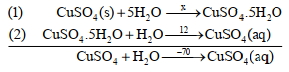
-
- (A) \(38\)
- (B) \(39\)
- (C) \(40\)
- (D) \(45\)
Show answer and solution
Correct Answer: (A)
\(\mathrm{H}_2 \mathrm{O}(\ell) \rightleftharpoons \mathrm{H}_2 \mathrm{O}(\mathrm{g}) \quad \Delta \mathrm{H}_{\text {ap }}^0=40.79 \mathrm{~kJ} / \mathrm{mole}\)\(\Delta \mathrm{H}_{\text {vap }}^0=\Delta \mathrm{U}_{\text {vap }}^0+\Delta \mathrm{n}_{\mathrm{g}} \mathrm{RT}\)
\(40.79=\Delta \mathrm{U}_{\text {vap }}^0+\frac{1 \times 8.3 \times 373.15}{1000}\)
\(\Delta \mathrm{U}_{\text {Tap }}^0=40.79-3.0971\)
\(=37.6929\)
\(\Delta \mathrm{U}_{T \mathrm{ap}}^0 \simeq 38\)
-
- (A) \(2\)
- (B) \(5\)
- (C) \(8\)
- (D) \(9\)
Show answer and solution
Correct Answer: (A)
\(\mathrm{H}^{+}+\mathrm{OH} \rightarrow \mathrm{H}_2 \mathrm{O} \Rightarrow \mathrm{x}\)\(2 \mathrm{H}^{+}+2 \mathrm{OH} \rightarrow 2 \mathrm{H}_2 \mathrm{O} \Rightarrow 2 \mathrm{x}=\mathrm{y}\)
\(\mathrm{y} / \mathrm{x}=2\)
-
- (A) \(600\)
- (B) \(200\)
- (C) \(800\)
- (D) \(500\)
Show answer and solution
Correct Answer: (C)
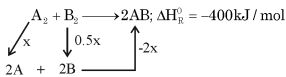
\(A _2+ B _2 \rightarrow 2 AB ; \Delta H _{ r }^0=-200\,kJ\,mol ^{-1}\)\(\Rightarrow \Delta H _{ p }^0( AB )=-200\,kJ\,mol\,m ^{-1}\)
\(\therefore \Delta H _{ R }^0\) for reaction \(A _2+ B _2 \rightarrow 2 AB\) is \(-400\,kJ\,mol ^{-1}\)
Given: Bond Enthalpy of \(A _2, B _2\) and \(AB\) is \(1: 0.5: 1\)
Assuming bond enthalpy of \(A _2\) be \(x\, kJ\, mol { }^{-1}\)
\(\therefore\) Bond enthalpy \(B _2=0.5 \times kJ\, mol ^{-1}\)
\(\therefore\) Bond enthalpy \(AB =( x ) kJ\, mol\, m ^{-1}\)
\(-400= x +0.5 x -2 x\)
\(-400=-0.5 x\)
\(\therefore x =800\,kJ / mol\)
-
- (A) \(180\)
- (B) \(360\)
- (C) \(90\)
- (D) \(45\)
Show answer and solution
Correct Answer: (B)
\(C _6 H _{12} O _6( s )+6 O _2 \rightarrow 6 CO _2( g )+6 H _2 O ( l )\)Extra energy used to convert \(H _2 O (1)\) into \(H _2 O (1)\) into \(H _2 O ( g )\)
\(=\frac{1800}{2}=900\,kJ\)
\(900= n _{ H _2 O } \times 45\)
\(n _{ H _2 O }=\frac{900}{45}=20\,mole\)
\(W _{ H _2 O }=20 \times 18=360\,g\)
-
- (A) \(172\)
- (B) \(174\)
- (C) \(173\)
- (D) \(176\)
Show answer and solution
Correct Answer: (C)
\(\Delta_{ r } H =\sum H _{ p }-\sum H _{ R }\)\(=(-394+4 \times-92)-(-105+(2 \times-242))\)
\(=-173\,kJ / mol\)
-
- (A) \(NaI < NaBr < NaCl < NaF\)
- (B) \(NaF < NaCl < NaBr < NaI\)
- (C) \(NaCl < NaF < NaBr < NaI\)
- (D) \(NaI < NaBr < NaF < NaCl\)
Show answer and solution
Correct Answer: (A)
For a given metal \(\Delta_{ f } H ^0\) always becomes less negative from fluoride to iodide. -
- (A) \(3\)
- (B) \(2\)
- (C) \(5\)
- (D) \(4\)
Show answer and solution
Correct Answer: (D)
\(Fe _2 O _3+2 Al \rightarrow Al _2 O _3+2 Fe\)Molar mass \(160\,g \quad 27\,g\)
\(\left(\Delta H _{ f }^0\right)_{\text {reaction }}=\left[\left(\Delta H _{ f }^0\right)_{ Al _2 O _3}+2\left(\Delta H _{ f }^0\right)_{ Fe }\right]\)
\(- \left[\left(\Delta H _{ f }^0\right)_{ Fe _2 O _3}+2\left(\Delta H _{ f }^0\right)_{ Al }\right]\)\(=[-1700+0]-[-840+0]\)
\(=-860\,kJ / mol\)
\(\text { Total mass of mixture }= Fe _2 O _3+ Al (1: 2 \text { molar }\)
\(\text { ratio })\)
\(=160+2 \times 27\)
\(=214\,g / mol\)
\(\text { Heat evolved per gram }=\frac{860}{214}=4\,kJ / g\)
-
- (A) \(600\)
- (B) \(620\)
- (C) \(630\)
- (D) \(610\)
Show answer and solution
Correct Answer: (D)
\(\frac{1}{2} Cl _{2( g )} \rightarrow Cl _{( g )} \rightarrow Cl _{( g )}^{-} \rightarrow Cl _{( aq .)}^{-}\)\(\Delta H ^{\circ}=\frac{1}{2} \times 240+(-350)+(-380)\)
\(=-610 \text { ans. }\)
- 31. The standard electrode potential of \(M ^{+} / M\) in aqueous solution does not depend on 2023 Medium
- (A) Ionisation of a solid metal atom
- (B) Sublimation of a solid metal
- (C) Ionisation of a gaseous metal atom
- (D) Hydration of a gaseous metal ion
Show answer and solution
Correct Answer: (A)
Factual -
- (A) \(81\)
- (B) \(117\)
- (C) \(453\)
- (D) \(751\)
Show answer and solution
Correct Answer: (B)
Given data is for \(1 \,moles\) and asked for \(5\, moles\) so value is \(23.4 \times 5=117\, kJ\) -
- (A) \(+54.0\, kJ \,mol ^{-1}\)
- (B) \(-68.0 \,kJ \,mol ^{-1}\)
- (C) \(-86.0\, kJ \,mol ^{-1}\)
- (D) \(+97.0\, kJ \,mol ^{-1}\)
Show answer and solution
Correct Answer: (C)
\(C _{2} H _{6}( g )+\frac{7}{2} O _{2}( g ) \rightarrow 2 CO _{2}( g )+3 H _{2} O (\ell)\)\(\Delta_{ C } H \left( C _{2} H _{6}\right)=2 \Delta_{ f } H CO _{2}( g )+3 \Delta_{ f } H \left( H _{2} O , \ell\right)\)
\(-\Delta_{ f } H ^{\prime}\left( C _{2} H _{6}, g \right)\)
\(-1560=2(-394)+3(-286)-\Delta_{ f } H \left( C _{2} H _{6}, g \right)\)
\(\Delta_{ f } H \left( C _{2} H _{6}, g \right)=-86 \,kJ / mole\)
-
- (A) \(+\,324\)
- (B) \(+\,632\)
- (C) \(-\,632\)
- (D) \(-\,324\)
Show answer and solution
Correct Answer: (C)
\(\Delta H =\sum \Delta H _{\text {Combustion }}\) (Reactant) \(-\sum \Delta H _{\text {Combustion }}\) (Product)\(=3 \times(-1300)\,-\,[-3268]\)
\(=-632\, kJ\, mol ^{-1}\)
-
- (A) \(1600\; kJ\)
- (B) \(3200\; kJ\)
- (C) \(4400\; kJ\)
- (D) \(6600\; kJ\)
Show answer and solution
Correct Answer: (D)
\(C ( S )+ O _{2}( g ) \rightarrow CO _{2}( g )+400\; kJ\)\(1\; g \;mole\)
\(C ( s )+\frac{1}{2} O _{2}( g ) \rightarrow CO ( g )+100\; kJ \ldots (II)\)
\(0.6 \times 1000\)
\(=600 \;gm\)
\(600 \times \frac{60}{100}\) (Pure Carbon)
\(=360 \;gm =\frac{360}{12}=30 \;mole\) (Pure Carbon)
Carbon converted into \(CO _{2}=\left(30-30 \times \frac{60}{100}\right)\)
\(=12\; mole\)
and carbon converted in \(CO =30 \times \frac{60}{100}=18\; mole\)
Energy generated during \(II\) equation
\(=18 \times 100\)
\(=1800 \;kJ\)
Energy generated during \(I^{st}\) equation
\(=12 \times 400\)
\(=4800\)
Total \(=1800+4800=6600\; kJ\)
-
- (A) \(105\)
- (B) \(106\)
- (C) \(104\)
- (D) \(103\)
Show answer and solution
Correct Answer: (C)
\(3 C _{( gr )}+4 H _{2( g )} \rightarrow C _{3} H _{8( g )}\)\(=-103.7\,kJ\,mol ^{-1}\)
-
- (A) \(53\)
- (B) \(54\)
- (C) \(55\)
- (D) \(56\)
Show answer and solution
Correct Answer: (B)
\(HNO _{3} \quad NaOH\)\(600 \;mL \times 0.2\; M \quad 400 \;mL \times 0.1 \;M\)
\(=120\; m \;mol \quad=40 \;m\; mol\)
\(HNO _{3}+ NaOH \rightarrow NaNO _{3}+ H _{2} O\)
\(\begin{array}{lccc}\text { Bef. } & 120 & 40 \\ \text { Aft. } & 80 & 0 & 40\; m\; mol\end{array}\)
\(\Delta_{ r } H =40 \;m \;mol \times\left(57 \times 10^{3}\right) \frac{ J }{ mol }\)
\(=40 \times 10^{-3} mol \times 57 \times 10^{3} \frac{ J }{ mol }\)
\(=2280\; J\)
\(m\; S \Delta T =2280\)
\(\Rightarrow 1000\; mL \times \frac{1 gm }{ mL } \times 4,2 \times \Delta T =2280\)
\(\Delta T =\frac{2280}{4.2} \times 10^{-3}\)
\(=\frac{22800}{42} \times 10^{-3}\)
\(=542.86 \times 10^{-3}\)
\(\Delta T =54.286 \times 10^{-2}\; K\)
\(\Delta T =54.286 \times 10^{-20} \;C\)
Ans \(54.286\)
-
- (A) \(5\)
- (B) \(2\)
- (C) \(4\)
- (D) \(3\)
Show answer and solution
Correct Answer: (B)
\(\Delta H _{\text {ionisation }}\) of \(CH _{3} COOH =|-57.3-(-55.3)|\)\(=2\,KJ / mol\)
-
- (A) \(700\)
- (B) \(667\)
- (C) \(845\)
- (D) \(321\)
Show answer and solution
Correct Answer: (B)
\(2700\, \mathrm{~kJ}\) energy requires \(=180\, \mathrm{gm}\)\(10000\, \mathrm{~kg}\) energy requires \(=\frac{180 \times 10000}{2700} \,\mathrm{gm}\)
mass of glucose \(=667\, \mathrm{gm}\)
-
- (A) \(E_{H}=\frac{1}{2} E_{D}\)
- (B) \(E_{H}=E_{D}\)
- (C) \(E_{H}=2 E_{D}\)
- (D) \(E_{H} \simeq E_{D}-7.5\)
Show answer and solution
Correct Answer: (D)
Enthalpy of bond dissociation \((\mathrm{kJ} / \mathrm{mole})\) at \(298.2\, \mathrm{~K}\)For, hydrogen \(=4.35 .88\)
For, Deuterium \(=443.35\)
\(\therefore E_{H}=E_{D}-7.5\)
-
- (A) \(99\)
- (B) \(100\)
- (C) \(101\)
- (D) \(201\)
Show answer and solution
Correct Answer: (C)
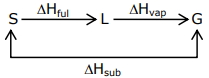
\(\Delta \mathrm{H}_{\text {sub }}=\Delta \mathrm{H}_{\text {fus. }}+\Delta \mathrm{H}_{\text {vap. }}\)\(=2.8+98.2\)
\(=101\, \mathrm{KJ} / \mathrm{mol}\)
-
- (A) \(120\)
- (B) \(132\)
- (C) \(128\)
- (D) \(125\)
Show answer and solution
Correct Answer: (C)
\(\Delta_{ r } H =\left[\epsilon_{ C - C }+2 \epsilon_{ C - H }\right]-\left[\epsilon_{ C = C }+\epsilon_{ H - H }\right]\)\(=[347+2 \times 414]-[611+436]\)
\(=128\)
-
- (A) \(718\)
- (B) \(951\)
- (C) \(632\)
- (D) \(521\)
Show answer and solution
Correct Answer: (A)
\(\Delta_{\mathrm{f}} \mathrm{H}_{\mathrm{KCl}}^{\Theta}=\Delta_{\text {sub }} \mathrm{H}_{(\mathrm{K})}^{\Theta}+\Delta_{\text {ionization }} \mathrm{H}_{(\mathrm{K})}^{\Theta}+\frac{1}{2} \Delta_{\mathrm{bond}} \mathrm{H}_{\left(\mathrm{Cl}_{2}\right)}^{\Theta}\)\(+\Delta_{\text {electron gain }} \mathrm{H}_{(\mathrm{Cl})}^{\ominus}+\Delta_{\text {lattice }} \mathrm{H}_{(\mathrm{KCl})}^{\ominus}\)
\(\Rightarrow-436.7=89.2+419.0+\frac{1}{2}(243.0)+\{-348.6\}\)
\(+\Delta_{\text {lattice }} \mathrm{H}_{(\mathrm{KCl})}^{\ominus}\)
\(\Rightarrow \Delta_{\text {lattice }} \mathrm{H}_{(\mathrm{KCl})}^{\ominus}=-717.8 \mathrm{~kJ}\, \mathrm{~mol}^{-1}\)
The magnitude of lattice enthalpy of \(\mathrm{KCl}\) in \(\mathrm{kJ}\,\mathrm{mol}^{-1}\) is \(718\) (Nearest integer).
-
- (A) \(5581\)
- (B) \(4856\)
- (C) \(5596\)
- (D) \(5576\)
Show answer and solution
Correct Answer: (D)
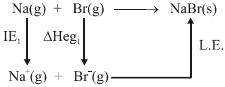
\(\Delta H _{\text {formation }}= IE _{1}+\Delta Heg _{1}+ LE\)\(=495.8+(-325)+(-728.4)\)
\(=-557.6\)
\(=-5576 \times 10^{-1} KJ / mol .\)
Note: The above calculation is not for \(\Delta H _{\text {formation }}\) but for \(\Delta H _{ Reaction}\)
But on the basis of given data it is the best ans.
-
- (A) \(220\)
- (B) \(240\)
- (C) \(230\)
- (D) \(250\)
Show answer and solution
Correct Answer: (C)
Given reaction:\(3 CaO + Al \rightarrow Al _{2} O _{3}+3 Ca\)
Now, \(\Delta_{ r } H ^{\circ}=\Sigma \Delta_{ f } H _{\text {Products }}^{\circ}-\Sigma \Delta_{ f } H _{\text {Reactants }}^{\circ}\)
\(=[1 \times(-1675)+3 \times 0]-[3 \times(-635)+2 \times 0]\)
\(=+230 kJ mol ^{-1}\)
-
- (A) is \(x = y\)
- (B) is \(x < y\)
- (C) does not exist
- (D) is \(x > y\)
Show answer and solution
Correct Answer: (D)
Enthalpy of atomisation of \(\mathrm{Br}_{2}(l)\)\(\mathrm{Br}_{2}(l) \stackrel{\Delta \mathrm{H}_{\mathrm{vap}}}{\longrightarrow} \mathrm{Br}_{2}(\mathrm{g}) \stackrel{\Delta \mathrm{H}_{\mathrm{BE}}}{\longrightarrow} 2 \mathrm{Br}(\underline{\mathrm{g}})\)
\(\Delta \mathrm{H}_{\mathrm{atom}}=\Delta \mathrm{H}_{\mathrm{vap}}+\Delta \mathrm{H}_{\mathrm{BE}}\)
\(\mathrm{x}=\Delta \mathrm{H}_{\mathrm{vap}}+\mathrm{y}\)
So, \(x>y\)
-
- (A) \(-780\)
- (B) \(-784\)
- (C) \(780\)
- (D) \(784\)
Show answer and solution
Correct Answer: (B)
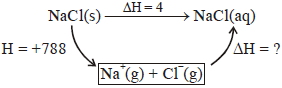
\(4=788+\Delta H\)\(\Delta H =-784 kJ\)
-
- (A) \(189494\)
- (B) \(189480\)
- (C) \(189989\)
- (D) \(189950\)
Show answer and solution
Correct Answer: (A)
\(H _{2} O (\ell) \rightleftharpoons H _{2} O ( g ) \quad 90 gm\) of \(H _{2} O\)\(\Delta H =\Delta U +\Delta n _{ g } RT \quad \Rightarrow 5\) moles of \(H _{2} O\)
\(5 \times 41000 J =\Delta U +1 \times 8.314 \times 373 \times 5\)
\(\Delta U =189494.39\) Joule
-
- (A) \(-172.5\)
- (B) \(-192.5\)
- (C) \(-202.5\)
- (D) \(-162\)
Show answer and solution
Correct Answer: (B)
\(2 \mathrm{C}(\text { graphite })+3 \mathrm{H}_{2}(\mathrm{g}) \longrightarrow \mathrm{C}_{2} \mathrm{H}_{6}(\mathrm{g})\)\(\Delta_{f} \mathrm{H}\left(\mathrm{C}_{2} \mathrm{H}_{6}\right) =2 \Delta \mathrm{H}_{\text {comb }}\left(\mathrm{C}_{\text {parplite }}\right)+3 \Delta \mathrm{H}_{\text {coond }}\left(\mathrm{H}_{2}\right) -\Delta \mathrm{H}_{\text {comb }}\left(\mathrm{C}_{2} \mathrm{H}_{6}\right)\)
\(=-(286 \times 2)-(393.5 \times 3)-(-1560)\)
\(=-572-1180.5+1560=-192.5 \mathrm{kJ} / \mathrm{mol} \mathrm{e}\)
-
- (A) \(-676.5\)
- (B) \(-110\)
- (C) \(110.5\)
- (D) \(676.5\)
Show answer and solution
Correct Answer: (B)
Many enthalpy changes are difficult to measure directly under standard conditions. Hess law states that the total enthalpy change of a reaction is independent of the route taken. To find\(H _{ f }, C _{( s )}+\frac{1}{2} O _{2}( g ) \rightarrow CO ( g )\)
Given:- combustion of carbon
\(C + O _{2} \rightarrow CO _{2}: \Delta H _{1}=-393.5 KJmol\)
combination of carbon monoxide
\(CO +\frac{1}{2} O _{2} \rightarrow CO _{2}: \Delta H _{2}=-283.5 kJ mol ^{-1}\)
Formation of carbon monoxide:
\(\triangle H =\triangle H _{1}-\Delta H _{2}=-393.5-(-283.5)\)
\(=39.3 .5+283.5=-110 kJ / mol\)
No questions on this page match these filters.
Other STD 11 - Thermodynamics and thermochemistry topics
Frequently asked
How many Heat of reaction questions came in JEE Mains?
57 questions from 2013–2026, each with the correct answer and a full solution.
How difficult are Heat of reaction questions?
7% are easy, 61% medium and 32% hard.