


Topics
4 topicsAll P -Block elements - ll questions
Newest firstShowing 1–50 of 160 questions
-
- (A) 1312
- (B) 1086
- (C) 1402
- (D) 801
Show answer and solution
Correct Answer: (C)
Element E is N, the species is \(NH_{4}^{+}\), among B, C, N and O, N has highest first ionization energy. -
- (A) B, C and D Only
- (B) C, D and E Only
- (C) A, C and E Only
- (D) A and E Only
Show answer and solution
Correct Answer: (D)
Statement A is correct. Nitrogen in oxidation states from \(+1\) to \(+4\) tends to disproportionate in acidic medium. For example, \(3HNO_2 \rightarrow HNO_3 + H_2O + 2NO\).
Statement B is incorrect. Nitrogen does not have d-orbitals in its valence shell, so it cannot form \(d\pi - p\pi\) multiple bonds. It forms \(p\pi - p\pi\) multiple bonds.
Statement C is incorrect. The N-N single bond is weaker than the P-P single bond due to high interelectronic repulsion between the non-bonding electrons, which arises from the small N-N bond length.
Statement D is incorrect. Density increases down the group in group 15. Nitrogen is a gas and has the lowest density in its group, while bismuth has the highest.
Statement E is correct. Nitrogen has only four valence orbitals (one 2s and three 2p orbitals) available for bonding. Therefore, its maximum covalency is restricted to four.
Thus, only statements A and E are correct.
Answer: A and E Only -
- (A) N & As
- (B) As & Bi
- (C) Bi & N
- (D) As & Sb
Show answer and solution
Correct Answer: (A)
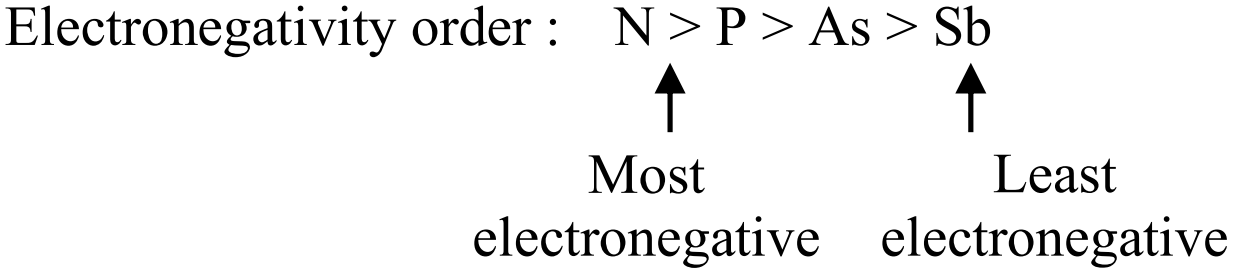
Element EN N 3.0 P 2.1 As 2.0 Sb 1.9 Bi 1.9
X = Nitrogen (N)
Y = Arsenic (As) -
- (A) A and B only
- (B) B and C only
- (C) A, B, C and D
- (D) A, C and D Only
Show answer and solution
Correct Answer: (C)
Statement A: The reducing nature of group 15 hydrides depends on the E-H bond strength. As the size of the central atom increases down the group, the E-H bond dissociation enthalpy decreases. Hence, the reducing character increases from NH\(_3\) to BiH\(_3\). This statement is correct.
Statement B: The basic character or the tendency to donate a lone pair of electrons depends on the electron density on the central atom. As the size of the central atom increases down the group, the electron density decreases. Thus, the basicity decreases from NH\(_3\) to BiH\(_3\). This statement is correct.
Statement C: Due to the decrease in E-H bond dissociation enthalpy down the group, the thermal stability of the hydrides decreases from NH\(_3\) to BiH\(_3\). This statement is correct.
Statement D: The H-E-H bond angle decreases down the group because the electronegativity of the central atom decreases and the size increases, causing the bond pairs to move further away from the central atom. This decreases the bond pair-bond pair repulsion. The bond angles are NH\(_3\) (\(107.8^{\circ}\)), PH\(_3\) (\(93.6^{\circ}\)), AsH\(_3\) (\(91.8^{\circ}\)), and SbH\(_3\) (\(91.3^{\circ}\)). This statement is correct.
All statements A, B, C, and D are correct.
Answer: A, B, C and D -
- (A) Both Statement-I and Statement-II are true.
- (B) Statement-I is true but Statement-II is false.
- (C) Both Statement-I and Statement-II are false.
- (D) Statement-I is false but Statement-II is true.
Show answer and solution
Correct Answer: (B)
\(X = N \quad X _2 O _3= N _2 O _3(\text { Acidic })\)
\(Y = Sb \quad Y _2 O _3= Sb _2 O _3(\text { Amphoteric })\)
Statement-I is true.
\(BCl_{3} + 3H_{2}O \rightarrow B(OH)_{3} + 3HCl\).
Statement-II is false. -
- (A) Statement I is true but Statement II is false
- (B) Both Statement I and Statement II are true
- (C) Statement I is false but Statement II is true
- (D) Both Statement I and Statement II are false
Show answer and solution
Correct Answer: (A)
Statement I :
Bond energy order is \(Cl _2> Br _2> F _2> I _2\)
Bond energy increases with increase in bond order.
Statement-II
Correct order of covalent character
According to the Fajan's rule, higher the charge on cation, greater is the covalent character.
\(PbCl _2< PbCl _4\)
\(UF _6> UF _4\),
\(SnCl _4> SnCl _2\) -
- (A) Both Statement I and Statement II are true
- (B) Both Statement I and Statement II are false
- (C) Statement I is true but Statement II is false
- (D) Statement I is false but Statement II is true
Show answer and solution
Correct Answer: (A)
Statement I: The electronic configuration of oxygen is \(1s^{2} 2s^{2} 2p^{4}\). Due to the absence of d-orbitals, its maximum covalency is limited to four (using one 2s and three 2p orbitals). Its covalency is generally two, but it can exceed two and go up to four in certain compounds. In \(SO_2\), oxygen is more electronegative than sulphur, so its oxidation state is \(-2\). In \(OF_2\), fluorine is more electronegative than oxygen, so the oxidation state of oxygen is \(+2\). Thus, Statement I is true.
Statement II: Oxygen differs from the rest of the group 16 elements due to its small atomic size, high electronegativity, and the absence of d-orbitals in its valence shell. This leads to its anomalous behaviour, such as the ability to form strong hydrogen bonds and \(p\pi-p\pi\) multiple bonds. Thus, Statement II is true.
Both Statement I and Statement II are true.
Answer: Both Statement I and Statement II are true -
- (A) Both Statement I and Statement II are true.
- (B) Statement I is false but Statement II is true.
- (C) Both Statement I and Statement II are false.
- (D) Statement I is true but Statement II is false.
Show answer and solution
Correct Answer: (C)
\(HF < HCl < HBr < HI\) (bond length order)
\(F < Cl < Br < I\) (radius order)
\(PH _3< AsH _3< NH _3< SbH _3< BiH _3\) (Boiling point order)
Maximum possible covalency of phosphorous is 6 -
- (A) Both Statement I and Statement II are true
- (B) Statement I is true but Statement II is false
- (C) Both Statement I and Statement II are false
- (D) Statement I is false but Statement II is true
Show answer and solution
Correct Answer: (A)
Correct order of
(i) Boiling point: \(HF > HI > HBr > HCl\)
(ii) Melting point: \(HI > HF > HBr > HCl\) -
- (A) A, B & C only
- (B) A & D only
- (C) A, B, C & D
- (D) B & C only
Show answer and solution
Correct Answer: (A)
Stability: \( NH_{3}>PH_{3}>AsH_{3}>SbH_{3}>BiH_{3} \)
Basicity: \( NH_{3}>PH_{3}>AsH_{3}>SbH_{3}>BiH_{3} \)
Reducing character : \(NH _3< PH _3< AsH _3< SbH _3< BiH _3\)
Boiling point: \(PH _3< AsH _3< NH _3< SbH _3< BiH _3\) -
- (A) 10
- (B) 15
- (C) 20
- (D) 25
Show answer and solution
Correct Answer: (B)
Phosphorus belongs to \(15^{\text {th }}\) group and forms \(\mathrm{d} \pi-\mathrm{d} \pi\) bond with transition metal and \(\mathrm{PH}_3\) is strongest base among the other group members except \(\mathrm{NH}_3\). -
- (A) Statement I is true but Statement II is false
- (B) Both Statement I and Statement II are false
- (C) Statement I is false but Statement II is true
- (D) Both Statement I and Statement II are true
Show answer and solution
Correct Answer: (D)
In oxide of nitrogen it can achieve +5 oxidation state because it can form \(\mathrm{p} \pi-\mathrm{p} \pi\) bond with oxygen e.g. \(\mathrm{N}_2 \mathrm{O}_5\)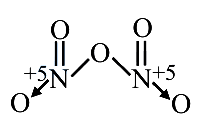
Nitrogen cannot form halide in +5 oxidation state because it does not contain d-orbital.
e.g. \(\mathrm{NX}_5\) does not exist
\(\mathrm{X}=\text { halide }\) -
- (A) Statement I is true but statement II is false
- (B) Both statement I and statement II are false
- (C) Statement I is false but statement II is true
- (D) Both statement I and statement II are true
Show answer and solution
Correct Answer: (B)
\(\ddot{\mathrm{N}}-\ddot{\mathrm{N}}\) single bond weaker than \(\ddot{\mathrm{P}}-\ddot{\mathrm{P}}\) due to more \(\ell \mathrm{p}-\ell \mathrm{p}\) repulsion.
Bond length \(\Rightarrow d_{p-p} \gt d_{N-N}(\operatorname{size} \uparrow\), B.L. \(\uparrow)\)
In group 15 elements only N & P show disproportionation in +3 oxidation state, As, Sb & Bi have almost inert for disproportionation in +3 oxidation state.
So both statements are false. -
- (A) A-IV, B-I, C-II, D-III
- (B) A-IV, B-III, C-I, D-II
- (C) A-III, B-I, C-IV, D-II
- (D) A-II, B-III, C-IV, D-I
Show answer and solution
Correct Answer: (B)
(A) Pnictogen \(\Rightarrow\) Mc (Moscovium),
Atomic No. \(=115\)
(B) Chalcogen \(\Rightarrow \mathrm{Lv}\) (Livermorium),
Atomic No. \(=116\)
(C) Halogen \(\Rightarrow \mathrm{Ts}\) (Tennessine),
Atomic No. \(=117\)
(D) Noble gas \(\Rightarrow \mathrm{Og}\) (Oganesson),
Atomic No. \(=118\) -
- (A) \(\mathrm{PH}_3\) shows lower proton affinity than \(\mathrm{NH}_3\).
- (B) \(\mathrm{SO}_2\) can act as an oxidizing agent, but not as a reducing agent.
- (C) \(\mathrm{PF}_3\) exists but \(\mathrm{NF}_5\) does not.
- (D) \(\mathrm{NO}_2\) can dimerise easily.
Show answer and solution
Correct Answer: (B)
\(\stackrel{+4}{\mathrm{SO}_2}\) can acts as both oxidising agent as well reducing agents because due to intermediate oxidation state, it can oxidise and reduce as well. - 16. The large difference between the melting and boiling points of oxygen and sulphur may be explained on the basis of _______. 2025 Easy
- (A) Atomicity
- (B) Electron gain enthalpy
- (C) Electronegativity
- (D) Atomic size
Show answer and solution
Correct Answer: (A)
The large difference in the melting and boiling points of oxygen and sulphur is due to atomicity as oxygen exists as \(\mathrm{O}_2\) and sulphur exists as \(\mathrm{S}_8\). - 17. The maximum covalency of a non-metallic group 15 element ' E ' with weakest \(\mathrm{E}-\mathrm{E}\) bond is _______. 2025 Easy
- (A) 4
- (B) 6
- (C) 3
- (D) 5
Show answer and solution
Correct Answer: (A)
\(\mathrm{N}-\mathrm{N} < \mathrm{P}-\mathrm{P}\) : single \((\sigma)\) bond strength
Due to L.P.-L.P. replusion and maximum possible covalency of nitrogen is 4 . -
- (A) Oxidising and acidic
- (B) Reducing and basic
- (C) Reducing and acidic
- (D) Oxidising and basic
Show answer and solution
Correct Answer: (A)
\(\mathrm{TeO}_2\) is oxidizing in nature because it can be reduced from +4 oxidation state to lower oxidation state.
\(\mathrm{TeH}_2\) due to less bond dissociation energy easily breaks and hence acidic in nature. -
- (A) B and D only
- (B) A and C only
- (C) B only
- (D) A, B, C and D
Show answer and solution
Correct Answer: (C)
The order of first four elements of group-17 are as follows.
\(\mathrm{F} \lt \mathrm{Cl} \lt \mathrm{Br} \lt \mathrm{I}\) (Covalent radius)
\(\mathrm{Cl} \gt \mathrm{F} \gt \mathrm{Br} \gt \mathrm{I}\) (Electron affinity)
\(\mathrm{F}^{-} \lt \mathrm{Cl}^{-} \lt \mathrm{Br}^{-} \lt \mathrm{I}^{-}\)(Ionic radius)
\(\mathrm{F} \gt \mathrm{Cl} \gt \mathrm{Br} \gt \mathrm{I}\left(\mathrm{I}^{\text {st }}\right.\) ionization energy)
Electron affinity order is irregular. - 20. Among the following halogens \(\mathrm{F}_2, \mathrm{Cl}_2, \mathrm{Br}_2\) and \(\mathrm{I}_2\) Which can undergo disproportionation reaction? 2024 Medium
- (A) Only \(I_2\)
- (B) \(\mathrm{Cl}_2, \mathrm{Br}_2\) and \(\mathrm{I}_2\)
- (C) \(\mathrm{F}_2, \mathrm{Cl}_2\) and \(\mathrm{Br}_2\)
- (D) \(\mathrm{F}_2\) and \(\mathrm{Cl}_2\)
Show answer and solution
Correct Answer: (B)
\(F_2\) do not disproportionate because fluorine do not exist in positive oxidation state however \(\mathrm{Cl}_2, \mathrm{Br}_2 \& \mathrm{I}_2\) undergoes disproportionation. -
- (A) \(2\)
- (B) \(6\)
- (C) \(4\)
- (D) \(3\)
Show answer and solution
Correct Answer: (D)
Acidic oxide: \(\mathrm{Cl}_2 \mathrm{O}_7, \mathrm{SiO}_2, \mathrm{~N}_2 \mathrm{O}_5\)Neutral oxide: \(\mathrm{CO}, \mathrm{NO}, \mathrm{N}_2 \mathrm{O}\)
Amphoteric oxide: \(\mathrm{Al}_2 \mathrm{O}_3, \mathrm{SnO}_2, \mathrm{PbO}_2\)
-
- (A) Large size and high electronegativity
- (B) Small size and low electronegativity
- (C) Small size and high electronegativity
- (D) Large size and low electronegativity
Show answer and solution
Correct Answer: (C)
Fact Based. -
- (A) Both \(A\) and \(R\) are true, but \(R\) is not the correct explanation of \(A.\)
- (B) Both \(A\) and \(R\) are true, and \(R\) is the correct explanation of \(A.\)
- (C) \(A\) is false, but \(R\) is true.
- (D) \(A \) is true, but \(R\) is false
Show answer and solution
Correct Answer: (B)
Due to lower Bond dissociation enthalpy of \(\mathrm{H}_2 \mathrm{Te}\) it ionizes to give \(\mathrm{H}^{+}\)more easily than \(\mathrm{H}_2 \mathrm{S}\). -
- (A) \(B\) and \(C\) only
- (B) \(C\) and \(D\) only
- (C) \(A\) and \(B\) only
- (D) \(A \)and \(D\) only
Show answer and solution
Correct Answer: (C)
On moving down the group, bond strength of \(\mathrm{M}-\mathrm{H}\) bond decreases, which reduces the thermal stability but increases reducing nature of hydrides, hence \(A\) and \(B\) are correct statements. -
- (A) \(A \) and \(D\) only
- (B) \(B\) and \(C\) only
- (C) \(C\) and \(D\) only
- (D) \(A \) and \(B\) only
Show answer and solution
Correct Answer: (D)
(A) All group \(16\) elements form oxides of the \(\mathrm{EO}_2\) and \(\mathrm{EO}_3\) type where \(\mathrm{E}=\mathrm{S}, \mathrm{Se}, \mathrm{Te}\) or \(\mathrm{Po}\).
(B) \(\mathrm{SO}_2\) is reducing while \(\mathrm{TeO}_2\) is an oxidising agent.
(C) The reducing property increases from \(\mathrm{H}_2 \mathrm{~S}\) to \(\mathrm{H}_2\) Tedown the group.
-
- (A) Statement \(I\) is false but Statement \(II\) is true.
- (B) Both Statement \(I\) and Statement \(II\) are true.
- (C) Statement \(I\) is true but Statement \(II\) is false.
- (D) Both Statement \(I\) and Statement \(II\) are false.
Show answer and solution
Correct Answer: (D)
Statement \(I\) and \(II\) are False Noble gases have low boiling pointsNoble gases are held together by weak dispersion forces. -
- (A) \((A)\) is false but \((R)\) is true
- (B) Both \((A)\) and \((R)\) are true but \((R)\) is not the correct explanation of \((\mathrm{A})\)
- (C) \((A)\) is true but \((R)\) is false
- (D) Both \((A)\) and \((R)\) are true and \((R)\) is the correct explanation of \((A)\)
Show answer and solution
Correct Answer: (B)
According to \(NCERT\),Statement-\(I\) : Factual data,
Statement-\(II\) is true.
But correct explanation is presence of completely filled \(d\) and f-orbitals of heavier members.
-
- (A) Both \((A)\) and \((R)\) are correct and \((R)\) is not the correct explanation of \((A)\)
- (B) \((A)\) is not correct but \((R)\) is correct
- (C) Both \((A)\) and \((R)\) are correct but \((R)\) is the correct explanation of \((A)\)
- (D) \((A)\) is correct but \((R)\) is not correct
Show answer and solution
Correct Answer: (D)
Unlike \(\mathrm{NH}_3, \mathrm{PH}_3\) molecules are not associated through hydrogen bonding in liquid state. That is why the boiling point of \(\mathrm{PH}_3\) is lower than \(\mathrm{NH}_3\). -
- (A) Both \((A)\) and \((R)\) are correct and \((R)\) is the correct explanation of \((A)\).
- (B) Both \((A)\) and \((R)\) are correct but \((R)\) is not the correct explanation of \((A)\).
- (C) \((A)\) is correct but \((R)\) is not correct.
- (D) \((A)\) is not correct but \((R)\) is correct.
Show answer and solution
Correct Answer: (C)
Oxygen can form \(2 \mathrm{p} \pi-2 \mathrm{p} \pi\) multiple bond with itself due to its small size while sulphur cannot form multiple bond with itself as \(3 \mathrm{p} \pi-3 \mathrm{p} \pi\) bond will be unstable due to large size of sulphur, but sulphur can form multiple bond with small size atom like \(\mathrm{C}\) and \(\mathrm{N}\).\(\text { eg. } \mathrm{S}=\mathrm{C}=\mathrm{S}\)
\(\mathrm{S}=\mathrm{C}=\mathrm{N} \leftrightarrow \mathrm{S}^{\odot}-\mathrm{C} \equiv{N}\)
-
- (A) Statement \(I\) is correct but Statement \(II\) is incorrect
- (B) Both Statement \(I\) and Statement \(II\) are correct
- (C) Both Statement \(I\) and Statement \(II\) are incorrect
- (D) Statement \(I\) is incorrect but Statement \(II\) is correct
Show answer and solution
Correct Answer: (C)
Statement-\(I\): Oxygen can have oxidation state from \(-2\) to \(+2\) , so statement \(I\) is incorrect
Statement- \(II\): On moving down the group stability of \(+4\) oxidation state increases whereas stability of \(+6\) oxidation state decreases down the group, according to inert pair effect.
So both statements are wrong. -
- (A) Both Statement-I and Statement-II are false
- (B) Statement-I is false but Statement-II is true
- (C) Statement-I is true but Statement-II is false
- (D) Both Statement-I and Statement-II are true.
Show answer and solution
Correct Answer: (C)
\(Na _2 S+ H _2 SO _4 \rightarrow Na _2 SO _4+ H _2 S\)
\(\left( CH _3 COO \right)_2 Pb+ H _2 S \rightarrow \underset{\substack{\text { Black lead } \\ \text { sulphide }}}{ Pbs }+2 CH _3 COOH\) -
- (A) \((A)\), \((B)\), \((D)\) only
- (B) \((A)\), \((C)\), \((E)\) only
- (C) \((B)\), \((D)\), \((E)\) only
- (D) \((D)\) and \((E)\) only
Show answer and solution
Correct Answer: (D)
\((D)\) Due to inert pair effect lower oxidation state is more stable.\((E)\) Nitrogen belongs to \(2^{\text {nd }}\) period and cannot expand its octet.
- 33. In the precipitation of the iron group (III) in qualitative analysis, ammonium chloride is added before adding ammonium hydroxide to : 2024 Medium
- (A) increase concentration of \(Cl ^{-}\)ions
- (B) increase concentration of \(NH _4{ }^{+}\)ions
- (C) prevent interference by phosphate ions
- (D) decrease concentration of \({ }^{-} OH\) ions
Show answer and solution
Correct Answer: (D)
\(NH _4 OH \rightleftharpoons NH _4^{+}+ OH ^{-}\)
\(NH _4 Cl \rightarrow NH _4^{+}+ Cl\)
Due to common ion effect of \(NH _4^{+}\),
[ \(OH ^{-}\)] decreases in such extent that only group-III cation can be precipitated, due to their very low \(K_{s p}\) in the range of \(10^{-38}\). -
- (A) \(4\)
- (B) \(5\)
- (C) \(6\)
- (D) \(7\)
Show answer and solution
Correct Answer: (C)
\(\mathrm{A}_2 \mathrm{~B} \rightarrow 2 \mathrm{~A}^{+}+\mathrm{B}^{-2}, \mathrm{~B}^{-2}\) has complete octet in its dianionic form, thus in its atomic state it has 6 electrons in its valence shell. As it has negative charge, it has acquired two electrons to complete its octet. -
- (A) 68
- (B) 78
- (C) 88
- (D) 98
Show answer and solution
Correct Answer: (B)
\(CaF _2\) does not evolve any gas with concentrated \(H _2 SO _4\).
\(NaBr \rightarrow\) evolve \(Br _2\)
\(NaNO _3 \rightarrow\) evolve \(NO _2\)
\(KI \rightarrow\) evolve \(I _2\) - 36. Number of oxygen atoms present in chemical formula of fuming sulphuric acid is _______. 2024 Medium
- (A) \(7\)
- (B) \(9\)
- (C) \(10\)
- (D) \(15\)
Show answer and solution
Correct Answer: (A)
Fuming sulphuric acid is a mixture of conc. \(\mathrm{H}_2 \mathrm{SO}_4+\mathrm{SO}_3\) Or \(\mathrm{H}_2 \mathrm{~S}_2 \mathrm{O}_7\)So, Number of Oxygen atoms \(=7\)
-
- (A) \(\left[3\left(\mathrm{Ca}_3\left(\mathrm{PO}_4\right)_2\right) \cdot \mathrm{CaF}_2\right]\)
- (B) \(\left[3\left(\mathrm{Ca}_2\left(\mathrm{PO}_4\right)_2\right) \cdot \mathrm{Ca}(\mathrm{OH})_2\right]\)
- (C) \(\left[3\left(\mathrm{Ca}_3\left(\mathrm{PO}_4\right)_3\right) \cdot \mathrm{CaF}_2\right]\)
- (D) \(\left[3\left(\mathrm{Ca}_3\left(\mathrm{PO}_4\right)_2\right) \cdot \mathrm{Ca}(\mathrm{OH})_2\right]\)
Show answer and solution
Correct Answer: (A)
Fluoroapatite \(\Rightarrow\left[3 \mathrm{Ca}_3\left(\mathrm{PO}_4\right)_2 \cdot \mathrm{CaF}_2\right]\) -
- (A) \(\mathrm{NH}_3\)
- (B) \(\mathrm{SbH}_3\)
- (C) \(\mathrm{BiH}_3\)
- (D) \(\mathrm{PH}_3\)
Show answer and solution
Correct Answer: (C)
Strongest reducing agent : \(\mathrm{BiH}_3\) explained by its low bond dissociation energy. -
- (A) \(NO _2, N _2 O _5\)
- (B) \(NO _2, N _2 O _4\)
- (C) \(NO , NO _2\)
- (D) \(N _2 O _3, NO _2\)
Show answer and solution
Correct Answer: (C)
\(4 NH _3+5 O _2 \stackrel{\Delta}{\longrightarrow} 4 NO +6 H _2 O\)\(2 NO + O _2 \longrightarrow 2 NO _2\)
-
- (A) \(A > B > C > D\)
- (B) \(A > B > D > C\)
- (C) \(B > A > C > D\)
- (D) \(D > C > B > A\)
Show answer and solution
Correct Answer: (A)
Bond dissociation energy of \(E - H\) bond in hydrides of group \(16\) follows the order\(H _2 O > H _2 S > H _2 Se > H _2 Te\)
-
- (A) Colourless gas with trigonal bipyramidal geometry.
- (B) Colourless gas with square pyramidal geometry
- (C) Colourless liquid with square pyramidal geometry
- (D) Colourless liquid with trigonal bipyramidal geometry
Show answer and solution
Correct Answer: (C)
\(ClF _5\) is colourless liquid.
-
- (A) \(C, D, E\) only
- (B) \(B, E, A\) only
- (C) \(A, C, D\) only
- (D) \(A, B, D\) only
Show answer and solution
Correct Answer: (D)
- Two lone pair one oxygen- Molecule is ' \(v\) ' shaped
- Bond angle is less than \(104.5^{\circ}\left(102^{\circ}\right)\)
- \(O \cdot S \cdot\) of ' \(O\) ' is \(+2\)

-
- (A) Both statement \(I\) and Statement \(II\) are correct
- (B) Both statement \(I\) and Statement \(II\) are incorrect
- (C) Statement \(I\) is correct but Statement \(II\) is incorrect
- (D) Statement \(I\) is incorrect but Statement \(II\) is correct
Show answer and solution
Correct Answer: (A)
Statement \(I:\) Is correct according to Fajan's rule \(Sb ^{+5}\) more polarising power than \(Sb ^{+3}\).Statement \(II:\) Stability of higher oxides of halogen is primarily due to
\(a)\) Higher oxidation state
\(b)\) More EN halogen
\(c)\) Resonance stabilization
-
- (A) \(Xe < Kr < Ne < He\)
- (B) \(He < Ne < Kr < Xe\)
- (C) \(He < Xe < Kr < Ne\)
- (D) \(He < Kr < Xe < Ne\)
Show answer and solution
Correct Answer: (C)
From NCRETSo, order is \(Ne > Kr > Xe > He\)
-
- (A) \(A-II, B-IV, C-III, D-I\)
- (B) \(A-II, B-I, C-III, D-IV\)
- (C) \(A-III, B-I, C-IV, D-II\)
- (D) \(A-III, B-I, C-II, D-IV\)
Show answer and solution
Correct Answer: (D)
\(N _2 O _4\)
-
- (A) \(PCl _3, S _2 Cl _2\) and \(4\)
- (B) \(POCl _3, S _2 Cl _2\) and \(4\)
- (C) \(PCl _3, S _2 Cl _2\) and \(2\)
- (D) \(POCl _3, S _2 Cl _2\) and \(2\)
Show answer and solution
Correct Answer: (A)
\(P _4+8 SOCl _2 \rightarrow 4 PCl _5+2 S _2 Cl _2+4 SO _2\) -
- (A) \(P _4 O _6\) and \(H _3 PO _3\)
- (B) \(PCl _3\) and \(H _3 PO _3\)
- (C) \(PCl _5\) and \(H _3 PO _4\)
- (D) \(POCl _3\) and \(H _3 PO _4\)
Show answer and solution
Correct Answer: (B)
\(P _4+8 SOCl _2 \rightarrow 4 PCl _3+4 SO _2+2 S _2 Cl _2\)\(PCl _3+3 H _2 O \rightarrow H _3 PO _3+3 HCl\)
-
- (A) \(8\)
- (B) \(16\)
- (C) \(24\)
- (D) \(32\)
Show answer and solution
Correct Answer: (A)
(a)No. of \(\pi-\) bonds \(=4\)
(b)
No. of \(\pi-\) bonds \(=4\)
Total \(\pi-\) bonds \(=8\)

-
- (A) \(Cl _2\)
- (B) \(I _2\)
- (C) \(Br _2\)
- (D) \(F_2\)
Show answer and solution
Correct Answer: (A)
Bond energy of \(F _2\) less than \(Cl _2\) due to lone pair lone pair repulsions.Bond energy order \(Cl _2 > Br _2 > F _2 > I _2\)
- 50. The correct group of halide ions which can be oxidised by oxygen in acidic medium is 2023 Medium
- (A) \(Br ^{-}\)only
- (B) \(Cl ^{-}, Br ^{-}\)and \(I ^{-}\)only
- (C) \(Br ^{-}\)and \(I ^{-}\)only
- (D) \(I ^{-}\)only
Show answer and solution
Correct Answer: (D)
Only \(I ^{-}\)among halides can be oxidised to Iodine by oxygen in acidic medium\(4 I ^{-}( aq )+4 H ^{+}( aq )+ O _2( g ) \rightarrow 2 I _2( s )+2 H _2 O ( l )\)
No questions on this page match these filters.
About P -Block elements - ll PYQs
P -Block elements - ll has 160 questions from 2013–2026. The most came in 2021 (28), 2022 (26) and 2023 (21).
The most asked topics are Nitrogen family, Halogen family and Oxygen family.
21% are easy, 48% medium and 32% hard.
P -Block elements - ll PYQs by year
Frequently asked
How many P -Block elements - ll questions came in JEE Mains?
160 questions from 2013–2026, each with the correct answer and a full solution.
Which P -Block elements - ll topic is asked the most?
Nitrogen family, with 72 questions, followed by Halogen family with 42.
Which year had the most P -Block elements - ll questions?
2021, with 28 questions.
How difficult are P -Block elements - ll questions?
21% are easy, 48% medium and 32% hard.