


All JEE Mains 2023 Physics questions
32 chaptersShowing 51–100 of 644 questions
-
- (A) \(210\) and \(82\)
- (B) \(210\) and \(84\)
- (C) \(210\) and \(80\)
- (D) \(211\) and \(80\)
Show answer and solution
Correct Answer: (C)
\({ }_{84}^{218} A \stackrel{\alpha}{\longrightarrow}{ }_{82}^{214} A _1 \stackrel{\beta^{-}}{\longrightarrow}{ }_{83}^{214} A _2 \stackrel{\gamma}{\longrightarrow}{ }_{83}^{214} A _3\)\({ }_{83}^{214} A _3 \stackrel{\alpha}{\longrightarrow}{ }_{81}^{210} A _4 \stackrel{\beta^{+}}{\longrightarrow}{ }_{80}^{210} A _5 \stackrel{\gamma}{\longrightarrow}{ }_{80}^{210} A _6\)
-
- (A) \(15\)
- (B) \(14\)
- (C) \(16\)
- (D) \(13\)
Show answer and solution
Correct Answer: (C)
Binding energy of system \(=\frac{k e^2}{2 r}\) joule and \(\frac{k e^2}{2 r}=12.8\,ev\)\(\frac{9 \times 10^9 \times\left(1.6 \times 10^{-19}\right)^2}{2 r}=12.8 \times 1.6 \times 10^{-19}\)
\(\Rightarrow r=\frac{9 \times 10^9 \times 1.6 \times 10^{-19}}{12.8 \times 2}\)
\(\Rightarrow r=\frac{9 \times 10^{-10}}{16}\)
-
- (A) \(C, D\) only
- (B) \(B, C, E\) only
- (C) \(A, B, C, D\) only
- (D) \(B, C\) only
Show answer and solution
Correct Answer: (A)
Surface energy per nucleon \(\propto \frac{r^2}{A} \propto \frac{A^{2 / 3}}{A} \propto \frac{1}{A^{1 / 3}}\) \(\left(\right.\) Mass number \(\left.A \propto r^3 \Rightarrow r \propto A^{1 / 3}\right)\).A is incorrect
Contribution to binding energy by columbic forces is
\(=\frac{-a_2 Z(Z-1)}{A^{1 / 3}}\)
\(B\) is incorrect
Volume energy \(\propto A\)
\(C\) is correct
For \((D)\) ,if we consider only surface energy contribution then option is correct.
For \((E)\) only \(3\) interactions contribute to surface energy.
-
- (A) Both \(A\) and \(R\) are true and \(R\) is the correct explanation of \(A\)
- (B) \(A\) is false but \(R\) is true
- (C) \(A\) is true but \(R\) is false
- (D) Both \(A\) and \(R\) are true but \(R\) is \(NOT\) the correct explanation of \(A\)
Show answer and solution
Correct Answer: (B)
Nuclear density is independent of \(A\). -
- (A) Both \(A\) and \(R\) are true but \(R\) is NOT the correct explanation of \(A\)
- (B) \(A\) is true but \(R\) is false
- (C) \(A\) is false but \(R\) is true
- (D) Both \(A\) and \(R\) are true and \(R\) is the correct explanation of \(A\)
Show answer and solution
Correct Answer: (D)
Binding energy per nucleon is almost same for nuclei of mass number ranging \(30\) to \(170\). -
- (A) \(\frac{1}{8}\)
- (B) \(\frac{1}{16}\)
- (C) \(\frac{1}{4}\)
- (D) \(\frac{1}{2}\)
Show answer and solution
Correct Answer: (A)
\(\frac{ N }{ N _0}=\left(\frac{1}{2}\right)^{ t / t \frac{1}{2}}=\left(\frac{1}{2}\right)^{\frac{90}{30}}\)\(\frac{ N }{ N _0}=\left(\frac{1}{2}\right)^3=\frac{1}{8}\)
-
- (A) \(3\)
- (B) \(2\)
- (C) \(8\)
- (D) \(6\)
Show answer and solution
Correct Answer: (D)
For \(A\) mass number \(=34\)Total binding energy \(=1.2 \times 34=40.8\,MeV\)
For \(B\) mass number \(=26\)
total binding energy \(=1.8 \times 26\,MeV\)
\(=46.8\,MeV\)
Difference of \(BE =6\,MeV\)
-
- (A) \(3.38\)
- (B) \(6.76\)
- (C) \(67.6\)
- (D) \(1.69\)
Show answer and solution
Correct Answer: (A)
\(\left( N _0\right) A =\frac{320}{16}=20 \text { moles }\)\(\left( N _0\right) B =\frac{320}{32}=10 \text { moles }\)
\(N _{ A }=\frac{\left( N _0\right)_{ A }}{(2)^{2 / 1}}=\frac{20}{4}=5\)
\(N _{ B }=\frac{\left( N _0\right)_{ B }}{(2)^{2 / 5}}=\frac{10}{2^4}=0.625\)
Total \(N =5.625\)
No. of atoms \(=5.625 \times 6.023 \times 10^{23}\)
-
- (A) \(14\)
- (B) \(13\)
- (C) \(12\)
- (D) \(15\)
Show answer and solution
Correct Answer: (D)
\(\lambda=1.5 \times 10^{-5} s ^{-1}\)No. of mole \(=\frac{1 \times 10^{-6}}{60}=\frac{10^{-7}}{6}\)
No. of atoms \(=\) no. of moles \(\times N _{ A }\) \(=\frac{10^{-7}}{6} \times 6 \times 10^{23}=10^{16}\)
\(A=N_0 \lambda e^{-\lambda t}\)
For, \(t =0, A = A _0= N _0 \lambda\)
\(=1.5 \times 10^{-5} \times 10^{16}=15 \times 10^{10} Bq .\)
-
- (A) \(5\)
- (B) \(4\)
- (C) \(6\)
- (D) \(3\)
Show answer and solution
Correct Answer: (C)
\(\text { No. of mole }=\frac{120}{240}=\frac{1}{2}\)\(\text { No. of molecules }=\frac{1}{2} \times N _{ A }\)
\(\text { Energy released }=\frac{1}{2} \times 6 \times 10^{23} \times 200\)
\(=6 \times 10^{25}\,MeV\)
- 61. The half-life of a radioactive nucleus is \(5\) years, The fraction of the original sample that would decay in \(15\) years is 2023 Medium
- (A) \(\frac{1}{8}\)
- (B) \(\frac{1}{4}\)
- (C) \(\frac{7}{8}\)
- (D) \(\frac{3}{4}\)
Show answer and solution
Correct Answer: (C)
\(15\) year \(=3\) half livesNumber of active nuclei \(=\frac{N_0}{8}\)
Number of decay \(=\frac{7 N _0}{8}\)
- 62. The half-life of a radioactive substance is \(T\). The time taken, for disintegrating \(\frac{7}{8}\) th part of its original mass will be 2023 Medium
- (A) \(3T\)
- (B) \(8T\)
- (C) \(T\)
- (D) \(2T\)
Show answer and solution
Correct Answer: (A)
\(t _{1 / 2}= T\)\(1 \underset{ T }{\longrightarrow} \frac{ T }{2} \underset{ T }{\longrightarrow} \frac{1}{4} \underset{ T }{\longrightarrow} \frac{1}{8}\)
\(t _{7 / 8}=3 T\)
-
- (A) \(14.2\)
- (B) \(28.4\)
- (C) \(56.8\)
- (D) \(7.1\)
Show answer and solution
Correct Answer: (B)
\(\text { B.E of Helium }=\left(2 m_P+2 m_N-m_{H e}\right) c^2\)\(=28.4\,MeV\)
- 64. The ratio of the density of oxygen nucleus \(\left({ }_8^{16} O \right)\) and helium nucleus \(\left({ }_2^4 He \right)\) is 2023 Medium
- (A) \(4:1\)
- (B) \(8:1\)
- (C) \(1:1\)
- (D) \(2:1\)
Show answer and solution
Correct Answer: (C)
Nuclear density is independent of mass number As nuclear density \(=\frac{ Au }{\frac{4}{3} \pi R ^3}\)Also , \(R = R _0 A ^{\frac{1}{3}}\)
And \(R ^3= R _0^3 A\)
\(\Rightarrow\) Nuclear density \(=\frac{ Au }{\frac{4}{3} \pi R _0^3 A }\)
Nuclear density \(=\frac{3 u }{4 \pi R _0^3}\)
\(\Rightarrow\) Nuclear density is independent of \(A\)
-
- (A) \(\lambda_{ A }=\lambda_{ B }\)
- (B) \(\lambda_{ A }=2 \lambda_{ B }\)
- (C) \(\lambda_{ A }=\lambda_{ B } \ln 2\)
- (D) \(\lambda_{ A } \ln 2=\lambda_{ B }\)
Show answer and solution
Correct Answer: (C)
\(T_{1 / 2}(A)=T_{w N}(B)\)\(\frac{\ln 2}{\lambda_{ A }}=\frac{1}{\lambda_{ B }}\)
\(\lambda_{ A }=\lambda_{ B } \ell 2\)
-
- (A) \(2\)
- (B) \(1\)
- (C) \(3\)
- (D) \(4\)
Show answer and solution
Correct Answer: (C)
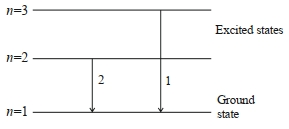
According to Bohr's postulates, an electron makes jump to higher energy orbital if it absorbs a photon of energy equal to difference between the energies of an excited state and the ground state. Assuming that collided electron takes energy equal to \(10.2\,eV\) or \(12.09\,eV\) from incoming electron beam (some part lost due to collision). The maximum excited state is \(n =3\). So, number of spectral lines is \(\frac{3(3-1)}{2}=3\) -
- (A) \(800\)
- (B) \(828\)
- (C) \(830\)
- (D) \(895\)
Show answer and solution
Correct Answer: (B)
In the ground state energy \(=-13.6\,eV\)So energy
\(\quad \frac{-13.6 eV }{n^2}=-13.6+12.75\)
\(\frac{-13.6 eV }{n^2}=-0.85\)
\(\quad n=\sqrt{16}\)
\(\qquad n=4\)
\(\text { Angular momentum }=\frac{n h}{2 \pi}=\frac{4 h}{2 \pi}=\frac{2 h}{\pi}\)
\(\text { Angular momentum }=\frac{2}{\pi} \times 4.14 \times 10^{-15}\)
\(\qquad=\frac{828 \times 10^{-17}}{\pi} eVs\)
-
- (A) \(2\)
- (B) \(3\)
- (C) \(4\)
- (D) \(8\)
Show answer and solution
Correct Answer: (B)
\(6={ }^4 C _2 \quad \Rightarrow n _2=4\)\(h v= E _4- E _1\)
\(\therefore v=13.6\left(\frac{1}{1^2}-\frac{1}{4^2}\right) \times \frac{1}{4.25 \times 10^{-15}}\)
\(=3 \times 10^{15}\,Hz\)
-
- (A) \(94.1\)
- (B) \(941\)
- (C) \(97.4\)
- (D) \(99.3\)
Show answer and solution
Correct Answer: (A)
\(\frac{ hc }{\lambda}=\left[1-\frac{1}{16}\right](13.6\,eV )\)So, \(\lambda=94.1\,nm\)
-
- (A) \(\sqrt{n}\)
- (B) \(n\)
- (C) \(n^2\)
- (D) \(\frac{1}{n}\)
Show answer and solution
Correct Answer: (A)
\(U=\frac{1}{2} m \omega^2 r^2\)\(F=-\frac{d v}{d r}=-m \omega^2 r\)
Now \(m \omega^2 r=\frac{m v^2}{r} \Rightarrow v=\omega v^{\prime}\)
\(m vr=\frac{n h}{2 \pi} \ldots (ii)\)
From \((i)\) and \((ii)\)
\(m \omega r^2=\frac{n h}{2 \pi}\)
\(\Rightarrow r \propto \sqrt{n}\)
-
- (A) \(4124\)
- (B) \(4125\)
- (C) \(4123\)
- (D) \(4122\)
Show answer and solution
Correct Answer: (B)
\(E = E _1- E _2=\frac{ hc }{\lambda_1}-\frac{ hc }{\lambda_2}= hc \left(\frac{1}{\lambda_1}-\frac{1}{\lambda_2}\right)\)\(=6.6 \times 10^{-34} \times 3 \times 10^8\left(\frac{1}{500 \times 10^{-9}}-\frac{1}{600 \times 10^{-9}}\right)\)
\(=6.6 \times 10^{-20}\,J\)
\(=\frac{6.6 \times 10^{-20}}{1.6 \times 10^{-19}} eV =4.125 \times 10^{-1}\,eV\)
\(=4125 \times 10^{-4}\,eV\)
-
- (A) \(13.6\)
- (B) \(10.5\)
- (C) \(3.4\)
- (D) \(40.8\)
Show answer and solution
Correct Answer: (D)
\(\Delta E =13.6 Z ^2\left[\frac{1}{2^2}-\frac{1}{4^2}\right]\,eV\)\(=13.6 \times(4)^2\left(\frac{1}{4}-\frac{1}{16}\right)\,eV\)
\(=13.6[4-1]\,eV\)
\(=13.6 \times 3=40.8\,eV\)
-
- (A) \(5\)
- (B) \(10\)
- (C) \(15\)
- (D) \(20\)
Show answer and solution
Correct Answer: (A)
As \(\frac{1}{\lambda}=R Z^2\left[\frac{1}{ n _1^2}-\frac{1}{ n _2^2}\right]\)\(\frac{1}{\lambda_1}=R(1)^2\left[\frac{1}{(2)^2}-\frac{1}{(3)^2}\right]=R\left(\frac{5}{36}\right)\)
\(\frac{1}{\lambda_2}=R(1)^2\left[\frac{1}{(3)^2}-\frac{1}{(4)^2}\right]=R\left(\frac{7}{144}\right)\)
\((ii) \div (i)\) gives
\(\frac{\lambda_1}{\lambda_2}=\frac{7 / 144}{5 / 36}=\frac{7}{20}=\frac{7}{4 \times 5}\)
\(\therefore n =5\)
-
- (A) \(27\)
- (B) \(26\)
- (C) \(25\)
- (D) \(24\)
Show answer and solution
Correct Answer: (A)
\(\frac{1}{\lambda}= Rz ^2\left[\frac{1}{ n _1^2}-\frac{1}{ n _2^2}\right]\)\(\frac{1}{\lambda_1}= Rz ^2\left[\frac{1}{1^2}-\frac{1}{3^2}\right]=\frac{8}{9} Rz ^2\)
\(\frac{1}{\lambda_2}= Rz ^2\left[\frac{1}{1^2}-\frac{1}{2^2}\right]=\frac{3}{4} Rz ^2\)
\(1 / 2 \Rightarrow \frac{\lambda_2}{\lambda_1}=\frac{8}{9} \times \frac{4}{3}=\frac{32}{27}\)
\(\frac{\lambda_1}{\lambda_2}=\frac{27}{32}\)
Ans.\(27\)
- 75. If \(917 \mathring A\) be the lowest wavelength of Lyman series then the lowest wavelength of Balmer series will be .......\(\mathring A\). 2023 Medium
- (A) \(3667\)
- (B) \(3365\)
- (C) \(3668\)
- (D) \(3658\)
Show answer and solution
Correct Answer: (C)
For lowest wavelength of Lyman series\(\frac{1}{\lambda}=R Z^2\left[\frac{1}{1^2}-\frac{1}{\infty^2}\right]=R Z^2\)
For lowest wavelength of Balmer series
\(\frac{1}{\lambda^{\prime}} = RZ ^2\left[\frac{1}{2^2}-\frac{1}{\infty^2}\right]=\frac{ RZ ^2}{4}\)
\(\lambda^{\prime} =\frac{4}{R Z^2}=4 \times 917\)
\(=3668 \mathring A\)
-
- (A) \(1.8\)
- (B) \(7.5\)
- (C) \(3.6\)
- (D) \(8.4\)
Show answer and solution
Correct Answer: (D)
\(V _{ n } \propto \frac{ Z }{ n }\)\(Z =1, \therefore V _{ n } \propto \frac{1}{ n }\)
\(\therefore \frac{ V _3}{ V _7}=\frac{7}{3}\)
\(\therefore V _3 =\frac{7}{3} V _7\)
\(=\frac{7}{3} \times 3.6 \times 10^6\,m / s\)
\(=8.4 \times 10^6\,m / s\)
-
- (A) \(\frac{L}{2}\)
- (B) \(0\)
- (C) \(L\)
- (D) \(2L\)
Show answer and solution
Correct Answer: (C)
\(L = mvr , \quad r \propto n ^2, \quad v \propto \frac{1}{ n }\)\(\therefore L \propto n\)
\(\text { Also, } L =\frac{ nh }{2 \pi}, \text { Bohr orbit is, } L _1= L =\frac{1 . h }{2 \pi}\)
\(L _2=2[ L ]=2 L\)
\(L _2=\frac{2 h }{2 \pi}\)
So, change \(= L _2- L _1=2 L - L = L\)
-
- (A) \(B\)
- (B) \(A\)
- (C) \(C\)
- (D) \(D\)
Show answer and solution
Correct Answer: (D)
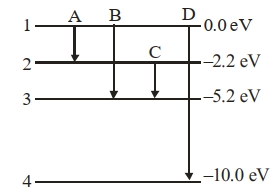
\(\lambda=\frac{ hc }{\Delta E }\)\(\Delta E _{ A }=2.2\,eV\)
\(\Delta E _{ B }=5.2\,eV\)
\(\Delta E _{ C }=3\,eV\)
\(\Delta E _{ D }=10\,eV\)
\(\lambda_{ A }=\frac{6.62 \times 10^{-34} \times 3 \times 10^8}{2.2 \times 1.6 \times 10^{-19}}\)
\(=\frac{12.41 \times 10^{-7}}{2.2}\,m\)
\(=\frac{1241}{2.2}\,nm =564\,nm\)
\(\lambda_{ B }=\frac{1241}{5.2}\,nm =238.65\,nm\)
\(\lambda_{ C }=\frac{1241}{3}\,nm =413.66\,nm\)
\(\lambda_{ D }=\frac{1241}{10}=124.1\,nm\)
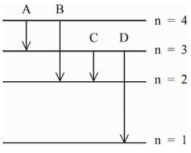
- 79. The energy levels of an hydrogen atom are shown below. The transition corresponding to emission of shortest wavelength is
 2023 Medium
- (A) \(C\)
- (B) \(D\)
- (C) \(B\)
- (D) \(A\)
Show answer and solution
Correct Answer: (B)
\(\Delta E =\frac{ hc }{\lambda} \Rightarrow \lambda \alpha \frac{1}{\Delta E }\)For shortest wavelength, energy gap should be maximum.
So, correct choice is transition from \(n =3\) to \(n =1\).
-
- (A) \(-3.4\)
- (B) \(-54.4\)
- (C) \(-13.6\)
- (D) \(-27.2\)
Show answer and solution
Correct Answer: (C)
\(E _{ n }=\frac{-13.6 Z ^2}{ n ^2}=\frac{-13.6 \times 4}{4}=-13.6\,eV\) -
- (A) \(4\)
- (B) \(6\)
- (C) \(2\)
- (D) \(10\)
Show answer and solution
Correct Answer: (C)
\(r \propto \frac{ n ^2}{ z }\)\(\frac{ r _{ He ^{+}}}{ r _{ Be ^{3+}}}=\frac{2^2 \times 4}{2 \times 4 \times 4}=\frac{1}{2}\)
- 82. The radius of electron's second stationary orbit in Bohr's atom is \(R\). The radius of the third orbit will be 2023 Medium
- (A) \(3 R\)
- (B) \(2.25 R\)
- (C) \(9 R\)
- (D) \(\frac{R}{3}\)
Show answer and solution
Correct Answer: (B)
(b) \( r \propto {n^2}\) ==> \(\frac{{{r_{(n = 2)}}}}{{{r_{(n = 3)}}}} = \frac{4}{9}\) ==> \({r_{(n = 3)}} = \frac{9}{4}R = 2.25\,R\) - 83. The radius of electron's second stationary orbit in Bohr's atom is \(R\). The radius of \(3 rd\) orbit will be \(.........R\) 2023 Easy
- (A) \(\frac{1}{3}\)
- (B) \(2.25\)
- (C) \(3\)
- (D) \(9\)
Show answer and solution
Correct Answer: (B)
\(r =0.529 \times \frac{ n ^2}{ z }\)\(r \propto n ^2\)
\(R \propto(2)^2\)
\(R _1 \propto(3)^2\)
\(\frac{ R _1}{ R }=\frac{4}{9}\)
\(R _{ l }=\frac{9 R }{4}\)
\(R _1=2.25 R\)
- 84. The radius of fifth orbit of the \(L ^{++}\)is \(.........\times 10^{-12}\,m\). Take : radius of hydrogen atom \(=0.51 \mathring A\) 2023 Medium
- (A) \(424\)
- (B) \(423\)
- (C) \(422\)
- (D) \(425\)
Show answer and solution
Correct Answer: (D)
\(r _{ n }= r _0 \frac{ n ^2}{ z } \rightarrow r _{ n }=0.51 \times \frac{25}{3} \mathring A=4.25 \times 10^{-10}\,m\)\(=425 \times 10^{-12}\,m\)
-
- (A) \(27\)
- (B) \(26\)
- (C) \(25\)
- (D) \(24\)
Show answer and solution
Correct Answer: (A)
\(\frac{1}{\lambda}= R \left[\frac{1}{ n _1{ }^2}-\frac{1}{ n _2{ }^2}\right]\) for \(H\)-atomFor balmer series, \(n _1=2\)
\(\frac{1}{\lambda}= R \left[\frac{1}{4}-\frac{1}{ n _2^2}\right]\)
For \(H _{ i }, n _2=3\)
\(H _\beta, n _2=4\)
\(\frac{1}{\lambda_{ H _{ \alpha }}}= R \left[\frac{1}{4}-\frac{1}{9}\right]=\frac{5 R }{36}\)
\(\frac{1}{\lambda_{ H _{ \beta }}}= R \left[\frac{1}{4}-\frac{1}{16}\right]=\frac{3 R }{16}\)
\(\frac{\frac{1}{\lambda_{H_\alpha}}}{\frac{1}{\lambda_{H_\beta}}}=\frac{\frac{5 R }{36}}{\frac{3 R }{16}}\)
\(\frac{\lambda_{H_{\alpha}}}{\lambda_{ H _{\beta}}}=\frac{27}{20}=\frac{ x }{20}\)
\(x=27\)
-
- (A) \(22\)
- (B) \(21\)
- (C) \(20\)
- (D) \(27\)
Show answer and solution
Correct Answer: (D)
Second excited state \(\rightarrow\) first excited state\(n =3 \rightarrow n =2\)
\(\frac{ hc }{\lambda_0}=13.6\left(\frac{1}{2^2}-\frac{1}{3^2}\right) \ldots \ldots \text { (i) }\)
Third excited state \(\rightarrow\) second orbit
\(n =4 \rightarrow n =2\)
\(\frac{ hc }{\left(20 \lambda_0 / x \right)}=13.6\left(\frac{1}{2^2}-\frac{1}{4^2}\right) \text {. }\)
\((ii)\) \(\div\) \((i)\)
\(\frac{x}{20}=\frac{\frac{1}{2^2}-\frac{1}{4^2}}{\frac{1}{2^2}-\frac{1}{3^2}}\)
\(x=27\)
-
- (A) Microwaves
- (B) \(X-\)rays
- (C) Infrared rays
- (D) Radio Waves
Show answer and solution
Correct Answer: (B)
\(X\) rays are emitted when target metal is bombarded with high energy electron. -
- (A) \(\frac{\lambda}{4}\)
- (B) \(4 \lambda\)
- (C) \(\frac{3}{2} \lambda\)
- (D) \(3 \lambda\)
Show answer and solution
Correct Answer: (D)
From the equation of photoelectric effect\(eV _0=\frac{ hc }{\lambda}-\phi_0=\frac{ hc }{\lambda}-\frac{ hc }{\lambda_0}\)
\(\frac{ eV _0}{4}=\frac{ hc }{2 \lambda}=\frac{ hc }{\lambda_0}\)
\(\Rightarrow \frac{1}{4}\left(\frac{ hc }{\lambda}-\frac{ hc }{\lambda_0}\right)=\frac{ hc }{2 \lambda}-\frac{ hc }{\lambda_0}\)
\(\frac{1}{\lambda_0}-\frac{1}{4 \lambda_0}=\frac{1}{2 \lambda}-\frac{1}{4 \lambda}\)
\(\frac{3}{4 \lambda_0}=\frac{1}{4 \lambda}\)
\(\Rightarrow \lambda_0=3 \lambda\)
-
- (A) \(3\)
- (B) \(2\)
- (C) \(1\)
- (D) \(4\)
Show answer and solution
Correct Answer: (D)
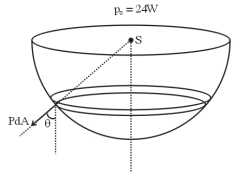
\(\text { Force }=\int PdA \cos \theta\)\(=\frac{2 I }{ C } \int dA \cos \theta=\frac{2 I }{ C } \pi R ^2=2 \frac{ p _0}{4 \pi R ^2} \cdot \frac{\pi R ^2}{ C }\)
\(=\frac{ p _0}{2 C }=\frac{24}{2 \times 3 \times 10^8}=4 \times 10^{-8} N \text { (Ans) }\)
-
- (A) \(4:1\)
- (B) \(2:1\)
- (C) \(8:1\)
- (D) \(16:1\)
Show answer and solution
Correct Answer: (A)
\(\lambda=\frac{ h }{ mv }=\frac{ h }{\sqrt{2 mK }}=\frac{ h }{\sqrt{2 mq \Delta V }}\)\(\frac{\lambda_\alpha}{\lambda_p}=\sqrt{\frac{m_p V_p q_p}{ m _\alpha V_\alpha q_\alpha}}\)
\(\Rightarrow \frac{\lambda_\alpha}{\lambda_p}=\sqrt{\frac{1 \times 2 \times 1}{4 \times 4 \times 2}}=\frac{1}{4}\)
\(\Rightarrow \lambda_p: \lambda_\alpha=4: 1\)
-
- (A) \(2: 1\)
- (B) \(4: 1\)
- (C) \(1: 2\)
- (D) \(1: 4\)
Show answer and solution
Correct Answer: (B)
\(K E=\frac{p^2}{2 m}=\frac{h^2}{2 m \lambda^2}\)\(\frac{K E_p}{K E_\alpha}=\frac{m_\alpha}{m_p}=4: 1\)
-
- (A) \(0.5\)
- (B) \(2\)
- (C) \(3\)
- (D) \(1\)
Show answer and solution
Correct Answer: (B)
Momentum \(=\frac{\text { Energy }}{ C }\)\(=\frac{\text { Power } \times \text { time }}{ C }\)
\(=\frac{\left(20 \times 10^{-3} w \right)\left(300 \times 10^{-9}\,s \right)}{3 \times 10^8 m / s }\)
\(=2 \times 10^{-17}\,kg - m / s\)
-
- (A) \(3\)
- (B) \(\frac{9}{4}\)
- (C) \(\frac{3}{2}\)
- (D) \(4\)
Show answer and solution
Correct Answer: (B)
\(KE =\frac{ P ^2}{2 m }, \quad P =\frac{ h }{\lambda}\)\(eV _1=\frac{\left(\frac{ h }{\lambda}\right)^2}{2 m }\)
\(eV _2=\frac{\left(\frac{ h }{1.5 \lambda}\right)^2}{2 m }\)
\(\frac{ V _1}{ V _2}=(1.5)^2=\frac{9}{4}\)
-
- (A) \(\lambda_\alpha>\lambda_{ p }>\lambda_{ e }\)
- (B) \(\lambda_\alpha<\lambda_{ p }<\lambda_{ e }\)
- (C) \(\lambda_\alpha=\lambda_{ p }=\lambda_{ e }\)
- (D) \(\lambda_\alpha>\lambda_{ p }<\lambda_{ e }\)
Show answer and solution
Correct Answer: (B)
\(\lambda_{ D }=\frac{ h }{ p }=\frac{ h }{\sqrt{2 mK }}\)\(\therefore \lambda \propto \frac{1}{\sqrt{ m }}\)
\(\because m _\alpha > m _{ p } > m _{ e }\)
\(\lambda_{ e } > \lambda_{ p } > \lambda_\alpha\)
-
- (A) \(3 \lambda_0\)
- (B) \(9 \lambda_0\)
- (C) \(\frac{\lambda_0}{2}\)
- (D) \(\frac{\lambda_0}{\sqrt{2}}\)
Show answer and solution
Correct Answer: (D)
When electron is accelerated through potential difference \(V\), then\(\text { K.E. }= eV\)
\(\Rightarrow \lambda=\frac{ h }{\sqrt{2 m ( KE )}}=\frac{ h }{\sqrt{2 meV }}\)
\(\therefore \quad \lambda \propto \frac{1}{\sqrt{ V }}\)
\(\therefore \quad \frac{\lambda}{\lambda_0}=\sqrt{\frac{20}{40}}\)
\(\therefore \quad \lambda=\frac{\lambda_0}{\sqrt{2}}\)
-
- (A) \(B, C\) only
- (B) \(A, C, D\) only
- (C) \(B\) only
- (D) \(A, B, D\) only
Show answer and solution
Correct Answer: (C)
\((A)\) Stopping potential depends on both frequency of light and work function.\((B)\) Saturation current \(\propto\) intensity of light
\((C)\) Maximum \(KE\) depends on frequency
\((D)\) Photoelectric effect is explained using particle theory
-
- (A) \(A\) is correct but \(R\) is not correct
- (B) \(A\) is not correct but \(R\) is correct
- (C) Both \(A\) and \(R\) are correct but \(R\) is Not the correct explanation of \(A\)
- (D) Both \(A\) and \(R\) are correct and \(R\) is the correct explanation of \(A\)
Show answer and solution
Correct Answer: (D)
Conceptual -
- (A) Statement \(I\) is true but Statement \(II\) is false
- (B) Both Statement \(I\) and Statement \(II\) are true
- (C) Statement \(I\) is false but Statement \(II\) is true
- (D) Both Statement \(I\) and Statement \(II\) are false
Show answer and solution
Correct Answer: (A)
\(UV\) rays have maximum frequency hence are most effective for emission of electrons from a metallic surface.\(KE _{\max .}= hf - hf _0\)
-
- (A) Statement \(I\) is incorrect but statement \(II\) is correct
- (B) Both Statement \(I\) and Statement \(II\) are incorrect
- (C) Statement \(I\) is correct but statement \(II\) is incorrect
- (D) Both statement \(I\) and statement \(II\) are correct
Show answer and solution
Correct Answer: (D)
Stopping potential \(V _{ S }=\frac{ KE _{\max }}{ e }\)\(V _{ S }=\frac{\frac{ hC }{ \lambda }-\phi}{ e }\)
Stopping potential does not depend on intensity or power of light used, it only depends on frequency or wavelength of incident light.
So both statements \(I\) and \(II\) are correct
-
- (A) \(A\) and \(C\) only
- (B) \(A\) and \(E\) only
- (C) \(B\) and \(C\) only
- (D) \(A\) and \(B\) only
Show answer and solution
Correct Answer: (A)
Intensity of light \(\propto\) number of photons \(\propto\) no of photo electrons \(\propto\) photo currentSo, \(A\) is correct
\(KE _{\max }= h v-\phi\)
\(KE _{\max }\) depends on frequency
So, \(C\) is correct
So, \(A\) and \(C\) are correct
No questions on this page match these filters.