


Chapters asked in 2016
26 chapters- 3Qs STD 11 Units, dimensions and measurement
- 6Qs STD 12 Semicondutor electronics Most asked
- 1Qs STD 12 Nuclei
- 1Qs STD 12 Atoms
- 1Qs STD 12 Dual nature of radiation and matter
- 2Qs STD 12 Electromagnetic waves
- 3Qs STD 12 Wave optics
- 6Qs STD 12 Ray optics and optical instruments Most asked
- 1Qs STD 12 Alternating current
- 8Qs STD 11 System of particles and rotational motion Most asked
- 5Qs STD 12 Moving charges and magnetism
- 1Qs STD 12 Electromagnetic induction
- 2Qs STD 12 Magnetism and matter
- 3Qs STD 12 Current electricity
- 4Qs STD 12 Electric potential and capacitance
- 1Qs STD 12 Electric charges and fields
- 4Qs STD 11 Waves and sound
- 3Qs STD 11 Oscillations
- 1Qs STD 11 Kinetic theory of gases
- 4Qs STD 11 Thermodynamics
- 1Qs STD 11 10.1, thermonetry, thermal expansion and calorimetry
- 3Qs STD 11 Mechanical properties of solids
- 1Qs STD 11 Fluid mechanics
- 1Qs STD 11 Newtons laws of motion
- 2Qs STD 11 Gravitation
- 5Qs STD 11 Work, energy, power and collision
All JEE Mains 2016 Physics questions
26 chaptersShowing 1–50 of 73 questions
-
- (A) \(\frac{C}{{BD}} - \frac{{A{D^2}}}{C}\)
- (B) \({A^2} - {B^2}{C^2}\)
- (C) \(\frac{A}{B} - C\)
- (D) \(\frac{{\left( {A - C} \right)}}{D}\)
Show answer and solution
Correct Answer: (D)
Dimension of \(A \ne \) dimension of \((C)\) Hence \(A - C\) is not possible -
- (A) \(0.70\)
- (B) \(0.50\)
- (C) \(0.75\)
- (D) \(0.80\)
Show answer and solution
Correct Answer: (D)
\(L.C = \frac{{0.5}}{{50}} = 0.001\,mm\)
zero error \(= 5 \times 0.001 = 0.05\) mm negativeReading \(= \left( {0.5 + 25 \times 0.01} \right) + 0.05 = 0.80\) mm
-
- (A) \(92\pm 2\;s\)
- (B) \(92\pm 3\;s\)
- (C) \(92\pm 1.8\;s\)
- (D) \(92\pm 5\;s\)
Show answer and solution
Correct Answer: (A)
\(\Delta T = \frac{{\left[ {\Delta {T_1}| + |\Delta {T_2}| + |\Delta {T_3}| + |\Delta {T_4}} \right]}}{4}\)
\( = \frac{{2 + 1 + 3 + 0}}{4} = 1.5\)
As the resolutions of measuring clock is \(1.5\) therefore the mean time should be \(92\) pm \(1.5\)
but Least count is \(1\; sec\)then answer should be \(92\, \pm \,2\;\;sec\)
-
- (A) \(0-5\,\,V\)
- (B) \(0-24\,\,V\)
- (C) \(0-12\,\,V\)
- (D) \(0-8\,\,V\)
Show answer and solution
Correct Answer: (C)
The minimum voltage range of \(DC\) source is given by\(\mathrm{V}^{2}=\mathrm{PR}\)
\( \because \,\, \mathrm{P}=1\,watt\),
\(\mathrm{R}=100 \Omega\)
\(=1 \times 100\)
\(\therefore \mathrm{V}=10 \mathrm{volt}\)
-
- (A) \(+ve\) terminal \(2,\) \(-ve\) terminal \(3,\) resistance low
- (B) \(+ve\) terminal \(2,\) \(-ve\) terminal \(1,\) resistane high
- (C) \(+ve\) terminal \(1 ,\) \(-ve\) terminal \(2,\) resistance high
- (D) \(+ve\) terminal \(3,\) \(-ve\) terminal \(2,\) resistance high
Show answer and solution
Correct Answer: (C)
Connecting circuit according to question, it is clear\(+\,ve\) terminal \(1\), \(-\,ve\) terminal \(2\), resistance high.
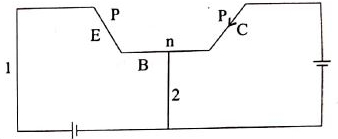
- 6. Identify the semiconductor devices whose characteristics are given below, in the order \((a),(b),(c),(d) \)
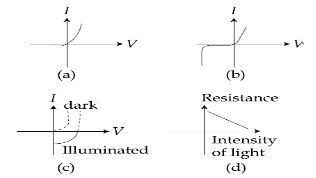 2016 Medium
- (A) Solar cell, Light dependent resistance, Zener diode, simple diode
- (B) Zener diode, Solar cell, simple diode, Light dependent resistance
- (C) Simple diode, Zener diode, Solar cell, Light dependent resistance
- (D) Zener diode, Simple diode, Light dependent resistance, Solar cell
Show answer and solution
Correct Answer: (C)
Graph \((a)\) is for a simple diode.Graph \((b)\) is showing the \(V\) Break down used for zener diode.
Graph \((c)\) is for solar cell which shows cut-off voltage and open circuit current.
Graph \((d)\) shows the variation of resistance \(h\) and hence current with intensity of light.
- 7. If \(a,\, b,\,c,\,d\) are inputs to a gate and \(x\) is its output, then, as per the following time graph, the gate is
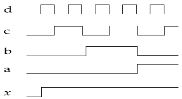 2016 Medium
- (A) \(OR\)
- (B) \(NAND \)
- (C) \(NOT\)
- (D) \(AND\)
Show answer and solution
Correct Answer: (A)
In case of an \('OR'\) gate the input is zero when all inputs are zero. If any one inputs is \('1'\), then the output is \('1'\). -
- (A) \(R \approx {10^2} - {10^3}\)
- (B) \(R \approx 1 - 10\)
- (C) \(R \approx 0.1 - 1.0\)
- (D) \(R \approx 0.1 - 0.01\)
Show answer and solution
Correct Answer: (C)
For \(C.B.\) configuration \(\frac{{{r}_{i}}}{{{r}_{0}}}\,\cong \,0.1\,\,\Omega \)For \(CE\) and \(CC\) configuration
\(\frac{{{r}_{i}}}{{{r}_{0}}}\,\approx \,1\,\,\Omega \)
-
- (A) Linear increase for \(Cu\), exponential decrease for \(Si\)
- (B) Linear decrease for \(Cu\), linear decrease for \(Si\)
- (C) Linear increase for \(Cu\), linear increase for \(Si\)
- (D) Linear increase for \(Cu\), exponential increase for \(Si \)
Show answer and solution
Correct Answer: (A)
\(Cu\) is conductor so with increase in temperature, resistance will increase
\(Si\) is semiconductor so with increase in temperature resistance will decrease -
- (A) \(1 : 4\)
- (B) \(5 : 4\)
- (C) \(1 : 16\)
- (D) \(4 : 1\)
Show answer and solution
Correct Answer: (B)
For \(A_{t / 2}=20\, min\), \(t=80\,min\), number of half lifes \(n=4\)\(\therefore \) Nuclei remaining \(=\frac{\mathrm{N}_{\mathrm{o}}}{2^{4}} .\) Therefore nuclei decayed \(=\mathrm{N}_{0}-\frac{\mathrm{N}_{0}}{2^{4}}\)
For \(\mathrm{B}_{\mathrm{t} / 2}=40 \mathrm{min} ., \mathrm{t}=80 \mathrm{min},\) number of half lifes \(\mathrm{n}=2\)
\(\therefore \) Nuclei remaining \(=\frac{\mathrm{N}_{\mathrm{o}}}{2^{2}} .\) Therefore nuclei decayed \(=\mathrm{N}_{0}-\frac{\mathrm{N}_{\mathrm{o}}}{2^{2}}\)
\(\therefore\) Required ratio\( = \frac{{{\text{No}} - \frac{{{\text{No}}}}{{{2^4}}}}}{{{\text{No}} - \frac{{{\text{No}}}}{{{2^2}}}}} = \) \(\frac{{1 - \frac{1}{{16}}}}{{1 - \frac{1}{4}}} = \frac{{15}}{{16}} \times \frac{4}{3} = \frac{5}{4}\)
-
- (A) \(2\)
- (B) \(4\)
- (C) \(5\)
- (D) \(3\)
Show answer and solution
Correct Answer: (B)
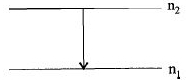
A hydrogen atom makes a transition from \(n=2\) to \(n=1\)Then wavelength
\(=\operatorname{Rcz}^{2} \frac{1}{\mathrm{n}_{1}^{2}}-\frac{1}{\mathrm{n}_{2}^{2}}=\operatorname{Rc}(1)^{2}\left[1-\frac{1}{4}\right]\)
\(\lambda=\operatorname{Rc}\left[\frac{3}{4}\right]\) ..... \((1)\)
Forionized lithium
\(\lambda=\operatorname{Rc}(3)^{2}\left[\frac{1}{n^{2}}\right]=\operatorname{Rc} 9\left[\frac{1}{n^{2}}\right]\) ..... \((2)\)
\(\operatorname{Rc}\left[\frac{3}{4}\right]=\operatorname{Rc9}\left[\frac{1}{n^{2}}\right]\)
\(\Rightarrow \frac{3}{4}=\frac{9}{n^{2}} \Rightarrow n=\sqrt{12}=2 \sqrt{3}\)
The least quantum number must be \(4\).
-
- (A) \(\frac{{hc}}{e}\left[ {\frac{1}{{{\lambda _3}}} + \frac{1}{{{\lambda _2}}} - \frac{1}{{{\lambda _1}}}} \right]\)
- (B) \(\frac{{hc}}{e}\left[ {\frac{1}{{{\lambda _3}}} + \frac{1}{{{2\lambda _2}}} - \frac{1}{{{\lambda _1}}}} \right]\)
- (C) \(\frac{{hc}}{e}\left[ {\frac{1}{{{\lambda _3}}} - \frac{1}{{{\lambda _2}}} - \frac{1}{{{\lambda _1}}}} \right]\)
- (D) \(\frac{{hc}}{e}\left[ {\frac{1}{{{\lambda _3}}} + \frac{1}{{{2\lambda _2}}} - \frac{3}{{{2\lambda _1}}}} \right]\)
Show answer and solution
Correct Answer: (D)
From Einstein's photoelectric equation, we have\(\frac{h c}{\lambda_{1}}=\frac{h c}{\lambda_{0}}+e V\) ..... \((1)\)
\(\frac{\mathrm{hc}}{\lambda_{2}}=\frac{\mathrm{hc}}{\lambda_{0}}+3 \mathrm{eV}\) ..... \((2)\)
\(\frac{\mathrm{hc}}{\lambda_{3}}=\frac{\mathrm{hc}}{\lambda_{0}}+\mathrm{eV'}\) ..... \((3)\)
Fromequation \((1)\) and \((2)\)
\(\frac{3}{2 \lambda_{1}}-\frac{2}{2 \lambda_{2}}=\frac{1}{\lambda_{0}}\)
\(\frac{{{\text{hc}}}}{{{\lambda _3}}} - {\text{hc}}\left[ {\frac{3}{{2{\lambda _1}}} - \frac{1}{{2{\lambda _2}}}} \right] = {\text{eV'}}\)
\(\frac{{hc}}{e}\left[ {\frac{1}{{{\lambda _3}}} - \frac{3}{{2{\lambda _1}}} + \frac{1}{{2{\lambda _2}}}} \right] = {V^\prime }\)
-
- (A) \(C,A,B,D\)
- (B) \(D,B,A,C\)
- (C) \(B,A,D,C\)
- (D) \(A,B,D,C\)
Show answer and solution
Correct Answer: (B)
\(\text { Energy }=\frac{h c}{\lambda}\)order of wavelength
\(x\) ray, \(VIBGYOR\), Radiowaves
\(\mathrm{C} \quad(\mathrm{A})(\mathrm{B})\,\,\,\,\,\,\mathrm{D}\)
order of energy
\(A < B < C < D\)
- 14. Consider an electromagnetic wave propagating in vacuum . Choose the correct statement 2016 Medium
- (A) For an electromagnetic wave propagating in \(+y\) direction the electric field is \(\vec E = \frac{1}{{\sqrt 2 }}\,{E_{yz}}\,\left( {x,t} \right)\,\hat z\) and the magnetic field is \(\vec B = \frac{1}{{\sqrt 2 }}\,{B_z}\,\left( {x,t} \right)\hat y\)
- (B) For an electromagnetic wave propagating in \(+y\) direction the electric field is \(\vec E = \frac{1}{{\sqrt 2 }}\,{E_{yz}}\,\left( {x,t} \right)\,\hat y\) and the magnetic field is \(\vec B = \frac{1}{{\sqrt 2 }}\,B_{yz}\,\left( {x,t} \right)\hat z\)
- (C) For an electromagnetic wave propagating in \(+x\) direction the electric field is \(\vec E = \frac{1}{{\sqrt 2 }}\,{E_{yz}}\,\left( {y,z,t} \right)\,\left( {\hat y + \hat z} \right)\) and the magnetic field is \(\vec B = \frac{1}{{\sqrt 2 }}\,B_{yz}\,\left( {y,z,t} \right)\,\left( {\hat y + \hat z} \right)\)
- (D) For an electromagnetic wave propagating in \(+x\) direction the electric field is \(\vec E = \frac{1}{{\sqrt 2 }}\,{E_{yz}}\,\left( {x,t} \right)\,\left( {\hat y - \hat z} \right)\) and the magnetic field is \(\vec B = \frac{1}{{\sqrt 2 }}\,B_{yz}\,\left( {x,t} \right)\,\left( {\hat y + \hat z} \right)\)
Show answer and solution
Correct Answer: (D)
Wave in \(X-\) direction means \(E\) and \(B\) should be function of \(x\) and \(t\)\(\overset\frown{y}-\overset\frown{z}\,\bot \,\overset\frown{y}+\overset\frown{z}\,\)
-
- (A) \(1\)
- (B) \(3\)
- (C) \(2\)
- (D) \(4\)
Show answer and solution
Correct Answer: (C)
Given \(D=1.0\, \mathrm{m},\) wavelength of monochromatic light \(\lambda=600\, \mathrm{nm}\)\(d: D \theta=1 \times \frac{\pi}{180} \times \frac{1}{60}\)
\(\mathrm{d}_{0}=2 \times 10^{-3}=2\, \mathrm{mm}\)
-
- (A) \(a = \sqrt {\lambda L} \) and \(b_{min}\)=\(\sqrt {4\lambda L} \)
- (B) \(a = \frac{{{\lambda ^2}}}{L}\) and \(b_{min}\)=\(\sqrt {4\lambda L} \)
- (C) \(a = \frac{{{\lambda ^2}}}{L}\) and \(b_{min}\)=\(\left( {\frac{{2{\lambda ^2}}}{L}} \right)\)
- (D) \(a = \sqrt {\lambda L} \) and \(b_{min}\)=\(\left( {\frac{{2{\lambda ^2}}}{L}} \right)\)
Show answer and solution
Correct Answer: (A)
Given geometrical spread \(=\,a\)Diffraction spread \(=\frac{\lambda}{\mathrm{a}} \times \mathrm{L}=\frac{\lambda \mathrm{L}}{\mathrm{a}}\)
The sum \(b=a+\frac{\lambda L}{a}\)
For \(b\) to be minimum \(\frac{{{\text{db}}}}{{{\text{da}}}} = 0\) \(\frac{{\text{d}}}{{{\text{da}}}}\left( {{\text{a}} + \frac{{\lambda {\text{L}}}}{{\text{a}}}} \right) = 0\)
\(a =\sqrt{\lambda L}\)
\(b\, \min =\sqrt{\lambda L}+\sqrt{\lambda L}=2 \sqrt{\lambda L}=\sqrt{4 \lambda L}\)
-
- (A) \(10^8\,km\)
- (B) \(10^{10}\,km\)
- (C) \(10^{11}\,km\)
- (D) \(10^6\,km\)
Show answer and solution
Correct Answer: (A)
We know that \(\Delta \theta=\frac{1.22 \lambda}{D}=\frac{l}{R}\)The minimum distance between them
\(l=\frac{9.46 \times 10^{15} \times 10 \times 1.22 \times 600 \times 10^{-9}}{0.3}\)
\(=2308.24 \times 10^{8}\, \mathrm{m}\)
\(\Rightarrow 2.308 \times 10^{8}\, \mathrm{km}\)
-
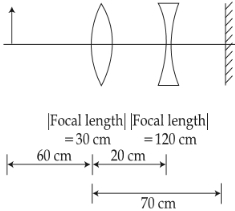
- (A) \(60\,cm\) from the convex lens
- (B) \(60\,cm\) from the concave lens
- (C) \(70\,cm\) from the convex lens
- (D) \(70\,cm\) from the concave lens
Show answer and solution
Correct Answer: (A)
Len's formula is given by\(\frac{1}{f}=\frac{1}{v}-\frac{1}{u}\)
For convex lens,
\(\frac{1}{30}=\frac{1}{v}+\frac{1}{60} \Rightarrow \frac{1}{60}=\frac{1}{v}\)
Similarly for concave lens
\(\frac{1}{-120}=\frac{1}{v}-\frac{1}{40} \Rightarrow \frac{1}{v}=\frac{1}{60}\)
Virtual object \(10\,\mathrm{cm}\) behind plane mirror.
Hencereal image \(10\,\mathrm{cm}\) infront of mirror or, \(60\,\mathrm{cm}\) from convex lens
-
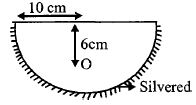
- (A) \(14\, cm\) below flat surface
- (B) \(20\, cm\) below flat surface
- (C) \(16\, cm\) below flat surface
- (D) \(30\, cm\) below flat surface
Show answer and solution
Correct Answer: (B)
Given, radius of herrispherical glass \(\mathrm{R}=10\, \mathrm{cm}\)\(\therefore\) Focal length \(\mathrm{f}=\frac{10}{2}=-5 \,\mathrm{cm}\)
\(\mathrm{u}=(10-6)=-4\, \mathrm{cm}\)
By using mirror formula,
\(\frac{1}{v}+\frac{1}{u}=\frac{1}{f} \Rightarrow \frac{1}{v}+\frac{1}{-4}=\frac{1}{-5}\)
\(\Rightarrow v=20 \,\mathrm{cm}\)
Apparen the height,
\(\mathrm{h}_{\mathrm{a}}=\mathrm{h}_{\mathrm{r}} \frac{\mu_{1}}{\mu_{2}}=30 \times \frac{1}{15}=20\, \mathrm{cm}\) below flat surface.
-
- (A) \(20\) times taller
- (B) \(20\) times nearer
- (C) \(10 \) times taller
- (D) \(10\) times nearer
Show answer and solution
Correct Answer: (B)
A telescope magnifies by making the object appering closer. -
- (A) \(1.7\)
- (B) \(1.8\)
- (C) \(1.5\)
- (D) \(1.6\)
Show answer and solution
Correct Answer: (C)
We know that \(i+e-A=\delta\)\(35^o+79^o-\mathrm{A}=40^o\) \(\therefore \quad \mathrm{A}=74^o\)
But \(\mu = \frac{{\sin \left( {\frac{{{\text{A}} + {\delta _{\text{m}}}}}{2}} \right)}}{{\sin {\text{A}}/2}}\) \( = \frac{{\sin \left( {\frac{{74 + {\delta _{\text{m}}}}}{2}} \right)}}{{\sin \frac{{74}}{2}}}\)
\( = \frac{5}{3}\sin \left( {{{37}^o} + \frac{{{\delta _{\text{m}}}}}{2}} \right)\)
\(\mu_{\max }\) can be \(\frac{5}{3}\). That is \(\mu_{\max }\) is less than \(\frac{5}{3}=1.67\)
But \(\delta_{\mathrm{m}}\) will be less than \(40^o\) so
\(\mu < \frac{5}{3}\sin {57^o}\) \( < \frac{5}{3}\sin {60^o}\) \( \Rightarrow \mu = 1.45\)
- 22. To determine refractive index of glass slab using a travelling microscope, minimum number of readings required are 2016 Medium
- (A) \(2\)
- (B) \(4\)
- (C) \(3\)
- (D) \(5\)
Show answer and solution
Correct Answer: (C)
Reading one \( \Rightarrow \) without slab
Reading two \( \Rightarrow \) with slab
Reading three \( \Rightarrow \) with saw dust
Minimum three readings are required to determine refractive index of glass slab using a travelling microscope -
- (A) \(f_1 = 7.8\,cm\,\,\,\,\, f_2 = 12.7\,\,cm\)
- (B) \(f_1 = 12.7\,cm\,\,\,\,\, f_2 = 7.8\,\,cm\)
- (C) \(f_1 = 15.6\,cm\,\,\,\,\, f_2 = 25.4\,\,cm\)
- (D) \(f_1 = 7.8\,cm\,\,\,\,\, f_2 = 25.4\,\,cm\)
Show answer and solution
Correct Answer: (A)
From lens\(u_{1}=-(32.2-22.2) c m=-10 c m\)
\(v_{1}=(71.2-32.2) \mathrm{cm}=39 \mathrm{cm}\)
\(\frac{1}{f_{1}}=\frac{1}{v_{1}}-\frac{1}{u_{1}}=\frac{1}{36}+\frac{1}{10}=\frac{49}{390}\)
or \(f_{1}=\frac{390}{49} \mathrm{cm}=7.8 \mathrm{cm}\)
For mirror \(R=(71.2-45.8) \mathrm{cm}=25.4 \mathrm{cm}\)
or \(f_{2}=\frac{25.4}{2} \mathrm{cm}=12.7 \mathrm{cm}\)
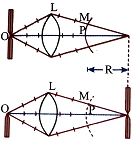
-
- (A) \(0.044 \) \(H\)
- (B) \(0.065\) \( H\)
- (C) \(80\) \( H\)
- (D) \(0.08\) \( H\)
Show answer and solution
Correct Answer: (B)
Here\(\mathrm{i}=\frac{\mathrm{e}}{\sqrt{\mathrm{R}^{2}+\mathrm{X}_{\mathrm{L}}^{2}}}=\frac{\mathrm{e}}{\sqrt{\mathrm{R}^{2}+\omega^{2} \mathrm{L}^{2}}}=\frac{\mathrm{e}}{\sqrt{\mathrm{R}^{2}+4 \pi^{2} \mathrm{v}^{2} \mathrm{L}^{2}}}\)
\(10=\frac{220}{\sqrt{64+4 \pi^{2}(50)^{2} \mathrm{L}}}\left[\because \mathrm{R}=\frac{\mathrm{V}}{\mathrm{I}}=\frac{80}{10}=8\right]\)
On solving we get
\(\mathrm{L}=0.065\, \mathrm{H}\)
-
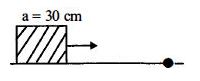
- (A) \(13.3\)
- (B) \(5.0\)
- (C) \(9.4\)
- (D) \(6.7\)
Show answer and solution
Correct Answer: (B)
Angular momentum, \(mvr = I\omega \)momrnt of Inertia \((I)\) of cubical block is given by
\(\begin{array}{l}
I = m\left( {\frac{{{R^2}}}{6} + {{\left( {\frac{R}{{\sqrt 2 }}} \right)}^2}} \right)\\
\therefore \,\,\omega = \frac{{m.2\frac{R}{2}}}{{m\left( {\frac{{{R^2}}}{6} + {{\left( {\frac{R}{{\sqrt 2 }}} \right)}^2}} \right)}}\\
\Rightarrow \omega = \frac{{12}}{{8R}} = \frac{3}{{2 \times 0.3}} = \frac{{10}}{2} = 5\,rad/s.
\end{array}\) -
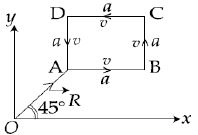
- (A) \(\;\left( a \right)\overrightarrow {\;L} \) \( = mv\left[ {\frac{R}{{\sqrt 2 }} + a} \right]\hat k\) ,when the particle is moving from \(B\) to \(C\)
- (B) \(\vec L\) \( = \frac{{mv}}{{\sqrt 2 }}\;R\;\hat k\) , when the particle is moving from \(D\) to \(A\)
- (C) \(\left( d \right)\overrightarrow {\;L} \) \( = mv\left[ {\frac{R}{{\sqrt 2 }} - a} \right]\hat k\) ,when the particle is moving from \(C\) to \(D\)
- (D) Both (b) and (c)
Show answer and solution
Correct Answer: (D)
\(\overrightarrow{\mathrm{L}}=\overrightarrow{\mathrm{r}} \times \overrightarrow{\mathrm{P}}\) or \(\overrightarrow{\mathrm{L}}=\mathrm{rpsin} \theta \hat{\mathrm{n}}\)\(\overrightarrow{\mathrm{L}}=\mathrm{r}_{\perp}(\mathrm{P}) \hat{\mathrm{n}}\)
For \(D\) to \(A\)
\(\overrightarrow{\mathrm{L}}=\frac{\mathrm{R}}{\sqrt{2}} \mathrm{mV}(-\hat{\mathrm{k}})\)
For \(A\) to \(B\)
\(\overrightarrow{\mathrm{L}}=\frac{\mathrm{R}}{\sqrt{2}} \mathrm{mV}(-\hat{\mathrm{k}})\)
For \(\mathrm{C}\) to \(\mathrm{D}\)
\(\overrightarrow{\mathrm{L}}=\left(\frac{\mathrm{R}}{\sqrt{2}}+\mathrm{a}\right) \mathrm{mV}(\hat{\mathrm{k}})\)
For \(B\) to \(C\)
\(\overrightarrow{\mathrm{L}}=\left(\frac{\mathrm{R}}{\sqrt{2}}+\mathrm{a}\right) \mathrm{mV}(\hat{\mathrm{k}})\)
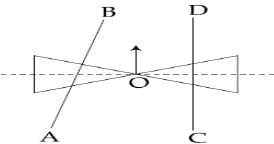
-
- (A) go straight
- (B) tum left and right alternately
- (C) turn left
- (D) turn right
Show answer and solution
Correct Answer: (C)
As shown in the diagram, the normal reaction of \(AB\) on roller will shift towards \(O\).This will lead to tending of the system of cones to trun left.
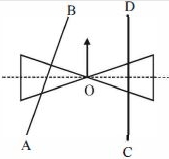
-
- (A) go straight
- (B) tum left and right alternately
- (C) turn left
- (D) turn right
Show answer and solution
Correct Answer: (C)
As shown in the diagram, the normal reaction of \(AB\) on roller will shift towards \(O\).This will lead to tending of the system of cones to trun left.
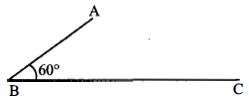
-
- (A) \(1.85\)
- (B) \(1.5\)
- (C) \(1.37\)
- (D) \(3\)
Show answer and solution
Correct Answer: (C)
Center of mass\(\begin{array}{l}
{x_{cm}} = \frac{x}{2} = \frac{{\left( {\rho x} \right)\left( {\frac{x}{2}} \right)\frac{1}{2} + \rho y\left( {\frac{y}{2}} \right)}}{{\rho \left( {x + y} \right)}}\\
\Rightarrow \frac{1}{2} + \frac{y}{x} = \frac{{{y^2}}}{{{x^2}}}\\
\therefore \frac{{BC}}{{AB}} = \frac{y}{x} = \frac{{1 + \sqrt 3 }}{2} = 1.37
\end{array}\)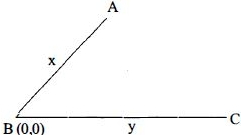
-
- (A) \(1.85\)
- (B) \(1.5\)
- (C) \(1.37\)
- (D) \(3\)
Show answer and solution
Correct Answer: (C)
Center of mass\(\begin{array}{l}
{x_{cm}} = \frac{x}{2} = \frac{{\left( {\rho x} \right)\left( {\frac{x}{2}} \right)\frac{1}{2} + \rho y\left( {\frac{y}{2}} \right)}}{{\rho \left( {x + y} \right)}}\\
\Rightarrow \frac{1}{2} + \frac{y}{x} = \frac{{{y^2}}}{{{x^2}}}\\
\therefore \frac{{BC}}{{AB}} = \frac{y}{x} = \frac{{1 + \sqrt 3 }}{2} = 1.37
\end{array}\) -
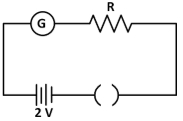
- (A) \(r_s = 0.5\, \Omega \) in series with the galvanometer
- (B) \(r_s = 1\, \Omega \) in series with galvanometer
- (C) \(r_s = 1\, \Omega \) in parallel with galvanometer
- (D) \(r_s = 0.5\, \Omega \) in parallel with the galvanometer
Show answer and solution
Correct Answer: (D)
As we know, \(\mathrm{I}=\frac{\mathrm{V}}{\mathrm{R}}=\frac{5}{50}=0.1\)\(I' = 0.099\)
When Galvanometer is connected
\(R_{e q}=50+\frac{100 S}{100+S}=\frac{V}{I}\)
\(\Rightarrow \frac{100 \mathrm{S}}{100+\mathrm{S}}=\frac{5}{0.099}-50\)
\(\Rightarrow \frac{100 \mathrm{S}}{100+\mathrm{S}}=50.50-50 \Rightarrow \frac{100 \mathrm{S}}{100+\mathrm{S}}=0.5\)
\(\Rightarrow 100 \mathrm{S}=50+0.55 \Rightarrow 99.5 \mathrm{S}=50\)
\(S=\frac{50}{99.05}=0.5 \,\Omega\)
So, shunt of resistance \(=0.5\, \Omega\) is onnected in parallel with the galvanometer.
-
- (A) Full scale deflection current is \(2\, mA\).
- (B) Resistance of galvanometer is \(200\,\Omega \,\)
- (C) Resistance required on \(R.B.\) for a deflection of \(10\) \(divisions\) is \(9800\,\Omega \,\)
- (D) Current sensitivity of galvanometer is \(20\,\mu A\) \(/ division\)
Show answer and solution
Correct Answer: (D)
Let full scale deflection of current \(=1\)In case \(1,\) when \(\mathrm{R}=2400 \Omega\) and deflection of 40 divisions present.
\(\therefore \quad \frac{40}{50} \mathrm{I}=\frac{V}{G+R}\)
\(\Rightarrow \quad \frac{4}{5} \mathrm{I}=\frac{2}{G+2400}\dots (1)\)
In case \(2,\) when \(\mathrm{R}=4900 \Omega\) and deflection of 20 divisions present
\(\therefore \quad \frac{20}{50} \mathrm{I}=\frac{V}{G+R}\)
\(\Rightarrow \quad \frac{2}{5} \mathrm{I}=\frac{2}{G+4900}\dots (2)\)
From \((1)\) and \((2)\) we get,
\(\frac{4}{2}=\frac{G+4900}{G+2400}\)
\(\Rightarrow 2 G+4800=G+4900\)
\(\Rightarrow \mathrm{G}=100 \Omega\)
Putting value of G in equation (1), we get.
\(\frac{4}{5} \mathrm{I}=\frac{2}{100+2400}\)
\(\Rightarrow \mathrm{I}=1 \mathrm{mA}\)
Current sensitivity \(=\frac{\mathrm{I}}{\text { number of divisions }}\)
\(=\frac{1}{50}\)
\(=0.02 \mathrm{mA} /\) division
\(=20 \mu \mathrm{A} /\) division
Resistance required for deflection of 10 divisions
\(\frac{10}{50} \mathrm{I}=\frac{V}{G+R}\)
\(\Rightarrow \frac{1}{5} \times 1 \times 10^{-3}=\frac{2}{100+R}\)
\(\Rightarrow \mathrm{R}=9900 \Omega\)
-
- (A) \(0.1\)
- (B) \(3\)
- (C) \(0.01\)
- (D) \(2 \)
Show answer and solution
Correct Answer: (C)
\(\lg \mathrm{G}=(\mathrm{I}-\mathrm{Ig}) \mathrm{s}\)\(\therefore 10^{-3} \times 100=\left(10-10^{-3}\right) \times \mathrm{S}\)
\(\therefore \mathrm{S} \approx 0.01 \,\Omega\)
-
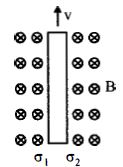
- (A) \({\sigma _1} = \frac{{ - { \in _0}\,vB}}{2}\,,\,{\sigma _2} = \frac{{{ \in _0}\,vB}}{2}\)
- (B) \({\sigma _1} = { \in _0}\,vB\,,\,{\sigma _2} = - { \in _0}\,vB\)
- (C) \({\sigma _1} = \frac{{{ \in _0}\,vB}}{2}\,,\,{\sigma _2} = \frac{{ - { \in _0}\,vB}}{2}\)
- (D) \({\sigma _1} = {\sigma _2} = { \in _0}\,vB\)
Show answer and solution
Correct Answer: (B)
\(\because F=q E\) and \(F=q v B\)\(\therefore \mathrm{E}=\mathrm{vB}\)
And Gauss's law in Electrostatics \(\mathrm{E}=\frac{\sigma}{\varepsilon_{0}}\)
\(\mathrm{E}=\frac{\sigma}{\varepsilon_{0}}=\mathrm{vB} \Rightarrow \sigma=\varepsilon_{0} \mathrm{vB}\)
\(\sigma_{1}=-\sigma_{2}\)
-
- (A) \(S (R+ G) = RG\)
- (B) \(2S (R+G)=RG\)
- (C) \(2G = S\)
- (D) \(2S=G\)
Show answer and solution
Correct Answer: (A)
According to Ohm's Law, \(I\) \(=\frac{V}{R}\)\(\mathrm{I}_{\mathrm{g}}=\frac{\mathrm{V}}{\mathrm{R}+\mathrm{G}}\)
where, \(I \)\(_{g}\) - Galvanometer current, \(G-\)Galvonometer resistance
When shunt of resistance \(S\) is connected parallel to the Galvanometer then
\(\mathrm{G}=\frac{\mathrm{GS}}{\mathrm{G}+\mathrm{S}}\)
\(\therefore I=\frac{V}{R+\frac{G S}{G+S}}\)
Equal potential difference is given by
\(\mathrm{I}_{\mathrm{g}}^{\prime} \mathrm{G}=\left(\mathrm{I}-\mathrm{I}_{\mathrm{B}}^{\prime}\right) \mathrm{S}\)
\(\mathrm{I}_{\mathrm{g}}^{\prime}(\mathrm{G}+\mathrm{S})=\mathrm{IS}\)
\(\Rightarrow \frac{\mathrm{I}_{\mathrm{g}}}{2}=\frac{\mathrm{IS}}{\mathrm{G}+\mathrm{S}}\)
\(\Rightarrow \frac{\mathrm{v}}{2(\mathrm{R}+\mathrm{G})}=\frac{\mathrm{v}}{\mathrm{R}+\frac{\mathrm{GS}}{\mathrm{G}+\mathrm{S}}} \times \frac{\mathrm{S}}{\mathrm{G}+\mathrm{S}}\)
\( \Rightarrow \frac{1}{{2(R + G)}} = \frac{S}{{R(G + S) + GS}}\)
\(\Rightarrow R(G+S)+G S=2 S(R+G)\)
\(\Rightarrow \mathrm{RG}+\mathrm{RS}+\mathrm{GS}=2 \mathrm{S}(\mathrm{R}+\mathrm{G})\)
\(\Rightarrow \mathrm{RG}=2 \mathrm{S}(\mathrm{R}+\mathrm{G})-\mathrm{S}(\mathrm{R}+\mathrm{G})\)
\(\therefore \mathrm{RG}=\mathrm{S}(\mathrm{R}+\mathrm{G})\)
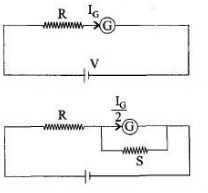
-
- (A) \(\frac{{{\pi ^2}{r^4}B_0^4}}{{2\tau R}}\)
- (B) \(\frac{{{\pi ^2}{r^4}B_0^2}}{{2\tau R}}\)
- (C) \(\frac{{{\pi ^2}{r^4}B_0^2R}}{\tau }\)
- (D) \(\frac{{{\pi ^2}{r^4}B_0^2}}{{\tau R}}\)
Show answer and solution
Correct Answer: (B)
Electric flux is given by\(\phi=\mathrm{B} . \mathrm{A}\)
\(\phi=\mathrm{B}_{0} \pi \mathrm{r}^{2} \mathrm{e}^{-1 / \tau}\)
\(\left(\because B=B_{0} e^{-t / \tau}\right)\)
Induced \(E.m.f.\) \(\varepsilon=\frac{\mathrm{d} \phi}{\mathrm{dt}}=\frac{\mathrm{B}_{0} \pi \mathrm{r}^{2}}{\tau^{2}} \mathrm{e}^{-t / \tau}\)
Heat \(=\int_{0}^{\infty} \frac{\varepsilon^{2}}{\mathrm{R}}=\frac{\pi^{2} \mathrm{r}^{4} \mathrm{B}_{0}^{2}}{2 \tau \mathrm{R}}\)
-
- (A) \(V_B = 40\, mV\); \(V_W = 135\,mV\) with left side of pilot at higher voltage
- (B) \(V_B = 45\,mV\); \(V_W = 120\, mV\) with right side of pilot at higher voltage
- (C) \(V_B= 40\, mV\); \(V_W = 135\,mV\) with right side of pilot at higher voltage
- (D) \(V_B = 45\, mV\); \(V_W = 120\, mV\) with left side of pilot at higher voltage
Show answer and solution
Correct Answer: (D)
\(\mathrm{V}_{\mathrm{B}}=\mathrm{VB}_{\mathrm{H}} l=240 \times 5 \times 10^{-5} \cos (\theta) \times 5\)\(=44.7\, \mathrm{mV}\)
By right hand rule, the charge moves to the left of pilot.
-
- (A) \(A\) for transformers and \(B\) for electric generators.
- (B) \(B\) for electromagnets and transformers
- (C) \(A\) for electric generators and trasformers
- (D) \(A\) for electromagnets and \(B\) for electric generators.
Show answer and solution
Correct Answer: (B)
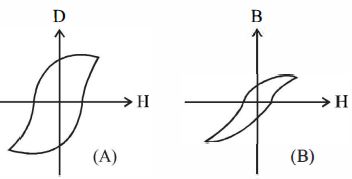
Graph \([A]\) is for material used for making permanent magnets (high coercivity)
Graph \([B]\) is for making electromagnets and transformers -
- (A) \(\frac {1}{4}\)
- (B) \(1\)
- (C) \(\frac {1}{2}\)
- (D) \(\frac {3}{4}\)
Show answer and solution
Correct Answer: (C)
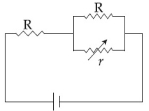
Heat generation in \(r\) will be, \(H=I_{r}^{2} r\)\(H=\left(\frac{V}{R+\frac{R r}{R+r}} \times \frac{r}{R+r}\right)^{2} r=\left(\frac{V}{R(R+2 r)}\right)^{2} r\)
Putting \(\frac{d H}{d r}=0\) gives, \(r=\frac{R}{2} .\) Hence, \(f=\frac{1}{2}\)
-
- (A) \(M^{-1} L^{-3}T^3I\)
- (B) \(M^{-1}L^{-3}T^3I^2\)
- (C) \(M^{-1}L^3T^3I\)
- (D) \(ML^{-3}T^{-3}I^2\)
Show answer and solution
Correct Answer: (B)
We know that resistivity\(\rho=\frac{R A}{\ell}\)
Conductivity \(=\frac{1}{\text { resistivity }}=\frac{\ell}{R A}\)
\(=\frac{\ell I}{V A}(\because V=R D)\)
\( = \frac{{[{\rm{L}}][{\rm{I}}]}}{{\left[ {\frac{{\left[ {{\rm{M}}{{\rm{L}}^2}{{\rm{T}}^{ - 2}}} \right]}}{{[I][{\rm{T}}]}}} \right] \times \left[ {{{\rm{L}}^2}} \right]}}\quad \left[ {{\rm{V}} = \frac{{\rm{W}}}{{\rm{q}}} = \frac{{\rm{W}}}{{{\rm{it}}}}} \right]\)
\(=\left[M^{-1} L^{-3} T^{3}\right]\left[I^{2}\right]=\left[M^{-1} L^{-3} T^{3} I^{2}\right]\)
-
- (A) \(400\,\ln \,\frac{1.5}{1.3}\,J\)
- (B) \(200\,\ln \,\frac{2}{3}\,J\)
- (C) \(300\,J\)
- (D) \(400\,\ln \,\frac{5}{6}\,J\)
Show answer and solution
Correct Answer: (D)
\(R(T)=R_{o}\left(1+\alpha\left(T-T_{o}\right)\right)\)Applying boundary conditions, \(120=100(1+200 \alpha)\)
\(\alpha=10^{-3}\, K^{-1}\)
It is given that temperature increases at a constant rate from \(300\, \mathrm{K}\) to \(500\, \mathrm{K}\) in \(30 \,\mathrm{s}\). Hence, \(T(t)=300+20 t / 3\)
By Joule's Law, heat dissipated in a resistor is given by:
\(W=\int_{0}^{30} \frac{V^{2}}{R} d t\)
\(=\int_{0}^{30} \frac{V^{2}}{R_{0}\left(1+\alpha\left(T-T_{0}\right)\right)} d t\)
\(=\frac{V^{2}}{R_{o}} \int_{0}^{30} \frac{1}{(1+20 \alpha t / 3)} d t\)
Solving, \(W=400 \ln (6 / 5)\)
Work done on resistor \(=-W=400 \ln (5 / 6) \,J\)
-
- (A) \(\frac{{32}}{{23}}\,\mu F\)
- (B) \(\frac{{31}}{{23}}\,\mu F\)
- (C) \(\frac{{33}}{{23}}\,\mu F\)
- (D) \(\frac{{34}}{{23}}\,\mu F\)
Show answer and solution
Correct Answer: (A)
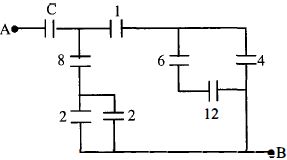
Capacitors \(2\, \mu \mathrm{F}\) and \(2\, \mu \mathrm{F}\) are parallel, their equivalent \(=4\, \mu \mathrm{F}\)\(6 \,\mu \mathrm{F}\) and \(12\, \mu \mathrm{F}\) are in series, their equivalent \(=4\, \mu \mathrm{F}\)
Now \(4 \,\mu F(2 \text { and } 2\, \mu F)\) and \(8\, \mu F\) in series
\(=\frac{3}{8}\, \mu F\)
And \(4\, \mu \mathrm{F}(12 \& 6\, \mu \mathrm{F})\) and \(4\, \mu \mathrm{F}\) in parallel \(=4+4=8\, \mu \mathrm{F}\)
\(8\, \mu \mathrm{F}\) in series with \(1\, \mu \mathrm{F}=\frac{1}{8}+1 \Rightarrow \frac{8}{9}\, \mu \mathrm{F}\)
Now \(C_{e q}=\frac{8}{9}+\frac{8}{3}=\frac{32}{9}\)
\(C_{eq}\) of circuit \(=\frac{32}{9}\)
With \(C-\frac{1}{C_{e q}}=\frac{1}{C}+\frac{9}{32}=1 \Rightarrow C=\frac{32}{23}\)
-
- (A) \({\rho _0}\, = \,20\,{\varepsilon _0}\) in the entire region
- (B) \({\rho _0}\, = \,10\,{\varepsilon _0}\) for \(\left| z \right|\, \le 1\,\,m\) and \(P_0 = 0\) elsewhere
- (C) \({\rho _0}\, = \,20\,{\varepsilon _0}\) for \(\left| z \right|\, \le 1\,\,m\) and \(P_0 = 0\) elsewhere
- (D) \({\rho _0}\, = \,40\,{\varepsilon _0}\) in the entire region
Show answer and solution
Correct Answer: (B)
\(\Sigma_{1}=\frac{-d v}{d r}=10|z|\)\(\Sigma_{2}=\frac{-\mathrm{dv}}{\mathrm{dr}}=10 \quad(\text { constant : } \mathrm{E})\)
\(\therefore \) The source is an infinity large non conducting thick plate of thickness \(2\, \mathrm{m}\).
\(\therefore 10 \mathrm{Z} \cdot 10 \mathrm{A}=\frac{\rho \cdot \mathrm{A} \propto \mathrm{Z}}{\varepsilon_{0}}\)
\(\rho_{0}=10 \mathrm{e}_{0}\) for \(|\mathrm{z}| \leq 1\, \mathrm{m}\)
-
- (A) all in series
- (B) all in parallel
- (C) two in parallel and one in series
- (D) two in series and one in parallel
Show answer and solution
Correct Answer: (D)
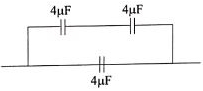
To get effective capacitance of \(6\,\mu F\) two capacitors of \(4\, \mu \mathrm{F}\) each connected in series and one of \(4\, \mu \mathrm{F}\) capacitor in parallel with them.Two capacitances in series
\(\therefore \frac{1}{C}=\frac{1}{C_{1}}+\frac{1}{C_{2}}=\frac{1}{4}+\frac{1}{4}=\frac{1}{2}\)
\(1\) capacitor in parallel
\(\therefore \) \(C_{\mathrm{eq}}=C_{3}+C=4+2=6\, \mu \mathrm{F}\)
-
- (A) \(\rho \left( r \right) = \) constant
- (B) \(\rho \left( r \right) \propto \frac{1}{{{r^2}}}\)
- (C) \(\rho \left( r \right) \propto \frac{1}{r}\)
- (D) \(\rho \left( r \right) \propto r\)
Show answer and solution
Correct Answer: (C)
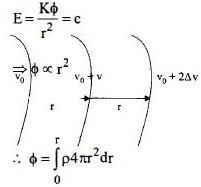
As we know electric field, \(E = \frac{{ - dv}}{{dr}}\)\(E=\) constant \(\therefore \) \(dv\) and \(dr\) same
\( \Rightarrow \,\rho \propto \frac{1}{r}\)
-
- (A) \(\frac{{2Q}}{{\pi \left( {{a^2} - {b^2}} \right)}}\;\;\;\;\;\;\;\;\;\;\;\;\;\;\)
- (B) \(\;\frac{{2Q}}{{\pi {a^2}}}\)
- (C) \(\;\frac{Q}{{2\pi {a^2}}}\)
- (D) \(\;\frac{Q}{{2\pi \left( {{b^2} - {a^2}} \right)}}\)
Show answer and solution
Correct Answer: (C)
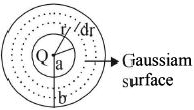
Applying Gauss's law\(\oint_{\mathrm{S}} \overrightarrow{\mathrm{E}} \cdot \overrightarrow{\mathrm{ds}}=\frac{Q}{\epsilon_{0}}\)
\(\therefore \mathrm{E} \times 4 \pi \mathrm{r}^{2}=\frac{\mathrm{Q}+4 \pi \mathrm{ar}^{2}-4 \pi \mathrm{Aa}^{2}}{\epsilon_{0}}\)
\(\rho=\frac{\mathrm{d} \mathrm{r}}{\mathrm{d} \mathrm{v}}\)
\(Q=\rho 4 \pi r^{2}\)
\(\mathrm{Q}=\int_{\mathrm{a}}^{\mathrm{A}} \frac{\mathrm{A}}{\mathrm{r}} 4 \pi \mathrm{r}^{2} \mathrm{dr}=4 \pi \mathrm{A}\left[\mathrm{r}^{2}-\mathrm{a}^{2}\right]\)
\(\mathrm{E}=\frac{1}{4 \pi \epsilon_{0}}\left[\frac{\mathrm{Q}-4 \pi \mathrm{Aa}^{2}}{\mathrm{r}^{2}}+4 \pi \mathrm{A}\right]\)
For \(\mathrm{E}\) to be independent of \('{r}'\)
\(\mathrm{Q}-2 \pi \mathrm{Aa}^{2}=0\)
\(\therefore A=\frac{Q}{2 \pi a^{2}}\)
-
- (A) \(2\)
- (B) \(1\)
- (C) \(0.5\)
- (D) \(0.75\)
Show answer and solution
Correct Answer: (B)
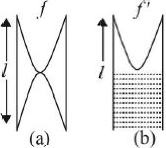
The fundamental frequency in case \((a)\) is \(f=\frac{v}{2 \ell}\)The fundamental frequency in case \((b)\) is
\(f^{\prime}=\frac{v}{4(\ell / 2)}=\frac{u}{2 \ell}=f\)
-
- (A) \(680\)
- (B) \(510\)
- (C) \(340\)
- (D) \(167\)
Show answer and solution
Correct Answer: (D)
From Doppler's effect\(f(\text { direct })=f\left(\frac{340}{340-5}\right)=f_{1}\)
\(f\left(b y \text { wall) } f\left(\frac{340}{340+5}\right)=f_{2}\right.\)
Beats \(=\left(f_{1}-f_{2}\right)\)
\(5=f\left(\frac{340}{340-5}-\frac{340}{340+5}\right)\)
\(\Rightarrow \mathrm{f}=170 \mathrm{Hz}\)

No questions on this page match these filters.
Other years
Frequently asked
How many JEE Mains 2016 Physics questions are on ExamBro?
73 questions, each with the correct answer and a full solution.
Which JEE Mains 2016 Physics chapter is asked the most?
System of particles and rotational motion, with 8 questions, followed by Semicondutor electronics with 6.
How difficult are JEE Mains 2016 Physics questions?
8% are easy, 40% medium and 52% hard.