


Questions
17 questionsShowing 1–17 of 17 questions
-
- (A) \(461\)
- (B) \(460\)
- (C) \(462\)
- (D) \(469\)
Show answer and solution
Correct Answer: (C)
\(d =2.5\,mm , D =150\,cm\)Fringe width \(\beta=\frac{\lambda D}{d}\)
Let \(n^{\text {th }}\) bright tringle of \(\lambda_1\) match with \(m ^{\text {th }}\) bright triangle of \(\lambda_2\)
\(\Rightarrow n \beta_1=m \beta_2\)
\(\Rightarrow n \lambda_1=m \lambda_2 \Rightarrow \frac{n}{m}=\frac{\lambda_2}{\lambda_1}=\frac{5500}{7000}\)
\(\Rightarrow \frac{n}{m}=\frac{11}{14}\)
Distance where bright fringe will match
\(=n \beta_1=\frac{11 \times 7000 \mathring A \times 150\, cm }{0.25\,cm }\)
\(=462 \times 10^{-5}\)
-
- (A) Increase the wave length of the light.
- (B) Increase the refractive index of the medium between the object and objective lens.
- (C) Decrease the focal length of the eye piece.
- (D) Decrease the diameter of the objective lens.
Show answer and solution
Correct Answer: (B)
\(P=\frac{2 \mu \sin \theta}{1.22 \lambda}\) -
- (A) \(0.6\)
- (B) \(1.2\)
- (C) \(1.8\)
- (D) \(3\)
Show answer and solution
Correct Answer: (B)
As for first minima\(a \sin \theta=\lambda\)
\(\Rightarrow a \sin 30^{\circ}=600 \times 10^{-9}\)
\(\Rightarrow a =1200 \times 10^{-9}\,m\)
\(\Rightarrow a =1.2\,\mu m\)
-
- (A) \(24\)
- (B) \(23\)
- (C) \(22\)
- (D) \(21\)
Show answer and solution
Correct Answer: (A)
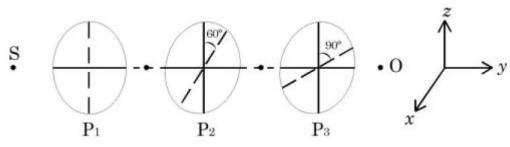
By first polaroid \(P_1\) intensity will be halved then \(P_2\) and \(P_3\) will make intensity \(\cos ^2\left(60^{\circ}\right)\) and \(\cos ^2\left(30^{\circ}\right)\) times respectively.\(\text { Intensity out }=\frac{256}{2} \times \frac{1}{4} \times\left(\frac{\sqrt{3}}{2}\right)^2=\frac{256 \times 3}{2 \times 4 \times 4}= 2 4\)
-
- (A) \(2\)
- (B) \(3\)
- (C) \(6\)
- (D) \(4\)
Show answer and solution
Correct Answer: (D)
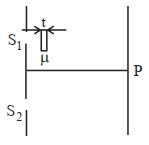
\(\text { Fringe shift }=\frac{ t (\mu-1)}{\lambda} B\)\(=\frac{10 \times 10^{-6}(1.2-1)}{5 \times 10^{-7}} B\)
\(=\frac{10^{-5} \times 0.2}{5 \times 10^{-7}}=4\)
-
- (A) Both Statements \(I\) and Statement \(II\) are true.
- (B) Statement \(I\) is true but Statement \(II\) is false.
- (C) Both Statement \(I\) and Statement \(II\) are false.
- (D) Statement \(I\) is false but Statement \(II\) is true.
Show answer and solution
Correct Answer: (B)
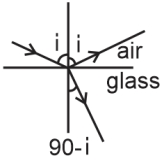
\(\mu_{ a } \sin i_1=\mu_{ g } \sin \left(90- i _1\right)\)\(\tan i _1=\frac{\mu_{ g }}{\mu_{ a }}\)
When going from glass to air
\(\tan i_2=\frac{\mu_{ a }}{\mu_{ g }}=\cot i_1\)
Hence
\(i_2=\frac{\pi}{2}-i_1\)
-
- (A) \(2\)
- (B) \(1\)
- (C) \(3\)
- (D) \(4\)
Show answer and solution
Correct Answer: (C)
\(I =4 I _0 \cos ^2\left(\frac{\Delta \phi}{2}\right)\)\(I _1=4 I _0 \cos ^2\left(\frac{\pi}{4}\right)=2 I _0\)
\(I _2=4 I _0 \cos ^2\left(\frac{2 \pi}{3}\right)= I _0\)
\(\Rightarrow \frac{ I _1+ I _2}{ I _0}=3\)
-
- (A) \(0.4\)
- (B) \(0.5\)
- (C) \(0.2\)
- (D) \(0.1\)
Show answer and solution
Correct Answer: (C)
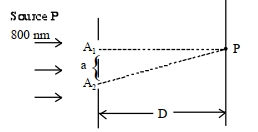
\(A _2 P - A _1 P =\frac{\lambda}{2} \quad \text { (Condition of minima) }\)\(\sqrt{ D ^2+ a ^2}- D =\frac{\lambda}{2}\)
\(D \left(1+\frac{ a ^2}{ D ^2}\right)^{1 / 2}- D =\frac{\lambda}{2}\)
\(D \left(1+\frac{1}{2} \times \frac{ a ^2}{ D ^2}\right)- D =\frac{\lambda}{2}\)
\(\frac{ a ^2}{2 D }=\frac{\lambda}{2} \Rightarrow a =\sqrt{\lambda . D }\)
\(=\sqrt{800 \times 10^{-6} \times 50}\)
\(a =0.2\,mm\)
-
- (A) \(9: 4\)
- (B) \(9: 1\)
- (C) \(2: 1\)
- (D) \(25: 9\)
Show answer and solution
Correct Answer: (B)
Given that \(\frac{ A _1}{ A _2}=\frac{2}{1}\)\(\frac{I_{\max }}{I_{\min }}=\left(\frac{ A _1+ A _2}{ A _1- A _2}\right)^2=\frac{9}{1}=9: 1\)
-
- (A) \(11\)
- (B) \(9\)
- (C) \(7\)
- (D) \(10\)
Show answer and solution
Correct Answer: (D)
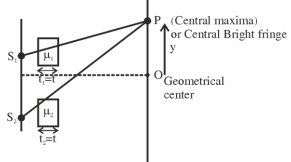
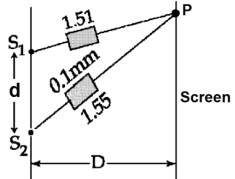
Path difference at \(P\) be \(\Delta x\)\(\Delta x =\left(\mu_2-\mu_1\right) t\)
\(=(1.55-1.51) 0.1\,mm\)
\(=0.04 \times 10^{-4}\)
\(\Delta x =4 \times 10^{-6}=4\,\mu m\)
\(y =\frac{\Delta xD }{ d }=4 \times 10^{-6} \frac{ D }{ d }\)
\(\{ y\) is the distance of central maxima from geometric center \(\}\)
fringe width \((\beta)=\frac{\lambda D}{d}=4 \times 10^{-6} m \frac{ D }{ d }=4\,\mu m \frac{ D }{ d }\)
Central bright fringe spot will shift by ' \(x\) '
Number of shift \(=\frac{y}{\beta}\)
\(=\frac{4 \times 10^{-6} D / d }{4 \times 10^{-7} D / d }=10\,Ans\)
-
- (A) \(60\)
- (B) \(48\)
- (C) \(12\)
- (D) \(36\)
Show answer and solution
Correct Answer: (A)
Given\(D =1\,m\)
\(\lambda=600 \times 10^{-9}\,m\)
\(n =5\)
\(\text { As } y _{ nth }=\frac{ n \lambda D }{ d }\)
\(\Rightarrow \frac{5 \times 600 \times 10^{-9} \times 1}{ d }=5 \times 10^{-2}\)
\(\Rightarrow d =\frac{5 \times 600 \times 10^{-9} \times 1}{5 \times 10^{-2}}=60 \times 10^{-6}\,m\)
\(\Rightarrow d =60\,\mu m\)
-
- (A) \(3\)
- (B) \(6\)
- (C) \(5\)
- (D) \(4\)
Show answer and solution
Correct Answer: (B)
After passing through first sheet\(I_1=\frac{I}{2}\)
After passing through second sheet
\(I_2=I_1 \cos ^2\left(45^{\circ}\right)=\frac{I}{4}\)
After passing through \(n^{\text {th }}\) sheet
\(I_{ n }=\frac{I}{2^{ n }}=\frac{I}{64}\)
\(n=6\)
-
- (A) \(1: 3\)
- (B) \(3: 1\)
- (C) \(3: 2\)
- (D) \(2: 3\)
Show answer and solution
Correct Answer: (C)
\(I _{ vet }= I _1+ I _2+2 \sqrt{ I _1 I _2} \cos \phi\)\(= I _0+ I _0+2 I _0 \cos \frac{\pi}{3}\)
\(=2 I _0+2 I _0 \times \frac{1}{2}=3 I _0\)
\(I _{\text {net }}= I _0+ I _0+2 I _0 \cos 90^{\circ}=2 I _0\)
\(\text { Ratio }=\frac{3}{2}\)
-
- (A) \(4\)
- (B) \(1.33\)
- (C) \(3\)
- (D) \(2\)
Show answer and solution
Correct Answer: (C)
\(\text { Fringe width }(\beta)=\frac{ D \lambda}{ d }\)\(\Rightarrow \frac{\beta_2}{\beta_1}=\frac{\lambda_2}{\lambda_1}\)
\(\Rightarrow \frac{\beta_2}{2\,mm }=\frac{600\,nm }{400\,nm }=\frac{3}{2}\)
\(\Rightarrow \beta_2=3\,mm\)
-
- (A) \(45\)
- (B) \(46\)
- (C) \(48\)
- (D) \(47\)
Show answer and solution
Correct Answer: (C)
Correct answer is \(\mathbf{4 8}\)\(\omega_1=\frac{\lambda_1 D}{d} \& \omega_2=\frac{\lambda_2 D}{d} \)
\(\omega_1=16 \mathrm{~mm} \& \omega_2=12 \mathrm{~mm} \)
\(\text { so LCM }\left(\omega_1, \omega_2\right)=48 \mathrm{~mm}\)
so at 48 mm distance both bright fringes will be found.
-
- (A) \(\frac{I_0}{4}\)
- (B) \(\frac{I_0}{2}\)
- (C) \(\frac{I_0}{8}\)
- (D) \(Zero\)
Show answer and solution
Correct Answer: (C)
\(I _{ A }=\frac{ I _{ o }}{2}\)\(I_C =\frac{ I _{\circ}}{2} \cos ^2 45=\frac{ I _{\circ}}{4}\)
\(I _{ B }= I _{ C } \cos ^2 45=\frac{ I _{\circ}}{8}\)
-
- (A) \(20\)
- (B) \(40\)
- (C) \(90\)
- (D) \(30\)
Show answer and solution
Correct Answer: (D)
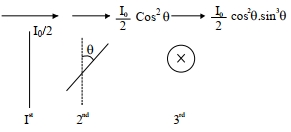
\(I _{\text {net }}=3=\frac{32}{2} \cos ^2 \theta \cdot \sin ^2 \theta\)\(\frac{3}{4}=4 \sin ^2 \theta \cdot \cos ^2 \theta=(\sin 2 \theta)^2\)
\(\frac{\sqrt{3}}{2}=\sin (2 \theta)\)
Hence, \(\theta=30^{\circ}\) and \(60^{\circ}\)
No questions on this page match these filters.